Archive for the ‘Poetry’ Category

William Stafford’s poetry lightened his life having woven a parachute out of everything broken.

January 25, 2021

My son sent me a link to a quote by William Stafford that Michael Meade had posted on his Instagram. I couldn’t find the source.

Update: Leslie Marlowe sent me more of the quote. I did a search and discovered the poem in The Way It Is, and then online. I include this information in my reply below. It was part of the third stanza of a 24-line 4-stanza poem, Any Time, first published in Allegiances (1970).
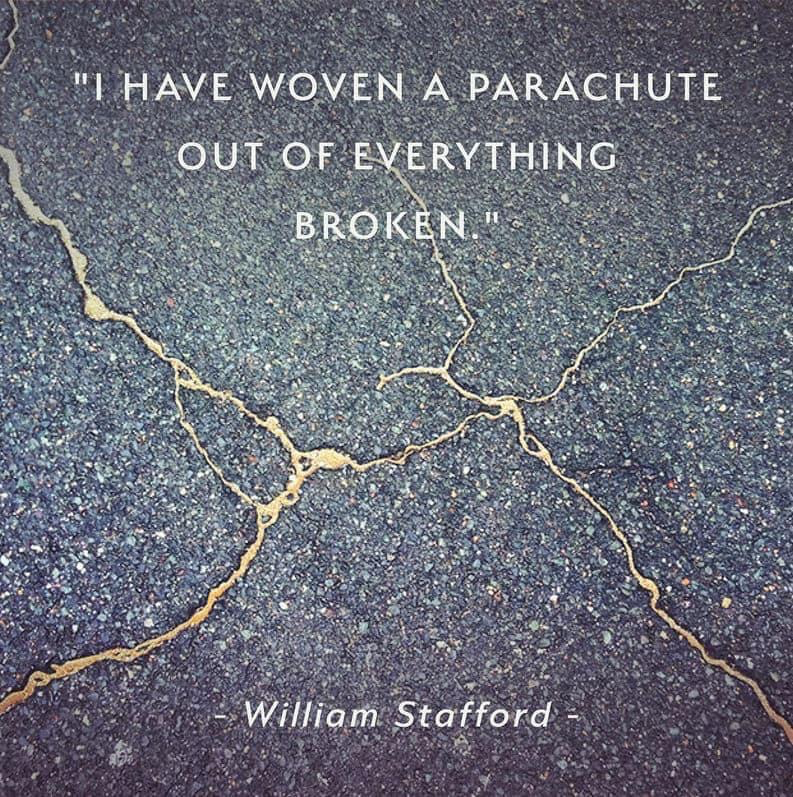
“I have woven a parachute out of everything broken.” — William Stafford

The Japanese art of kintsugi

The quote and background image remind me of kintsugi or kintsukuroi, the Japanese art of repairing broken pieces of pottery using lacquer mixed with powdered gold, silver, or platinum. As a philosophy, it treats breakage and repair as part of the history of an object, rather than something to disguise. The piece becomes stronger and more beautiful than the original because of its unique imperfections.

To me, this serves as a metaphor for overcoming life’s challenges, scars and all, which build character. When I first saw a piece of repaired broken Japanese pottery using this method, it inspired a poem using one of the forms of Japanese poetry—kintsugi tanka.

A poet of peace

William Stafford responded creatively and with integrity to the challenges life sent his way. He remained true to his voice as a conscientious objector, poet of peace, and the innovative way he taught writing.

A realist on the human condition, his poems made us think, as in A Ritual to Read to Each Other, from his poetry collection, Traveling through the Dark, which won the National Book Award in 1963.

For it is important that awake people be awake,
or a breaking line may discourage them back to sleep;
the signals we give—yes or no, or maybe—
should be clear: the darkness around us is deep.

Following the thread

During his early morning writing, Stafford subscribed to the approach of William Blake’s golden string.

“I give you the end of a golden string,
Only wind it into a ball,
It will lead you in at Heaven’s gate
Built in Jerusalem’s wall.”

As any persistent writer will tell you, when they finally “get it right,” there’s a feeling of euphoria, the metaphorical equivalent of entering “Heaven’s gate.”

Stafford was awake to that revelatory moment when each thread of thought presented itself to him. They would lead to unexpected associations and realizations. In the last poem he wrote the day he died, he said: You can’t tell when strange things with meaning will happen.

Speaking of weaving together a parachute from everything broken, this most popular poem by Stafford, and my favorite, talks about holding onto an unseen thread that’s woven throughout all of life’s experiences.

The Way It Is

There’s a thread you follow. It goes among
things that change. But it doesn’t change.
People wonder about what you are pursuing.
You have to explain about the thread.
But it is hard for others to see.
While you hold it you can’t get lost.
Tragedies happen; people get hurt
or die; and you suffer and get old.
Nothing you do can stop time’s unfolding.
You don’t ever let go of the thread.

Coincidentally, I came across a quote from the Vedic literature that takes this idea of an uncommon thread and extends it to a cosmic thread.

He who knows the fine-drawn thread of which the creatures that we see are spun, who knows the thread of that same thread—he also knows Brahman, the Ultimate. (Atharva Veda Samhita 10.8.37)

I later found an audio recording of William Stafford reciting The Way It Is posted on his son Kim Stafford’s website. Kim later used lines from the poem as chapter headings in his wonderful biography, Early Morning: Remembering My Father, William Stafford.

Other favorite poems by William Stafford

I’ve posted some of William Stafford’s poetry and his approach to teaching writing on The Uncarved Blog. A few of those poems that stand out for me are: When I Met My Muse, You and Art, Ask Me, The Way It Is, A Course in Creative Writing, and Rx Creative Writing: Identity.

The last poem he had written the day he died, August 28, 1993, was “Are you Mr. William Stafford?”. It was featured and published posthumously in The Way It Is: New & Selected Poems, by Graywolf Press in 1999, which was how I first discovered it.

Years later I had a realization about that last poem and created this memorial post including insightful quotes into Stafford’s creative process with related links: William Stafford’s last poem now seemed prophetic—an unintended literary epitaph.

William Stafford the teacher

When it comes to student-centered teaching, I featured William Stafford and other trailblazers of the writing process in this related blog post: The perils of praise or blame for young writers. New ways to help students find their own voice.

That was later followed up with Writing can become a process of self-discovery & self-empowerment, especially for young students. It includes a video posted by OPB January 16, 2014 10 p.m. on Oregon Art Beat to celebrate the 100th anniversary of his birth: Discovering William Stafford.

Related posts on this topic

Mary Oliver mended Everything That Was Broken with her loving poetry

Richard Wagamese bravely entered the cracks in his life to reveal the hidden gold buried within

Leonard Cohen said there’s a crack in everything—how the light gets in. It came thru him & lit up a broken humanity.

Japanese culture: poetic aesthetics, artistry, and martial arts, inspired me to write haiku and tanka

— Written and compiled (citing sources) by Ken Chawkin for The Uncarved Blog.

Japanese culture: poetic aesthetics, artistry, and martial arts, inspired me to write haiku and tanka

January 9, 2021

Discovering and writing haiku and tanka

Many years ago, at a local bookstore I used to frequent, I came across a profound little poem on a poster with a beautiful image from nature. The name of the poet, Kiyo, appeared under the poem. It may have been the first type of Japanese poetry I’d ever read, in English translation of course. I had discovered haiku—a 3-line poem of 5-7-5 syllables respectively. I had written it down and recently found it. Here it is.

Softly unfolding,
Beauty awakens each heart
to wonder … to life.

I’d never heard of Kiyo. Did a search and found Ungo Kiyo (1582–1659), a Japanese Rinzai Zen master and poet. Couldn’t find any more poetry, just a quote on enlightenment in an antique book of calligraphy.

Even though we can’t adequately translate haiku into English due to the syntactical differences of a pictorial language, an important aspect of it was explained to me by a Japanese TM teacher I had met on an international course. Haiku was part of his educational upbringing. They usually have a seasonal reference. To be effective, the first 2 lines describe something in nature, but the 3rd line brings in another element that causes the mind to skip a beat, have an ‘aha’ moment of realization.

Kiyo’s beautiful short poem inspired me to start writing haiku and then tanka, a 2-stanza poem combining haiku with 2 lines of 7 syllables each. The second part would continue the theme of the first part, but give it a slightly new angle. In olden times, the Japanese court poets used to compete with each other in rounds of tanka called renga, linked verses.

I wrote my first haiku after a walk-and-talk about relationships with a lady friend. I noticed a furry caterpillar crawling on the ground. It became the metaphor for a poem on commitment and spiritual transformation.

Transformed

Caterpillars spin
increments of commitment;
Butterflies fly free!

I wrote many haiku and tanka over the years. I even wrote Haiku on The Nature of Haiku, which was very meta. These first 4 haiku—Defined, Discovered, Transformed, Translated—were among the 13 Ways to Write Haiku: A Poet’s Dozen, published in The Dryland Fish, An Anthology of Contemporary Iowa Poets.

Five Haiku, selected from The Dryland Fish; Cold Wet Night, a tanka; and Poetry—The Art of the Voice, a poem; were published in This Enduring Gift—A Flowering of Fairfield Poetry. The University of Iowa’s “Iowa Writes” program also published Five Haiku on The Daily Palette.

Defined

3 lines, 2 spaces,
17 feet to walk thru;
then,   the unending

Discovered

a poem unfolds
as words take their place in line
this one’s a haiku

Translated
(Inspired by Gareth Jones–Roberts’ painting “Egrets in Morning Light”)

on the edge of space
two egrets in morning light
woken from a dream

I recently came across a poem I had written a while ago, but never posted it. A photograph of cranes flying in a snowstorm inspired this Japanese Haiku.

Red-crowned cranes in Akan National Park, Hokkaido, Japan. Photograph by Vincent Munier. Click on image to enlarge it.

Three Japanese cranes
Soar above trees in snowstorm
Grace under pressure

Tanka on the Japanese art of kintsugi

I discovered other aspects of Japanese culture, which inspired tanka poems. Click on the titles below for more information and images.

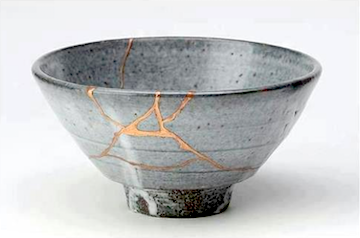
The first is about kintsugi, the Japanese art of repairing broken pottery with gold or silver lacquer thereby making it appear more beautiful than the original. Robert Yellin had tweeted an image of a repaired bowl to show this art, which is how I discovered it.

kintsugi tanka

kintsukuroi
turning obstacles into
opportunities

life’s lessons build character
what was broken is now whole

The Japan Ministry of Foreign Affairs selected Robert to introduce Japanese craftsmen to the world in a special documentary, Takumi: Japan’s artisan tradition. Because of his expertise, Robert became a cultural ambassador. His film inspired people from all over the world to visit the country, and helped boost Japanese tourism.

How Robert ended up in Japan is revealed in the documentary film, Jerry’s Last Mission, about his father, Jerry Yellin, who was the last WWII fighter pilot, an author, and proponent of TM for veterans with PTSD.

Tanka on the Japanese martial art of Aikido

On a visit to see my son in California, I wrote this tanka after watching his Aikido teacher demonstrate how to defend oneself from attack. She stood in one spot and effortlessly deflected the repeated charges from her students. It was mesmerizing! It took me a while to process what I had seen before writing the poem. I had emailed it to my son to read to her on her birthday. A volunteer at the dojo found the poem and posted it with a photo of a leaning tree as a screensaver on the office computer. It’s beautiful. Click the title and scroll down to see it.

My Son’s Sensei

Rooted to the ground
She repels her attackers
Flowing, not moving.

In storms, trees bear great burdens
Bending, not breaking.

Two tree tanka

Speaking of trees, this tanka is from the perspective of a willow tree. Click the title to see a photo of a special one, and links to audio clips of me reading the poem on different media platforms.

Willow Tree
An Overflowing Fountain of Green

Willow Tree Whispers
People say … Weeping Willow
But I’m not crying

Just bowing down … to the Earth
Kissing the ground … with my leaves

Another tree tanka resulted when I saw the willow that inspired the previous poem, and the honey locust next to it, intertwined on top! They were on each side of the entrance to the place I was living in at the time.

Friendship

Trees like to hold hands
Bending branches to link leaves
They forge deep friendships

Swaying with the wind—they dance
Under the moonlight—romance

A two-haiku relationship poem

When it comes to a committed relationship, this two-haiku poem turned out to be prophetically true.

COMMITTED

when the tide rolls in
bows of boats bump each other
tethered to the dock

with our ups and downs
we remain tied together
solid as a rock

© Ken Chawkin

See more haiku and tanka archived on The Uncarved Blog.

Suggested Reading

Jane Hirshfield’s 29-page essay about the life and poetry of Matsuo Bashō—recognized as a master of concise, compelling Japanese haiku—is worth reading. The Heart of Haiku was named “Best Kindle Single of 2011.” It was the first Kindle I ever bought, and described it in a post, Haiku on The Heart of Haiku, with links to interviews and more.

Author and translator Harold Stewart‘s essay On Haiku and Haiga in A Net of Fireflies: Japanese Haiku and Haiku Paintings, was very edifying.

This classic was recommended to me: Unknown Craftsman by Soetsu Yanagi. I see it’s been updated and illustrated by Bernard Leach and Soetsu Yanagi: The Unknown Craftsman: A Japanese Insight into Beauty.

Although not Japanese, Creativity and Taoism: A Study of Chinese Philosophy, Art, and Poetry by Chang Chung-yuan was also worth reading. A 2nd Edition is now available. I reference the Taoist concept of the uncarved block explaining How The Uncarved Blog got its name.

You may also find this post from nine years earlier also interesting: Singing Image of Fire, a poem by Kukai, with thoughts on language, translation, and creation.

This later post, Hokusai says—a poem by Roger Keyes—inspires us to notice, to feel, to care, to live fearlessly, fully, features images of and the story behind the world-famous Japanese woodblock print by Hokusai of The Great Wave off Kanagawa, aka, The Great Wave or The Wave.

— Written and compiled (citing sources) by Ken Chawkin for The Uncarved Blog.
Good Medicine Haiku: Take quality time for yourself as this crazy year comes to a close

December 28, 2020

December 29, 2020, my son Nathanael emailed to say he was planning to go offline and take some downtime to close out this crazy year. I sent him this haiku, and he replied: GOOD MEDICINE. I used it as the title.

Good Medicine Haiku

Trust inner feelings
Let go; settle in silence
Honor your essence

© Ken Chawkin

So if you’re wanting to forget 2020 ever happened and are looking to refresh for 2021, think of this Good Medicine Haiku as a prescription to take a much-needed, guilt-free time-out. Try a digital diet, meditate, go within—take quality time for yourself. We owe it to ourselves. Peace out.

WRITING TANKA—Preparing to Write

December 10, 2020

Here’s a little backgrounder on this poem, which I wrote around 20 years ago while on a course at Heavenly Mountain in Boone, North Carolina. The first part was originally just a haiku. It was a fun way to point out the need to increase awareness as a preparation to write. Years later, an idea presented itself extending the metaphor to its logical conclusion. The phrase, taken literally, was an unexpected surprise, along with the irresistible pun. I added them as a hoku, completing the poem, transforming it into a tanka on writing. Enjoy reading “Preparing to Write.”

Ken Chawkin's avatarThe Uncarved Blog

PREPARING TO WRITE
a tanka on writing

.

Railroad Crossings Are

Places To Become Aware—

STOP! LOOK! And LISTEN!

.

If you hear a train of thought

You’ll know you’re on the write track!

.

© Ken Chawkin

.

Also see Haiku On The Nature of Haiku.

a writing tanka on writing tanka by ken chawkin

View original post

Being in Nature—a gift from a tree

December 6, 2020

We often hear about the the benefits of being in nature. I remembered an experience I had with a tree when I went for a winter walk with a friend on the University Endowment Lands in Vancouver during the mid-1990s. I’ve now updated that blog post with what had happened and how a poem came to be written around 25 years ago. The post contains links to other poems written about trees, and advice from Mary Oliver.

Ken Chawkin's avatarThe Uncarved Blog

We often hear about the the benefits of being in nature. I remembered an experience I had with a tree when I went for a winter walk with a friend on the University Endowment Lands in Vancouver during the mid-1990s.

I stopped in front of a particular tree to admire its intricate bark structure up close. I felt a ray of loving attention come from the tree into my heart-mind with these words: “the realness of natural things, the nearness of you.” It was an unexpected intimate experience and I quickly wrote the words down for further exploration. The next morning, I rewrote them as a two-line stanza, and then sequential stanzas naturally unfolded sharing its wisdom. It was as if I had been given a creative seed and it sprouted into a poem.

This gift from the tree was much appreciated. The experience reiterated what Mary Oliver described in…

View original post 321 more words

William Stafford prescribed creative writing to find your own voice and reveal your inner light

November 30, 2020

One of the first books of poetry I ever bought for myself was You Must Revise Your Life by William Stafford. It was part of The University of Michigan Press series of Poets on Poetry. His poems, essays and interviews on writing, teaching, and performing were a revelation!

I was discovering the writing process at the time and how to facilitate it, and found Stafford’s poems and his thoughts on the teaching of writing poetry to be very relevant. Here are a few that caught my attention: When I Met My Muse, You and Art, Ask Me, and A Course in Creative Writing.

I reread his poem, Rx Creative Writing: Identity, and decided to include it.

Rx Creative Writing: Identity
By William Stafford

You take this pill, a new world
springs out of whatever sea
most drowned the old one,
arrives like light.

Then that bone light belongs
inside of things. You touch
or hear so much yourself
there is no dark.

Nothing left but what Aquinas
counted: he—touched, luminous—
bowed over sacred worlds, each one
conceived, then really there—

Not just hard things: down on
a duck as real as steel.
You know so sure there burns
a central vividness.

It tells you;
all you do is tell about it.

This poem was also later included in The Way It Is, New & Selected Poems. The last poem he wrote the day he would die introduces the book. You can read it in this blog post: William Stafford’s last poem now seemed prophetic—an unintended literary epitaph.

There is a quote on the back cover of You Must Revise Your Life taken from an earlier compilation of his, Writing the Australian Crawl: Views on the Writer’s Vocation. It epitomizes Stafford’s approach to writing.

A writer is not so much someone who has something to say as he is someone who has found a process that will bring about new things he would not have thought of if he had not started to say them.

As part of their Poets on Poetry series, The University of Michigan Press published four books of Stafford’s collections of prose and poetry on the writing profession, the poetics of a new generation. Writing the Australian Crawl was the first, followed by You Must Revise Your Life. The third and fourth volumes, published posthumously, were: Crossing Unmarked Snow: Further Views on the Writer’s Vocation and The Answers Are Inside the Mountains: Meditations on the Writing Life.

I also very much enjoyed reading the biography written by his son Kim, Early Morning: Remembering My Father, William Stafford. The lines from his most profound and favorite poem, The Way It Is, were used as chapter headings. I’ve posted more of his poems on The Uncarved Blog.

Stafford and other trailblazers of the writing process are mentioned in this related blog post: The perils of praise or blame for young writers. New ways to help students find their own voice. That was later followed up with Writing can become a process of self-discovery & self-empowerment, especially for young students. 

I was naturally influenced by what I was reading and experiencing at the time. Some of my first inspired attempts were very meta, commentaries on Writing—a poem on the writing process, and Sometimes Poetry Happens: a poem about the mystery of creativity.

William Stafford & Mary Oliver on an inner light and telling about it

William Stafford describes “then that bone light belongs inside of things. You touch or hear so much yourself there is no dark. You know so sure there burns a central vividness.”

Mary Oliver’s uses similar imagery in her poem, White Owl Flies Into And Out Of The Field: “maybe death isn’t darkness, after all, but so much light wrapping itself around us—that is without the least dapple or shadow, that is nothing but light–scalding, aortal light—in which we are washed and washed out of our bones.”

Stafford concludes his poem with the role of the poet: “It tells you; all you do is tell about it.”

Mary Oliver, in her poem, Sometimes (4th stanza of 7), teaches us how to live a life — especially as a poet — in 3 short, powerful sentences. “Instructions for living a life: Pay attention. Be astonished. Tell about it.”

She exemplified this essential message in her poem, Mindful, where she delights in the world around her, which leaves her “like a needle in the haystack of light. It was what I was born for — to look, to listen, to lose myself inside this soft world — to instruct myself over and over in joy, and acclamation.”

Both poems are included in this post: Attentive to and delighting in her surroundings, Mary Oliver lived a life writing astonishing poetry.

New York poet laureate Marie Howe’s experience captured in her poem, Annunciation, and her conversations with On Being’s Krista Tippett and The Millions’ Alex Dueben, reveal a profound understanding of how poetry vividly comes to and through us.

These great poets remind us that, at our core, we are essentially pure light. All they do is listen and tell us about it.

— Written and compiled (citing sources) by Ken Chawkin for The Uncarved Blog.
Mary Oliver is the Messenger for Thanksgiving

November 26, 2020

Happy Thanksgiving to all of our American friends, and to everyone of us who are thankful for life and staying healthy.

Ken Chawkin's avatarThe Uncarved Blog

Mary Oliver’s poem, Messenger, was written in her own unique voice, but it must have been influenced by her favorite American poet, Walt Whitman. It’s a perfect poem to share for Thanksgiving, since her poetry is a thanksgiving for being alive in the world, appreciating every living thing in it, and singing their praises. “My work is loving the world…mostly standing still and learning to be astonished…which is mostly rejoicing…which is gratitude…a mouth with which to give shouts of joy.”

My work is loving the world.
Here the sunflowers, there the hummingbird—
equal seekers of sweetness.
Here the quickening yeast; there the blue plums.
Here the clam deep in the speckled sand.
 
Are my boots old? Is my coat torn?
Am I no longer young, and still half-perfect? Let me
keep my mind on what matters,
which is my work,
 
which is mostly standing still and learning…

View original post 333 more words

What is Poetry, where does it come from, and how does it enter into us?

November 11, 2020

I posted many wonderful poems under this blog’s Poetry category. Also saved comments about poetry written by poets throughout the ages. These three made an impression on me years ago.

Hazrat Inayat Khan (1882–1927): The Music of Life, Poetry (pg. 327)

The one who reads poetry, the one who enjoys poetry, and the one who writes poetry must know that poetry is something that does not belong to this earth: it belongs to heaven, in whatever form one shows one’s appreciation and love for poetry, one really shows one’s appreciation and love for the spirit of beauty.

Yang Wan–li (1127–1206) Sung dynasty poet: What is Poetry?

Now, what is poetry? If you say it is simply a matter of words, I will say a good poet gets rid of words. If you say it is simply a matter of meaning, I will say a good poet gets rid of meaning. “But,” you ask, “without words and without meaning, where is the poetry?” To this I reply, “Get rid of words and get rid of meaning, and still there is poetry.”

Wei T’ai (5th Century BC) Chinese Song Dynasty poet and scholar

Poetry presents the thing in order to convey the feeling. It should be precise about the thing and reticent about the feeling, for as soon as the mind responds and connects with the thing the feeling shows in the words; this is how poetry enters deeply into us.

This Teapot Poem came about as a result of following Wei T’ai’s advice.

William Carlos Williams reiterates Wei T’ai in Jim Jarmusch film

In the Jim Jarmusch film, Paterson, the writing philosophy of American poet William Carlos Williams reiterates what Wei T’ai wrote around 2600 years ago, when he said, no ideas but in things. It’s similar to no feelings but in things. This historical view of Williams is discussed in an essay by Ed Wickliffe in the 2nd issue of Triggerfish Critical Review: Historical View of W.C.Williams’: “No Ideas But in Things” by Ed Wickliffe.

A Quote from May Sarton on Poetry

This quote from May Sarton reminds me of the bus-driving poet in Jim Jarmusch’s wonderful little film, Paterson: “poetry is first of all a way of life and only secondarily a way of writing.”

A Quote from Leonard Cohen on Poetry

Leonard Cohen said a similar thing: “Poetry is just the evidence of life. If your life is burning well, poetry is just the ash.”

Poems on Poetry

Here are links to a few meta-poems I’ve written over the years about the sometimes mysterious creative process of writing poetry and its influence on an audience: Writing; Sometimes Poetry Happens; Poetry—The Art of the Voice; a seven-haiku poem, Coalescing Poetry: Creating a Universe; and Haiku on The Nature of Haiku.

The Purpose of Poetry

I found an interesting and informative presentation by Dana Gioia: What is Poetry? 10 observations about the art. The final minutes of his talk contain descriptions of how poets describe what poetry is and its effects.

Also see this post: Writers on Writing–What Writing Means To Writers.

— Written and compiled (citing sources) by Ken Chawkin for The Uncarved Blog.

Don Henley and Lissie use the same approach to writing songs—don’t force it and wash the dishes!

October 4, 2020

I enjoy listening to songwriters talk about their creative process—how they approach the task of writing a song, the kind of strategies they use.

How Don Henley writes his songs

I recently watched a 92nd Street Y interview posted on YouTube in 2015. American Rock royalty Billy Joel and Eagles drummer and singer-songwriter Don Henley covered a lot of ground in 85 minutes. One of the things Joel asked Henley about was what does he do to get himself into the space where he can write songs.

Don tells Billy how he may hole up in a cabin, or somewhere where he won’t be disturbed, and shuts out all electronic distractions. He also says he doesn’t just sit there and write; he can’t force the words to come. He says he follows the zen-like advice to do a simple task first.

He tells the audience, “I’m dead serious. I’ve written some of my best stuff loading and unloading the dishwasher! Because you’re distracted and yet you’re not. I don’t know how to explain this. But, and I’ve read, you know, zen masters talking about the same sort of thing—if you can just do a menial task instead of sitting there with a pen and paper, in front of you going, (he clenches his fists and grunts).” That part of this fascinating discussion starts at 57:14 in the embedded video below.

How Lissie writes her songs

That reminds me of the exact same thing Lissie said in The A-Sides Interview. She discusses how she is learning to balance art with commerce, and spontaneity with structure. Describing her creative process she usually comes up with a melody, sometimes working with other musicians, then later writes the lyrics alone.

When writing lyrics, she’s “careful to not force it” and is always surprised when rhyming phrases pop into her head “if I’m doing the dishes, or if I’m walking.” That’s when she’s presented with newer better word choices she hadn’t thought of.

Lissie emphasizes finding a balance “being spontaneous, yet structured.” That part, and more, of this interesting interview starts at 4:58 in the embedded video below.

How Colin Hay writes his songs

Another singer-songwriter I had discovered and recently wrote about is Colin Hay. When it comes to writing songs he says he likes to have as empty a mind as possible and puts himself in a space where he won’t be interrupted. He emphasizes that time is important, to give himself enough time to fail. He describes a scene where he’s all alone for 3 or 4 hours without any distractions, just sitting with his acoustic guitar doing nothing, just idling, coming up with musical ideas.

At other times, a friend may drop by and mention something in passing that will act as a catalyst to what he’s been thinking about. It triggers the melody, and then the words spontaneously come out in one take. In those cases he’ll quickly finish a song in under an hour. That’s how he wrote Waiting for my Real Life to Begin.

Colin explains this to Brooke Baldwin in a 2011 CNN interview when she asks him where he was when he wrote that song, then quotes some of the lyrics to him. That part starts at 3:52 in the embedded video below.

TM, creativity, and the default mode network

Our minds are usually working on a particular problem, consciously and unconsciously. I’ve had the same thing happen to me when I’m writing a poem or a blog post and reach an impasse. I give up, let it go, and, surprisingly, the right solution later presents itself when I least expect it.

Science calls that place in our brains the default mode network (DMN), a.k.a. the imagination network or genius lounge. It’s activated when the mind is daydreaming, not engaged or concentrating on anything, just “idling” as Colin Hay put it. The key is to be easy. Focusing or “forcing it” turns it off.

Interestingly, the DMN is also activated during the effortless practice of the Transcendental Meditation technique as practitioners experience a state of “restful alertness.” Sometimes great ideas may show up during, but more likely after TM, what David Lynch calls, “Catching the Big Fish.” He often tells students, “TM is a boon for the filmmaker.” It facilitates access to one’s inner resources to create and think out of the box.

Jon Bon Jovi says washing dishes brings on hit songs

Addendum: Jon Bon Jovi, who loves doing TM, shared the same experience as Don Henley and Lissie on Monday night’s A Late Show with Stephen Colbert when they discussed the events that influenced his new album, Bon Jovi 2020. He told Colbert how the song Do What You Can came about when he was washing dishes in one of their JBJ Soul Kitchens during the COVID-19 pandemic. Bon Jovi concluded, “Washing dishes brings on hit songs, Stephen.”

Related: Lissie @lissiemusic and her connections to Twin Peaks, Fairfield and #TranscendentalMeditation and Colin Hay’s song—I Just Don’t Think I’ll Ever Get Over You—is so relevant during these tough times

Nikita Gill highlights the difference between Temporary and Permanent people in our life

October 1, 2020
Click twice to enlarge and read this poem by Nikita Gill.

“A few are as permanent as love is old.” Wise words from this young poet! They ring true; go deep. Some of us may be blessed to have such people in our lives. Maybe we are that person for someone. Either way, it’s a blessing.

I was lucky to have been in a committed relationship with a special lady in my life, and was there for her, right up to her last breath, and beyond. Even though she passed away four years ago tonight (Oct 1, 2016), the love remains.

Related: A tanka remembering Sali and her gift to me on the one-year anniversary of her passing.

For more info on Nikita Gill visit her Wiki, Facebook, and Amazon pages, and follow her on Instagram. She is quoted by others on Twitter.

Later added: Lake Street Dive’s nostalgic love song “Twenty-Five” about a temporary love filled with “summer laughter” and “affogato” produced a permanent loving memory.

I searched online and found out more about her in these interviews: ROADBOOK: Poet Nikita Gill on identity, mythology and the power of oral tradition; Eastern Eye: Nikita Gill’s poetic words of wisdom; Absolutely Education: Nikita Gill – poet for our times.

— Written and compiled (citing sources) by Ken Chawkin for The Uncarved Blog.