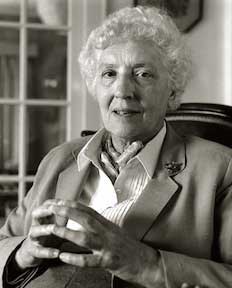
May Sarton (Belgian-American, 1912-1995) was a highly respected American poet, novelist, and memoirist. Her literature encompasses themes of aging, solitude, family and romantic relationships. Self-identified as a lesbian and regarded as a feminist, she preferred that her work found a place in a broad humanitarian connection rather than within the identities she embodied.
A good writer uses words to discover, and to bring that discovery to other people. He rewrites so that his prose is a pleasure that carries knowledge with it. That pleasure-carrying knowledge comes from self-understanding, and creates understanding in the minds of other people.
I must have time alone
The implication from these quotes is that we need a time and place to be alone to create in the dark of the unknown, shut off from distractions that divide the mind, to experience the richness of our inner world, and blossom with the light of our newly discovered self-knowledge. We write to know—to discover and understand.
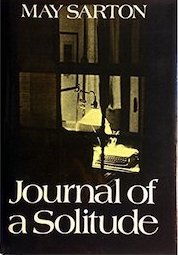
Yet, like every true artist it is always a challenge to balance the personal with the social, our own needs with those of another in a relationship. In her Journal of Solitude May Sarton wrote:
This is so true. And if we don’t express our need for solitude in a healthy manner, resentment builds up, and we find ourselves passively-aggressively taking our frustration out on those closest to us, causing pain for both parties involved. We blame others for our inability to properly balance our priorities. We lash out or fall into inertia and suffer.
However, when free to fully engage in the creative process, writing can become an ecstatic experience. This quote stood out for me, showing May Sarton’s passion for writing and how significant it was for her.
Talking to paper is talking to the divine. Paper is infinitely patient. Each time you scratch on it, you trace part of yourself, and thus part of the world, and thus part of the grammar of the universe. It is a huge language, but each of us tracks his or her particular understanding of it.
Read about Mary Oliver (1935-2019) and her astonishing poetry in this memorial acknowledgment to her poetic legacy. It contains links to articles, interviews, and poetry readings, as well as many of her favorite poems I’ve loved and posted over the years.
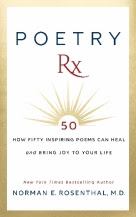
Best-selling author, world-renowned researcher, psychiatrist Norman E. Rosenthal, MD prescribes poems to his patients, publishes Poetry Rx, donates book sale proceeds to benefit veterans. Virtual book-signing at Prairie Lights in Iowa City, Iowa, a UNESCO-designated City of Literature. Read the book description and connect to this upcoming event.
Poems, I now realize, thanks to Dr. Rosenthal, can be a literary panacea for the pandemic. —Jane Brody, Personal Health Columnist, New York Times
VIRTUAL BOOK SIGNING: The David Lynch Foundation and Prairie Lights Bookstore cordially invite you to “POETRY RX: How Poetry Can Heal and Bring Joy to Your Life” featuring world-renowned psychiatrist, Norman E. Rosenthal, M.D., Prairie Lights Bookstore owner and published poet Jan Weissmiller, along with moderator Bob Roth, CEO of the David Lynch Foundation.
SPECIAL OFFER: 100% of the author’s book sale proceeds will go to the David Lynch Foundation’s Resilient Warrior Program to help reduce the epidemic of suicides among U.S. military veterans.
OVERVIEW: Imagine your therapist writing a prescription for “Hope is the thing with feathers” by Emily Dickinson or a Shakespeare sonnet or “Do Not Go Gentle into That Good Night” by Dylan Thomas—before prescribing an anxiety medication…
Dr. Norman Rosenthal is that therapist! World-renowned for his pioneering NIH research on seasonal affective disorder (SAD) and for developing the light therapy intervention to treat it, Dr. Rosenthal’s new book, Poetry Rx: How 50 Inspiring Poems Can Heal and Bring Joy to Your Life (G&D Media, May 4, 2021), delivers potent medicine—without side effects.
“As a result of the COVID-19 pandemic, the world has closed down in many ways, depriving us of joy, companionship, love and adventure,” says Dr. Rosenthal. “Against this backdrop of loss and hardship, we are seeking novel remedies, and poetry is a surprisingly powerful remedy, not just for the moment but for our entire life. Poetry can serve both as a balm and a vaccine for the soul.”
Poetry Rx published on May 4 during Mental Health Awareness Month, and on the cusp of National Poetry Month, which marked its 25th annual celebration in April.
Newsmax:When the Doctor Prescribes Poetry. May is National Mental Health Awareness Month and a leading psychiatrist has just published a groundbreaking book filled with powerful poetic prescriptions to help strengthen mental, emotional, and spiritual well-being.
ADVANCE PRAISE Dr. Rosenthal, a renowned psychiatric researcher and clinician, has given us a gift with Poetry Rx. He takes us on a journey through the varieties of human experience and shows us specifically how poetry has the power to help us understand ourselves and to heal. The wonderful effect of Rosenthal’s humanity and lucid analysis is to make us feel that our own experiences are universal and that we are not alone. —Richard A. Friedman, M.D., Professor of Clinical Psychiatry, Director of Psychopharmacology Clinic, Weill Cornell Medical College
Poetry Rx is a great read, entertaining as it teaches. These are, after all, poems the doctor ordered. But what a doctor! And what poems! —Peter Sacks, Professor of English, Harvard
Norman E. Rosenthal, M.D., is a clinical professor of psychiatry at Georgetown Medical School and was the psychiatrist who first described seasonal affective disorder and pioneered the use of light in its treatment during his 20 years at the National Institute of Mental Health. He has researched other innovative psychiatric treatments and is the author of several books including the New York Times bestseller Transcendence: Healing and Transformation through Transcendental Meditation and the national bestseller Super Mind. He currently maintains a private clinical and coaching practice in the Maryland suburbs of Washington, D.C. His work has earned him national and international attention in the world of psychiatry and psychology, as well as in the media.
Choice Magazine: Britain’s leading independent magazine for women and men over 50. The October 2021 issue published an article for their print edition, filed under Health. It will probably be archived online the following month. For now, click the title, which will take you to a PDF of the article: The healing power of poetry. Can poems act as a form of medicine? David Hughes seeks the answers…
I gave the book a 5-star rating on Amazon and goodreads. In my review I share Norman’s introductory story of how he discovered the healing power of a poem (One Art by Elizabeth Bishop), how it led him to develop the practice of prescribing poems for his patients, and how he came to write this book. Here is the conclusion to my review of Poetry Rx.
Anyone can benefit from and enjoy reading this book. Dr. Rosenthal guides the reader, showing us how to get the most out of a poem. He explains each poem, points out takeaways, and gives us a backgrounder on the poem and the poet who wrote it. It’s like having a friend of the family over for dinner that shares his enthusiasm for poetry, and in the process, entertains and enlightens us. I highly recommend this book.
In that review, I also mention the poem, ‘Love After Love’ by Derek Walcott, which Rosenthal includes in his collection on page 48. He reads and comments on it in his blog. I had posted the poem around 7 years ago after a friend had sent it to me. It reminded me of an experience I had had about 20 years earlier, about getting over a breakup and reclaiming yourself. But it was more than that.
One day I walked on the mountain and the flute song went through me. That’s all. I became the reed and the wind went through and I wrote it down in my journal.
I include an excerpt from one of her entries that the publisher edited down to put on the back cover. The four-sentence paragraph starts: “Talking to paper is talking to the divine.” I include that paragraph and the full eight-sentence journal entry from which it was taken. Together they represent the essential message of this inspirational little book.
A 4-line poem by John O’Donohue says a similar thing—how he was amazed by each revelatory moment and turned them into poems.
Enjoy this profound blog post by Deborah J. Brasket: Like Flowers Falling Everywhere: A Poem. Click on the title to see an accompanying painting by Odilon Redon. This beautiful little poem, aptly titled “Morning Prayer,” is soft and mysterious, filled with an intimate silence that just might leave you feeling sanctified.
“Morning Prayer” Deborah J. Brasket
Everywhere I look I see you, I see us. This fragile hand, this blue pen, this yellow pad.
These fingers gently folded, Embracing the eagerness of your movements across the page.
This tender paper accepting All we write. These words that rise up and lay down, so simple.
You are what I feel. This beating heart, this circling breath, this wide sphere of silence that enfolds us. Your soft sigh.
The day waits. It pours out of us whole and clear, unending. How kind you are. Kindness like flowers falling everywhere.
* * * * *
I asked a writer-artist friend who she thought is speaking in the poem, and to whom. She nailed it with this reply: “It sounds like the poet is speaking to herself about her writing life, and the love she feels for it.”
This reminds me of what B. Nina Holzer wrote in her lovely book, “A Walk Between Heaven and Earth,” A Personal Journal on Writing and the Creative Process. This edited journal entry is on the back cover:
Talking to paper is talking to the divine. Paper is infinitely patient. Each time you scratch on it, you trace part of yourself, and thus part of the world, and thus part of the grammar of the universe. It is a huge language, but each of us tracks his or her particular understanding of it.
Louise Glück was awarded The Nobel Prize in Literature 2020 “for her unmistakable poetic voice that with austere beauty makes individual existence universal.” She served as Chancellor for the Academy of American Poets and was the Library of Congress’s twelfth poet laureate consultant in poetry. Click on her name to read her biography filled with many publications and awards.
In The Red Poppy, Glück shows us the glory of the heart, but from a different perspective. She does not use the word, love, but the opening and closing to it is powerfully implied.
The Red Poppy
Louise Glück

The great thing
is not having
a mind. Feelings:
oh, I have those; they
govern me. I have
a lord in heaven
called the sun, and open
for him, showing him
the fire of my own heart, fire
like his presence.
What could such glory be
if not a heart? Oh my brothers and sisters,
were you like me once, long ago,
before you were human? Did you
permit yourselves
to open once, who would never
open again? Because in truth
I am speaking now
the way you do. I speak
because I am shattered.
Glück’s conclusion to this beautiful poem, “I speak because I am shattered,” may be due to a deep loss of connection with the Divine, her “lord in heaven called the sun,” where she permitted herself “to open once, who would never open again,” brokenhearted, “speaking now the way you do.” From the flower’s perspective, it is like a death. In another flower poem, The Wild Iris, death is not the end: “whatever returns from oblivion returns to find a voice.” See her read that poem on YouTube. Both poems were from a May 11, 2016 Lannan Foundation Literary Event.
This loss is reiterated in her quote from a human perspective: We look at the world once, in childhood. The rest is memory. As humans, there may yet be a chance for illumination and grace. Rumi wrote: “The wound is the place where the Light enters you.” Leonard Cohen sang in his song, Anthem: “There is a crack in everything/ That’s how the light gets in.”
Wendell Erdman Berry (born August 5, 1934) is an American novelist, poet, essayist, environmental activist, cultural critic, and farmer. He has published more than 50 books. Berry is an elected member of the Fellowship of Southern Writers, a recipient of The National Humanities Medal, and the Jefferson Lecturer for 2012. He lives in Port Royal, Kentucky. Click here to listen to him read this poem, and 5 others posted at the On Being website.
The Peace of Wild Things
When despair for the world grows in me and I wake in the night at the least sound in fear of what my life and my children’s lives may be, I go and lie down where the wood drake rests in his beauty on the water, and the great heron feeds. I come into the peace of wild things who do not tax their lives with forethought of grief. I come into the presence of still water. And I feel above me the day-blind stars waiting with their light. For a time I rest in the grace of the world, and am free.
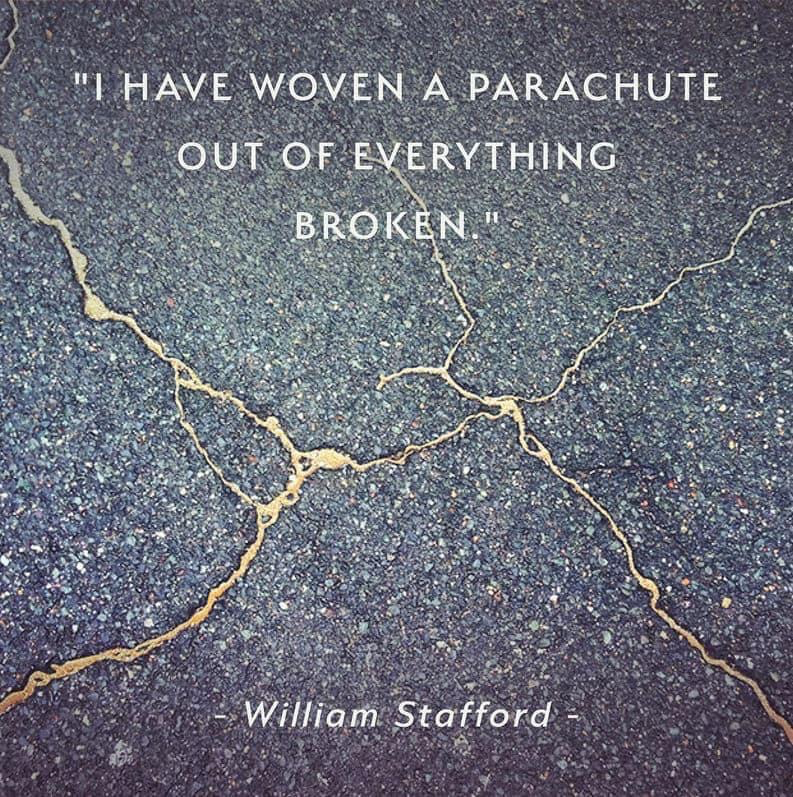
My son sent me a link to a quote by William Stafford that Michael Meade had posted on his Instagram. I couldn’t find the source.
Update: Leslie Marlowe sent me more of the quote. I did a search and discovered the poem in The Way It Is, and then online. I include this information in my reply below. It was part of the third stanza of a 24-line 4-stanza poem, Any Time, first published in Allegiances (1970).
“I have woven a parachute out of everything broken.” — William Stafford
The Japanese art of kintsugi
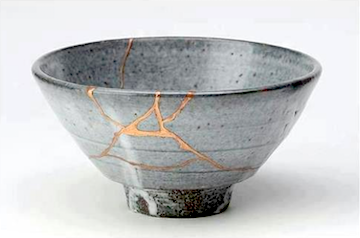
The quote and background image remind me of kintsugi or kintsukuroi, the Japanese art of repairing broken pieces of pottery using lacquermixed with powdered gold, silver, orplatinum. As a philosophy, it treats breakage and repair as part of the history of an object, rather than something to disguise. The piece becomes stronger and more beautiful than the original because of its unique imperfections.
To me, this serves as a metaphor for overcoming life’s challenges, scars and all, which build character. When I first saw a piece of repaired broken Japanese pottery using this method, it inspired a poem using one of the forms of Japanese poetry—kintsugi tanka.
A poet of peace
William Stafford responded creatively and with integrity to the challenges life sent his way. He remained true to his voice as a conscientious objector, poet of peace, and the innovative way he taught writing.
For it is important that awake people be awake, or a breaking line may discourage them back to sleep; the signals we give—yes or no, or maybe— should be clear: the darkness around us is deep.
“I give you the end of a golden string, Only wind it into a ball, It will lead you in at Heaven’s gate Built in Jerusalem’s wall.”
As any persistent writer will tell you, when they finally “get it right,” there’s a feeling of euphoria, the metaphorical equivalent of entering “Heaven’s gate.”
Stafford was awake to that revelatory moment when each thread of thought presented itself to him. They would lead to unexpected associations and realizations. In the last poem he wrote the day he died, he said: You can’t tell when strange things with meaning will happen.
Speaking of weaving together a parachute from everything broken, this most popular poem by Stafford, and my favorite, talks about holding onto an unseen thread that’s woven throughout all of life’s experiences.
There’s a thread you follow. It goes among things that change. But it doesn’t change. People wonder about what you are pursuing. You have to explain about the thread. But it is hard for others to see. While you hold it you can’t get lost. Tragedies happen; people get hurt or die; and you suffer and get old. Nothing you do can stop time’s unfolding. You don’t ever let go of the thread.
Coincidentally, I came across a quote from the Vedic literature that takes this idea of an uncommon thread and extends it to a cosmic thread.
He who knows the fine-drawn thread of which the creatures that we see are spun, who knows the thread of that same thread—he also knows Brahman, the Ultimate. (Atharva Veda Samhita 10.8.37)
Many years ago, at a local bookstore I used to frequent, I came across a profound little poem on a poster with a beautiful image from nature. The name of the poet, Kiyo, appeared under the poem. It may have been the first type of Japanese poetry I’d ever read, in English translation of course. I had discovered haiku—a 3-line poem of 5-7-5 syllables respectively. I had written it down and recently found it. Here it is.
Softly unfolding, Beauty awakens each heart to wonder … to life.
I’d never heard of Kiyo. Did a search and found Ungo Kiyo (1582–1659), a Japanese Rinzai Zen master and poet. Couldn’t find any more poetry, just a quote on enlightenment in an antique book of calligraphy.
Even though we can’t adequately translate haiku into English due to the syntactical differences of a pictorial language, an important aspect of it was explained to me by a Japanese TM teacher I had met on an international course. Haiku was part of his educational upbringing. They usually have a seasonal reference. To be effective, the first 2 lines describe something in nature, but the 3rd line brings in another element that causes the mind to skip a beat, have an ‘aha’ moment of realization.
Kiyo’s beautiful short poem inspired me to start writing haiku and then tanka, a 2-stanza poem combining haiku with 2 lines of 7 syllables each. The second part would continue the theme of the first part, but give it a slightly new angle. In olden times, the Japanese court poets used to compete with each other in rounds of tanka called renga, linked verses.
I wrote my first haiku after a walk-and-talk about relationships with a lady friend. I noticed a furry caterpillar crawling on the ground. It became the metaphor for a poem on commitment and spiritual transformation.
Caterpillars spin increments of commitment; Butterflies fly free!
I wrote many haiku and tanka over the years. I even wrote Haiku on The Nature of Haiku, which was very meta. These first 4 haiku—Defined, Discovered, Transformed, Translated—were among the 13 Ways to Write Haiku: A Poet’s Dozen, published in The Dryland Fish, An Anthology of Contemporary Iowa Poets.
on the edge of space two egrets in morning light woken from a dream
I recently came across a poem I had written a while ago, but never posted it. A photograph of cranes flying in a snowstorm inspired this Japanese Haiku.
Red-crowned cranes in Akan National Park, Hokkaido, Japan. Photograph by Vincent Munier. Click on image to enlarge it.
Three Japanese cranes Soar above trees in snowstorm Grace under pressure
Tanka on the Japanese art of kintsugi
I discovered other aspects of Japanese culture, which inspired tanka poems. Click on the titles below for more information and images.
The first is about kintsugi, the Japanese art of repairing broken pottery with gold or silver lacquer thereby making it appear more beautiful than the original. Robert Yellin had tweeted an image of a repaired bowl to show this art, which is how I discovered it.
life’s lessons build character what was broken is now whole
The Japan Ministry of Foreign Affairs selected Robert to introduce Japanese craftsmen to the world in a special documentary, Takumi: Japan’s artisan tradition. Because of his expertise, Robert became a cultural ambassador. His film inspired people from all over the world to visit the country, and helped boost Japanese tourism.
How Robert ended up in Japan is revealed in the documentary film, Jerry’s Last Mission, about his father, Jerry Yellin, who was the last WWII fighter pilot, an author, and proponent of TM for veterans with PTSD.
Tanka on the Japanese martial art of Aikido
On a visit to see my son in California, I wrote this tanka after watching his Aikido teacher demonstrate how to defend oneself from attack. She stood in one spot and effortlessly deflected the repeated charges from her students. It was mesmerizing! It took me a while to process what I had seen before writing the poem. I had emailed it to my son to read to her on her birthday. A volunteer at the dojo found the poem and posted it with a photo of a leaning tree as a screensaver on the office computer. It’s beautiful. Click the title and scroll down to see it.
Rooted to the ground She repels her attackers Flowing, not moving.
In storms, trees bear great burdens Bending, not breaking.
Two tree tanka
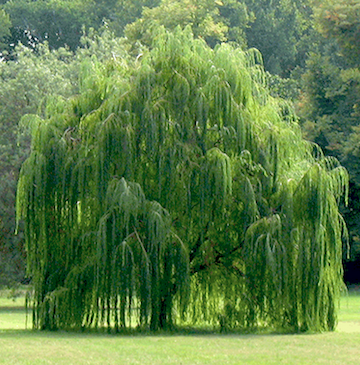
Speaking of trees, this tanka is from the perspective of a willow tree. Click the title to see a photo of a special one, and links to audio clips of me reading the poem on different media platforms.
Willow Tree Whispers People say … Weeping Willow But I’m not crying
Just bowing down … to the Earth Kissing the ground … with my leaves
Another tree tanka resulted when I saw the willow that inspired the previous poem, and the honey locust next to it, intertwined on top! They were on each side of the entrance to the place I was living in at the time.
See more haiku and tanka archived on The Uncarved Blog.
Suggested Reading
Jane Hirshfield’s 29-page essay about the life and poetry of Matsuo Bashō—recognized as a master of concise, compelling Japanese haiku—is worth reading. The Heart of Haiku was named “Best Kindle Single of 2011.” It was the first Kindle I ever bought, and described it in a post, Haiku on The Heart of Haiku, with links to interviews and more.
December 29, 2020, my son Nathanael emailed to say he was planning to go offline and take some downtime to close out this crazy year. I sent him this haiku, and he replied: GOOD MEDICINE. I used it as the title.
Good Medicine Haiku
Trust inner feelings Let go; settle in silence Honor your essence
So if you’re wanting to forget 2020 ever happened and are looking to refresh for 2021, think of this Good Medicine Haiku as a prescription to take a much-needed, guilt-free time-out. Try a digital diet, meditate, go within—take quality time for yourself. We owe it to ourselves. Peace out.




 The Uncarved Blog