Finding the needle in a haystack: MUM teaches data-mining class – Andy Hallman/Fairfield Ledger

December 14, 2013

Finding the needle in a haystack MUM class teaches students how to find useful information in a sea of data

Article & photo by ANDY HALLMAN, news editor for The Fairfield Ledger Dec 13, 2013

Maharishi University of Management professor Anil Maheshwari teaches a class on data mining at the school. The students learn how to glean insights from enormous data sets to help businesses serve their customers, among many other things.

Maharishi University of Management is becoming a key player on the national stage for its research into data mining.

Data mining refers to techniques for finding useful knowledge in a vast sea of information. Due to a recent partnership between IBM and MUM, university students have free access to IBM software to help them crunch huge data sets. They’re using those tools from IBM in a course titled “Business Intelligence and Data Mining,” taught by MUM professor Anil Maheshwari.

The IBM Academic Initiative offers participating schools course materials, training and curriculum development to 6,000 universities and 30,000 faculty around the world.

Maheshwari said modern computers have taken number crunching to new heights. They allow programmers to find correlations between sometimes seemingly unrelated variables. This kind of computing power is valuable for businesses because it allows them to fine-tune their advertisements.

Businesses collect reams of information about the demographics of their customers. Data mining allows them to sort through this information to find out who buys the product, such as whether the customers are mostly male or female, young or old, single or married, etc. Learning which variables are important and which are not is key to a successful marketing campaign.

“Data mining is just like mining into diamond,” he said. “You need a lot of skill and tools but also an artistic edge of identifying the diamond.”

Maheshwari said data mining holds the promise of being able to answer questions the way contestants do on a game show such as Jeopardy! He even mentioned a computer called “Watson” that has competed on the show. The computer is fed the question and then generates an answer based partly on how the words in the question correspond to encyclopedia articles in its database. Data mining power has reached a point where Watson’s sophisticated algorithms can arrive at the correct answer even when the question employs puns.

A computer that can answer questions after searching through a database would be useful to doctors who are trying to predict whether a symptom in a patient is likely to lead to a malignant or benign tumor. Data mining computers could search through thousands of cases to find which variables, symptoms in this case, predicted malignant tumors and which predicted benign tumors.

Such technology could be applied in other realms, too, such as finding out which students were likely to drop out of school based on data about previous drop outs.

Maheshwari said collecting large amounts of data is easier than most people think considering so much of it is publically available on the Internet. He said the government gathers massive amounts of data for everything under the sun. Accessing the data is not the tricky part – knowing how to separate the wheat from the chaff is. Actually, Maheshwari said the analogy he prefers is finding a needle in a haystack, because the vast majority of data in a database is useless in answering the researcher’s question.

In response to the growing need for experts in information technology such as data mining, MUM has introduced an online graduate certificate program in Management Information Systems. The program can be completed entirely online in one to two years.

This front-page news story is reprinted with permission from the Fairfield Ledger. Click on this link to see how it appears in that issue: FFLedger12-13-13_1A.

For more on the story, including a video interview with Anil Maheshwari, see http://link.mum.edu/DataMining.

a new tanka: Dementia Blues

December 12, 2013

Dementia Blues
A tanka written after a holiday party at Parkview

Brain cell by brain cell
You’re disappearing from me
I’m alone again

How hard it must be for you
Disappearing from yourself

© Ken Chawkin
December 8, 2013
Fairfield, Iowa, USA

Related: An Unwanted Guest

The Curse of Dementia: On watching a loved one diminish before your eyes, poem by Ken Chawkin

Sitting with Sally: 5-haiku poem

Rage Against the Disease

Maharishi University’s Fred Travis talks about the brain and meditation on What Women Must Know

November 21, 2013
Sherrill Sellman

Sherrill Sellman

Sherrill Sellman, host of What Women Must Know, interviewed Fred Travis of Maharishi University of Management on the Progressive Radio Network, PRN.fm, “The #1 Internet Radio Station for Progressive Minds,” on November 21, 2013. Listen to this interesting interview as they discuss different stages of the brain’s development and how it is affected by PTSD, ADHD, and different meditations. Today’s show is titled Your Brain, Rejuvenation and Meditation with Dr. Fred Travis.

Dr. Fred Travis

Dr. Fred Travis

Dr. Fred Travis is Professor of Maharishi Vedic Science, Chair of the Department of Maharishi Vedic Science, Dean of the Graduate School, and Director of the Center for Brain, Consciousness, and Cognition, at Maharishi University of Management. He earned an M.S. and Ph.D. in Psychology from Maharishi University of Management, and a B.S. in Design and Environmental Analysis from Cornell University. He is also the author of Your Brain is a River, Not a Rock. Visit his website for video presentations, publications and more: drfredtravis.com.

Listen to a Podcast of the show or search for it in the Archives.

Andy Bargerstock reveals a costly disconnect in Lean companies not completely walking their talk

November 12, 2013

Standard Costing Very Costly, New Research Shows

Lean Accounting expert, Andrew Bargerstock, PhD, CPA, Director of Maharishi University’s MBA Programs, will present new research findings that show for the first time, empirical evidence of the waste inherent in Lean manufacturing companies that still use a standard costing accounting model. His talk, “The failure of standard accounting systems in Lean companies,” will be presented this week at the local chapter of the Institute for Management Accounting (IMA) during their Fall Conference in Cedar Rapids, Iowa.

Fairfield, Iowa (PRWEB) November 12, 2013

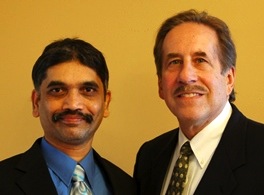
Andrew Bargerstock, PhD, CPA, Director of MBA Programs at Maharishi University of Management

Andrew Bargerstock, PhD, CPA, Director of MBA Programs at Maharishi University of Management

Lean Accounting expert, Andrew Bargerstock, PhD, CPA, Director of Maharishi University’s MBA Programs, will present new research findings that show for the first time, empirical evidence of the waste inherent in Lean manufacturing companies that still use a standard costing accounting model. Lean management principles are based on the generic elements of organizational development from companies like the Toyota Motor Corporation who build long-term customer loyalty while streamlining operational processes.

Dr. Bargerstock says, “Many mature lean manufacturers continue to use standard costing when it is no longer useful. This wasteful practice costs companies millions of dollars.” Professor Bargerstock will present his findings this Thursday, November 14 at 1pm, at the regional chapter of the Institute for Management Accounting (IMA) during their Fall Conference in the Double Tree Hotel in Cedar Rapids, IA. His presentation will include a summary of the research study and a model of a three-tiered system of organizational performance metrics that drive lean innovations.

“Companies are still attached to standard costing because it is the staple of business schools emulating General Motors operational controls from the 1950s. Lean offers a new model for operational controls. Our research is the first to show that mature Lean companies who still use standard costing accounting systems are leaving money on the table.” Professor Bargerstock says.

Lean manufacturing is a sustainable, cost-saving, adaptive and highly efficient manufacturing management process originated by Toyota Motor Company in the 1980’s, and since adopted worldwide by hundreds, even thousands of manufacturers. The Lean strategy can be applied to any type of organization profit or non-profit.

Wasted money, lost profits, weaker earnings

The new research, done at Maharishi University of Management, a 4-year Iowa college of arts and sciences that integrates practice of the Transcendental Meditation® technique into its curriculum, shows that many companies using Lean manufacturing processes are not discarding standard costing, and as a result, are missing significant additional savings, losing profits and weakening the bottom line. “Companies using Lean manufacturing, but not using Lean Accounting are losing money by clinging to an antiquated costing model.” Dr Bargerstock says.

This is the first empirical study to test a prediction made by many Lean Accounting theorists, that mature lean manufacturing enterprises will discard standard costing systems. Anecdotal evidence suggested that companies may be holding onto standard costing, but no empirical study has verified the observed behavior.

Manjunath Rao, PhD and Andrew Bargerstock, PhD

Rao and Bargerstock

In 2011 and 2013, Bargerstock and one of his PhD students, Manjunath Rao, published articles in the Management Accounting Quarterly on the research conducted at MUM. The article published in Summer 2013 MAQ is entitled, “Do Lean Implementation Initiatives Have Adequate Accounting Support?”

Dr. Bargerstock was the chair of Rao’s dissertation committee. Lean accounting experts and academics at the Institute for Management Accounting collaborated on the research. The article describes the analysis of some of the data gathered during Rao’s dissertation research. The study found that in a sample of mature lean manufacturing companies, lean accounting implementation lags behind lean operations implementation, which may give rise to inadequate accounting support in lean initiatives.

A former Fortune 500 executive and national consultant for federal and state governmental agencies and private corporations, Dr. Bargerstock was selected as the 2009 Excellence in Lean Accounting Professor by the Lean Enterprise Institute (LEI), one of the leading non-profit associations dedicated to the education and promotion of Lean Management in the country. LEI, along with the co-sponsorship of the IMA, have also recognized two of Prof. Bargerstock’s PhD students during the last three years as Lean Accounting Student of the Year.

See a short video of Dr. Bargerstock outlining the main points for his talk to the IMA, and an additional segment on the success of MUM students in the MBA Lean Accounting Program.

Founded in 1971, Maharishi University of Management (MUM) offers Consciousness-Based℠ Education, a traditional academic curriculum enhanced with self-development programs like the Transcendental Meditation® technique. Students are encouraged to follow a more sustainable routine of study, socializing and rest without the typical college burnout. All aspects of campus life nourish the body and mind, including organic vegetarian meals served fresh daily. Located in Fairfield, Iowa, MUM is accredited by The Higher Learning Commission and offers bachelor’s, master’s, and doctoral degrees in the arts, sciences, humanities, and business. Visitors Weekends are held throughout the year. For more information, call the Admissions Office at 800-369-6480 or visit http://www.mum.edu.

PRWeb: http://www.prweb.com/releases/Lean/IMA/prweb11309348.htm or bit.ly/19Z629I

Posted on: Virtual-Strategy Magazine and other top news outlets.

In an effort to encourage more faculty to attend the The Lean Accounting Summit, organizers interviewed Andy Bargerstock on Friday, October 18, 2013 in Orlando, FL. He was asked to share what he had learned from previous summits. Of all the interviewees, they selected Andy to go in their LEAF (Lean Education Advancement Foundation) newsletter. You can see both here: A Special Letter to Lean Accounting Summit Participants from the LEAF Board of Directors.

David Lynch on meditation in the NewStatesman: Heaven is a place on earth

November 1, 2013

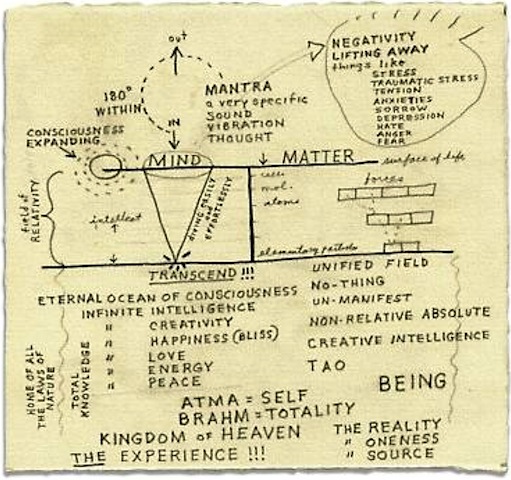
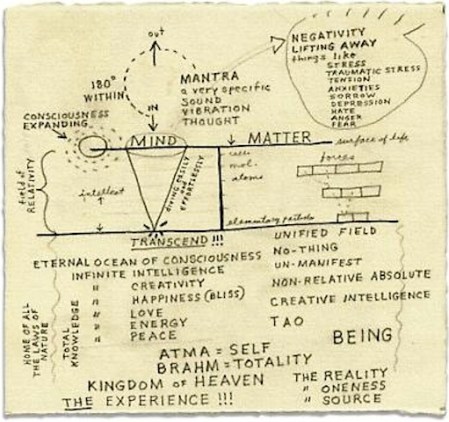
This week Russell Brand was guest editor of the UK’s NewStatesman, which came out October 24, 2013. He invited David Lynch to contribute an article on meditation. The diagram looks like it may be the same one David drew during an interview with a French journalist in Paris as he was explaining Transcendental Meditation to her. A large part of the article reads like a transcription of that brilliant explanation, which was woven throughout a documentary film made of David’s 16-country tour, Meditation Creativity Peace.

David Lynch on meditation: Heaven is a place on earth

Transcending is the only experience in life that gives total brain coherence. Any other thing we do utilises different small parts of the brain, this small part for painting, another small part for mathematics, that small part for playing the piano.
By David Lynch Published 31 October 2013 14:45

Mind and matter: Lynch’s diagram of Transcendental Meditation. Image: copyright David Lynch

Mind and matter: Lynch’s diagram of Transcendental Meditation.
Image: copyright David Lynch

What is Transcendental Meditation? What is transcending? Where do you go when you transcend? And what good is it to transcend? To help answer these questions, I’ve done a little drawing and you can refer to it from time to time. You will notice a line at the top of the drawing representing the surface of life. We live on the surface and see surfaces everywhere. This right side represents matter and the left side will represent mind. Mind and matter.

About 300 years ago, scientists started wondering: what was matter, what was wood, what was air, what was water, what was flesh, etc? And they started looking into matter and they began to find things – things that we now learn about in school. They found cells and molecules. They went deeper and found atoms; they went deeper and deeper, all the way down to the tiniest particles – the elementary particles.

They found four forces that act upon the particles. And on a deeper level, they found that the four forces became three. Some unification started. And, on a deeper level, the three forces became two. About 35 years ago, modern science, quantum physics, discovered the Unified Field at the base of all matter. This field is the unity of all the particles and all the forces of creation. This is a field of nothing, but the scientists say that out of this nothing emerges everything that is a thing. This Unified Field is unmanifest yet all manifestation comes from this field.

Ancient Vedic science, the science of consciousness, has always known of this field. Believers say that it is an eternal unbounded ocean of consciousness. And this consciousness has qualities. So this Unified Field, this ocean of consciousness, is a field of unbounded intelligence, unbounded creativity, unbounded happiness, unbounded love, energy and peace.

Transcendental Meditation is a mental technique, an ancient form of meditation brought back for this time by Maharishi Mahesh Yogi. It is a technique that allows any human being to dive within, through subtler levels of mind and intellect, and then transcend – that is experience, that ocean of pure consciousness at the base of all mind and matter – to experience this Unified Field within with those all-positive qualities.

In Transcendental Meditation you’re given a mantra. A mantra is a very specific sound vibration – thought. The mantra that Maharishi gives is like a law of nature designed for a specific purpose and that purpose is to turn the awareness 180 degrees from out, out, out to within, within, within. Once pointed within, one will dive easily and effortlessly. It is easy and effortless because the nature of the human mind is always to want to go to fields of greater happiness.

Each deeper level of mind and each deeper level of intellect has more and more happiness – charm, as they say. So the happiness growing is like a magnet that gently pulls us within. And at the border of intellect, one then transcends and experiences the transcendent, the Unified Field, the ocean of pure consciousness, the kingdom of heaven that lies within – the Tao, the home of total knowledge, being or divine being; Atma, meaning the Self, the Self with a capital “S”.

There’s a line we’ve all heard: “Know thyself.” This is the Self they’re talking about. This field is also known as Brahm, meaning totality. First seek the kingdom of heaven that lies within and all else will be added unto you. All else is totality.

Every time a human being transcends, they infuse some of this all-positive consciousness and they truly begin to expand whatever consciousness they had to begin with. There is a side effect to expanding consciousness, and that side effect is that negativity begins to recede. Things like stress, traumatic stress, anxieties, tension, sadness, depression, hate, anger, rage and fear start to lift away very naturally.

The analogy is: negativity is just like darkness. When this light of consciousness begins to truly expand, it is like being in a dark room with a light on a dimmer. As the light gets brighter, the darkness starts to go. And when the light is full on, there is no darkness. Likewise with the light of unity – consciousness – growing, negativity very naturally starts to recede, automatically and without you having to worry about it. This heavy weight of negativity lifting gives such a joyful feeling of freedom to a human being. So you could say the person practising Transcendental Meditation each day is infusing gold and getting rid of garbage.

Transcending is the key word!!! Transcending is truly experiencing that deepest eternal level of life. It is this experience that does everything good for a human being. Every human being has consciousness but not every human being has the same amount. The good news is, every human being has the potential for infinite consciousness. Every time you experience this ocean of consciousness within, you expand more and more consciousness and you are unfolding your full potential as a human being. The full potential of the human being is called enlightenment – infinite consciousness, infinite happiness, total fulfilment. Totality.

Transcending is a holistic experience, meaning that all avenues of life will start improving. The things that used to stress you will still be out there in the world but they will not be able to hit you so hard. You’ll still be able to feel sadness but the sadness won’t last so long. It will lift away more quickly. The same with anger; the anger will leave more quickly. It won’t stay with you and poison you and the environment. Fears begin to lift – you work in more and more freedom. This is a field of infinite creativity. You will see creativity and problem-solving start to expand. Through research, scientists know that IQ can go up because of transcending each day.

Happiness comes more and more and you feel good in your body and enjoy the doing of things more and more. The field within is a field of universal love. This universal love feeds personal love and relationships improve. This field within is a field of infinite energy. People today are so fatigued and here within each of us is an infinite amount of energy to fuel our work and play. There is infinite peace within and that is deep, deep contentment, harmony, coming up inside the human being. It is so beautiful.

Transcendental Meditation is, as I said, easy and effortless. Many people might think that because it is easy it is not as good as other meditation techniques. This is wrong thinking. Concentration forms of meditation, contemplation forms of meditation, will keep a human being hovering on the surface. There will be no transcending. And it is hard work and it is boring and the reward is not there.

Transcendental Meditation as taught by Maharishi Mahesh Yogi is a technique that has been here many times before and it is a blessing. It is the real thing. It works. Brain research scientists have found a wondrous thing. When a human being truly transcends, hooked up to an EEG machine, then the full brain gets engaged in concert. They call this “total brain coherence”.

Transcending is the only experience in life that gives this total brain coherence. Any other thing we do utilises different small parts of the brain, this small part for painting, another small part for mathematics, that small part for playing the piano, and so on. Scientists have always told us before that we use only 5 per cent or 10 per cent of our brain but transcending is an experience that utilises the full brain.

This shows us something of the relationship of the human being to this glorious Unified Field within. The more we transcend, the more this coherence stays with us and this eventually gives rise to higher states of consciousness, culminating with supreme enlightenment. On the EEG machine, Transcendental Meditation meditators are seen to transcend many times in each 20-minute meditation. Those meditators who practise concentration or contemplation forms of meditation do not transcend. They do not get the experience of that ocean of bliss consciousness, the Unified Field.

A ten-year-old child can practise this technique of Transcendental Meditation; a 110-year-old can do it, easily and effortlessly, and they will each get the experience they are yearning for. It is a sublime experience to transcend and feel that rejuvenation and that happiness and all those other all-positive qualities growing.

Transcendental Meditation is not a religion. People from all religions practise this technique and they see there is no conflict with their religion. On the contrary, they say they understand and appreciate their religion more because understanding and appreciation for all things grow by transcending each day. It is a technique for human beings, no matter what walk of life, what religion or where you are from. People who have experienced great suffering have gotten this technique and happily said, “Now I have my life back again.” The real story is: THE NATURE OF LIFE IS BLISS and THE INDIVIDUAL IS COSMIC.

Russell Brand’s article in this paper is about revolution. Revolutions are usually associated with violence or force. Transcendental Meditation leads to a beautiful, peaceful revolution. A change from suffering and negativity to happiness and a life more and more free of any problems. The secret has always been within. We just need a technique that works to get us there to unfold a most beautiful future.

Find out even more about Transcendental Meditation at: davidlynchfoundation.org.uk.

For American readers, visit www.tm.org and davidlynchfoundation.org.

See Russell Brand and David Lynch at LA Premiere of ‘Meditation, Creativity, Peace’ Documentary and related links to other videos and articles. Visit http://meditationcreativitypeace.com to see a preview of the film and where it may be playing.

This is an excellent interview: David Lynch speaks with Alan Colmes about his 16-country tour film Meditation Creativity Peace.

The NewStatesman article reads like a transcription from this film, which you can now see: “Meditation Creativity Peace”—A documentary of David Lynch’s 16-country tour during 2007–2009.

See an earlier article written by David Lynch published in Jane Magazine: Celeb Spiritual Report: One significant day in my life by David Lynch for Jane Magazine (May 2004).
Maharishi University of Management’s Ye Shi Named Lean Accounting Student of the Year

October 26, 2013

Maharishi University of Management PhD candidate, Ye Shi (Linlin), was awarded the 2013 Lean Enterprise Institute’s annual Excellence in Lean Accounting Student Award during their Lean Accounting Summit this month in Orlando, Florida. This award continues a pattern of recognition for MUM from LEI: Dr. Andrew Bargerstock was named Lean Accounting Professor of the Year in 2009, and Manjunath Rao was selected as Lean Accounting Student of the Year in 2011 for his PhD dissertation.

Tabitha Dubois (right), LEI's Director of Finance and Administration, gave the Lean Accounting Student Award to MUM’s Ye Shi, and the Lean Accounting Professor Award to WWU's Dr. Audrey Taylor.

Tabitha Dubois (right), LEI’s Director of Finance and Administration, gave the Lean Accounting Student Award to MUM’s Ye Shi, and the Lean Accounting Professor Award to WWU’s Dr. Audrey Taylor.

Fairfield, Iowa (PRWEB) October 25, 2013

By Ken Chawkin

Maharishi University of Management PhD candidate, Ye Shi (Linlin), was awarded the 2013 Lean Enterprise Institute’s annual Excellence in Lean Accounting Student Award during their Lean Accounting Summit this month in Orlando, Florida. The Lean Enterprise Institute (LEI) is a non-profit educational association, which recognizes students who have been actively engaged in research, education, and the development of Lean Accounting and accounting for Lean.

Andrew Bargerstock, PhD, CPA, director of MUM’s MBA programs, had nominated Linlin for this award based on her accomplishments in lean accounting. “We are very happy that Lin Lin’s accomplishments are recognized by one of the biggest names in Lean Accounting, James Huntzinger, in his role as the chair of the Student of the Year selection committee for Lean Enterprise Institute (LEI) and the Lean Accounting Summit.”

Jim Huntzinger

Jim Huntzinger, president and founder of Lean Frontiers

On September 23rd Jim Huntzinger, president and founder of Lean Frontiers, and author of Lean Cost Management: Accounting for Lean by Establishing Flow, notified Linlin of her selection as Lean Accounting Student of the Year. Huntzinger founded the Lean Accounting Summit in 2005, as well as produced many other Lean summits.

As to why she was selected, Jim Huntzinger said, “Linlin was recognized as LEI Lean Accounting Student for 2013 due to her commitment to help others understand and develop a deep understanding of the new paradigm in Lean Accounting. We hope that she will continue to deepen her knowledge of this area and encourage more students and faculty to join the Lean Accounting adventure, and utilize her PhD research to both deepen and further her understanding of lean accounting.”

This award continues a pattern of recognition for MUM from LEI. Dr. Andrew Bargerstock was named Lean Accounting Professor of the Year in 2009, and Manjunath Rao was selected as Lean Accounting Student of the Year in 2011 for his PhD dissertation.

Linlin completed both the MBA in Accounting (2011) and the Post-graduate Certificate in Lean Accounting (2012) at MUM. In September 2013 she began her second year of teaching three of the two-credit courses in the Lean Accounting Certificate program.

In collaboration with Dr. Bargerstock, Linlin has developed case studies to illustrate how to implement kaizen methodologies to improve accounts payable processing. Linlin is currently taking coursework in the PhD program at MUM and expects to begin her dissertation next year.

Linlin is passionate about Lean, which she says is “the great strategic thinking that leads to true sustainable development. Lean accounting is an advanced way of articulating business through present and real financial numbers compared to the historical and sometimes misleading numbers provided by traditional accounting.”

Linlin says Lean enables better communication and employee engagement, and greatly enhances leadership. She adds, “It’s also a great illustration of how to do less and accomplish more, which is a fundamental principle of our university’s educational approach, Consciousness-Based Education.”

Ye Shi (Linlin) with MUM Professor Andrew Bargerstock at the 2013 Lean Accounting Summit

Ye Shi (Linlin) with MUM Professor Andrew Bargerstock at 2013 Lean Accounting Summit

Linlin says she is thrilled and honored to be recognized as the Lean Accounting Student of the year. “I am grateful for the support from MUM, Lean Frontiers, LEI and IMA. I appreciate the guidance and support from Dr. Andrew Bargerstock and other mentors and friends. Without them, any personal development for me would not have been possible.”

The summit offered Linlin, and other participants, the opportunity to meet with elite academic lean professionals and business lean practitioners. “It’s thought provoking to hear the speakers from different fields articulating the Whys and Hows of lean accounting based on their empirical research and practical experience. To be able to talk to them face to face and exchange opinions during the open discussions was fantastic. Also, the Q&A session with the executive team from the renowned Institute and the rest of the speakers provided the practical solutions for any problems people may encounter during lean transformation. It was really exciting to learn the live examples and have the inspiring conversations.”

Included in Linlin’s award was a complimentary registration at the Summit and $500 towards her travel expenses.

Photos of LEI Award Winners are available at garrethoover.com/LEI. Tabitha Dubois (red dress), Director of Finance and Administration for LEI, gave the Excellence in Lean Accounting Student Award to MUM’s Ye Shi, and the Excellence in Lean Accounting Professor Award to Dr. Audrey Taylor, Professor of Accounting at Western Washington University.

Founded in 1971, Maharishi University of Management (MUM) offers Consciousness-Based℠ Education, a traditional academic curriculum enhanced with self-development programs like the Transcendental Meditation® technique. Students are encouraged to follow a more sustainable routine of study, socializing and rest without the typical college burnout. All aspects of campus life nourish the body and mind, including organic vegetarian meals served fresh daily. Located in Fairfield, Iowa, MUM is accredited by The Higher Learning Commission and offers bachelor’s, master’s, and doctoral degrees in the arts, sciences, humanities, and business. Visitors Weekends are held throughout the year. For more information, call the Admissions Office at 800-369-6480 or visit http://www.mum.edu.

Source: PRWeb: MUM’s Ye Shi Named LEI’s 2013 Lean Accounting Student of the Year

In an effort to encourage more faculty to attend the The Lean Accounting Summit, organizers interviewed Andy Bargerstock on Friday, October 18, 2013 in Orlando, FL. He was asked to share what he had learned from previous summits. Of all the interviewees, they selected Andy to go in their LEAF (Lean Education Advancement Foundation) newsletter. You can see both here: A Special Letter to Lean Accounting Summit Participants from the LEAF Board of Directors.

Also posted on AndyB’s Blog: MUM’s Ye Shi Named LEI’s 2013 Lean Accounting Student of the Year

See MUM MBA Students Win at CAPSIM: The Role of Business Simulation Competitions in Higher Education.

See: Maharishi University’s Rao and Bargerstock published in Management Accounting Quarterly.

See Maharishi University MBA Students Win National Business Simulation Competition.

Not the loss alone — a poem by Gregory Orr

October 22, 2013

Not the loss alone,
But what comes after.
If it ended completely
At loss, the rest
Wouldn’t matter.

But you go on.
And the world also.

And words, words
In a poem or song:
Aren’t they a stream
On which your feelings float?

Aren’t they also
The banks of that stream
And you yourself the flowing?

~ Gregory Orr ~

 (Concerning the Book that is the Body of the Beloved)

See two other poems by Gregory Orr from the same book:

Let’s remake the world with words

Concerning the Book that is the Body of the Beloved


Alec Baldwin asks Jerry Seinfeld about learning Transcendental Meditation on Here’s The Thing

October 20, 2013

HerestheThing_web_header_alt3Monday, October 14, 2013 | Episode #52 | Jerry Seinfeld
Listen | Download | Stream m3u | Transcript

 Jerry Seinfeld (Jason Sheldon)

Jerry Seinfeld (Jason Sheldon)

This month, Alec Baldwin sat down with comedian Jerry Seinfeld for his show, Here’s The Thing, which airs on WNYC. Jerry had debuted on HBO in 1981, the same year he first appeared on Johnny Carson. Jerry Seinfeld was 27 years old.

Seinfeld’s material stood out. It wasn’t about his upbringing or personal relationships. It was about our universal experience of small things. Eight years after his HBO debut, he and Larry David created a weekly series that changed both their lives. After Seinfeld ran for nine seasons, Seinfeld went back to stand-up, and to his audience. As he explains to Alec, Seinfeld feels uniquely connected to his fans: “You have this relationship with the audience that is private between you and them. Critics want to write, people want to talk. We have our own thing that nobody can break … once you build that it can’t be broken by outside forces.”

In the closing segment (last 3 minutes) Alec asks Jerry about meditation, how and when he learned it. Here’s that section of the transcript:

Alec Baldwin: Jerry Seinfeld has meditated for over four decades and it shows. He says it makes stress float away. I wanted to find out more about Jerry and meditation. So I called him.

Jerry Seinfeld: Transcendental Meditation, that’s what I do. TM.

Alec Baldwin: And how long have you been doing that?

Jerry Seinfeld: Since ’72.

Alec Baldwin: So when did that come into your life? You like saw a billboard when you were at the Long Island Railroad station?

Jerry Seinfeld: Yeah, I saw a flyer in the union at Oswego State University, where I was enrolled.

Alec Baldwin: Seriously?

Jerry Seinfeld: Because I couldn’t take senior year anymore so I left high school six months early, got into college, and left in the middle of senior year. Now I know you didn’t do that.

Alec Baldwin: No.

Jerry Seinfeld: Because you were handsome and the girls were hanging off of you, and senior year was fantastic for you. That’s what I know.

Alec Baldwin: Yeah. It was a vending machine of women. It was just endless.

Jerry Seinfeld: I know. Well it wasn’t like that for me, buddy boy. So I thought I gotta get out of here, and start a new life with people that don’t know me. So I went to Oswego and while I was there, now remember this is still in the flora and fauna of 60s experimentalism, so Transcendental Meditation, somebody told me about it, I don’t remember who. And I thought, well let me see what that’s about and I went to this thing and I learned the technique. It cleared up my acne immediately, I had this great energy and focus, and I’ve been doing it the rest of my life.

Alec Baldwin: So you sound, when you say you learned the technique, and it cleared up your acne, and your energy and focus, it sounds like you ultimately had the sex that had been evading you up until then, before you went to Oswego.

Jerry Seinfeld: That’s correct.

Alec Baldwin: So the TM was really a pathway to sex, correct?

Jerry Seinfeld: What isn’t?

Alec Baldwin: How can I do it? Like where do you do it? Can you do it anywhere? Or do you have to be in a sacred space?

Jerry Seinfeld: You can do it anywhere.

Alec Baldwin: You can do it anywhere.

Jerry Seinfeld: I’m gonna get you doing it now.

Alec Baldwin: I want you to get me doing it.

Jerry Seinfeld: You’re my next victim.

Alec Baldwin: I want more energy, more focus, I want my acne to clear up.

Jerry Seinfeld: Well you don’t need, you can’t have more energy, you can’t even dispose of the energy that you have.

Alec Baldwin: It’s true. But it’s toxic energy. It’s more like a Chernobyl than it is a kind of a babbling brook.

Jerry Seinfeld: Ok, well this is a different, this is a nice energy, really nice. Here’s how I’ll describe it to you. You know how three times a year, you wake up and you go, ‘Boy, that was a really good sleep?’

Alec Baldwin: Yes!

Jerry Seinfeld: Imagine feeling like that every day.

Alec Baldwin: Oh my god!

Jerry Seinfeld: That’s what it is.

Alec Baldwin: Meditation. I gotta try that.

(And I have a feeling he just might.)

Jerry Seinfeld – Personal Archives

Comedians in Cars Getting Coffee

Looking for an episode of Here’s the Thing? View the Full Archive

Related clips involving Jerry Seinfeld and TM. These are funny!!!

@JerrySeinfeld talks about @TMmeditation at David @LynchFoundation #ChangeBeginsWithin

George Stephanopoulos interviews Jerry Seinfeld & Bob Roth on the importance of Transcendental Meditation for PTSD

Highlights of David Lynch Foundation honoring legendary manager and producer George Shapiro at first annual Night of Comedy

Jerry Seinfeld and Howard Stern share stories about their Transcendental Meditation practice

Newly added from Issue 20 of Enlightenment, The Transcendental Meditation Magazine: Jerry Seinfeld Talks TM with Bob Roth, a partial transcription from the Sirius XM radio show “Success Without Stress.” Click here to listen to the complete 60-minute interview.

William T. Hathaway’s Wellsprings: A Fable of Consciousness, concerns future eco-crisis and TM

October 19, 2013

Wellsprings coverWellsprings: A Fable of Consciousness, William T. Hathaway’s just-published book, concerns Transcendental Meditation and the environmental crisis. It is set in 2026 as the earth’s ecosystem has broken down under human abuse. Water supplies are shrinking. Rain is rare, and North America is gripped in the Great Drought with crops withering and forests dying. In the midst of environmental and social collapse, an old woman and a young man set out to heal nature and reactivate the cycle of flow by using techniques of higher consciousness. But the corporations that control the remaining water lash out to stop them. A blend of adventure, ecology, and mystic wisdom, Wellsprings: A Fable of Consciousness is a frightening but hopeful look into a future that is looming closer every day.

Bob, 18, and Jane, 77, meet at a California hot springs and set out together on a quest. Jane is convinced North America’s water has retreated into a deep subterranean aquifer, and she is searching for the place where it comes close enough to the surface to access it. She teaches him to meditate, and their visions help them find the cavern that connects to the water.

A selection:

Jane and I drive around to the north side of Mt. Shasta, hoping to be able to sense the subterranean springs from there. In the moonlight the mountain looks like a silver pyramid soaring up from the horizon into the starry purple night. The ancient volcano is lord of all it surveys. Veils of clouds are blowing around its peak.

We find a grassy glade in the forest, but the grass is dry and brittle and the tree branches droop from the drought. As we are spreading our blankets out to meditate, motion on the other side of the clearing catches our eyes. Out of the trees steps a black-tailed doe. She sees us and pauses, one foot raised, sniffing, listening, looking. Jane and I stare enthralled. As the doe gazes at us, our eyes join across the space, across the species. Communication flows between us: cautious curiosity about a fellow creature. She breaks contact, begins nibbling, then looks back at us as if saying, As long as you stay on your side, it’s OK.

We watch her in delight until she trots off, then we close our eyes to meditate. At first my mantra goes with my heartbeat then slows and goes with my breath. The sound stretches out into a long hum floating through me. I seem to be beyond my skin, filling the whole clearing. I feel like I’m sinking into the earth. I want to hold on, to keep from disappearing, but something tells me to let everything go. I free-fall through space, then realize it’s impossible to fall because there’s no down. I’m hovering … like a dragonfly over water. The sound fades away, leaving me without thoughts. I seem to expand beyond all space and boundaries to unite with everything. For a moment I know I am everything, the whole universe, but as soon as I think, I’m everything, I’m not anymore. I’m just Bob Parks sitting on a blanket over cold ground.

I start the mantra again. Its whisper clears my thoughts away, and my mind becomes quiet. Part of me is watching the quietness of my mind and enjoying it. I never knew I had this watching part before. It doesn’t need to think. It’s just there, aware of everything but separate from it — a wise old part of me.

I realize I’m off the mantra, drifting on thoughts, so I pick up the sound again and follow it as it gets fainter and finer until it becomes more visual, pulsing light behind my closed eyes. It seems to shine into something, a big cavern that’s inside of me but also outside of me. The boundaries between me and everything else disappear — no difference now between inside and outside. I can see dimly into the cavern. The walls and ceiling are crystal, its facets glinting in the mantra light. Below them in all directions stretches a vast dark sea of water, its ripples gleaming. It’s deep, deep as the earth, and I want to plunge in and dive all the way to the bottom. I’m sitting above it. Down there beneath me, beneath these rocks and dirt, rests the water.

I can sense this sea’s immensity, stretching from California under the Great Basin of Nevada, Utah, and Arizona, the parched American desert, the last place the corporate drillers would’ve looked. We’re sitting by the tip of it closest to the surface. From here it goes deeper and deeper, soaking through strata of sand and porous rock, a huge aquifer waiting to be freed and flow again.

I want to jump up and yell, “I found it!” but that thought makes it disappear. I take a deep breath and am back sitting cross-legged on my blanket. Too stunned to say anything, I lie back and feel the ground under me, this good ground with all that good water under it.

###

A further sample of Wellsprings: A Fable of Consciousness is posted at http://www.cosmicegg-books.com/books/wellsprings.

William T. Hathaway’s other books include A World of Hurt (Rinehart Foundation Award), CD-Ring, Summer Snow, and Radical Peace: People Refusing War. He and his wife, Daniela, direct the Transcendental Meditation Center in Oldenburg, Germany. A selection of his writing is available at www.peacewriter.org.

REVIEWS & ENDORSEMENTS

….. Although this is a little book (only 100 pages), its message is huge. It has so much to offer in the way of warning and of hope. It tells a vital truth about our connection with all life and with water, which is the basic component of life and which unifies us with all other forms of life. Hathaway warns us that we must do something about the ecological disaster that we are facing, and in order to succeed at this awesome task we must change our consciousness. This “Fable of Consciousness” provides an engaging lesson in unified consciousness and how to achieve it through meditation. It is a must read! ~ Jan Krause Greene, Goodreads

William Hathaway’s new novella, “Wellsprings – A Fable of Consciousness” – is a coming of age story located in a not too distant, nor unlikely, future. Hathaway weaves concepts of unifying consciousness as a mechanism for addressing environmental crisis in an age of corporate ownership of all natural resources. A second, though important, theme of the book is that we can control our reactions to situations. This is an important message in a time when everything seems to push us towards non-reflective responses. Hathaway’s novel serves as both a teaching tool and a cautionary tale. ~ Rowan Wolf, Author

Also see: Radical Peace: People Refusing War, by William T. Hathaway.

And here is another TM-based novel written from a different perspective: Writers’ Voices interviews B. Steven Verney, author of “The Best of All Possible Worlds.”

Renowned (TM) meditation teacher Bob Roth featured on The Third Metric and HuffPost Live

October 14, 2013

Huffington Post Senior Writer profiled Bob Roth, Executive Director of the David Lynch Foundation, an exemplary representative for The Third Metric: Redefining Success Beyond Money and Power. huff.to/1albfF9 (10/14/2013)

Meditation Teacher To The Stars: His clients include Oprah, Russell Brand, Martin Scorcese and Dr. Oz, but renowned meditation teacher Bob Roth also serves low-income and under-served communities by sharing his passion: Transcendental Meditation.

Bob Roth was also interviewed on @HuffPostLive: Stress Is The New Black Plague: Meditation guru Bob Roth ‏@meditationbob joins host Nancy Redd ‏@nancyredd to explain the benefits of meditation: Bob Roth Talks Transcendental Meditation @TMmeditation. Watch this lively interview http://huff.lv/GZQpn9 (12:46).

Bob Roth: Bringing Calm To The Center Of Life's Storm

Bob Roth: Bringing Calm To The Center Of Life’s Storm

If there was a perfect year in which to discover Transcendental Meditation, it might just have been 1968. That was the year that Bob Roth was a freshman at UC Berkeley — a campus considered Ground Zero for the anti-war movement and the cultural changes sweeping through the country at the time. He remembers living surrounded by helicopters spewing tear gas over student war protesters and Army tanks parked outside his front door. Demonstrations. Riots. Chaos.

And against this backdrop, Roth did what many college students do: He took a part-time job. He sold scoops of ice cream at Swenson’s ice cream parlor, never expecting that amid the rush of pending social changes engulfing him, it would be at the ice cream shop where he would meet a guy who would ultimately alter the course of his life forever.

The college crew at Swenson’s was the usual motley collection of hippies, straights and everything in between, recalls Roth. But one guy stood out: Peter Stevens. “He was like a quiet reflection pool amid the chaos,” recalls Roth, “and I was drawn to him.”

“Peter was centered, energetic, super-smart, kind to all, easy-going, never agitated, with an ineffable calm about him,” Roth told The Huffington Post. He learned that Peter “meditated,” something that Roth said was a bit of a disconnect for him. “Meditation was not in my vocabulary.” But he was intrigued and curious, and went with Stevens to a class in Transcendental Meditation, a meditative practice derived from the ancient Vedic tradition in India. After just one class, Roth was hooked.

Today, Roth is the executive director of the David Lynch Foundation, where he has helped bring Transcendental Meditation programs to more than 300,000 at-risk kids in 35 countries, as well as veterans suffering from post-traumatic stress disorder, and women and girls who are survivors of domestic violence. He’s also the national director of the Center for Leadership Performance, which introduces the TM program to business, industry and government organizations — and even some United Nations groups.

Today, Roth’s student roster includes a lot of very recognizable names: Oprah, Russell Simmons, Russell Brand, Martin Scorsese, Mehmet Oz, Hugh Jackman and dozens of others. He’d be embarrassed to be called “meditation teacher to the stars,” but such a description wouldn’t be far off. For the past 40 years, he has meditated twice a day no matter where he is, in places as discombobulating as an airplane when need be.

He explains Transcendental Meditation with the following analogy: The surface of the ocean is waves and white caps. But deeper down, the ocean is still. How TM differs from other meditations, he says, is that it doesn’t attempt to still the waves, but rather allow access to the stillness. By practicing it twice a day for 20 minutes, he said, studies have shown that people sleep better, reduce their stress, and lower their blood pressure. In children, the practice can reduce ADHD symptoms and symptoms of other learning disorders.

Not all Roth’s clients are rich and famous. One of the key focuses of the David Lynch Foundation is to target those who aren’t and improve their lives through TM. There’s a story that Roth likes to tell about the DLF’s Quiet Time program — where thousands of at-risk children are taught TM in school. It involves a little girl he called Jessica (not her real name) who lives in a crime-infested neighborhood of San Francisco. Jessica showed up one day at school wearing a white dress splattered with what her teacher, at first glance, thought was red paint. It was blood — blood from Jessica’s uncle who had been shot that morning in a random drive-by while waiting with her at the bus stop.

Instead of running home, Jessica ran to school so that she could meditate, she told her teachers. The DLF Quiet Time program had been in her school for about a year at the time and for her, it made school a safe place whereas her home often couldn’t be. “For me,” said Roth, “that says it all.”

As part of the Quiet Time Program, the foundation supplies teachers for each child to have one-on-one meditation instruction and follow-up. “In a school with 1,000 students,” he said, “we bring in 20 teachers.”

The results have been gratifying, said Roth, who believes that results must be quantifiable to matter. “Change needs to show up in grades, reduced number of suspensions and dropout rates,” he said. And the Quiet Time program has done all that. The San Francisco Unified School District reports an 86 percent reduction in suspensions over two years in schools where the program has been introduced; a 65 percent decrease in violent conflict at the John O’Connell High School; and the Journal of Psychiatry shows reduced ADHD symptoms and symptoms of other learning disorders among students who practice TM.

Carlos Garcia, retired superintendent of the San Francisco Unified School District, heralded the program as one which is “transforming lives.” He said, “It is transforming schools and neighborhoods, and it will transform our society.”

All of which is music to Roth’s ears. TM is a life-changer for individuals, he said, but also a game changer in the broader sense. It may start with an individual’s desire to sleep better or reduce stress, but results are similar to what happens when you pull on one leg of the table, said Roth. “The whole table moves.” And what moves in this case are blood pressure numbers, heart attack risk factors, and the overall ability to make better decisions with a more focused mind. “You are thinking more clearly, are able to make decisions more ethically, perform more creatively.” It’s like when you water a plant because some leaves are wilting, he said, but the whole plant benefits from the water. And it spills over into those around you in a chain reaction.

Companies interested in innovation are drawn to TM because of the positive impact it has on their work force. It’s why Oprah had Roth bring his program to her staff of 400. “It’s not just about learning to relax,” said Roth. “TM wakes up the brain and the executive functions. It resets the brain to perform in a less ‘flight or fight’ manner.”

And yes, it reduces stress. Whether he is teaching a homeless guy — the DLF has a program that works with New York City homeless — or a billionaire, “they both suffer from stress,” said Roth.

But as one celebrity who shall remain unnamed quipped when Roth asked her why she wanted to learn to meditate, “I want to maintain a permanent connection with the intelligence of the universe. I also can’t sleep.”

TM training allows people to access an ability they already are hard wired for: to take a profound rest at will.

Roth says the tipping point has been reached in regard to the public’s understanding of the value of meditation. As he wrote on Maria Shriver’s blog, “It feels like something foundational can be done to help transform lives through meditation, not only among those most at-risk to suffer traumas in life, but also the teen in the private school who battles the very real demons of substance abuse and unspoken thoughts of suicide; the parent who is struggling to survive an ugly divorce and still keep the family intact; or just the person — man, woman, boy, girl — who is navigating life’s daily vicissitudes and can’t seem to catch a breath, turn off the noise, get a good night’s sleep.”

Ann Brenoff can be reached at: ann.brenoff@huffingtonpost.com.

Here is a lovely reproduction of the Huffington Post article with more pictures created by the David Lynch Foundation: Meditation Man.

See The GQ Guide to Transcendental Meditation: The Totally Stressed-Out Man’s Guide to Meditation, an excellent article written by Josh Dean who learned TM from Bob Roth and interviewed him.

Bob Roth is also featured in the April 2, 2014 issue of MANHATTAN Magazine: Transcendental Inspiration.

Bob Roth (S)(C)On July 16, 2015, Harper Spero, a New York City-based lifestyle and career coach, published this wonderful interview on her blog: (So)(Co) Sit Down with Bob Roth. While working at Agent of Change, she produced the Women.Meditation.Stress. Luncheon and Panel Discussion for the David Lynch Foundation (DLF), which is how she met Bob, its executive director. It contains a nice large-sized photo of Bob at the bottom of the blog post.