Archive for the ‘Articles’ Category

Watch the trailer for a new documentary film on David Lynch titled “Meditation Creativity Peace”

February 9, 2012

“Meditation Creativity Peace”

“Meditation Creativity Peace” is David Lynch Foundation Television’s compelling new documentary film featuring exclusive, candid footage from David Lynch’s 16-country tour around the world when he spoke to government leaders, film students, and the press during 2007 and 2008. David’s unique, free-styling demeanor grabs your attention from the very beginning of the film. David has also selected deeply insightful quotes from great thinkers and revered texts throughout history, which reveal how the practice of meditation, developing creativity, and enjoying true inner peace are the birthright of everyone. As David says in the documentary, “Transcendental Meditation is for human beings—it doesn’t matter where you live.” Watch the trailer for this new documentary film here: Meditation Creativity Peace.*

About the David Lynch Foundation

The David Lynch Foundation, a 501(c)(3) organization, was established in 2005 to fund the implementation of scientifically proven stress-reducing modalities including Transcendental Meditation, for at-risk populations such as underserved inner-city students; veterans with PTSD and their families; American Indians suffering from diabetes, cardiovascular disease, and high suicide rates; homeless men participating in reentry programs striving to overcome addictions; and incarcerated juveniles and adults. The Foundation also funds university and medical school research to assess the effects of the program on academic performance, ADHD and other learning disorders, anxiety, depression, substance abuse, cardiovascular disease, post-traumatic stress disorder, and diabetes.

Related Websites and Posts

David Lynch Foundation http://www.davidlynchfoundation.org
Operation Warrior Wellness http://www.operationwarriorwellness.org
David Lynch Foundation Music http://davidlynchfoundationmusic.org
David Lynch Foundation Television http://dlf.tv
Transcendental Meditation http://www.tm.org
Click here for DLF Featured Past Events

Announcements and Reviews: Julie Eagleton: Meditation Creativity Peace: A Documentary of David Lynch’s 16 Country Tour | BlackBook: David Lynch’s Transcendental Meditation Documentary Gets a New York Premiere | New York Times: David Lynch Double Bill | Gothamist: David Lynchian Events Happening All Over NYC This Weekend | Yelp: An Evening with the Work of David Lynch, from Transcendental Meditation to Eraserhead

Related articles: HUFFPOST: David Lynch: Why I Meditate | Meditation for Students: Results of the David Lynch Foundation’s Quiet Time/TM Program in San Francisco Schools | Replay of David Lynch Foundation Launch of Operation Warrior Wellness Los Angeles | Third Annual David Lynch Foundation Benefit Gala | David Lynch gives $1M to teach vets meditation | David Lynch donates $1 million in grants through his foundation to teach veterans to meditateRussell Brand Does Stand-Up for Transcendental Meditation | What do Stephen Collins, Ellen DeGeneres, Russell Brand, Russell Simmons, David Lynch and Oprah have in common?

New related posts: Russell Brand and David Lynch at LA Premiere of ‘Meditation, Creativity, Peace’ Documentary, and David Lynch, Russell Brand, Bob Roth Q&A after screening Meditation, Creativity, Peace documentary at Hammer Museum. Enlightenment, The TM Magazine, reported on the LA Premiere: Meditation Creativity Peace: How the David Lynch Foundation Brings Change from Within. David Lynch speaks with Alan Colmes about his 16-country tour film Meditation Creativity Peace.

*Visit the new website, Meditation Creativity Peace, for a list of upcoming and previous screenings. You can also ask your local TM Center if they have a copy and plan to show it. http://meditationcreativitypeace.com

You can now see the film “Meditation Creativity Peace”—A documentary of David Lynch’s 16-country tour during 2007–2009.

MUM President Dr Bevan Morris Suggests Ghana Should Consider Consciousness-Based Education

February 3, 2012
   Education  |  3 February 2012

Consider Consciousness-Based Education
Through 15 Minutes Quiet Time

The President of Maharishi University of Management in the United States, Dr Bevan Morris, says the country should consider the adoption of consciousness-based education through which a learning technique known as transcendental meditation or ‘quiet time’ is used to improve academic performance and discipline in schools.

He explained that transcendental meditation was a simple technique to aid the development of total brain functioning so that students could unfold the inner reserves of brain potentials by increasing their creative intelligence, reducing their stress and anxiety and having greater success in their academic performance.

At a presentation on consciousness-based education in Accra, Dr Morris said scientific evidence was so strong that the technique could change students’ lives in positive ways, adding that more than 51 countries in the world had adopted the technique which was working well for their students.

“They (students) just need 10 to 15 minutes practice in the morning and in the afternoon, added to their regular academic programme. They (students) just sit down comfortably in a chair and close their eyes and follow a simple technique that allows the mind to settle down to a more restful stage until they (students) reach a stage of restful alertness where the whole body is deeply relaxed and the mind is silent and peaceful, and when they come out from that they come out with great joy and energy to go ahead and study what they have to study during the day,” he said.

The act, he said, led to excellent academic results and better behavior where the problem of misbehavior such as fighting, destruction of school property and bullying in school was common around the world.

Dr Morris said in tackling indiscipline, it was not adequate to enforce rules and regulations which students were asked to adhere to.

He said with the evidence and experience all over the world, it would be great opportunity for Ghana to look at the practice seriously to be introduced in schools in the country.

The teachers of transcendental meditation, he said, went through four or five months of intensive study to become skillful, adding that there were already teachers of transcendental meditation in Ghana.

Dr Morris said the university was ready to assist in the implementation of transcendental meditation in the country.

He said in practicing the technique, pre-tertiary students could adopt 10-15 minutes while tertiary students could adopt 20 minutes in the morning and afternoon.

He said in the course of transcendental meditation, students did not need to concentrate on anything but would just relax their mind.

Dr Morris said transcendental meditation was not a religious practice, and that it was only a systematic development of brain functioning and higher consciousness.

“TM comes from an ancient tradition in India, ”he emphasised.

The President of Maharishi Foundation in Ghana, Dr T.K. Orgle, said there were two training centres at Labone and Odorkor.

He said TM was being practiced at a school in Chorkor.

The Headmaster of the Manhean Senior High School, Mr Joseph Amuah, said it was up to the country to decide which way to go, as far as transcendental meditation was concerned.

Source: Emmanuel Bonney – Daily Graphic
Also see Permanent World Peace CAN be created says Dr Morris

James McCartney sings Angel on David Letterman

January 31, 2012

Posted on James McCartney.

James appeared on the Late Show with David Letterman January 30, 2012. On that show Dave welcomed actress Jennifer Lopez, actor Rob Schneider from the CBS comedy series “Rob!”, and musical guest James McCartney. You can watch the full show here. ©CBS, All Rights Reserved.

James had played 2 days, Jan 23-24, at the Sundance Film Festival the previous week. Here he is drawing a picture of a fan and signing autographs after one of those concerts. He also played at the Viper Room after he appeared on GDLA. James made his US Television debut when he sang Angel on Good Day LA from his album “The Complete EP Collection.”

Awesome song! He played it for a few of us who were fortunate enough to see him on his first visit to Fairfield, and later on a David Lynch Weekend at the Sondheim Theater. You knew it was going to be a hit, and he was going to be a star. James is a quiet unassuming person, and a very talented young man. We wish him much success in his chosen career.

Here’s one of two photos of James at the Late Show rehearsal posted on his Facebook. You can follow James on Twitter @JamesMcCartney, and  visit the James McCartney Website: http://www.jamesmccartney.com.

See some earlier press coverage on James: Paul McCartney and Nancy show up to see James play, and surprise the small Brighton club audience | Audience Goes Wild for James McCartney | Paul McCartney’s son says he’s ready to follow in dad’s footsteps | McCartney wins over Fairfield audience in U.S. debut concert.

A year and a half later, July 29-30, 2013, James makes a return visit to Letterman. See James McCartney sings new single ‘Wisteri’ on David Letterman and ABC NEWS What’s The Buzz.

Oprah writes in O Mag about her visit to TM Town and meditating with ladies in their Golden Dome

January 17, 2012

In the February 2012 issue of O, The Oprah Magazine, Oprah in her column, What I Know for Sure, (page 162) shares her mission in life, what she’s all about: seeking the fullest expression of self. Part of that life’s purpose brought her to Fairfield, Iowa, or TM Town, as she calls it.

Oprah and her crew were here filming segments for her Next Chapter on OWN, including interviews with students at the Maharishi School; Vedic Pandits in neighboring Maharishi Vedic City; a visit to a home in Abundance Eco-Village, which is totally off the grid and designed with Vedic architectural principles; and practicing Transcendental Meditation with the ladies in one of the two golden domes on the campus of Maharishi University of Management. The show may be airing sometime in March. Updates to follow.

In the article, Oprah shares some personal thoughts on her visit to Fairfield, in particular, meditating in one of the golden domes with the ladies of the Fairfield community. She had a “powerfully energizing yet calming experience” of deep inner stillness and “didn’t want it to end.” When it did, she “walked away feeling fuller than when I’d come in…full of hope, a sense of contentment, and deep joy.” She elaborates saying we all need to tap into and experience “the constancy of stillness” from where “you can create your best work and your best life,” even during “the daily craziness that bombards us from every direction.”

Click on the photo and then the text box to enlarge and better see them. You can also click on this Oprah Feb 2012 to download a pdf of the article, or pick up a copy at a store where her magazine is sold. The same article is now posted on Oprah.com with a larger photo showing hundreds of ladies meditating behind Oprah in a packed dome: Oprah on Stillness and Meditation – Oprah Visits Fairfield Iowa – What Oprah Knows for Sure About Finding the Fullest Expression of Yourself. Enjoy!

AND THANK YOU, OPRAH!

Also reported in Global Good News | Maharishi School News | TM Program for Women Professionals | Transcendental Meditation Blog | Peacetown, USA.

See related posts: Some Reports on Dr. Oz’s Interview with Oprah about TM and her Next Chapter, which includes a segment of that interview, Oprah meditates with ladies in MUM Golden Dome, Reports of Oprah’s visit to Fairfield, Iowa, and Oprah says she and her staff meditate, enjoy a Quiet Time twice a day—Facebook Live interview.

Free Your Mind Project Show Discusses the David Lynch Foundation’s Commitment to 10,000 Vets

January 15, 2012

David Lynch Foundation’s Commitment to 10,000 Vets and 8 Easy Ways Make Your New Year’s Resolutions Work for Real Happiness

Here’s another Free Your Mind Projects On Air Radio Show on Transcendental Meditation and the David Lynch Foundation’s work with Veterans. Guests include longtime Teacher of Transcendental Meditation, Denny Goodman, and Veteran Infantryman David George. You can hear them on the 3rd and 4th segments of this 55:24 minute show. Information about this FYMP show is copied below from their post.

We have had the honor of inviting the people over at the David Lynch Foundation onto our show again. Thanks to Ken Chawkin and Lynn Kaplan, who both set us up with one of their great Transcendental Meditation (TM) teachers, Denny Goodman, and also a US veteran, David George, who has been to hell and back. Listen as they talk about how TM has helped soldiers recover from PTSD, and how they are committed to helping 10,000 Vets across the country. We also have a clip of our interview with David Lynch at his past event. Also thanks to our guest host from LA County Department of Mental Health, PIO Kathleen Piche´, for getting us in touch with TM!

This is the video that we talk about on the show, which has David and his mother talking about his ups and downs and finally his recovery.

Please note, our guest stated the way to make this kind of therapy available for all Veterans across the country who may be coming back with conditions such as PTSD (that’s about 500,000 vets!), is to have them tell the Veteran’s Administration they want this for everyone. Please, if you know a Vet, let them know this is available and to reach out to the VA and the David Lynch Foundation. Thank you.

Here is the link for Operation Warrior Wellness, the David Lynch Foundation division that is offering Transcendental Meditation to Veterans: http://www.operationwarriorwellness.org/contact-us.html.

You can find the printed version of previous Free Your Mind Projects Radio Show Guest Dr. William Arroyo from LACDMH and Project ABC’s “8 Easy Ways to do Your New Year’s Resolutions” on our Free Your Mind Blog.

I checked their blog posts and found 3 so far on Transcendental Meditation. Click here, scroll down and you’ll see 3 entries on the 7th of Oct, Nov, and Dec. Also listen to a previous show: Bob Roth, Executive Director, David Lynch Foundation, Discusses Transcendental Meditation On Free Your Mind Projects Radio Show.

Maharishi University’s Rao and Bargerstock published in Management Accounting Quarterly

January 15, 2012

Rao and Bargerstock published in Management Accounting Quarterly

Rao and Bargerstock

Manjunath Rao, a Ph.D. candidate at Maharishi University of Management, and his doctoral thesis advisor, Associate Professor, Andrew Bargerstock,  had a paper published in the Fall 2011 issue of Management Accounting Quarterly, the refereed online journal of the Institute for Management Accountants (IMA).

Rao noticed an apparent disconnect with companies not walking their talk. It seems the more mature lean manufacturing plants are still using the older standard costing methods. The paper, Exploring the Role of Standard Costing in Lean Manufacturing Enterprises: A Structuration Theory Approach, was posted online the first week of the year, and presents the theory and research plan for his dissertation. It will address why a majority of manufacturers continue to use traditional standard cost accounting even as they adopt lean manufacturing.

Rao will attempt to understand the nature of this discrepancy, and demonstrate the need for change, for companies to become more current in the way they do business. The system of Lean Management focuses on adding value to customers while streamlining operations and eliminating waste. It grew out of management principles used by the remarkably successful Toyota Motor Corporation.

Mr. Rao said he is very pleased with all of the support the IMA has given him for this research. “The IMA helped me in collecting data for my research by sending out the survey questionnaire to their members, and last June they invited me to participate in their 92nd Annual Conference at Orlando, Florida.”

Lean Accounting Award from the Lean Enterprise Institute Goes to an Accounting Professor and 2 Ph.D. Candidates

Winners of the LEI Excellence in Lean Accounting Award

In September, 2011, Rao was recognized nationally as one of two Ph.D. students who were awarded the Lean Accounting Student of the Year. An accounting professor and two doctoral candidates received 2011 Excellence in Lean Accounting Awards, sponsored by the nonprofit Lean Enterprise Institute (LEI) at the seventh annual Lean Accounting Summit in Orlando, Florida.

And last month, Rao received a $4,000 research grant from the IMA’s Research Foundation’s Doctoral Student Grant Program. The Program is designed to assist accounting doctoral students who are pursuing research that has the potential to contribute to the management accounting profession.

Accounting Methods: Lean vs. SCVA

According to Lean accounting theory published in numerous books and articles, mature lean manufacturing companies are expected to eliminate the use of standard costing and variance analysis (SCVA). However, field reports suggest that many companies continue to retain SCVA even after they have successfully implemented an effective system of work cell metrics.

SCVA is taught worldwide as the traditional method for controlling costs in manufacturing operations by averaging input costs and quantities over the entire production process. It involves setting quantitative average cost and quantity targets for key categories of inputs: material, labor and overhead. Reports are typically generated each month that summarize and compare actual costs to standard costs. Differences (variances) are investigated to determine root causes of unexpected results.

By contrast, in a lean manufacturing company, work cell teams (typically 6-10 people who perform a few sequential tasks) develop the relevant data they need to control quality and costs in real time (as compared to monthly reports with SCVA). From the perspective of Lean Management, work cell metrics are clearly superior to SCVA reports. Mature lean companies are therefore expected to eliminate the more outdated method of reporting.

Surprisingly, there has been no significant research study that has tested the lean accounting theory that mature manufacturers will eliminate SCVA. Rao’s research will gather such information via survey and he will also collect data to understand why companies are retaining SCVA.

Structuration Theory and Vedic Science

Rao utilized GiddensStructuration Theory, a general social theory model, to test the relevancy and completeness of questions on his survey. In his dissertation, Rao will show how Giddens’ theory mirrors Maharishi’s consciousness-based Samhita concept that explains the relationships among the knower, the known, and process of knowing.

“For a long time there was a debate in Western Sociological Sciences regarding Objective versus Subjective approach to knowledge,” explains Rao. “Giddens adopted a reconciliatory approach by stating that objective and subjective approaches are two sides of the same coin. He formulated the structuration theory wherein he introduced three concepts: Structure (object), Agency (subject), and Systems (wherein duality of structure and agency interact).”

According to Rao, “This three-concept model clearly overlaps with the Samhita model where Maharishi speaks of the same three concepts using the language of Vedic Science: Chandas (object), Rishi (subject), and Devata (process or Systems).”

Giddens also emphasizes the interaction of these concepts in three dimensions: Domination, Signification and Legitimation, which Rao says also mirror other concepts in Maharishi’s Vedic Science, the three gunas, or  fundamental operating principles found in nature (Prakriti) and their doshic counterparts, qualities known as Rajas (Pitta=Domination), Sattva (Vata=Signification) and Tamas (Kapha=Legitimation). If any one of these goes out of balance, problems occur.

To summarize Giddens, the Agency Dominates, through a System, which Signifies, and creates a Structure, which becomes Legitimate. This locks others into the existing interpretation of Reality. People get stuck, and there is no room to change to another way of looking at the world, managing or accounting more effectively on the work being done.

It is human nature to resist change, and that includes companies. A quote from Arthur Schopenhauer (1788-1860) on recognizing truth, accepting a different worldview, a different paradigm, seems very relevant here: All truth passes through three stages. First, it is ridiculed. Second, it is violently opposed. Third, it is accepted as being self-evident.

Research from a Consciousness-Based Education Framework

Rao credits M.U.M. founder, Maharishi Mahesh Yogi, for his “Samhita” concept, the togetherness of three basic elements, Rishi, Devata, and Chandas, or Knower, Knowing, and Known, a unique feature of Maharishi University of Management’s Consciousness-Based Education, which, Rao says, made it easier for him to understand difficult material.  “I was able to grasp the wholeness of the problem without getting lost in the details. It has helped me see the forest without getting lost in counting the trees.”

According to Dr. Bargerstock, Rao’s dissertation adviser, “Manjunath’s research has garnered significant attention by experts in the field of lean accounting.  In June 2011, the IMA invited Manjunath to give a poster presentation of his research plan at their annual conference in Orlando, Florida.  In September, 2011, he was named as one of two Ph.D. students nationally who were recognized as Lean Accounting Students of the Year at the Lean Accounting Summit in Orlando, FL.  In December, Manjunath received a research grant award of $4,000 from the IMA.  And now, he is recognized again by the IMA with the publication of this article.  We are very pleased with the progress of Manjunath’s dissertation.”

This is Mr. Rao’s first published article. “I am really thrilled to have my article published even while working on my Ph.D. dissertation.”  He says, “This has made it easier for me to establish relevance for my research in addressing issues currently faced by the management accounting profession.”

Manjunath Rao is a Certified Cost and Works Accountant from India (Grad “CWA), a Certified Management Accountant (CMA), with MBA and Masters in Accountancy (MSA) degrees from the US. He hopes to complete his Ph.D. in Management by June of this year.

Source: Rao and Bargerstock Article Published in Management Accounting Quarterly.

Reported in Iowa Association of Independent Colleges and Universities: MUM Student Receives National Management Accounting Grant, and in MUM’s Achievements and The Review.

Related articles: Maharishi University MBA Students Win National Business Simulation Competition and Iowa and Nepal Rotary Clubs Provide Well for City in Nepal.

ArtWords—poem about a creative awakening

January 7, 2012

Ever tried painting? I mean the creative kind, not just painting the walls of your apartment. During my last year (1998), living in Vancouver, BC, Canada, one of my friends gave me the gift of an art class with Anita Nairne, an intuitive artist and teacher. She had been studying with Anita and I was impressed with the transformation in her artwork. At the time Anita was promoting her classes as Paint with your Angels. I found her website and she now calls her Intuitive Painting workshops & classes Creative Awakening.

Painting From The Inside Out

Anita is like a midwife to your artistic instincts. It was an unforgettable experience. She gave me a large white gessoed piece of thick art paper stock, brushes, and acrylic paints, and told me to just cover it with paint, anyway I liked. Without realizing what was happening, I found myself freely, intuitively brushing blotches of paint all over the paper. I was having fun. At one point she took the paper and put it up on the wall under lights and asked me what I saw. She would outline those shapes with chalk, or erase them, depending on what I thought was there. Much to my surprise, the edges of those blotches looked like facial profiles. She returned the artwork and showed me how to accentuate and bring out the faces. At one point, I realized I was ‘painting’ a sort of visual biography of my life, ‘recognizing’ some of the people I had loved, and who had loved me, or at least attempts at loving.

Feelings Not Thoughts

During this process my active thinking mind was not involved—a rare occurrence for someone who’s used to working with words all the time to express himself. I was now creating from a deeper, quieter, more intuitive place within me. I was painting from my heart. I was painting feelings, and they were telling me something! That realization blew my mind. Automatically the words started to form in my mind to describe what had just happened. Below is a poem from that experience.

ArtWords

The artwork informs
The canvas reveals
The mind then knows
What the heart feels

The faces in the painting
The pictures of my life
Where love was a saviour
Where love caused much strife

This process uncovers
Those parts of our lives
To show us the truth
To make us more wise

It’s possible to know
It’s possible to forgive
I’ll never forget you
As long as I live

© Ken Chawkin

I returned for two more classes. I was taking a new direction in my life and was getting ready to leave town in a few months to join the Purusha group in North Carolina. During my last class, I guess that sense of impending movement and transformation, the anticipated travel and making a new beginning, was trying to express itself on paper. I ended up painting a brightly colored phoenix bird at the top, flying eastward. Prophetic!

Here is a related poem featured in a film about verbal vs visual creativity: A poem in a movie inviting you to be who you are.

Words of Wisdom on Writing from Literary Lights

December 30, 2011

Maria Popova

Maria Popova – Maria Popova is the editor of Brain Pickings, a curated inventory of miscellaneous interestingness. She writes for Wired UK and GOOD, and spends a shameful amount of time on Twitter. All Posts | Email Popova

What sleep and plagiarism have to do with the poetry of experience and the experience of poetry
 
advicetowritersresize.jpg

I recently stumbled upon a delightful little book called Advice to Writers, “a compendium of quotes, anecdotes, and writerly wisdom from a dazzling array of literary lights,” originally published in 1999. From how to find a good agent to what makes characters compelling, it spans the entire spectrum of the aspirational and the utilitarian, covering grammar, genres, material, money, plot, plagiarism, and, of course, encouragement. Here are some words of wisdom from some of my favorite writers featured:

“Finish each day before you begin the next, and interpose a solid wall of sleep between the two. This you cannot do without temperance.” ~ Ralph Waldo Emerson

“Begin with an individual and you find that you have created a type; begin with a type and you find that you have created—nothing.” ~ F. Scott Fitzgerald

“Don’t ever write a novel unless it hurts like a hot turd coming out.” ~ Charles Bukowski

“Breathe in experience, breathe out poetry.” ~ Muriel Rukeyser

“A short story must have single mood and every sentence must build towards it.” ~ Edgar Allan Poe

“You never have to change anything you got up in the middle of the night to write.” ~ Saul Bellow

“Immature poets imitate; mature poets steal.” ~ T. S. Eliot

“Fiction is a lie, and good fiction is the truth inside the lie.” ~ Stephen King

“Good fiction is made of what is real, and reality is difficult to come by.” ~ Ralph Ellison

“The problem with fiction, it has to be plausible. That’s not true with non-fiction.” ~ Tom Wolfe

“You cannot write well without data.” ~ George Higgins

“Listen, then make up your own mind.” ~ Gay Talese

“Find a subject you care about and which you in your heart feel others should care about. It is this genuine caring, not your games with language, which will be the most compelling and seductive element in your style.” ~ Kurt Vonnegut

“Write without pay until somebody offers pay; if nobody offers within three years, sawing wood is what you were intended for.” ~ Mark Twain

brainpickingslogo.jpg

This post appears courtesy of Brain Pickings, an Atlantic partner site.

Image credit: Knopf

This article available online at: http://www.theatlantic.com

Here’s a good resource of Writers on writing – an updated reading list of 70 notable meditations by Bradbury, Didion, Sontag, Hemingway & more http://j.mp/1huxG1S posted by Maria Popova @brainpicker.

Meditation for Students: Results of the David Lynch Foundation’s Quiet Time/TM Program in San Francisco Schools

December 24, 2011

David Lynch Foundation Event in San Francisco: Meditation for Students

The David Lynch Foundation held a benefit gala in San Francisco on June 1 at the Legion of Honor, to showcase the successes of a five-year project to bring the stress-reducing Transcendental Meditation technique to students in inner-city San Francisco schools. In this video, you will hear James Dierke, principal of Visitacion Valley Middle School talk about the unprecedented academic achievements of his meditating students; iconic filmmaker David Lynch talk about the inspiring work of his foundation among at-risk populations; and Dr. Norman Rosenthal, internationally renowned psychiatrist and NY Times bestselling author, discuss the amazing results of scientific research on the TM technique. See other featured past events posted on the David Lynch Foundation website. To hear more about the David Lynch Foundation and it’s programs, please visit: http://www.davidlynchfoundation.org.

Uploaded by on Jul 7, 2011.

See selected highlights of Inspiring results from the TM-Quiet Time Program in the San Francisco Unified School District.

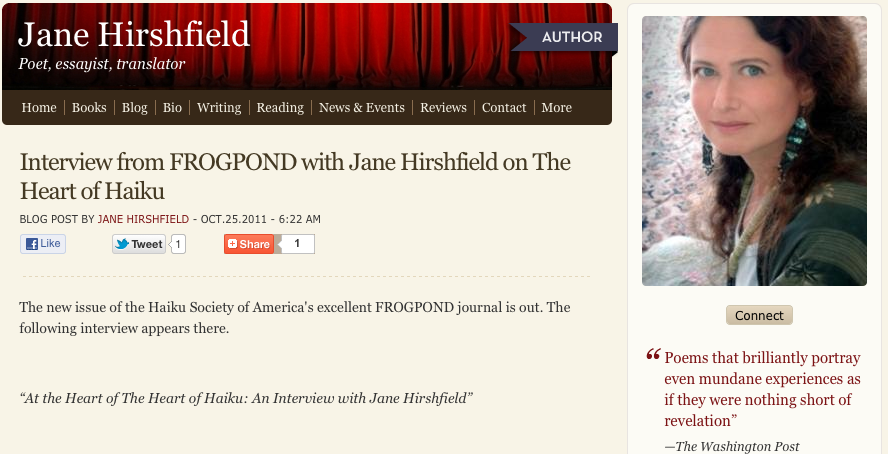
Interview from FROGPOND with Jane Hirshfield on The Heart of Haiku

December 15, 2011

where the writers are

Interview from FROGPOND with Jane Hirshfield on The Heart of Haiku

Blog Post by Jane Hirshfield – Oct.25.2011 – 6:22 am

The new issue of the Haiku Society of America’s excellent FROGPOND journal is out. The following interview appears there.

“At the Heart of The Heart of Haiku: An Interview with Jane Hirshfield”

This interview was conducted by email in August, 2011.

CE: Thank you, Jane, for agreeing to this interview. I think your Kindle Single, The Heart of Haiku, will be of interest to many haiku poets, as will your comments about this essay. You have a long history of printed publications, and you have described yourself previously as someone who is not especially comfortable with computer technology. What prompted you to circulate The Heart of Haiku as a Kindle Single?

JANE: Thank you—I appreciate the chance to talk about this with what I see as this piece’s most natural audience, the haiku community.

Bringing this piece out as a Kindle Single was an experiment—I had never read an e-book myself before this came out. I have to admit, I don’t really like reading on-screen. But many others do, and mostly I did this because the description for the Single program fit exactly what I had: an essay-lecture too long for publication in any magazine, but not long enough for a formal printed book. I had thought about expanding it into a regular book—but I’d have needed to polish many more of the new translations I’d done (with the invaluable help of Mariko Aratani, my co-translator for the classical-era tanka poets in The Ink Dark Moon), and I’d also have needed to round the book more fully. I do now wish I had put some back matter into even this Single—a “further resources” section, for instance. But I never could quite decide to expand it, the piece stayed on my desk, and when the suggestion to submit this to the new Kindle Singles program came up, I took it almost on impulse. I didn’t actually expect them to accept it—it’s by far the most literary thing on their list so far. And then from acceptance to publication was dizzyingly fast—two weeks, including their copyediting, which was, by the way, very good. So I didn’t have any time for anything but the quickest final pass.

You know, Basho himself might have been one of the first to buy an iPad or Kindle. He was never without the books of earlier Chinese and Japanese poets he loved, and I imagine would have been happy to carry less weight in his knapsack. He was, throughout his life, both practical and what’s now called “an early adopter”—haiku anthologies were the first broadly popular printed books in Japan, so Basho, who published in them and also brought one out himself, was participating in the leading-edge technology of his time. One thing I muse over in The Heart of Haiku is that Basho, today, might have been the first person to take You Tube videos and turn them into a true art form. What he did feels comparable to that, to me.

There are so many superb books on Basho already, I’m not sure the world needs another. That was always one of my hesitations about turning this into a book. I do retain all the rights, and will quite likely include this in my next book of essays. That way it will reach more people who don’t already know about haiku—which is what I first wrote it to do. And the Kindle Single did do that—a truly startling number of people have bought it so far, in only two months. I’m sure it helps that it costs only 99 cents, and can be downloaded onto any computer almost instantly. I hope some of them may continue to pursue that curiosity further.

CE: I understand that this project began as a presentation for the 2007 Branching Out series of poetry lectures held in public libraries around the country, a program co-sponsored by the Poetry Society of America and Poets’ House. How would you characterize your initial audience? How much did you revise the presentation before it was published by Amazon? For instance, to what extent was this project originally conceived of as a way to help people better understand and appreciate haiku as readers or as casual writers of haiku-like poems? Do you feel that the current version is at least as much directed toward those who already write haiku as it is toward the initial audience?

I was asked by the Branching Out program to give a talk for the general public—for people who might not have read much poetry, let alone haiku. I tried to do that—to find ways to open the field to newcomers—but poetry is a universal language, whose very point is that it does not simplify; it expands, saturates, investigates, faces many directions at once. I tried to make the original talk something that would be interesting to both kinds of audience—new, and informed—and truly, there isn’t that much of a gap. You’re always a beginner, entering a poem. A poem asks an original, unjaded presence, some state that includes both informed awareness and the erasure of preconception.

I have polished the piece quite a lot since the original lecture, but that’s just what I do with anything I write, poetry or prose. I’d gone over it again just this past February, when I was asked to lecture on Basho at a Japanese university. As to whether I changed it to make it more useful for serious writers of haiku, no, not specifically. I myself don’t make that strong a distinction between looking at poetry as a writer and as a reader. Every serious writer needs also to read alertly, with a real depth of attention—both her or his own work, and the work of others; and every act of reading a poem is a recreation of the original energies of its writing—that is what a poem is: not a record of thought, experience, emotion, realization, but a recipe for its own reenactment.

CE: You have extensive knowledge about poetry in general and haiku in particular, including a knowledge of the history of haiku in English. Where do you see this book fitting in among some of the other work on haiku in English (for instance, Eric Amann’s The Wordless Poem; R. H. Blyth’s Haiku in 4 volumes; Harold G. Henderson’s Haiku in English; and William J. Higginson and Penny Harter’s The Haiku Handbook to name just a few foundational texts in this field)?

And where do you see this essay fitting in among other considerations specifically focused on Basho’s life and work (Robert Aiken’s A Zen Wave; Haruo Shirane’s Traces of Dreams; Makoto Ueda’s Basho and His Interpreters come to mind among others)?

Those books are indispensable, and many were part of my own introduction to haiku and, I’ll add, to poetry as a whole: the first book of any kind I ever bought for myself, at age eight, was a Peter Pauper Press book of translated Japanese haiku. We should add also the many translations of Basho’s poetry now in print. I recommend them all—I think that to understand anything, especially when there are large leaps of culture and time and translation involved, the most accurate understanding comes from looking at multiple sources. There is no single “best” authority. If you can’t read Basho, Issa, Buson, or Yosano Akiko in the original, then reading them through many eyes is best.

As for how my contribution fits in, The Heart of Haiku was retitled by Amazon when they took it for the Kindle Singles program; my title was Seeing Through Words: Matsuo Basho, an Introduction. I think that tells you quite a lot about how I see this piece: I would never myself have made such a grand claim for it as “The Heart of Haiku” does. My piece is introductory, not exhaustive, and its angle of entrance is historical, through Basho, not haiku in general, though to read Basho you have to understand what haiku are, and how they work, and what they can hold at their best. Basho himself, though, is a perennially useful lens, since haiku as we now know it was so radically changed by Basho, generally described as its “founder,” even though the form existed before him. For current, American writers of haiku, The Heart of Haiku is really a way to look back to the rootstock, to refresh their relationship with how haiku was first conceived by its extraordinarily radical and continually evolving founding figure. Basho himself was concerned with so many of the issues that current haiku writers are concerned with—how to write in this moment’s language and perception, how to learn from the past without being bound by it, how to use haiku as a tool not only for expression but for the navigation of a life. I still read Sappho and Homer, I still read Su Tung Po and Dante, and I still read Basho and Issa and Buson. These are wellspring poets for me. Basho’s teachings about writing are as relevant and provocative now as they were when he was alive. “Poetry is a fan in winter, a fireplace in summer.” “To learn of the pine, go to the pine.” “Don’t imitate me, like the second half of a melon.” His navigation of the creative life and poverty, his restless curiosity, his losses, even his death was exemplary, really—Basho’s last spoken words take the point of view of the flies his students were trying to chase from the room. They show how supple and compassionate a poet’s sense of existence can be.

CE: The Ink Dark Moon, it’s been said, helped inspire what’s become a working community of tanka writers, both in the U.S. and in Australia. How do you see  your role here, as a poet, translator, and teacher?

JANE: I might not have published this Basho piece at all, except that people who’d heard it or read it in manuscript kept telling me both that they loved the translations and that it does bring something new to the table. That it was helpful. That’s my hope for anything I do, though I write my own poems outside of any hope, or intention, beyond the needs of that particular poem and moment. I translated Basho’s haiku freshly mostly because I found I couldn’t use other people’s translations for the original talk—not because they weren’t good, just because, once you’ve done some translating, you understand how much more intimate an entrance to a poem that is. I am tremendously lucky that my old co-translator, Mariko Aratani, agreed to re-join me for this project. As a teacher of poems, I’ve been investigating the deep workings of poetry for almost forty years now, both Japanese and Western. I believe in the happy accidents of cross-fertilization and that different traditions have always informed one another. There are two essays in Nine Gates: Entering the Mind of Poetry that talk about Japanese poetics and translation. My interest is always the same: in how poems work, precisely, in why they affect us they do, and in bringing in whatever background helps us read more vulnerably, openly, accurately, and deeply. I think this is especially needed for haiku. We teach haiku to third graders, but in fact it’s an art form that requires some real initiation to be truly practiced or read. Haiku are the most immediate of art forms in one way, but in another, they are slip knots that you need to know the knack of, to untie fully.The more I learn about haiku, the more I feel how much I have not yet learned. It is bottomless, really. Any good poetry is.

CE: In your essay, you address the wide popular interest in non-literary haiku and you specifically reference the thousands of haiku written about Spam (“Spamku”) and posted online. You foreground that, “… to write or read with only this understanding is to go back to what haiku was before Basho transformed it: ‘playful verse’ is the word’s literal meaning. Basho asked for more: to make of this brief, buoyant verse-tool the kinds of emotional, psychological and spiritual discoveries that he experienced in the work of earlier poets. He wanted to renovate human vision by putting what he saw into a bare handful of mostly ordinary words, and he wanted to renovate language by what he asked it to see.” To what extent do you find contemporary English-language haiku poets continuing to follow this approach?

It seems to me that the best contemporary haiku writers are in Basho’s lineage, and Issa’s and Buson’s. This is of course my own definition of “best.” It’s fine that many poets do other things as well. But the central work of poetry is the same everywhere—from Sappho to Akhmatova, Tu Fu to Frank O’Hara, lyric poets magnify and enlarge and open our relationship to our lives, to the lives of others, and to the world.

Your consideration of Basho’s overall output of haiku leads to an intriguing claim about the impact transparent seeing can have. You state, “Basho’s haiku, taken as a whole, conduct an extended investigation into how much can be said and known by image. When the space between poet and object disappears, Basho taught, the object itself can begin to be fully perceived. Through this transparent seeing, our own existence is made much larger.” Would you please elaborate on how this type of seeing enlarges our existence?

I’ve come to feel that every good poem does this, not only haiku. The exchange currency of the imagination is fundamentally transformative and empathic. The current thinking in neuroscience is that this recreation of other within self has something to do with mirror neurons, but poets have known the alchemies of empathy from the beginning. Permeability is how image works, how metaphor works. Every time we take in an image in a poem, we become for an instant that image. Reading “mountain,” I become for that moment everything I know of mountainness—its steepness, its insects, its largeness, its seeming immobility punctuated by streams or rockslide, what it asks of the legs that travel it, what it asks of the breathing, of the eyes, what it tells us of abidingness and perspective, of distance and scale.  Any time we take in a poem’s held experience, we become that experience. The experience of a poem is not “about” life—it is life. And so taking in a good poem, our lives are expanded by that poem’s measure. One of the great paradoxes of haiku is that the measure of taken-in meaning can be so large, from a vessel so small, and how meaning in haiku can reach in almost any direction. A haiku can puncture our human hubris, or can remind us that we too are going to die. It can pierce us with the beauty of spareness or open us to the futility of ambition. It can evoke humor, memory, grief. It can, at times, do all these things at once.

CE: You also note that “…the haiku presents its author as a person outside any sense of the personal self.” Do you see contemporary English-language haiku presenting the authors as people outside a sense of the personal self? What might the author gain from striving to experience and write haiku in this manner?

JANE: I recently judged a haiku competition and was a bit startled by the frequency of the pronoun “I” in one form or the other, and by the strong presence of personal life that was in them, including in those I chose as the winners. In some cases, I wondered if the pronoun might have been there to fill in the count, since these were haiku written in the traditional 5-7-5. But I think it runs deeper, and is more a reflection of how poetry in general is written in America today.

Basho studied both Taoism and Zen, and his relationship to poetry reflected that. Basho once said that the problem with most haiku was that they were either subjective or objective. A student asked him, “Don’t you mean too subjective or objective?” Basho answered, simply “No.” I share Basho’s Zen training and interests, and I see poetry as, in part, a mode of perception by which we can slip the shackles of single view and single stance. I think that is one of poetry’s tasks in our lives, to liberate us from narrow, overly pointed seeing. A good poem never says or holds only one thing.

This opening into broader ways of perceiving does happen in poems that include “I” and personal circumstance, I should add. And on the other side, I think it a misconception to believe that all haiku ae somehow supposed to be “objective,” and impersonal. Poetry reflects inner experience and understanding. The most objective haiku I can think of is Buson’s: “Spring rain,/ the belly of the frog/ is not wet.” This is not a metaphor for anything other than what it holds, the awareness of rain so gentle that it does not drip down to or splash up to even something so near as the frog’s belly. And yet, reading that haiku, I feel it, in body and in spirit; I feel appreciation for the action of the small and the subtle, for the wetness of the frog’s back and the grass tips’ thirst. To have such an experience is to step outside of ego, but not outside our experience of life on this earth, a life with rain, shared with other creatures. And this modest, homely, silent frog is something that emerged into Japanese poetry with haiku—in earlier Japanese poems, we know frogs by their voices, not by their skin’s dryness or wetness. Frogs’ calling is an image of our own longing, desire, and courtship, of the small sounds we ourselves make amid the vast dark. Buson’s silent frog, or Basho’s in his famous “Old pond,/ frog jumps in/ the sound of water,” these are different. Frog is frog, water is water, the sound of their meeting is completely itself, part and whole neither vanish nor are separate. This seems to me something worth noticing, worth storing in repeatable words, worth practicing. Isolation is real, the solitude of the self is real, but interconnection is equally real. A good haiku keeps us in the particular and multiple, not the generic. It stops us from leaning too far in any direction.

Thank you again, Jane, for participating in this interview and providing additional insights into your essay, The Heart of Haiku.

NOTE: Jane Hirshfield’s The Heart of Haiku is available from Amazon.com as a $.99 Kindle Single, and can be read on any computer or smart phone, not only Kindles, with a free download. A new book of poetry, Come, Thief, has also just been published, by Knopf.

Keywords:, , , , , , , ,
———–
Also see A Haiku on The Heart of Haiku; the excellent Poetry Foundation biography on Jane Hirshfield, including poems, articles and more; Pirene’s Fountain: Jane Hirshfield on Poetic Craft; and What Rainer Maria Rilke inscribed on the copy of The Duino Elegies he gave his Polish translator.

Ten years later On Being with Krista Tippett interviewed Jane Hirshfield on The Fullness of Things, which I discovered today, March 6, 2023, in Pebbles – Brief poems by Jane Hirshfield posted by Brief Poems.