War veterans say Transcendental Meditation could help with PTSD

February 11, 2013

War veterans say meditation could help with PTSD

By Agence France-Presse
Tuesday, February 5, 2013 6:27 EST

Meditation might sound an unlikely activity for men trained in killing people and blowing things up in Afghanistan and Iraq. But US war veterans say meditation could help heal the post-war mental disturbances that afflict a growing number of American soldiers, including possibly the ex-Marine who gunned down the country’s most famous sniper over the weekend.

Luke Jensen, a former undercover police officer who fell apart mentally on arrival in Afghanistan, said that after trying to commit suicide in front of his family, he agreed to try Transcendental Meditation — and was saved.

“There’s a lot of coping methods out there that are offered to our veterans. This needs to be one of them,” the heftily built man said in a shaking voice at a meeting of the David Lynch Foundation, which promotes meditation for treating post-traumatic stress disorder.

Jensen said he has since taken a job in the government’s Department of Veterans Affairs, helping other stressed out vets. Just two weeks ago, one of those he worked with committed suicide.

Transcendental Meditation “needs to be implemented. It needs to be an option,” Jensen told the panel in New York.

After years of being a little-talked about subject, PTSD is increasingly acknowledged as a mental health epidemic in the United States and one of the less easily quantifiable costs of America’s wars on the other side of the world.

The Department of Veterans Affairs estimates that PTSD occurs in between 11 and 20 percent of veterans from the Afghan and Iraq wars, and in 31 percent of Vietnam war veterans.

Although combat is commonly assumed to be the main cause of PTSD, simply witnessing the effects of bombings, for example, or the stress of being in a hostile country, are also blamed.

Another major source of PTSD, though less often discussed, is what the government calls military sexual trauma. Veterans Affairs figures show that 23 percent of women report sexual assault in the ranks, while more than half have experienced sexual harassment.

The most frightening result associated with PTSD is the rising number of suicides, which now run at 22 a day among military veterans, according to a government study released last week.

And the problem is no less alarming among active duty soldiers, with a record 349 killing themselves in 2012 — more than were killed by the Taliban or other enemy in the field.

In the latest incident to highlight the violence engulfing former soldiers, an ex-Marine in Texas was accused Saturday of shooting dead another veteran who had devoted himself to helping comrades adjust to peaceful life.

Adding to the shock value, the victim, Chris Kyle, was an author of a best-selling book about his former exploits as a sniper with 150 confirmed kills.

In the effort to address the problem of PTSD, meditation is an outlier.

However, early studies show remarkable success, and demand is growing, advocates at filmmaker Lynch’s foundation said.

Transcendental Meditation involves entering “a state of rest in many cases deeper than sleep,” said Bob Roth, executive director of the David Lynch Foundation. “This allows deeply rooted stresses to be dissolved.”

Retired rear admiral Richard Schneider, president of the private military institute Norwich University, said tests showed that cadets using the techniques increased focus in class and were better “emotionally prepared.”

The meditation instructor, a chisel-faced air force veteran called David Zobeck, said a stigma long attached to meditation was evaporating among students, who are preparing for careers as officers.

“They’re not getting the weird stares anymore,” he said.

Jerry Yellin, a fighter pilot in World War II who spoke of losing comrades and making dangerous missions in the bloody Pacific theater, said he began suffering nightmares, then behavioral problems on return home at a time when PTSD was rarely discussed.

“The hard stuff began in my life, because I didn’t sleep,” he said. “I had an addiction that ruled my life.”

Meditating, he said, “got my life back 100 percent.”

The Raw Story published this report from Agence France-Presse.

See more articles on PTSD and TM posted on The Uncarved Blog.

Reposting that wonderful poem by E.E. Cummings for Valentine’s Day

February 5, 2013

Ken Chawkin's avatarThe Uncarved Blog

For Valentine’s Day: i carry your heart with me by E.E. Cummings

[i carry your heart with me(i carry it in]

i carry your heart with me(i carry it in
my heart)i am never without it(anywhere
i go you go,my dear;and whatever is done
by only me is your doing,my darling)
                                                      i fear
no fate(for you are my fate,my sweet)i want
no world(for beautiful you are my world,my true)
and it’s you are whatever a moon has always meant
and whatever a sun will always sing is you

here is the deepest secret nobody knows
(here is the root of the root and the bud of the bud
and the sky of the sky of a tree called life;which grows
higher than soul can hope or mind can hide)
and this is the wonder that’s keeping the stars apart

i carry your heart(i carry it in my heart)

“[i carry…

View original post 352 more words

Blue Dragonfly—A Love Renga for Valentine’s Day

February 2, 2013

Here’s a poem for those alone on Valentine’s Day.

Blue Dragonfly

A Blue Dragonfly
Flits about the light-filled pond
Looking for its mate

Do you get blue sometimes too
Wandering the world for love

If you’re still enough
You may find yourself being
The one to attract

As sattva gathers the means
So love comes to those who wait

© Ken Chawkin
February 2, 2013
Fairfield, Iowa, USA

The best preparation to love another is to first love yourself. Nobel Poet Laureate Derek Walcott explains it beautifully in Love After Love.

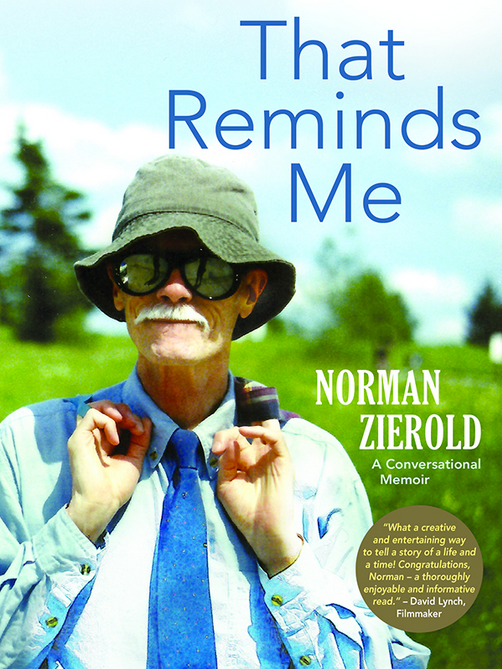
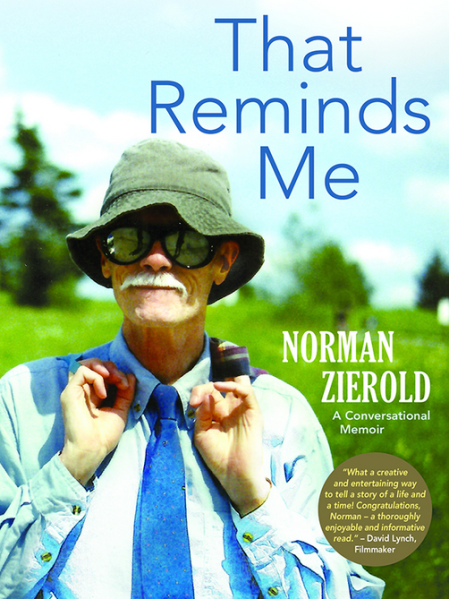
That Reminds Me: A Conversational Memoir by Hollywood biographer Norman Zierold is now out!

January 10, 2013

ThatRemindsMe Lynch quote

That Reminds Me is a conversational memoir by Hollywood biographer and award-winning author Norman Zierold. Rather than a chronology of his life, the author engages the reader in a conversational manner, relating various episodes from his life that come to mind, one triggering another. There’s never a dull moment!

Norman Zierold’s charmed life started humbly in the Amana Colonies of Iowa. All that changed after Norman joined the Navy. The war came to an end and Norman used the GI Bill of Rights to attend Harvard, where he graduated cum laude. He then earned a graduate degree in English Literature at the University of Iowa.

While looking for work he was given the opportunity to teach English in France. One of his jobs was enjoying English conversations with the son of the President of France. They even invited him to watch the coronation of Britain’s Queen Elizabeth II on television at their personal residence. Other meetings with cultural luminaries ensued.

Upon Norman’s return to the States he headed for New York, where he worked his way up to becoming the editorial director of Theatre Arts Magazine. Eventually he went to Hollywood to fulfill his lifelong calling to become a writer and published several noted Hollywood biographies: The Child Stars, The Moguls: Hollywood’s Merchants of Myth, Garbo, Sex Goddesses of the Silent Screen; and two true-crime accounts, Little Charley Ross: The story of America’s first kidnapping for ransom, and Three Sisters in Black, which garnered a Special Edgar Allen Poe Award from the Mystery Writers of America. He also wrote a science-fiction novel titled The Skyscraper Doom.

In the late 1960s, when Barbara Walters was an anchor on NBC’s Today Show, she interviewed Norman on his recently published book, Little Charley Ross. He describes a humorous account of what happened as they were preparing to go on air. Before the segment was about to begin Barbara was pressing her leg against Norman’s under the table in what seemed to him a suggestive fashion. He wondered if she might be coming on to him and didn’t know what to do. She asked him if he felt that, and he sheepishly said he did. She then explained that this was the signal for him to quickly finish his sentence during the interview so they could break for a commercial. Norman felt relieved. After the interview they had a private chat off camera about Judy Garland since Norman had written about her in The Child Stars, and Barbara’s then husband, Lee Guber, had produced one of Judy’s world tours. They had met and Judy’s issues about her mother came up. Barbara had her own opinion about Judy’s relationship with her mother, but you’ll have to read the book to find out what she said and Norman’s take on it.

In addition to Barbara Walters, Norman met many cultural icons of the day, like Andy Warhol, Shelley Winters, Anthony Quinn, Mae West, Groucho Marx, Roddy McDowall, Jackie Coogan, Rex Harrison, Anaïs Nin, Tennessee Williams, E.E. Cummings, Dylan Thomas, a president of France, the gifted composer Francis Poulenc, and TM founder Maharishi Mahesh Yogi, to mention a few. Anaïs mentioned Norman in her diary. Norman spent months with Anthony Quinn helping him edit down his thousand-page biography into something publishable. It did very well.

In the early 70’s Norman took up the practice of Transcendental Meditation. He found it so satisfying he became a teacher and taught the TM technique to several hundred people. Since 2002 he has been living in Fairfield, Iowa, and works in his retirement years as a part-time publicist in the communications office at Maharishi University of Management.

WHERE TO ORDER THAT REMINDS ME

Sit down with Norman Zierold and enjoy a fascinating conversation. Order copies of That Reminds Me from Amazon or Barnes & Noble in the US. Release date is January 12, 2013. Also available in Canada, the UK, Europe, Germany, Russia, and Brazil in paperback, and Amazon’s Kindle worldwide.

Cover design by George Foster, front cover photo by Mary Drew, and interior design by Allen Cobb for Anapurna Press.

ARTICLES

Diane Vance interviewed Norman Zierold at Revelations Café for The Fairfield Ledger, which came out March 12, 2013: Fairfield author talks about recent work. In case you can’t access the full article online you can see what it looks like here: Fairfield author talks about recent work – By DIANE VANCE – Fairfield, IA – Fairfield Ledger. I also posted it here: Diane Vance and Norman Zierold discuss his new memoir, That Reminds Me, at Revelations Café.

Tony Ellis wrote a feature article in the March 2013 issue of The Iowa Source, Iowa’s Enlightening Magazine: Norman Zierold: A Charmed Life: Celebrated Hollywood Author Reminisces on Six Decades of Extraordinary Encounters. You can also download a PDF of the article on Norman Zierold as it appears in The Iowa Source.

An edited version of Tony’s article later appeared in Britain’s National Transcendental Meditation Magazine—Transcendental Meditation News • June 2013 • Vol. 19 • No. 7 • Pages 12 and 13, titled, The Hollywood Biographer Who Found Bliss (Page 7 of PDF).

British writer & editor, Julie Eagleton also reviewed That Reminds Me by Norman Zierold.

Here’s a great article about Norman Zierold in The Chronicle of Higher Education: Notes From Academe: The Spokesman Who Kept Calling.

Here’s a comprehensive article Norman Zierold wrote for Healthy Referral on THE REMARKABLE DAVID LYNCH FOUNDATION.

INTERVIEWS

Norman Zierold was interviewed by KMCD host Steve Smith for the MUM Spotlight show on January 10, 2013. Click here to listen. (17:23)

Norman Zierold will be interviewed on 100.1 FM KRUU in Fairfield. The show, Writers’ Voices, airs Friday, January 11, 2013, 1:00–2:00 p.m. CT, and replays Monday, January 14, 2013, 8:00–9:00 a.m. CT. Tune in: Listen Live.

This great description posted by host Monica Hadley says it all: From Iowa, Around the World, and Back Again with Norman Zierold. “That Reminds Me: A Conversational Memoir” by Norman Zierold, takes the reader on an exuberant journey, both outward and inward, from pre-Depression-era Iowa (the Amana Colonies), to Europe, NYC, Hollywood, and back again to Iowa (Fairfield, that is.) Join Writers’ Voices hosts Monica Hadley and Caroline Kilbourn to learn from Norman the inside stories that only the author of such Hollywood biographies as “Garbo”, “The Child Stars”, and “The Moguls” would know. How did a boy from the Amanas come to rub elbows with the rich and famous of the mid-20th century? And what brought him back to Iowa?

Update: If you missed it, the Writers’ Voices Archives now has Norman’s interview (59:51) posted there as well as on monicahadley’s Audio page. And KRUU station manager James Moore created a permanent link to the interview here: http://www.kruufm.com/node/14926. KRUU’s website was rebuilt. The interview is now posted on the Writers Voices website.

A third interview took place at a book signing in the Maharishi University of Management Library on Saturday afternoon, March 2, 2013. Rustin Larson talked with Norman Zierold about his conversational memoir, That Reminds Me. Download and enjoy this very entertaining interview. (87 MB) It’s now available on YouTube.

A fourth interview took place on KHOE, the MUM campus radio station. Author and M.U.M.: Publicist Norman Zierold, interviewed by Dean Cathy Gorini and station manager Stan Stansberry on his newly published book “That Reminds Me.” Listen online here: http://link.mum.edu/NormanZierold.

Stan says: [This is] “a real-life adventure conversational memoir by our esteemed Norman Zierold. [Norman takes us from] “his hometown Amana Colonies, to the U.S. Navy, to New York City, to Hollywood, to finding Transcendental Meditation, teaching TM, and to the campus of Maharishi University of Management. Along the way he interviewed and hob-nobbed with famous New York and Hollywood actors, writers and people like Barbara Walters.” mp3 63 min, 18MB.

Here is the latest interview on KRUU FM with Producer, Writer & Host, Cheryl Fusco Johnson of The Studio: Small Town Boy to Hollywood Biographer: Norman Zierold’s Memoir, THAT REMINDS ME, July 14+16, 2014. You can listen here at this archived link: The Studio – 20140715-Norman Zierold.

How did small-town Iowa boy Norman Zierold become a Hollywood biographer, recording the stories of movie moguls, child stars, and famous actors? Even more exciting than his tales about the many celebrities he’s encountered is Norman’s own story. Lucky us! Norman’s recorded his journey from shelling peas beside cooks in his family’s Amana colonies restaurant to rubbing knees with Barbara Walters on TV. This week on The Studio with Cheryl, Norman discusses the mentors and experiences that inspired his life choices. Learn about his life and about THAT REMINDS ME, his stream-of-consciousness memoir (and what a consciousness it is!), by tuning in to The Studio with Cheryl and Norman this week.

Enlightenment, The Transcendental Meditation Magazine, has posted an article on Norman in Issue 16 under My Story: From Utopia to Hollywood and Back. In this column meditators share their stories of how they started the Transcendental Meditation technique and what kinds of positive changes have occurred in their lives.

The book has been updated with chapter headings, a table of contents, and a list of praise for the book, including a cover quote from filmmaker David Lynch, which reads: “What a creative and entertaining way to tell a story of a life and a time! Congratulations, Norman — a thoroughly enjoyable and informative read.”

March 9, 2018: Remembering Norman Zierold: Hollywood biographer, novelist, TM Teacher, member of Maharishi’s Purusha program, raconteur, publicist, beloved by all.

Cheryl Strayed, author of WILD, talks about the unique role of artists and writers in the world

January 10, 2013
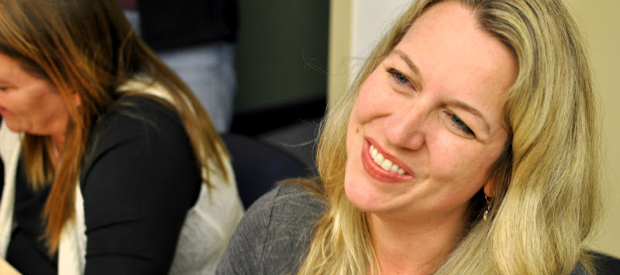
Cheryl Strayed

“I think that artists are here, and writers are here, to be the truth-tellers of the human experience, the world we live in. And so, if you’re not going to tell the truth, don’t bother.” — Cheryl Strayed

I love this frank quote from memoirist Cheryl Strayed on the role of artists and writers in society during this CBC interview, Publishing phenom Cheryl Strayed, with Q host Jian Ghomeshi posted on Q Blog Monday, December 31, 2012. Here’s their description.

Cheryl Strayed had a banner year in 2012. Wild, her memoir of hiking the Pacific Crest Trail while working through grief, divorce, and a dalliance with drugs, was a bestseller. Oprah Winfrey even relaunched her book club for it.

Strayed also outed herself as the popular online advice columnist Dear Sugar, and published a collection of columns as Tiny Beautiful Things to rave reviews.  Back in September, she dropped by Studio Q to talk about literary success and what it really means to be a “fearless” writer.

From the Best of Q: Originally aired September 13, 2012

Listen: 16:47

Download and listen to the complete introduction and interview: http://www.cbc.ca/q/popupaudio.html?clipIds=2278707963

Watch the 15:38 edited version minus the formal introduction on YouTube: “Wild” author Cheryl Strayed in Studio Q.

See what other writers have to say about writing on The Uncarved Blog.

Found this interesting article: The Wandering Writer: A Tour through Inner Northeast Portland with Cheryl Strayed.

Here’s the WordPress.Com Annual Report for The Uncarved Blog. See 2012’s most popular posts.

December 30, 2012

The WordPress.com stats helper monkeys prepared a 2012 annual report for this blog. Here’s an excerpt:

19,000 people fit into the new Barclays Center to see Jay-Z perform. This blog was viewed about 62,000 times in 2012. If it were a concert at the Barclays Center, it would take about 3 sold-out performances for that many people to see it.

Click here to see the complete report.

8,000 Mayan and indigenous tribal students meditate for peace to mark the end of an era

December 22, 2012

8,000 Mayan, Zapotec, and Mixtec Students Meditate for World Peace and Restructure the Apocalypse to Create the End of the [War-torn] World

By David Leffler | December 23, 2012  | The Liberian Dialogue
Mexico students meditate for peace

Nine countries in Latin America are implementing Transcendental Meditation and Yogic Flying in military and/or educational settings.

With much media fanfare worldwide, the Mayan calendar came to an end on 21 December 2012, with far-flung predictions of global apocalypse. But most of us are still here, so perhaps the “end of the world” was in fact a new beginning – the end of the world as we know it, and the dawn of a new and more enlightened age.

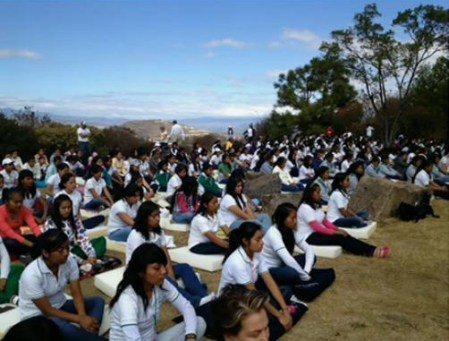
On that apocalyptic day, 8,000 young children – descendants of the Mayans, Mixtec, Zapotec, and other indigenous tribes – gathered at Monte Alban, a sacred mountain of the Zapotec people in southern Mexico, to meditate together for world peace. Around the world, people of all ages, cultures, and religions participated with them in simultaneous group practice of the non-religious Transcendental Meditation® (TM) program and its advanced TM-Sidhi program, both founded by the late Maharishi Mahesh Yogi.

In Latin American military circles, this collective TM practice by large groups of peace-creating experts is known as the Invincible Defense Technology (IDT) due to its scientifically confirmed ability to neutralize the destabilizing influence of collective stress, held to be the root cause of terrorism, war, and violent crime.

These young Mexican children, along with many students in other Latin America countries, had been trained in these peace-creating technologies for approximately eight months. Their gathering at Monte Alban was a demonstration to the world of the effectiveness of these technologies in defusing social violence and “averting the danger that has not yet come” – a principle of collective coherence drawn from the ancient Yoga Sutras.

Is this gathering something out of a “New Age” science fiction thriller? No. This unusual defense strategy really works. It is advocated by the Global Union of Scientists for Peace (GUSP, http://www.gusp.org), a coalition of Nobel laureates and leading scientists who see it as the best way to avert the growing threats of nuclear proliferation, terrorism, and weapons of mass destruction; to create national security in every country; and to establish lasting world peace.

John Hagelin, Ph.D., a renowned Harvard-trained quantum physicist who heads this group, says, “In recent years, [this] powerful, innovative approach to peace has been extensively field-tested – in the Middle East and throughout the world. The consistent result has been dramatic reductions in terrorism, war, and social violence. These findings have been replicated, published in leading academic journals, and endorsed by hundreds of independent scientists and scholars. The efficacy of this approach is beyond question.” [An Op-Ed piece: “Reducing Tension in the Middle East” was recently published worldwide advocating this approach.]

According to Luis Intof Alvarez, the organizer of the Monte Alban gathering, the advanced TM-Sidhi practice has been taught to 8,000 students in 54 schools in southern Mexico and Guatemala during just the past weeks. With over 250 Latin American schools now participating in this program, at least 20,000 students will be collectively practicing these peace-creating technologies by this time next year. Alvarez says that our world leaders now have a choice. Which direction do we want to take: continued violence or creating peace?

His point is made more vivid by the tragic recent events at the Sandy Hook elementary school in Newton, Connecticut, USA. Throughout the U.S., students in schools and colleges continue to be the victims of senseless violence. By contrast, the Mayan and other tribal students throughout Latin America are creating peace, not only within themselves but also on a much grander scale – for their schools, cities, and nation as a whole.

Latin American students in both civilian and military  schools are learning and applying this strategy. Currently, at least nine Latin American countries are soon due to have fully operational peace-creating groups in military and/or educational settings. Military leaders worldwide will soon be surprised to learn that students can actually do a much better, safer, and more effective job of protecting their nations with an advanced TM meditation practice than with expensive hi-tech military weaponry. Informed Latin American leaders, especially those now in charge of military schools, have already deployed this approach. Lieutenant General José Martí Villamil, a pioneering former Vice-Minister of Defense for Ecuador, first conducted a military field-test during their war with Peru in the early 1990s, with promising results.

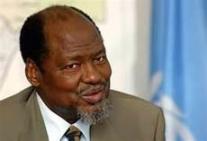
In the past, in non-Latin American countries, field tests of these coherence-creating groups achieved measurable positive results that were also apparent from news reports. In trouble spots, violence and war deaths subsided, peace negotiations improved, and/or treaties were signed. The first head of state to ever implement such a program was President Joachim Chissano of Mozambique. Read the amazing story of what happened when members of his government and military learned to meditate. (See: Psychology Today, “Can Meditation Change the World?“)

Over fifty studies have scientifically documented the profound and measurable benefits of this approach to peace. In one such study, conducted during the first Lebanon war, the predicted effects and publicly available measures to be used were specified in advance for scientific review boards in North America and Israel. The outcomes of this and other such experiments have been published in respected peer-reviewed journals, including the Journal of Conflict Resolution, 1988, 32: 776–812; Social Indicators Research, 1999, 47: 153-201; Journal of Offender Rehabilitation, 2003, 36 (1-4): 283-302; Journal of Social Behavior and Personality, 2005, 17(1): 339-373; Journal of Social Behavior and Personality, 2005, 17(1): 285-338; and Journal of Scientific Exploration, 2009, 23(2): 139-166.

It could be argued that the positive social effects of these deployments are already beginning to be documented. In a 2011 poll, Gallup measured positive emotions in 148 countries and found that Latin Americans are the most positive people in the world. Their region is home to eight of the top 10 countries for positive emotions worldwide.

Certainly Evo Morales Ayma, the President of Bolivia, believes that “the end of the world” is only the end of the world as we know it. At the 67th General Assembly of the United Nations, he said:

“And I would like to say that according to the Mayan calendar on the 21 of December is the end of the non-time and the beginning of time. It is the end of the Macha and the beginning of the Pacha, the end of selfishness and the beginning of brotherhood, it is the end of individualism and the beginning of collectivism – 21 of December this year. The scientists know very well that this marks the end of an anthropocentric life and the beginning of a bio-centric life.

It is the end of hatred and the beginning of love, the end of lies and beginning of truth. It is the end of sadness and the beginning of happiness, it is the end of division and the beginning of unity, and this is a theme to be developed. That is why we invite all of you, those of you who bet on mankind, we invite those who want to share their experiences for the benefit of mankind.”

Dr. David Leffler received his Ph.D. in Consciousness-Based Military Defense (Invincible Defense Technology – IDT) from The Union Institute & University in Cincinnati. He served as an Associate of the Proteus Management Group at the Center for Strategic Leadership, US Army War College. He has published articles in over 400 locations worldwide about IDT and now serves as the Executive Director at the Center for Advanced Military Science (CAMS). Dr. Leffler teaches IDT and is available at http://www.StrongMilitary.org

More photos of the meditating students are available at the end of David Leffler’s article posted here. These are the countries where the article has been featured so far: INDIA – Mangalorean; LIBERIA – The Liberian Dialogue; NIGERIA – Nigeria Sun; AUSTRALIA – The International News Magazine U.S. Edition; UK – The News Tribe, a bilingual news website covering Pakistan, South Asia, Middle East and UK; Global Edition – One News Page. Global Good News reported the news as well as an earlier backgrounder of how the parents and students prepared for this special event: Mexico: Thousands of indigenous students to meditate together at traditional celebration.

For a scientific explanation behind the power of large groups collectively practicing the Transcendental Meditation and TM-Sidhi program including Yogic Flying, read The Power of The Collective, by John Hagelin. Also see Op-Ed peace piece spreading around the world: Reducing Tension in the Middle East and Ken Wilber said meditation can change the world. Jaochim Chissano showed it could – Steve Taylor.

Ken Wilber said meditation can change the world. Jaochim Chissano showed it could – Steve Taylor.

December 19, 2012

Can Meditation Change the World?
The amazing story of the ‘meditating president.’
Published on December 10, 2012 by Steve Taylor in Out of the Darkness

Ken WilburLast week a group of my students were giving a presentation on the spiritual philosopher Ken Wilber. It included a video interview in which Wilber remarked, ‘The best way to stop famine in the world is to meditate.’ Some students were outraged, and my initial thought was that the comment was glib and offensive. Surely the best way to stop famine is to provide food, to donate money, or at least to end conflict or reduce corruption? However, there is a case study which illustrates Wilber’s meaning very clearly. It’s the story of the ‘meditating president’, Joachim Chissano of Mozambique.

In 1992, Mozambique’s civil war came to an end, after 15 years of devastation, and around a million casualties. The country was completely broken, and showing all signs of being trapped in the cycle of conflict and corruption which has afflicted many African countries. But Joachim Chissano – whose forces had won the war – surprised the world by acting sensibly and empathically. Rather than trying to shore up his own power base and enacting revenge, Chissano treated the rebel forces who had been trying to overthrow his government with respect. He made compromises, promised there would be no prosecutions or punishments and offered the rebels half of the places in the Mozambiquan army. He gave them the chance of gaining power through political means. Rather than trying to crush the rebels, he began to work with them.

Two years later, Mozambique’s first ever multi-party elections were held, and Chissano and the former rebel leader came face to face in the polls. Chissano won the election, and set about the task of establishing lasting peace by reducing poverty. Between 1997 and 2003, almost three million people were rescued from extreme poverty, out of a total population of almost 20 million. This lead to a 35% decrease in the number of children dying under the age of five, and an increase of 65% in the number of children going to primary school. Through Chissano’s ability to set aside differences and connect with his former enemies, Mozambique was brought back from the brink of self-destruction and has instead become one of Africa’s most stable and peaceful countries.

What was it that made Chissano so rational and compassionate as a leader?

Joachim Chissano

In 1992, he learned Transcendental Meditation. Quickly becoming aware of the benefits of the practice himself, he taught it to his family, then his cabinet ministers and his wider government. In 1994, it became a requirement for all military and police recruits to meditate twice a day, for 20 minutes.

Chissano himself is in no doubt that this collective meditation was responsible for the peace and increasing prosperity of the country. As he said, ‘The result has been political peace and balance in nature in my country…The culture of war has to be replaced by the culture of peace. For that purpose, something deeper has to be changed in our mind and in our consciousness to prevent the recurrence of war.’

In 2004, Chissano’s second term in office came to end. Rather than pursuing a third term – as he would have been legally able to do under Mozambique law – he stepped aside. Since then he has been an elder statesman, campaigning for peace and working as an envoy and negotiator for the United Nations. In 2007, on his 68th birthday, he was awarded Africa’s equivalent of the Nobel Prize, the $5 million prize for Achievement in African Leadership.

This is Wilber’s point, of course. In the short term, meditation reduces anger and aggression. In the long term, it increases our capacity for empathy, compassion and rationality. It leads to less self-centred behaviour, and reduces cravings for power and wealth. It generates a sense of well-being which makes us less liable to be affected by slights or prejudices.

Research has confirmed these effects. In 2003, scientists at the University of Wisconsin scanned the brain of people with a long experience of Buddhist meditation. They found that their left pre-frontal lobes – the areas of the brain linked with positive moods and emotions – were unusually active. In other words, they seemed to be happier than normal. In a 2011 study at the University of Massachusetts Center for Mindfulness 16 people meditated for an average of 27 minutes each day. MRI scans after 8 weeks showed increased ‘grey matter’ in parts of the brain associated with compassion, introspection and learning.

So Wilber’s seemingly glib comments may well be right. Human social behaviour is a manifestation of our inner state. Discord in the world stems from discord in our minds, and there will only be harmony and peace in the world once there is harmony and peace inside us.

Steve Taylor is a lecturer in psychology at Leeds Metropolitan University, UK. He is the author of Back to Sanity: Healing the Madness of the Human Mind. Eckhart Tolle has called his work ‘an important contribution to the shift in consciousness happening on our planet at this time.’ stevenmtaylor.co.uk | Follow Steve on Facebook and Twitter

###

What Steve Taylor says in this Psychology Today article is true. In addition, there have also been hundreds of scientific studies on Transcendental Meditation showing improvements in mental and emotional development as well as health and social behavior. See Hard evidence grows for including meditation in government-sponsored health programs and Excellent article by Tom Jacobs on Meditation: Strong Preventative Medicine for Heart Patients.

But one of the most striking effects is the impact large numbers of people practicing Transcendental Meditation together in large groups in one or more places can have on their environment. This is what happened in Mozambique. The longtime drought also came to an end as balance was restored in nature; the rain came!

Over fifty studies have scientifically documented the profound and measurable benefits of this approach to peace. Many have been published in respected peer-reviewed journals, including the Journal of Conflict Resolution, 1988, 32: 776–812; Social Indicators Research, 1999, 47: 153-201; Journal of Offender Rehabilitation, 2003, 36 (1-4): 283-302; Journal of Social Behavior and Personality, 2005, 17(1): 339-373; Journal of Social Behavior and Personality, 2005, 17(1): 285-338; and Journal of Scientific Exploration, 2009, 23(2): 139-166.

For a scientific explanation behind the power of large groups collectively practicing the Transcendental Meditation and TM-Sidhi program including Yogic Flying, read The Power of The Collective, by John Hagelin. Also see this Op-Ed peace piece spreading around the world: Reducing Tension in the Middle East

And here is a newly published study on this topic: Can group meditation prevent violent crime? Surprisingly, the data suggests yes: New study (SAGE Open Apr 2016, 6 (2).

One last point, and that is comparing different meditation practices and generalizing their results can be a bit misleading. With the aid of fMRI, EEG, and other methods, we can now see that different parts of the brain are effected by different meditation techniques, which utilize their own approaches, like concentration, open monitoring, or transcending. To better understand these differences and outcomes scientists have created categories of meditation, matching approaches with their scientific measurements. See Are all meditation techniques the same?. And this more recently published paper using fMRI:  New study highlights unique state of “restful alertness” during Transcendental Meditation.

For a current perspective on how TM has been successfully applied in various settings, see this recent video presentation: John Hagelin speaks on meditation as a powerful tool for health, education & post-traumatic stress at TEDxWomen 2012.

Read two reviews of Can meditation change the world? in the January 28, 2013, UK TM News blog, and below in a print copy from the February 2013 issue (Vol. 19, No. 5.) of UK Transcendental Meditation News. Click twice on the image to read it.

Update: Athens Democracy Award Goes to Mozambique’s Joaquim Chissano. This article, published Sept 18, 2018, references President Chissano’s use of TM. “Besides bringing peace, reconciliation, stable democracy and economic progress to Mozambique, and supporting LGBT rights in Africa, Chissano is said to have introduced Transcendental Meditation techniques to government officials, police and military.”

Read the rest of this entry »

David Lynch on His Lifetime Achievement Award at Plus Camerimage’s International Film Festival

December 15, 2012

Plus Camerimage: David Lynch on His Lifetime Achievement Award

Source: Silas Lesnick | November 28, 2012

An attendee of the Plus Camerimage’s International Film Festival of the Art of Cinematography since 2000, legendary filmmaker David Lynch is, this year, the recipient of a Lifetime Achievement Award for now-classic works like Eraserhead, The Elephant Man, Blue Velvet, The Straight Story, Mullholland Dr. and many more.

On location in the town of Bydgoszcz, Poland all this week, ComingSoon.net caught Lynch shortly after his awards ceremony and had a chance to speak with the artist on a wide range of topics, including factories, nude women, Transcendental Meditation and sparrows. Check out the interview below and, if you missed yesterday’s report, click here to check out a conversation with Keanu Reeves and the fellow filmmakers behind the recent documentary Side By Side.

I’ve extracted the TM-related excerpts from this interview with David Lynch at the Polish International Film Festival on his receiving a lifetime achievement award. It’s a very interesting article on film, the digital revolution, and that sparrow story. The ending is particularly sweet. 

CS: What are you working on now?
Lynch:
I’m working on painting and music, lithography, drawing and… [long, long pause] …maybe some other things.

CS: In terms of balancing all of that, what’s a normal day for you?
Lynch:
Get up. Have a coffee. Have a smoke. Then I do my Transcendental Meditation. Then I go to work. It depends on the ideas. I always say, “It depends on the ideas.” But normally in the mornings I work on painting and then, in the afternoon, I work on music. If I’m getting other ideas, I work on those also in the morning and also the afternoon. But I usually end up in the music studio near the end of the day.

CS: I know you’ve been very fond of Transcendental Meditation. What does it actually entail?
Lynch:
Transcendental Meditation is a mental technique. An ancient form of meditation that allows every human being to dive within and experience that deepest level of life. An eternal level. Pure consciousness. The unified field of reality. The Self with a capital “S.” Every time a human being experiences that deepest level, they infuse some of that. They begin to expand consciousness. Whatever size consciousness they had, now it starts expanding. Every human being has consciousness, but not every human being has the same amount. Qualities of consciousness in that deepest level, offer unbounded consciousness. Unbounded creativity. Unbounded happiness. Unbounded love. Unbounded energy. Unbounded peace. You start transcending, experiencing that deepest level, whoa, it’s such a beautiful feeling. You infuse that. You grow in that. The side effect is that negativity starts to lift away from the human being. Anxiety. Stress. Traumatic stress. Sorrow. Depression. Hate, anger and fear start to lift away. You start to work in more and more freedom. Gold coming up from within. Garbage going out. And you are unfolding your full potential as a human being. The full potential of every human being is called enlightenment, which total fulfillment. Total liberation. Infinite bliss. Happiness. Totality. It’s the full potential of a human being and it’s every human being’s birthright to enjoy enlightenment. Transcendental Meditation is not concentration. It’s not contemplation. It’s a unique form of meditation which is easy and effortless. You dive within through deeper levels of mind and intellect. At the border of intellect, you transcend and you experience this eternal level. It’s very, very beautiful. A ten-year-old child can do it and a 110-year old adult can do it. If you can think, it will work. Life gets better and better and better.

CS: Would you compare the effects of Transcendental Meditation in any way to seeing a film or experiencing another piece of art that truly moves you?
Lynch:
No. You see a powerful film, it’s like seeing a powerful experience in your life. People have an idea that, number one, all meditations are the same and they’re not. There are surface experiences that can be beautiful. Seeing a great film is a thrill. Some films, I think, can enliven deeper levels just like some music can enliven deeper levels. When you feel, “Whoa, man. That took me someplace.” It was so beautiful. So powerful. I don’t know how it happened, but I felt deep. But Transcendental Meditation takes you to the deepest. The first time and every time. It’s so beautiful. It’s so blissful. It’s so profound. It’s a cosmic experience. In brain research they see that, when a person truly transcends. Experiences the transcendent. The big self. The unified field. Ocean of consciousness. They see a wonderful thing on the EEG machine. The full brain lights up. It’s the only experience in life that does it. Any other thing we do — if we play the piano, it’s this little part of the brain. If we do a math problem, it’s this little part of the brain. We paint a picture, it’s this little part of the brain. But here’s an experience that lights up the whole brain. They call it “total brain coherence”. So it shows you the relationship of the human being to this deepest level of life. This is that level of life what they say never had a beginning. It is and it will be forever. That’s the definition of eternal. It’s not a religion to practice Transcendental Meditation. It’s just a technique that will get you there. It’s like being handed a key to the treasury. It will open that door to the treasury within easily and effortlessly. It’s such an important thing for the human being. So that’s the deal.

CS: Coming out of it, do you know what you’re doing with the rest of the day?
Lynch:
You come out feeling refreshed, happier and more energized. That’s the normal feeling. This thing of bliss is a strange feeling. Bliss takes up where happiness leaves off. Bliss is physical happiness. Emotional happiness, mental happiness, and physical happiness all rolled into one. It’s thick happiness. It’s intense happiness. Every human being was meant to feel that. Mankind was not. made. to. suffer. Bliss is our nature. The individual is cosmic. To have a human physiology is a great, great blessing. It has a full potential. It’s just not taught in schools. More and more people are realizing this. They’re called seekers. They’re looking for something and they don’t know what it is, but they know it’s there. It’s built into the human being. It’s very, very beautiful. When they have this experience, like the Maharishi said, when they transcend, more often than not, the first thing they say is, “Thank you very much.” It’s so beautiful.

The Hollywood Reporter also interviewed David about his win and the debate over digital cinema versus analog: David Lynch: ‘Feature Films Have Become Cheap’ (Q&A).

The Hollywood Reporter: Clips from your films were shown before you received your lifetime-achievement award. What was going through your mind while you watched?

David Lynch: First of all, I think I’ve gotten some lifetime-achievement awards before. But I thought it would be something I’d be kind of separated from. I don’t know what happened, but I was overwhelmed with emotion. I couldn’t believe that I’d done it; it was pretty impressive, really.

THR asks him why he isn’t making anything for television anymore and David gives his quintessential answer. Read the short interview: http://www.hollywoodreporter.com/news/david-lynch-feature-films-have-395849.

Investment director and author Alexander Green tells you how to take a vacation inside your head

December 14, 2012

Here’s an interesting article I received from a friend. One of her friends subscribes to a financial service newsletter called Spiritual Wealth and he sent it to her. Alexander Green, investment director and author, posted this personal account December 14th, 2012. While on a club tour in Europe, he struck up a conversation with a fellow traveler. What came out of it led to him learning how to take a daily vacation in his own mind. You can read more about Alex at the end of his article. Bon voyage!

How to Take a Vacation Inside Your Head

On a recent Oxford Club tour of Italy, I got to know Dr. Satinder Swaroop, a cardiologist based in Fountain Valley, CA. Among the many topics we discussed during our ten days together was Transcendental Meditation (TM).

Dr. Swaroop is a lifelong meditator. And he has found that his patients who practice it enjoy better heart health. They are less anxious and sleep better. Their chest pains are less frequent. They are more able to stay on a diet and lower their cholesterol levels. They are calmer, too.

He suggested I give it a try.

I don’t have any heart issues. I’m not an anxious person. If anything, I lean toward the overly mellow. Dr. Swaroop just smiled. “You should try it and see what happens.”

I told him I’d look into it.

A few weeks after I returned home, Dr. Swaroop sent me an email. Had I visited TM.org as he suggested?

Uh, no.

“You should,” he said again. “Just check out a couple of the videos.”

And so I did. That’s when I stumbled across a five-minute short by filmmaker David Lynch and became intrigued. I began reading up on TM and listening to people who practiced it. A week later, I signed up with an instructor.

I would have scoffed at this idea a few years ago. To the extent that I thought about meditation at all, I considered it a somewhat hippie, vaguely self-indulgent practice tied to Eastern religions or mystical “woo-woo” of one kind or another. Meditation seemed too… well… flaky.

But that view changed as I became more familiar with the scientific literature. There is an astonishing amount of research on meditation’s physical and psychological benefits, including hundreds of peer-reviewed articles. Researchers have found that TM spreads a wave of calmness across the brain, organizing the prefrontal region in a way that improves focus and decision-making. Studies also suggest it enhances physical health and increases longevity. How? By helping people deal effectively with stress.

In today’s hectic and competitive world, stress wears us down and burns us out. It fuels countless disorders, including anxiety, insomnia and depression. It also promotes cardiovascular disease, obesity, diabetes and digestive disorders. Exercising and eating better can help counteract this. But meditation helps practitioners develop mental resilience, as well. The benefits are well documented.

In Transcendence, psychologist and educator Dr. Norman Rosenthal writes: “A great deal of clinical research has been done on TM. For example, we now know that when people practice TM, their blood pressure drops. They show higher blood levels of a soothing hormone called prolactin, as well as more coherent brain wave patterns, which are associated with good mental functioning. New evidence suggests that TM may improve longevity and lower medical costs by reducing hospital stays and doctors’ visits. Even people who are not in physical or psychological distress can be helped. TM has been shown to help ‘normal’ people reach their full potential and live in greater harmony with one another.”

Transcendental Meditation is not a religion. No one who practices it is asked to accept any belief system. The technique goes back thousands of years and was brought to the United States by Maharishi Mahesh Yogi, an Indian teacher who extracted the meditative technique from its Vedic origins and distilled it to its essence. Today it is practiced by people of all religions and no religion.

How does it work?

TM is not learned from a book or video. It is taught by a certified instructor and experienced meditator.  The process has seven steps: two lectures, a personal interview with the teacher, then four teaching sessions on four consecutive days.

Essentially, the student is taught to sit with hands folded in an upright chair in a quiet place. After a brief ceremony of gratitude, the instructor gives him his own mantra (a two-syllable wordless sound) to think about as he sits in quiet relaxation for 20 minutes twice a day.  Ideally, this would be first thing in the morning and again in the late afternoon or early evening. (The mantra is simply a mental “vehicle” to let the mind settle down.)

In the beginning, I wondered how I would possibly find time to fit two 20-minute sessions into days already crammed with research, writing, traveling, speaking, exercising, socializing and raising a family. But since no new skill can be learned without practice, I made time.

I haven’t been at it long enough to report anything world-changing. But I will pass along a few observations. First off, there’s something inherently pleasurable about taking a break from your daily routine to sit in quiet contemplation. Meditation helps you sort through all the mental flotsam and jetsam your mind throws up. The typical meditative session results in greater relaxation, inner peacefulness and, occasionally, an enjoyable shift in consciousness.

Insights like these are hardly new, of course. Meditation has been practiced in both the East and West for thousands of years. In the second century AD, the Roman emperor Marcus Aurelius wrote in his Meditations:

“Men seek retreats for themselves in country places, on beaches and mountains, and you yourself are wont to long for such retreats, but that is altogether unenlightened when it is possible at any hour you please to find a retreat within yourself. For nowhere can a man withdraw to a more untroubled quietude than in his own soul.”

Psychologists report that in a typical day we process up to 70,000 thoughts and this continues even as we sleep. (Basically the brain never shuts up.) Meditation is a pleasant and peaceful retreat, a tool for stilling the mind.

Thoughts or worries will arise during TM too, of course. But meditators are counseled not to argue with or analyze them, but rather just to acknowledge them and let them go. Experienced meditators often report a blissful state of acceptance, serenity and a feeling of being at one with the world.

TM is easy to learn and practice. It is less expensive than analysis, safer than prescriptions, and available for a lifetime without special equipment or facilities. Researchers have discovered that sitting with your eyes closed and repeating a mantra twice a day can cut your risk of serious disease by half. And it has no adverse side effects. If TM were a drug, it would be a multi-billion-dollar blockbuster.

As Rosenthal writes, “I have found most long-time meditators to be physically relaxed in their posture, alert in their expressions, and open-minded in their attitudes. It is not surprising that this demeanor and approach to life, played out day after day over years, would make a huge difference to health, longevity, and just plain enjoyment of life.”

The good news is you don’t have to follow a guru, visit an ashram, recite Sanskrit or get into the lotus position on a hardwood floor. All you need is a comfortable chair, a quiet space and 20 minutes.

And I invite you to be skeptical. I’ve learned it works for skeptics too.

Carpe Diem,

Alex

P.S. The David Lynch Foundation sponsors the teaching of Transcendental Meditation to inner-city schoolchildren, prisoners and even refugees in war-torn parts of the world. To see his five-minute introductory video, click here.

Alex Green—Spiritual WealthAlexander Green is the Investment Director of The Oxford Club. The Oxford Club Communique, whose portfolio he directs, is ranked among the top investment letters in the nation for 10-year performance by the independent Hulbert Financial Digest. Alex is the author of The New York Times bestseller “The Gone Fishin’ Portfolio: Get Wise, Get Wealthy… and Get On With Your Life,” “The Secret of Shelter Island: Money and What Matters,” and most recently, “Beyond Wealth: The Road Map to a Rich Life.” He has been featured on Oprah & Friends, CNBC, National Public Radio (NPR), Fox News and “The O’Reilly Factor,” and has been profiled by The Wall Street Journal, BusinessWeek, Forbes, and Kiplinger’s Personal Finance, among others. He currently lives in Charlottesville, Virginia and Winter Springs, Florida with his wife Karen and their children Hannah and David.

Copyright © 2008-2012