Two and a half years ago, I heard that Jeff Beck had died unexpectedly. It sent shockwaves throughout the music world as the media reported the news to fans everywhere. Not knowing that much about his career since the early days, I checked out those reports, went to YouTube to look for his music, and discovered so many riches. Equally at home in different musical genres, this amazing, innovative musician had his own unique style of playing that defied categorization. Jeff was in a class by himself. I shared what I had discovered as a way to appreciate and honor the man: The virtuosity and versatility of Jeff Beck was unique among rock guitarists. One of the best!
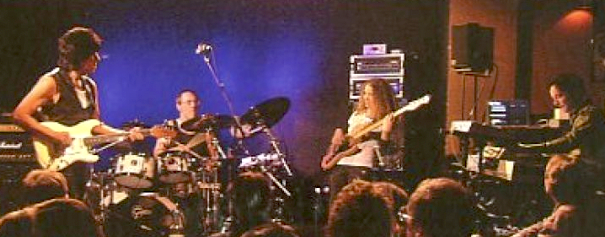
From L-R: Jeff Beck, Vinnie Colaiuta, Tal Wilkenfeld, Jason Rebello
I really enjoyed Jeff Beck – Performing This Week… Live at Ronnie Scott’s, with its many outstanding performances, including special guest artists. Accompanying Jeff on guitar were Vinnie Colaiuta on drums, Tal Wilkenfeld on bass guitar, and Jason Rebello on keyboards. Amazing musicians in their own right, they produced an exciting cohesive sound. The joy they shared making great music together was self-evident and the audience responded in kind. Surprise guests included Joss Stone, Imogen Heap, and Eric Clapton. One highlight was Jeff using a glass bottleneck slide to delicately tap out high notes at the lowest position on the strings towards the conclusion of Angel (Footsteps), which drew a standing ovation from the audience, and a satisfied smile from Jeff. Beck was interviewed on the success of the 5-night run at Ronnie Scott’s. He talked about each musician and every song on the set list. The show was edited into a 1-hour program for broadcast on the BBC.
But I keep coming back to three sublime pieces from that one-week residency in November 2007 at Ronnie Scott’s Jazz Club in London: Stevie Wonder’s Cause We’ve Ended As Lovers* featuring Tal’s impressive bass solo, Imogen Heap singing and riffing her way through a jazzy-bluesy performance of her song Blanket with Jeff contributing two short sublime solos, and Jeff concluding the night with the hauntingly beautiful Where Were You.
*Also see them play that piece at Eric Clapton’s Crossroads Guitar Festival in Chicago Southland July 2007 featuring Tal’s bass solo and Beck repeating his enthusiastic response to her playing.
“Yes, I was the brilliance floating over the snow and I was the song in the summer leaves, but this was only the first trick I had hold of among my other mythologies, for I also knew obedience: bringing sticks to the nest, food to the young, kisses to my bride.
But don’t stop there, stay with me: listen.
If I was the song that entered your heart then I was the music of your heart, that you wanted and needed, and thus wilderness bloomed there, with all its followers: gardeners, lovers, people who weep for the death of rivers.
And this was my true task, to be the music of the body. Do you understand? for truly the body needs a song, a spirit, a soul. And no less, to make this work, the soul has need of a body, and I am both of the earth and I am of the inexplicable beauty of heaven where I fly so easily, so welcome, yes, and this is why I have been sent, to teach this to your heart.”
But before she read the poem, Lisa told the audience she was “taking a tiny bit of poetic license tonight, changing two letters, and I’m gonna call it, Red Bird Explains Herself.”
Even though Mary’s muse, Mother Nature, epitomized as the Red Bird, inspired and informed her, Mary’s poetry did that for us. She is our Red Bird, the song that entered our hearts with the beauty of heaven—a living testament to her life here on Earth.
Bill Reichblum, literary executor of the Mary Oliver Estate, spoke first 1:13, followed by Lindsay Whalen 7:00, Secretary Hillary Rodham Clinton 11:55, Maria Shriver 18:11, Coleman Barks 28:04, Lisa Starr 33:05, Eve Ensler 50:30, John Waters 58:10, and Mary Oliver 1:04:43, from a recording of her 2012 reading of Wild Geese at the 92nd Street Y.
I just discovered a beautiful love song, “Twenty-Five” by Lake Street Dive. It was written by bassist Bridget Kearney and sung by Rachel Price with Akie Bermiss on piano. I was so moved I had to post a comment: Songwriting at its best, as is the singing of it and piano accompaniment. Nostalgic story and sound. A masterpiece!
I first listened to the Lyric Video and then found two live concert performances of the song. While I was preparing this post a new video of a studio recording was published for promotional purposes. I added all four videos. You’ll want to hear it again anyway it’s that compelling.
Here is the Description they provided: A song celebrating a love that wasn’t built to last but was magical and meaningful and true, if only for a short time. A human connection, even if it doesn’t end in marriage or kids or two gravestones side by side on a hillside, can still be treasured. Whatever the future holds, whoever else our paths may cross with down the line, we can carry along love and gratitude for the time we spent loving each other.
There was a time when I imagined us forever
I can’t quite remember how I thought we’d work it out
I guess I would move to California or you to Boston
And I’d learn to like to stay at home
Or you’d learn to like going out

And although the stories that I tell myself about us now
Don’t take me to the grave
I’ll be an old woman with somebody else by my side
But I will always be in love with you in my memories
When we were twenty-five

I always think of you when I drink affogato
Cuz that summer we would have them every afternoon
The hot and cold were such a perfect combination
Melt all together, bitter, sweet and creamy, and always gone too soon

But all the joy we had and love we gave away back then
Well, it never went to waste
I’ll be an old woman with somebody else by my side
But I will always be in love with how you loved me
When we were twenty-five
No doubt there will be more media opportunities for them to promote this song and their new album before it’s released in a few weeks time.
Final Thoughts
Different kinds of love come along at different stages in our lives. Some more than others have a special place in our hearts. While “Twenty-Five” may have been about a memorable love for a summer, Nikita Gill, in her wise and wonderful poem, Temporary and Permanent, contrasts that with those people who never leave us to face our painful times alone. Maybe you are one of these people who is always there for a friend in need.
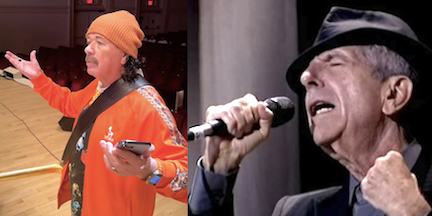
Carlos Santana recently told musicians their role was to help people open up to feel their totality, to claim back their divinity, their light, concluding—it’s church. Leonard Cohen fulfilled this responsibility by courageously standing for the complexity of his own emotions at the center of his song giving audiences everything he had. Together they revealed the purpose of playing music—creating holy moments. Artists who listened to Leonard Cohen sing “Hallelujah” confirmed this: “It felt like a beautiful, holy moment. It was a church moment. You get this feeling of having a modern prayer.”
As musicians we are given the gift to help humans feel the totality of themselves. Because a lot of people feel like they’re not worthy. They walk around… Most people are not happy unless they’re miserable. You know. And it’s our duty as musicians to open them up and help them feel their totality. You know. It’s not ego. It’s just that people forget that we are spirit first. And then chromosomes and molecules and blood, and bones, and all that stuff later. But as musicians, with each note, we compel people to: claim back your divinity, claim back your light. We’re not wretched sinners. And we’re not a mistake. We are grand, because we are made from the Grand Design. Thank you for sharing your light and your music. And you will see, you will see that when people start dancing, they get chills and they start crying and laughing. It’s church. That’s what we’re supposed to do. Anything else is show business. I don’t know anything about that. (He blows them a kiss. They laugh and applaud.) — Carlos Santana
This inspiring biographical documentary examines the life and influence of singer-songwriter Leonard Cohen through the lens of his most famous song, “Hallelujah.” It’s available on Digital, Blu-ray, and DVD: https://bit.ly/GetHallelujah. It’s also included in a Netflix subscription. From there it would later move to Hulu and Disney+. You can rent it on Amazon and other platforms. Sony Pictures Entertainment posted the First 7 Minutes.
Directors Dan Geller and Dayna Goldfine, and head of the Cohen estate/Executive Producer Robert Kory discuss HALLELUJAH: Leonard Cohen, A Journey, A Song at the Rock & Roll Hall of Fame. This was the first RRHF screening and discussion since the covid pandemic had shut them down for a year. See the 42-minute video.
Why Leonard Cohen came out of retirement to tour again
After leaving the Mount Baldy Zen Center where he had spent several years in retirement meditating and serving his Roshi, Cohen soon discovered that his manager had siphoned off all of his money leaving him penniless. He had to get back to work. He put a band together and after rehearsing for 3 months, Leonard Cohen, his backup singers, and the band performed their first concert in a small Canadian Maritime venue. Word spread and they kept performing at sold out venues and shows. The demand became so great they played sold-out concerts all over the world for 5 years! It more than made up for his loses and blessed those thousands of lucky attendees. Not bad for an old retiree!
Musical collaborator Sharon Robinson said: “Leonard really honored his audiences. He said every night before the show: ‘We’re gonna give you everything we’ve got.’” And Leonard concluded each show saying: “Thanks so much friends, it’s been a real privilege and an honor to play for you tonight.”
What Leonard Cohen said here gets to the essence of what makes for a memorable concert.
The only way you can sell a concert is to put yourself at risk. And if you don’t do that, people know, and they go home with a feeling that they liked the songs, but you know, they prefer to listen to them at home. But if you can really stand at the center of your song, if you can inhabit that space and really stand for the complexity of your own emotions, then everybody feels good. The musicians feel good, and you feel good, and the people who’ve come feel good. — Leonard Cohen
What some musicians said after hearing a Leonard Cohen concert
New York writer Larry “Ratso” Sloman said Leonard Cohen “was always a spiritual seeker, and that gave him a dimension that most rock stars couldn’t even fathom.”
John Lissauer, who produced Leonard’s 1984 album, “Various Positions”, which includes “Hallelujah”, commented, “When people hear ‘Hallelujah’, it must be something so universal. It’s really, really powerful. And that’s a big deal. We don’t get to be involved in very many things that hit people as strongly as that does.”
Towards the end of the film various artists commented on how they felt seeing Leonard Cohen in concert.
I was doing my first-ever solo show at Coachella, and I remember looking at the lineup and going: “Oh my God! Leonard Cohen.” Seeing Leonard Cohen felt like a beautiful, holy moment, to be outside with all of those people watching him. It was a church moment.” (2009 Coachella Music Festival, Indio, California) — Amanda Palmer
You get this feeling of having a modern prayer. I think that’s why people were coming to the shows so much because they were getting that feeling. Even how he thanked everybody, everybody in the crew, and all the different jobs that people did to put together the show. It was like an instruction manual on how to be in the world. It’s like you can be this good, you really can. — Regina Spektor
When Judy Collins first met Leonard Cohen and heard him sing “Suzanne” for her, she told him she was going to record his song the next day. It was included on her 1966 landmark album, In My Life. She later forcefully invited him to sing “Suzanne” at a town hall charity event attended by many well-known musicians. He was so nervous he couldn’t complete the song, apologized, and walked off stage, which endeared him to the audience. Judy convinced him to return and finish the song. Judy Collins sang “Suzanne” with Leonard Cohen on her PBS TV “Soundstage” concert performance in January 1976. That episode helped launch his career as a special singer-songwriter. In this documentary film she summarized:
People who respond to him in the way they do—and they respond to him all over the world, of course—are responding to something that is different. You’re getting things that are so deep and so resonant in your own spiritual journey, that you are benefitting from his. And that’s of course the highest compliment to a poet or a songwriter. — Judy Collins
There is a crack in everything. That’s how the light gets in.
Another film worth watching is Marianne & Leonard: Words of Love (2019)—a sensitive in-depth look at the relationship between Leonard Cohen and his Norwegian muse Marianne Ihlen. More relevant content has been added in the previous post about it.
— Written and compiled (citing sources) by Ken Chawkin for The Uncarved Blog.
Postscript: Speaking of creating a church moment, on May 31, 2024, Angelina Jordan premiered her own powerful rendition, with Toby Gad, of the hit song he co-wrote with BC Jean for Beyonce, If I Were A Boy (Piano Diaries), recorded in a London church.
There are many YouTube performances of these two beautiful pieces of classical music for piano—Passacaglia by Händel and Halvorsen, and Mariage d’Amour by Paul de Senneville. They’re usually played at a faster tempo, but I prefer a slower version, especially when performed by the two classical guitarists I recently discovered and posted—Passacaglia by Boris Björn Bagger and Mariage d’Amour by Iva Kosić.
Passacaglia was written by the great German-British Baroque composer George Friedrich Händel (1685-1759) HWV 432, and later adapted by Norwegian composer, conductor, violinist Johan Halvorsen (1864-1935).
I listened to many fine pianists on YouTube playing these beautiful pieces. Danish pianist and composer Jacob’s Piano plays Passacaglia at the same speed as Boris Björn Bagger on guitar. But Pianist Daisy plays Passacaglia a bit softer and slower, which creates a finer effect.
Jacob Ladegaard from Copenhagen, Denmark, aka Jacob’s Piano, pointed out that Mariage d’Amour had been mistakenly titled and uploaded as Chopin’s Spring Waltz by someone on YouTube. It reached around 25M views before it was taken down. He said that Chopin never wrote such a piece. You can read about it here: Did Chopin ever write a Spring Waltz?
I later found a young Indonesian musician, Amy Evelyn (Amy Tapping), playing Passacaglia and Mariage d’Amour on a double neck electric guitar using a two-handed tapping technique. Impressive!
I discovered a wonderful young classical guitarist on YouTube. Iva Kosić is a Serbian musician studying classical guitar at a German university. She recently graduated with a Masters degree in music. She performs concerts, teaches online, and is active on social media where she creates and posts her own YouTube videos.
This performance of Mariage d’Amour – Paul de Senneville played by Iva Kosić is so beautiful I had to post it. On Dec 24, 2023, Iva Kosić gifted her followers with this YouTube video and holiday message: “For Christmas Eve I am sharing with you my performance of this well-known piano piece played on classical guitar. Merry Christmas and enjoy🎄💖” She also posted a YT Short version of it on a loop.
Iva later wished her fans a Happy Valentine’s Day🌹 with this beautiful romantic Short, Romance (Wiki). See more videos on her social media: YouTube, Instagram, TikTok, Facebook.
I later found a young Indonesian musician, Amy Evelyn (Amy Tapping), playing Passacaglia and Mariage d’Amour on a double neck electric guitar using a two-handed tapping technique. Impressive!
This blog post is thanks to Ellen Metropole for telling me that Markus K, a busker I follow on YouTube, attended the 10,000 course in Hyderabad, India! I didn’t know he was a TM-er. He wrote a song about the course while he was there and premiered it when he went to Morocco. It’s a catchy tune and tells the story of why everyone from so many countries attended. He performed the song on Feb 21, 2024 in Casablanca at his first Moroccan busking session.
Enjoy ‘Consciousness is All there Is’ written by Markus Koehorst, aka, Markus K, during an international Peace Project in Hyderabad, India called Ten Thousand For World Peace.
In his notes, Markus mentioned a great article about the Peace Project in Hyderabad, India published in Pressenza India: Ten thousand people meditating for world peace. I posted more articles listed below.
He also mentions 10 000 For World Peace – Transcendental Meditation, a beautiful video with images from the course, to the music of ‘Across the Universe’ by John Lennon. Unfortunately, the video was later taken down.
John Lennon wrote the song in England before the Beatles left for India. He had had a disagreement with Cynthia and couldn’t sleep. So he went downstairs and wrote down the words as they came to him. Of all the songs he had ever written he said Across The Universe was his best. It wrote itself. I remember reading somewhere that John had sung it to Maharishi in India, especially the chorus, “nothing’s gonna change my world.” Maharishi had suggested that he sing, “meditation’s gonna change my world,” but he didn’t change it. The Beatles Bible describes a complete history of Across The Universe in two parts 1 & 2.
David Lynch gave his own take on John’s expression in the song, “Nothing’s gonna change my world.” He explained that “nothing” as “no-thing”, i.e., the transcendent, which Maharishi was discussing, would change his world. John must’ve loved the double entendre, and contradictory meaning of that word in the repeating expression of his song. David mentioned that as part of his message to a DLF event via Zoom. He concluded his call with his short prayer for peace. You can listen to it here.
Born in Holland, Markus K spent 30 years in England based in Liverpool, UK and now travels the world playing on the street and connecting with people. Main instruments: guitar, vocal, percussion. Looper Master. Mostly originals; some drastic reworks of classics. Main influences: blues and anything with real soul, warts and all. Passionate about inner peace and conscious living. We Are All In This Together. In this video, Markus K – blues fusionist (presentation) Dec 31, 2017, Markus talks about his music, his busking and his travels.
On December 7, 2024, I came across a new and very cool variation of Markus K’s song, when, on May 24, 2024, he posted MAGIC on the street in HAMBURG – Consciousness Is All There Is. He wrote: “This is why I love to jam with Dominic Dobernowsky. He always brings magic to the mix, like that opening theme of his from where the whole thing evolves. Magic happens on the street!” Enjoy this new version. He also posted it a year later On This Day 24 May 2024 on TikTok.
Friends emailed me to see the premiere episode of Season 3’s NCIS: Hawai’i. NCIS (Naval Criminal Investigative Service) is a popular TV series. I was able to stream it on Paramount+ and now watch new episodes each week. Here’s how they describe the show.
NCIS is more than just an action drama. With liberal doses of humor, it’s a show that focuses on the sometimes complex and always amusing dynamics of a team forced to work together in high-stress situations. From murder and espionage to terrorism and stolen submarines, these special agents investigate all crimes with Navy or Marine Corps ties.
James Todd Smith, known professionally as LL Cool J (short for Ladies Love Cool James), is an American rapper, songwriter, record producer, and actor. He starred for many years as federal agent Sam Hanna in NCIS: Los Angeles and was recently transferred to NCIS: Hawai’i. He brought everyone up to date via Instagram and TikTok on how Season 2 ended, with Jane Tennant (Vanessa Lachey) in bad shape.
After passing her medical and psych evaluations, Jane Tennant is surprised to see Sam Hanna conducting her final interview to clear her return to work. In the middle of this premiere Season 3 Episode 1, Run and Gun (Feb 12, 2024), Tennant and Hanna have a heart-to-heart talk one evening at a private shooting range (23:15).
Both have been deeply traumatized due to violent situations on the job. Tennant may have been medically cleared to return to work after healing from severe injuries, but she is in denial about her psychological and emotional state.
Hanna has been there and is trying to get through to her about it. Tennant finally asks Hanna what he did “to get out of the hole.” See his answer and how she responds to it in this 2-minute segment—Whatever Gets You Through The Night!—available on cbs.org and The NCISverse.
LL Cool J was involved in the creation of the Def Jam Recordings label. His collaboration with Rick Rubin laid the foundation for one of the most influential hip-hop record labels.
A TM practitioner since he was a teenager, legendary music producer Rick Rubin received the Lifetime of Harmony Award (Feb 27, 2014) from the David Lynch Foundation through its new performance arts events division, DLF Live. See more details in this Feb 25, 2014 billboard article.
Which leads me to think that maybe LL Cool J has also been doing TM, is familiar with its researched beneficial effects, the good work of the David Lynch Foundation, and might have had something to do with including Transcendental Meditation into the script. Whatever the reason, it was an unexpected surprise, and turned out to be an appropriate plug for TM!
— Written and compiled (citing sources) by Ken Chawkin for The Uncarved Blog.
The Great Wave off Kanagawa has been described as possibly the most reproduced image in the history of all art, as well as being a contender for the most famous artwork in Japanese history. This woodblock print has influenced several Western artists and musicians, including Claude Debussy, Vincent van Gogh and Claude Monet.
Roger Start Keyes, art historian, Hokusai scholar, and co-founder of York Zen, wrote his poem “Hokusai Says,” featured on the York Zen Welcome Page, in Venice in 1990. It appeared suddenly as he was making notes for the “Young Hokusai” paper he was to give at a symposium on Hokusai the following day.
Hokusai says look carefully. He says pay attention, notice. He says keep looking, stay curious. He says there is no end to seeing. He says look forward to getting old. He says keep changing, you just get more who you really are. He says get stuck, accept it, repeat yourself as long as it’s interesting. He says keep doing what you love. He says keep praying. He says every one of us is a child, every one of us is ancient, every one of us has a body. He says every one of us is frightened. He says every one of us has to find a way to live with fear. He says everything is alive – shells, buildings, people, fish, mountains, trees. Wood is alive. Water is alive. Everything has its own life. Everything lives inside us. He says live with the world inside you. He says it doesn’t matter if you draw, or write books. It doesn’t matter if you saw wood, or catch fish. It doesn’t matter if you sit at home and stare at the ants on your veranda or the shadows of the trees and grasses in your garden. It matters that you care. It matters that you feel. It matters that you notice. It matters that life lives through you. Contentment is life living through you. Joy is life living through you. Satisfaction and strength is life living through you. Peace is life living through you. He says don’t be afraid. Don’t be afraid. Look, feel, let life take you by the hand. Let life live through you.
Click to listen to poet Roger Keyes recite his poem, Hokusai Says.
Hokusai’s instructions, received, written and recited by Roger Keyes, about paying attention, noticing things, and living life fully, remind me of Mary Oliver‘s lessons on attention, receptivity, listening, delighting in and writing, expressed in many of her poems, like Mindful and Praying.
This Famous Artwork Isn’t What You Think … | “The Great Wave off Kanagawa” by Hokusai explained. Why It’s Art dives into the fascinating story behind “The Great Wave off Kanagawa,” one of the most famous Japanese artworks in the world. This video reveals the surprising truth about Hokusai’s masterpiece and how it was created. We explore the deep symbolism within the image, from the powerful wave to the distant Mount Fuji, and uncover how this single woodblock print profoundly influenced Western artists like Vincent van Gogh and Claude Monet. Discover the incredible journey of a piece of Japanese popular art that ended up changing the course of art history across continents.
This first video (6:05) features Dr. Tony Nader at Maharishi International University (MIU) in Fairfield, Iowa talking about the need for TM in today’s stressful world. The video opens with students meditating with Dr. Nader. Using EEG, Dr. Fred Travis demonstrates the increase in brainwave coherence of a subject as she starts meditating. Students also discuss the practical benefits from their TM practice.
The second video (7:50) takes place in Medellín, Columbia at one of Father Gabriel Mejia’s shelters for rehabilitating homeless children with addiction problems. One of them went on to become a TM teacher and returned to teach the students how to meditate. They were inspired by the positive transformation and growth in his life.
The third video (5:02) was filmed in a Rhode Island hospital where medical staff were still dealing with the stressful repercussions from the Covid-19 pandemic. TM provided welcome relief from the traumatic loss of life and continues to be taught there. Dr. Nader mentions the David Lynch Foundation’s Heal the Healers Now campaign. They provided the funding for TM instruction, which helped thousands of healthcare professionals during the pandemic. Many continue to meditate regularly.
Embedded below are the videos with their short descriptions posted on the GWI site. Each title and chapter also take you to the BBC StoryWorks pages with the same videos plus 3 slides selected from each per chapter: Nature, Self, Community.
1. TM: Listening to your inner rhythm: Dr Tony Nader has been researching the mind and meditation since he was a medical student. Discover his methods for finding peace in a busy and ever-changing world.
2. TM: A healing journey: For Breiner, meditation had a transformational effect on his life, a lesson which he is now passing on to younger generations.
3. TM: The calm in the storm. Finding a peaceful moment to recalibrate. Ongoing strains on health clinicians from the Covid-19 pandemic are still apparent in hospitals. These medical doctors are finding strength in the moments of peace that Transcendental Meditation can provide.

 The Uncarved Blog