I first discovered French guitarist Roxane Elfasci playing Claude Debussy’s Clair de Lune in a Paris concert from Oct 3, 2016. I had mentioned her in two previous posts on female harpists performing the same romantic composition: Canadian harpist Kristan Toczko and Serbian pianist and harpist Nadja Dornik. She was so good I had to create her own post playing this beautiful piece by Debussy, along with Erik Satie’s Gymnopédia No. 1, and Leonard Cohen’s Hallelujah. Roxane Elfasci dedicated her first album to the composer, Hommage à Debussy.
You can actually hear Debussy playing Clair de Lune (1913), recorded on a piano roll, Claude Debussy plays Debussy. It is included in the Complete recordings made by Claude Debussy: The Composer as Pianist.
For performances of Claude Debussy’s Clair de Lune, I prefer the slower, tender interpretation by Portuguese concert pianist Maria João Pires.
I also love Erik Satie’s famous composition Gymnopédie No. 1. Roxane Elfasci arranged this sublime piece of music for two guitars. Enjoy their stunning performance!
Erik Satie and Claude Debussy were influential French composers who significantly impacted the music scene in the late 19th and early 20th centuries. Satie is known for his minimalist piano works like the Gymnopédies, while Debussy is celebrated for his innovative compositions that helped shape Impressionism in music. Both composers shared a friendship and mutual respect, often influencing each other’s work. They were part of the same artistic circles in Paris, where they explored new musical ideas and broke away from traditional forms. Their collaboration and individual contributions helped shape modern music in France and beyond.
Listen to other amazing artists I’ve been inspired by and written about available in the Archive of the ‘Music’ Category on The Uncarved Blog. I listed examples of beautiful music across genres in this previous post.
— Written and compiled (citing sources) by Ken Chawkin for The Uncarved Blog.
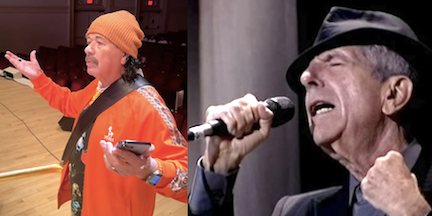
Carlos Santana recently told musicians their role was to help people open up to feel their totality, to claim back their divinity, their light, concluding—it’s church. Leonard Cohen fulfilled this responsibility by courageously standing for the complexity of his own emotions at the center of his song giving audiences everything he had. Together they revealed the purpose of playing music—creating holy moments. Artists who listened to Leonard Cohen sing “Hallelujah” confirmed this: “It felt like a beautiful, holy moment. It was a church moment. You get this feeling of having a modern prayer.”
As musicians we are given the gift to help humans feel the totality of themselves. Because a lot of people feel like they’re not worthy. They walk around… Most people are not happy unless they’re miserable. You know. And it’s our duty as musicians to open them up and help them feel their totality. You know. It’s not ego. It’s just that people forget that we are spirit first. And then chromosomes and molecules and blood, and bones, and all that stuff later. But as musicians, with each note, we compel people to: claim back your divinity, claim back your light. We’re not wretched sinners. And we’re not a mistake. We are grand, because we are made from the Grand Design. Thank you for sharing your light and your music. And you will see, you will see that when people start dancing, they get chills and they start crying and laughing. It’s church. That’s what we’re supposed to do. Anything else is show business. I don’t know anything about that. (He blows them a kiss. They laugh and applaud.) — Carlos Santana
This inspiring biographical documentary examines the life and influence of singer-songwriter Leonard Cohen through the lens of his most famous song, “Hallelujah.” It’s available on Digital, Blu-ray, and DVD: https://bit.ly/GetHallelujah. Netflix offered it. From there it moved to Hulu and Disney+. You can rent it on Amazon and the other platforms listed on IMDb. Sony Pictures Entertainment posted the First 7 Minutes.
Directors Dan Geller and Dayna Goldfine, and head of the Cohen estate/Executive Producer Robert Kory discuss HALLELUJAH: Leonard Cohen, A Journey, A Song at the Rock & Roll Hall of Fame. This was the first RRHF screening and discussion since the covid pandemic had shut them down for a year. See the 42-minute video.
Why Leonard Cohen came out of retirement to tour again
After leaving the Mount Baldy Zen Center where he had spent several years in retirement meditating and serving his Roshi, Cohen soon discovered that his manager had siphoned off all of his money leaving him penniless. He had to get back to work. He put a band together and after rehearsing for 3 months, Leonard Cohen, his backup singers, and the band performed their first concert in a small Canadian Maritime venue. Word spread and they kept performing at sold out venues and shows. The demand became so great they played sold-out concerts all over the world for 5 years! It more than made up for his loses and blessed those thousands of lucky attendees. Not bad for an old retiree!
Musical collaborator Sharon Robinson said: “Leonard really honored his audiences. He said every night before the show: ‘We’re gonna give you everything we’ve got.’” And Leonard concluded each show saying: “Thanks so much friends, it’s been a real privilege and an honor to play for you tonight.”
What Leonard Cohen said here gets to the essence of what makes for a memorable concert.
The only way you can sell a concert is to put yourself at risk. And if you don’t do that, people know, and they go home with a feeling that they liked the songs, but you know, they prefer to listen to them at home. But if you can really stand at the center of your song, if you can inhabit that space and really stand for the complexity of your own emotions, then everybody feels good. The musicians feel good, and you feel good, and the people who’ve come feel good. — Leonard Cohen
What some musicians said after hearing a Leonard Cohen concert
New York writer Larry “Ratso” Sloman said Leonard Cohen “was always a spiritual seeker, and that gave him a dimension that most rock stars couldn’t even fathom.”
John Lissauer, who produced Leonard’s 1984 album, “Various Positions”, which includes “Hallelujah”, commented, “When people hear ‘Hallelujah’, it must be something so universal. It’s really, really powerful. And that’s a big deal. We don’t get to be involved in very many things that hit people as strongly as that does.”
Towards the end of the film various artists commented on how they felt seeing Leonard Cohen in concert.
I was doing my first-ever solo show at Coachella, and I remember looking at the lineup and going: “Oh my God! Leonard Cohen.” Seeing Leonard Cohen felt like a beautiful, holy moment, to be outside with all of those people watching him. It was a church moment.” (2009 Coachella Music Festival, Indio, California) — Amanda Palmer
You get this feeling of having a modern prayer. I think that’s why people were coming to the shows so much because they were getting that feeling. Even how he thanked everybody, everybody in the crew, and all the different jobs that people did to put together the show. It was like an instruction manual on how to be in the world. It’s like you can be this good, you really can. — Regina Spektor
When Judy Collins first met Leonard Cohen and heard him sing “Suzanne” for her, she told him she was going to record his song the next day. It was included on her 1966 landmark album, In My Life. She later forcefully invited him to sing “Suzanne” at a town hall charity event attended by many well-known musicians. He was so nervous he couldn’t complete the song, apologized, and walked off stage, which endeared him to the audience. Judy convinced him to return and finish the song. Judy Collins sang “Suzanne” with Leonard Cohen on her PBS TV “Soundstage” concert performance in January 1976. That episode helped launch his career as a special singer-songwriter. In this documentary film she summarized:
People who respond to him in the way they do—and they respond to him all over the world, of course—are responding to something that is different. You’re getting things that are so deep and so resonant in your own spiritual journey, that you are benefitting from his. And that’s of course the highest compliment to a poet or a songwriter. — Judy Collins
There is a crack in everything. That’s how the light gets in.
Another film worth watching is Marianne & Leonard: Words of Love (2019)—a sensitive in-depth look at the relationship between Leonard Cohen and his Norwegian muse Marianne Ihlen. More relevant content has been added in the previous post about it.
— Written and compiled (citing sources) by Ken Chawkin for The Uncarved Blog.
Postscript: Speaking of creating a church moment, on May 31, 2024, Angelina Jordan premiered her own powerful rendition, with Toby Gad, of the hit song he co-wrote with BC Jean for Beyonce, If I Were A Boy (Piano Diaries), recorded in a London church.