In meditation last morning, a thought came that I was “in search of my own doing.” My life is the result of choices, of things I did and did not do that cannot be undone. Life goes on, and I am still wondering what I should be doing with the rest of my life.
Then I thought of my children and their attempts to make sense of their lives, to fulfill their destiny. So, I wrote this philosophical tanka about being and becoming.
Searching For The Meaning of Your Life
Your destiny is
A search for your own doing
What your life will mean
But doing starts with being
Only then can you become
…
Yogastah kurukarmani
Established in Being, perform action
I’m reminded of what Krishna said to Arjuna on the battlefield of life — to perform his duty and fight. But he also gave him the technique for skill in action — to first transcend, to Be (Ch 2, V 45); and then, established in Being, to perform action (Ch 2, V 48).
So “meditate and act” is the formula for success in life. Do what comes naturally and brings you bliss. And if life sometimes stretches you in ways you’re not comfortable with, keep meditating and acting, and you will have grown stronger in the process, becoming more of yourself.
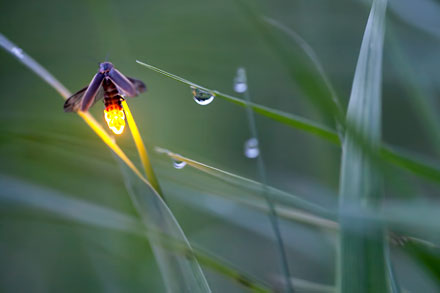
“I like to capture the magic.” — photographer Radim Schreiber
The little luminary pictured above was photographed in 2010 by award-winning photographer Radim Schreiber, of Fairfield, Iowa. The photo, entitled Amber Firefly, took 1st place out of 56,000 entries in “The Natural World” category at the 8th annual Smithsonian Magazine Photo Contest published in March 2011.
A designer, photographer and videographer, formerly for the Sky Factory, Radim has won several national and international photography competitions. Also in 2011 he took 1st place in the 41st annual National Wildlife Photo Contest in the “Backyard Habitat” professional category out of 27,000 entries. He won the 2010 Galapagos Conservancy Photography Contest, and the 2008 and 2009 Rainforest Alliance’s “Picture Sustainability” Photo Contest. Awards are listed on his website.
Radim Schreiber had rarely seen fireflies back home and was surprised and thrilled by their abundance here in Iowa. He started taking still photos and then made a movie of them.
“In the Czech Republic where I grew up, I only saw fireflies a couple of times, deep in the forest. When I came to the United States, I was shocked and thrilled to see the abundance of fireflies and their amazing glow. I was happy to encounter this firefly and photograph its magical bioluminescence.”
Read this July 2011 Iowa Source interview with Christine Schrum to find out how Radim braved ditches, swamps, mosquitoes, and chiggers to obtain his fantastic firefly photos: Stalking Fireflies in the Night.
Radim’s award-winning firefly images have been featured at CBS, NPR, National Geographic, Smithsonian Magazine, Iowa PBS (Iowa Outdoors, Ep. Aug 11, 2013, go to 13:15,Fireflies In Iowa) The Weather Channel, The National Wildlife Federation, and KEW – Royal Botanical Gardens. Read more in Mo Ellis’s updated profile of Radim on the MIU website.
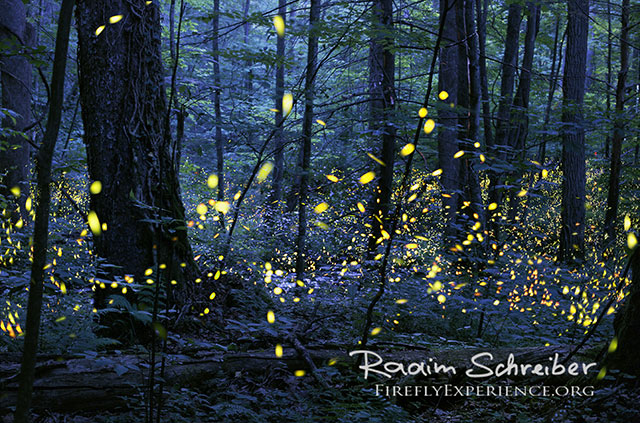
The photo was taken mid-June 2014* at twilight in Great Smoky Mountains National Park, Tennessee. Radim was in almost complete darkness surrounded by fireflies and witnessed one of the most amazing and magical natural phenomena—fireflies that synchronize. He used the latest low-light camera technology and took several long exposures over several minutes and merged them together to preserve detail and clarity. He uploaded it November 2015 and it was selected as Shot Of The Day on December 24, 2015, then Editors’ Pick, Finalist, and now Altered Images Winner. Radim had used this photo for the cover of his Firefly Experience film described below.
The Firefly Experience on Film
This summer I saw a magical little film at the first annual Creative Edge Film Fest in Fairfield, Iowa. Made by fellow MUM alum Radim Schreiber, BFA, it was so beautifully put together visually and musically, the audience was spellbound. When it was over, the 2½-minute short elicited an extended exuberant response.
In this film, Radim Schreiber tried to capture his experiences with fireflies in Lamson Woods, a State Preserve and segment of the Jefferson County Trails Systemnear his house in Fairfield, Iowa. He wanted to document not only their beauty and magical glow, but also behavior in their natural environment, the Neff Wetlands section of the Fairfield Loop Trail.
“When I walk through a quiet forest in the middle of the night full of fireflies, I have an experience of a magical forest. When I see fireflies being a mere reflection of stars under the Milky Way, I feel connected to everything in the universe. They are communicating to me. I am listening.”
Radim chose to not do any digital manipulation to the video itself. The footage came straight from the camera. This is not time-lapse photography, but realtime footage of fireflies!
Radim Schreiber’s Firefly Experience is synchronistically edited with a beautiful soundtrack specifically composed and performed for the film by Tiko Lasola. Radim loves the song. “It is a perfect match for my photos. In fact I was shocked that it happened this way.” I agree! After watching the film you can hear Tiko’s full 3½-minute Fireflies piece here.
After the screening, Radim was selling HD and Blu-ray DVDs of his film. I bought the Blu-ray. I never tire of watching and listening to it; it’s beautiful! It produces a calming effect.
For optimal viewing, Radim suggests we watch the video at night in full screen mode with all lights turned off and the sound turned up.
Have you ever experienced the magic of fireflies? I’ve seen them around Fairfield, but never like what I saw in eastern Missouri during a summer Residence Course in the early 1990s. I had driven with three other Maharishi Ayurveda Health Technicians to a movement facility in Ste. Genevieve County, Missouri to provide rejuvenation therapies.
The building was located at the edge of the Mark Twain National Forest. The warm night air was thick with nature’s sounds and sights. Hundreds of frogs incessantly called out to each other from a pond behind the building. Swarms of fireflies dazzled me with their exuberant flashing lights as I walked around the grounds. Their colors and bubbly nature reminded me of Champagne! Inspired, I wrote this short four-line poem.
FIREFLIES
EFFERVESCENT FIREFLIES PHOSPHORESCENT HUE SPARKLING LUMINOSITY EVENING DROPS OF DEW
*In July 2018, I discovered CBS Sunday Morning was also there that same summer in 2014 when Radim was capturing his award-winning photographs of the synchronous fireflies. They posted their report on July 13, 2014: Tennessee fireflies: A summertime light show.
Iowa PBS posted this Aug 22, 2013 profile on Radim’s work in their Iowa Outdoors series: Fireflies in Iowa.
New: This summer, August 2020, a video and a magazine cover story came out about Radim Schreiber and his work.
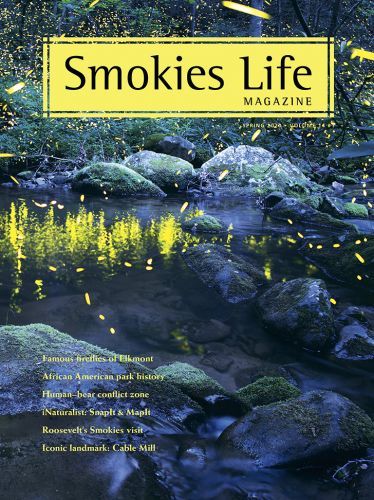
Frances Figart, editor of Smokies Life Magazine, interviewed Radim for their spring 2020 issue, Vol 14 #1. They created a wrap-around glow-in-the-dark firefly cover with one of Radim’s images of the famous lightning bugs of Elkmont. The edition’s cover story featured a sidebar about Radim and showed many of his incredible photographs. They also included a special video introducing Radim and his work. See Illuminating the Magic and Mystery: An Interview with Radim Schreiber, Firefly Photographer.
Radim was hired to film fireflies for the new Netflix series Alien Worlds. In Janus, Season 1 Episode 2, you see his work from 31:40 – 36:19.
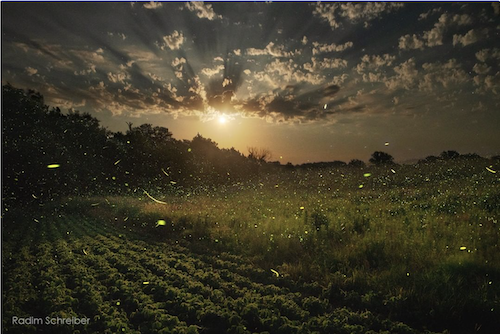
On the evening of the full moon in July (7/13/22), Radim posted this stunningly beautiful photo on his Instagram radimphoto and wrote: Lightning Bugs and Full Moon. Photo I took last night in Fairfield Iowa. Multiple exposures, about hour total. Repost freely ❤️
On March 5, 2023, Radim sent out a newsletter announcing that last summer he had photographed a very elusive and endangered firefly species in the cypress swamps of southern Illinois. The “Cypress Firefly” Photuris walldoxeyi, first described by Lynn Fast, displays a unique flashing pattern. It has been Red Listed as vulnerable and has only so far been found in a handful of locations in four states — IL, IN, MS, and TN. See a short video of Cypress Firefly – Red List Vulnerable Species.
Last Friday night, as I was walking into Revelations for some dinner, I saw a sign in the window for a poetry reading by a friend I knew. It also said a birthday cake would be shared afterwards. I bought a big bowl of soup and headed downstairs. The place was packed and I had to stand at the back by a desk having my soup. The birthday poet was Karen Karns. Her husband, Don (aka, Ark-hal) Karns, offered me his seat, but the owner brought me a chair in time. Don, Karen and I used to work together as Maharishi Ayurveda technicians in the late ’80’s & early 90’s.
Karen Karns has a Masters in Divinity from Earlham School of Religion, a Quaker seminary, and is a Life Counselor. She has twenty years of experience in Fairfield, Iowa offering individual, pre-marital & couples counseling, which she continues to do in the afternoons. As a Sidha, Karen has been on the Invincible America Assembly continuously since its inception in 2006!
I’ve always found Karen to be a very friendly, cheerful, compassionate and gentle person. You’d never know she had reached retirement age. Maybe all that meditation has kept her looking eternally young and beautiful, inside and out!
Now I discover she’s a poet! Karen was shy about reading her poems in front of an audience, but she did well. The last poem took our collective breath away as she shared an intimate experience of a poem coming to her during a deep meditation in the Ladies Golden Dome.
When a poem comes to you and you don’t write it down, you never forgive yourself. That’s what happened to Karen the first time. But, luckily for her, and us, it came back again during her next meditation in the dome and she quickly wrote it down. This happened during Guru Purnima this year, a special gift. I’ll let her words speak for themselves as the poem asks us, tells us, what could be more intimate.
WHAT COULD BE MORE INTIMATE
than these shimmering sheets of light
enfolding the features of each face
as we meditate in silence together,
our spines, divining rods for the deepest
currents and reservoirs of peace.
What could be more intimate
than to be held captive by this
moment, its piracy complete
with all the spoils and riches
from past and future laid
immediately at our feet.
What could be more intimate
than this play of hide and seek,
peeking around corners, into doors—
only to find ourselves hidden
in the marrow of every beam
and rafter in our own huge house.
What could be more intimate
than the waking up of sleep
inside itself
spellbound by the sound
of its own sweet voice
humming an ancient lullaby.
What could be more intimate
than the filling and emptying,
the steady pump of liquid love
as it funnels its way into the portals
and pathways of our bodies, joyfully
mothering each tender cell.
What could be more intimate
than the downpour and drench of bliss.
What could be more intimate than this?
Karen Karns
Guru Purnima 2015
I was so blown away I had to post it on my blog. Luckily she agreed, so I could share it with all of you. I also took her photo to go with the poem.
When I asked Karen if she just wrote it down as a scribe or if she had to work at it, she replied, “I scribed and scrubbed both,” with a smiley face.
That’s been my experience too—creative expression is a collaborative process, especially when the muse whispers something to you! You start with a seed idea, words, even lines, if you’re lucky, and you work at it until it’s done, you polish it until it’s right. Karen sure got this one right!
The discussion on Vedic cognition at the end of “Are you Mr. William Stafford?” is very relevant to Karen’s experience as a poet!
It’s Fairfield’s 1st Fridays Art Walk and tonight I’m at ICON Gallery talking with owner/curator Bill Teeple about the creative process, painting, poetry, and consciousness. I’m moved by one of his new images on the wall in the smaller gallery/studio upstairs. It’s deeply blue and draws me in like a magnet.
Bill tells me it’s made of multiple layers of acrylic paint, like a glaze. It’s translucent; it glows in your awareness. Tiny white specks look like stars in the night sky. Bill says it’s the paper, meant to be part of the painting.
Click on the blue image to enlarge it and you’ll see them. Enlarge it again and stare into the BLUE, and like the Hubble telescope, you’ll discover a world that previously was not visible.
The simplicity and minimalism of the piece inspires me to write a haiku. I do, and share it with Bill who says, “That’s it!”
BLUE: A Translucent Painting by Bill Teeple
Ten Layers of Blue
Look at it looking at you
Aglow between two
I can’t help myself when it comes to rearranging words in lines and their meanings. Here is a second version of the haiku.
BLUE: A Translucent Painting by Bill Teeple
Ten Layers of Blue
Looking at it look at you
A glow between two
While feeding Sali lunch yesterday I would joke and make her smile and laugh. It was sweet. No matter how lousy I was feeling before, she made me feel better. I told her she had a happy heart and a blissful soul, and thanked her for making me feel happier. That’s when I wrote the first two lines. I thought about it some more and the next day when I came in to feed her, the last two lines came out spontaneously. She is my muse. Even though Sali is severely compromised on so many levels, she still maintains her inner nature, an inspiration to us all!
Sally has a happy heart
And a deeply blissful soul
When she laughs it all comes out
Leaving me smiling and whole
I received an email this morning from a member of the TMhomeTeam, an international Transcendental Meditation news website. I’ve admired their wonderful work over the years representing TM internationally, especially their interesting interviews with famous, and not so famous people who have benefited from this unique meditation practice.
They wrote to say the article they had been putting together about me was now up. As a publicist who is always concerned with properly promoting other people and their work, this was a complete turnaround for me. I very much enjoyed sharing stories with Liisa of how I started TM, my work as a publicist, and the wonders of the creative process writing poetry. So when I read her article I was very moved; she did an excellent job representing me!
The article is currently featured on their home page and under the People section. I invite you to visit their website and enjoy reading it. They also did a lovely job laying it out with personal photos and two of my poems.
I am thrilled to share this milestone with you! Click on the title of the article to take you there.
In 1967, Ken Chawkin walked into the local TM centre without any intention of learning Transcendental Meditation. He simply wanted to buy a copy of The Science of BeingandArt of Living written by Maharishi Mahesh Yogi.
The job of a poet is translating what he or she is experiencing into words. If it resonates with other people’s experience, allows them to identify with what’s in the poem in a way they could not have expressed as well with words, and gives them pleasure, then it’s a good poem.
While in NYC recently, my son commented on my m.o. as a poet, how I notice things, name and say what I’m experiencing at the time. So I wrote this simple haiku for him, a sort of job description.
Experiencing
Noticing … Naming … Saying
Job of a Poet
Case in point, when I was returning from Iowa City last week, I dropped in to see Sali. She was still in her bed; they hadn’t gotten her up yet for dinner. I held her hand and spoke to her, telling her how much I loved her. A part of me was noticing how I was feeling, what was happening within and between us. From that experience, I wrote this haiku for her.
The thrill of the heart
Holding hands and loving you
The peace that follows
See this remembrance of Mary Oliver (1935-2019) and her astonishing poetry, with links to articles, interviews, and readings, as well as more of her favorite poems I’ve loved and posted over the years.
— Written and compiled (citing sources) by Ken Chawkin for The Uncarved Blog.
Enjoy the poetic genius and humor of Billy Collins reading his poem “January in Paris” on Page Meets Stage, November 12, 2005. The video was posted by Taylor Mali who shared the stage with Collins. A poet and teacher, Mali curates the Page Meets Stage series, which takes place at The DL Lounge in New York City. A version of this poem was published in “Ballistics” (Random House, 2010). I read it in my copy of Aimless Love: New and Selected Poems, pages 89–91 (Random House, 2013).
January in Paris
Poems are never completed—they are only abandoned. — Paul Valéry
That winter I had nothing to do
but tend the kettle in my shuttered room
on the top floor of a pensione near a cemetery,
but I would sometimes descend the stairs,
unlock my bicycle, and pedal along the cold city streets
often turning from a wide boulevard
down a narrow side street
bearing the name of an obscure patriot.
I followed a few private rules,
never crossing a bridge without stopping
mid-point to lean my bike on the railing
and observe the flow of the river below
as I tried to better understand the French.
In my pale coat and my Basque cap
I pedaled past the windows of a patisserie
or sat up tall in the seat, arms folded,
and clicked downhill filling my nose with winter air.
I would see beggars and street cleaners
in their bright uniforms, and sometimes
I would see the poems of Valéry,
the ones he never finished but abandoned,
wandering the streets of the city half-clothed.
Most of them needed only a final line
or two, a little verbal flourish at the end,
but whenever I approached,
they would retreat from their ashcan fires
into the shadows—thin specters of incompletion,
forsaken for so many long decades
how could they ever trust another man with a pen?
I came across the one I wanted to tell you about
sitting with a glass of rosé at a café table—
beautiful, emaciated, unfinished,
cruelly abandoned with a flick of panache
by Monsieur Paul Valéry himself,
big fish in the school of Symbolism
and for a time, president of the Committee of Arts and Letters
of the League of Nations if you please.
Never mind how I got her out of the café,
past the concierge and up the flights of stairs—
remember that Paris is the capital of public kissing.
And never mind the holding and the pressing.
It is enough to know that I moved my pen
in such a way as to bring her to completion,
a simple final stanza, which ended,
as this poem will, with the image
of a gorgeous orphan lying on a rumpled bed,
her large eyes closed,
a painting of cows in a valley over her head,
and off to the side, me in a window seat
blowing smoke from a cigarette at dawn.
I love his clever association of completing a poem to an act of lovemaking with his pen as a sexual organ. Very funny! Reminds me of a poem I wrote about The Power of The Pen.
I’m in New York City this week with my son Nathanael, along with other extended family members, to see the premier of my nephew Zachary Sluser’s film, The Driftless Area, at the Tribeca Film Festival. We’ve been doing a lot of walking lately and I gotta tell ya, New York is a noisy city. Cars honk their horns at all hours of the day and night, ambulances blare and police cars wail their sirens. Construction is going on somewhere. People are everywhere. I had to write this New York Haiku in a New York Minute.
A NEW YORK HAIKU
WALKING ON THE STREETS
NEW YORK’S A NOISY CITY
CONSTANT CONSTRUCTION
Nathanael took this video of me as I was rewriting this haiku. Note how he titled the description as a haiku: Haiku composing / captured in motion real-time / gotta love my dad.
Driving to the airport for our trip to New York City I noticed a series of billboards that seemed to tell a story. It cracked me up. We took pictures on the drive home, and I included them in this new blog post: The battle for Good and Evil along Highway 218.