Posts Tagged ‘TM’

Washington Post: VA testing whether meditation can help treat PTSD

May 4, 2012
 

VA testing whether meditation can help treat PTSD

By Steve Vogel, Published: May 3

Seeking new ways to treat post-traumatic stress, the Department of Veterans Affairs is studying the use of transcendental meditation to help returning veterans of Iraq and Afghanistan.

Veterans Affairs’ $5.9 billion system for mental-health care is under sharp criticism, particularly after the release of an inspector general’s report last month that found that the department has greatly overstated how quickly it treats veterans seeking mental-health care.

VA has a “huge investment” in mental-health care but is seeking alternatives to conventional psychiatric treatment, said W. Scott Gould, deputy secretary of veterans affairs.

“The reality is, not all individuals we see are treatable by the techniques we use,” Gould said at a summit Thursday in Washington on the use of TM to treat post-traumatic stress suffered by veterans and active-duty service members.

By some estimates, 10 percent of veterans returning from Iraq and Afghanistan show effects of post-traumatic stress disorder, numbers that are overwhelming the department

“Conventional approaches fall woefully short of the mark, so we clearly need a new approach,” said Norman Rosenthal, a clinical professor of psychiatry at Georgetown University’s medical school.

Rosenthal told the gathering that TM, a meditative practice that advocates say helps manage stress and depression, is “possibly even a game-changer” in how to treat PTSD.

VA is spending about $5 million on a dozen clinical trials and demonstration studies of three meditation techniques involving several hundred veterans from a range of conflicts, including Iraq and Afghanistan. Results from the studies will not be available for 12 to 18 more months.

But Gould said he was “encouraged” by the results of other trials presented at the summit.

Two independent pilot studies of Iraq and Afghanistan veterans showed a 50 percent reduction in symptoms of post-traumatic stress after eight weeks, according to the summit’s sponsor, the David Lynch Foundation, a charitable organization founded by the American filmmaker and television director.

Results from the initial phase of a long-term trial investigating the effects of TM on 60 cadets at Norwich University, a private military college in Vermont, have shown promise, school officials said at the summit.

Students practising TM at Norwich showed measurable improvement in the areas of resilience, constructive thinking and discipline over a control group not using the method. “The statistical effect we found in only two months was surprisingly large,” Carole Bandy, an associate professor of psychology who is directing the Norwich study, said at the summit.

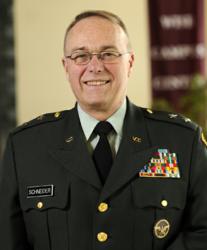
“For us, it’s all about the evidence,” said Norwich President Richard W. Schneider, who added that he was a skeptic before the trial began.

Operation Warrior Wellness, an initiative of the David Lynch Foundation, is providing TM training to troops recovering from wounds at Joint Base Lewis-McChord in Washington state. Soldiers report “dramatic improvements” in sleep, according to the foundation, as well as significant reductions in pain, stress and the use of prescription medications.

Lynch, the director of “Blue Velvet,” “Mulholland Drive” and the television series “Twin Peaks,” is a longtime practitioner of TM.

“The VA is very interested in what this can do,” Lynch said in a telephone interview Thursday. He acknowledged that many in the military are wary of transcendental meditation, with its New Age and mystic connotations.

“Big-time,” Lynch said. “They’re skeptical until they start hearing stories, or experiencing it for themselves.”

Related articles: Washington Post: Does Transcendental Meditation help veterans with PTSD? | POLITICO: Coping with PTSD | Norwich University President Receives “Resilient Warrior Award” at National Veterans Summit in Washington, DC | Huffington Post: David Lynch Brings Transcendental Meditation To D.C.

Norwich University President Receives “Resilient Warrior Award” at National Veterans Summit in Washington, DC

May 4, 2012

Norwich University President was honored with the “Resilient Warrior Award” during a National Veterans Summit in Washington, DC for his leadership in exploring the use of Transcendental Meditation in building resilient warriors

“The disturbing prevalence of PTSD among returning troops underlines the need for more effective resilience training among our cadets.” — Norwich University President Richard W. Schneider, RADM USCGR (Ret.)

Washington, DC (PRWEB) May 03, 2012

Dr. Richard W. Schneider, RADM USCGR (Ret.), the 23rd President of Norwich University in Northfield, Vt., received the inaugural “Resilient Warrior Award” for 2012 during a national summit on “Resilience, the Brain and Meditation,” held on Thursday, May 3, at the Army and Navy Club in Washington D.C.

The award was presented to President Schneider by veterans of four wars who direct Operation Warrior Wellness, a division of the David Lynch Foundation 501(c)(3) nonprofit organization, which has provided Transcendental Meditation (TM) scholarships for more than 250,000 at-risk youth and veterans and their families who suffer from post traumatic stress disorder (PTSD).

The award cites Schneider for “leading and training a new generation of resilient warriors who will safeguard America and secure the peace with honor and integrity.”

Under Schneider’s leadership, Norwich University recently completed the initial phase of a long-term, longitudinal, randomized controlled trial with 60 cadets, investigating the effects of TM on psychological distress and resilience. Key results of the first nine-week period included reduced perceived stress, improved constructive thinking, decreased state anxiety, increased behavioral coping, reduced depression and improved dispositional resilience.

“Norwich is proud to be in partnership with the David Lynch Foundation and the Educational Foundation of America for providing the resources for this wonderful effort,” Schneider said.

“The disturbing prevalence of PTSD among returning troops underlines the need for more effective resilience training among our cadets. Based on existing data and preliminary results of ongoing trials at Norwich, I believe the Transcendental Meditation technique represents an essential tool to promote resilience in cadets.”

Ed Schloeman, CMS (Ret.), national co-chair of Operation Warrior Wellness, praised President Schneider for “equipping his cadets with the most important of tools—one that will help them overcome stress and promote resilience throughout their life in the military—throughout their life. He is a great educator, a wise man, and a true leader.”

After receiving the news of the award, Schneider said: “I am honored to accept this award on behalf of all those who have worked so hard on this project to experiment with providing our future soldiers, sailors, and airmen the tools necessary to become more resilient, even better warriors, and better human beings.”

Other speakers at the Summit included W. Scott Gould, the US Deputy Secretary of the Veterans Administration, and Norman Rosenthal, M.D., clinical professor of psychiatry, Georgetown University Medical School and author of a breakthrough research study, which found a 50% reduction in the symptoms of PTSD among veterans who practice TM.

Reported in newstimes.com. Related articles: Washington Post: Does Transcendental Meditation help veterans with PTSD? | POLITICO: Coping with PTSD | Washington Post: VA testing whether meditation can help treat PTSD |

POLITICO: Coping with PTSD

May 4, 2012
Opinion Contributor
Coping with PTSD

More than 500,000 returning veterans suffer from psychological injuries, the author said. | AP Photo

By RICHARD W. SCHNEIDER | 5/3/12 9:24 AM EDT

Developing military leaders who are smart, strong and courageous — both on and off of the battlefield — is essential. We are still learning how to create soldiers prepared for the emotional wounds of war. We need to teach coping skills to help these men and women reduce the terrible effects of post-traumatic stress disorder.

Veterans, who have experienced the horrors of war, are the most common sufferers. More than 500,000 returning veterans from Iraq and Afghanistan suffer from psychological injuries — including PTSD or major depression.

But even military cadets, when in a highly disciplined and rigorous academic environment, can feel similarly overwhelmed. Under intense stress, many men and women just give up. They don’t have the tools to stay focused and grounded.

We must give them the tools they need. This means helping them to be successful socially, emotionally and in a military setting. Our future leaders need this knowledge.

Transcendental Meditation has demonstrated an ability to help those suffering from PTSD and high stress environments. Recent trials of TM’s effects on psychological distress have revealed: reduced perceived stress, improved constructive thinking, decreased state anxiety, increased behavioral coping and reduced depression. This is the focus of the David Lynch Foundation, which highlights TM’s positive effects.

TM helps military cadets become more resilient, according to Norwich University studies, so that they can be better soldiers on the battlefield as well as better equipped to recover from the traumas of war and have a normal life after returning home.

Evidence suggests that TM may help people handle the stresses that come before as well as during military service and when they return to civilian life.

A 2011 Norwich University study, with funding from the David Lynch Foundation and the Educational Foundation of America, showed the positive effects that TM can have on helping students cope with the stresses of leadership in being a member of the Norwich University Corps of Cadets. TM has proven to be a highly effective coping strategy and has set a high bar to further explorations and research.

Many cadets who enter the military will likely be exposed to trauma that can have a destructive effect on their lives and the lives of their families. Whether a veteran or a military cadet, the method of dealing with PTSD is crucial.

For these “invisible wounds” can take a high toll — on family, quality of life and work performance. There is also a greater risk for violent and self-destructive behavior.

Effective treatments have been difficult to identify. Many expensive combinations of chemicals, for example, have been explored. But TM is an evidence-based technique that is available anywhere and at any time. Those who practice it develop the ability to improve daily stresses in the workplace and in life.

The technique helps address anxiety, mood change and situational awareness. Its powerful impact can produce long-term results in improving daily lives.

The goal is clear: to develop the whole person with maximized abilities and capacity in all situations.

Richard W. Schneider, a rear admiral USCGR (Ret.) is the president of Norwich University. The David Lynch Foundation on Thursday is hosting its first annual National Summit, investigating effects of Transcendental Meditation on active-duty personnel and veterans suffering from PTSD, cadets in training — and their families.

Short URL: http://politi.co/JPLv7Z

Related articles: Washington Post: Does Transcendental Meditation help veterans with PTSD? | Norwich University President Receives “Resilient Warrior Award” at National Veterans Summit in Washington, DC | Washington Post: VA testing whether meditation can help treat PTSD

Washington Post: Does Transcendental Meditation help veterans with PTSD?

May 4, 2012

Posted at 02:45 PM ET, 05/03/2012.
This story has been updated. Previously titled: Summit Examines Use of Transcendental Meditation to help Vets with PTSD. Later published in Washington Post: VA testing whether meditation can help treat PTSD

Does Transcendental Meditation help veterans with PTSD?

By Steve Vogel

Seeking new ways to treat post-traumatic stress, the Department of Veteran Affairs is studying the use of transcendental meditation to help returning veterans of Iraq and Afghanistan.

“The reality is not all individuals we see are treatable by the techniques we use,” said W. Scott Gould, deputy secretary for the Department of Veterans Affairs, told a summit on the use of TM to treat post traumatic stress Thursday in Washington.

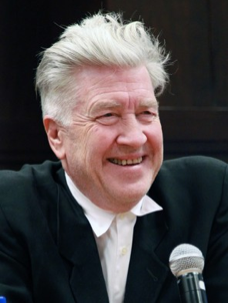
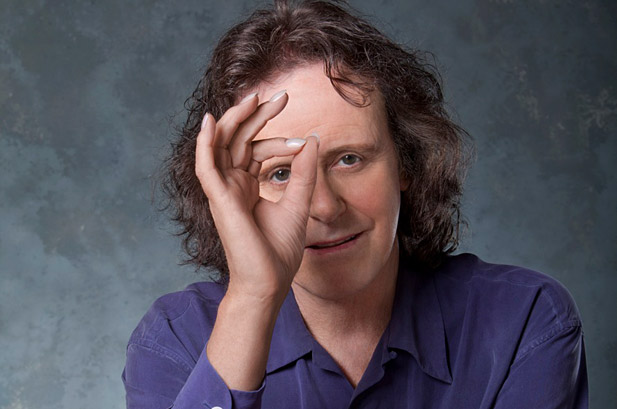
Director David Lynch founded a charitable organization that funded a summit on using Transcendental Meditation to treat military veterans with PTSD. (David Livingston – GETTY IMAGES)

The VA is spending about $5 million on a dozen trials involving several hundred veterans from a range of conflicts, including Iraq and Afghanistan. Results from the trials will not be available for another 12 to 18 months.

But Gould said he was “encouraged” by the results of trials which were presented at the summit.

Two independent pilot studies of Iraq and Afghanistan veterans showed a 50 percent reduction in symptoms of post-traumatic stress after eight weeks, according to the summit’s sponsor, the David Lynch Foundation, a charitable organization founded by the American filmmaker and television director.

Results from the initial phase of a long-term trial investigating the effects of Transcendental Meditation on 60 cadets at Norwich University, a private military college in Vermont, have been encouraging, school officials said at the summit, held at The Army and Navy Club.

Students practising TM showed measurable improvement in the areas of academic performance and discipline over a control group. “The statistical effect we found in only two months was surprisingly large,” Carole Bandy, an associate professor of psychology who is directing the study at the university, said at the summit.

“For us, it’s all about the evidence,” said Richard W. Schneider, president of the university, who added that he was a skeptic before the trial began.

“Conventional approaches fall woefully short of the mark, so we clearly need a new approach,” Norman Rosenthal, a clinical professor of of psychiatry at Georgetown University Medical School.

Operation Warrior Wellness, a division of the foundation, is providing TM training to troops recovering from wounds at Joint Base Lewis-McChord in Washington state. Troops report “dramatic improvements” in sleep, according to the foundation, as well as significant reductions in pain, stress and the use of prescription medications

Lynch, the director of “Blue Velvet,” “Mullholland Drive” and the television series “Twin Peaks,” is a longtime practitioner of TM, a meditative practice advocates say helps manage stress and depression.

Related articles: POLITICO: Coping with PTSD | Norwich University President Receives “Resilient Warrior Award” at National Veterans Summit in Washington, DC | Huffington Post: David Lynch Brings Transcendental Meditation To D.C.

Donovan and Deepak talk about meditation, music, on abc carpet & home via livestream

May 2, 2012

Astrid Stawiarz/Getty Images

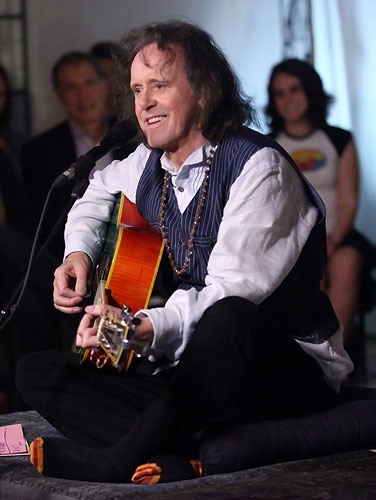
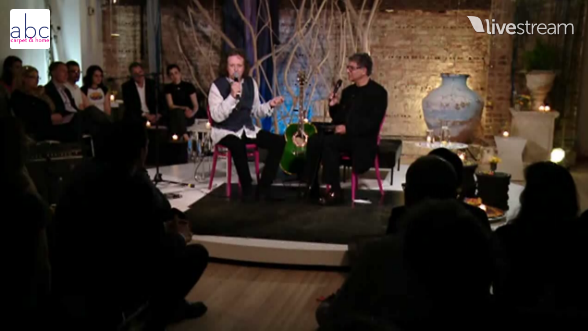
Here’s an online streaming event with Donovan and Deepak talking about the old days with Maharishi, Transcendental Meditation, The Beatles, and the music from the 60’s. Thanks to Linda, Donovan’s wife and muse, for suggesting Donovan be on this special event: http://livestre.am/1IWyp on abc carpet & home via @livestream.

Also see: Donovan shares his excitement and fulfillment after playing at the Rock and Roll Hall of Fame | Billboard interview: Donovan Q&A: Catching Up With a Folk Rock Superman | Ode to Donovan by Meghan for Altavoz: Conan introduces Donovan while holding the DLF Music vinyl box-set “Music That Changes The World” | Donovan Inducted into Rock and Roll Hall of Fame | Donovan and Ben Lee on Good Day LA | The former Beatles Paul McCartney and Ringo Starr reunion for David Lynch’s benefit concert airs on New York’s THIRTEEN, Sunday, April 29

Maharishi University of Management featured in Education Executive Magazine — Spring 2012

April 14, 2012

Maharishi University of Management

Higher Education – Spring 2012 (pages 62-63)

Open Mindedness

Transcendental Meditation® helps students at Maharishi University of Management enhance their learning, the institution says.

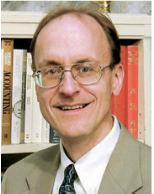
All successful administrators believe firmly in the missions of their institutions, but the connection runs deeper for Dr. Craig Pearson, executive vice president of Maharishi University of Management (MUM). After graduating from Duke University in 1971 and feeling disillusioned from the tumultuous impact of the Vietnam War, Pearson discovered the practice of Transcendental Meditation (TM).

“I saw a need for change, and I wanted to participate in that and I wanted it to be meaningful,” Pearson says. “Finally, I realized it would be a nice contribution to make to this society that I lived in if I taught TM.” After he became versed in teaching TM, Pearson discovered an opportunity to teach at MUM, and what has followed has been a learning experience that has lasted more than 30 years.

“I’ve had just an amazing range of opportunities and experiences here,” Pearson says.

Located in Fairfield, Iowa, MUM was founded on the practice of TM, brought to light from the ancient Vedic tradition by Maharishi Mahesh Yogi, a Vedic sage who taught the practice in his native India before traveling the world with it. Not a religion or philosophy, TM is a simple, effortless technique practiced for 20 minutes at the start and end of each day that allows the mind to settle to a state of inner quiet. Those who practice TM say it can help expand consciousness and expand the mind’s capacity for learning. This is why the university’s approach is called Consciousness-BasedSM education.

“This is huge for education,” Pearson says, adding that studies have shown growth of intelligence and other measures of personal development to level off during adolescence. Practicing TM, research suggests, unfreezes that potential and allows the mind to continue growing.

Same, But Different

Aside from the beginning and end of each day, when students and faculty join in practicing TM, Pearson says MUM offers the same curriculum one would find at a top university elsewhere in the world. “If you or anybody were to come to MUM and walk around during the day, you would find a lot that’s similar to what’s going on in universities around the world,” he says. “If you were to go into a Shakespeare class, it’s the same Shakespeare.”

Where MUM differs from other universities, of course, is the 20-minute TM sessions twice a day, built into the daily schedule. Pearson says this has a profound impact on the campus culture and in the performance of its student body and the overall feeling on the campus. Pearson says TM significantly reduces stress and mental fatigue by allowing the mind effortlessly to relax and settle inward rather than focus on the outside world.

“These days, one of the things most problematic on college campuses is stress,” he says.

Through TM, students at MUM are able to expand their consciousness to a point where learning and personal growth are practically unlimited, Pearson claims. The implications for higher education are significant, he adds. “Now human development can be unfrozen, now it can continue to develop,” he says, adding that the university has found student IQs increase after enrolling. One study, for example, found IQ to increase an average of 4 points after one year and 9 points after 4 years.

Expanding Future

The university’s application of TM in the curriculum has implications for more than student performance and stress levels, Pearson says. It also affects enrollment trends, as nearly 75 percent of MUM’s student body consists of transfer students from other institutions. Most of them discover the university on the Internet, but an increasing number are hearing about it by word of mouth.

“Since that’s our mission, students come because they’re attracted to the mission,” Pearson says. “They transfer because they’re not satisfied with where they are.”

As the concept of meditation becomes more popular through yoga classes and other fitness regimens, MUM has seen a long-term upswing in enrollment. The university’s current enrollment of about 1,100 is double what it was five years ago, and nearly triple what it was 10 years ago, according to Pearson. “Now, meditation is mainstream and the idea of meditation in education isn’t so unusual,” he adds.

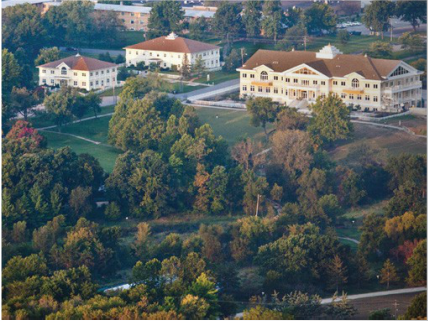
To deal with the continuing growth, the university 11 years ago embarked on an ambitious campaign to reconstruct its campus. Originally built as Parson’s College before it closed in 1973, the MUM campus has torn down 45 old buildings and has invested substantially in renovating a number of others. Additionally, 60-plus new buildings have been constructed on campus. The newest building is the university’s Sustainable Living Center, which, when completed, will be unique in the world, embodying four different sustainable building philosophies and completely off the grid with respect to heating/cooling, electricity, water, and sewage. Pearson says the university’s commitment to sustainability is another attractive feature for many students, citing the campus’ all-organic, vegetarian menu.

Pearson says the university hopes to reach an enrollment of 2,000 in the years to come, with a long-term vision of approximately 8,000 students. To help achieve that goal it has established an endowment campaign with an initial goal of $50 million. Pearson says the campaign has received some very good initial support, and that those funds will be used for scholarships, faculty support, academic programs, and campus development.

Seeing the university grow has been a rewarding experience for Pearson, and he says he believes the education students receive at MUM will give them a consciousness-based approach to decision making that will be needed to solve the world’s greatest problems.

“It’s one thing to change the way we get our power or food, but our students recognize there needs to be a change in the kind of consciousness that created those types of problems, and I’m very inspired by that,” he says.

—Chris Petersen

Copyright 2012 Education Executive Magazine. All Rights Reserved.

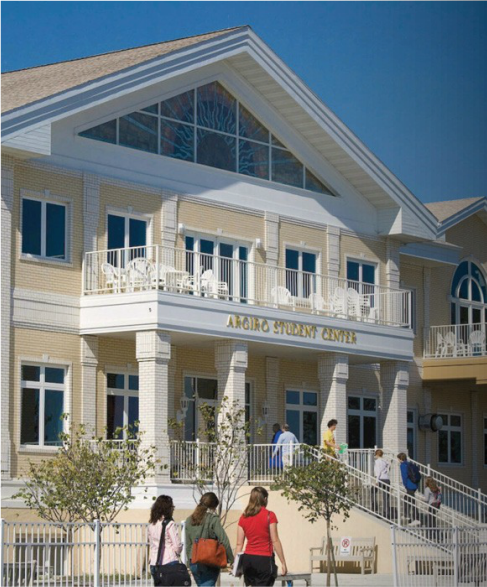
Links to the online version with only one photo: http://www.education-executive.com/index.php/higher-education/1125-maharishi-university-of-management and digital edition: http://www.nxtbook.com/nxtbooks/phoenix/eduexec_2012spring/#/64 of the two-page layout containing photos of Craig Pearson, Argiro Student Center, MUM campus, and the Aladdin Food Management Services ad.

Finding peace in Fairfield by Diane Vance

April 13, 2012

Finding peace in Fairfield

By DIANE VANCE, Ledger staff writer | Apr 12, 2012

At the Transcendental Meditation Blog, www.tm.org/blog, Mario Orsatti wrote on April 4, the TM.org website was flooded with visitors the week following Oprah Winfrey’s televised take on TM, Fairfield and her October visit here.

The hour show, one in her series of “Next Chapter” programs first aired on the Oprah Winfrey Network TV channel April 1. It was repeated on Easter Sunday and will air again at 6 p.m. this Sunday. Video segments also are available online.

It’s resulted in “thousands of Americans learning the TM technique,” Orsatti wrote.

While Oprah’s endorsements have propelled other products, some may doubt her embrace of TM will make much difference in Fairfield.

However, the planners and shakers in the TM community are preparing.

A summer session will be newly offered at the Maharishi University of Management, moving its annual graduation ceremony to May 26, rather than its typical mid-summer date.

“Experience the Self” course, offered as a one- or two-week course in July, promises to address consciousness, one’s body and mind, allow participants to discover sustainable living projects, relax in nature and celebrate the cultural opportunities of Fairfield.

As I mentioned in my introduction column the fourth day of Ledger employment in October, I was a student at M.U.M. in the Spring 2010 semester. It was not my first time on campus.

I moved to southeast Iowa in the summer of 1997 with my former husband and two children. We had moved after five years in a small town north of Davenport, after my spouse left 13 years of active duty Army in 1992. (Yes, this San Diego native has now lived in the Midwest 20 years!)

At my job at Keokuk’s newspaper the Daily Gate City, I heard remarks about those weird “flyers” up in Fairfield.

As the education reporter, many press releases from schools around the state and region passed through my desk. I began learning more about M.U.M.

When Vedic City, became incorporated, we drove up here to look around. Dirt lanes took us past cute little white houses with golden topknots and white picket fences.

In October 2007, my spouse and I traveled to Fort Hood, Texas, (where we lived in 1981) to hug our youngest good-bye. His Cavalry Scout unit was deploying to Iraq for 15 months. He was on the older side of 23 years of age.

Having a child at war makes it hard to breathe.

He was at a remote place in the Diyala Province. His care packages needed to include the basics, such as razor blades, toothpaste, etc. He asked for canned soup because it could be heated on the Bradley’s radiator when they spent days at a time away from base camp.

Sending a small Christmas tree and chocolates (chocolates and other meltables can only be mailed October-March) comforted me probably more than my son.

Still, the weeks dragged on. And on. I had a large wall map of Iraq on the wall of my cubicle. I read daily Associated Press stories about Iraq and the U.S. military. I always volunteered to do the stories on local veterans and active military.

When a press release about an April 2008 David Lynch weekend landed in my in-box, I investigated.

The TM promise of stress relief kept calling. I signed up, received a scholarship for the four-day weekend, came to Fairfield and fell in love with this place.

I was delighted to see, and hear, John Hagelin, because I had watched “What the Bleep Do We Know” video a few years earlier. I was astounded to see Donovan, a musician from my youth! And though I didn’t know who David Lynch was, I enjoyed his interaction with all of us visitors that weekend.

I traipsed around in the light rain and mud to view the on-campus green house and one of the golden domes. I ate organic, vegetarian meals (new experience).

And yes, I learned TM that weekend, in a comfortable, non-threatening space from a sweet woman, Linda Mainquist, who happens to be married to Mario Orsatti, where I started this column.

I have to admit to being sort of a slacker; I don’t always make time in my day for 20 minutes each morning and evening. But TM has helped with my stress levels — a good thing!

My son returned from Iraq in January 2009 having survived through two I.E.D.s blowing up the Bradleys he rode in.

And I have survived — and hopefully thrived; through my son-in-law’s year deployment to Guantanamo in 2008; both Army “sons” in Iraq in 2009 and 2010; and my divorce in 2010.

Calming peace is good to have in any form it comes.

Diane Vance is a Ledger staff writer. See other Columns by Diane Vance.

Reprinted with permission from The Fairfield Ledger.

See NPR: Fairfield, Iowa: Where ‘Art Belongs To Everyone’

Billboard interview: Donovan Q&A: Catching Up With a Folk Rock Superman

April 12, 2012

In the three months since Donovan received the news that he will be inducted into the Rock and Roll Hall of Fame, he has stepped up his activity in front of the film, TV and music industries. He performed at  the Sundance Film Festival, made numerous private performances for music supervisors and delivered a sold-out chat and performance at L.A.’s Grammy Museum.

“Good Day L.A.,” the morning show of the Los Angeles’ FOX affiliate, devoted daily segments to Donovan during the last week of  March, culminating in a live performance on March 30. Next up is the induction ceremony on April 14, which will be followed by Sony Legacy’s release of “The Essential Donovan” on April 17. HBO will air the Hall of Fame ceremony/concert on May 5.

In an interview held at his daughter’s home in the Hollywood Hills, Donovan spelled out his plan for the Rock Hall concert. “‘Sunshine Superman’, I cannot not play, but I would like to preface it with an acoustic song, probably ‘Catch the Wind.’ We’ll follow with ‘Season of the Witch.’ It looks like Jim James of My Morning Jacket (will join in). We played together at Radio City for the meditation concert and I got on really well with him so I will have the younger generation there.”

The meditation concert he referred to was held in 2009 for the David Lynch Foundation that funds the teaching of Transcendental Meditation for school-age children. Donovan, who turns 65 in May, has been an avid supporter of the Lynch Foundation, contributing a track last year to “Download For Good: Music That Changes The World.” A copy of the CD was on the coffee table so our conversation, which would touch on  poets from the 18th century up through the Beat Generation, Bob Dylan and his last studio album, the underrated 2004 release “Beat Café,” began with TM.

Billboard: Last year we heard a new song from you, “Listen.” As one of the first and most visible people to experience TM in India, how has it affected your music?

Donovan: In the early days when the Beatles and I went to India and returned, we knew our fans should have it and then the world should have it. We needed it. Flash forward 35 years later (April 4, 2009) and Paul (McCartney) and Ringo (Starr) and Donovan and David Lynch are on the stage at Radio City Music Hall announcing to the world how schools have applied this meditation. Fear and anger and doubt have been subdued somewhat. It doesn’t mean that you’ll never be angry or filled with doubt again, but you won’t hold on to it —  all things the Maharishi spoke of. This one was designed to be very applicable to the Western way of thinking. My dream was to (figure out) how do we bring in a new generation of songwriters? As it progressed, I wrote songs with meditation in them. The Beatles wrote songs with meditation in them.

What was the first song you were aware of writing because of TM?

“Happiness Runs” is the most direct one, which I wrote while in India with the Beatles and one Beach Boy (Mike Love) and Mia Farrow. Before India in ’68 I was always looking for songs where people could sing along. It’s part of the job to be a poet, folk singer — children’s songs, rounds, circular songs. And so I made this circular song “Happiness Runs” and it directly references meditation because it says ‘happiness runs in a circular motion/thought is like a little boat upon the sea.’ Simple words, but profound. More rocking was the “Hurdy Gurdy Man.” In the 18th century the hurdy gurdy man played the instrument the hurdy gurdy and he traveled from town to town and he brought the news. So I related the hurdy gurdy man in the song to the teacher, the Maharishi, who brings us songs of love.

When you said meditation affected your songwriting, the first thing I thought of was “There is a Mountain.” What’s its origin?

It comes from a Zen haiku, but it is a koan as well — the clever question asked of the student by the Zen master. “First there is a mountain, then there is no mountain, then there is.” “The caterpillar sheds its skin/to find the butterfly within.” It’s very literal. If we could discard our skin, our hard husk of persona, it’s an obvious description that inside there is a softer human. I found (sayings) in old books and by putting them into songs, I hoped they would trigger a question in the listener. By giving it a rhythm it has an attraction — people were singing my lyrics not knowing what they were about.

On a certain level, you were far ahead of your time. Musicians of the last decade seem to understand you better than the musical community of the 1980s and ’90s. Have you sensed that?

I could sit cross-legged in front of 20,000 people and play solo with one guitar (in the early 1970s tours) and a pin could drop and (be heard). I assumed even then, that everything I was singing they knew. It was just a veil hiding it. That didn’t mean that the outside world would understand the Donovan magic or the songwriting. But I have been recognized, extraordinarily so, by the audience. We’re talking 17 top 100 singles, selling out all the great concert halls of the world — Sydney Opera House, Hollywood Bowl, Royal Albert Hall, Carnegie Hall. One gets recognized by one’s peers and journalists who have a lot of experience and have studied and know where the various parts of my music came from.

There were so many facets to your music – there was a dramatic change from “Catch the Wind” to “Cosmic Wheels” and that’s just 10 years. What made you want to be more than a folk singer and bring so many other elements into your music?

I’m a sponge. When I was younger I absorbed so much music and (the story) is always the same — passed on by an older Bohemian who has a house that becomes a crossroads for visitors. Such a one was in the town of St. Albans for me. Such a one was in Minnesota for Dylan. It’s where the older Bohemian says I know what you’re up to; you better spend a few days with my record collection. In it is everything – folk, jazz, blues, classical, baroque, spoken word. I was so fascinated that I absorbed all of the styles, even the antique music of Sicily, rare flamenco from 1928. It was fascinating to me that I started dressing my lyrics in all kinds of costumes musically. Many of my contemporaries had one or two styles — folk, blues. But when I did “Sunshine Superman,” begun in 1965 and finished in May 1966, and presented so many genres blended, it was a natural thing to me. It represented what the Bohemian said: all the cultures should share the planet. That meant be brave, break the rules and walk over the genre lines and blend. I could see how it made me difficult to pin down.

At the beginning of it all, though, was folk music.

It was. (As a young boy) all the relatives would come around, the room would be cleared and a chair would be put in the middle. And a slightly tipsy relative would be pushed into the chair to sing their one song. These songs I didn’t know at the time, were folk songs from the Scottish and the Irish, about the troubles and the migrations.  Only later, when I was 15, did I learn these were called folk songs. After that my father’s record collection of Sinatra and my mother’s Billie Holiday and five-piece jazz groups from the ’30s and musicals. When I was 15 ,that would be Everly Brothers and Buddy Holly and I’d collect all the records. At 16, I plugged into a (college) campus for nine months and became aware of the older Bohemians who introduced me to the jazz club, the folk club and the coffee house and the art school and soon the blues club. After that it was easy for me to fuse (styles); I just wanted to see how far it could go. The base is always the same – the guitar and the vocal.

At some point early on, you made the decision to write songs, which many folk singers of the early 1960s did not do.

I much more wanted to be recognized as a poet than as a musician. Poetry is still looked upon as something ineffectual, narcissistic. In actual fact, the Bohemian poets in the ’40s,  their mission was to return poetry to popular culture. When you bring a poet into popular culture, two lines from a poem can alter a whole nation, it can bring a government down. The beat poets were wrong when they thought poetry would come back on the wings of jazz. Some poets were improvising with jazz improvisers in clubs, but improvisational poetry only works within improvisational music. When folk jumped into bed with rock, the form of the folk ballad would allow the new lyric (to thrive), first with Bobby Dylan then with myself and Joni Mitchell, Leonard Cohen, Neil Young. The Beatles realized it, too. They were from the Irish tradition of social activism  (in poetry) but didn’t know it. I somehow knew it, because my father had brought me up reading poetry to me of social change.  Before I heard Woody Guthrie, my father was reading poems of social consciousness to me —  Wordsmith, Coleridge, Shelly. I got fired with the zeal that we could bring something (literate) to the fans of pop music to get their teeth into.

You arrived in the U.S. as a folkie but sign to Epic and become a rock star. A conscious decision?

It came to a boil in May 1965 when Joan (Baez), Bobby and I met (as documented) in (the film) “Don’t Look Back.” At the time, folk singers, classical and jazz musicians released albums, pop music went on 45s. I was a bit ahead, releasing a single. That bit of harmless plastic, the 45, I realized was cheap, available and millions of Baby Boomers bought them. There was already something going on that I was joining (socially conscious folk-rock music). But the folk singers rebelled,saying ‘We’re not plugging in our banjos and guitars.’ Nobody understood that folk could meet pop or rock.

It wasn’t until 2004 when you did “Beat Café” that you really exposed the importance of poets on your work. Why did you decide the time was right for that project?

I was exploring the Bohemian cooking pot that was going on when folk and jazz and poetry were mixing in these special hangouts. (Producer) John Chelew suggested that I and (the bassist) Danny Thompson (record). He said ‘That’s unique when you and Danny play a drone. I’ll pay for it. Come in and we’ll do the drone for an hour.’ Before I went in, I couldn’t do just a drone. We were recording at Capitol so I thought I’ll write a song for Danny that will be like Peggy Lee’s ‘Fever.’ I’ll get  a bass line going and I’ll write about when we used to play in the clubs. It was simple. We went into the studio and did the track. My wife, Linda, was in the studio. She knows her stuff and says there’s only one drummer who can join this thing, (Jim) Keltner. In came Jim. Set up his whole kit never knowing what it was about, having never played with Danny. He’s got the big kit set up and  I went (sings bass line). He looked at me laughed, ‘OK I’m in.’ And we sang about life in the beat cafes.

Good as the album is, the shows were even better – you mixed talk about poets and their affect on your writing.

San Francisco was particularly touching because Michael McClure was there. He jumped on stage and did (a poem). In New York, in Joe’s Pub, a girl stood up on a table and pumped it out. Nobody knew her. I took it on tour in the U.K., but it wasn’t the same. Before I took it on tour, I said it can only be in a small room, a  Bohemian café and there just aren’t enough of them.

You’ve been active this year, getting out to places such as the Sundance Film Festival to perform at the BMI Snow Ball and at the musical instrument trade show NAMM. What will come out of this activity?

The music supervisors have always been friends of mine and (publisher) Peermusic is introducing me to all these (projects). I would love to do a soundtrack with the right director – I have a love of cinema and by extension TV and commercials. I’m fascinated that Gibson wants to make me a custom cherry red J-45, which I used for every album up through 1969. It was stolen in 1970 — a fan walked into a stadium in 1970 and out with the J-45. It’s never been returned. I carried around the J-45 nostalgically as a second guitar while I played my new custom guitar, the moon shaped guitar designed by Tony Zemaitis. When Gibson heard there was a wanted poster out, they decided to make a guitar. To have a custom guitar and then possibly a line of guitars for my fans, that’s a lovely thing.

VIDEOS

These videos were embedded in the interview: “Catch the Wind” — 1964, “Cosmic Wheels” — 1972, and Bob Dylan And Donovan.

Donovan Tribute Week on Good Day L.A. All week they were saluting Donovan as he gets inducted into the Rock and Roll Hall of Fame. Watch the Interviews in their Video Player.

Donovan Tribute Week, Poe Performs “Season Of The Witch”

Eric Burdon “Spills The Wine” Saluting Donovan!

Jackie DeShannon “Puts A Little Love In Our Hearts”

Smothers Brothers’ Tommy Gives “Big-ups” to Donovan

Spencer Davis “Keeps On Running” and Salutes Donovan!

Donovan Week Continues With Tribute From Jon Anderson of “YES”.

The Essential…Donovan!! – Live On Good Day L.A.: interview and singing

Listen to WKSU: Scottish singer-songwriter looks back at his career with WKSU’s Bob Burford: Donovan still mellow as Rock Hall honors awaits

Visit http://www.donovan.ie/en/ for more interviews.

Related posts: Ode to Donovan by Meghan for Altavoz: Conan introduces Donovan while holding the DLF Music vinyl box-set “Music That Changes The World” | Donovan Inducted into Rock and Roll Hall of Fame | Donovan and Ben Lee on Good Day LADonovan GDLA and Off-Ramp Interviews | Donovan to be Named Icon at BMI London Awards | Mellow Fellow Donovan



Meditation key to finding balance for Paralympian Daniel Westley — special to The Vancouver Sun

April 5, 2012
By TOM HILL, Special to The Sun April 4, 2012

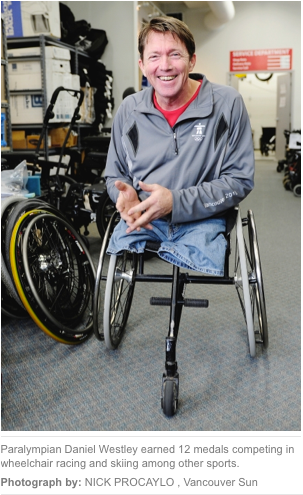
Daniel Westley has been on so many podiums you’d think he’d been playing sports all his life. In fact, he had barely shown any interest in athletics until after a tragic accident forced doctors to amputate both of his legs.

While in the hospital, Westley happened to meet a young Rick Hansen who, years before raising millions for spinal cord injury research, introduced Westley to wheelchair athletics.

Westley was hooked. After being released from the hospital he started playing sports as much as possible, earning his spot in the 1988 Paralympic Games in Seoul, South Korea.

“I happened to get involved in 1988 and at that time they embraced disabled sports.” recalls Westley, who lives in New Westminster.

But as the Paralympic Games grew in size and popularity, so too did the pressure of training and competing on the world stage. Westley was now participating in both the summer and winter games in a wide range of sports that included everything from wheelchair racing to skiing.

“Any given day I was racing two and three times a day,” he explains. “It was a pretty high intensity to be competing at.”

To perform at the highest level, Westley relied on Transcendental Meditation, a technique that involves two 15- to 20-minute sessions each day and promises a clear and quiet calmness for its practitioners.

”It gave me a chance to settle down and recover from my training,” he says. “I thought that if I wanted to do really well, I’d have to rest really well.”

With his meditation keeping him centred, Westley certainly did do well, going on to win 12 Paralympic medals – four of which were gold medals – in five Paralympic Games.

And yet, for Westley, who now works in sales for a home medical equipment company, the positive influence of meditation extended far beyond sports and has helped him sustain a positive attitude in all facets of his life.

“If you really step into the moment and are really relaxed then the outcomes take care of themselves.”

See the excellent accompanying Sun video report: story.html?tab=VID.

Empowered Health airs Thursdays on CJDC at 11 a.m.; CHEK-TV Vancouver and Victoria, CFJC and CKPG at 7 p.m. and CHAT at 7:30 p.m. The show is broadcast Tuesdays on CFTK at 11:30 a.m. You can also view episodes online at vancouversun.com/empoweredhealth.

© Copyright (c) The Vancouver Sun

Related: Watch this inspiring Chek TV program: North of 49: A guide to the rest of your life: Former paralympian Daniel Westley talks about achieving balance in your life as you head North of 49 from Season 2, Episode 1.

Later reported in the TM Blog: Paralympic Medalist Daniel Westley Relies on TM to Ease Training Pressures

Midwest Meditation: ingathering in rural Iowa, published in issue 12 of The PresenTense Group

March 30, 2012

“Small-town Iowa is not the place one expects to find a blossoming Jewish community. However, Fairfield is different from most Iowa towns.”

This opening statement to an excellent article about Fairfield Jews who meditate reiterates what Oprah Winfrey kept saying during her visit to Fairfield, Iowa—Jews, Christians, Muslims, people from different religions, who also meditate (Transcendental Meditation) find no conflict with their beliefs; they’re not practicing another religion. And for those who do practice their religion, this article shows there’s no confusion between the two, rather an enrichment. TM, they say, makes one a “better Jew.”

I enjoyed reading Midwest Meditation, a well-written article by James Edward Johnson, published in the Around the World section of Fall 2010-Issue 12, by The PresenTense Group: Fostering Innovation. It’s available online. Here it is reproduced for your reading enjoyment.

Small-town Iowa is not the place one expects to find a blossoming Jewish community. However, Fairfield is different from most Iowa towns. Much of its population began moving there in the mid-1970s, when the Maharishi International University (now Maharishi University of Management, or MUM) was founded. MUM is the learning and communal meditation center for the Transcendental Meditation (TM) Movement, in which members use TM techniques to achieve a deeply tranquil level of consciousness and a state of restful alertness.

Brent Willett, the executive director of the Fairfield Area Chamber of Commerce, explained that in the 30-plus years since the influx of TM practitioners, “Fairfield has become a melting pot of cultures and has developed a harmonious and dynamic model for community development.”

Among Fairfield’s population of 9,500, approximately 200 residents are Jewish, and nearly all of them are TM practitioners. When Jewish TM practitioners came to Fairfield, there was no established community, and the nearest synagogue was 25 miles away. Though they had not come for a Jewish community, they created one when they arrived. MUM was established on the former campus of Parsons College, where a Torah scroll was left behind by the college’s Hillel chapter. It was the first major asset of the Fairfield Jewish community.

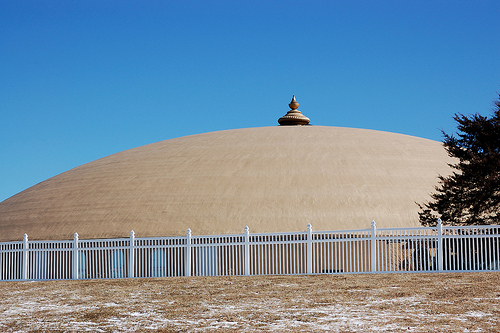
Today, the community holds most Kabbalat Shabbat services at Congregation Beth Shalom, a building that functioned as a Baptist church before the Jewish community purchased it in 1984. The unassuming synagogue looks like a place of Jewish prayer in any small Midwestern town. The ritual items and decorative symbols show no indication that most congregants are TM practitioners. Yet before Kabbalat Shabbat services, most Jews join communal meditation at one of Fairfield’s two gigantic golden domes.

The larger community of committed TM practitioners in Fairfield is disproportionately Hindu, due to the Hindu background of TM’s founder Maharishi Mahesh Yogi. Pictures of Hindu gods such as Rama and Ganesha appear in many places around Fairfield. Jewish TM practitioners explain with the regularity of a mantra that “TM is just a technique,” rather than a religious practice. “The important thing in the practice of TM is this experience of unbounded awareness. That reality is not a religious reality and has no connection with a specific religious tradition,” explained Rabbi Alan Green, who lives in Canada but has deep roots in Fairfield and is unofficially regarded by many as its rabbi. “Meditation was my chief inspiration for wanting to become a rabbi…I realized that this experience of unbounded awareness was the experience of God,” Green said.

“It’s like going to yoga class…it doesn’t mean that you are Hindu… You go on and go to shul afterwards,” said Kabuika Kamunga, a Jewish TM practitioner born in Kinshasa, Democratic Republic of Congo. She converted to Judaism after working as an au pair for a Jewish family and developed an interest in meditation from a TM practitioner “who was so calm … amid the family brouhaha” at a Passover Seder. In 2008, she went to MUM to get an MBA and learn meditation.

Robert Rabinoff, a frum Jewish TM practitioner, explains why the transition between Judaism and TM is so clean. “If you try and mix the two, both will suffer. But they’re pretty easy to not mix.”

Kamunga and Rabinoff both express the idea that TM makes one a “better Jew.” Each believes that TM prepares them for the kavanah (spiritual intention) of prayer, giving them the mindfulness for Jewish observance. Rabinoff explained, “TM makes the connection, opens the lines of communication. Our tradition tells you what to say.”

Joel and Joy Hirshberg’s home resembles those of other Jews who are serious meditators. A mezuzah greets one at the door. However, the house is built according to the principles of Sthapatya Veda, the architectural form based on the Maharishi’s teachings about natural law. Its entrance faces east, the direction of the rising sun. It has a kalash (cupola) on its roof, connecting the house to the cosmos, and a traditional vastu fence (picket fence) to define the homestead. The house has a Brahmasthan, an unobstructed center lit by a skylight, which gives the house wholeness.

When the couple hosts potluck dinners at their home on Shabbat, however, the space transforms into a typically Conservative minyan for services. Congregants read from Siddur Sim Shalom and recite much of the service in Hebrew. On many Shabbatot, cantor Haim Menashehoff, who grew up in Tehran, leads the congregation in Persian Jewish melodies as well as melodies common to American synagogues.

Anyone hoping for a service infused with the style of a kirtan mantra (a Sanskrit call-and-response chanting form) would be sorely disappointed. Tradition is alive and well in this otherwise nontraditional Jewish community.

Link to article: http://presentense.org/magazine/midwest-meditation.

A clarification from my side

Although the author wrote a very clear accurate article on this topic, he does make an inaccurate assumption—that most of the meditating community are Hindu because of TM’s founder, Maharishi Mahesh Yogi’s background—but this is just not the case.

Maharishi was a great scientist of consciousness. He taught a systematic method of meditation, a scientific understanding of it, and the nature and development of consciousness to its full potential. Is the theory of Relativity Jewish because Einstein discovered it? Is gravity English because Sir Issac Newton discovered it? Is genetics Catholic because Gregor Mendel discovered it? Maharishi’s cultural and religious background are separate from what he taught. In fact, he always said that Transcendental Meditation would allow people from different backgrounds to better understand and appreciate their own religion. That’s certainly been the case here as people from different faiths attend the church or temple, and in this case, synagogue, of their choice.

Actually, there are very few Hindus in Fairfield. But there are students from many different countries and faiths, including many from India and Nepal. The campus is multinational, like a miniature United Nations. Also, there are more restaurants per capita than San Francisco. For example, there are 3 Indian restaurants around the town square, including several Asian ones, not necessarily run by meditators. They all have posters on the walls from their religious and cultural heritage. So it is easy to imagine how the author could have come to such a conclusion.

There are, however, hundreds of Vedic Pandits from India who also practice TM that have been invited to help create world peace by adding their numbers to the overall effort. But they live completely separate from everyone on their own campus in Maharishi Vedic City, a few miles north of Fairfield, and are never seen in town. Oprah did meet with them during her visit here. It’s the last segment of her show.

Click here to see Video segments of Oprah’s Next Chapter on OWN: Oprah Visits Fairfield, Iowa—“TM Town”—America’s Most Unusual Town.