Posts Tagged ‘Poetry’

Upon waking uP by Ken Chawkin

June 3, 2012

I enjoyed this poem What To Remember When Waking by David Whyte and remembered one I had written seven years ago on waking up.

Upon waking uP
Smritir labdha*

when waking in the morning
becoming conscious
before letting in the world
busying the mind
listen to your small still voice
telling its story
it’s where the All speaks to you

wave becomes ocean
fathoming the silent depths
ocean becomes wave
crashing on the shore of life
it all sounds so clear
you understand everything
memory’s restored

* I have regained memory.
(Bhagavad-Gita 18.73)

© Ken Chawkin
March 2, 2005
Fairfield, Iowa

Here’s a humorous poem I just wrote on the subject: A Wake-Up Haiku.

A Wake-Up Haiku

May 31, 2012

A koan is an unsolvable riddle meant to stop a Zen meditator’s analytical mind from thinking, and hopefully transition into a state of no-thought, the state of transcendence. There is a classic Zen koan meant to do just that, which asks the question: What is the sound of one hand clapping? Here is one tongue-in-cheek answer meant to enlighten or wake you up.

A Wake-Up Haiku

Solve this Zen koan:
The sound of one hand clapping?
A slap in the face!

© Ken Chawkin, May 30, 2012, Fairfield, Iowa

Luckily there is a simpler way—the effortless practice of Transcendental Meditation, which allows the conscious thinking mind to transcend. With the help of a mantra, a specific harmonious suitable meaningless thought-sound, together with step-by-step instructions from a qualified TM teacher, the mind naturally, effortlessly settles down to lesser and lesser states of mental activity, to the least excited state of awareness, when the thought drops off, leaving the mind without an object of attention, yet deeply restful and alert, fully awake inside. This inner unbounded wakefulness is the basis for all clarity, energy, and creativity after meditation.

TM allows the mind to experience its own essential nature beyond thought—transcendental consciousness or pure awareness, called turiya in Sanskrit, a 4th major state of consciousness at the basis of the other 3 relative states of consciousness—waking, dreaming and sleeping. With regular practice, over time, a natural integration occurs in the nervous system as it unfolds its inherent ability to live the two states simultaneously—a 5th style of functioning called Cosmic Consciousness. With continued practice, utilizing advanced techniques, including the TM-Sidhi program, the evolution of even two more states of consciousness develop—a 6th, God Consciousness, a refined experience of the 5th; and ultimately a 7th, Unity Consciousness, where the individual is truly universal.

Related posts: Words—a poem on the nature of words and mindUpon waking uP by Ken Chawkin | Are all meditation techniques the same?John Hagelin — “Only Higher Consciousness Can Transform Our World” — Beyond Awakening Blog and THP: How Meditation Techniques Compare.

What To Remember When Waking by David Whyte

April 30, 2012

WHAT TO REMEMBER WHEN WAKING

In that first
hardly noticed
moment
to which you wake,
coming back
to this life
from the other
more secret,
moveable
and frighteningly
honest
world
where everything
began,
there is a small
opening
into the new day
which closes
the moment
you begin
your plans.

What you can plan
is too small
for you to live.

What you can live
wholeheartedly
will make plans
enough
for the vitality
hidden in your sleep.

To be human
is to become visible
while carrying
what is hidden
as a gift to others.

To remember
the other world
in this world
is to live in your
true inheritance.

You are not
a troubled guest
on this earth,
you are not
an accident
amidst other accidents
you were invited
from another and greater
night
than the one
from which
you have just emerged.

Now, looking through
the slanting light
of the morning
window toward
the mountain
presence
of everything
that can be,
what urgency
calls you to your
one love? What shape
waits in the seed
of you to grow
and spread
its branches
against a future sky?

Is it waiting
in the fertile sea?
In the trees
beyond the house?
In the life
you can imagine
for yourself?
In the open
and lovely
white page
on the waiting desk?

~ David Whyte ~

(The House of Belonging)

Thanks to Joe Riley of Panhala for posting this one!

Here are some complementary poems by John O’Donohue you may also enjoy reading: For a New Beginning and The Inner History of a Day.

And here are two poems I wrote on the subject: Upon waking uP by Ken Chawkin and A Wake-Up Haiku.

Billboard interview: Donovan Q&A: Catching Up With a Folk Rock Superman

April 12, 2012

In the three months since Donovan received the news that he will be inducted into the Rock and Roll Hall of Fame, he has stepped up his activity in front of the film, TV and music industries. He performed at  the Sundance Film Festival, made numerous private performances for music supervisors and delivered a sold-out chat and performance at L.A.’s Grammy Museum.

“Good Day L.A.,” the morning show of the Los Angeles’ FOX affiliate, devoted daily segments to Donovan during the last week of  March, culminating in a live performance on March 30. Next up is the induction ceremony on April 14, which will be followed by Sony Legacy’s release of “The Essential Donovan” on April 17. HBO will air the Hall of Fame ceremony/concert on May 5.

In an interview held at his daughter’s home in the Hollywood Hills, Donovan spelled out his plan for the Rock Hall concert. “‘Sunshine Superman’, I cannot not play, but I would like to preface it with an acoustic song, probably ‘Catch the Wind.’ We’ll follow with ‘Season of the Witch.’ It looks like Jim James of My Morning Jacket (will join in). We played together at Radio City for the meditation concert and I got on really well with him so I will have the younger generation there.”

The meditation concert he referred to was held in 2009 for the David Lynch Foundation that funds the teaching of Transcendental Meditation for school-age children. Donovan, who turns 65 in May, has been an avid supporter of the Lynch Foundation, contributing a track last year to “Download For Good: Music That Changes The World.” A copy of the CD was on the coffee table so our conversation, which would touch on  poets from the 18th century up through the Beat Generation, Bob Dylan and his last studio album, the underrated 2004 release “Beat Café,” began with TM.

Billboard: Last year we heard a new song from you, “Listen.” As one of the first and most visible people to experience TM in India, how has it affected your music?

Donovan: In the early days when the Beatles and I went to India and returned, we knew our fans should have it and then the world should have it. We needed it. Flash forward 35 years later (April 4, 2009) and Paul (McCartney) and Ringo (Starr) and Donovan and David Lynch are on the stage at Radio City Music Hall announcing to the world how schools have applied this meditation. Fear and anger and doubt have been subdued somewhat. It doesn’t mean that you’ll never be angry or filled with doubt again, but you won’t hold on to it —  all things the Maharishi spoke of. This one was designed to be very applicable to the Western way of thinking. My dream was to (figure out) how do we bring in a new generation of songwriters? As it progressed, I wrote songs with meditation in them. The Beatles wrote songs with meditation in them.

What was the first song you were aware of writing because of TM?

“Happiness Runs” is the most direct one, which I wrote while in India with the Beatles and one Beach Boy (Mike Love) and Mia Farrow. Before India in ’68 I was always looking for songs where people could sing along. It’s part of the job to be a poet, folk singer — children’s songs, rounds, circular songs. And so I made this circular song “Happiness Runs” and it directly references meditation because it says ‘happiness runs in a circular motion/thought is like a little boat upon the sea.’ Simple words, but profound. More rocking was the “Hurdy Gurdy Man.” In the 18th century the hurdy gurdy man played the instrument the hurdy gurdy and he traveled from town to town and he brought the news. So I related the hurdy gurdy man in the song to the teacher, the Maharishi, who brings us songs of love.

When you said meditation affected your songwriting, the first thing I thought of was “There is a Mountain.” What’s its origin?

It comes from a Zen haiku, but it is a koan as well — the clever question asked of the student by the Zen master. “First there is a mountain, then there is no mountain, then there is.” “The caterpillar sheds its skin/to find the butterfly within.” It’s very literal. If we could discard our skin, our hard husk of persona, it’s an obvious description that inside there is a softer human. I found (sayings) in old books and by putting them into songs, I hoped they would trigger a question in the listener. By giving it a rhythm it has an attraction — people were singing my lyrics not knowing what they were about.

On a certain level, you were far ahead of your time. Musicians of the last decade seem to understand you better than the musical community of the 1980s and ’90s. Have you sensed that?

I could sit cross-legged in front of 20,000 people and play solo with one guitar (in the early 1970s tours) and a pin could drop and (be heard). I assumed even then, that everything I was singing they knew. It was just a veil hiding it. That didn’t mean that the outside world would understand the Donovan magic or the songwriting. But I have been recognized, extraordinarily so, by the audience. We’re talking 17 top 100 singles, selling out all the great concert halls of the world — Sydney Opera House, Hollywood Bowl, Royal Albert Hall, Carnegie Hall. One gets recognized by one’s peers and journalists who have a lot of experience and have studied and know where the various parts of my music came from.

There were so many facets to your music – there was a dramatic change from “Catch the Wind” to “Cosmic Wheels” and that’s just 10 years. What made you want to be more than a folk singer and bring so many other elements into your music?

I’m a sponge. When I was younger I absorbed so much music and (the story) is always the same — passed on by an older Bohemian who has a house that becomes a crossroads for visitors. Such a one was in the town of St. Albans for me. Such a one was in Minnesota for Dylan. It’s where the older Bohemian says I know what you’re up to; you better spend a few days with my record collection. In it is everything – folk, jazz, blues, classical, baroque, spoken word. I was so fascinated that I absorbed all of the styles, even the antique music of Sicily, rare flamenco from 1928. It was fascinating to me that I started dressing my lyrics in all kinds of costumes musically. Many of my contemporaries had one or two styles — folk, blues. But when I did “Sunshine Superman,” begun in 1965 and finished in May 1966, and presented so many genres blended, it was a natural thing to me. It represented what the Bohemian said: all the cultures should share the planet. That meant be brave, break the rules and walk over the genre lines and blend. I could see how it made me difficult to pin down.

At the beginning of it all, though, was folk music.

It was. (As a young boy) all the relatives would come around, the room would be cleared and a chair would be put in the middle. And a slightly tipsy relative would be pushed into the chair to sing their one song. These songs I didn’t know at the time, were folk songs from the Scottish and the Irish, about the troubles and the migrations.  Only later, when I was 15, did I learn these were called folk songs. After that my father’s record collection of Sinatra and my mother’s Billie Holiday and five-piece jazz groups from the ’30s and musicals. When I was 15 ,that would be Everly Brothers and Buddy Holly and I’d collect all the records. At 16, I plugged into a (college) campus for nine months and became aware of the older Bohemians who introduced me to the jazz club, the folk club and the coffee house and the art school and soon the blues club. After that it was easy for me to fuse (styles); I just wanted to see how far it could go. The base is always the same – the guitar and the vocal.

At some point early on, you made the decision to write songs, which many folk singers of the early 1960s did not do.

I much more wanted to be recognized as a poet than as a musician. Poetry is still looked upon as something ineffectual, narcissistic. In actual fact, the Bohemian poets in the ’40s,  their mission was to return poetry to popular culture. When you bring a poet into popular culture, two lines from a poem can alter a whole nation, it can bring a government down. The beat poets were wrong when they thought poetry would come back on the wings of jazz. Some poets were improvising with jazz improvisers in clubs, but improvisational poetry only works within improvisational music. When folk jumped into bed with rock, the form of the folk ballad would allow the new lyric (to thrive), first with Bobby Dylan then with myself and Joni Mitchell, Leonard Cohen, Neil Young. The Beatles realized it, too. They were from the Irish tradition of social activism  (in poetry) but didn’t know it. I somehow knew it, because my father had brought me up reading poetry to me of social change.  Before I heard Woody Guthrie, my father was reading poems of social consciousness to me —  Wordsmith, Coleridge, Shelly. I got fired with the zeal that we could bring something (literate) to the fans of pop music to get their teeth into.

You arrived in the U.S. as a folkie but sign to Epic and become a rock star. A conscious decision?

It came to a boil in May 1965 when Joan (Baez), Bobby and I met (as documented) in (the film) “Don’t Look Back.” At the time, folk singers, classical and jazz musicians released albums, pop music went on 45s. I was a bit ahead, releasing a single. That bit of harmless plastic, the 45, I realized was cheap, available and millions of Baby Boomers bought them. There was already something going on that I was joining (socially conscious folk-rock music). But the folk singers rebelled,saying ‘We’re not plugging in our banjos and guitars.’ Nobody understood that folk could meet pop or rock.

It wasn’t until 2004 when you did “Beat Café” that you really exposed the importance of poets on your work. Why did you decide the time was right for that project?

I was exploring the Bohemian cooking pot that was going on when folk and jazz and poetry were mixing in these special hangouts. (Producer) John Chelew suggested that I and (the bassist) Danny Thompson (record). He said ‘That’s unique when you and Danny play a drone. I’ll pay for it. Come in and we’ll do the drone for an hour.’ Before I went in, I couldn’t do just a drone. We were recording at Capitol so I thought I’ll write a song for Danny that will be like Peggy Lee’s ‘Fever.’ I’ll get  a bass line going and I’ll write about when we used to play in the clubs. It was simple. We went into the studio and did the track. My wife, Linda, was in the studio. She knows her stuff and says there’s only one drummer who can join this thing, (Jim) Keltner. In came Jim. Set up his whole kit never knowing what it was about, having never played with Danny. He’s got the big kit set up and  I went (sings bass line). He looked at me laughed, ‘OK I’m in.’ And we sang about life in the beat cafes.

Good as the album is, the shows were even better – you mixed talk about poets and their affect on your writing.

San Francisco was particularly touching because Michael McClure was there. He jumped on stage and did (a poem). In New York, in Joe’s Pub, a girl stood up on a table and pumped it out. Nobody knew her. I took it on tour in the U.K., but it wasn’t the same. Before I took it on tour, I said it can only be in a small room, a  Bohemian café and there just aren’t enough of them.

You’ve been active this year, getting out to places such as the Sundance Film Festival to perform at the BMI Snow Ball and at the musical instrument trade show NAMM. What will come out of this activity?

The music supervisors have always been friends of mine and (publisher) Peermusic is introducing me to all these (projects). I would love to do a soundtrack with the right director – I have a love of cinema and by extension TV and commercials. I’m fascinated that Gibson wants to make me a custom cherry red J-45, which I used for every album up through 1969. It was stolen in 1970 — a fan walked into a stadium in 1970 and out with the J-45. It’s never been returned. I carried around the J-45 nostalgically as a second guitar while I played my new custom guitar, the moon shaped guitar designed by Tony Zemaitis. When Gibson heard there was a wanted poster out, they decided to make a guitar. To have a custom guitar and then possibly a line of guitars for my fans, that’s a lovely thing.

VIDEOS

These videos were embedded in the interview: “Catch the Wind” — 1964, “Cosmic Wheels” — 1972, and Bob Dylan And Donovan.

Donovan Tribute Week on Good Day L.A. All week they were saluting Donovan as he gets inducted into the Rock and Roll Hall of Fame. Watch the Interviews in their Video Player.

Donovan Tribute Week, Poe Performs “Season Of The Witch”

Eric Burdon “Spills The Wine” Saluting Donovan!

Jackie DeShannon “Puts A Little Love In Our Hearts”

Smothers Brothers’ Tommy Gives “Big-ups” to Donovan

Spencer Davis “Keeps On Running” and Salutes Donovan!

Donovan Week Continues With Tribute From Jon Anderson of “YES”.

The Essential…Donovan!! – Live On Good Day L.A.: interview and singing

Listen to WKSU: Scottish singer-songwriter looks back at his career with WKSU’s Bob Burford: Donovan still mellow as Rock Hall honors awaits

Visit http://www.donovan.ie/en/ for more interviews.

Related posts: Ode to Donovan by Meghan for Altavoz: Conan introduces Donovan while holding the DLF Music vinyl box-set “Music That Changes The World” | Donovan Inducted into Rock and Roll Hall of Fame | Donovan and Ben Lee on Good Day LADonovan GDLA and Off-Ramp Interviews | Donovan to be Named Icon at BMI London Awards | Mellow Fellow Donovan


ArtWords—poem about a creative awakening

January 7, 2012

Ever tried painting? I mean the creative kind, not just painting the walls of your apartment. During my last year (1998), living in Vancouver, BC, Canada, one of my friends gave me the gift of an art class with Anita Nairne, an intuitive artist and teacher. She had been studying with Anita and I was impressed with the transformation in her artwork. At the time Anita was promoting her classes as Paint with your Angels. I found her website and she now calls her Intuitive Painting workshops & classes Creative Awakening.

Painting From The Inside Out

Anita is like a midwife to your artistic instincts. It was an unforgettable experience. She gave me a large white gessoed piece of thick art paper stock, brushes, and acrylic paints, and told me to just cover it with paint, anyway I liked. Without realizing what was happening, I found myself freely, intuitively brushing blotches of paint all over the paper. I was having fun. At one point she took the paper and put it up on the wall under lights and asked me what I saw. She would outline those shapes with chalk, or erase them, depending on what I thought was there. Much to my surprise, the edges of those blotches looked like facial profiles. She returned the artwork and showed me how to accentuate and bring out the faces. At one point, I realized I was ‘painting’ a sort of visual biography of my life, ‘recognizing’ some of the people I had loved, and who had loved me, or at least attempts at loving.

Feelings Not Thoughts

During this process my active thinking mind was not involved—a rare occurrence for someone who’s used to working with words all the time to express himself. I was now creating from a deeper, quieter, more intuitive place within me. I was painting from my heart. I was painting feelings, and they were telling me something! That realization blew my mind. Automatically the words started to form in my mind to describe what had just happened. Below is a poem from that experience.

ArtWords

The artwork informs
The canvas reveals
The mind then knows
What the heart feels

The faces in the painting
The pictures of my life
Where love was a saviour
Where love caused much strife

This process uncovers
Those parts of our lives
To show us the truth
To make us more wise

It’s possible to know
It’s possible to forgive
I’ll never forget you
As long as I live

© Ken Chawkin

I returned for two more classes. I was taking a new direction in my life and was getting ready to leave town in a few months to join the Purusha group in North Carolina. During my last class, I guess that sense of impending movement and transformation, the anticipated travel and making a new beginning, was trying to express itself on paper. I ended up painting a brightly colored phoenix bird at the top, flying eastward. Prophetic!

Here is a related poem featured in a film about verbal vs visual creativity: A poem in a movie inviting you to be who you are.

Interview from FROGPOND with Jane Hirshfield on The Heart of Haiku

December 15, 2011

where the writers are

Interview from FROGPOND with Jane Hirshfield on The Heart of Haiku

Blog Post by Jane Hirshfield – Oct.25.2011 – 6:22 am

The new issue of the Haiku Society of America’s excellent FROGPOND journal is out. The following interview appears there.

“At the Heart of The Heart of Haiku: An Interview with Jane Hirshfield”

This interview was conducted by email in August, 2011.

CE: Thank you, Jane, for agreeing to this interview. I think your Kindle Single, The Heart of Haiku, will be of interest to many haiku poets, as will your comments about this essay. You have a long history of printed publications, and you have described yourself previously as someone who is not especially comfortable with computer technology. What prompted you to circulate The Heart of Haiku as a Kindle Single?

JANE: Thank you—I appreciate the chance to talk about this with what I see as this piece’s most natural audience, the haiku community.

Bringing this piece out as a Kindle Single was an experiment—I had never read an e-book myself before this came out. I have to admit, I don’t really like reading on-screen. But many others do, and mostly I did this because the description for the Single program fit exactly what I had: an essay-lecture too long for publication in any magazine, but not long enough for a formal printed book. I had thought about expanding it into a regular book—but I’d have needed to polish many more of the new translations I’d done (with the invaluable help of Mariko Aratani, my co-translator for the classical-era tanka poets in The Ink Dark Moon), and I’d also have needed to round the book more fully. I do now wish I had put some back matter into even this Single—a “further resources” section, for instance. But I never could quite decide to expand it, the piece stayed on my desk, and when the suggestion to submit this to the new Kindle Singles program came up, I took it almost on impulse. I didn’t actually expect them to accept it—it’s by far the most literary thing on their list so far. And then from acceptance to publication was dizzyingly fast—two weeks, including their copyediting, which was, by the way, very good. So I didn’t have any time for anything but the quickest final pass.

You know, Basho himself might have been one of the first to buy an iPad or Kindle. He was never without the books of earlier Chinese and Japanese poets he loved, and I imagine would have been happy to carry less weight in his knapsack. He was, throughout his life, both practical and what’s now called “an early adopter”—haiku anthologies were the first broadly popular printed books in Japan, so Basho, who published in them and also brought one out himself, was participating in the leading-edge technology of his time. One thing I muse over in The Heart of Haiku is that Basho, today, might have been the first person to take You Tube videos and turn them into a true art form. What he did feels comparable to that, to me.

There are so many superb books on Basho already, I’m not sure the world needs another. That was always one of my hesitations about turning this into a book. I do retain all the rights, and will quite likely include this in my next book of essays. That way it will reach more people who don’t already know about haiku—which is what I first wrote it to do. And the Kindle Single did do that—a truly startling number of people have bought it so far, in only two months. I’m sure it helps that it costs only 99 cents, and can be downloaded onto any computer almost instantly. I hope some of them may continue to pursue that curiosity further.

CE: I understand that this project began as a presentation for the 2007 Branching Out series of poetry lectures held in public libraries around the country, a program co-sponsored by the Poetry Society of America and Poets’ House. How would you characterize your initial audience? How much did you revise the presentation before it was published by Amazon? For instance, to what extent was this project originally conceived of as a way to help people better understand and appreciate haiku as readers or as casual writers of haiku-like poems? Do you feel that the current version is at least as much directed toward those who already write haiku as it is toward the initial audience?

I was asked by the Branching Out program to give a talk for the general public—for people who might not have read much poetry, let alone haiku. I tried to do that—to find ways to open the field to newcomers—but poetry is a universal language, whose very point is that it does not simplify; it expands, saturates, investigates, faces many directions at once. I tried to make the original talk something that would be interesting to both kinds of audience—new, and informed—and truly, there isn’t that much of a gap. You’re always a beginner, entering a poem. A poem asks an original, unjaded presence, some state that includes both informed awareness and the erasure of preconception.

I have polished the piece quite a lot since the original lecture, but that’s just what I do with anything I write, poetry or prose. I’d gone over it again just this past February, when I was asked to lecture on Basho at a Japanese university. As to whether I changed it to make it more useful for serious writers of haiku, no, not specifically. I myself don’t make that strong a distinction between looking at poetry as a writer and as a reader. Every serious writer needs also to read alertly, with a real depth of attention—both her or his own work, and the work of others; and every act of reading a poem is a recreation of the original energies of its writing—that is what a poem is: not a record of thought, experience, emotion, realization, but a recipe for its own reenactment.

CE: You have extensive knowledge about poetry in general and haiku in particular, including a knowledge of the history of haiku in English. Where do you see this book fitting in among some of the other work on haiku in English (for instance, Eric Amann’s The Wordless Poem; R. H. Blyth’s Haiku in 4 volumes; Harold G. Henderson’s Haiku in English; and William J. Higginson and Penny Harter’s The Haiku Handbook to name just a few foundational texts in this field)?

And where do you see this essay fitting in among other considerations specifically focused on Basho’s life and work (Robert Aiken’s A Zen Wave; Haruo Shirane’s Traces of Dreams; Makoto Ueda’s Basho and His Interpreters come to mind among others)?

Those books are indispensable, and many were part of my own introduction to haiku and, I’ll add, to poetry as a whole: the first book of any kind I ever bought for myself, at age eight, was a Peter Pauper Press book of translated Japanese haiku. We should add also the many translations of Basho’s poetry now in print. I recommend them all—I think that to understand anything, especially when there are large leaps of culture and time and translation involved, the most accurate understanding comes from looking at multiple sources. There is no single “best” authority. If you can’t read Basho, Issa, Buson, or Yosano Akiko in the original, then reading them through many eyes is best.

As for how my contribution fits in, The Heart of Haiku was retitled by Amazon when they took it for the Kindle Singles program; my title was Seeing Through Words: Matsuo Basho, an Introduction. I think that tells you quite a lot about how I see this piece: I would never myself have made such a grand claim for it as “The Heart of Haiku” does. My piece is introductory, not exhaustive, and its angle of entrance is historical, through Basho, not haiku in general, though to read Basho you have to understand what haiku are, and how they work, and what they can hold at their best. Basho himself, though, is a perennially useful lens, since haiku as we now know it was so radically changed by Basho, generally described as its “founder,” even though the form existed before him. For current, American writers of haiku, The Heart of Haiku is really a way to look back to the rootstock, to refresh their relationship with how haiku was first conceived by its extraordinarily radical and continually evolving founding figure. Basho himself was concerned with so many of the issues that current haiku writers are concerned with—how to write in this moment’s language and perception, how to learn from the past without being bound by it, how to use haiku as a tool not only for expression but for the navigation of a life. I still read Sappho and Homer, I still read Su Tung Po and Dante, and I still read Basho and Issa and Buson. These are wellspring poets for me. Basho’s teachings about writing are as relevant and provocative now as they were when he was alive. “Poetry is a fan in winter, a fireplace in summer.” “To learn of the pine, go to the pine.” “Don’t imitate me, like the second half of a melon.” His navigation of the creative life and poverty, his restless curiosity, his losses, even his death was exemplary, really—Basho’s last spoken words take the point of view of the flies his students were trying to chase from the room. They show how supple and compassionate a poet’s sense of existence can be.

CE: The Ink Dark Moon, it’s been said, helped inspire what’s become a working community of tanka writers, both in the U.S. and in Australia. How do you see  your role here, as a poet, translator, and teacher?

JANE: I might not have published this Basho piece at all, except that people who’d heard it or read it in manuscript kept telling me both that they loved the translations and that it does bring something new to the table. That it was helpful. That’s my hope for anything I do, though I write my own poems outside of any hope, or intention, beyond the needs of that particular poem and moment. I translated Basho’s haiku freshly mostly because I found I couldn’t use other people’s translations for the original talk—not because they weren’t good, just because, once you’ve done some translating, you understand how much more intimate an entrance to a poem that is. I am tremendously lucky that my old co-translator, Mariko Aratani, agreed to re-join me for this project. As a teacher of poems, I’ve been investigating the deep workings of poetry for almost forty years now, both Japanese and Western. I believe in the happy accidents of cross-fertilization and that different traditions have always informed one another. There are two essays in Nine Gates: Entering the Mind of Poetry that talk about Japanese poetics and translation. My interest is always the same: in how poems work, precisely, in why they affect us they do, and in bringing in whatever background helps us read more vulnerably, openly, accurately, and deeply. I think this is especially needed for haiku. We teach haiku to third graders, but in fact it’s an art form that requires some real initiation to be truly practiced or read. Haiku are the most immediate of art forms in one way, but in another, they are slip knots that you need to know the knack of, to untie fully.The more I learn about haiku, the more I feel how much I have not yet learned. It is bottomless, really. Any good poetry is.

CE: In your essay, you address the wide popular interest in non-literary haiku and you specifically reference the thousands of haiku written about Spam (“Spamku”) and posted online. You foreground that, “… to write or read with only this understanding is to go back to what haiku was before Basho transformed it: ‘playful verse’ is the word’s literal meaning. Basho asked for more: to make of this brief, buoyant verse-tool the kinds of emotional, psychological and spiritual discoveries that he experienced in the work of earlier poets. He wanted to renovate human vision by putting what he saw into a bare handful of mostly ordinary words, and he wanted to renovate language by what he asked it to see.” To what extent do you find contemporary English-language haiku poets continuing to follow this approach?

It seems to me that the best contemporary haiku writers are in Basho’s lineage, and Issa’s and Buson’s. This is of course my own definition of “best.” It’s fine that many poets do other things as well. But the central work of poetry is the same everywhere—from Sappho to Akhmatova, Tu Fu to Frank O’Hara, lyric poets magnify and enlarge and open our relationship to our lives, to the lives of others, and to the world.

Your consideration of Basho’s overall output of haiku leads to an intriguing claim about the impact transparent seeing can have. You state, “Basho’s haiku, taken as a whole, conduct an extended investigation into how much can be said and known by image. When the space between poet and object disappears, Basho taught, the object itself can begin to be fully perceived. Through this transparent seeing, our own existence is made much larger.” Would you please elaborate on how this type of seeing enlarges our existence?

I’ve come to feel that every good poem does this, not only haiku. The exchange currency of the imagination is fundamentally transformative and empathic. The current thinking in neuroscience is that this recreation of other within self has something to do with mirror neurons, but poets have known the alchemies of empathy from the beginning. Permeability is how image works, how metaphor works. Every time we take in an image in a poem, we become for an instant that image. Reading “mountain,” I become for that moment everything I know of mountainness—its steepness, its insects, its largeness, its seeming immobility punctuated by streams or rockslide, what it asks of the legs that travel it, what it asks of the breathing, of the eyes, what it tells us of abidingness and perspective, of distance and scale.  Any time we take in a poem’s held experience, we become that experience. The experience of a poem is not “about” life—it is life. And so taking in a good poem, our lives are expanded by that poem’s measure. One of the great paradoxes of haiku is that the measure of taken-in meaning can be so large, from a vessel so small, and how meaning in haiku can reach in almost any direction. A haiku can puncture our human hubris, or can remind us that we too are going to die. It can pierce us with the beauty of spareness or open us to the futility of ambition. It can evoke humor, memory, grief. It can, at times, do all these things at once.

CE: You also note that “…the haiku presents its author as a person outside any sense of the personal self.” Do you see contemporary English-language haiku presenting the authors as people outside a sense of the personal self? What might the author gain from striving to experience and write haiku in this manner?

JANE: I recently judged a haiku competition and was a bit startled by the frequency of the pronoun “I” in one form or the other, and by the strong presence of personal life that was in them, including in those I chose as the winners. In some cases, I wondered if the pronoun might have been there to fill in the count, since these were haiku written in the traditional 5-7-5. But I think it runs deeper, and is more a reflection of how poetry in general is written in America today.

Basho studied both Taoism and Zen, and his relationship to poetry reflected that. Basho once said that the problem with most haiku was that they were either subjective or objective. A student asked him, “Don’t you mean too subjective or objective?” Basho answered, simply “No.” I share Basho’s Zen training and interests, and I see poetry as, in part, a mode of perception by which we can slip the shackles of single view and single stance. I think that is one of poetry’s tasks in our lives, to liberate us from narrow, overly pointed seeing. A good poem never says or holds only one thing.

This opening into broader ways of perceiving does happen in poems that include “I” and personal circumstance, I should add. And on the other side, I think it a misconception to believe that all haiku ae somehow supposed to be “objective,” and impersonal. Poetry reflects inner experience and understanding. The most objective haiku I can think of is Buson’s: “Spring rain,/ the belly of the frog/ is not wet.” This is not a metaphor for anything other than what it holds, the awareness of rain so gentle that it does not drip down to or splash up to even something so near as the frog’s belly. And yet, reading that haiku, I feel it, in body and in spirit; I feel appreciation for the action of the small and the subtle, for the wetness of the frog’s back and the grass tips’ thirst. To have such an experience is to step outside of ego, but not outside our experience of life on this earth, a life with rain, shared with other creatures. And this modest, homely, silent frog is something that emerged into Japanese poetry with haiku—in earlier Japanese poems, we know frogs by their voices, not by their skin’s dryness or wetness. Frogs’ calling is an image of our own longing, desire, and courtship, of the small sounds we ourselves make amid the vast dark. Buson’s silent frog, or Basho’s in his famous “Old pond,/ frog jumps in/ the sound of water,” these are different. Frog is frog, water is water, the sound of their meeting is completely itself, part and whole neither vanish nor are separate. This seems to me something worth noticing, worth storing in repeatable words, worth practicing. Isolation is real, the solitude of the self is real, but interconnection is equally real. A good haiku keeps us in the particular and multiple, not the generic. It stops us from leaning too far in any direction.

Thank you again, Jane, for participating in this interview and providing additional insights into your essay, The Heart of Haiku.
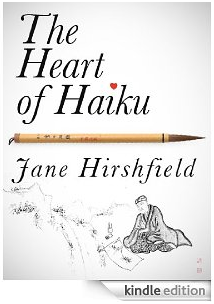
NOTE: Jane Hirshfield’s The Heart of Haiku is available from Amazon.com as a $.99 Kindle Single, and can be read on any computer or smart phone, not only Kindles, with a free download. A new book of poetry, Come, Thief, has also just been published, by Knopf.

Keywords:, , , , , , , ,
———–
Also see A Haiku on The Heart of Haiku; the excellent Poetry Foundation biography on Jane Hirshfield, including poems, articles and more; Pirene’s Fountain: Jane Hirshfield on Poetic Craft; and What Rainer Maria Rilke inscribed on the copy of The Duino Elegies he gave his Polish translator.

Ten years later On Being with Krista Tippett interviewed Jane Hirshfield on The Fullness of Things, which I discovered today, March 6, 2023, in Pebbles – Brief poems by Jane Hirshfield posted by Brief Poems.

Wild Geese by Mary Oliver, photo by Ken West

November 14, 2011

Wild Geese

You do not have to be good.
You do not have to walk on your knees
for a hundred miles through the desert repenting.
You only have to let the soft animal of your body
love what it loves.
Tell me about despair, yours, and I will tell you mine.
Meanwhile the world goes on.
Meanwhile the sun and the clear pebbles of the rain
are moving across the landscapes,
over the prairies and the deep trees,
the mountains and the rivers.
Meanwhile the wild geese, high in the clean blue air,
are heading home again.
Whoever you are, no matter how lonely,
the world offers itself to your imagination,
calls to you like the wild geese, harsh and exciting
over and over announcing your place
in the family of things.

—Mary Oliver

From Dream Work published by Atlantic Monthly Press
 

This photo of a family of Canadian Geese was taken by Ken West Iowa Landscape and Nature Photography. Ken West and his unique landscape photographs are featured on IPTV show Iowa Outdoors.

For more on Mary Oliver see The Journey by Mary Oliver, with links to other poems and an interview with Maria Shriver.

Listen to Mary Oliver read “Wild Geese” for The On Being Project. This poem is featured in Mary Oliver’s extraordinary conversation with Krista Tippett—one of the few in-depth interviews she gave in her lifetime: “I got saved by the beauty of the world.” She describes her creative process On Being: Listening to the World. 

Mary Oliver Reads Wild Geese (14:36) from A Thousand Mornings (1986) at the 92nd St Y, New York in 2012. 

A beautiful soundtrack was later added to her reciting this poem and posted on Instagram by coffee_with_keats.

Mary Oliver’s poem, Swan, asks us if we see, hear, and feel what she does, drawing rich references to the beautiful aspects of a swan, culminating in two powerful questions.

Mary Oliver’s poem, Mockingbirds, teaches us how to listen, and experience the wonders around us.

See this remembrance of Mary Oliver with links to more of her poems.

At last—the truth about Frankenstein

August 19, 2011

This is one of my favorite poems, written by a good friend and a fine poet, Bill Graeser. The title now links to his new website where the poem has since been divided into seven stanzas. 

What You May Not Know About Frankenstein

Although he had not the hands to crochet, the patience to build birdhouses or the nerve to push a hook through a worm in the hope of pulling a fish from the sea, he did write poems and wrote often and late into the night.  Was it pain that made him write?  The pain of all those stitches, of shoes that despite their size were still too small?  Was it psychological pain of social non-acceptance?  Or the electricity that years later still snapped between his fingers?

No, it was simply what his brain wanted to do, the brain they dug up and sowed into his head, it was just grave-robbing luck.  At poetry readings, where everyone is welcome, he read his poems sounding like a man who having fallen into a well and cried out for years was now finally being heard.

Like this there are many so-called monsters with poems to share.  The same is true of angels, of gangsters, shepherds, anyone who fits words together like body parts, revises, revises again, until magically, beautifully, lightning leaps from the pen and the poem opens its eyes, sits up from the page, staggers into the world, and whether it is seen as monster, or friend, it is alive, every word it says is real and it comes not from the grave, but from the sky.

© Bill Graeser

Also see Bill Graeser memorializes Ansel Adams in his award-winning poem “Magic Light”.

In an interview for the Fall 2001 issue of Paris Review, George Plimpton asks US Poet Laureate Billy Collins to describe what it takes to be a poet.

(more…)

Poetry—The Art of the Voice

January 6, 2011

Poetry—The Art of the Voice is another one of my poems published in This Enduring Gift – A Flowering of Fairfield Poetry, 2010. Editor Freddy Niagara Fonseca posted this poem on his Amazon.com page: VISITING POET Ken Chawkin: Poetry – The Art of the Voice, which links to the complete version on his Live Journal.

Poetry—The Art of the Voice

How fine will your breath become
from listening to these words?
How soft will they seem to be
as they settle through the mind
like silent snowflakes falling
from a windless winter sky?

I often marvel at the mystery—
how words can work
on a listener’s heart and mind,
upon hearing a poet’s thoughts,
a poet’s breath, flowing
from an inner voice—

a windless wind, speaking
through a voiceless voice.

© Ken Chawkin
Published in This Enduring Gift – A Flowering of Fairfield Poetry, 2010
http://www.thisenduringgift.com

This poem came out of the inspiration listening to the Diane Rhem Show: Bill Moyers on Poetry, when she invited him on to talk about his latest PBS special on the Poetry Festival he had attended and filmed, and his new book of it, “Fooling With Words: A Celebration of Poets and Their Craft” (William Morrow). They had invited 3 poets: Marge Piercy, former poet laureate Mark Strand, and Jane Hirschfield, to call in and discuss the inspiration for a poem they had written and share it with the listening audience. The effect on the Festival audiences was also discussed. See , with links to the program, book, and each poet reading their poem.

When the call went out for poems from Fairfield poets for This Enduring Gift-A Flowering of Fairfield Poetry, I sent it in along with some haiku and a tanka. It was published and later selected as the POEM OF THE DAY: Poetry – The Art of the Voice, by Ken Chawkin.

Stories from war: a writing workshop for military veterans

February 9, 2010

Stories from war

By MIKE KILEN • mkilen@dmreg.com • February 8, 2010

A writing workshop for military veterans was a tough sell. Grants were denied and help was hard to come by.

Maybe Emma Rainey’s idea was pie-in-the-sky.

But she had been a military kid who moved every year and didn’t know what was buried inside her war veteran father.

She had discovered writing later in life. The tiny, lithe former dancer enrolled at the University of Iowa and commuted from Fairfield, where she and four daughters moved with her husband from the West Coast so he could engage in Maharishi’s Transcendental Meditation. She lost the child custody battle after their divorce five years ago; it shattered her.

“Writing kept me sane,” Rainey said. “Writing is the space between holding it in and speaking.”

Then 18 months ago, during her commute to her graduate non-fiction writing classes, Rainey heard radio reports from Iraq and Afghanistan, already heartbroken by endless print stories on returning veterans’ struggles.

“One day I read one too many,” she said.

Few were interested in her idea: Writing could help the vets and studies show its positive therapeutic effects. She plowed ahead, anyway, and decided to pay for the free workshop out of her own pocket.

But John Mikelson, an advisor at the University of Iowa Veterans Center, was sold.

“A writing workshop in the city of literature seemed like a no-brainer,” he said. “Most vets have wonderful stories bottled up inside them. But getting them from their head to a pen is difficult.”

He helped get the word out to vets; one whom helped put up a Web site. UI’s Distance Learning Site offered space for the weekend workshop. Teaching assistants and professors offered to help teach writing.

Rainey’s 82-year-old father heard about it and wrote her an e-mail the week before the Jan. 15 Vets Midwestern Writing Workshop.

“Would you be interested in what an old Korean War vet had to say?”

“He tried sending the attachment 10 times before finally sending it snail mail,” Rainey said.

She opened the two-page piece. It was the story of his ship, blasting the coast of Korea and the backfire in turret number one. The siren. The 30 men lying dead. His men.

“He wrote about going back in the room with the body parts everywhere,” Rainey said.

She picked up the telephone to call him. He didn’t want to talk about it. Writing was a gap that was safe.

“Writing is the space between where they can get this out,” she said.

Any lingering doubts that the idea was good were over.

Forty men and women from all over the country, ages 20s to 70s, showed up for the workshop in Iowa City. They had questions and doubts, too. One said he wasn’t up to any “pissing contest” for most horrible story. Another wondered if it was just going to be a group therapy session.

But as they broke up into classes on style and characterization, poetry and point of view, description and dialogue, the weekend unfolded in a unique blend of sharing deep emotions and the art of communicating them well. The time flew by.

Eddie Allen, 64, of Iowa City arrived with no writing experience and little contact with veterans. After ruminating over his own experience for years, he wanted to hear others.

Events long buried surfaced, both big and small. Refusing a drink from his best buddy in Vietnam on the last day he would see him. What the war did to him over the next 38 years.

“I grew up in Oklahoma and went to Sunday school. All the sudden you are a soldier and then a warrior,” he said. “It’s a different mindset and even though you are not a warrior anymore it affects the way you do things for the rest of your life.”

He found poetry there. Writing instructors, counselors and other vets helped.

“It was like liquid love. There were no barriers between ages or professions,” Rainey said. “The most shocking thing to me was how uplifting it was. I thought it would be sad.”

It lifted her spirits to see a Vietnam vet sit for an hour with a published poet, talking words.

In the process, Rainey said, they could unburden themselves from the stories.

“The physical act of writing it down gives them permission,” she said. “Their story takes on its own energy and they can let it go without being bitter or shattered.”

Some moved from writing nothing but a grocery list to writing poems or essays. Given the tools, they could now find the right words.

The hum of the helicopter was still in their heads.

Or the shouting. Army veteran Mary Chavez of Reinbeck remembered the shouting. She grew claustrophobic on an overseas truck convey, which was forced to stop and let her out. Her superior screamed in her face about the danger she could cause.

She remembered the scream back home when her boss at work did the same after she made a mistake. She ran to the supply closet and sat there for hours.

“Writing it down helped detoxify some of the trauma,” Chavez said. “I was able to see it from a different perspective and it weakened the strength of it from my memories.”

Jon Kerstetter of Iowa City was already working on a book.

He was deployed three times to Iraq from 2003 to 2005 as part of a medical battalion with the Iowa National Guard.

He broke his ankle, then dislocated his shoulder. The injuries were worse than he first thought and he had 10 surgeries. One caused a debilitating stroke that required extensive cognitive therapy.

He had to give up his job as an Iowa City physician.

“I’m using writing as one of my vehicles for rehab,” he said.

“The telling of it is not so simple because they are complicated emotions. When you are writing something as tragic as war, you have to get involved. You have to relive the story.”

But it helped him purge. It helped him understand the complexities of combat.

“Soldiers have a predefined task and you keep your eyes on the task,” he said. “When you come away and have time to reflect, you understand how complex it is. You realize you are not all that powerful. It’s a machine that all has to work.”

Rainey had even fewer doubts after the weekend was over.

“Poetry amazed me,” a vet wrote on her workshop evaluation. “My pen writes poetry!”

She hopes to take the workshop to other cities, maybe even now land grants. Distance Learning officials were so impressed they kicked in the $1,500 of expenses for the weekend.

“There is a gap in understanding between vets’ experience and the population,” Rainey said. “That gap needs to be closed. We don’t know if we don’t hear their voices.”

A check arrived in the mail one day to go toward workshop expenses. It was from her father.

“He knew why I was doing it,” she said.

Register reporter MIKE KILEN tells the stories of Iowans across the state. Contact him at mkilen@dmreg.com

JOHN GAPS III / THE REGISTER

Writing instructor Emma Rainey (top right corner) goes over a paper as she meets with armed services veterans.
Writing instructor Emma Rainey looks to Luke Huisenga as he talks about his poetry with (left to right) Brian Smith, Dr. Jon Kerstetter and Luke Sheperd. She meets with armed services veterans to help them write creatively about their experiences at an Iowa City coffee shop.
Rainey talks with Luke Huisenga (foreground) as Luke Sheperd listens. “Writing is the space between where (vets) can get this out,” she said.

‘This is my aircraft, my office’

Following is a sample of a book worked on during the workshop by Jon Kerstetter, MD, COL, Iowa Army National Guard, retired.

Often, just before sunrise, I used to walk the flight line where the aircraft were waiting just at the edge of the runway, perfectly aligned, standing at attention. The rising sun would paint colors on their shapes. I would smell the JP-8 jet fuel, smell the hints of metallic oil and let my eyes feast on all that is military; on all the sun-colored, olive-drab, gray-green shapes, the dark browns and the dusty whites of military markings. The colors were like flowers in the desert. I could name each aircraft by the pattern of its colors, its faded spots and stains, and by its scattered chips of military CARC (Chemical Agent Resistant Coating) paint. I used to love to watch the morning pre-flights of the crew. Watch the checks and movements about the aircraft. Soldier ants at war. Occasionally, I would walk up and just touch one of the helicopters and let my hand move across the skin, feeling the rivets, the sand-scarred paint, feeling the door handle or the cockpit seams. I would breathe in the morning smells, the aircraft smells, the war smells, and be taken on a sort of mental excursion that drew me close to the familiar and nearer to the battle: the sights and sounds of army aviation, military medicine, rescue, resupply, interdiction, attack and medevac. This ritual would function like a liturgy of sorts, so that when I was finished I felt restored in faith, restored in my role as a soldier and as a flight surgeon. It made me bold to the point that I would lay claim on the aircraft – on the mission. This is my aircraft. No other doc in the entire Army has this aircraft. It belongs to me. It’s my office. It’s where I go to war.

Comments for

Stories from war

kennyji wrote:

Powerful article, Mike, on the cathartic effect of writing. Thank you. Reminds me of something Jesus said in the Gospel of Thomas. “If you bring forth what is inside you, what you bring forth will save you. If you don’t bring forth what is inside you, what you don’t bring forth will destroy you.”

2/9/2010 12:10:18 AM