Sitting with Sali on a cold winter Sunday afternoon at Parkview Care Center, looking out the window of her room at the powdered snow being blown off the white roofs in swirls. At one point, with the sun shining through in front of us, you could almost see a rainbow; only it was a snowbow! Made that up. We laughed. I had been in a rough mood, but what I saw, and the spontaneous playful art of composing a haiku, transformed me. The second and third lines came out first, and the first line last. I changed wind blows to winds blow to rhyme with snow. The rhythms, rhymes and meanings of the words sort of sound like what we saw. They’re powerful. Say them aloud a few times and see what happens. Sali seemed to like it. I love it! it’s fun! Here’s the poem.
WINTER HAIKU
The winter winds blow
Swirling whirling dervishes
Of powdery snow
Transcendental Meditation significantly reduces PTSD in African refugees within 10 days
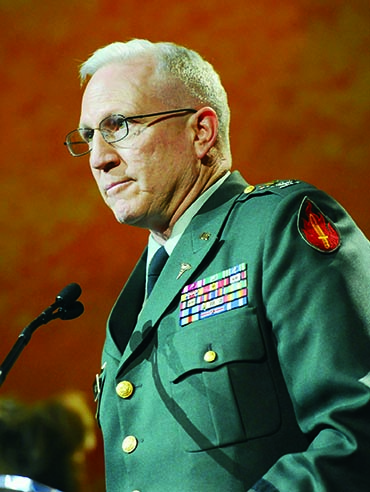
This is lead author Col. Brian Rees, MD, MPH, US Army Reserve Medical Corps
African civilians in war-torn countries have experienced the threat of violence or death, and many have witnessed the abuse, torture, rape and even murder of loved ones. Many Congolese living in Ugandan refugee camps are suffering from severe posttraumatic stress disorder (PTSD).
New research shows that Congolese war refugees who learned the Transcendental Meditation® technique showed a significant reduction in posttraumatic stress disorder in just 10 days, according to a study published today in the February 2014 issue of the Journal of Traumatic Stress (Volume 27, Issue 1, pages 1–119).
“An earlier study found a similar result after 30 days where 90% of TM subjects dropped to a non-symptomatic level. But we were surprised to see such a significant reduction with this group after just 10 days,” said study author Brian Rees, MD, MPH.
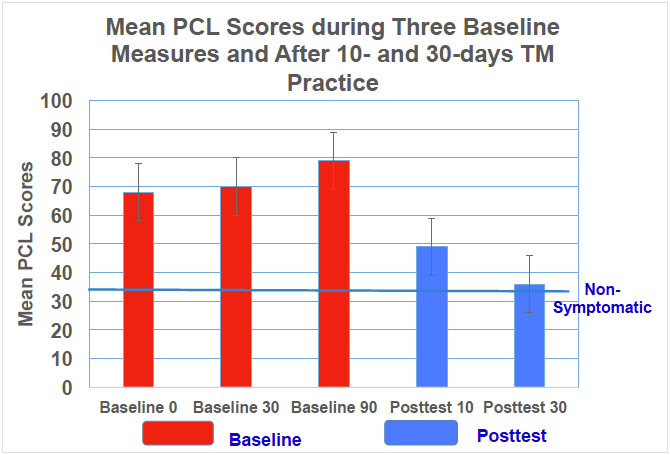
The subjects were assessed using the Posttraumatic Stress Disorder Checklist for Civilians, (PCL-C), which rates the severity of PTSD on a scale from 17 to 85. A score below 35 means the symptoms of PTSD have abated.
Eleven Congolese refugees who had been tested three times over a 90-day period on the PCL-C, which rates the level of PTSD on a scale from 17 to 85, began with an average score of 77.9. They learned Transcendental Meditation within 8 days of the third test and after 10 days their average score dropped to 48, which was highly clinically significant. They were retested 30 days later measuring an average score of 35.3. With scores below 35 considered non-symptomatic, they were practically symptom free.
The subjects in the study initially tested with an average score of 77.9. After just 10 days of practicing the Transcendental Meditation technique, their PTSD test scores dropped to an average of 48, which was highly significant clinically.
Thirty days later the subjects were tested again with their PTSD scores falling to an average of 35.3 — meaning that they were nearly without symptoms of PTSD.
“What makes this study interesting is when we tested them in the 90 days before they began the TM technique, their PTSD scores kept going up,” said coauthor Fred Travis, director of the Center for Brain, Consciousness, and Cognition at Maharishi University of Management. “During that period their scores were rising, from 68.5 at the beginning to 77.9 after 90 days. But once they started the Transcendental Meditation technique, their PTSD scores plummeted.”
According to the researchers, during this particular meditation technique one experiences a deep state of restful alertness. Repeated experience of this state for 20 minutes twice a day cultures the nervous system to maintain settled mental and physical functioning the rest of the day. This helps to minimize disturbing thoughts, sleep difficulties, and other adverse PTSD symptoms.
In this video, Dr. Travis explains the neurophysiology of trauma and how TM relieves it. He says, “Something very profound is happening. Because experience changes the brain, and trauma locks in a specific brain functioning (the over stimulated amygdala), you’re stuck in a specific way of thinking and feeling, (vigilance, fear and mistrust) and appreciating the world.” He further explains how the experience of transcending, with Transcendental Meditation, calms the amygdala, relieves PTS symptoms and frees the individual “to see more possibilities.”
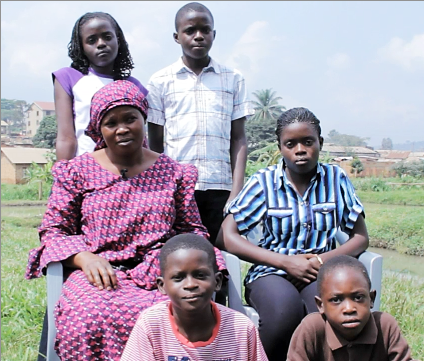
Congolese refugee Esperance Ndozi and her 5 children
Esperance Ndozi was one of the Congolese refugees traumatized by the civil war. The 35-year old mother of 5 was part of the group of refugees that learned TM. Before learning the effortless technique, Esperance couldn’t find relief from a flood of dark disturbing memories. She could hardly sleep. After a week of meditating 20-minutes twice a day she describes increasing relaxation and relief from PTSD symptoms. “Your mind, your body relaxes. You feel you are out of the outside world. You are just in your peaceful world. No negativity. It doesn’t come near me now.” Like other refugees in the study the calm and peace grew to last throughout the day. Watch the video.
A previous study of Congolese refugees, which involved 42 subjects found that the Transcendental Meditation group had an average Checklist score of below 35 after 30 days, a non-symptomatic level, while the average score of the control group actually worsened over the same period.
“This is now the fourth study to show an improvement in PTSD,” said Dr. Rees, a colonel in the US Army Reserve Medical Corps. “The Transcendental Meditation technique is increasingly being seen as a viable treatment by the US military.”*
###
Study co-author Dr Fred Travis is a professor of neurophysiology at Maharishi University of Management, an accredited university to the PhD level, where Transcendental Meditation is incorporated into its curriculum and practiced by faculty and students. This provides a way for students, including veterans, to reduce the effects of past stress and trauma, and make learning easier and more enjoyable. www.mum.edu
*Two earlier studies have shown the Transcendental Meditation (TM®) technique to effectively lower post-traumatic stress in veterans of Vietnam and Iraq/Afghanistan wars.
Transcendental Meditation Reduces Teacher Stress and Burnout, New Research Shows
Effect of Transcendental Meditation on Employee Stress, Depression, and Burnout: A Randomized Controlled Study
This graph shows the average level of change in total burnout, as measured by the Maslach Burnout Inventory, in the Transcendental Meditation group compared to controls. The graph displays a marked reduction in burnout symptoms in the TM group, with the control group showing a small increase in burnout over the duration of the study.
A new study published in The Permanente Journal (Vol. 18, No.1) on health showed the introduction of the Transcendental Meditation® technique substantially decreased teacher stress and burnout.
Research indicates that stress and burnout are pervasive problems among employees, with teachers being especially vulnerable to feeling frequent stress from their jobs. Burnout, a syndrome of emotional exhaustion, depersonalization, and job dissatisfaction, has been found to contribute to lower teacher classroom performance and higher absenteeism and job turnover rates.
This current study sought to determine whether practice of the Transcendental Meditation (TM) program results in lower psychological distress and decreased burnout in teachers and support staff at the Bennington School in Vermont, a special in-residence school for students with behavioral problems.
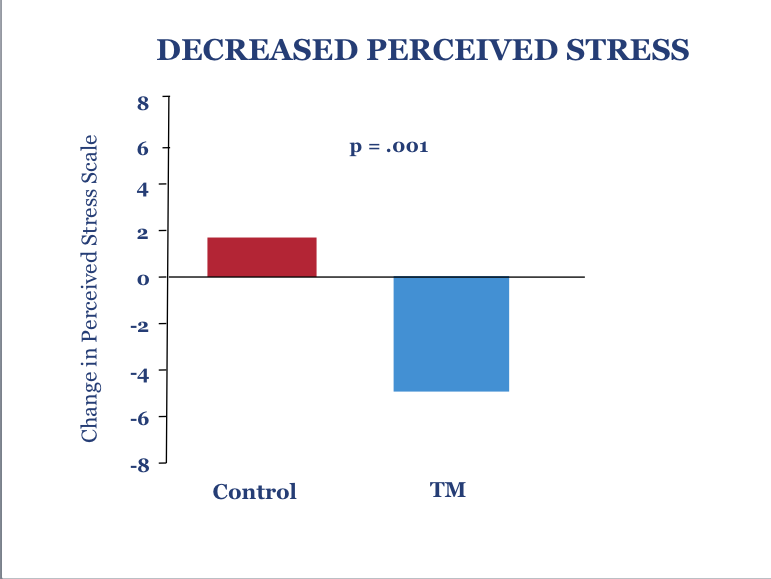
This graph shows the average level of change in perceived stress, as measured by the Perceived Stress Scale, in the Transcendental Meditation group compared to controls. The graph displays a marked reduction in perceived stress in the TM group, with the control group showing a small increase in stress over the duration of the study.
According to Dr. Charles Elder, MD, MPH, lead author of the study and a Senior Physician in the Department of Internal Medicine at Kaiser Permanente Northwest, “The results of this randomized controlled trial are very striking and demonstrate the utility of introducing a stress reduction program for teachers and other public and private employees. The four-month study found significant and clinically important decreases in perceived stress, emotional exhaustion associated with teacher burnout, and depressive symptoms in those practicing the TM program compared to a wait-list control group.”
“Burnout and other psychological distress factors have been linked to negative health behaviors, obesity, and hypertension, all of which are major contributors to cardiovascular disease,” emphasized Dr. Sanford Nidich, EdD, study principal investigator and Professor of Education at Maharishi University of Management. “Prior medical research has found that practice of the TM program is effective in reducing both risk factors for heart disease and cardiovascular events. Taken as a whole, this present study and prior research provide evidence for the value of the TM program for enhancing mental and physical health and well-being, explained Dr. Nidich.”
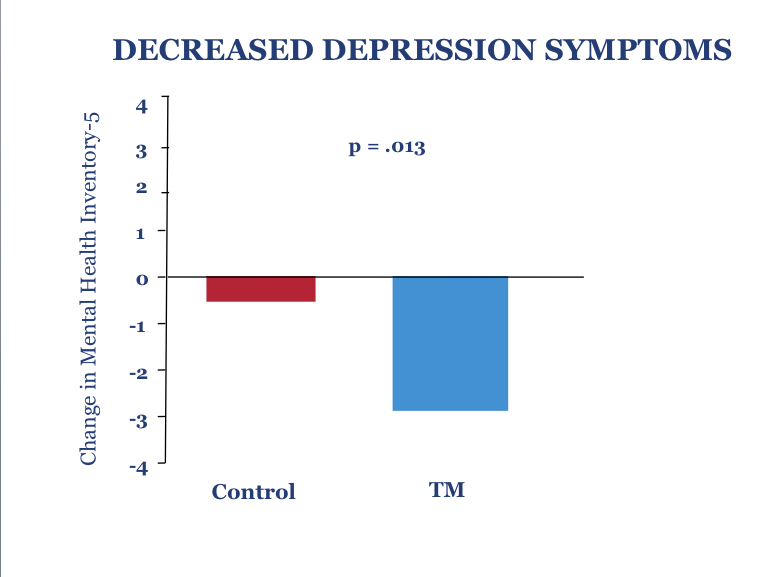
This graph shows the average level of change in decreased depression symptoms, as measured by the Mental Health Inventory-5, in the Transcendental Meditation group compared to controls. The graph displays a marked reduction in depression symptoms in the TM group, with the control group showing a small decrease in depression over the duration of the study.
The study included 40 teachers and support staff measured at baseline and then randomly assigned to either immediate start of the TM program or delayed start (wait-list control group). Compliance with practice of the TM technique throughout the four-month intervention period was high; 100% of the participants assigned to the TM group meditated at least once a day. Of those, 56% meditated regularly at home twice a day.
This is the first study to investigate the effects of Transcendental Meditation on teacher burnout. Recent published studies have shown a positive impact of this program on student graduation rates, academic achievement, and psychological distress. Transcendental Meditation has seen widespread implementation in secondary schools across the country within the context of school-wide Quiet Time programs.
The TM technique is a simple, natural, effortless procedure practiced 20 minutes twice each day while sitting comfortably with the eyes closed. Extensive peer-reviewed research studies have found that TM reduces psychological distress, including anxiety and depression, and promotes overall mental and physical health.
The TM technique is available in the USA through Maharishi Foundation USA, a federally recognized non-profit educational organization. Through partnerships with other non-profit organizations and foundations, full TM scholarships have been given to more than 250,000 at-risk children, school teachers, veterans suffering from PTSD, homeless people, and others. Visit http://www.tm.org for more information.
About Maharishi University of Management
Maharishi University of Management is an accredited university offering bachelor’s, master’s, and doctoral degrees in the arts, sciences, humanities, and business, where Transcendental Meditation is also practiced by both professors and students. Visit http://www.mum.edu for more information.
Published over a year ago, this report on Transcendental Meditation, by the ABC’s Catalyst in Sydney, Australia, takes an objective look at the uniqueness of the practice, and its personal and health benefits. One skeptical physician says most people would sooner pop a pill to lower their blood pressure than waste time meditating. But, based on the scientific research, the American Heart Association now recommends that physicians may safely prescribe only TM for those patients who want to lower their blood pressure naturally, instead of taking long-term costly medications with potentially harmful side effects.
Dr. Robert Schneider’s tour in Australia and New Zealand educating physicians on the value of TM for heart health
Dr. Robert Schneider, MD, FACC, a leading medical researcher on the application of Transcendental Meditation for heart health, toured Australia and New Zealand in the fall of 2013. He presented the breakthrough scientific research findings of TM’s ability to reduce heart attack, stroke and early death by about 50%.
Dr. Schneider also mentioned the AHA statement, based on meta-analyses of data on different relaxation and meditation techniques, that physicians could only recommend TM to their patients wanting to naturally lower their HBP. You can see a video clip from a presentation made at Macquarie University Hospital in Sydney, Australia.
While making presentations in New Zealand, Dr. Schneider appeared on NZTV’s Breakfast ONE News program explaining how TM improves heart health, and the response from the medical community. You see that lively interaction here.
Here is an article in the Israeli paper Haaretz about a film on David Lynch’s 16-country tour made several years ago. One of the countries he had visited was Israel. The film was shown at the Tel Aviv Cinematheque Monday night, January 20, 2014, David’s 68th birthday. David also connected with the audience after the film via Skype to answer questions.
Real peace isn’t just the absence of war the legendary director tells Israeli filmgoers via Skype, and sets the record straight on the ‘Twin Peaks’ rumors.
Article and photo by Avshalom Halutz | Jan. 22, 2014 |12:54 PM
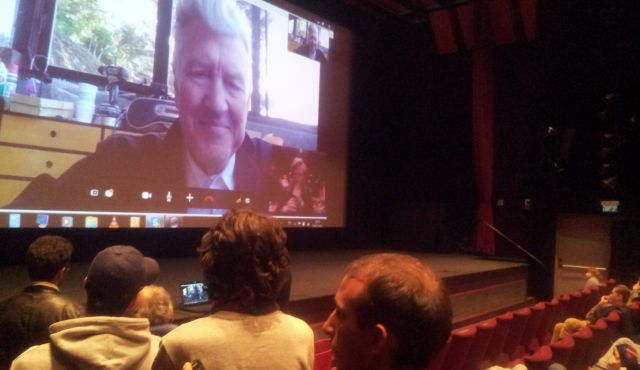
David Lynch speaks to Israeli moviegoers via Skype, on Monday
Moviegoers might associate director David Lynch with wailing babies, dead women in plastic bags and severed ears, but the audience at the Tel Aviv Cinematheque Monday night got nothing but peace and positivity from the man responsible for the perversity in films like “Blue Velvet,” “Eraserhead” and “Mullholland Drive.”
It was the Israeli premiere of the documentary “Meditation, Creativity, Peace,” which follows Lynch’s tour through 16 countries in Europe and the Middle East. The main topic: Transcendental Meditation.
Most of the documentary was shot by film students. The movie, which was edited by Noriko Miyakawa, was completed in 2012 and is in theaters across the United States now. It offers a fascinating glimpse into the creative process of one of history’s great filmmakers.
After the screening, Tel Avivians were treated to a Skype conversation with Lynch himself, who was celebrating his 68th birthday. He answered questions at length on meditation, cinema and creativity – and the Mideast conflict.
The documentary begins with Lynch’s visit to Israel in 2007, when he met with President Shimon Peres and thousands of enthusiastic film students. It opens with Lynch speaking to the camera while holding a jelly doughnut.
“This is a doughnut,” Lynch says. “It is very sweet, and very good. But if you’ve never tasted a doughnut, you wouldn’t really know how sweet and how good a doughnut is …. Transcendental Meditation is like that. Transcendental Meditation gives an experience much sweeter than the sweetness of this doughnut. It gives the experience of the sweetest nectar of life: pure bliss consciousness.”
The film then spends 70 minutes following Lynch on his tour. He explains how Transcendental Meditation, which he has been practicing morning and evening for 40 years, has changed the way he thinks and creates.
Lynch doesn’t lecture, he goes straight to the Q&A. So the film is mostly questions by film students and his take on topics like his love for Franz Kafka’s “Metamorphosis,” how to write a script, and living a more positive life.
During a session in Edinburgh, one questioner asks how he dares talk about meditation and world peace after visiting Israel, and how meditation can help Palestinians living under Israeli occupation. Lynch answers that people are similar all over the world, and that he was happy to meet Israeli film students, Peres and the mayor of Haifa. He wasn’t at all ashamed to visit Israel.
But the trip to Israel had a special objective: to achieve regional peace by establishing “peace groups” that would practice meditation and effect change.
Take it from the Maharishi
When Lynch appeared on the cinematheque’s big screen live via his home computer, the audience sang “Happy Birthday” and followed with an ovation. It’s not every day Israelis interact with giants like Lynch, though the birthday boy remained humble throughout.
One questioner wanted to know if Lynch considered his visit to Israel a failure given that there was still no peace. Lynch mentioned the father of Transcendental Meditation, Maharishi Mahesh Yogi.
“I think the journey was to plant some seeds. And those seeds are still there, and they do need some watering, for sure. They say that Maharishi is the man who revived the science of consciousness and the technologies of consciousness,” Lynch said.
“One of the technologies of consciousness is Transcendental Meditation, a mental technique that any human being can take, and which allows any human being to transcend, to dive within and experience that unbounded eternal level of life. This unbounded eternal level of life is also a field of infinite unbounded peace.”
This peace has always been there, it just needs enlivening, Lynch said.
“Maharishi brought out the technologies of the peace-creating group – a group of human beings practicing the Transcendental Meditation that enliven the field of unity, this field of peace within, so powerfully that it can bring peace up in the field of diversity and raise collective consciousness,” he said. It can make people feel happier and more harmonious.
“And they say when real peace comes it is because this field within has been enlivened in the field of diversity. You can say it’s unity in the midst of diversity. I was telling all the people in Israel that I met: Start a peace-creating group for Israel, enliven that field of unity, get real peace.”
According to Lynch, “A peace treaty is a piece of paper on the surface of life. It does not address the hate, the anger, the torment inside the human beings. We want peace and here is a technology to truly bring real peace, and real peace is not just the absence of war – real peace is the absence of all negativity.”
Lynch was also asked about the situation in Israel compared to other conflicts around the world.
“The situation in Israel exists in lots of places: People just don’t get along. Surface cures will never work. Never work. If you want to get rid of that negativity that causes disputes you need to enliven that field of unity and peace that has always and forever been there,” he said.
“This is the big, big, big secret: Get to work, help form a peace-creating group for Israel and watch what happens, it will be so beautiful. It’s the real thing. Get to work and make this thing happen.”
When asked if he liked any new Israeli movies, Lynch said he didn’t have time to watch films lately. He said he didn’t understand how Martin Scorsese had the time to watch every movie that exists and still have the time to make more films than him.
Many questioners tried to pry information from Lynch about his next projects; they were eager to see more of his work. One brought up the rumor about a new version of “Twin Peaks,” the cult TV series from the early 1990s.
“Rumors are just rumors. There have always been rumors about things. So there is no real truth to it,” said Lynch.
“I don’t know where these rumors come from, but I think they were based on some misunderstanding of what’s going on. It’s true that there will be a new Blu-ray [disc] of ‘Twin Peaks,’ including the pilot, first season and second season. And there will be some special things that haven’t been seen before. That’s about all I can say.”
Below is a Teaser: “Meditation, Creativity, Peace” – David Lynch 16 Country Tour Documentary posted on the DavidLynchFoundation YouTube channel.
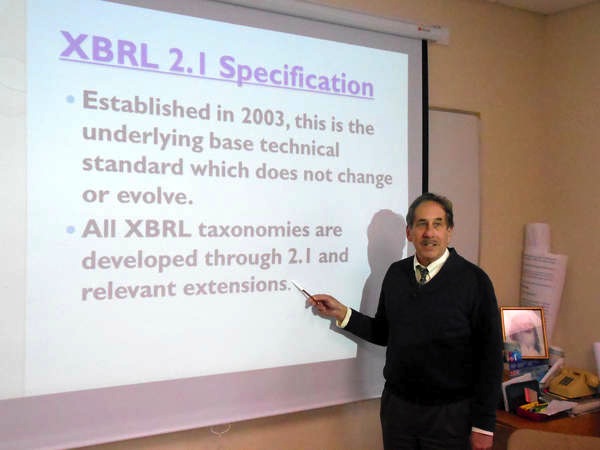
Maharishi University of Management accounting professor Andrew Bargerstock teaches a class in which students are certified in an accounting program called Extensible Business Reporting Language. M.U.M. is the first college in the world to offer certification in the program as part of its academic curriculum. / Photo by: ANDY HALLMAN
Accounting students at Maharishi University of Management are getting a leg up on the competition.
Those students have the opportunity to become certified in a worldwide accounting standard. According to M.U.M. accounting professor Andrew Bargerstock, the university is the first in the world to offer this certification as part of its curriculum.
The standard is called Extensible Business Reporting Language, often referred to simply as XBRL. It is a way of creating an accounting document that allows the information to be easily transferred to government agencies such as the Federal Deposit Insurance Corporation or the Securities and Exchange Commission.
The program requires a high level of computer coding knowledge. Bargerstock said learning how to use the program is no easy task because the students are bombarded with tons of technical computer jargon unfamiliar to most accountants.
“Accountants typically don’t have a lot of training in IT [information technology],” Bargerstock said. “They’ll know how to run ‘Quickbooks’ and ‘Excel,’ but they don’t know anything about the underlying coding. It’s a bit of a challenge. It takes a little bit longer for the water to seep into the sponge – a very dry sponge.”
Bargerstock and 11 of his students have been certified in XBRL, so he knows just how difficult the program is to learn.
“I failed the test the first time I took it, and had to go over it and over it again,” he said.
The certification training is done online and includes instructional audio files. The first time Bargerstock tuned in to one of the audio courses, he reacted by saying to himself, “This is way beyond what I was expecting. There was so much jargon it sounded like a foreign language.”
Learning XBRL is no picnic but once the students complete the necessary training they will stand out from their peers. Recruiting firms have told Bargerstock XBRL certification will put M.U.M.’s students at the top of the pile of résumés when it comes time to look for a job.
“In job interviews, people will say whatever they need to to get the job, and they’ll be a chameleon who changes from day to day,” he said. “This certification shows the students have taken the initiative to learn something.”
The federal government has required businesses and organizations to submit their accounting records in XBRL format since 2011. Bargerstock said the advantage of XBRL is the numbers only have to be entered in the original accounting document and not in every report created from that document. When it comes time to create the reports for the various government agencies, each agency extracts from the document whatever it needs to create its own report.
In the past, accountants would have to tediously fill out reports for each government agency. Now, those reports are created automatically by the computer thanks to the way the information is coded.
Bargerstock introduced his students to XBRL certification last fall. Although he helped the students with their certification, they trained for the certification on their own outside of class and did not receive academic credit. Another group of six students began taking a class with Bargerstock in November in which they were receiving academic credit while obtaining XBRL certification. Those students will finish their class in February.
Reprinted with permission from The Fairfield Ledger. The article was on the front page of Thursday’s Ledger, five columns across the middle of the page, with a photo.
Added point of clarification from Andy Bargerstock: “The certification training does not teach the technical side (tagging) of XBRL. XBRL certification training is the first step towards competency. If any of our certified students get hired, they will need 2-3 months of intensive training in the technical aspects of XBRL.”
Meditation, a simple yet deep-rooted technique that helps you think better, control your emotions with finesse and even makes you a better person. First practiced in India, meditation is a method carried down through the ages. It was first mentioned in the Vedas and is well-known in India as a doorway to nirvana. But now the Americans have woken up to its benefits.
According to study carried out by Fred Travis, director of the centre for brain, consciousness, and cognition at Maharishi University of Management in the US, physiological measures and first-person descriptions of transcendental experiences and higher states have only been investigated during practice of the Transcendental Meditation (TM) technique.
After analysing descriptions of transcendental consciousness from 52 people practicing TM, Travis found that they experienced ‘a state where thinking, feeling, and individual intention were missing, but self-awareness remained’. A systematic analysis of their experiences revealed three themes – absence of time, space and body sense.
‘This research focuses on the larger purpose of meditation practices – to develop higher states of consciousness,’ explained Travis. With regular meditation, experiences of transcendental consciousness begin to co-exist with sleeping, dreaming and even while one is awake.
This state is called cosmic consciousness in the Vedic tradition, said the paper published in the journal Annals of the New York Academy of Sciences. Whereas people practicing TM describe themselves in relation to concrete cognitive and behavioural processes, those experiencing cosmic consciousness describe themselves in terms of a continuum of inner self-awareness that underlies their thoughts, feelings and actions, added the paper.
‘The practical benefit of higher states is that you become more anchored to your inner self, and, therefore, less likely to be overwhelmed by the vicissitudes of daily life,’ said Travis. TM is an effortless technique for automatic self-transcending, different from the other categories of meditation – focused attention or open monitoring.
It allows the mind to settle inward beyond thought to experience the source of thought – pure awareness or transcendental consciousness. This is the most silent and peaceful level of consciousness – one’s innermost self, said the study.
Wondering what it is? Here is all you need to know about the TM technique
Transcendental Meditation?
Also called the TM technique, Transcendental Meditation is a simple practice one does for 20 minutes twice in a day. All you need to do is sit comfortably and close your eyes. This meditation technique is not a religion, philosophy or lifestyle, it is simply a way to reach self-development.
This technique allows your mind to settle and gives you a chance to experience pure awareness, also known as transcendental consciousness. It allows you to experience the most silent and peaceful level of consciousness – your innermost self. It also allows your brain to attain deep rest helping you be more efficient and betters your cognitive functions.
Where did this technique originate?
About 50 years ago, Maharishi Mahesh Yogi introduced Transcendental Meditation to the world. Maharishi Mahesh Yogi is considered the representative of Vedic tradition in our day and age. This form of meditation helped in restoring knowledge and helps people experience a higher state of consciousness. The most important aspect of this technique is that it is still practiced with the same technique and principles as it was when the Vedas were first written, giving it maximum effectiveness.
How do I learn?
The TM technique has local teachers who will guide you through the process. It consists of seven steps after which one can practice the TM technique on their own.
Benefits of the TM technique
The TM technique is known to calm your mind, directly affecting the stress that your brain experiences on a daily basis. According to the experts, practicing the TM technique regularly helps in developing total brain control, thereby making you more equipped to deal with every day stress. It indirectly reduces the production on hormones that are commonly produced when one is stressed and thereby stops the damage that is normally produced.
Apart from all this, a calm mind and body is the best way to protect your body from cardiovascular stress. The TM technique also has great benefits for students, it helps improve their memory, IQ and helps them fight stress.
Fairfield man guest speaker in South Africa Craig Pearson’s visit coincided with Nelson Mandela’s funeral
By ANDY HALLMAN | Jan 13, 2014 | The Fairfield Ledger
Photos: Courtesy of CRAIG PEARSON
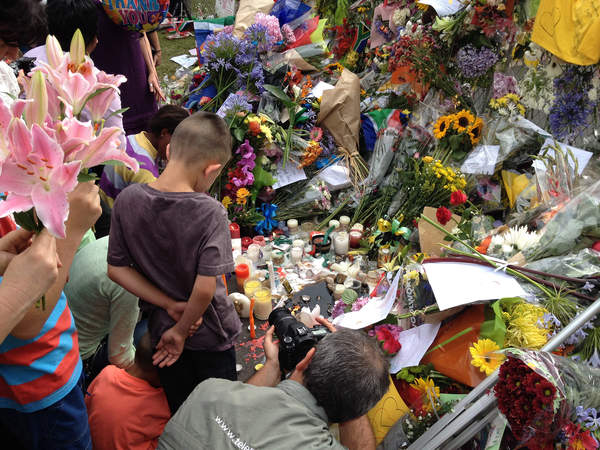
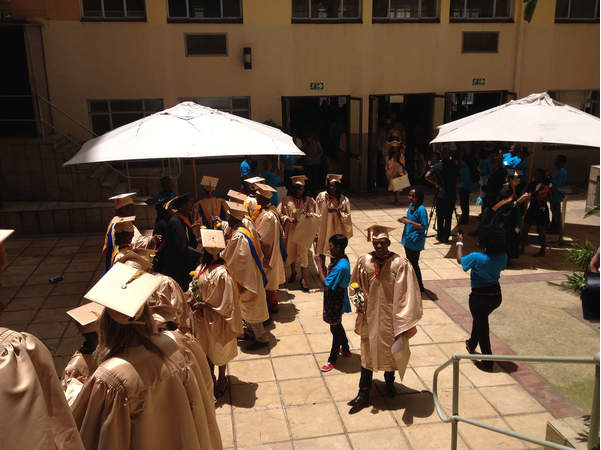
People deliver flowers, candles and cards to the home of former president Nelson Mandela in Johannesburg, South Africa, after his death Dec. 5. Maharishi University of Management’s executive vice president Craig Pearson was in the country at the time of Mandela’s death and witnessed how the public responded with kind gestures to the man they admired so much.
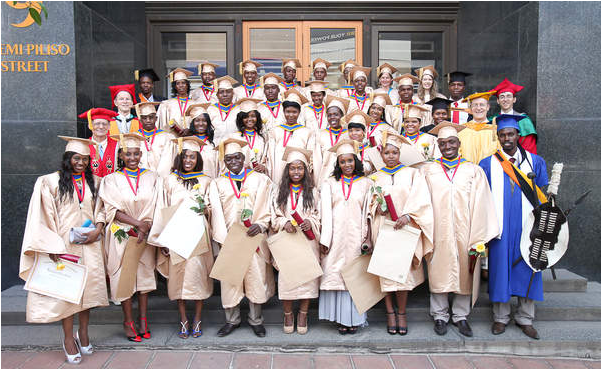
Pearson was in South Africa on official business to give the commencement address at Maharishi Institute in Johannesburg. The institute is a sister organization of M.U.M. and the students who graduated from it received M.U.M. degrees.
The students pictured are the first graduating class of Maharishi Institute in Johannesburg, South Africa. Maharishi University of Management’s executive vice president Craig Pearson, far right in second row, delivered the commencement address at the institute’s graduation ceremony in December.
Maharishi University of Management’s executive vice president Craig Pearson received quite the honor in December when he was asked to give a college commencement address in South Africa.
Pearson just so happened to be in Johannesburg when all eyes were on the country after the death of former president Nelson Mandela on Dec. 5. Pearson was able to witness first-hand the outpouring of support and admiration the locals had for the man who symbolized the nation’s struggle against racial separation.
Upon his arrival in the country Dec. 2, the M.U.M. vice president learned he was staying a mere five blocks from Mandela’s home. Pearson planned to walk by the home to take photos, which would not be too difficult since it was normally a quiet street. Within a few days, the street outside Mandela’s home was packed full of people dropping off flowers and singing songs in honor of their fallen leader.
On the morning of Mandela’s death, Pearson opened his laptop to check the news. He saw a headline that read, “The World Mourns,” and he knew right away what it was about.
“When I went down to take photos outside his home, instead of empty streets there were hundreds and hundreds of people,” he said. “People of every age and skin color were standing there. Singing spontaneously came from this epicenter of the crowd and it rang out until everyone joined in.”
Pearson saw a “mountain range of flowers and hand-written notes” placed on the gate outside Mandela’s home.
“Some of the notes were from children who expressed how they felt about their leader with quotes from ‘Madiba,’ as they called him, which is his tribal name,” Pearson said. “He was also referred to as ‘tata,’ which means ‘father.’”
The Associated Press dubbed Mandela a “master of forgiveness” for his insistence on a peaceful cessation to the state-enforced racial separation known as “apartheid.” Mandela brought apartheid to an end after he became president of the country in 1994. Mandela became the country’s first black president after spending 27 years in prison for championing equality against the white-minority government.
“The significance of what he accomplished goes far beyond the borders of the country,” Pearson said.
After the memorial service for Mandela at a large soccer stadium, South Africans approached Pearson to tell him they were touched by the words of President Barack Obama, who spoke during the service.
Maharishi Institute in Johannesburg held an assembly the day after Mandela died. Pearson was asked to speak at the assembly, and he said it was clear from the other speakers how much Mandela meant to everyone.
“It’s extraordinary to see a leader be so beloved by the people these days,” he said. “Mandela was not without opposition for a long time, but once he became president and people saw he was a harmonizing force, then there was full support for him. I told the students they have a leadership role to play by building on his legacy.”
Pearson said when he visited Mandela’s home he was only able to see the roof because the rest was obscured by a wall. He said that was not unusual and that nearly every house in the city has a wall around it topped with barbed wire.
“They’re beautiful walls and the city has beautiful tree-lined streets,” he said. “Johannesburg claims to have the largest man-made forest, and it really is a forest of a city. When you go on a hill you can see all the trees covering the streets.”
Pearson said Mandela lived in a well-off neighborhood but his house did not seem any more extravagant than his neighbors.
Maharishi Institute, where Pearson gave his commencement address, began in 2006 and is affiliated with M.U.M. in Fairfield. In fact, the students at the institute are actually earning degrees from M.U.M.. In some cases their instruction is provided online and in other cases a professor from M.U.M. travels to South Africa to teach a class in person. The 27 students who received their diplomas in December are the first to graduate from the institute. Pearson said the institute hopes to expand in the near future by adding 1,000 students in February.
Despite the end of state-sanctioned racial discrimination in 1994, blacks still lag far behind whites in educational attainment. Pearson said the institute was founded in Johannesburg to correct for the lack of higher education for blacks.
Students at the institute receive 1.5 years of free education and then begin a work-study program. One form work-study takes is to work at a call center in the same building as the school. Students who don’t work in the call center work as janitors or some other occupation that maintains the school.
“People living in the shanties may get an education through high school but their opportunities for college education are pretty miniscule,” he said. “Maharishi Institute takes the students who are ready for college and gives them a college education at no cost. One student told me he might be in a gang if not for the institute.”
Reprinted with permission from The Fairfield Ledger. The Monday Ledger ran this front page story five columns across with all three photos, two from South Africa, plus one of Craig Pearson. Dr. Pearson also spoke at the graduation of several managers at Neotel, one of the top communications companies in South Africa, who received MBA degrees from MUM.
Also see MUM Executive Vice President Comments on Nelson Mandela and more photos at link.mum.edu/Mandela.
Overview of research on individuals experiencing higher states of consciousness published in Annals of the New York Academy of Sciences
Today, millions of Americans say they practice some form of yoga and/or meditation. It’s become a health fad. Yet the goal of these practices seems unknown or elusive to many practitioners — transcendence.
Fred Travis, PhD, is the Director of the Center for Brain, Consciousness, and Cognition at Maharishi University of Management
The paper is based on a presentation Dr. Travis was invited to give at “Advances in Meditation Research” (AMR), a meeting of the nation’s top meditation researchers, which took place a year ago at the New York Academy of Sciences New York City.
In his paper Dr. Travis explains that different meditations have different effects, and that meditation can lead to nondual or transcendental experiences, a sense of self-awareness without content.
However, after a search of the scientific literature he reported that physiological measures and first-person descriptions of transcendental experiences and higher states have only been investigated during practice of the Transcendental Meditation® (TM) technique.
TM is an effortless technique for automatic self-transcending, different from the other categories of meditation — focused attention or open monitoring. It allows the mind to settle inward beyond thought to experience the source of thought — pure awareness or Transcendental Consciousness. This is the most silent and peaceful level of consciousness — one’s innermost Self.
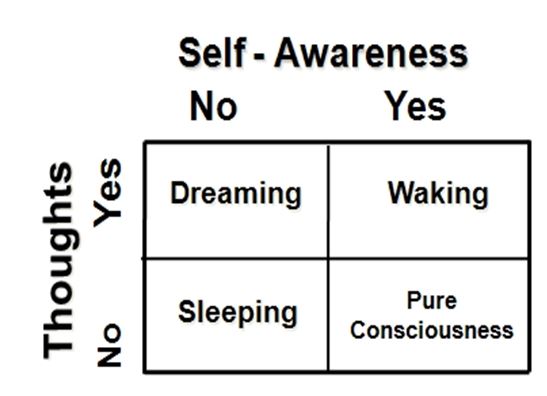
This figure, a 2 X 2 table, compares subjective and objective experiences during waking, sleeping, dreaming, and pure consciousness. As seen in this table, waking state contains a sense of self and mental content — thoughts and perceptions. In contrast, during pure consciousness (Transcendental Consciousness), there is only Self-awareness, without any sense of time, space, and body awareness.
Dr. Travis discusses a study of descriptions of Transcendental Consciousness from 52 subjects practicing the Transcendental Meditation technique and found that they experienced “a state where thinking, feeling, and individual intention were missing, but Self-awareness remained.” A systematic analysis of their experiences revealed three themes: absence of time, space, and body sense.
Specific physiological changes are associated with this subjective experience of Transcendental Consciousness. These include changes in breath rate, skin conductance, and EEG patterns.
Dr. Travis further explains that with regular meditation, experiences of Transcendental Consciousness begin to co-exist with sleeping, dreaming, and even while one is awake. This state is called Cosmic Consciousness, in the Vedic tradition. The paper presents first-person accounts followed by an overview of the physiological patterns associated with Cosmic Consciousness.
Whereas control subjects describe themselves in relation to concrete cognitive and behavioral processes, those experiencing Cosmic Consciousness describe themselves in terms of a continuum of inner self-awareness that underlies their thoughts, feelings, and actions.
In addition, the Cosmic Consciousness subjects showed the EEG patterns seen during Transcendental Consciousness along with the EEG patterns when they were asleep, and during waking tasks. This leads to higher scores on the Brain Integration Scale developed by Dr. Travis.
Dr. Travis suggests that such higher states of consciousness can be seen as normal developments beyond the classic stages described by Piaget. One simply needs a technique to experience transcendence and thereby facilitate the development of these states. The practical benefit of higher states, he says, is that you become more anchored to your inner Self, and therefore less likely to be overwhelmed by the vicissitudes of daily life.
“This research focuses on the larger purpose of meditation practices — to develop higher states of consciousness,” explained Dr. Travis. “This paper is the outgrowth of meetings at Esalen and the Institute for Noetic Sciences to chart the future of meditation research.”
The Annals of the New York Academy of Sciences is the oldest continuously published scientific serial in the United States and among the most cited of multidisciplinary scientific serials worldwide. Established in 1823, the Annals is the premier publication of the Academy, offering volumes of review articles in special topical areas and proceedings of conferences sponsored by the Academy as well as other scientific organizations. You can find out more about them here: http://www.nyas.org/whatwedo/publications/annals.aspx.




 The Uncarved Blog