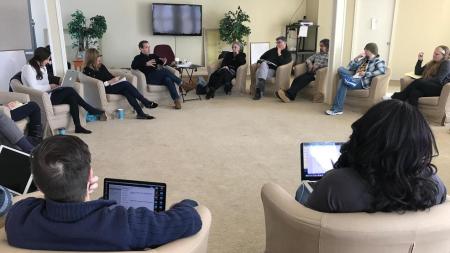
16 students met with producer Michael Rauch Sunday afternoon at the Maharishi University of Management./KTVO
FAIRFIELD, IOWA — Meditate and create. That’s the main focus of the Maharishi University of Management’s David Lynch Screenwriting Program.
Sixteen students are currently enrolled in this two-year masters in fine arts program. Over the course of 10 days, they’ll go through intensive training and meet with well-known producers and executives in the business.
Dorothy Rompalske is the program’s director. She says teaching Transcendental Meditation is what makes this course so special.
“We use Transcendental Meditation in order for the students to sort of dive within and find material that they feel really passionate about, writing about,” said Rompalske.
And the meditation seems to really be working for the students.
“One of the scripts I wrote pretty much all came through meditation. And it’s such a different way of thinking that I wasn’t used to, so it’s just opened a lot more creativity,” said student Josh Lee.
Saturday, students had the chance to meet with Michael Rauch, who’s produced various TV shows such as ‘Royal Pains’ and ‘Beautiful People.’
Rauch answered questions and talked about what it’s really like to be a writer and work in this industry.
“To sit down and get the actual information on how to do it, how they pitch, how the process is, it’s really a unique and valuable experience,” said student Tracy Flannigan.
While the David Lynch screenwriting program is only a year old, Rompalske says she hopes to see it grow over the next few years.
“I think we’re such a different model than what people are used to, so we’ll have hopefully even more students next time around,” said Rompalske.
MUM is currently accepting applications for the program.
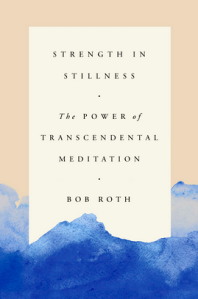
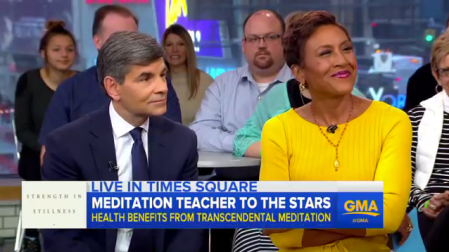
Bob Roth sat down with Robin Roberts and George Stephanopoulos to discuss the benefits of Transcendental Meditation on Good Morning America Live in Times Square. His new book, Strength in Stillness: The Power of Transcendental Meditation, came out today, Feb 6, 2018.
Along with many A-list celebrities who have learned TM from Bob Roth—Oprah Winfrey, David Letterman, Ellen Degeneres, Hugh Jackman, Russell Brand, Katy Perry, Michael J. Fox, Tom Hanks, Martin Scorsese, Stella McCartney, and many more—Robin and George are also students of his.
Bob says, “We’re talking in Transcendental Meditation a medical tool that can just give anyone access whether they believe in it or not. You can be a 100% skeptical. And anyone can learn it—how to allow the active thinking mind to just access calm. And when that happens, your body, according to research, gains a profound state of rest.”
Bob Roth describes how TM works to George Stephanopolous & Robin Roberts
Bob explains, “In Transcendental Meditation we just effortlessly access these deeper, quieter, calmer levels that are already there. And it happens effortlessly because the nature of the mind is to be drawn to something more satisfying, and inside, most satisfying.”
Robin adds the notion of having no expectations, then brings up the issue of time, the amount of time needed to meditate for 20 minutes twice a day. Bobby then relates a true, funny story about that.
George says, “I think it creates time. If you do 40 minutes a day, you go through the rest of the 22, 23 hours, feeling more calm, more focused, more connected to everyone around you, and that’s invaluable.”
Robin says, “It calms you and energizes you at the same time. It’s the oddest thing.” George, who was very skeptical when he learned, reiterates, “Exactly!”
I really appreciate how Bob keeps coming back to TM basics in this interview when he describes the nature of our minds at the surface and at the depth. “Transcendental Meditation is a very natural technique that gives effortless access to the stillness that lies within.”
They actually started 15 minutes later, so fast forward to watch it below. Hugh Jackman and Deborra-Lee Furness open the evening, then invite Bob Roth up to the stage. Bobby later invites Jerry Seinfeld to join him on stage around 40 minutes in.
Jerry is on for 15 minutes. In the first 7 minutes he shares where he first learned TM as a college student and says it gave him “the greatest rest that there is in the world.” Joking about how busy and tiring it is to live and work in New York City, he tells everyone they need to learn how to recharge naturally. Jerry loves life and says, “TM is the greatest tool for work.”
In the next half of the discussion Jerry talks about his work for the David Lynch Foundation. Bob starts to tell the story of how they asked Jerry to perform for a fundraiser. Jerry takes over and tells it like it was in his own hilarious way, when he found out he was going to be on the same stage that night with Beatles Paul and Ringo who were headlining the first Change Begins Within benefit concert at Radio City Music Hall. He also takes questions from the audience. Definitely one of the highlights of the evening!
Proceeds from today’s event and sales of the book will go towards teaching women and children who are survivors of domestic violence and sexual assault to meditate through the Manhattan Family Justice Center.
Visit the book’s website www.stillnessbook.com and scroll down to see Events & Tour Dates for book signings at locations around the country, some with other celebrities joining Bob Roth. Below that you will also find featured print and online news and stories, as well as a video library with event, television, radio, and podcast appearances.
More News Coverage on Bob Roth and his Book Launch
On Wed, Feb 7, Bob was interviewed by Rosanna Scotto and Lori Stokes on Good Day NY FOX 5 | WNYW. Rosanna posted a photo on Instagram of the 3 of them. The next book event followed that evening at the 92Y On Demand. It was moderated by Tony, Emmy and Golden Globe-winning actress and writer Mary-Louise Parker. Watch their wonderful conversation here.
More news coverage continues to come out. Feb 10, 2018, The Guardian published this excellent article: Top US meditation teacher brings his message to stressed-out Britons. Guru Bob Roth, who numbers Katy Perry and Hugh Jackman among his fans, is to set up a TM project in London schools.
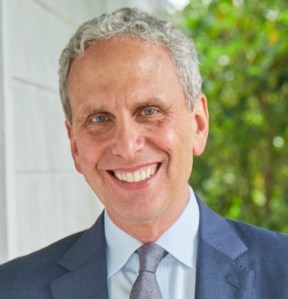
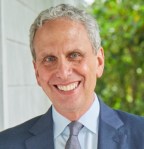
Bob Roth @Alexander Berg
Bob Roth is the most experienced and sought-after meditation teacher in America. Over the past forty-five years, Bob has taught Transcendental Meditation to thousands of people, from billionaire CEOs to combat-scarred veterans, to at-risk students in violence-filled schools, to leading figures in government, business, medicine, media, the arts, and more. In addition to serving as the CEO of the David Lynch Foundation he also directs the Center for Leadership Performance.
In Strength in Stillness, Roth breaks down the science behind meditation in a new, accessible way. He highlights the three distinct types of meditation—focused attention, open monitoring, and self-transcending—and showcases the evidence that the third, Transcendental Meditation, is the most effective and efficient way to reduce stress, access inner power, and build resilience. Free of gimmicks, mystical verbiage, and over-inflated research studies, the book is a simple and straightforward guide to calming mind, body, and spirit.
I just love this funny video clip of Russell Brand and Bob Roth promoting the British and American cover versions of Strength In Stillness. Bob says it’s available in 9 different languages. Watch what Russell has to say about it all.
• Watch a replay of Bob Roth and David Lynch talk about Transcendental Meditation and the work of the David Lynch Foundation. The evening, hosted by Writers Bloc Presents, took place at the Wilshire Ebell Theatre in Los Angeles on Feb 12, 2018.
Have you ever heard of Eva Cassidy, or heard her sing? Eva Marie Cassidy (February 2, 1963 – November 2, 1996) was an unpretentious humble girl from small town Bowie, Maryland. She worked hard with her mother in their nursery growing flowers and plants. But Eva also sang. She had the voice of an angel, and delivered songs with purity, passion, and power. She accompanied herself on guitar, and also sang with a band. She would immerse herself in the words, she “connected to the lyric” and lived the songs. Her voice communicated directly to the hearts of her listeners. Rarely was there a dry eye in the place.
In the film Eva Cassidy: Timeless Voice, Carrie Grant, a British vocal coach who worked with top recording artists in the UK and US, was amazed when she heard Eva’s voice. After listening to Over The Rainbow, she said, “I cannot imagine what Eva Cassidy was thinking of when she chose to make it sound the way it does. But it’s just genius!” She describes how she redefines the song in unexpected ways, “yet for some reason it just works.”
She also explained the effect that Eva’s voice had on listeners. “She sounds like she’s singing just to you. And that is what makes it so intimate. And that becomes even more profound once you know she’s no longer alive. Because it’s haunting. And it’s personal.”
Eva sang the songs that she liked, regardless of genres, which is why record companies would not sign her during the days of manufactured music. They couldn’t slot her into a specific category. She sang blues, jazz, gospel, folk, old standards, and more. At first she was extremely shy, didn’t care for stage presence or how she dressed. With the help of local musicians she performed at Blues Alley, a local jazz spot in Georgetown, Maryland. One of her shows was later recorded. She sold two locally produced CDs out of the trunk of her car. You can listen to Live At Blues Alley on Spotify.
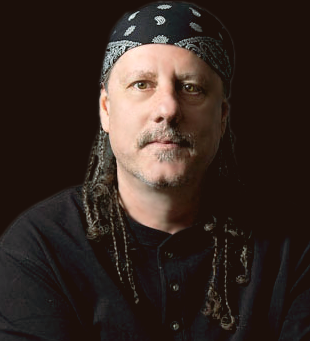
We might wonder how her singing was recorded in the first place when no company would sign her. One comment on Ain’t No Sunshine explained that the world owes Chris Biondo a debt of gratitude. Chris worked as a bassist, guitarist, keyboardist, recording engineer, and producer. He owned a studio in the 80s and 90s, and Eva would come in for session work. He recognized her ability, and said he “would just roll tape and stay out of her way.” At one point they were romantically involved. Chris “was the one who recognized her transcendent, ageless genius.”
In 1986 Chris began recording the then-unknown singer Eva Cassidy. For the next ten years he worked with Eva to develop her as a recording artist, producing most of her recordings available today. In the years since Eva’s death in 1996, her recordings have sold more than 10 million copies and achieved international renown, including three albums that reached number one in the UK charts. Chris has received numerous Gold and Platinum records in the U.S. and internationally for his work with Eva.
Bill Straw of Blix Street Records signed her up and continues to release and reissue her music, like the 20th anniversary of the new 32 track/2CD Nightbird album, The Best Of Eva Cassidy, Simply Eva, and eight other collections listed there that you can sample.
Sting himself was blown away when he heard her rendition of his song. He put a copy of her Songbird CD into record producer David Foster’s hands who quoted him saying, “‘If you want to hear the greatest version of my song ever’—he didn’t say it in an egotistical way—he said, ‘listen to Fields Of Gold with this girl, it’ll change your life.’ And her voice is life-changing, she’s that spiritual.” I love that song and remember hearing it on an airplane’s music channel during a flight. It was astounding! I had to find out who this singer was.
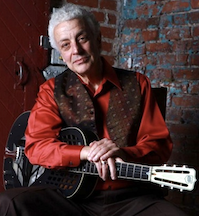
Another singer-songwriter who was overwhelmed by Eva Cassidy singing one of his songs was award-winning acoustic bluesman Doug MacLeod. During an interview he was asked: “Your songs have been recorded by many artists, so which are your favorite interpretations?” He said he had a couple of favorites, and that Eva Cassidy’s version of Nightbird was one of them. He told the story of how he first heard Eva sing when his wife put on her CD in the car. He said it moved him so much, “I pulled over to the side of the road and I was weeping.” When people ask him to play Nightbird, he tells them that “if they want to hear THE version, she is the one to listen to.” Read the whole interesting story in the highlighted comment Harvey Bobb posted to Eva Cassidy – Nightbird.
A relatively unknown singer in America at the time, somehow her music made its way across the Atlantic. From the first time Sir Terry Wogan, a BBC radio broadcaster, listened to Eva sing, he knew “she was an outstanding talent.” He said, “It was pure sound. A bell-like voice. She had this perfect pitch.” He couldn’t wait to play it on the radio. His was the most listened to program in the country at the time. It created a huge response from many of their seven million listeners wanting to know who she was. Unfortunately they found out that she had died two years earlier of cancer at the young age of 33.
When Mark Hagon, a Top of the Pops BBC (TOTP2) producer at the time, agreed to play that homemade video of Eva Cassidy singing Over The Rainbow, people kept calling in for weeks wanting to know her name. The listening public created a demand for her music. It was a groundswell! Sales of her CDs went from a hundred thousand to over a million in the UK. “Radio broke it. Television exploded it.”
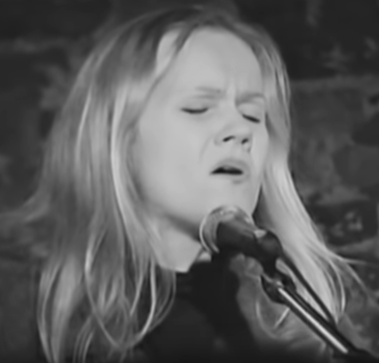
Cropped screensaver taken from the video of Eva Cassidy singing Over The Rainbow at Blues Alley, Georgetown, DC, January 3, 1996.
At one point five of her CDs became top sellers at the same time, a feat usually held by the Beatles and Rolling Stones. She was then discovered back home in the USA. ABC Nightline in Washington, DC researched and produced The Eva Cassidy Story (18:40). It was shown in many countries around the world and within a week of it airing her CDs went to the top of the local charts.
In Timeless Voice, Terry Wogan concluded, “You’d have to say about Eva Cassidy that her talent was pretty timeless. The voice has a quality of timelessness about it. Anytime you would hear it, whether it was thirty years ago, or thirty years from now, it’ll still be worth listening to, and still strike a responsive chord in most people’s hearts.”
Mick Fleetwood of Fleetwood Mac who knew Eva said, “She was brilliant. She had the magic. And I call it, It. She had It!”
Eva Cassidy: 25 years ago, a little known singer, Eva Cassidy, and her producer scraped together enough money to record a gig and self-produce an album. This is the story of one night – 3rd January 1996 – at a jazz club in Georgetown, Washington D.C., a set of recordings that almost never happened, and the extraordinary success that followed told by her band members who played with her that night. No one could have imagined that the audio and video recordings from that night would prove to be the foundation of her unparalleled posthumous worldwide success.
Coming down out of the freezing sky with its depths of light, like an angel, or a Buddha with wings, it was beautiful and accurate, striking the snow and whatever was there with a force that left the imprint of the tips of its wings– five feet apart–and the grabbing thrust of its feet, and the indentation of what had been running through the white valleys of the snow–
and then it rose, gracefully, and flew back to the frozen marshes, to lurk there, like a little lighthouse, in the blue shadows– so I thought: maybe death isn’t darkness, after all, but so much light wrapping itself around us–
as soft as feathers– that we are instantly weary of looking, and looking, and shut our eyes,
not without amazement, and let ourselves be carried, as through the translucence of mica, to the river that is without the least dapple or shadow, that is nothing but light–scalding, aortal light– in which we are washed and washed out of our bones.
The ideas and imagery of light and dark that Mary Oliver uses remind me of William Stafford’s poem, Rx Creative Writing: Identity, where he describes “then that bone light belongs inside of things. You touch or hear so much yourself there is no dark. You know so sure there burns a central vividness.”
— Written and compiled (citing sources) by Ken Chawkin for The Uncarved Blog.
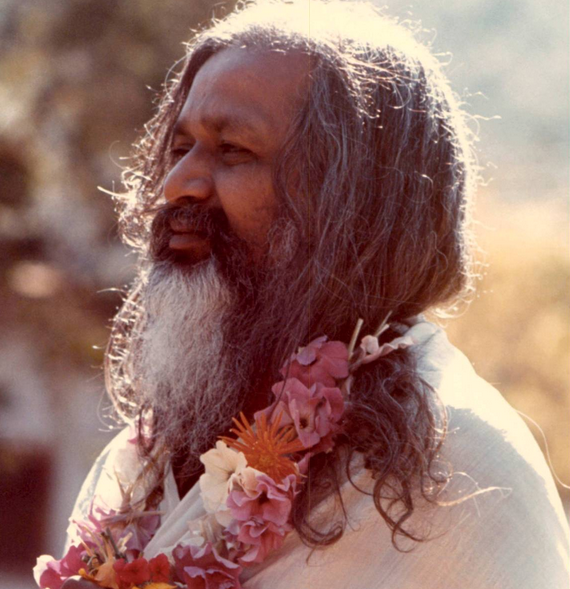
January 12th has been traditionally celebrated as the birthday of Maharishi Mahesh Yogi. This year, January 12, 2018, is the centenary of his birth. After taking a Week of Silence at the start of every year, Maharishi would use the occasion of his birthday to inaugurate a new theme for the new year for his worldwide Transcendental Meditation Movement. See a PDF of Maharishi’s Achievements for each year.
For example, on January 12, 1975, after hearing of a few cities in the United States where 1% of the population were practicing TM and the crime rate had gone down compared to similar cities where it had gone up, he inaugurated the year as the Dawn of the Age of Enlightenment, saying, “Through the window of science, we see the Dawn of the Age of Enlightenment.”
On January 18, 2011, The Times of India published an article about Maharishi by Lane Wagger, The Prime Mover of Life. In this article, titled, Transcendental Meditation, Lane Wagger recalls the legacy of Maharishi Mahesh Yogi for his centenary year. Don’t know the date and paper it was published in, but here is an image of the article I had converted into a PDF: Maharishi’s Legacy by Lane Wagger. If you open it, go to Tools, Rotate Clockwise, then Zoom up to 110% to read it.
These remembrances are just a fraction of what he had accomplished. He created schools, universities, revived ancient Vedic medicine, architecture, music, encouraged scientific research on TM, and so much more. Maharishi’s Vedic knowledge and technologies continue to transform millions of people’s lives for the better, and for that we are very thankful. Jai Guru Dev.
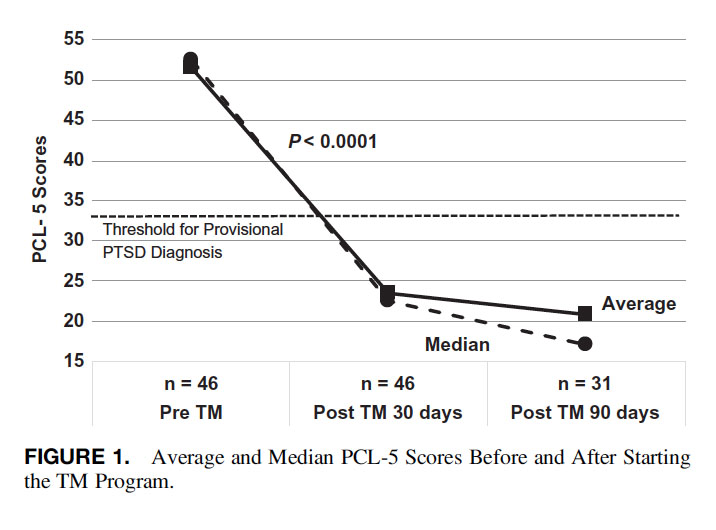
SUMMARY: A study published in Military Medicine showed that after 30 days of practicing the Transcendental Meditation (TM) technique, 80% of the 46 veterans and active-duty personnel no longer had PTSD. All participants had been clinically diagnosed with PTSD using a standard assessment. By comparison, standard treatments for PTSD—prolonged exposure therapy, cognitive processing therapy, and medication—are only partially successful: approximately two-thirds of patients receiving cognitive processing therapy or prolonged exposure still have PTSD after treatment.¹
Participants in the study went from an average PCL-5 pretest score of 51.52 (with a score of 33 or above indicating PTSD) to an average posttest score of 23.43 after 30 days of practicing Transcendental Meditation (TM).
Veterans of the war in Vietnam, the Gulf War, Somalia, Iraq, and Afghanistan suffering from post-traumatic stress disorder (PTSD) found significant relief from their symptoms as a result of practicing the Transcendental Meditation (TM) technique, according to a new study published in Military Medicine. (PDF)²
The 41 veterans and 5 active-duty soldiers in the study had been diagnosed with clinical levels of PTSD, as measured by the PTSD Checklist-Civilian (PCL-5). After one month, 87% had a clinically significant decrease of more than 10 points. The reduction was so great that 37 participants (80%) had their symptoms reduced to below the clinical level, meaning that they were no longer considered to have a disorder.
The effect size, which is a measure of the magnitude of a treatment, was 1.91. This is unusually high, with a value of .8 considered to be a strong effect. In addition, the very low p-value (p < 0.0001) indicates these results were probably not due to chance. The study included a 90-day posttest; PTSD symptoms continued to improve.
“It’s remarkable that after just one month we would see such a pronounced decrease in symptoms, with four out of five veterans no longer considered to have a serious problem with PTSD,” said lead author Robert Herron.
More effective than standard treatment
By way of comparison, the standard treatment, which entails veterans attending counseling and re-experiencing their trauma as part of the therapy, is typically only partially successful, with approximately two-thirds still suffering from PTSD after being treated.
“Transcendental Meditation is very easy to do and results come quickly,” said James Grant, Director of Programs for TM for Veterans, which provided partial funding for this study. “TM promotes self sufficiency – it’s a tool that the veteran can use for life, on his or her own.”
In addition, research has shown that Transcendental Meditation has a positive benefit for many of the conditions associated with PTSD, such as high anxiety, insomnia, depression, and high blood pressure.
“Because it works on the neurophysiological level to reduce stress, it has broader impact than cognitively-based therapies,” he said.
Veterans able to help themselves
An interesting facet of the study was that the veterans were recruited through media advertising rather than through a veterans hospital.
“The importance of this study is that it shows that veterans are able to help themselves,” said lead author Robert Herron. “After learning about the opportunity to participate in the study, they went to local Transcendental Meditation centers to be instructed in the practice.”
Dr. Herron said that because of their huge caseload, the Veterans Administration hasn’t been able to help all veterans in a timely manner. And veterans are often in desperate need of help.
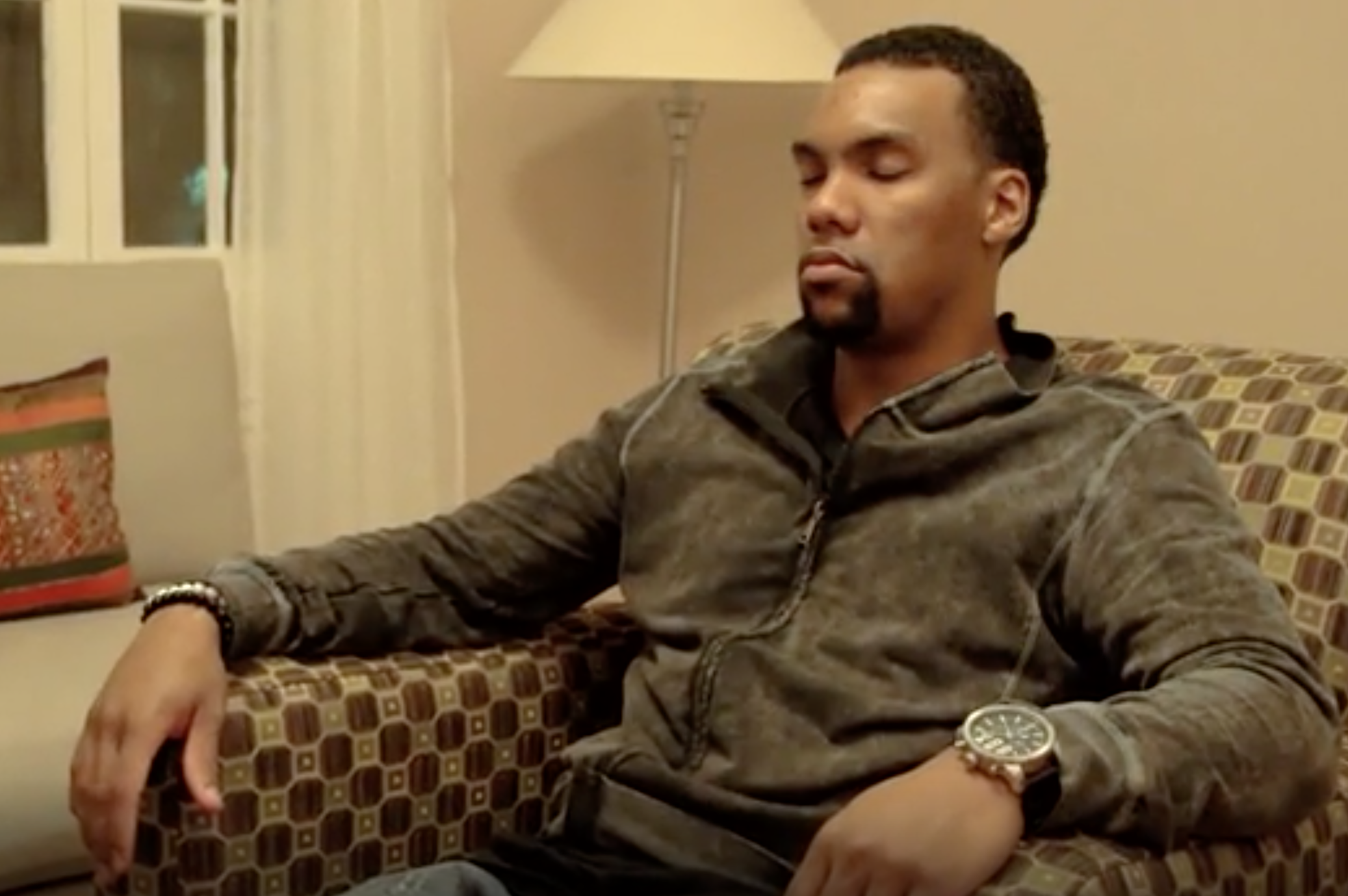
Veteran practicing Transcendental Meditation
“The veterans involved were pleased that they were able to do this on their own, and no doubt the VA hospitals appreciate that there are therapeutic approaches that can be undertaken without the costly intensive care of a therapist that treatment typically entails,” he said.
Dr. Grant said some veterans are reluctant to go to counseling because of the perceived stigma, but that there’s no stigma associated with meditation, which is widely practiced by healthy people.
Practiced 20 minutes twice a day
The participants learned the standard Transcendental Meditation technique, which is practiced 20 minutes twice a day. The study found that the veterans who practiced twice a day as recommended had greater benefits than those who practiced once a day.
This approach to meditation, which was introduced in the West by Maharishi Mahesh Yogi beginning in the late 1950s, has been widely researched over the past 50 years, with over 400 peer-reviewed studies. It is unique in that it doesn’t entail contemplation or concentration and is easy to learn and effortless to practice.
“Researchers have been calling for new approaches to PTSD treatments, and Transcendental Meditation seems to be particularly effective,” Dr. Grant said. “Veterans who elect to learn Transcendental Meditation themselves can find significant reductions in PTSD. The results are promising and suggest that this is a treatment modality that deserves more rigorous study as a potential treatment for PTSD.”
DoD supports researchon TM
The current study follows four previous studies on veterans that suggested a benefit for PTSD. Because of these promising findings, the U.S. Department of Defense has supported a randomized controlled trial involving 210 veterans that is now nearing completion.
“The evidence is mounting that Transcendental Meditation is an effective treatment for PTSD,” said Colonel Brian Rees, MD, coauthor of the current study. Dr. Rees was the lead researcher on two earlier studies on Congolese refugees suffering from PTSD, and found a significant benefit after just 10 days of TM practice.
Funding for veterans to learn the Transcendental Meditation technique in this study was provided by the Wege Foundation of Grand Rapids, Michigan.
Watch veterans describe their PTS symptoms and how TM changed their lives in this video made by the David Lynch Foundation: Real PTS Relief for our Veterans.
Listen to this excellent interview about TM for Veteranswith Colonel Dr. Brian Rees on Better Worldlians, Podcast #109 — Aired November 7, 2016, in honor of Veterans Day: Transcendental Meditation and PTSD.
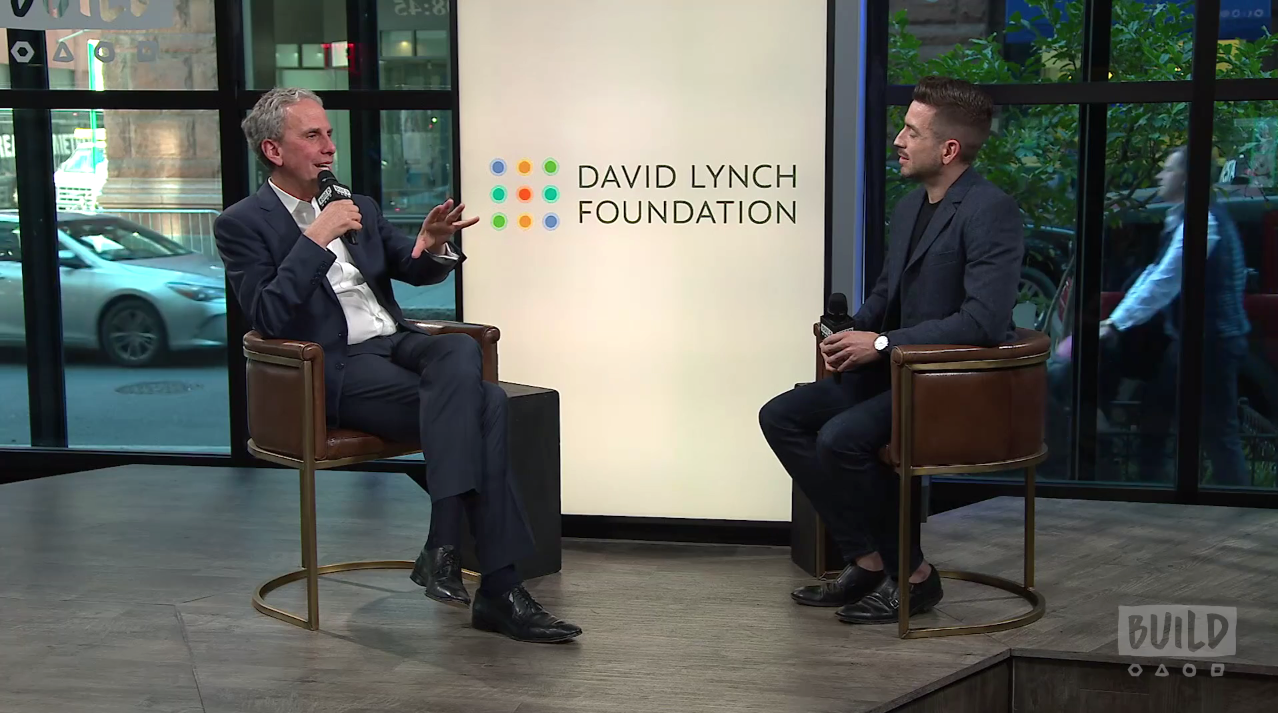
David Lynch Foundation CEO Bob Roth talks TM with BUILD host Charles Thorp
David Lynch Foundation (DLF) CEO Bob Roth joined BUILD Series NYC host Charles Thorp to talk about the work of the global charitable organization. DLF addresses the epidemic of trauma and toxic stress among at-risk populations. It hosted “Change Begins Within: Healing the Hidden Wounds of War,” a benefit dinner and conversation, which featured meditating actors Tom Hanks and Mary Louise-Parker. The proceeds benefited David Lynch Foundation programs, including the Center for Excellence in Military Health, a division of the David Lynch Foundation helping veterans and those in the armed services dealing with post-traumatic stress (PTS). Watch this engaging interview here: https://goo.gl/zpKLwa.
Bob Roth, DLF CEO. (Photo Alexander Berg)
Bob Roth is the most experienced and sought-after meditation teacher in America. Over the past forty-five years, Bob has taught Transcendental Meditation to thousands of people, from billionaire CEOs to combat-scarred veterans, to at-risk students in violence-filled schools, to leading figures in government, business, medicine, media, the arts, and more. In addition to serving as the CEO of the David Lynch Foundation he also directs the Center for Leadership Performance.
In Strength in Stillness, Roth breaks down the science behind meditation in a new, accessible way. He highlights the three distinct types of meditation—focused attention, open monitoring, and self-transcending—and showcases the evidence that the third, Transcendental Meditation, is the most effective and efficient way to reduce stress, access inner power, and build resilience. Free of gimmicks, mystical verbiage, and over-inflated research studies, Strength in Stillness is a simple and straightforward guide to calming mind, body, and spirit. Read more here: www.stillnessbook.com.
Watch this excellent book promo video, containing excerpts from various presentations, interviews, and famous meditators talking about what TM does for them, and others in need, on Bob Roth’s (@meditationbob)Twitter feed.
Jan 10, 2018: Bob Roth explained his book on his Facebook page live.
The vegetation in Santa Barbara is varied and lush, with many exotic succulent plants, beautiful flowering bushes, and tall trees. I share my admiration for them as we drive through the city. Nathanael comments: “A tree can only grow as high as its roots go deep.” I write it down and start converting the idea into the first two lines of a haiku. I tell him we need a third line to complete it. After pondering the question for a moment, he recalls a universal phrase from the somatic arts (yoga, dance, martial arts) that his friend and coaching colleague LeeAnn Mallory had shared with him: “Root to rise.” I turn it into the last line to complete this short poem on a basic principle of growth.
Growth Haiku
Trees can only grow
as high as their roots go deep
Root yourself to rise
Maharishi always talked about developing 200% of life—100% inner spiritual development and 100% outer material accomplishments. We both say, “Water the root to enjoy the fruit.” Nathanael quotes the SCI Principle, “Outer depends on Inner.” I remember an early analogy: To erect a tall building you have to first dig a deep foundation. It’s similar to: First pull the arrow back on the bow to hit the target. Meditate then act. Established in Being, perform action.
I’m here in Santa Barbara, California visiting my son Nathanael and his girlfriend Evangeline for the Thanksgiving holiday. They live high up in the hills of the Riviera overlooking this beautiful city and the ocean. The panoramic views are spectacular! It’s like living in a constantly changing painting. My first visit a year and a half ago resulted in a spontaneous haiku. Early one morning, Nathanael excitedly invited me out onto the balcony to watch the predawn colors. It inspired this haiku.
Dawn in Santa Barbara Haiku by Ken Chawkin
Golden glow of light
Brightening the morning sky
The sun is rising
Happy Thanksgiving!
Ken Chawkin
Nathanael posted 6 photos of that sunrise and of me taking pictures of it posted on his Instagram. Their wonderful friend Jada Delaney also posted photos and a video of that same sunrise on her Instagram.
This is the one-year anniversary of the start of my trip to India. A year ago today, I boarded a very long non-stop flight from Chicago to New Delhi. After clearing customs I went to an airport bank to change some money. It took a while, but a driver who had been sent to pick me up waited to take me to a Holiday Inn, where I finally crashed. The next morning another driver took me to the airport for a flight to Jabalpur. My sister and brother-in-law where there to welcome me when I arrived, which was very nice. We then traveled to the holy Narmada River, to fulfill the prime purpose of my long journey.
As it turned out, November 14, 2016 was a very significant day in three major religious traditions at this celebratory time of year. We hired a boatman, and after some special prayers, I spread Sali’s ashes on this peaceful celestial river as he rowed the boat towards and around a small Mother Narmada Temple at the foot of the Gwari Ghat.
This took place during the late afternoon on a Monday, a moon day, but the largest full moon in 70 years, the supermoon! It was highly significant, worthy of Sali’s spiritual merit she had earned offering a lifetime of one-pointed devoted service to Maharishi Mahesh Yogi, founder of the Transcendental Movement. Some of his ashes had been spread at this holy place as well.
It was evening by the time we arrived at the Bijouri Campus in the Brahmasthan of India. During my 3-week stay there I would meet many wonderful meditators and sidhas from different countries around the world who came for the Maharishi India Courses, to meditate and enjoy the recitations of the Maharishi Vedic Pandits. It was a very healing atmosphere to settle into. Just what I needed, thanks to my family.
Traditional Indian Greeting
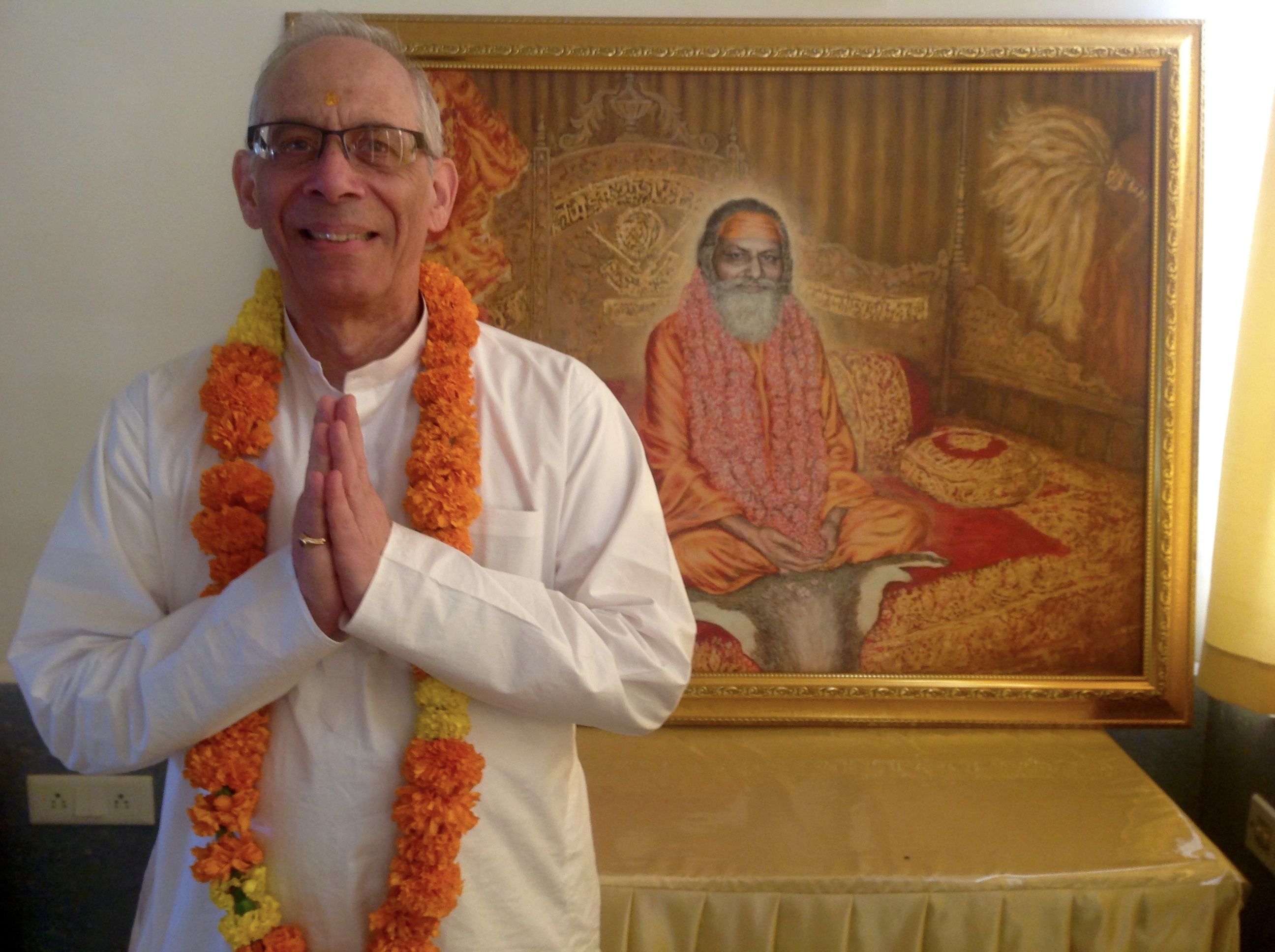
To start our course, we were each given a special welcome by the Maharishi Vedic Pandits and garlanded with flowers. Here is a photo of me, taken last year, November 16, 2016, after that warm reception.
I purposefully stood in front of a large beautiful painting of Guru Dev, Maharishi’s master. I had purchased a print of this latest painting of Guru Dev the previous summer, having seen it featured at Art Fifty Two in Fairfield during a reception for the artist and her work. I had taken a photo of Frances Knight at the gallery standing in front of the original painting. You can also see part of a large Holy Tradition painting on the back wall behind her, one of many she had painted in the past.
Visiting the Maharishi Vedic Pandit Campus
On one of our trips we were taken to the geographical center of India known as the Brahmasthan. We shared a short group meditation and took photographs. And once a week we were driven to the Maharishi Vedic Pandit campus to hear 1,500 pandits recite Atirudrabhishek, an ancient Vedic performance to create world peace.
Sitting there with my eyes closed listening to the powerful Vedic recitation, I started to feel a deeply relaxing peacefulness growing inside my body. Soon, much to my surprise, I started to smile, then chuckle! I felt an inner happiness welling up within me that was totally unexpected. This bliss was a welcome contrast, a relief from the grief I was carrying around with me, mourning the loss of my sweetheart. This profound experience was worth the long tiring trip over there!
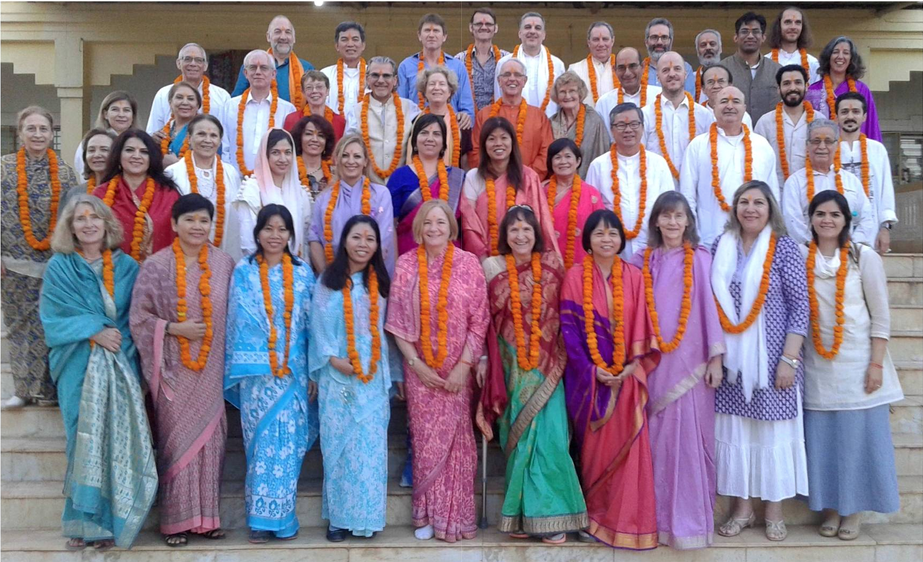
We put on traditional Indian clothing for these special occasions and posed for a group photo before boarding the buses back to our campus. I am standing in the upper second-to-last row on the far left. The course participants came from England, Ireland, USA, Canada, several European and Asian countries, Israel, Australia, and many from Iran. We were a diverse and harmonious group.
Now that I finally transferred all of my photos from my iPad onto my computer, I could post some of them related to this story. Who knows, maybe other photos will spark new stories.

 In Strength in Stillness, Roth breaks down the science behind meditation in a new, accessible way. He highlights the three distinct types of meditation—focused attention, open monitoring, and self-transcending—and showcases the evidence that the third, Transcendental Meditation, is the most effective and efficient way to reduce stress, access inner power, and build resilience. Free of gimmicks, mystical verbiage, and over-inflated research studies, the book is a simple and straightforward guide to calming mind, body, and spirit.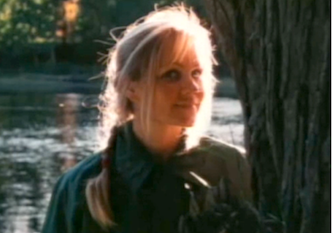
 In the film
  We might wonder how her singing was recorded in the first place when no company would sign her. One comment on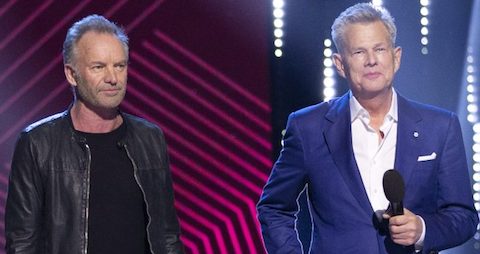
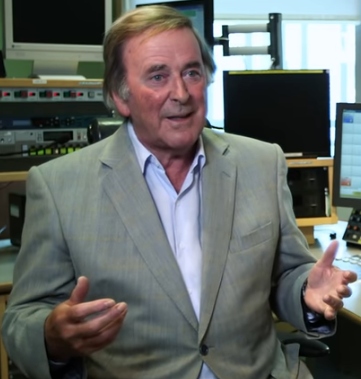 In Timeless Voice, Terry Wogan concluded, “You’d have to say about Eva Cassidy that her talent was pretty timeless. The voice has a quality of timelessness about it. Anytime you would hear it, whether it was thirty years ago, or thirty years from now, it’ll still be worth listening to, and still strike a responsive chord in most people’s hearts.”