I’m not young enough to know everything. ― Oscar Wilde (1854–1900)
By the time you’re eighty years old you’ve learned everything. You only have to remember it. ― George Burns (1896–1996)
Two kinds of knowledge
There are two kinds of knowledge: Youth knows it all, without having lived; And having lived and learned, Old Age Soon forgets what it’s come to know.
Then there’s the wisdom Of knowing you know nothing; But knowing your Self.
― Ken Chawkin (1944–still learning)
The Coming Of Wisdom With Time
Though leaves are many, the root is one; Through all the lying days of my youth I swayed my leaves and flowers in the sun; Now I may wither into the truth.
― William Butler Yeats (1865–1939)
The only true wisdom is in knowing you know nothing.
― Socrates (469–399 B.C.E.)
Know thyself.
― Ancient Greek aphorism on the Temple of Apollo at Delphi
Those who know others are wise; those who know themselves are enlightened.
Later added: These two famous quotes from an older more mature place in one’s life hold much wisdom.
When I was young, I admired clever people. Now that I am old, I admire kind people. — Abraham Joshua Heschel
I’ve learned that people will forget what you said, people will forget what you did, but people will never forget how you made them feel. ― Maya Angelou
Sitting with Sali on a cold winter Sunday afternoon at Parkview Care Center, looking out the window of her room at the powdered snow being blown off the white roofs in swirls. At one point, with the sun shining through in front of us, you could almost see a rainbow; only it was a snowbow! Made that up. We laughed. I had been in a rough mood, but what I saw, and the spontaneous playful art of composing a haiku, transformed me. The second and third lines came out first, and the first line last. I changed wind blows to winds blow to rhyme with snow. The rhythms, rhymes and meanings of the words sort of sound like what we saw. They’re powerful. Say them aloud a few times and see what happens. Sali seemed to like it. I love it! it’s fun! Here’s the poem.
WINTER HAIKU
The winter winds blow
Swirling whirling dervishes
Of powdery snow
New York poet laureate Marie Howe speaks with Krista Tippett about her poetry on the NPR show, On Being. Closing the interview, The Poetry of Ordinary Time, recorded In The Room, April 2013, Howe reads a poem in the voice of Mary, mother of Jesus, describing the Annunciation, which, her friend and mentor, Stanley Kunitz, said no one had ever gotten right. She wrote several versions, tore them up, and then this final one came through her.
Marie Howe said it had nothing to do with her. It just came through her, a reminder that the best poetry comes through us when we get out of the way. When we are emptied of our small self, “by being no one,” transcend our senses and turn within and are open to the higher Self, then that great creative force of Love within us creates, and the miracle of life, of poetry, happens. You can hear “Annunciation” by Marie Howe on SoundCloud.
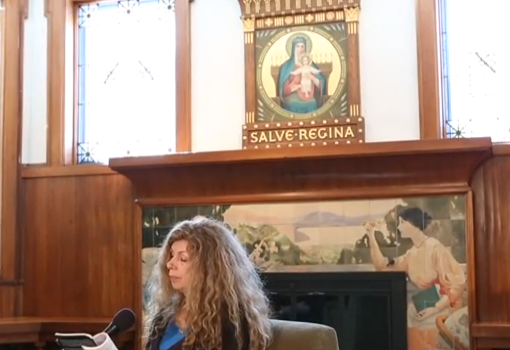
Thought this screen save from the video is most appropriate with the poster of Mother Mary holding the infant Jesus!
Marie Howe reads her poem “Annunciation” to Krista Tippett for On Being
Annunciation
Even if I don’t see it again—nor ever feel it I know it is—and that if once it hailed me it ever does—
And so it is myself I want to turn in that direction not as towards a place, but it was a tilting within myself,
as one turns a mirror to flash the light to where it isn’t—I was blinded like that—and swam in what shone at me
only able to endure it by being no one and so specifically myself I thought I’d die from being loved like that.
This amazingly beautiful and profound poem can be found at 1:36:02 at the end of the interview, but she starts talking about it at 1:34:45. There are six audio clips of Howe reading her poems posted on SoundCloudrecorded on March 16, 2003, at the College of Saint Benedict in Saint Joseph Minnesota.
Enjoy reading: The Millions Interviews Marie Howe—Words Can Sustain and Save Us, published January 11, 2018, where Marie describes what the writing and reading of poetry has done for her, and what it can do for the rest of us. This Q&A particularly reinforces the point Marie Howe made to Krista Tippett when writing “Annunciation.”
TM: Do you think of writing as a spiritual act at its core?
MH: I do, because it involves a wonderful contradiction, which is, in order for it to happen, you have to be there, and you have to disappear. Both. You know, nothing feels as good as that. Being there and disappearing—being possessed by something else. Something happening through you, but you’re attending it. There are few other things in the world like that, but writing is pretty much a relief from the self—and yet the self has to be utterly there.
William Stafford in his poem, Rx Creative Writing: Identity, also writes about being open to “that bone light,” which “belongs inside of things.” And “You know so sure there burns a central vividness.” He reiterates this idea of being a recipient, a receptacle, and an attendant, a reporter: “It tells you; all you do is tell about it.”
In her poem, Mindful, Mary Oliver delights in the world around her, which leaves her “like a needle in the haystack of light. It was what I was born for — to look, to listen, to lose myself inside this soft world — to instruct myself over and over in joy, and acclamation.”
Oliver codifies this message in 3 short, powerful sentences in the 4th stanza of Sometimes, where she gives us “Instructions for living a life: Pay attention. Be astonished. Tell about it.”
Later added this article/interview by Kim Rosen for Spirituality&Health, Feb 16, 2014: Marie Howe: Holding the Silence. The acclaimed poet reflects on prayer, desperation, and letting go of what can’t be said. (PDF)
This past Thursday, September 19, 2013, turned out to be an early Full Moon night. For some reason I ended up visiting Sali 3 times that day, twice to drop off things. The first time I stayed with her as she and the other residents were going to be entertained by a country music band. Their gentle songs from the fifties brought back memories when I first heard them as a child. It was very relaxing and healing for us as we listened together. When I returned later that night to read to her, she was already in bed. I leaned in and looked closely into her eyes. We both started laughing out loud, with great joy in our hearts. While sharing this experience with a friend at lunch today, the day of the autumnal equinox, I spoke of experiencing an orgasm of the heart. She repeated that line, and said it was something special. I noticed it also had seven syllables and wrote it down. Later, when we all went out for a walk together, the rest of the haiku easily assembled itself. I shared it with her; it sounded powerful. She said it gave her goosebumps, from head to toe and back.
Haiku of the Heart for Sali
♥ ♥ ♥
Such joy between us
An orgasm of the heart
Looking in your eyes
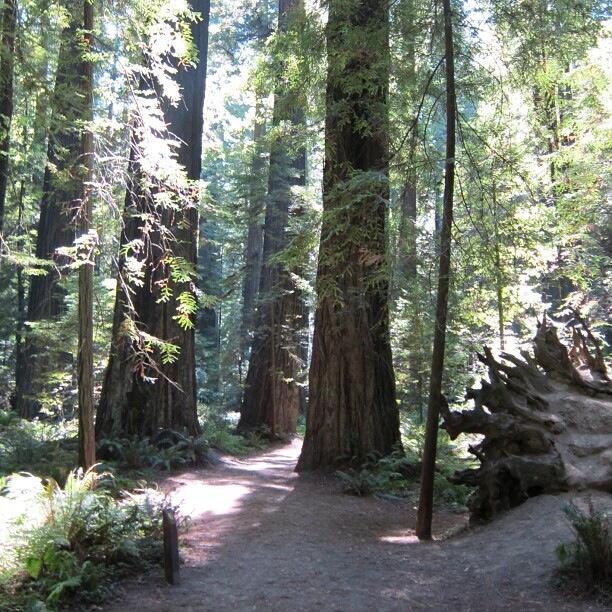
I signed up with Instagram so I could see the pictures my sister took on her vacation to Mendocino in Northern California. They drove north to Humboldt County to see the California Redwood Coast Park Forest. Among the beautiful photos she posted, this one of the Giant Redwoods, considered the largest trees in the world, inspired me to write this haiku. Here is that photo, and two haiku versions, for your enjoyment.
Redwood Forest Haiku
~1~
In Redwood Forests
There are Giants among us
Who Hold The Silence
~2~
In Redwood Forests
There are Giants among us
Holding The Silence
Ansel Adams sits up
reaches for his camera—
his arm bony as a tripod leg
for it is “Magic Light”
the golden light of sunrise
and sunset.
But then he lays back down
and focusing instead
through the lens of his soul
in the black box of his skull
he sees… all the light
that ever filled Yosemite
or blazed the crosses at Hernandez
and with his brittle jaw
with its few teeth remaining
there in the dark room of a coffin
he smiles.
“Magic Light” by Bill Graeser won the Iowa Poetry Association’s 2012 Norman Thomas Memorial Award. Bill posted it August 28, 2012.
Congratulations, Bill, you deserve this memorial award for a memorial poem of the great Ansel Adams. I’m sure he’d approve, and be pleased! Visit https://www.anseladams.com for more amazing photos.
I found this detailed interview with Marc Silber and Michael Adams: An Inside Look at Ansel Adams’ Photography In Yosemite, posted April 10, 2013. I also found this earlier fascinating video posted by Silber Studios on May 7, 2011 on How Ansel Adams Photographed His Iconic “Moonrise Hernandez”. Marc is given a tour of the house and darkroom by Ansel’s son, Michael Adams. He was seven years old and with his father when he took the iconic picture of the moonrise over Hernandez and described how he created it. The music was composed by Andrew Buffett, the American musician, composer, author and philanthropist. Peter is an Emmy Award winner, New York Times best-selling author and co-chair of the NoVo Foundation. He is the youngest son of billionaire investor Warren Buffett. Here is an earlier video posted by Marc Silber about advice on how to visualize your photos, from a rare interview with Ansel Adams: Photography Visualization Advice by Ansel Adams. Photo visualization was so important to Ansel Adams that he made it the first chapter of his book on photography.
 The Uncarved Blog