Archive for the ‘Peace’ Category

Transcendental experiences during meditation practice – paper published in @AcademyAnnals

January 13, 2014

Overview of research on individuals experiencing higher states of consciousness published in Annals of the New York Academy of Sciences

Today, millions of Americans say they practice some form of yoga and/or meditation. It’s become a health fad. Yet the goal of these practices seems unknown or elusive to many practitioners — transcendence.

Dr. Travis, PhD, Director, Center for Brain, Consciousness, and Cognition, Maharishi University of Management

Fred Travis, PhD, is the Director of the Center for Brain, Consciousness, and Cognition at Maharishi University of Management

An article: Transcendental experiences during meditation practice, by Fred Travis, PhD, Director of the Center for Brain, Consciousness, and Cognition at Maharishi University of Management, provides an overview of research on individuals experiencing higher states of consciousness. It is published today in Annals of the New York Academy of Sciences: January 2014, Volume 1307, Advances in Meditation Research: Neuroscience and Clinical Applications, pages 1-8.

The paper is based on a presentation Dr. Travis was invited to give at “Advances in Meditation Research” (AMR), a meeting of the nation’s top meditation researchers, which took place a year ago  at the New York Academy of Sciences New York City.

In his paper Dr. Travis explains that different meditations have different effects, and that meditation can lead to nondual or transcendental experiences, a sense of self-awareness without content.

However, after a search of the scientific literature he reported that physiological measures and first-person descriptions of transcendental experiences and higher states have only been investigated during practice of the Transcendental Meditation® (TM) technique.

TM is an effortless technique for automatic self-transcending, different from the other categories of meditation — focused attention or open monitoring. It allows the mind to settle inward beyond thought to experience the source of thought — pure awareness or Transcendental Consciousness. This is the most silent and peaceful level of consciousness — one’s innermost Self.
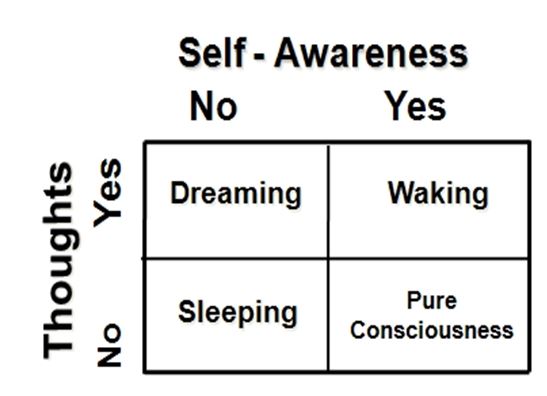
This figure, a 2 X 2 table, compares subjective and objective experiences during waking, sleeping, dreaming, and pure consciousness. As seen in this table, waking state contains a sense of self and mental content, thoughts and perceptions. In contrast, during pure consciousness, there is only Self-awareness, without any sense of time, space, and body awareness.

This figure, a 2 X 2 table, compares subjective and objective experiences during waking, sleeping, dreaming, and pure consciousness. As seen in this table, waking state contains a sense of self and mental content — thoughts and perceptions. In contrast, during pure consciousness (Transcendental Consciousness), there is only Self-awareness, without any sense of time, space, and body awareness.

Dr. Travis discusses a study of descriptions of Transcendental Consciousness from 52 subjects practicing the Transcendental Meditation technique and found that they experienced “a state where thinking, feeling, and individual intention were missing, but Self-awareness remained.” A systematic analysis of their experiences revealed three themes: absence of time, space, and body sense.

Specific physiological changes are associated with this subjective experience of Transcendental Consciousness. These include changes in breath rate, skin conductance, and EEG patterns.

Dr. Travis further explains that with regular meditation, experiences of Transcendental Consciousness begin to co-exist with sleeping, dreaming, and even while one is awake. This state is called Cosmic Consciousness, in the Vedic tradition. The paper presents first-person accounts followed by an overview of the physiological patterns associated with Cosmic Consciousness.

Whereas control subjects describe themselves in relation to concrete cognitive and behavioral processes, those experiencing Cosmic Consciousness describe themselves in terms of a continuum of inner self-awareness that underlies their thoughts, feelings, and actions.

In addition, the Cosmic Consciousness subjects showed the EEG patterns seen during Transcendental Consciousness along with the EEG patterns when they were asleep, and during waking tasks. This leads to higher scores on the Brain Integration Scale developed by Dr. Travis.

Dr. Travis suggests that such higher states of consciousness can be seen as normal developments beyond the classic stages described by Piaget. One simply needs a technique to experience transcendence and thereby facilitate the development of these states. The practical benefit of higher states, he says, is that you become more anchored to your inner Self, and therefore less likely to be overwhelmed by the vicissitudes of daily life.

“This research focuses on the larger purpose of meditation practices — to develop higher states of consciousness,” explained Dr. Travis. “This paper is the outgrowth of meetings at Esalen and the Institute for Noetic Sciences to chart the future of meditation research.”

Source: EurekAlert!

The Annals of the New York Academy of Sciences is the oldest continuously published scientific serial in the United States and among the most cited of multidisciplinary scientific serials worldwide. Established in 1823, the Annals is the premier publication of the Academy, offering volumes of review articles in special topical areas and proceedings of conferences sponsored by the Academy as well as other scientific organizations. You can find out more about them here: http://www.nyas.org/whatwedo/publications/annals.aspx.

Read the Foreword to Advances in Meditation Research: Neuroscience and Clinical Applications, by editor Sonia Sequeira.

Related: Health India’s Editorial Team says Transcendental Meditation (TM) is taking the world by storm

Medical News Today: Overview of research on individuals experiencing higher states of consciousness during transcendental meditation.

A PDF of the study is now available at ResearchGate.

@MaharishiU Dean of Faculty, Dr. Cathy Gorini, interviews author Steven Verney on MUM’s KHOE

January 2, 2014
Steve Verney Cathy Gorini

Steve Verney  Cathy Gorini

Author Steven Verney is interviewed by Dr. Cathy Gorini, Dean of Faculty at M.U.M. on the KHOE radio program “A Chat with the Dean.” Titled “The Best of all Possible Worlds” Steven Verney’s novel is based on his experiences as a teacher of Maharishi Mahesh Yogi‘s Transcendental Meditation.

Steven sprinkles gems of Maharishi’s knowledge before the reader along with threads of life-changing experiences many teachers of TM will relate to while going about the business of bringing enlightenment to the individual and the world and balancing life in the “real world.” Readers have found it difficult to put down this well-written book.

Click to listen: Steven Verney and Cathy Gorini – mp3 58 min, 16.8MB

A generous percentage of book sales will benefit the David Lynch Foundation teaching Transcendental Meditation to at-risk populations.

To find out more about Steven and his book, read this post and listen to an earlier interview on KRUU FM: Writers’ Voices interviews B. Steven Verney, author of “The Best of All Possible Worlds”.

Visit Steve’s new website one of his son’s designed for him http://steveverney.com and blog. Read the overview of the book and see the Xlibris Book Trailer: The Best of All Possible Worlds.

Steven is at work on his second book, about a lama that got away. The main protagonist is also a philosophy professor. I’ve read an excerpt and can’t wait to see the book when it comes out. If it’s anything like his first one, which I thoroughly enjoyed, then we’re in for another treat!

@JerrySeinfeld talks about @TMmeditation at David @LynchFoundation #ChangeBeginsWithin

January 1, 2014

On Tuesday, December 3rd, at the David Lynch Foundation‘s 5th Annual Change Begins Within Gala at the Conrad Hotel in New York City, Jerry Seinfeld took the stage to open the event. We were waiting for this to come out on YouTube. Jerry is absolutely brilliant! He opens with a funny diversion about Amazon and drones, and then segues to the main topic.

Jerry shares how he started Transcendental Meditation in college and has been practicing it for 41 years. But he reveals for the first time that he had only been meditating once a day instead of the twice-a-day instruction. Still, it was because of TM, he says, that he managed to keep it together during the nine years he was producing his successful hit show Seinfeld.

 “When I was doing the TV series in which I was the star of the show, the executive producer, the head writer, casting and editing, for 22 to 24 episodes on network television—not cable! Network—for 9 years. Okay? That’s a lot of work. And I’m a regular guy, pretty much. You know, I’m not one of these crazy people that has endless, boundless energy. I’m just a normal guy. But that was not a normal situation to be in. And so what I would do is every day when everybody would have lunch I would do TM [Transcendental Meditation] and then while we’d go back to work and then I would eat while I was working because I had missed lunch. But that is how I survived the 9 years, it was that 20 minutes in the middle of the day would save me.”

George Shapiro, Jerry’s manager and fellow meditator, had written into Jerry’s contract that he was to not do interviews or be disturbed during lunch hours, when he would go to his trailer during the taping of the Seinfeld show. Now we know why. What we didn’t know was that he was only doing it once a day, at that time. And look what he accomplished!

Jerry’s handling a lot these days, touring on weekends, producing his internet show, Comedians in Cars Getting Coffee, raising 3 young kids, and yet has the energy to enjoy it all, at 60, when he was thinking he should be slowing down. Meditating twice a day has transformed his life. Here’s the part where he mentions Bob Roth reminding him to do his morning meditation, at 6 mins, 54 secs, and what happened as a result.

By the way, David Lynch never missed his twice-daily TM during the over 40 years he’s been meditating. He also used to do his meditation (second), in private, on film sets when everyone else went to lunch.

Bob Roth interviewed Jerry Seinfeld for the new Sirius XM radio show on TM starting January 2014. Jerry is his first guest. David Lynch will also be on an episode of the show, as will other high-profile celebrities and expert guests.

New York is really the hub of American consciousness—media, finance, fashion, food, arts and entertainment. TM has created quite the buzz in the city. It’s a more peaceful and friendlier place to be in these days. 2014 holds much promise. May it bring us greater joy and success. Happy New Year!

Related stories:
George Stephanopoulos interviews Jerry Seinfeld & Bob Roth on the importance of Transcendental Meditation for PTSD
Renowned (TM) meditation teacher Bob Roth featured on The Third Metric and HuffPost Live
Alec Baldwin asks Jerry Seinfeld about learning Transcendental Meditation on Here’s The Thing
Style.com: David Lynch and Italo Zucchelli on their creativity and Transcendental Meditation
David Lynch on Esquire Network, How I Rock It, talking about Transcendental Meditation
David Lynch on meditation in the NewStatesman: Heaven is a place on earth
David Lynch speaks with Alan Colmes about his 16-country tour film Meditation Creativity Peace
Jerry Seinfeld and Howard Stern share stories about their Transcendental Meditation practice

Style.com: David Lynch and Italo Zucchelli on their creativity and Transcendental Meditation

December 25, 2013

Style.com: The Transcendentalists: David Lynch and Calvin Klein Collection’s Italo Zucchelli on their shared passions: creativity and Transcendental Meditation

By Matthew Schneier. Photographs by Olivia Malone
Published December 24, 2013

On a winding road high in the Hollywood Hills, not far from Mulholland Drive, is a Brutalist-looking concrete structure that’s equal parts manse and bunker. It’s the studio of David Lynch, and appropriately for his many pursuits—he is an auteur across media, from film and television to painting, music, self-help books, and coffee roasting—it has a variety of different spaces: a screening room, a recording studio, storage for his photographs and artwork, a kitchen with an industrial-grade espresso machine. (Lynch die-hards may recognize it as the house from Lost Highway.)

I’ve come here from New York, along with fashion designer Italo Zucchelli, to discuss one of Lynch’s abiding passions, Transcendental Meditation. The director established his own nonprofit, the David Lynch Center for Transcendental Meditation and World Peace, in 2005. He credits the practice with much of his success, and he’s devoted as much time to raising awareness of it as he has to virtually any of his other endeavors. His 2006 book, Catching the Big Fish, is dedicated to the subject.

Transcendental Meditation is an ancient practice, but its profile was raised in our era when the Beatles took it up in 1968, under the guidance of its twentieth-century guru, Maharishi Mahesh Yogi. It comes with, and rules out, no religion, faith, or creed, but because of its new-wave aura, it has largely bubbled away at the fringes of culture. Lately, however, it is experiencing a new boom. “In the last year, something tipped,” says Bob Roth, the affable executive director of The David Lynch Foundation for Consciousness-Based Education and World Peace. “If one [particular] thing happened, I haven’t seen it—and I’ve been on the front lines. But something happened, [because] I don’t have enough teachers to teach all the people in New York City who want to learn.”

TM has a very healthy celebrity fan base, which no doubt helps its public profile, and the foundation, which exists to provide scholarships to at-risk populations so they can learn the practice, including schoolchildren, survivors of domestic abuse, and military personnel, has taken advantage of that fact. Paul McCartney, a practitioner, performed at the foundation’s first benefit concert. Hugh Jackman and Jerry Seinfeld, Transcendental Meditators both, were honored at its most recent benefit gala, in December. Mario Batali and Martin Scorsese will both speak at its upcoming conference in February. The list of adherents is even longer. Ellen DeGeneres does it. Oprah does it. Ray Dalio, the founder of Bridgewater Associates, the world’s largest hedge fund, does it. And in the realm of fashion, so does Zucchelli, who is celebrating his tenth year as creative director of menswear for Calvin Klein Collection.

“It” is a relatively simple practice. It consists of devoting twenty minutes twice a day to meditating, which in the Transcendental iteration means silently chanting a Sanskrit mantra. (The mantra must be given by a teacher of Transcendental Meditation, as part of an instruction that can cost upwards of $1,000.) Devotees say that it combats stress, improves mood, and staves off illness and disease. Remarkably, science confirms much of this. The American Heart Association found in a study that Transcendental Meditation, alone among meditation practices it tested, reduces high blood pressure; other studies indicate it can improve functional capacity in patients with congestive heart failure. Over the past forty years, more than 300 studies have been published about the effects of the practice in peer-reviewed medical journals, and the National Institutes of Health and the Department of Defense have both given millions for further testing. While a quick Google search does turn up skeptics and critics—more of charlatan practitioners than of the practice itself—the tide seems to be now firmly in TM’s favor.

“In 1968, meditation was a fad,” says Roth. “In 2013, because of the research, Transcendental Meditation is being incorporated into the actual fabric of our culture.”

There’s something undeniably intriguing about the beatific bliss that Lynch and Zucchelli radiate—in the filmmaker’s case, in stark contrast to his dark, often violent work. I wanted to find out more about the connection they both draw between the practice and their creative lives. Below, condensed and edited, is a transcript of that free-flowing discussion.

Visit Style.com to read this intriguing interview and see the photos.

See David Lynch on Esquire Network, How I Rock It, talking about Transcendental Meditation.

(more…)

Maharishi University’s Fred Travis talks about the brain and meditation on What Women Must Know

November 21, 2013
Sherrill Sellman

Sherrill Sellman

Sherrill Sellman, host of What Women Must Know, interviewed Fred Travis of Maharishi University of Management on the Progressive Radio Network, PRN.fm, “The #1 Internet Radio Station for Progressive Minds,” on November 21, 2013. Listen to this interesting interview as they discuss different stages of the brain’s development and how it is affected by PTSD, ADHD, and different meditations. Today’s show is titled Your Brain, Rejuvenation and Meditation with Dr. Fred Travis.

Dr. Fred Travis

Dr. Fred Travis

Dr. Fred Travis is Professor of Maharishi Vedic Science, Chair of the Department of Maharishi Vedic Science, Dean of the Graduate School, and Director of the Center for Brain, Consciousness, and Cognition, at Maharishi University of Management. He earned an M.S. and Ph.D. in Psychology from Maharishi University of Management, and a B.S. in Design and Environmental Analysis from Cornell University. He is also the author of Your Brain is a River, Not a Rock. Visit his website for video presentations, publications and more: drfredtravis.com.

Listen to a Podcast of the show or search for it in the Archives.

David Lynch on meditation in the NewStatesman: Heaven is a place on earth

November 1, 2013

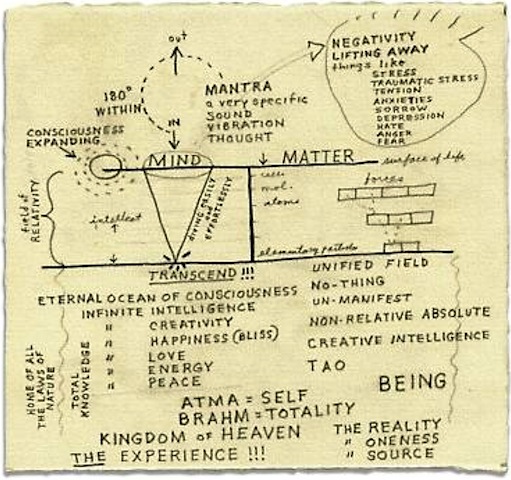
This week Russell Brand was guest editor of the UK’s NewStatesman, which came out October 24, 2013. He invited David Lynch to contribute an article on meditation. The diagram looks like it may be the same one David drew during an interview with a French journalist in Paris as he was explaining Transcendental Meditation to her. A large part of the article reads like a transcription of that brilliant explanation, which was woven throughout a documentary film made of David’s 16-country tour, Meditation Creativity Peace.

David Lynch on meditation: Heaven is a place on earth

Transcending is the only experience in life that gives total brain coherence. Any other thing we do utilises different small parts of the brain, this small part for painting, another small part for mathematics, that small part for playing the piano.

By David Lynch Published 31 October 2013 14:45

Mind and matter: Lynch’s diagram of Transcendental Meditation. Image: copyright David Lynch

Mind and matter: Lynch’s diagram of Transcendental Meditation.
Image: copyright David Lynch

What is Transcendental Meditation? What is transcending? Where do you go when you transcend? And what good is it to transcend? To help answer these questions, I’ve done a little drawing and you can refer to it from time to time. You will notice a line at the top of the drawing representing the surface of life. We live on the surface and see surfaces everywhere. This right side represents matter and the left side will represent mind. Mind and matter.

About 300 years ago, scientists started wondering: what was matter, what was wood, what was air, what was water, what was flesh, etc? And they started looking into matter and they began to find things – things that we now learn about in school. They found cells and molecules. They went deeper and found atoms; they went deeper and deeper, all the way down to the tiniest particles – the elementary particles.

They found four forces that act upon the particles. And on a deeper level, they found that the four forces became three. Some unification started. And, on a deeper level, the three forces became two. About 35 years ago, modern science, quantum physics, discovered the Unified Field at the base of all matter. This field is the unity of all the particles and all the forces of creation. This is a field of nothing, but the scientists say that out of this nothing emerges everything that is a thing. This Unified Field is unmanifest yet all manifestation comes from this field.

Ancient Vedic science, the science of consciousness, has always known of this field. Believers say that it is an eternal unbounded ocean of consciousness. And this consciousness has qualities. So this Unified Field, this ocean of consciousness, is a field of unbounded intelligence, unbounded creativity, unbounded happiness, unbounded love, energy and peace.

Transcendental Meditation is a mental technique, an ancient form of meditation brought back for this time by Maharishi Mahesh Yogi. It is a technique that allows any human being to dive within, through subtler levels of mind and intellect, and then transcend – that is experience, that ocean of pure consciousness at the base of all mind and matter – to experience this Unified Field within with those all-positive qualities.

In Transcendental Meditation you’re given a mantra. A mantra is a very specific sound vibration – thought. The mantra that Maharishi gives is like a law of nature designed for a specific purpose and that purpose is to turn the awareness 180 degrees from out, out, out to within, within, within. Once pointed within, one will dive easily and effortlessly. It is easy and effortless because the nature of the human mind is always to want to go to fields of greater happiness.

Each deeper level of mind and each deeper level of intellect has more and more happiness – charm, as they say. So the happiness growing is like a magnet that gently pulls us within. And at the border of intellect, one then transcends and experiences the transcendent, the Unified Field, the ocean of pure consciousness, the kingdom of heaven that lies within – the Tao, the home of total knowledge, being or divine being; Atma, meaning the Self, the Self with a capital “S”.

There’s a line we’ve all heard: “Know thyself.” This is the Self they’re talking about. This field is also known as Brahm, meaning totality. First seek the kingdom of heaven that lies within and all else will be added unto you. All else is totality.

Every time a human being transcends, they infuse some of this all-positive consciousness and they truly begin to expand whatever consciousness they had to begin with. There is a side effect to expanding consciousness, and that side effect is that negativity begins to recede. Things like stress, traumatic stress, anxieties, tension, sadness, depression, hate, anger, rage and fear start to lift away very naturally.

The analogy is: negativity is just like darkness. When this light of consciousness begins to truly expand, it is like being in a dark room with a light on a dimmer. As the light gets brighter, the darkness starts to go. And when the light is full on, there is no darkness. Likewise with the light of unity – consciousness – growing, negativity very naturally starts to recede, automatically and without you having to worry about it. This heavy weight of negativity lifting gives such a joyful feeling of freedom to a human being. So you could say the person practising Transcendental Meditation each day is infusing gold and getting rid of garbage.

Transcending is the key word!!! Transcending is truly experiencing that deepest eternal level of life. It is this experience that does everything good for a human being. Every human being has consciousness but not every human being has the same amount. The good news is, every human being has the potential for infinite consciousness. Every time you experience this ocean of consciousness within, you expand more and more consciousness and you are unfolding your full potential as a human being. The full potential of the human being is called enlightenment – infinite consciousness, infinite happiness, total fulfilment. Totality.

Transcending is a holistic experience, meaning that all avenues of life will start improving. The things that used to stress you will still be out there in the world but they will not be able to hit you so hard. You’ll still be able to feel sadness but the sadness won’t last so long. It will lift away more quickly. The same with anger; the anger will leave more quickly. It won’t stay with you and poison you and the environment. Fears begin to lift – you work in more and more freedom. This is a field of infinite creativity. You will see creativity and problem-solving start to expand. Through research, scientists know that IQ can go up because of transcending each day.

Happiness comes more and more and you feel good in your body and enjoy the doing of things more and more. The field within is a field of universal love. This universal love feeds personal love and relationships improve. This field within is a field of infinite energy. People today are so fatigued and here within each of us is an infinite amount of energy to fuel our work and play. There is infinite peace within and that is deep, deep contentment, harmony, coming up inside the human being. It is so beautiful.

Transcendental Meditation is, as I said, easy and effortless. Many people might think that because it is easy it is not as good as other meditation techniques. This is wrong thinking. Concentration forms of meditation, contemplation forms of meditation, will keep a human being hovering on the surface. There will be no transcending. And it is hard work and it is boring and the reward is not there.

Transcendental Meditation as taught by Maharishi Mahesh Yogi is a technique that has been here many times before and it is a blessing. It is the real thing. It works. Brain research scientists have found a wondrous thing. When a human being truly transcends, hooked up to an EEG machine, then the full brain gets engaged in concert. They call this “total brain coherence”.

Transcending is the only experience in life that gives this total brain coherence. Any other thing we do utilises different small parts of the brain, this small part for painting, another small part for mathematics, that small part for playing the piano, and so on. Scientists have always told us before that we use only 5 per cent or 10 per cent of our brain but transcending is an experience that utilises the full brain.

This shows us something of the relationship of the human being to this glorious Unified Field within. The more we transcend, the more this coherence stays with us and this eventually gives rise to higher states of consciousness, culminating with supreme enlightenment. On the EEG machine, Transcendental Meditation meditators are seen to transcend many times in each 20-minute meditation. Those meditators who practise concentration or contemplation forms of meditation do not transcend. They do not get the experience of that ocean of bliss consciousness, the Unified Field.

A ten-year-old child can practise this technique of Transcendental Meditation; a 110-year-old can do it, easily and effortlessly, and they will each get the experience they are yearning for. It is a sublime experience to transcend and feel that rejuvenation and that happiness and all those other all-positive qualities growing.

Transcendental Meditation is not a religion. People from all religions practise this technique and they see there is no conflict with their religion. On the contrary, they say they understand and appreciate their religion more because understanding and appreciation for all things grow by transcending each day. It is a technique for human beings, no matter what walk of life, what religion or where you are from. People who have experienced great suffering have gotten this technique and happily said, “Now I have my life back again.” The real story is: THE NATURE OF LIFE IS BLISS and THE INDIVIDUAL IS COSMIC.

Russell Brand’s article in this paper is about revolution. Revolutions are usually associated with violence or force. Transcendental Meditation leads to a beautiful, peaceful revolution. A change from suffering and negativity to happiness and a life more and more free of any problems. The secret has always been within. We just need a technique that works to get us there to unfold a most beautiful future.

Find out even more about Transcendental Meditation at: davidlynchfoundation.org.uk.

For American readers, visit www.tm.org and davidlynchfoundation.org.

See Russell Brand and David Lynch at LA Premiere of ‘Meditation, Creativity, Peace’ Documentary and related links to other videos and articles. Visit http://meditationcreativitypeace.com to see a preview of the film and where it may be playing.

This is an excellent interview: David Lynch speaks with Alan Colmes about his 16-country tour film Meditation Creativity Peace.

The NewStatesman article reads like a transcription from this film, which you can now see: “Meditation Creativity Peace”—A documentary of David Lynch’s 16-country tour during 2007–2009.

See an earlier article written by David Lynch published in Jane Magazine: Celeb Spiritual Report: One significant day in my life by David Lynch for Jane Magazine (May 2004).

William T. Hathaway’s Wellsprings: A Fable of Consciousness, concerns future eco-crisis and TM

October 19, 2013

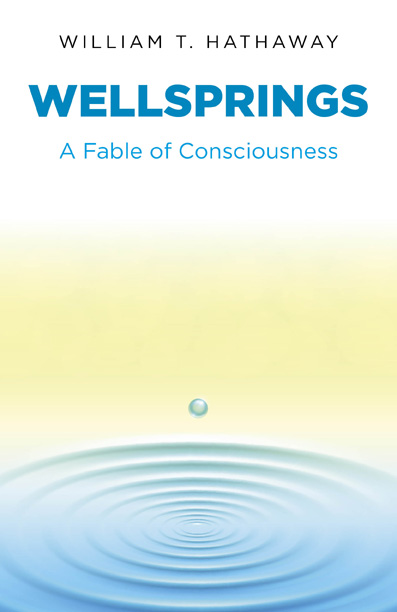
Wellsprings coverWellsprings: A Fable of Consciousness, William T. Hathaway’s just-published book, concerns Transcendental Meditation and the environmental crisis. It is set in 2026 as the earth’s ecosystem has broken down under human abuse. Water supplies are shrinking. Rain is rare, and North America is gripped in the Great Drought with crops withering and forests dying. In the midst of environmental and social collapse, an old woman and a young man set out to heal nature and reactivate the cycle of flow by using techniques of higher consciousness. But the corporations that control the remaining water lash out to stop them. A blend of adventure, ecology, and mystic wisdom, Wellsprings: A Fable of Consciousness is a frightening but hopeful look into a future that is looming closer every day.

Bob, 18, and Jane, 77, meet at a California hot springs and set out together on a quest. Jane is convinced North America’s water has retreated into a deep subterranean aquifer, and she is searching for the place where it comes close enough to the surface to access it. She teaches him to meditate, and their visions help them find the cavern that connects to the water.

A selection:

Jane and I drive around to the north side of Mt. Shasta, hoping to be able to sense the subterranean springs from there. In the moonlight the mountain looks like a silver pyramid soaring up from the horizon into the starry purple night. The ancient volcano is lord of all it surveys. Veils of clouds are blowing around its peak.

We find a grassy glade in the forest, but the grass is dry and brittle and the tree branches droop from the drought. As we are spreading our blankets out to meditate, motion on the other side of the clearing catches our eyes. Out of the trees steps a black-tailed doe. She sees us and pauses, one foot raised, sniffing, listening, looking. Jane and I stare enthralled. As the doe gazes at us, our eyes join across the space, across the species. Communication flows between us: cautious curiosity about a fellow creature. She breaks contact, begins nibbling, then looks back at us as if saying, As long as you stay on your side, it’s OK.

We watch her in delight until she trots off, then we close our eyes to meditate. At first my mantra goes with my heartbeat then slows and goes with my breath. The sound stretches out into a long hum floating through me. I seem to be beyond my skin, filling the whole clearing. I feel like I’m sinking into the earth. I want to hold on, to keep from disappearing, but something tells me to let everything go. I free-fall through space, then realize it’s impossible to fall because there’s no down. I’m hovering … like a dragonfly over water. The sound fades away, leaving me without thoughts. I seem to expand beyond all space and boundaries to unite with everything. For a moment I know I am everything, the whole universe, but as soon as I think, I’m everything, I’m not anymore. I’m just Bob Parks sitting on a blanket over cold ground.

I start the mantra again. Its whisper clears my thoughts away, and my mind becomes quiet. Part of me is watching the quietness of my mind and enjoying it. I never knew I had this watching part before. It doesn’t need to think. It’s just there, aware of everything but separate from it — a wise old part of me.

I realize I’m off the mantra, drifting on thoughts, so I pick up the sound again and follow it as it gets fainter and finer until it becomes more visual, pulsing light behind my closed eyes. It seems to shine into something, a big cavern that’s inside of me but also outside of me. The boundaries between me and everything else disappear — no difference now between inside and outside. I can see dimly into the cavern. The walls and ceiling are crystal, its facets glinting in the mantra light. Below them in all directions stretches a vast dark sea of water, its ripples gleaming. It’s deep, deep as the earth, and I want to plunge in and dive all the way to the bottom. I’m sitting above it. Down there beneath me, beneath these rocks and dirt, rests the water.

I can sense this sea’s immensity, stretching from California under the Great Basin of Nevada, Utah, and Arizona, the parched American desert, the last place the corporate drillers would’ve looked. We’re sitting by the tip of it closest to the surface. From here it goes deeper and deeper, soaking through strata of sand and porous rock, a huge aquifer waiting to be freed and flow again.

I want to jump up and yell, “I found it!” but that thought makes it disappear. I take a deep breath and am back sitting cross-legged on my blanket. Too stunned to say anything, I lie back and feel the ground under me, this good ground with all that good water under it.

###

A further sample of Wellsprings: A Fable of Consciousness is posted at http://www.cosmicegg-books.com/books/wellsprings.

William T. Hathaway’s other books include A World of Hurt (Rinehart Foundation Award), CD-Ring, Summer Snow, and Radical Peace: People Refusing War. He and his wife, Daniela, direct the Transcendental Meditation Center in Oldenburg, Germany. A selection of his writing is available at www.peacewriter.org.

REVIEWS & ENDORSEMENTS

….. Although this is a little book (only 100 pages), its message is huge. It has so much to offer in the way of warning and of hope. It tells a vital truth about our connection with all life and with water, which is the basic component of life and which unifies us with all other forms of life. Hathaway warns us that we must do something about the ecological disaster that we are facing, and in order to succeed at this awesome task we must change our consciousness. This “Fable of Consciousness” provides an engaging lesson in unified consciousness and how to achieve it through meditation. It is a must read! ~ Jan Krause Greene, Goodreads

William Hathaway’s new novella, “Wellsprings – A Fable of Consciousness” – is a coming of age story located in a not too distant, nor unlikely, future. Hathaway weaves concepts of unifying consciousness as a mechanism for addressing environmental crisis in an age of corporate ownership of all natural resources. A second, though important, theme of the book is that we can control our reactions to situations. This is an important message in a time when everything seems to push us towards non-reflective responses. Hathaway’s novel serves as both a teaching tool and a cautionary tale. ~ Rowan Wolf, Author

Also see: Radical Peace: People Refusing War, by William T. Hathaway.

And here is another TM-based novel written from a different perspective: Writers’ Voices interviews B. Steven Verney, author of “The Best of All Possible Worlds.”

Renowned (TM) meditation teacher Bob Roth featured on The Third Metric and HuffPost Live

October 14, 2013

Huffington Post Senior Writer profiled Bob Roth, Executive Director of the David Lynch Foundation, an exemplary representative for The Third Metric: Redefining Success Beyond Money and Power. huff.to/1albfF9 (10/14/2013)

Meditation Teacher To The Stars: His clients include Oprah, Russell Brand, Martin Scorcese and Dr. Oz, but renowned meditation teacher Bob Roth also serves low-income and under-served communities by sharing his passion: Transcendental Meditation.

Bob Roth was also interviewed on @HuffPostLive: Stress Is The New Black Plague: Meditation guru Bob Roth ‏@meditationbob joins host Nancy Redd ‏@nancyredd to explain the benefits of meditation: Bob Roth Talks Transcendental Meditation @TMmeditation. Watch this lively interview http://huff.lv/GZQpn9 (12:46).

Bob Roth: Bringing Calm To The Center Of Life's Storm

Bob Roth: Bringing Calm To The Center Of Life’s Storm

If there was a perfect year in which to discover Transcendental Meditation, it might just have been 1968. That was the year that Bob Roth was a freshman at UC Berkeley — a campus considered Ground Zero for the anti-war movement and the cultural changes sweeping through the country at the time. He remembers living surrounded by helicopters spewing tear gas over student war protesters and Army tanks parked outside his front door. Demonstrations. Riots. Chaos.

And against this backdrop, Roth did what many college students do: He took a part-time job. He sold scoops of ice cream at Swenson’s ice cream parlor, never expecting that amid the rush of pending social changes engulfing him, it would be at the ice cream shop where he would meet a guy who would ultimately alter the course of his life forever.

The college crew at Swenson’s was the usual motley collection of hippies, straights and everything in between, recalls Roth. But one guy stood out: Peter Stevens. “He was like a quiet reflection pool amid the chaos,” recalls Roth, “and I was drawn to him.”

“Peter was centered, energetic, super-smart, kind to all, easy-going, never agitated, with an ineffable calm about him,” Roth told The Huffington Post. He learned that Peter “meditated,” something that Roth said was a bit of a disconnect for him. “Meditation was not in my vocabulary.” But he was intrigued and curious, and went with Stevens to a class in Transcendental Meditation, a meditative practice derived from the ancient Vedic tradition in India. After just one class, Roth was hooked.

Today, Roth is the executive director of the David Lynch Foundation, where he has helped bring Transcendental Meditation programs to more than 300,000 at-risk kids in 35 countries, as well as veterans suffering from post-traumatic stress disorder, and women and girls who are survivors of domestic violence. He’s also the national director of the Center for Leadership Performance, which introduces the TM program to business, industry and government organizations — and even some United Nations groups.

Today, Roth’s student roster includes a lot of very recognizable names: Oprah, Russell Simmons, Russell Brand, Martin Scorsese, Mehmet Oz, Hugh Jackman and dozens of others. He’d be embarrassed to be called “meditation teacher to the stars,” but such a description wouldn’t be far off. For the past 40 years, he has meditated twice a day no matter where he is, in places as discombobulating as an airplane when need be.

He explains Transcendental Meditation with the following analogy: The surface of the ocean is waves and white caps. But deeper down, the ocean is still. How TM differs from other meditations, he says, is that it doesn’t attempt to still the waves, but rather allow access to the stillness. By practicing it twice a day for 20 minutes, he said, studies have shown that people sleep better, reduce their stress, and lower their blood pressure. In children, the practice can reduce ADHD symptoms and symptoms of other learning disorders.

Not all Roth’s clients are rich and famous. One of the key focuses of the David Lynch Foundation is to target those who aren’t and improve their lives through TM. There’s a story that Roth likes to tell about the DLF’s Quiet Time program — where thousands of at-risk children are taught TM in school. It involves a little girl he called Jessica (not her real name) who lives in a crime-infested neighborhood of San Francisco. Jessica showed up one day at school wearing a white dress splattered with what her teacher, at first glance, thought was red paint. It was blood — blood from Jessica’s uncle who had been shot that morning in a random drive-by while waiting with her at the bus stop.

Instead of running home, Jessica ran to school so that she could meditate, she told her teachers. The DLF Quiet Time program had been in her school for about a year at the time and for her, it made school a safe place whereas her home often couldn’t be. “For me,” said Roth, “that says it all.”

As part of the Quiet Time Program, the foundation supplies teachers for each child to have one-on-one meditation instruction and follow-up. “In a school with 1,000 students,” he said, “we bring in 20 teachers.”

The results have been gratifying, said Roth, who believes that results must be quantifiable to matter. “Change needs to show up in grades, reduced number of suspensions and dropout rates,” he said. And the Quiet Time program has done all that. The San Francisco Unified School District reports an 86 percent reduction in suspensions over two years in schools where the program has been introduced; a 65 percent decrease in violent conflict at the John O’Connell High School; and the Journal of Psychiatry shows reduced ADHD symptoms and symptoms of other learning disorders among students who practice TM.

Carlos Garcia, retired superintendent of the San Francisco Unified School District, heralded the program as one which is “transforming lives.” He said, “It is transforming schools and neighborhoods, and it will transform our society.”

All of which is music to Roth’s ears. TM is a life-changer for individuals, he said, but also a game changer in the broader sense. It may start with an individual’s desire to sleep better or reduce stress, but results are similar to what happens when you pull on one leg of the table, said Roth. “The whole table moves.” And what moves in this case are blood pressure numbers, heart attack risk factors, and the overall ability to make better decisions with a more focused mind. “You are thinking more clearly, are able to make decisions more ethically, perform more creatively.” It’s like when you water a plant because some leaves are wilting, he said, but the whole plant benefits from the water. And it spills over into those around you in a chain reaction.

Companies interested in innovation are drawn to TM because of the positive impact it has on their work force. It’s why Oprah had Roth bring his program to her staff of 400. “It’s not just about learning to relax,” said Roth. “TM wakes up the brain and the executive functions. It resets the brain to perform in a less ‘flight or fight’ manner.”

And yes, it reduces stress. Whether he is teaching a homeless guy — the DLF has a program that works with New York City homeless — or a billionaire, “they both suffer from stress,” said Roth.

But as one celebrity who shall remain unnamed quipped when Roth asked her why she wanted to learn to meditate, “I want to maintain a permanent connection with the intelligence of the universe. I also can’t sleep.”

TM training allows people to access an ability they already are hard wired for: to take a profound rest at will.

Roth says the tipping point has been reached in regard to the public’s understanding of the value of meditation. As he wrote on Maria Shriver’s blog, “It feels like something foundational can be done to help transform lives through meditation, not only among those most at-risk to suffer traumas in life, but also the teen in the private school who battles the very real demons of substance abuse and unspoken thoughts of suicide; the parent who is struggling to survive an ugly divorce and still keep the family intact; or just the person — man, woman, boy, girl — who is navigating life’s daily vicissitudes and can’t seem to catch a breath, turn off the noise, get a good night’s sleep.”

Ann Brenoff can be reached at: ann.brenoff@huffingtonpost.com.

Here is a lovely reproduction of the Huffington Post article with more pictures created by the David Lynch Foundation: Meditation Man.

See The GQ Guide to Transcendental Meditation: The Totally Stressed-Out Man’s Guide to Meditation, an excellent article written by Josh Dean who learned TM from Bob Roth and interviewed him.

Bob Roth is also featured in the April 2, 2014 issue of MANHATTAN Magazine: Transcendental Inspiration.

Bob Roth (S)(C)On July 16, 2015, Harper Spero, a New York City-based lifestyle and career coach, published this wonderful interview on her blog: (So)(Co) Sit Down with Bob Roth. While working at Agent of Change, she produced the Women.Meditation.Stress. Luncheon and Panel Discussion for the David Lynch Foundation (DLF), which is how she met Bob, its executive director. It contains a nice large-sized photo of Bob at the bottom of the blog post.

Watch the 1968 film of Maharishi at Lake Louise

September 24, 2013

See my earlier post on a segment from this film: Maharishi describes the nature of inner life: bondage and liberation, and gaining bliss consciousness through Transcendental Meditation. Maharishi is seen walking and talking about the nature of life, with the beautiful scene of Lake Louise and the Rocky Mountains behind him. He describes the lake, its surface and depth, and the reflections on it, as a metaphor to explain the spiritual content of life and how it gets lost and overshadowed when we identify with only the surface material objects of life, a state of bondage, at the expense of our own inner unbounded nature, bliss consciousness, which gets unfolded and integrated through the practice of his Transcendental Meditation technique, into a state of liberation. I transcribe Maharishi’s words there, the film’s essential spiritual message.

maharishi signs gita for ken

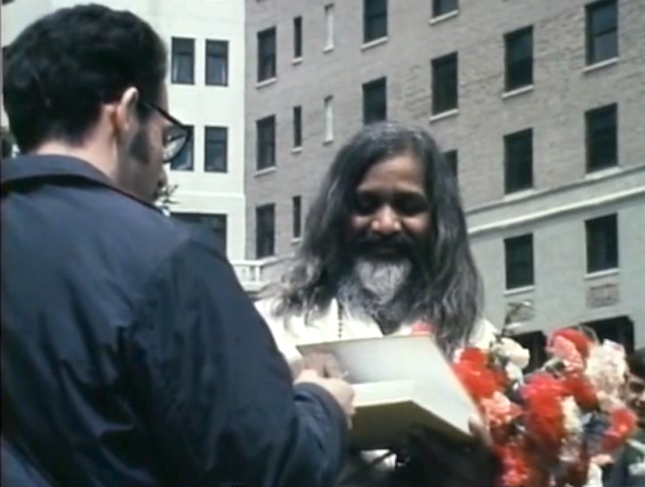
In the opening scenes of this complete video of the CBC documentary, we were all walking up to Maharishi to give him a flower. At 2:07-2:10, I’m seen coming up to Maharishi asking him to sign a copy of his translation and commentary on the Bhagavad-Gita, Chapters 1-6. The film closes with more of the same footage, which was all actually shot towards the end of the course. That wonderful week was the first time a lot of us got to meet Maharishi. It was an unforgettable divine experience in a most sublime natural setting!

Four years later, my mother, two sisters and I would meet privately with Maharishi at Queens University in Kingston, Ontario, where a Symposium on the Science of Creative Intelligence with many of Canada’s intellectual luminaries was taking place. But that’s another amazing story!

Forty years after I started TM, and thirty-nine years after having met Maharishi, I was able to assist an ITN Factual commissioned producer in making the A&E biographical film, Maharishi Mahesh Yogi, for the History International Channel (November 2007). Luckily I was able to procure vintage footage taken by Eileen Learoyd, a Victoria, BC journalist, and the first national leader of the Canadian TM Movement. Grania Litwin, her daughter and also a Victoria journalist, was kind enough to send us those home movies transferred to videos taken by her mother. We found one of Maharishi at Catalina Island from 1962 that was still in the original film canister! We had them all digitized and sent selections to the producer for use in the film. She was delighted to have received such historical footage. We also returned the videos with new DVDs to Grania.

I also put the producer in touch with Alan Waite, who had made the award-winning 1968 documentary, Maharishi Mahesh Yogi – Sage for a New Generation, and she ended up using many segments from that film as well. Also lined up interviews for her when she came to MUM in Fairfield, Iowa, as well as Mike Love in LA and Donovan in London.

Eileen and Hubert with Maharishi

Eileen and Hubert with Maharishi at Emerald Lake, British Columbia

Eileen Learoyd and her brother Hubert Gray organized a seminar for meditators with Maharishi at Emerald Lake, British Columbia in 1964. Elieen would later organize the 1972 SCI Symposium. In June 1968 they arranged for the CBC to film Maharishi at the Lake Louise, Alberta course. Interestingly, after Maharishi signed my copy of the Gita, we both turned it toward the camera. That footage was edited out, but it seemed to be a symbolic gesture for what I would end up doing with a large part of my life in my own small way — helping to teach, promote and publicize Maharishi and his world-transforming Vedic knowledge and TM technique. And for that I am most thankful and fulfilled. Jai Guru Dev, Maharishi. Na Guror Adhikam.

And last year, (2012) a small crew from DLF.TV and I were fortunate to have assisted Oprah’s producers by providing them with more b-roll footage for the OWN program on the meditators of Fairfield, Iowa, referred to as “TM Town” by Oprah. They even gave us a credit! Here’s a post with Video segments of Oprah’s Next Chapter on OWN: Oprah Visits Fairfield, Iowa—”TM Town”—America’s Most Unusual Town.

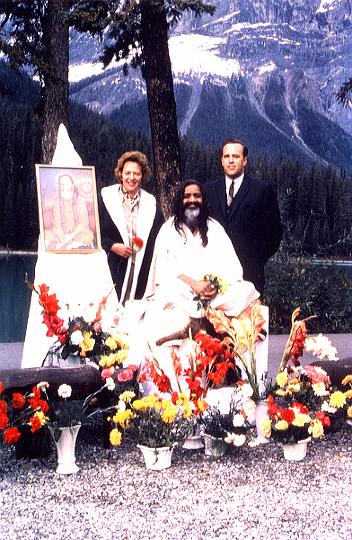
I later found a photo of Hubert and Eileen on either side of Maharishi arriving in the lobby of the Fairmont Chateau Lake Louise Five-Star Hotel. That’s when I saw him for the first time, from the other side of the lobby, and felt the thought, ‘Prince of Peace’. At the end of the course, we took a group photo with Maharishi outside in front of the lake to complete that sublime one-week residence course, June 9-14, 1968.

Enlightenment, the Transcendental Meditation Magazine, also published an article on Maharishi at Lake Louise discussing the blissful nature of the practice of the Transcendental Meditation® technique.

In the summer of 2014 I retired from my position at MUM. A year later I was featured on the TMhome website: PR to poetry – how things sometimes happen to Ken Chawkin. They followed up with The story behind the making of the International History documentary on Maharishi Mahesh Yogi (International History Channel documentary on Maharishi Mahesh Yogi). A nice way to go out. I continue to write, blog, and freelance as a publicist for the movement as needed.

On September 30, 2014 I had posted how I learned #TMmeditation 47 years ago today. In there I share more information about the making of the CBC Telescope film, The Guru, of Maharishi at Lake Louise. Richard Day shared a story he had heard many years later about the director of the film, Colin Smith, who told Maharishi that he wanted to film him saying something that would encapsulate all his teachings. Maharishi said, “I’ll walk by the lake, you walk with me, and I’ll tell you everything about spiritual development.” He did it in one take! That’s the part I had transcribed and posted in the first link above.

Save

On August 2, 2020, Bob Roth, CEO of the David Lynch Foundation, and Mario Orsatti, Executive Director of the Center for Health and Wellness, a division of the David Lynch Foundation, discuss this historic documentary on TM Talks.

The Beatles “Dear Prudence”: A Portrait of Prudence Farrow Bruns, Maharishi and TM

September 6, 2013

Dear Prudence: A Portrait of Prudence Farrow Bruns

Enjoy this video portrait of Prudence Farrow Bruns, the inspiration for the Beatles song “Dear Prudence”. Prudence discusses her personal journey, meditating with the Beatles in India, the transformation her generation tried to bring about in the world, and the change that can only come from within through Transcendental Meditation.

Directed, shot and edited by Kryshan Randel, music by Mike Pellarin, produced by David Shaw for iTranscend TM, a concept created by Ashley Cooper. For more information on Transcendental Meditation, visit these websites: http://maharishi.ca (Canada) and http://www.tm.org (USA).

Visit the newly launched Dear Prudence Foundation and click on About Prudence to read about her journey and why she set up a foundation: http://dearprudencefoundation.org.

See these other interviews with Prudence: 1) Amitava Sanyal, Allahabad, for BBC News India: Prudence Farrow — subject of the Beatles song Dear Prudence — visits India’s Kumbh Mela, and two videos: 2) Ted Henry interviews “Dear Prudence” Farrow Bruns about her life with TM and Maharishi, and 3) MicCameraAction: PRUDENCE FARROW BRUNS.

Other iTranscend TM Portraits

Another video portrait made by Canadian filmmaker Kryshan Randel is about Paralympian Daniel Westley. Westley had represented Canada in the 1988 Paralympic Games in Seoul, South Korea. As Paralympic Games grew, Daniel went on to participate in both the summer and winter games in a wide range of sports that included everything from wheelchair racing to skiing. Read this inspiring story: Meditation key to finding balance for Paralympian Daniel Westley — special to The Vancouver Sun, which contains the video, Physical Meditation: A Portrait Of Daniel Westley.

Both videos appear on the iTranscend TM YouTube channel series along with other heartfelt testimonials from new meditators, meditators dicussing meditation, and portraits of veteran meditators — people from all walks of life telling their stories — a physiotherapist, bakery story owner, musician, students, sharing how they are realizing their potential through the profound life-changing benefits of their Transcendental Meditation practice. And this video is an edited composite of some celebrities talking about the value of meditation, TM, in their lives: iTranscend Hollywood.

See: Who was Dear Prudence the Beatles sang to in India? What happened to her? Here is her story.

Prudence’s memoir is now out: Dear Prudence: The Story Behind the Song.

Read this excellent article in the Pensacola News Journal: Woman behind Beatles ‘Dear Prudence’ reads at Open Books.