Archive for the ‘Education’ Category

POLITICO: Coping with PTSD

May 4, 2012
Opinion Contributor
Coping with PTSD

More than 500,000 returning veterans suffer from psychological injuries, the author said. | AP Photo

By RICHARD W. SCHNEIDER | 5/3/12 9:24 AM EDT

Developing military leaders who are smart, strong and courageous — both on and off of the battlefield — is essential. We are still learning how to create soldiers prepared for the emotional wounds of war. We need to teach coping skills to help these men and women reduce the terrible effects of post-traumatic stress disorder.

Veterans, who have experienced the horrors of war, are the most common sufferers. More than 500,000 returning veterans from Iraq and Afghanistan suffer from psychological injuries — including PTSD or major depression.

But even military cadets, when in a highly disciplined and rigorous academic environment, can feel similarly overwhelmed. Under intense stress, many men and women just give up. They don’t have the tools to stay focused and grounded.

We must give them the tools they need. This means helping them to be successful socially, emotionally and in a military setting. Our future leaders need this knowledge.

Transcendental Meditation has demonstrated an ability to help those suffering from PTSD and high stress environments. Recent trials of TM’s effects on psychological distress have revealed: reduced perceived stress, improved constructive thinking, decreased state anxiety, increased behavioral coping and reduced depression. This is the focus of the David Lynch Foundation, which highlights TM’s positive effects.

TM helps military cadets become more resilient, according to Norwich University studies, so that they can be better soldiers on the battlefield as well as better equipped to recover from the traumas of war and have a normal life after returning home.

Evidence suggests that TM may help people handle the stresses that come before as well as during military service and when they return to civilian life.

A 2011 Norwich University study, with funding from the David Lynch Foundation and the Educational Foundation of America, showed the positive effects that TM can have on helping students cope with the stresses of leadership in being a member of the Norwich University Corps of Cadets. TM has proven to be a highly effective coping strategy and has set a high bar to further explorations and research.

Many cadets who enter the military will likely be exposed to trauma that can have a destructive effect on their lives and the lives of their families. Whether a veteran or a military cadet, the method of dealing with PTSD is crucial.

For these “invisible wounds” can take a high toll — on family, quality of life and work performance. There is also a greater risk for violent and self-destructive behavior.

Effective treatments have been difficult to identify. Many expensive combinations of chemicals, for example, have been explored. But TM is an evidence-based technique that is available anywhere and at any time. Those who practice it develop the ability to improve daily stresses in the workplace and in life.

The technique helps address anxiety, mood change and situational awareness. Its powerful impact can produce long-term results in improving daily lives.

The goal is clear: to develop the whole person with maximized abilities and capacity in all situations.

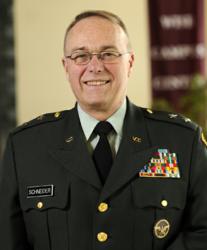
Richard W. Schneider, a rear admiral USCGR (Ret.) is the president of Norwich University. The David Lynch Foundation on Thursday is hosting its first annual National Summit, investigating effects of Transcendental Meditation on active-duty personnel and veterans suffering from PTSD, cadets in training — and their families.

Short URL: http://politi.co/JPLv7Z

Related articles: Washington Post: Does Transcendental Meditation help veterans with PTSD? | Norwich University President Receives “Resilient Warrior Award” at National Veterans Summit in Washington, DC | Washington Post: VA testing whether meditation can help treat PTSD

The David Lynch Foundation Quiet Time Program in San Francisco Schools

May 2, 2012

The David Lynch Foundation Quiet Time Program in San Francisco Schools

Here’s a recently produced inspiring 7-minute video showing the benefits of the Quiet Time program for students, teachers, and administrators at Visitation Valley Middle School, and other schools in the San Francisco Unified School District in California. Principal James Dierke and Superintendent Carlos Garcia are featured.

Here’s another previously posted video and article, with links to more: Meditation for Students: Results of the David Lynch Foundation’s Quiet Time/TM Program in San Francisco Schools | The San Francisco Examiner—Meditation program mends troubled Visitacion Valley Middle School.

New Video: Dr. Tony Nader speaks about the Ramayana in Human Physiology

May 1, 2012

Dr. Tony Nader speaks about the Ramayana in Human Physiology

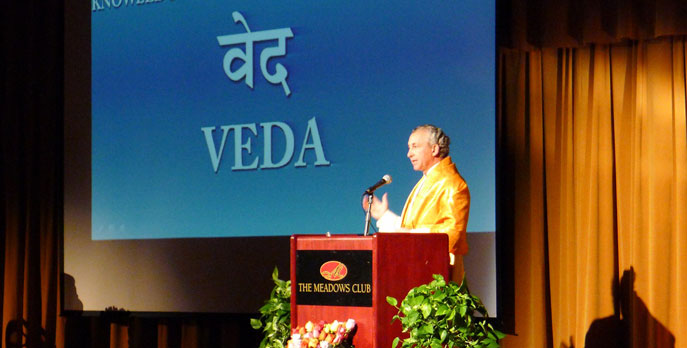
This new video beautifully encapsulates Dr. Tony Nader’s paradigm-changing discovery. He shared these profound details with an audience during one of the first New Paradigm Tour events. He explained how, under the guidance and blessings of Maharishi Mahesh Yogi, he discovered that the sounds of the Veda and Vedic Literature, and their architectural design, are actually structured in the human physiology. He described it as “a tremendous enlightening discovery.”

After that work was done and published in his first book, Human Physiology – Expression of Veda and Vedic Literature, with further direction from Maharishi, Dr. Nader went on to find their dynamic interactions displayed in the Ramayana, revealed as the growth and evolution of the human physiology towards enlightenment. The result was the recently published as Ramayan in Human Physiology. See the 12-page book preview: http://www.mumpress.com/ramayan. Now available as an ebook on iTunes.

As a scientist, Dr. Nader said the Ramayana was a scientific treatise on the human physiology, “a precise scientific description of how our body works, how our body evolves” towards enlightenment. Dr. Nader shows events that take place in the story of the Ramayana and what they mean in terms of the growing and evolving human physiology. “Now we know we truly are wholeness.”

This video was published today, May 1, 2012, on the Tony Nader M.D. YouTube channel. You’ll also notice other videos listed there of Dr. Nader answering questions on this topic. But this clip was taken from an actual presentation in the early part of the tour, which began in California. More videos from the tour will be added as time allows.

See photos in A report halfway into the New Paradigm Tour: Veda, Consciousness, the Ramayana and the Self.

See the general press release with links to some of the news coverage added at the bottom of Veda, Consciousness, the Ramayana, and the Self — A New Paradigm Tour Will Visit Ten Cities.

Details of the tour can be found at: www.NewParadigmTour.org. Check out the Facebook page: http://www.facebook.com/VedaConsciousness. And more videos: http://www.youtube.com/user/DrTonyNader/videos.

Some relevant quotes by famous scientists on changing paradigms

All truths are easy to understand once they are discovered; the point is to discover them. — Galileo Galilei (1564–1642)

All truth passes through three stages. First, it is ridiculed. Second, it is violently opposed. Third, it is accepted as being self-evident. — Arthur Schopenhauer (1788-1860)

A scientific truth does not triumph by convincing its opponents and making them see the light, but rather because its opponents eventually die and a new generation grows up that is familiar with it. — Max Planck (1858-1947)

Also see how one poet describes a remarkably similar understanding: What Turkish Sufi poet Yunus Emre realized — everything was found within his cosmic body and Yunus Emre says Wisdom comes from Knowing Oneself — a Singularity that contains the Whole.

A lecture by Dr. Tony Nader, International Head of the Transcendental Meditation Organization, was recorded in Silicon Valley at the Indian Cultural Center, April 10, 2014, later posted Oct 4, 2019: Unfolding the Mysteries of Veda: How Ancient Knowledge Influences Your Life.

Here is the same talk, but with the formal introductions and final credits posted 3 1/2 years earlier, April 5, 2016, by the Silicon Valley TM Center. Actual title: VEDA Discovering the Structural Relationship Between Consciousness, Natural Law, Physiology, and the Universe.

A report halfway into the New Paradigm Tour: Veda, Consciousness, the Ramayana and the Self

April 28, 2012

We are about halfway through the New Paradigm Tour now, and here is a summary report from a recent Maharishi Global Family Chat sent out with beautiful photos and descriptions: New Paradigm tour continues in waves of success and appreciation.

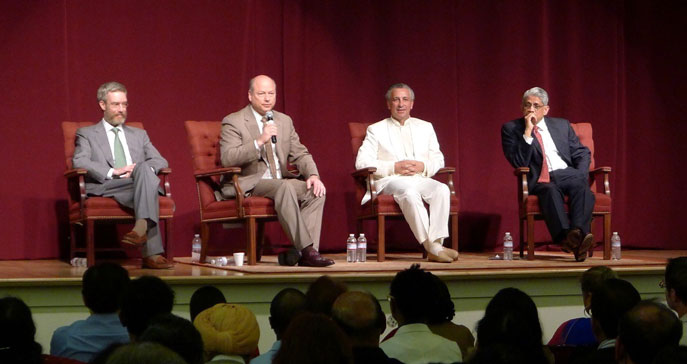
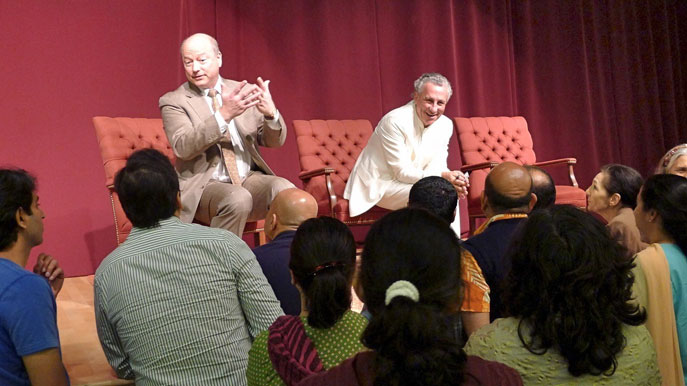
In the San Francisco Bay area, the New Paradigm Tour held its first public event for Indo-Americans, featuring keynote speaker Dr Tony Nader as well as John Hagelin, Ramani Ayer, and host Dr. Howard Chancellor. Well over 300 people filled the hall, mostly Indo-Americans hearing of Maharishi Vedic Science for the first time.

Dr Hagelin explained how Veda (Knowledge) or consciousness is the unified field of quantum physics, and how the Vedic technologies of Maharishi Yog and Maharishi Yagya benefit individuals and society (especially Transcendental Meditation and its advanced programs).

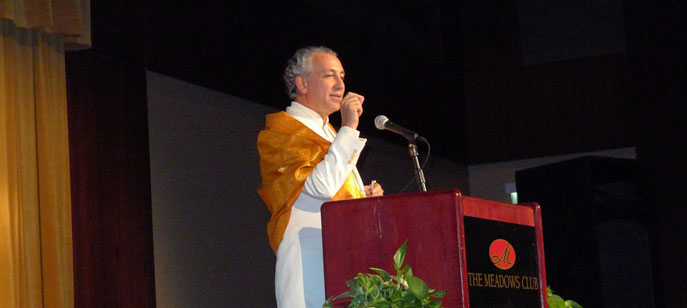
Dr. Nader then gave a captivating keynote address about the new paradigm that recognizes science and spirituality as two flavors of one Reality. Several times he was interrupted by spontaneous waves of applause!

A special moment then came when Shiv Sagar — whose grandfather Ramanand Sagar created the original Ramayan television series beloved throughout India — connected from India to express his family’s appreciation of Dr. Nader’s book Ramayan in Human Physiology. Shiv played a short video clip from the family’s more recent serialized production of the Ramayan that was watched by 600 million Indians. When a member of the audience requested if Dr. Nader would translate the characters and plot of that same Ramayan clip into the workings of the human physiology, he did so and won a round of applause.

Members of the audience were filled with wonder at the profundity of Maharishi Vedic Science and by the scientific insights brought to light by Dr Nader and Dr Hagelin. They were completely amazed when Ramani Ayer showed videos of 1,000 Maharishi Vedic Pandits in Iowa, USA and 2,500 in the Brahmasthan of India, and explained that these Peace Professionals are the main power-generators of a scientifically-documented Global Peace Initiative. Listen: http://bit.ly/vedicpandits.

Time and again remarks were heard like: “We feel so proud of our Vedic tradition!”; “Thank you so much for taking time to speak to us — we never knew!”; and “Now we must help create peace with you!”

While in the San Francisco area, Dr. Nader also presented to a group of about 100 enthusiastic Indian physicians, bringing the total to over 350 physicians in California. He also conducted a 3-hour Ramayan in Human Physiology Seminar to 130 meditators and Sidhas. In Vancouver he then spoke to over 500 Indo-American at two more lectures, and also gave a Ramayan seminar to about 120 people. In every case, he is being deeply acclaimed and respected for his wisdom and radiance.

Details of the tour can be found at: www.NewParadigmTour.org
See videos of Dr Nader at: http://www.youtube.com/drtonynader
A Facebook page is at: http://www.facebook.com/VedaConsciousness

Dr Chancellor reported that Dr. Nader’s New Paradigm tour has been extremely successful in California and Vancouver. The first leg of the tour ended last night with a presentation at the Meadows Club in Chicago.

An overflow crowd of about 800 people flocked to the Meadows Club. Almost all were Indo-Americans with little or no previous familiarity with Maharishi Vedic Science and its practical applied technologies for individual enlightenment, national invincibility, and world peace.

The presentations by Dr. Hagelin, Ramani Ayer and Dr. Nader stretched well over two hours with everyone completely focused on the speakers throughout.

The talks were punctuated by considerable applause, and the audience gave a standing ovation to Dr Nader at the end of his presentation.

There was also a huge round of warm applause when the crowd heard — in fact, they seemed to already be well aware of it — that Maharishi had appointed Dr Nader as his successor in the line of the Vedic Tradition and honored him with the title of the first Maharaja Adhiraj Rajaraam of the Global Country of World Peace, the umbrella entity for all of Maharishi’s global legacy.

TV ASIA prepared a Brief Highlights report on the the event, which took place at the Meadows Club in Chicago: Maharishi Foundation & GPI Hosts “A New paradigm: Veda, Consciousness, the Ramayana and the Self.” The TV Asia Community Roundup program aired on April 26th at 10:30pm (ET) and was rebroadcast on April 27th at 7:30pm (ET).

See the general press release with links to some of the news coverage added at the bottom of Veda, Consciousness, the Ramayana, and the Self — A New Paradigm Tour Will Visit Ten Cities.

See a video clip taken from one of the presentations: Dr. Tony Nader speaks about the Ramayana in Human Physiology.

KTVO News: Groundbreaking Sustainable Living Center a source of pride in Fairfield

April 25, 2012

Groundbreaking Sustainable Living Center a source of pride in Fairfield
by Kate Allt | Posted: 04.25.2012 at 5:03 PM

Maharishi University’s Sustainable Living Center

FAIRFIELD, IOWA — The first university to offer a sustainable living program and a MBA in green technology is still finding ways to look to the future of sustainable living.

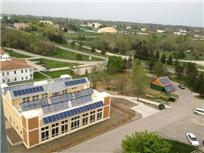
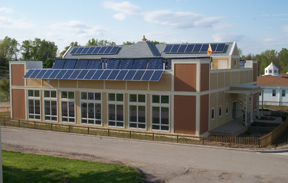
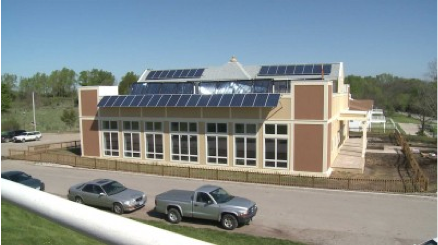
Maharishi University’s new Sustainable Living Center proves that a building and a community is capable of giving back more than it takes.

“This building is kind of a signal for hope for people who maybe don’t think this is possible,” said Lonnie Gamble, Sustainable Living professor. “They don’t think that it’s possible, they can point here and see that it is. We needed a place that reflected the principles that we teach, we teach in a building that – if we teach one thing in the classroom, but the building tells a different story, then which gives the stronger lesson?”

Today, the building used sun and solar energy to produce three times more energy than it required to function. Annually, the Sustainable Living Center will produce 30% more energy than it uses.

“The utility cottage… has photovoltaic panels on it and it also has all the inverters that convert DC electrical energy to AC energy that we use in the building,” said Tim Messenger, construction manager. “It’s our own little power center, we’re our own little utility company here.”

Maharishi’s students prove that there is a lot more to energy efficiency and green thinking than one small change.

“If you want to be sustainable, you don’t just really want to install energy efficient light bulbs, but you want to make sure that the source of your energy is sustainable,” said student Peter Hodak. “Everything around you, including yourself.”

And everything about this building is sustainable, from the 25,000 earth blocks made by students, to the windows that allow for the building to be lit by the sun, to the trees that provide the building’s support.

The center is an embodiment of the principles of the sustainable living program, and is close to the hearts of faculty and students.

“I think it’s very important to first of all realize that you can do something and one thing you can do is lead by example,” said John Collins, Associate Chair of the Sustainable Living Department. “And I think this building leads by example. We can yell at our legislators about renewable energy, but if we don’t have our own building that uses it, what’s the point in that?”

“Studying in this school building, it make you feel like you are more yourself and at the same time it makes you feel like… it makes you appreciate your environment much more,” Hodak said.

“It’s actually really amazing that students are allowed to do this because this building is so new and young and there’s so many things that are going to be done,” said student Sam Rose. “And the way this university kind of works is this project, this really homework assignment is actually going to be used and students are going to do this. It gives you hope, it makes you think you can do something great when it’s really intimidating, but you can come together. It’s a beautiful place to work.”

And they’re not done yet. Plans for an edible landscape, a sustainable sewer system and water collection are all in the works. Eventually, the building will be entirely off the grid. 

The students themselves are working on the constant improvements to the building with their class projects. Hodak’s project monitors the intake and outflow of energy, and Rose’s group has several improvements in the works, including a line of trees to block out sound from the highway and a rain garden.

The SLC is open for visitors who would like to see the building for themselves.


Related: WHO TV: BEYOND GREEN: Building Produces Extra Energy | The Fairfield Ledger: M.U.M.’s newest building sets new green standards | WHIO TV (AP): Maharishi University dedicates efficient building | MUM Blog: Now Open: MUM’s New Sustainable Living Center


The Fairfield Ledger: M.U.M.’s newest building sets new green standards

April 25, 2012

M.U.M.’s newest building sets new green standards

By DIANE VANCE, Ledger staff writer | Apr 23, 2012

It’s the ultimate green building, said Craig Pearson, executive vice president of Maharishi University of Management, at Friday’s grand opening of the Sustainable Living Center.

Pearson was quoting how The Associated Press described the newest building on campus while it was still under construction in an article that was published in national media, including Forbes, Business Week and MSNBC.

“This sets new standards,” said Pearson.

David Fisher, chairman of the Sustainable Living program, founded at M.U.M. in 2003, said plans for the building began in 2004.

“Its design evolved over time,” said Fisher. “The intention has been to be off the grid in all ways.

“Scores of environmental buildings are being built across the country, some much larger than this, but this is the only building to do it all in one building.”

Fisher said constructing the Sustainable Living Center was a teaching tool for builders, students and anyone who had a part in finishing the building.

“It’s a work in progress, a living building,” said Fisher.

Sustainability comes from materials used, the design and placement of windows for natural day lighting, rain catchment for water (not yet operational), solar panels and a wind turbine.

A classroom used for Friday’s grand opening news conference was furnished with about 21 wooden tables, constructed on campus.

“These tables are made from 19 different plant families all harvested within 100 miles of here,” said Fisher. “The differences in colors are natural, indicating the different woods.”

Faculty member Lonnie Gamble said designers and builders had to think outside the box on this building.

“This building and university are a great inspiration for the world,” he said.

Designer John Lippman has designed all the new buildings on campus since 2000. He listed the Sustainability Center as following architectural guidelines of Vastu, meeting gold LEED (Leadership in Energy and Environmental Design) certification with plans to reach platinum, meeting the Living Building Challenge and meeting Building Biology standards.

“Vastu guidelines means the building is in harmony with nature,” said Lippman. “We have the silent core at the center of the building. High windows allow daylight to extend from two directions into the building’s rooms.

“We used natural materials in here, earth from the campus and whole tree trunks from Wisconsin.”

Sustainable Living student Makayla McDonald said the building reflects the people in the program.

“Community is strength,” she said. “This building has already drawn many people to come here. But it’s not just a building of classrooms. This is the merging of our dreams for the future. I want to express profound gratitude for this university and program. At age 20, it’s very important to have dreams and get to see them become reality.”

Fairfield Mayor and M.U.M. board of trustees member Ed Malloy, said the university was showing the kind of leadership in education that inspires everyone to consider new horizons with the grand opening of the Sustainable Living Center.

“In 2008, Fairfield began a process of creating a strategic plan for a sustainable community,” he said. “In 2009, we published the Fairfield Go Green plan and received national recognition.

“The theme that runs through the plan is to demonstrate for ourselves and others what a city can look like as it adopts new strategies and community designs. This building sets the highest standard.”

Malloy congratulated the university and everyone involved. He noted it was worthy to be called a learning center.

“Students participated in making the very materials that the walls are made of and participated as the mechanical systems that power the building were assembled,” said Malloy. “They will always know as they study in here that they are sheltered and powered by the very elements of nature that surround them — the earth, trees, wind and sun.

“Last year we celebrated gold LEED certification for Hy-Vee, and Kum & Go completed a renovation that earns them a silver LEED certification.”

The Sustainability Center building produces its own kilowatt energies and can send extra back to the grid to use to power other buildings on campus. With more fundraising, the building will complete the rainwater catchment system and waste treatment process, to move from gold to platinum certification.

URL: http://fairfield-ia.villagesoup.com/news/story/m-u-m-s-newest-building-sets-new-green-standards/814324

Photo by: DIANE VANCE/Ledger photo. Posted with permission from The Fairfield Ledger.

Also see: BEYOND GREEN: Building Produces Extra Energy | Maharishi University of Management to open new Sustainable Living Center, a net-zero energy bldg | Maharishi University dedicates efficient building | The Fairfield Ledger: Fairfield draws ‘who-da thunk it’ quote from Lode

Maharishi University dedicates efficient building

April 25, 2012

Sunday, April 22, 2012, 11:28 a.m.

Maharishi University dedicates efficient building

The Associated Press

FAIRFIELD, Iowa —

Dozens of solar panels and a 100-foot-tall wind turbine will help the Maharishi University of Management’s sustainable living center in Fairfield be among the state’s most efficient buildings.

University officials dedicated the building Friday, showing off a building that also makes use of technology such as a heat pump, geothermal tubing and careful placement of windows to maximize the use of daylight.

The Ottumwa Courier reports (http://bit.ly/Jp31nc) that Maharishi University Executive Vice President Craig Pearson expressed hope that the center would help other builders learn about sustainable options and build more environmentally friendly structures.

Lonnie Gamble, the professor and curriculum director for the sustainable living program, said the building will help him teach students about the possibilities of efficient buildings.

“Being in here means that instead of saying ‘here are the principles to build by’ — then apologizing for the building we’re in — I can show them what I’m talking about,” Gamble said.

When the solar panels and turbine produce more power than needed for the building, the energy will be sent to the campus grid and used for other buildings.

Fairfield Mayor Ed Malloy, who also is a Maharishi University board member, said students who learn about sustainable structures in the center will later create similar buildings throughout the world.

As more funding becomes available, the school intends to add a rain catchment system to provide water and will handle sewage in an on-site facility.

___

Information from: The Ottumwa Courier http://www.ottumwacourier.com

Copyright The Associated Press.

See: Newton Daily News: Maharishi University dedicates efficient building

Australian TV: Cool School: Melbourne school teaches meditation to students

April 22, 2012

One with learning in peace

One Melbourne school is helping parents take some of the stress out of school children by teaching them meditation.

Nick, the Australian Sunrise TV reporter, asks a Maharishi School student how he feels after meditation. “Really peaceful and relaxed…ya,” the boy answers. “Peaceful and relaxed…how old are you?” Nick asks him. “Ten,” he replies. “I don’t hear many ten-year-olds thinking about being peaceful and relaxed,” Nick tells him. The boy looks him straight in the eye and says confidently, “I do.” Click on URL to see this lovely report! http://bit.ly/Ji8zys

BEYOND GREEN: Building Produces Extra Energy

April 18, 2012

NEWS: Renew Iowa

BEYOND GREEN: Building Produces Extra Energy

Posted on: 4:49 pm, April 18, 2012, by Megan Reutherupdated on: 06:46pm, April 18, 2012.

Students and staff at one University in Iowa have a new place to learn, and the building is as unique as the school. Students and staff at Maharishi University of Management in Fairfield are celebrating Earth Day this week by opening the school’s new Sustainable Living Center.

Designers say the multi-million project goes beyond green building. Sustainable Living Professor Lonnie Gamble says, “It does its own functions like a tree would. So, we use the metaphor of a tree for the design of the building.”

Gamble says the Sustainable Living Center is a living laboratory of classrooms, workshops and offices for the Sustainable Living Program. He says the building is like a tree because it collects and stores its own energy. The $2.5 million project includes a wind turbine and solar array and geothermal loop system. Architect Jon Lipman says, “The building produces more electricity than it uses.”

And, it doesn’t use much electricity. Lipman says the SLC is designed to strategically capture daylight, so lights aren’t needed anywhere in the building when the sun is shining. While showing the main hall, he says, “Up at the very top of it, we have windows, which are bringing south light down into the building, which then is being reflected down into the classrooms with these panels, and that allows us to get sunlight into the heart of the building.”

The students were also involved constructing the building made of local materials. Students made more than 25,000 compressed earth blocks. Gamble says, “The interior of the building is made from blocks of earth that are simply earth out of a parking lot we were building and put into a special machine that compressed it into blocks with no concrete or anything.”

As for the tree metaphor, trunks from the nearby state of Wisconsin actually serve a purpose by supporting the building’s roof. Lipman says round logs are more structurally sound than rectangular beams, so crews didn’t have to use as much of the resource found in nature. He says, “Which is a way of expressing in a very palpable way to the students that sustainable living, that discipline which teaches us how to live in harmony with nature, is really something that can be a part of the fabric of construction.”

You can see the Sustainable Living Center for yourself. The Maharishi University of Management is hosting a ribbon cutting this Friday in Fairfield. You can take a tour from 1 to 3:30 pm.

Click on URL to see the New at 5:00 report on Beyond Green Building: BEYOND GREEN: Building Produces Extra Energy http://whotv.com/2012/04/18/beyond-green-building-produces-energy/ (2:46).

Here are three permanent links to the report: a flash (.flv) file version (~22MB): http://www.rencapp.com/MUM_Schwartz-Guich-SLC.flv, an HD (720p .mp4) file (~32MB): MUM_Schwartz-Guich-SLC_x264.mp4, and an mpg file: http://www.rencapp.com/MUM_Schwartz-Guich-SLC_mpeg2.mpg. You can play whichever version might work best for you (the original and youtube uses flash).

Related: MSNBC: BEYOND GREEN: Building Produces Extra Energy | The Fairfield Ledger: Fairfield draws ‘who-da thunk it’ quote from Lode | Ottumwa Courier: Environmentally friendly building unveiled in Fairfield | The Hawk Eye: MUM to unveil sustainable center: Structure will be one of the only net-zero energy buildings in the nation | The Iowa Source: MUM’s Sustainable Living Center Opens April 20: Net Zero Building Will Produce More Energy Than It Consumes!Fairfield Ledger: M.U.M.’s newest building sets new green standards | WHIO TV (AP): Maharishi University dedicates efficient building | KTVO News: Groundbreaking Sustainable Living Center a source of pride in Fairfield | The Uncarved Blog: Maharishi University of Management to open new Sustainable Living Center, a net-zero energy bldg | AASHE Bulletin ArchivesMaharishi U Mgmt Debuts Net-Zero Sustainable Living Center + More | Iowa Association of Independent Colleges and Universities: New MUM Building a Net-Zero Energy Structure | Positive TV: MUM Sustainable Living Center to be “net-zero energy building” | The Iowan: Beyond LEED: Maharishi University’s Sustainable Living Center | MUM Blog: Now Open: MUM’s New Sustainable Living Center

Maharishi University of Management featured in Education Executive Magazine — Spring 2012

April 14, 2012

Maharishi University of Management

Higher Education – Spring 2012 (pages 62-63)

Open Mindedness

Transcendental Meditation® helps students at Maharishi University of Management enhance their learning, the institution says.

All successful administrators believe firmly in the missions of their institutions, but the connection runs deeper for Dr. Craig Pearson, executive vice president of Maharishi University of Management (MUM). After graduating from Duke University in 1971 and feeling disillusioned from the tumultuous impact of the Vietnam War, Pearson discovered the practice of Transcendental Meditation (TM).

“I saw a need for change, and I wanted to participate in that and I wanted it to be meaningful,” Pearson says. “Finally, I realized it would be a nice contribution to make to this society that I lived in if I taught TM.” After he became versed in teaching TM, Pearson discovered an opportunity to teach at MUM, and what has followed has been a learning experience that has lasted more than 30 years.

“I’ve had just an amazing range of opportunities and experiences here,” Pearson says.

Located in Fairfield, Iowa, MUM was founded on the practice of TM, brought to light from the ancient Vedic tradition by Maharishi Mahesh Yogi, a Vedic sage who taught the practice in his native India before traveling the world with it. Not a religion or philosophy, TM is a simple, effortless technique practiced for 20 minutes at the start and end of each day that allows the mind to settle to a state of inner quiet. Those who practice TM say it can help expand consciousness and expand the mind’s capacity for learning. This is why the university’s approach is called Consciousness-BasedSM education.

“This is huge for education,” Pearson says, adding that studies have shown growth of intelligence and other measures of personal development to level off during adolescence. Practicing TM, research suggests, unfreezes that potential and allows the mind to continue growing.

Same, But Different

Aside from the beginning and end of each day, when students and faculty join in practicing TM, Pearson says MUM offers the same curriculum one would find at a top university elsewhere in the world. “If you or anybody were to come to MUM and walk around during the day, you would find a lot that’s similar to what’s going on in universities around the world,” he says. “If you were to go into a Shakespeare class, it’s the same Shakespeare.”

Where MUM differs from other universities, of course, is the 20-minute TM sessions twice a day, built into the daily schedule. Pearson says this has a profound impact on the campus culture and in the performance of its student body and the overall feeling on the campus. Pearson says TM significantly reduces stress and mental fatigue by allowing the mind effortlessly to relax and settle inward rather than focus on the outside world.

“These days, one of the things most problematic on college campuses is stress,” he says.

Through TM, students at MUM are able to expand their consciousness to a point where learning and personal growth are practically unlimited, Pearson claims. The implications for higher education are significant, he adds. “Now human development can be unfrozen, now it can continue to develop,” he says, adding that the university has found student IQs increase after enrolling. One study, for example, found IQ to increase an average of 4 points after one year and 9 points after 4 years.

Expanding Future

The university’s application of TM in the curriculum has implications for more than student performance and stress levels, Pearson says. It also affects enrollment trends, as nearly 75 percent of MUM’s student body consists of transfer students from other institutions. Most of them discover the university on the Internet, but an increasing number are hearing about it by word of mouth.

“Since that’s our mission, students come because they’re attracted to the mission,” Pearson says. “They transfer because they’re not satisfied with where they are.”

As the concept of meditation becomes more popular through yoga classes and other fitness regimens, MUM has seen a long-term upswing in enrollment. The university’s current enrollment of about 1,100 is double what it was five years ago, and nearly triple what it was 10 years ago, according to Pearson. “Now, meditation is mainstream and the idea of meditation in education isn’t so unusual,” he adds.

To deal with the continuing growth, the university 11 years ago embarked on an ambitious campaign to reconstruct its campus. Originally built as Parson’s College before it closed in 1973, the MUM campus has torn down 45 old buildings and has invested substantially in renovating a number of others. Additionally, 60-plus new buildings have been constructed on campus. The newest building is the university’s Sustainable Living Center, which, when completed, will be unique in the world, embodying four different sustainable building philosophies and completely off the grid with respect to heating/cooling, electricity, water, and sewage. Pearson says the university’s commitment to sustainability is another attractive feature for many students, citing the campus’ all-organic, vegetarian menu.

Pearson says the university hopes to reach an enrollment of 2,000 in the years to come, with a long-term vision of approximately 8,000 students. To help achieve that goal it has established an endowment campaign with an initial goal of $50 million. Pearson says the campaign has received some very good initial support, and that those funds will be used for scholarships, faculty support, academic programs, and campus development.

Seeing the university grow has been a rewarding experience for Pearson, and he says he believes the education students receive at MUM will give them a consciousness-based approach to decision making that will be needed to solve the world’s greatest problems.

“It’s one thing to change the way we get our power or food, but our students recognize there needs to be a change in the kind of consciousness that created those types of problems, and I’m very inspired by that,” he says.

—Chris Petersen

Copyright 2012 Education Executive Magazine. All Rights Reserved.

Links to the online version with only one photo: http://www.education-executive.com/index.php/higher-education/1125-maharishi-university-of-management and digital edition: http://www.nxtbook.com/nxtbooks/phoenix/eduexec_2012spring/#/64 of the two-page layout containing photos of Craig Pearson, Argiro Student Center, MUM campus, and the Aladdin Food Management Services ad.