Posts Tagged ‘Russell Brand’

David Lynch Foundation launches Veteran’s Day national meditation initiative

October 14, 2011

David Lynch Foundation launches Veteran’s Day national meditation initiative

Veteran’s Day falls on 11.11.11. and the David Lynch Foundation is hosting a national meditation initiative for veterans.

The charitable organization is teaming up with online fundraising network Crowdrise, to raise funds for its veteran’s outreach – Operation Warrior Wellness – which has the goal of providing stress-reducing Transcendental Meditation to 10,000 veterans who suffer from post-traumatic stress and their families.

Here’s how it works: Donate $11 or more to Operation Warrior Wellness on Crowdrise and you are automatically entered to win the Warrior Wellness Gift Pack – which includes the Operation Warrior Wellness commemorative coin, OWW t-shirts and hoodies, and books by the iconic filmmaker David Lynch, the NY Times bestselling author Dr. Norman Rosenthal, and WWII fighter pilot Jerry Yellin. The value of the gift pack is approximately $200.

Recent published research has shown a 50% reduction in PTSD symptoms among meditating veterans, as well as greater resiliency, reduced cardiovascular disease, decreased substance abuse and decreased medical expenditures.

Russell Brand, Clint Eastwood, Martin Scorsese, Donna Karan, Candy Crowley, and many decorated veterans have partnered together in support for Operation Warrior Wellness. Explained Vietnam veteran Dan Burks, “The experience I had from Transcendental Meditation basically saved my life.”

To make a donation to the Operation Warrior Wellness Veteran’s Day Campaign and enter the give-away please visit: crowdrise.com/operationwarriorwellness.

For more information on the David Lynch Foundation’s veteran’s initiative, please visit operationwarriorwellness.org.

See: Finding Her Son Again – Julia George and Iraq Veteran David George:

Also see: Medication or Meditation for Veterans with PTSD?, Author Veteran Jerry Yellin To Sign Four Books Proceeds To Benefit Operation Warrior Wellness, Huffington Post: What Meditation Did for Me: A War Vet’s Story, Wall Street Journal: A Transcendental Cure for Post-Traumatic Stress by David Lynch and Norman E. Rosenthal.

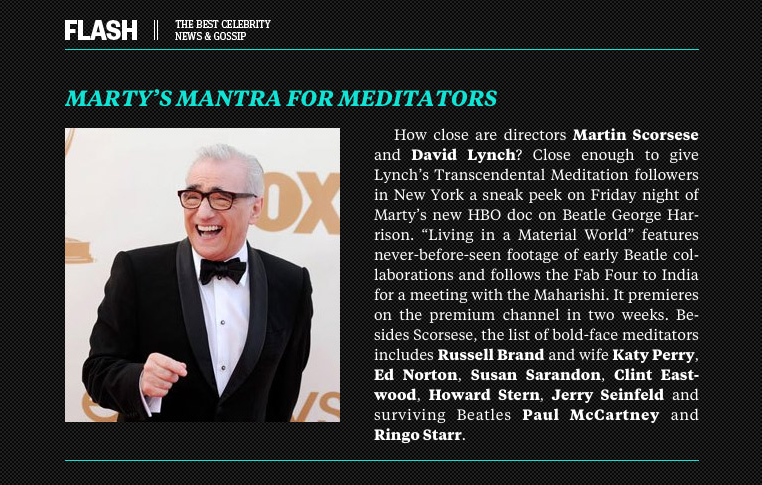
The Daily: Marty’s Mantra For Meditators

September 29, 2011

Wednesday, September 28, 2011

Also see: Martin Scorsese’s film, George Harrison: Living in the Material World, premiers at the Sondheim Center for the Performing Arts in Fairfield, Iowa

Fairfield Resident Helps Veterans Recover

September 10, 2011

Eastern Iowa News Now

Fairfield Resident Helps Veterans Recover

Posted September 9, 2011 10:50 pm
by Kathleen Serino/SourceMedia Group News

FAIRFIELD – Meditation is the best medicine for military veterans, some say.

Filmmaker David Lynch is set to announce on Sunday a $500,000 matching grant to teach Transcendental Meditation to veterans and active military with Post-Traumatic Stress Disorder (PTSD), according to a news release from Operation Warrior Wellness, an outreach campaign sponsored by the David Lynch Foundation.

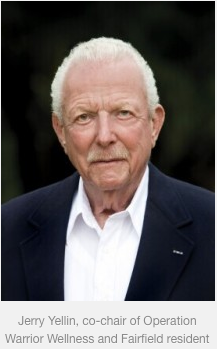
Lynch is inviting major donors to match the grant, which he hopes will be met by Veteran’s Day, Nov. 11, the release says. And Hollywood actors like Russell Brand and Paul McCartney are responding, said Jerry Yellin, co-chair of the initiative that he helped create in March 2010.

Yellin, a World War II veteran, Fairfield resident and author of “The Resilient Warrior, Healing the Hidden Wounds of War,” said he is currently giving four free presentations to 150 veterans in Minnesota on behalf of the campaign.

The 87-year-old said he suffered from PTSD for 30 years before he found Transcendental Meditation (TM), and now talks to veterans, active soldiers and their families about his story and how much it helped him recover.

“These guys are doing exactly what they should be doing and I hope they get their funding,” said Norman Rosenthal, MD, psychiatrist and clinical professor at Georgetown University.

Rosenthal, 61, a researcher on TM and PTSD said, “This very gentle technique had a very powerful effect within a month.”

“It relieves stress, and all of these guys have gone through stress. Big time,” said Yellin of the TM technique.

Yellin said his outreach continues with wife, Helene, and Vietnam veteran Dan Burks, also from Fairfield, to visit military bases, academies and other military organizations.

This entry was posted in War and tagged David Lynch, Fairfield Iowa, Jerry Yellin, Operation Warrior Wellness. Bookmark the permalink.

Responses:

Ken Chawkin says:
September 10, 2011 at 10:39 am

Thank you, Kathleen, for this inspiring and hopeful story. For more information, visit http://www.operationwarriorwellness.org/.

Also seeStar Tribune: Meditation brings peace to war vets | Medication or Meditation for Veterans with PTSD? | The Chippewa Herald: Soldiers with PTSD may benefit from meditation technique | WEAU13News: Veterans learn about meditation for treating post traumatic stress (includes video) | TwinCities.com Pioneer Press: Ruben Rosario: Recovered veteran’s latest mission: helping those like him | Global Good News: Health: Recovered veteran’s latest mission: helping those like him | Stars and Stripes: Celebrities push for transcendental meditation to treat PTSD


DETAILS: critical eye: Meditation Nation

August 14, 2011

Meditation Nation

Power brokers no longer motivate or medicate—they meditate. How Transcendental Meditation returned as the new status symbol.

Photograph by Adam Voorhes
September 2011 Issue

A funny thing happened on the way to enlightenment. The quest got stripped of yogic posturing, Buddhist trappings, and even the last vestige of spirituality and turned into a search for the kind of clarity that might help us all in our worldly pursuits. Which is why movers and shakers are again embracing that seventies mainstay Transcendental Meditation. You’re likely to hear it spoken of reverentially in interviews: Russell Brand, whose wildman behavior was cartoonish in its intensity, credits TM with helping him to conquer his heroin, sex, and alcohol addictions. “After meditation,” he has said, “I felt this beautiful serenity and selfless connection.” And where celebrities venture (the latest wave of TM-ers includes the likes of Hugh Jackman and Naomi Watts), many of us are likely to follow. The rolls of practitioners have tripled in the past three years, according to the Transcendental Meditation Program, the practice’s national organization.

“The game-changer, I think, is David Lynch and his foundation,” says Dr. Norman E. Rosenthal, the Georgetown University psychiatry professor who wrote the recent best seller Transcendence: Healing and Transformation Through Transcendental Meditation. Lynch, the surrealist director of Twin Peaks, Blue Velvet, and Mulholland Dr., had been quietly practicing TM since, yes, the seventies, but about six years ago he came out of the closet, launching a foundation to promote the practice and later publishing a manifesto, Catching the Big Fish: Meditation, Consciousness, and Creativity.

It’s a process perfectly matched to our self-interested times—”no pain, but a lot of gain,” according to Rosenthal. Bob Roth, an executive director of the David Lynch Foundation, who taught TM to Brand and Moby, explains that when the mind has been calmed with the help of a mantra, a Sanskrit word given to each TM grad, it will effortlessly sink below the level of thought to “pure consciousness.” Practically speaking, sit in a chair, close your eyes, and silently repeat the mantra for 20 minutes. Once you get the hang of it, Lynch says, you cut the elevator cables of your normal-thinking mind to descend to a place that feels different. You may experience a connection with the universe or a mental light show, what Rosenthal calls “four-star graphic effects.” At the very least, you should be blissfully relaxed, which is the foundation of the health benefits that have been measured in the medical research amassed, much of it funded by the government. The deep tranquillity TM promotes quiets the body’s “fight or flight” stress response, lowering blood pressure and anxiety and combating depression.

Maharishi Mahesh Yogi, the so-called giggling guru, who hosted the Beatles and Mia Farrow, among others, was the innovator who stripped Hindu meditation practice of its religious baggage and repackaged it as a systematic, stress-reducing, creativity-building technique. Lynch, a disciple, is responsible for adding a fresh civic-mindedness to the game. His foundation aims to bring TM free of charge to those most in need of its calming effects—at-risk kids, prison inmates, veterans suffering from post-traumatic stress. That, of course, means fund-raising benefits, which means reeling in rich folk and entertainers (many introduced to TM by Lynch and Roth), all of which attracts media coverage and an increased brand awareness among those in the general public who might be willing to shell out $1,500 for the basic course.

“It was straight out of The Great Gatsby,” Rosenthal says of the poolside benefit party thrown this past June at the Malibu home of Juicy Couture cofounder Pam Levy and her TV-director husband, Jefery Levy. One imagines the vibes spreading to their neighbor Ryan Kavanaugh, CEO of Relativity Media, the freshly minted Converse-wearing, 36-year-old movie mogul who practices TM twice a day. Kavanaugh, who started out as a stockbroker, has leveraged his connections by allying with the New York hedge fund Elliot Associates, among other investors, giving his company the billions required to dominate Hollywood film production. But his secret weapon is his risk-assessment algorithm, a high-tech quantitative analysis of the big picture that he says allows him to make money even on box-office dogs.

As the New York hard-chargers who flock to the TM courses Roth teaches at the Center for Leadership Performance soon learn, this kind of success is not coincidental. According to published research, TM enhances neural activity in the part of the brain that houses the decision-making “executive center.” “The businesspeople say they’re more focused during the day,” Roth says. As do the other Gotham heavy hitters who’ve evangelized for TM and the Lynch Foundation, from Jerry Seinfeld and Heather Graham to Ben Foster and Howard Stern. Leave it to Mr. Katy Perry himself, speaking at a gala fund-raiser at the Metropolitan Museum of Art this past winter, to get at the essence of TM’s guilt-free marriage of creativity and commerce: “I literally had an idea drop into my brain the other day while I was meditating which I think is worth millions of dollars.”

Also on Details.com
Celebrity Om-Meter: The Top 10 Moments in Meditation History
Retreat, Relax, Recharge: Inside the World’s Best Spas
How to Avoid the Office Strain
Guy-Friendly Alternatives to Yoga

Prop Styling by Robin Finlay

Russell Brand talks to Jay Leno on The Tonight Show about movies, marriage and meditation

March 31, 2011

Russell Brand was interviewed by Jay Leno on The Tonight Show, Monday night, March 28, 2011, (Season 19 Episode 55). They discussed his new movies, Arthur and Hop, getting his driving license, marriage and meditation. A very interesting and funny interview! Unfortunately that segment of the show, posted by two You Tubers, was removed.

Jay mentions that Russell meditates and wonders how he can sit still long enough to do it, and asks him if he could teach him to meditate too. Thanks to a friend you can watch this segment where Russell talks about his practice of Transcendental Meditation here: http://www.rencapp.com/Russell_Brand_on_Jay_Leno_28-03-11.mov

Since Russell took his mother as his date to The Oscars, I was curious to know who she was. I found and read this wonderful article from The Sunday Times archive about their relationship: Relative Values: Russell Brand and his mother, Barbara. A loving and amazing story!

Ever since Russell started TM and married Katy, he’s calmer, cleaner, classier, and still as funny as ever, even wittier! And his career has really taken off, which is nice to see. He should be great in Hop since he’s so expressive, always speaking in such an animated manner.

The New York Times: Look Who’s Meditating Now

March 19, 2011

Look Who’s Meditating Now

Evan Sung for The New York Times
POSTER BOY Russell Brand with David Lynch at the December Met fundraiser for Mr. Lynch’s foundation, which promotes Transcendental Meditation.

By IRINA ALEKSANDER
Published: March 18, 2011

RUSSELL BRAND, the lanky British comedian, has made a career of his outrageous antics. While a host at MTV UK, he went to work dressed up as Osama bin Laden. At the network’s annual music awards, he likened Britney Spears to a “female Christ.” And he was fired from the BBC after leaving raunchy messages on the voicemail of a 78-year-old actor, a comic bit that even his country’s then-prime minister felt compelled to denounce.

It is jarring then, to say the least, to hear Mr. Brand, 35, speaking passionately and sincerely about the emotional solace he has found in Transcendental Meditation, or TM. Yet there he was in December, onstage at the Metropolitan Museum of Art (as his new wife, the pop singer Katy Perry, waited backstage), describing how TM has helped him repair his psychic wounds.

“Transcendental Meditation has been incredibly valuable to me both in my recovery as a drug addict and in my personal life, my marriage, my professional life,” Mr. Brand said of the technique that prescribes two 15- to 20-minute sessions a day of silently repeating a one-to-three syllable mantra, so that practitioners can access a state of what is known as transcendental consciousness. “I literally had an idea drop into my brain the other day while I was meditating which I think is worth millions of dollars.”

Mr. Brand was the M.C. at a benefit for the David Lynch Foundation, an organization that offers TM at no cost to troubled students, veterans, homeless people, prisoners and others. Like many other guests in the room, Mr. Brand has been personally counseled by Mr. Lynch, the enigmatic film director, who has been a devout practitioner of TM, founded in 1958 by the spiritual leader Maharishi Mahesh Yogi, since its first wave of popularity in the late ’60s. That is when Mia Farrow, after her divorce from Frank Sinatra, joined the Beatles in the Maharishi’s ashram in Rishikesh, India; when George Lucas started meditating and was rumored to have based the Yoda character in “Star Wars” on the Maharishi (the resemblance is eerie); and when the talk show host Merv Griffin, after being introduced to the technique by his tennis buddy, the actor Clint Eastwood, invited the Maharishi to be on his show in 1975.

Since then, the celebrity endorsement, and therefore the enrollment numbers, had quieted down. That is, until the last three years when, according to the national Transcendental Meditation program, enrollment tripled.

At Trinity College in Hartford, the women’s squash league began meditating together after every practice last year. The Doe Fund, an organization that assists the homeless, has begun offering TM to its residents along with computer skills and job training. And Ray Dalio, the billionaire hedge-fund manager of Bridgewater, has long credited the success of his funds to his daily practice.

The Transcendental Meditation program attributes the spike to a series of recent studies that suggest TM can help reduce blood pressure and stress, and to the relatively recent affordability of TM. (The adult course, which had ballooned from $75 in the ’60s to $2,500 in 2007, dropped, because of the economy, to $1,500 in 2008.) No less important has been Mr. Lynch’s foundation, started in 2005, for which enlisted celebrities like Mr. Brand, interrogated often by news outlets about their diets and alternative lifestyle remedies, have been preaching about the technique.

“It’s like, imagine the ripples on top of an ocean,” Dr. Mehmet Oz, who meditates in an armchair in an enclave off his bedroom, said at Mr. Lynch’s benefit. “And I’m in a rowboat, reactively dealing with the waves and water coming into my boat. What I need to do is dive into the deeper solace, the calmness beneath the surface.”

The actress Susan Sarandon meditates once a day for 20 minutes in bed. “It helps me chill out and focus,” she said. (Ms. Sarandon said she doesn’t practice TM specifically, but was at the benefit to gather insight.)

The singer Moby, another guest, has meditated in the back of a taxicab. “Transcendental Meditation has given me a perspective on agitation,” he said. “That it’s a temporary state of mind and I don’t necessarily need to take it that seriously.” Moby said the technique helped him quit drinking more than a year ago. “I used to think that TM was for weird old hippies,” he added. “But then I heard that David Lynch was involved, and that made me curious.”

ON the afternoon before the benefit, Mr. Lynch, 65, arrived at the museum, holding hands with his wife, Emily Lynch, 32, and was escorted by a museum employee to a green room downstairs. Mr. Lynch, like a cartoon character, has maintained the same uniform for decades: a pressed white shirt under a boxy black suit and a hedge of gray hair. He scooped up a soggy egg-salad sandwich from a tray and explained what brought him to the practice.

“I was not into meditation one bit,” Mr. Lynch said, in his laconic Missoula, Mont., drawl that years of living in Los Angeles has failed to dilute. “I thought it was a fad. I thought you had to eat nuts and raisins, and I didn’t want any part of it.”

Mr. Lynch was persuaded by his sister, Martha, when he began having marital difficulties with the first of his four wives, Peggy, in the early ’70s. “I had a whole bunch of personal anger that I would take out on her,” he said. “I think I was a weak person. I wasn’t self-assured. I was not a happy camper inside. Two weeks after I started, my wife comes to me and says, ‘This anger, where did it go?’ I felt a freedom and happiness growing inside. It was like — poooft! — I felt a kind of smile from Mother Nature. The world looked better and better. It’s an ocean of unbounded love within us, so it’s real hard to get a conflict going.” (Still, a year later, the couple divorced.)

It’s easy to shrug off such utterances as hokey, New Age prattle — who can forget Jeff Goldblum’s flaky character in “Annie Hall” on the phone, complaining that he’d forgotten his mantra? — but less so when the person reciting it has dreamed up his most widely admired, vivid films on the days when he was dropping out of consciousness for at least 30 minutes a day.

“Artists like to say, ‘I like a little bit of suffering and anger,’ ” he said. “But if you had a splitting headache, diarrhea and vomiting, how much would you enjoy the work and how much work would you get done? Maybe suffering is a romantic idea to get girls, but it’s an enemy to creativity.”

A version of this article appeared in print on March 20, 2011, on page ST1 of the New York edition. It was also published Saturday, March 26, 2011, in the TheLedger.com: Transcendental Meditation: Celebrities, Recent Biological Studies Increase Interest in Discipline

Meditation May Ease PTSD for Vets

December 19, 2010

Health Stories Meditation May Ease PTSD for Vets

Tuesday, December 14, 2010 7:59 AM

Hollywood A-listers including Clint Eastwood joined grizzled U.S. military veterans Monday to promote what they called the near-miraculous powers of meditation in overcoming war stress.

The event in New York drew an unlikely alliance ranging from fashion designer Donna Karan to traumatized veterans of World War II, Vietnam, and Iraq.

Uniting them was a belief that transcendental meditation, dubbed TM for short, is the cheapest, most effective, and medication-free way of healing people who have suffered severe stress in war and any other extreme experience.

“I’m a great supporter of transcendental meditation. I’ve been using it for almost 40 years now. I think it’s a great tool for anyone to have,” said Eastwood, best known for playing violent, hardened characters on screen.

The fund-raising event at the Metropolitan Museum of Art in New York was organized by experimental filmmaker David Lynch, whose Foundation for Consciousness-Based Education and World Peace encourages meditation along the lines espoused by famed guru Maharishi Mahesh Yogi.

Lynch said his project, named “Operation Warrior Wellness,” aims to train 10,000 veterans in the art of finding inner peace.

Critics have cast doubt on the value of meditation for treating psychological disorders.

But Lynch said there are “a lot of misunderstandings about meditation.”

The director of “Blue Velvet” and “Mulholland Drive” said the technique can help everyone from disruptive school pupils to soldiers with post-traumatic stress disorder, or PTSD.

PTSD is an increasingly high-profile problem among servicemen returning from Afghanistan and Iraq, a large number of whom are believed to fear revealing their disorder to military health staff.

Vietnam vet Dan Burks gave a moving account of the mental scars he carried after a battle in which he says he killed Vietnamese soldiers and lost many of his own troops.

PTSD, he said, “is a wound. It takes your life away, just like losing a limb.”

“But guess what: You can get rid of it,” he said, describing his life after discovery of transcendental meditation as “the difference between heaven and hell.”

Another veteran, World War II pilot Jerry Yellin, told the fund-raiser that for three decades after the end of the war against Japan he “found no satisfaction in life in anything I did.”

At age 51, he took up TM and says he found peace. “We have the ability to teach young people who are suffering tremendously … young people who are in a foreign land,” he said of today’s veterans.

One of those, a former infantry soldier in Iraq, said TM “cleared the skies and I could tell where I was going.”

“I felt this warm groovy feeling,” he said. “It just gets better and better.”

The star-studded event hosted by Lynch also saw testimonials from Karan and British comedian Russell Brand.

Brand said he had suffered severe stress from his much-publicized sex-and-drugs addictions and also found solace in TM.

“I felt love, sort of love for myself but also love for everyone else,” he said in a rambling speech delivered in his trademark hyper-energized style.

“I am a human being and it is applicable to all human beings. Someone, everyone can draw from it.”

Skeptics may question whether war veterans already unwilling to speak about their mental problems will embrace regular meditation. Lynch says they can.

“Clint Eastwood is about as macho as they get and he’s been meditating longer than I have,” he told The Wall Street Journal.

“We’re behind this technique and we think it can help veterans reclaim their lives and save themselves, their families, and their friendships.”

Copyright AFP

Newsmax is one of the nation’s leading news sites; and AFP, Agence France Presse, is one of the world’s major news services. This AFP story was picked up by hundreds of news markets around the world.

Watch David Lynch Foundation Press Conference and the Change Begins Within Benefit Celebration

December 14, 2010

Watch livestream rebroadcasts of two extraordinary events: the David Lynch Foundation Press Conference to launch Operation Warrior Wellness, from the Paley Center for Media, and the Change Begins Within Gala Event at the Metropolitan Museum of Art, New York City, Monday, December 13, 2010. See David Lynch Foundation’s Photos – Change Begins Within and Broadway World photo coverage of the 2nd Annual David Lynch Foundation’s Change Begins Within Benefit Celebration. Watch highlights of both events: the press conference and the second annual benefit gala.

The Huffington Post: Jeanne Ball: David Lynch Talks About the Benefits of Meditation

December 13, 2010
Writer for the David Lynch Foundation,
Meditation Teacher for 25 Years
Posted: December 13, 2010 05:49 PM

David Lynch Talks About the Benefits of Meditation

“Change Begins Within,” a benefit event featuring David Lynch, Clint Eastwood, Russell Brand, Katy Perry, Dr. Mehmet Oz and Candy Crowley, takes place tonight, Dec. 13 at the Metropolitan Museum of Art in New York. You can watch it LIVE beginning at 9 p.m. EST.

We know David Lynch for his award-winning films — “Mulholland Drive” was recently voted movie of the decade by the LA Film Critics Association. Seems like every night there’s a “Twin Peaks” party going on somewhere. Lynch is also known as an artist, musician, philanthropist and proponent of meditation. He has been meditating twice a day for 37 years. His interests in meditation have led him to India and the Far East, as well as university EEG labs where brain researchers are exploring meditation’s effects on the brain.

I caught up with him amid his preparations for the David Lynch Foundation‘s upcoming benefit, happening tonight, to provide meditation training to 10,000 veterans with PTSD.

Click here to read the interview.

WATCH David Lynch speak about consciousness and creativity: