Posts Tagged ‘Maharishi’

Howard Stern interviews Donovan about his hits and time with The Beatles and Maharishi in India

February 11, 2014

Howard Stern Show – Donovan Interview 02/05/14

2-5-14-donovan-on-air-3.vault

Howard tells Donovan that he’s going to be inducted into the Songwriters Hall of Fame before he even knew, and today it’s news: Donovan, Kinks’ Ray Davies lead Songwriters Hall inductees. Listen to Donovan Perform a Live Medley on the Stern Show (1996). The whole interview where Donovan talks about how he got into meditation was later taken down. 

The Beatles “Dear Prudence”: A Portrait of Prudence Farrow Bruns, Maharishi and TM

September 6, 2013

Dear Prudence: A Portrait of Prudence Farrow Bruns

Enjoy this video portrait of Prudence Farrow Bruns, the inspiration for the Beatles song “Dear Prudence”. Prudence discusses her personal journey, meditating with the Beatles in India, the transformation her generation tried to bring about in the world, and the change that can only come from within through Transcendental Meditation.

Directed, shot and edited by Kryshan Randel, music by Mike Pellarin, produced by David Shaw for iTranscend TM, a concept created by Ashley Cooper. For more information on Transcendental Meditation, visit these websites: http://maharishi.ca (Canada) and http://www.tm.org (USA).

Visit the newly launched Dear Prudence Foundation and click on About Prudence to read about her journey and why she set up a foundation: http://dearprudencefoundation.org.

See these other interviews with Prudence: 1) Amitava Sanyal, Allahabad, for BBC News India: Prudence Farrow — subject of the Beatles song Dear Prudence — visits India’s Kumbh Mela, and two videos: 2) Ted Henry interviews “Dear Prudence” Farrow Bruns about her life with TM and Maharishi, and 3) MicCameraAction: PRUDENCE FARROW BRUNS.

Other iTranscend TM Portraits

Another video portrait made by Canadian filmmaker Kryshan Randel is about Paralympian Daniel Westley. Westley had represented Canada in the 1988 Paralympic Games in Seoul, South Korea. As Paralympic Games grew, Daniel went on to participate in both the summer and winter games in a wide range of sports that included everything from wheelchair racing to skiing. Read this inspiring story: Meditation key to finding balance for Paralympian Daniel Westley — special to The Vancouver Sun, which contains the video, Physical Meditation: A Portrait Of Daniel Westley.

Both videos appear on the iTranscend TM YouTube channel series along with other heartfelt testimonials from new meditators, meditators dicussing meditation, and portraits of veteran meditators — people from all walks of life telling their stories — a physiotherapist, bakery story owner, musician, students, sharing how they are realizing their potential through the profound life-changing benefits of their Transcendental Meditation practice. And this video is an edited composite of some celebrities talking about the value of meditation, TM, in their lives: iTranscend Hollywood.

See: Who was Dear Prudence the Beatles sang to in India? What happened to her? Here is her story.

Prudence’s memoir is now out: Dear Prudence: The Story Behind the Song.

Read this excellent article in the Pensacola News Journal: Woman behind Beatles ‘Dear Prudence’ reads at Open Books.

David Lynch speaks with Alan Colmes about his 16-country tour film Meditation Creativity Peace

August 8, 2013

banner-colmesLegendary Filmmaker David Lynch

Award-winning filmmaker David Lynch speaks with Alan Colmes about his 16-country tour, teaching millions of struggling people how to achieve peace through Transcendental Meditation. Click on the title to go to the website and listen to this dynamic and inspiring interview: [Video] Alan’s FASCINATING interview with legendary filmmaker David Lynch! and here: David Lynch On The Value Of Transcendental Meditation.

Watch the trailer for a new documentary film on David Lynch titled “Meditation Creativity Peace” | Russell Brand and David Lynch at LA Premiere of ‘Meditation, Creativity, Peace’ Documentary | Russell Brand and David Lynch at LA Premiere of ‘Meditation, Creativity, Peace’ Documentary | Enlightenment, The TM Magazine: Meditation Creativity Peace: How the David Lynch Foundation Brings Change from Within.

Visit the new website, Meditation Creativity Peace, for a list of upcoming and previous screenings: http://meditationcreativitypeace.com.

You may also enjoy this earlier article David Lynch wrote for Jane Magazine’s celeb issue: Celeb Spiritual Report: One significant day in my life by David Lynch for Jane Magazine (May 2004).

Ted Henry interviews “Dear Prudence” Farrow Bruns about her life with TM and Maharishi

June 9, 2013

This wonderful interview is also available from on Vimeo. Retired TV journalist Ted Henry conducts interviews with spiritual people for Souljourns. Last month he interviewed Prudence Bruns Farrow. You can also see the interview on their Vimeo channel: http://vimeo.com/67166559. Here is their introduction to the video:

From the very beginning Prudence Farrow Bruns recognized an added layer or texture to her life, a spiritual dimension that would take her deep within.

She was among the first in the West to become initiated into Transcendental Meditation and in the mid sixties she traveled to Rishikesh, India to learn to become a TM teacher. Her own teacher in India, Maharishi Mahesh Yogi who is credited for bringing TM to the world.

In India with her at this time, her sister and acclaimed actress, Mia Farrow, The Beatles, Mike Love of the Beach Boys, Donovan and others.

Prudence and her husband, Albert Bruns who is also a TM instructor, live in Seagrove along the Gulf of Mexico in Northwest Florida.

The interview was recorded in Seagrove, Florida in May, 2013.

See this related BBC news item: Prudence Farrow — subject of the Beatles song Dear Prudence — visits India’s Kumbh Mela. And this video: The Beatles “Dear Prudence”: A Portrait of Prudence Farrow Bruns, Maharishi and TM.

Who was Dear Prudence the Beatles sang to in India? What happened to her? Here is her story.

Meditation for Students: Results of the David Lynch Foundation’s Quiet Time/TM Program in San Francisco Schools

December 24, 2011

David Lynch Foundation Event in San Francisco: Meditation for Students

The David Lynch Foundation held a benefit gala in San Francisco on June 1 at the Legion of Honor, to showcase the successes of a five-year project to bring the stress-reducing Transcendental Meditation technique to students in inner-city San Francisco schools. In this video, you will hear James Dierke, principal of Visitacion Valley Middle School talk about the unprecedented academic achievements of his meditating students; iconic filmmaker David Lynch talk about the inspiring work of his foundation among at-risk populations; and Dr. Norman Rosenthal, internationally renowned psychiatrist and NY Times bestselling author, discuss the amazing results of scientific research on the TM technique. See other featured past events posted on the David Lynch Foundation website. To hear more about the David Lynch Foundation and it’s programs, please visit: http://www.davidlynchfoundation.org.

Uploaded by on Jul 7, 2011.

See selected highlights of Inspiring results from the TM-Quiet Time Program in the San Francisco Unified School District.

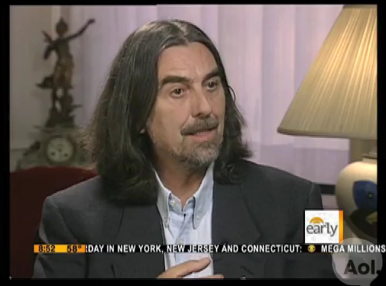
The Early Show looks at Martin Scorsese’s ‘George Harrison: Living in The Material World’

October 11, 2011

“Our true nature is consciousness and bliss.” George Harrison

‘The Early Show’ Takes a Look at Martin Scorsese’s ‘George Harrison: Living in The Material World’ 10/05/11. Click here to see the TV Replay.

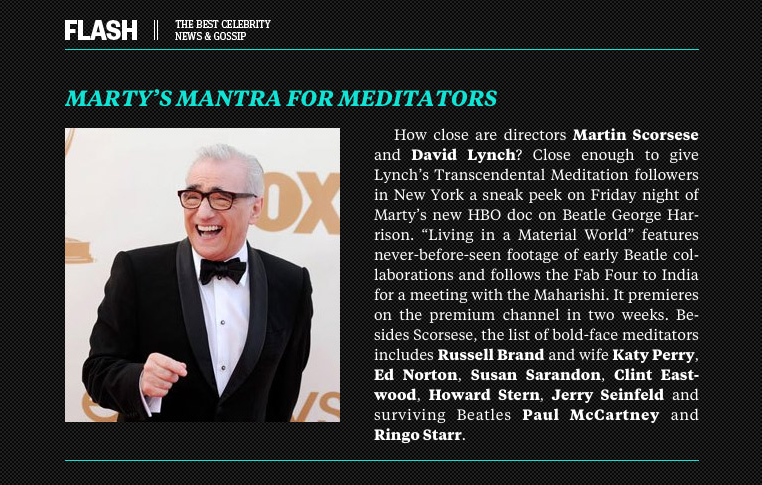
Also see The Daily: Marty’s Mantra For Meditators and Martin Scorsese’s film, George Harrison: Living in the Material World, premiers at the Sondheim Center for the Performing Arts in Fairfield, Iowa.

The Daily: Marty’s Mantra For Meditators

September 29, 2011

Wednesday, September 28, 2011

Also see: Martin Scorsese’s film, George Harrison: Living in the Material World, premiers at the Sondheim Center for the Performing Arts in Fairfield, Iowa

Sally describes her journey “To Jyotir Math” with Maharishi and scientists who met to tell the Shankaracharya about the dawning of a new age

April 17, 2010

To Jyotir Math

Late May, dusty dry hills, scrub brush, months before monsoons would come bringing green relief.

The ashram, quiet, in the fading sunlight, was impressive in these Himalayan foothills; ancient, two-storied cream stone, with saffron orange trim, the Shankarcharya’s colors, and flag flying, nestled against a hill beside Shankara’s cave and banyan tree, the same cave and tree where Shankara sat 3,000 years ago writing his commentaries with the disciples—Trotaka, Hasta-Malaka, Vartika-Kara, Padma-Pada. 3,000 years ago.

The air, though tired and dusty with summer heat, vibrated with ancient wisdom, lively still in that remote valley, hidden from time.

The great gong sounded from the ashram at sunset, calling the villagers to meet, poor peasants—the men road workers, wearing their army uniforms like badges of honor; the women, their good saris ragged to our eyes, glittered with tinseled trim and brilliant blended hand woven colors—scarlet, blue indigo and jaded greens.

They flowed like water into the meeting room—a small room, filled with greatness. Shankarcharya walked slowly into the room, an immense presence, pundits extolling his holiness with Vedic mantras. His gentle gaze, meeting our eyes, greeted the pale Americans who had come with Maharishi. He sat on Guru Dev’s throne, like a statue of stillness, waiting for us to settle, then beckoned to us gently to move forward so more of the villagers could enter the room.

The women to one side, sat apart, protected by their gentle warm togetherness, shifting, hushed whispers, pulling their saris as Maharishi and the great western scientists spoke of the dawning of a new age.

I had been there before, perhaps in a dream, of walking these hills, knowing with liquid clarity what would be around the curve, in the next cave, in the small Devi temple. I knew that holiness.

It was late, and we left quietly. Ahead of us, the village women walked slowly, heads together, chatting and laughing, apart from their men, gathering their tired children in their strong brown arms.

—Sally “Sali” Peden

——————————————

(Also see: Pilgrimage, and Timeless Journey, by Sally Peden)

Around 1995-96 Sali took some classes in the MA in Professional Writing program at Maharishi University of Management.  The poetry writing class was taught by poet Rustin Larson. It was there that she recalled and wrote about her journey to Jyotir Math in India with Maharishi Mahesh Yogi, which had taken place some 20 years earlier, in May 1975, the year Maharishi had inaugurated the Dawn of the Age of Enlightenment. For an explanation and further developments …. (more…)

Paul McCartney’s son says he’s ready to follow in dad’s footsteps

November 5, 2009

Paul McCartney’s son says he’s ready to follow in dad’s footsteps

November 4, 5:29 AMBeatles ExaminerSteve Marinucci

JamesMcCartneyJames McCartney, son of former Beatle Paul McCartney, will play his American debut concert Nov. 14 at Maharishi University in Fairfield, Iowa. The younger McCartney will perform during the fourth annual David Lynch “Change Begins Within” Weekend, Nov. 13 to 16. Also performing will be Donovan, who joined the Beatles in Rishikesh. Blueser Laura Dawn and her group The Little Death will fill out the bill.

The concert comes a little more than 40 years after James’ father, Paul McCartney, traveled to Rishikesh, India, to study Transcendental Meditation with Maharishi Mahesh Yogi.

“James has a way with melody and a set of pipes, which are more than a match for his dad’s,” a recent article in the UK Sun declared.

In a statement issued for the concert, he said this is something he’s been working towards for a while.                                                                               

“I have been playing music since I was nine and writing along the way. I met my band about a year ago. Producer David Kahne introduced us — and my dad, Paul, helped.”

McCartney says his father played a big role in helping him develop his musical talent. “My dad taught me guitar when I was nine. I play a Fender Stratocaster, which Carl Perkins gave me from the seventies, and a Gibson Les Paul that my dad gave me — heart red.

“The band consists of me, 32, on guitar, piano, and vocals; Brian Johnson, 28, on drums; Steven Bayley, 32, on guitar, synthesizers, toy piano, and harmonies; and Charles Turner, 27, on bass and harmonies, McCartney states. “I am from London and Sussex, Brian and Charlie are from Allerton, Liverpool, where my dad grew up, and Steve is from Birmingham. Brian and Charlie used to be in the Dead 60s and Steve used to be in The Open.”

The group is touring and also in the midst of recording an album. “We are mixing our album in Hog Hill Studio, Sussex. The words on the album refer to spirituality, love, family, trying to sort out one’s own life, and many other things. I have written the songs over a ten-year period,” he says.

“The music was inspired by the Beatles, Nirvana, the Cure, PJ Harvey, Radiohead — and all good music. It is basically rock ‘n ‘roll, clean sounding, and vocal.”

Just like his dad.

Q & A with Mike Love

October 1, 2009

Arkansas Times

Q&A with Mike Love

Lindsey Millar
Updated: 10/1/2009

Print E-mail del.icio.us Digg this
Mike Love
MIKE LOVE

In advance of the Beach Boys’ performance with the Arkansas Symphony Orchestra on Sunday, I spoke by phone to original member Mike Love, 68, about the benefits of transcendental meditation, being cast as a bad guy in the Beach Boys’ story and “acid alliteration.”

You still practice transcendental meditation?

Yes, I do. I did it this morning. I do it, as it’s meant to be, twice a day, morning and evening. It’s been a huge help in my life in terms of combating stress, but also giving me that deeper rest. Transcendental meditation can lower your metabolism to the level of rest twice as deep as deep sleep. I learned from Maharishi in Paris in December of 1967, and I’ve been doing it ever since.

So many of your greatest songs were about teen-age life and high school concerns. Does it get harder to sing those songs the farther removed you get from those days?

I have a young daughter. She came home from school three or four years ago and said, “Hey Dad, my fourth grade class’ favorite songs is ‘Wouldn’t It Be Nice.’” For children, pre-teens, teens and young adults, “Wouldn’t It Be Nice” is relevant to their lives at the place where they are. For me and for people who started out as fans of the Beach Boys in the ’60s, it’s going to be nostalgic. The fact that we’re appreciated by multiple generations is a blessing.

The Beach Boys have their own little slice of Americana. My mom and Brian, Dennis and Carl Wilson’s father were sister and brother. Whenever we got together for a birthday party or Thanksgiving or Christmas, it was always music. We had a grand piano, an organ and a harp in my living room, and we’d have these family get-togethers with aunts and uncles and cousins. The Beach Boys becoming a career started out as a love of singing and making harmonies together.

Do you feel like you’ve been cast as the bad guy in the Beach Boys story?

In some places. I think it’s the result of my not getting credit for a lot of the songs I wrote with Brian. I co-wrote “California Girls” and “Help Me Rhonda” and “I Get Around,” but I was never credited. Brian was under a conservatorship, an attorney, who would not allow him to right those wrongs. Yet wanted to. I know he wanted to because he told me so, but he wasn’t in charge of his business affairs because of the issues he’s had, emotionally and mentally, over the years. I wasn’t thrilled about being cheated or not credited, but as far as my relationship with Brian, how he felt about things and that he always wanted to rectify things and subsequently things have been, for the most part, rectified.

What about the idea that you hampered the creative evolution of the band?

That’s another fabrication. We all worked on the “Pet Sounds” album as diligently as we could as humans. Brian was the producer and he did the great orchestrations, but we all worked on the vocals extremely hard. Brian and I both went to Capitol Records and presented them with the record. Any talk of me not being in favor of “Pet Sounds” is garbage. So there’s misinformation like that that has its own life on websites that’s not true. If something’s true, I’ll own up to it. For instance, we wrote “Good Vibrations” together, and it went to number one. The follow-up to that was “Heroes and Villains” and that was done with another co-writer.

Van Dyke Parks.

Right. And it went to number 48 or something. I asked Van Dyke, what does “over and over the crow cries uncover the cornfield” mean, or “have you seen the Grand Coulee working on the railroad?” I coined the term “acid alliteration.” That’s what I called it. It’s absolutely true that I have an issue with doing lyrics that are so obscure and oblique that they can’t be relatable to by most people. I mean they can be appreciated, and I do appreciate the art form itself. But I like art that relates to people to the point where a song has a chance to go to number one. So I am guilty of liking songs that are artistic as well as popular.

So all of the court battles have been resolved and you and Brian and Al are in a good place?

Yeah, there’s no outstanding legal fracases going on, which is a good thing because there’s been some dialogue between Brian and I getting together and seeing what we could come up with, and there’s a 50th anniversary of the Beach Boys coming up in a couple of years, and it would make a lot of sense to do something together.

http://bit.ly/3qmn2t