Posts Tagged ‘Maharishi Mahesh Yogi’

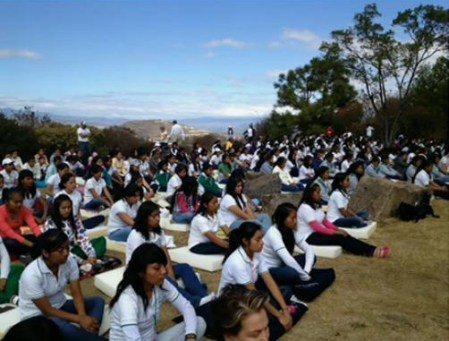
8,000 Mayan and indigenous tribal students meditate for peace to mark the end of an era

December 22, 2012

8,000 Mayan, Zapotec, and Mixtec Students Meditate for World Peace and Restructure the Apocalypse to Create the End of the [War-torn] World

By David Leffler | December 23, 2012  | The Liberian Dialogue
Mexico students meditate for peace

Nine countries in Latin America are implementing Transcendental Meditation and Yogic Flying in military and/or educational settings.

With much media fanfare worldwide, the Mayan calendar came to an end on 21 December 2012, with far-flung predictions of global apocalypse. But most of us are still here, so perhaps the “end of the world” was in fact a new beginning – the end of the world as we know it, and the dawn of a new and more enlightened age.

On that apocalyptic day, 8,000 young children – descendants of the Mayans, Mixtec, Zapotec, and other indigenous tribes – gathered at Monte Alban, a sacred mountain of the Zapotec people in southern Mexico, to meditate together for world peace. Around the world, people of all ages, cultures, and religions participated with them in simultaneous group practice of the non-religious Transcendental Meditation® (TM) program and its advanced TM-Sidhi program, both founded by the late Maharishi Mahesh Yogi.

In Latin American military circles, this collective TM practice by large groups of peace-creating experts is known as the Invincible Defense Technology (IDT) due to its scientifically confirmed ability to neutralize the destabilizing influence of collective stress, held to be the root cause of terrorism, war, and violent crime.

These young Mexican children, along with many students in other Latin America countries, had been trained in these peace-creating technologies for approximately eight months. Their gathering at Monte Alban was a demonstration to the world of the effectiveness of these technologies in defusing social violence and “averting the danger that has not yet come” – a principle of collective coherence drawn from the ancient Yoga Sutras.

Is this gathering something out of a “New Age” science fiction thriller? No. This unusual defense strategy really works. It is advocated by the Global Union of Scientists for Peace (GUSP, http://www.gusp.org), a coalition of Nobel laureates and leading scientists who see it as the best way to avert the growing threats of nuclear proliferation, terrorism, and weapons of mass destruction; to create national security in every country; and to establish lasting world peace.

John Hagelin, Ph.D., a renowned Harvard-trained quantum physicist who heads this group, says, “In recent years, [this] powerful, innovative approach to peace has been extensively field-tested – in the Middle East and throughout the world. The consistent result has been dramatic reductions in terrorism, war, and social violence. These findings have been replicated, published in leading academic journals, and endorsed by hundreds of independent scientists and scholars. The efficacy of this approach is beyond question.” [An Op-Ed piece: “Reducing Tension in the Middle East” was recently published worldwide advocating this approach.]

According to Luis Intof Alvarez, the organizer of the Monte Alban gathering, the advanced TM-Sidhi practice has been taught to 8,000 students in 54 schools in southern Mexico and Guatemala during just the past weeks. With over 250 Latin American schools now participating in this program, at least 20,000 students will be collectively practicing these peace-creating technologies by this time next year. Alvarez says that our world leaders now have a choice. Which direction do we want to take: continued violence or creating peace?

His point is made more vivid by the tragic recent events at the Sandy Hook elementary school in Newton, Connecticut, USA. Throughout the U.S., students in schools and colleges continue to be the victims of senseless violence. By contrast, the Mayan and other tribal students throughout Latin America are creating peace, not only within themselves but also on a much grander scale – for their schools, cities, and nation as a whole.

Latin American students in both civilian and military  schools are learning and applying this strategy. Currently, at least nine Latin American countries are soon due to have fully operational peace-creating groups in military and/or educational settings. Military leaders worldwide will soon be surprised to learn that students can actually do a much better, safer, and more effective job of protecting their nations with an advanced TM meditation practice than with expensive hi-tech military weaponry. Informed Latin American leaders, especially those now in charge of military schools, have already deployed this approach. Lieutenant General José Martí Villamil, a pioneering former Vice-Minister of Defense for Ecuador, first conducted a military field-test during their war with Peru in the early 1990s, with promising results.

In the past, in non-Latin American countries, field tests of these coherence-creating groups achieved measurable positive results that were also apparent from news reports. In trouble spots, violence and war deaths subsided, peace negotiations improved, and/or treaties were signed. The first head of state to ever implement such a program was President Joachim Chissano of Mozambique. Read the amazing story of what happened when members of his government and military learned to meditate. (See: Psychology Today, “Can Meditation Change the World?“)

Over fifty studies have scientifically documented the profound and measurable benefits of this approach to peace. In one such study, conducted during the first Lebanon war, the predicted effects and publicly available measures to be used were specified in advance for scientific review boards in North America and Israel. The outcomes of this and other such experiments have been published in respected peer-reviewed journals, including the Journal of Conflict Resolution, 1988, 32: 776–812; Social Indicators Research, 1999, 47: 153-201; Journal of Offender Rehabilitation, 2003, 36 (1-4): 283-302; Journal of Social Behavior and Personality, 2005, 17(1): 339-373; Journal of Social Behavior and Personality, 2005, 17(1): 285-338; and Journal of Scientific Exploration, 2009, 23(2): 139-166.

It could be argued that the positive social effects of these deployments are already beginning to be documented. In a 2011 poll, Gallup measured positive emotions in 148 countries and found that Latin Americans are the most positive people in the world. Their region is home to eight of the top 10 countries for positive emotions worldwide.

Certainly Evo Morales Ayma, the President of Bolivia, believes that “the end of the world” is only the end of the world as we know it. At the 67th General Assembly of the United Nations, he said:

“And I would like to say that according to the Mayan calendar on the 21 of December is the end of the non-time and the beginning of time. It is the end of the Macha and the beginning of the Pacha, the end of selfishness and the beginning of brotherhood, it is the end of individualism and the beginning of collectivism – 21 of December this year. The scientists know very well that this marks the end of an anthropocentric life and the beginning of a bio-centric life.

It is the end of hatred and the beginning of love, the end of lies and beginning of truth. It is the end of sadness and the beginning of happiness, it is the end of division and the beginning of unity, and this is a theme to be developed. That is why we invite all of you, those of you who bet on mankind, we invite those who want to share their experiences for the benefit of mankind.”

Dr. David Leffler received his Ph.D. in Consciousness-Based Military Defense (Invincible Defense Technology – IDT) from The Union Institute & University in Cincinnati. He served as an Associate of the Proteus Management Group at the Center for Strategic Leadership, US Army War College. He has published articles in over 400 locations worldwide about IDT and now serves as the Executive Director at the Center for Advanced Military Science (CAMS). Dr. Leffler teaches IDT and is available at http://www.StrongMilitary.org

More photos of the meditating students are available at the end of David Leffler’s article posted here. These are the countries where the article has been featured so far: INDIA – Mangalorean; LIBERIA – The Liberian Dialogue; NIGERIA – Nigeria Sun; AUSTRALIA – The International News Magazine U.S. Edition; UK – The News Tribe, a bilingual news website covering Pakistan, South Asia, Middle East and UK; Global Edition – One News Page. Global Good News reported the news as well as an earlier backgrounder of how the parents and students prepared for this special event: Mexico: Thousands of indigenous students to meditate together at traditional celebration.

For a scientific explanation behind the power of large groups collectively practicing the Transcendental Meditation and TM-Sidhi program including Yogic Flying, read The Power of The Collective, by John Hagelin. Also see Op-Ed peace piece spreading around the world: Reducing Tension in the Middle East and Ken Wilber said meditation can change the world. Jaochim Chissano showed it could – Steve Taylor.
Investment director and author Alexander Green tells you how to take a vacation inside your head

December 14, 2012

Here’s an interesting article I received from a friend. One of her friends subscribes to a financial service newsletter called Spiritual Wealth and he sent it to her. Alexander Green, investment director and author, posted this personal account December 14th, 2012. While on a club tour in Europe, he struck up a conversation with a fellow traveler. What came out of it led to him learning how to take a daily vacation in his own mind. You can read more about Alex at the end of his article. Bon voyage!

How to Take a Vacation Inside Your Head

On a recent Oxford Club tour of Italy, I got to know Dr. Satinder Swaroop, a cardiologist based in Fountain Valley, CA. Among the many topics we discussed during our ten days together was Transcendental Meditation (TM).

Dr. Swaroop is a lifelong meditator. And he has found that his patients who practice it enjoy better heart health. They are less anxious and sleep better. Their chest pains are less frequent. They are more able to stay on a diet and lower their cholesterol levels. They are calmer, too.

He suggested I give it a try.

I don’t have any heart issues. I’m not an anxious person. If anything, I lean toward the overly mellow. Dr. Swaroop just smiled. “You should try it and see what happens.”

I told him I’d look into it.

A few weeks after I returned home, Dr. Swaroop sent me an email. Had I visited TM.org as he suggested?

Uh, no.

“You should,” he said again. “Just check out a couple of the videos.”

And so I did. That’s when I stumbled across a five-minute short by filmmaker David Lynch and became intrigued. I began reading up on TM and listening to people who practiced it. A week later, I signed up with an instructor.

I would have scoffed at this idea a few years ago. To the extent that I thought about meditation at all, I considered it a somewhat hippie, vaguely self-indulgent practice tied to Eastern religions or mystical “woo-woo” of one kind or another. Meditation seemed too… well… flaky.

But that view changed as I became more familiar with the scientific literature. There is an astonishing amount of research on meditation’s physical and psychological benefits, including hundreds of peer-reviewed articles. Researchers have found that TM spreads a wave of calmness across the brain, organizing the prefrontal region in a way that improves focus and decision-making. Studies also suggest it enhances physical health and increases longevity. How? By helping people deal effectively with stress.

In today’s hectic and competitive world, stress wears us down and burns us out. It fuels countless disorders, including anxiety, insomnia and depression. It also promotes cardiovascular disease, obesity, diabetes and digestive disorders. Exercising and eating better can help counteract this. But meditation helps practitioners develop mental resilience, as well. The benefits are well documented.

In Transcendence, psychologist and educator Dr. Norman Rosenthal writes: “A great deal of clinical research has been done on TM. For example, we now know that when people practice TM, their blood pressure drops. They show higher blood levels of a soothing hormone called prolactin, as well as more coherent brain wave patterns, which are associated with good mental functioning. New evidence suggests that TM may improve longevity and lower medical costs by reducing hospital stays and doctors’ visits. Even people who are not in physical or psychological distress can be helped. TM has been shown to help ‘normal’ people reach their full potential and live in greater harmony with one another.”

Transcendental Meditation is not a religion. No one who practices it is asked to accept any belief system. The technique goes back thousands of years and was brought to the United States by Maharishi Mahesh Yogi, an Indian teacher who extracted the meditative technique from its Vedic origins and distilled it to its essence. Today it is practiced by people of all religions and no religion.

How does it work?

TM is not learned from a book or video. It is taught by a certified instructor and experienced meditator.  The process has seven steps: two lectures, a personal interview with the teacher, then four teaching sessions on four consecutive days.

Essentially, the student is taught to sit with hands folded in an upright chair in a quiet place. After a brief ceremony of gratitude, the instructor gives him his own mantra (a two-syllable wordless sound) to think about as he sits in quiet relaxation for 20 minutes twice a day.  Ideally, this would be first thing in the morning and again in the late afternoon or early evening. (The mantra is simply a mental “vehicle” to let the mind settle down.)

In the beginning, I wondered how I would possibly find time to fit two 20-minute sessions into days already crammed with research, writing, traveling, speaking, exercising, socializing and raising a family. But since no new skill can be learned without practice, I made time.

I haven’t been at it long enough to report anything world-changing. But I will pass along a few observations. First off, there’s something inherently pleasurable about taking a break from your daily routine to sit in quiet contemplation. Meditation helps you sort through all the mental flotsam and jetsam your mind throws up. The typical meditative session results in greater relaxation, inner peacefulness and, occasionally, an enjoyable shift in consciousness.

Insights like these are hardly new, of course. Meditation has been practiced in both the East and West for thousands of years. In the second century AD, the Roman emperor Marcus Aurelius wrote in his Meditations:

“Men seek retreats for themselves in country places, on beaches and mountains, and you yourself are wont to long for such retreats, but that is altogether unenlightened when it is possible at any hour you please to find a retreat within yourself. For nowhere can a man withdraw to a more untroubled quietude than in his own soul.”

Psychologists report that in a typical day we process up to 70,000 thoughts and this continues even as we sleep. (Basically the brain never shuts up.) Meditation is a pleasant and peaceful retreat, a tool for stilling the mind.

Thoughts or worries will arise during TM too, of course. But meditators are counseled not to argue with or analyze them, but rather just to acknowledge them and let them go. Experienced meditators often report a blissful state of acceptance, serenity and a feeling of being at one with the world.

TM is easy to learn and practice. It is less expensive than analysis, safer than prescriptions, and available for a lifetime without special equipment or facilities. Researchers have discovered that sitting with your eyes closed and repeating a mantra twice a day can cut your risk of serious disease by half. And it has no adverse side effects. If TM were a drug, it would be a multi-billion-dollar blockbuster.

As Rosenthal writes, “I have found most long-time meditators to be physically relaxed in their posture, alert in their expressions, and open-minded in their attitudes. It is not surprising that this demeanor and approach to life, played out day after day over years, would make a huge difference to health, longevity, and just plain enjoyment of life.”

The good news is you don’t have to follow a guru, visit an ashram, recite Sanskrit or get into the lotus position on a hardwood floor. All you need is a comfortable chair, a quiet space and 20 minutes.

And I invite you to be skeptical. I’ve learned it works for skeptics too.

Carpe Diem,

Alex

P.S. The David Lynch Foundation sponsors the teaching of Transcendental Meditation to inner-city schoolchildren, prisoners and even refugees in war-torn parts of the world. To see his five-minute introductory video, click here.

Alex Green—Spiritual WealthAlexander Green is the Investment Director of The Oxford Club. The Oxford Club Communique, whose portfolio he directs, is ranked among the top investment letters in the nation for 10-year performance by the independent Hulbert Financial Digest. Alex is the author of The New York Times bestseller “The Gone Fishin’ Portfolio: Get Wise, Get Wealthy… and Get On With Your Life,” “The Secret of Shelter Island: Money and What Matters,” and most recently, “Beyond Wealth: The Road Map to a Rich Life.” He has been featured on Oprah & Friends, CNBC, National Public Radio (NPR), Fox News and “The O’Reilly Factor,” and has been profiled by The Wall Street Journal, BusinessWeek, Forbes, and Kiplinger’s Personal Finance, among others. He currently lives in Charlottesville, Virginia and Winter Springs, Florida with his wife Karen and their children Hannah and David.
Copyright © 2008-2012

Study suggests meditation may help prevent PTSD—Boston Globe article by Bryan Bender

December 3, 2012

Study suggests meditation may help prevent PTSD

By Bryan Bender | Globe Staff | December 02, 2012

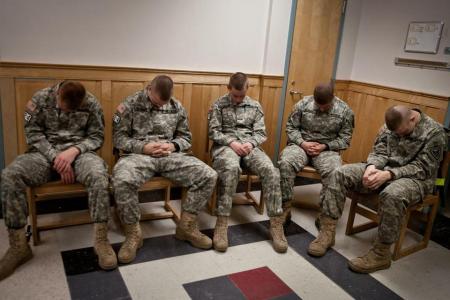
Norwich Rooks Meditate after classes

Lance Ostby, Rob Wetmore, Matt Miller, Aaron McDuffie, and Jeremy Ward practiced meditation following afternoon classes. Kayana Szymczak for the Boston Globe

NORTHFIELD, Vt. — It is part of a highly regimented daily routine at Norwich University, the nation’s oldest private military academy and a cultivator of battlefield leaders for nearly two centuries.

Dressed in combat fatigues and boots, a platoon of first-year cadets — “Rooks” — are up early in their barracks. On the orders of their instructor, the young men and women take their places. At 0800 sharp, they sit on wooden chairs in a circle and begin — to meditate.

The first-of-its-kind training is part of a long-term study to determine whether regular brief periods of silent, peaceful consciousness can improve troops’ performance. Ultimately, researchers hope the transcendental meditation training might be made available across all branches of the military to help inoculate troops against acute post-traumatic stress disorder, which has reached epidemic proportions and is blamed for a record number of suicides in the ranks.

For an institution that demands that incoming cadets exhibit physical and mental toughness, meditation training is a radical approach. The broader military culture had long associated meditation with a leftist, antiwar philosophy. Known by its shorthand, TM was widely introduced to the West by Maharishi Mahesh Yogi, the Hindu leader who once served as the spiritual guru to the Beatles.

“I was very skeptical at first,” said Norwich president Richard W. Schneider, a retired Coast Guard admiral who is among several university officials who have also been trained in the technique. “I’m not a touchy-feely guy.”

But the preliminary results of the study, now in its second year, surprised even its lead researchers. They have been methodically tracking the dozens of participants and several control groups of non-meditating cadets through detailed questionnaires as well as brain wave and eye scans to measure levels of stress, anxiety, and depression.

“All those things decreased significantly,” said Dr. Carole Bandy, a Norwich psychology professor overseeing the project. “In fact, they decreased very significantly.”

Positive traits such as critical thinking and mental resilience improved, according to preliminary findings shared with the Globe that Bandy and her team plan to publish next year.

The project has garnered high-level attention from the Army.

“Becoming more psychologically fit is just like becoming physically fit. It is better to do it before you are injured,” said retired Brigadier General Rhonda Cornum, a surgeon who until recently ran the Army’s Comprehensive Soldier Fitness Program and visited Norwich three times to be briefed on the work. “There seems to be no question that meditation is, frankly, good for you. I am very encouraged by the Norwich University study.”

(more…)

Op-Ed peace piece spreading around the world: Reducing Tension in the Middle East

November 29, 2012

In a response to the current volatile situation in the Middle East co-authors David Orme-Johnson and David Leffler ask if we want to continue repeating history, killing and destroying to solve political problems, or transform ourselves with a more enlightened alternative approach that’s been scientifically proven to create peace.

Modern unified field theory supports the perennial philosophy of all major cultural traditions that there exists a transcendental field at the most fundamental level of natural law, which can be directly accessed as the silent transcendental level of the human mind. Hundreds of studies have shown that experience of transcendental consciousness breaks the chain of conditioned reflexes coming on from past behavior, as seen in reduced addictive behaviors of all kinds, decreased prison recidivism, and reduced behavioral problems in inner-city children.

Are we as nations to go on like rats trapped in a conditioning cage, reacting the same way decade after decade? Or shall we step out of the cage into the transcendental level of our own consciousness and grow up into enlightened human beings, rather than continuing to resort to destroying and killing? This is the choice we have right now.

Read this paradigm-shifting Op-Ed piece on how we can put an end to war and create permanent peace: Reducing Tension in the Middle East. It’s being posted on news websites and online journals around the world. The AsiaN published it as Transcendental meditation proved helpful in solving enmity among nations. The Israel Herald published it under: Lasting peace in Middle East may need warring parties to meditate, and the Palestinian News: Meditation cited as possible remedy to reduce tensions in Mideast conflict.

Here is a list of publications under dates in the countries where the article was published, over 50 times so far: Israel, Afghanistan, Romania, UK, Nepal, USA, Pakistan, Greece, Cyprus, Ghana, Liberia, Balkans, India, Ivory Coast, Africa, Australia/Tonga, Canada, Jordan, Balkans, Palestine, South Korea, Kashmir, Ireland, China, South Africa, Egypt, Germany, France, Denmark, Spain, Thailand. Check them all posted here: Op-Ed Piece “Reducing Tension in the Middle East” by Drs. Orme-Johnson and Leffler is Available Worldwide in over 50 Locations.

For more information on this powerful benign approach, see: The Power of The Collective, by John Hagelin and John Hagelin — “Only Higher Consciousness Can Transform Our World” — Beyond Awakening Blog. Here are reports: Group Meditations Reduce Crime, As Predicted and Explanation to Steady Decline in Major Crime in the US.

Cancer stories: Greg James restored balance with Maharishi Ayurveda and TM to enjoy his life again

October 28, 2012

FAIRFIELD — October is National Breast Cancer Awareness Month and The Ottumwa Courier asked cancer survivors and/or family members to share their stories. A few people wrote to tell of their experiences and their stories have been running often throughout this month. The editor thanks all the people who participated. Many said they wanted others to know about the experience and to always have hope. Here’s a story from a friend of mine, Greg James, in Fairfield. I never would have guessed he had been through so much, he seems so healthy to me.

Cancer stories: Restore balance and enjoy life

October 25, 2012

“No one has ever survived this kind of cancer,” the Harvard oncologist told me back in September 1988. “It is a rare and very fast-growing form of Non-Hodgkins Lymphoma. Sloane Kettering in New York City has only seen 50 cases in the last 10 years, and no white male 37-year heterosexual has ever survived.  You are Stage 4 with complications (massive pleural effusions).”

“What are his chances of surviving?” asked my family, and the doctor would only cross his fingers.

It was very ironic that I got this cancer, as I was on a media team that was making Deepak Chopra and Maharishi Ayurveda household words. I had been in perfect vibrant health, an active hiker, then (and now).

My father was a hospital administrator and consultant. I grew up with mixed signals: the doctors were brilliant and great people, but their system limited them to drugs and they couldn’t think out of the box; they are brilliant technicians but lack training in vital areas of nutrition and bedside manner. So, I was, from the outset what Bernie Siegel (author of “Love, Medicine, and Miracles”) called a “difficult patient.” Dr. Siegel noted that the patients who take an active interest in their treatment, asking frequent questions and sometimes going against medical advice, were the ones that survive.

It was quickly found that I had a tumor the size of a fist in my throat choking me. That explained a lot! The CHOP protocol worked quickly, dissolving that tumor, and I got through tumor necrosis (the breaking up of the tumor and the spread of that material throughout the body). I was re-admitted to Mass General Hospital in Boston again for a total lack of white blood cells and put on a rescue remedy. Then, two months after my first treatment, I was in Intensive Care Unit for 12 days fighting for my life against pneumonia.

After that, consulting with various doctors outside of the cancer complex at Mass General, I decided to quit the chemo, brain radiation and spinal taps in favor of rebuilding my body with special herbs from India and a rejuvenation protocol (now offered at The Raj in Fairfield). I was totally devastated by the chemo and lack of sleep caused by the Prednizone, and couldn’t hold down food from nausea. My body was trying to throw off the “emergency medicine” and get back to some balance. The Ayurvedic treatments were designed not to cure disease but to promote good health, but they gave me what I needed most: vitality, strength and some hint of happiness.

Meanwhile, the oncologists were upset that I had taken a break from chemo, etc., and told me they had gotten approval for a bone marrow transplant from Dana Farber Institute, a procedure that would “bring me to the brink of death, and then we will re-inject your bone marrow” and I was prescribed three years of continuing chemo, etc. after the transplant. My oncologist quoted a published study and told me that three out of 23 patients had survived this type of bone marrow transplant, which angered me. “You want me to bet my life on one chance in eight? Who is on drugs here, doctor? (I didn’t continue, and saved the insurance company $300,000)”

Ten months after I started, I was back to walking without leg braces (after losing strength from the chemo), and loving life again. I was grateful to have the best of “emergency medicine” and the best of alternative medicine. For a few years after, everyone and their brother was calling me to ask me to talk to their wife or cousin or whomever about their cancer treatment. My answer included these points: realize that the surface condition of cancer is a symptom of an underlying imbalance in the mind-body connection and that this must be restored, and it could be. If your condition is terrible, by all means take allopathic medicines, but don’t be afraid to break from it to get much-needed vitality back through expert-prescribed herbs and rejuvenation therapies. Take “rasayanas,” herbal supplements that promote longevity. First of all, go to an established Maharishi Ayurveda clinic and take the rejuvenation therapy; it will promote your recovery very quickly. And practice verified techniques for improving health, namely Transcendental Meditation. Be honest about your feelings: of course you are scared, that is natural; if you aren’t scared, then somebody isn’t being honest.

People ask me, “So your cancer is in remission?” and I answer, “My health was in remission briefly, but that has been restored.” I change the emphasis because too many people fear the problem without re-defining it: cancer is an opportunity, a forced opportunity, to go deep inside, bring out the strength you need and restore balance to enjoy life.

Greg James

Fairfield

Reprinted with permission from the author

The Age features Transcendental Meditation and the Maharishi School in national education article

October 22, 2012

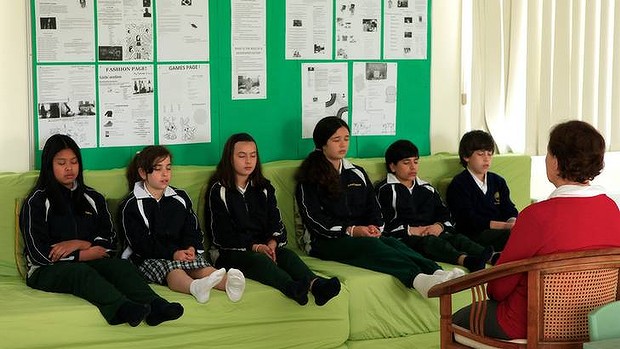
Australia’s The Age features Transcendental Meditation and the Maharishi School in a national education article written by Denise Ryan: School puts stress on staying calm: Meditation techniques embraced by the Beatles are helping students in Reservoir. October 22, 2012. (I added links.)

Students practise Transcendental Meditation at the Maharishi School in Reservoir. Photo: Eddie Jim

MOST children wouldn’t describe their primary school as “peaceful” or all their teachers and classmates as “kind”. But that’s how Bridgette Nicolosi views her new school.

The year 4 student says she used to feel “confused” in her former mathematics class, but since she has learnt Transcendental Meditation at the Maharishi School in Reservoir, she is no longer as “scared” of maths as she was. She also feels more accepted and included.

Isabelle Coates, the year 6 captain, is not surprised. She has compared how “calm and happy” she feels with the state of mind of friends at other schools. “I seem to be more relaxed,” she says. “I think if I didn’t meditate I would be more stressed.”

Fellow year 6 student Supreeya Bullock says meditation has helped her with schoolwork and in playing sport. Perrin Broszczyk says it has helped him relax and has improved his tennis.

These students are making big claims but their positive experiences from two 10-minute Transcendental Meditation sessions each day is backed by a wealth of international research.

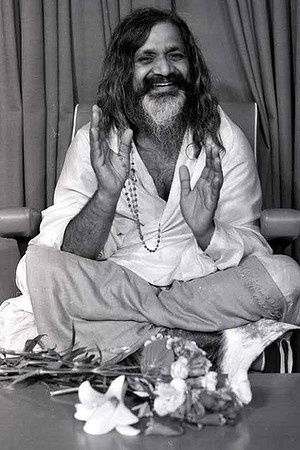
Maharishi Mahesh Yogi
Photo: Trevor Dallen

Transcendental Meditation was developed by Maharishi Mahesh Yogi and was first taught in India in the 1950s. Pop group the Beatles extolled its virtues, writing almost 50 songs while studying with Maharishi at his ashram in the foothills of the Himalayas in the late 1960s. Hollywood stars Mia Farrow and Shirley MacLaine also took it up. It is practised by millions world-wide, despite Maharishi’s death in 2008.

Some might regard the practice as New Age or bohemian but it has become mainstream, particularly in the US where it is used in some hospitals to help chronically or terminally ill patients manage their stress.

Principal Frances Clarke
Photo: Eddie Jim

Maharishi School founder and principal Frances Clarke says meditating in silence has profound results. Since the 1970s hundreds of research studies on Transcendental Meditation have been undertaken at more than 200 universities and research institutes across many countries.

These studies report benefits such as increased creativity, intelligence and learning ability, higher levels of brain function, improved memory and school behaviour. Studies have reported an increased sense of calm, decreased anxiety and reduced conflict.

When Ms Clarke founded this independent school with like-minded families in Bundoora in 1997, it had 20 students. The school gained a following since moving to Reservoir, drawing families from local suburbs such as Northcote. It now has 80 students, rising to 100 next year.

The school teaches the standard curriculum but adds a subject called Science of Creative Intelligence, and also the meditation sessions. In the extra class, students might do maths as part of learning such principles as that every action has a reaction.

An ancient system of architecture and design known as Maharishi Vedic principles have been included in two new buildings. For example, they are entered from the east, capturing early morning sun. The principles are different but are along the lines of Feng Shui, in that they seek to maximise health and success.

Ms Clarke first learnt to meditate at age 22. She found it helpful to deal with stress when she became a secondary school teacher. When she heard that the Maharishi School of the Age of Enlightenment in Iowa was getting outstanding results, she decided to visit.

The Iowa school is open entry yet it continues to record some of the top academic results in the state and its students regularly win awards for sports, science, art and problem-solving competitions. TV star Oprah Winfrey has highlighted the school’s results on her program.

Some US schools that deal specifically with Attention Deficit Hyperactivity Disorder have adopted Transcendental Meditation techniques after also witnessing its success at a Detroit Middle School.

A Maharishi School in Lancashire, England, has performed in the top 2.5 per cent of schools for 25 years, despite also being open entry. As a result, the education department has fully funded it. Other Maharishi Schools are being established there too.

Ms Clarke’s husband Larry, who has also taught Transcendental Meditation for many years, says it has a following in the US, Europe, South America and Thailand but has been slower to take off in Australia, despite the established benefits.

“It’s a bit of a sleepy hollow here, yet 6 million people have been trained world-wide.”

Transcendental Meditation differs from some other forms of meditation in that it allows the mind to effortlessly “transcend thought”.

“It does not require contemplation or concentration,” says Dr Clarke. He regards concentrating on breathing or an object, such as a candle flame, as an arduous practice where the mind is still active.

“In TM the mind becomes quieter and quieter until it is doing absolutely nothing. TM uses the natural tendency for the mind to move towards something more interesting or charming. It moves into subtler and subtler states until thought dissolves into silent wakefulness, or pure consciousness.”

Ms Clark says meditation helps children find their passion. “Around years 3 or 4 they discover what they love, and go for it.”

She says this is because children can concentrate. “Some schools spend all their time doing English and mathematics but our students focus so well they have time for everything else.”

The small scale also helps. “Students don’t get lost. Everyone has the opportunity to have a go at everything, whether it be a science or drama competition or to be in the school concert.”

Parents pay $1300 each term to send their children to this alternative school. At least one parent must practise or learn Transcendental Meditation also. The school offers a four-day course for parents. On weekends children meditate with their parents.

Students up to the age of 10 meditate with eyes open, walking about. Older children are seated in comfortable spots in the classroom. Ten-minute sessions are held about 9.30am and 3pm each day, which means students head home in a calm state. “But they don’t want to go home,” Ms Clark says. “It’s a small community and parents and students love to hang around after school.”

Teacher Samantha Russell loves the strong relationship between staff and parents. “I feel really sorry for my friends in other schools who don’t see the parents and don’t have the same objectives as them.”

She says parents talk to her about their experiences of meditating and it makes for a closer bond.

Students sometimes get a shock when they move from this environment to high school.

“They often express surprise that other students don’t want to learn and spend a lot of time mucking around,” says Ms Clarke.

She sees the government’s recent pressure on teachers to improve what they do as misplaced. “Transcendental Meditation develops the consciousness of the student so they are much more capable of learning. You can’t teach a class if children aren’t awake, alert or aware.”

Article URLs: http://bit.ly/TBUgpw and updated http://bit.ly/RqwoWW.

Earlier this year the Maharishi School was featured on Australian TV: Cool School: Melbourne school teaches meditation to students.

URLs for Maharishi School: http://www.maharishischool.vic.edu.au and TM in Australia: http://tm.org.au

Here is an image of the layout in Monday’s Age in Melbourne, Australia. Will replace it with a better resolution when available. (more…)

You Are God: Who? … Me? By William T. Hathaway

October 6, 2012

You Are God
Who? … Me?

By William T. Hathaway

The statement “You are God” seems an absurd and presumptuous blasphemy, so it needs to be clarified. According to pantheism, it’s not just you who are God; all of us are God. And it’s not just all of us who are God; everything is God. God is the universe in synergy, the whole that is more than the sum of its parts.

This contradicts mainstream Western theology, which is based on a split between creator and creature. According to this view, God made the universe with us in it and is now observing our behavior, rewarding us or punishing us based on our obedience to His rules.

The religions of the East and the mystic tradition of the West have a different view. They feel that God became the universe, manifested it, is it. Rather than observing the universe, God lives it. The universe is God’s active side, engaged in time, space, and matter. God is more than the universe, but there is nothing in it that isn’t God.

But if it’s true that we are God, why are we in such an ungodly mess? Because our unity with God is a living reality only in a higher state of consciousness. Reality, as Maharishi Mahesh Yogi said, is different in different states of consciousness. Ordinarily we experience three state of consciousness: deep sleep, dreaming, or waking. Each has its own reality with distinctive physiological parameters of brain waves, blood chemistry, and metabolic rate.

Waking state is the realm of duality. We are bound in the relativity of time, space, and matter, so we perceive separations between ourselves and others. In waking state the idea that we are God is nonsensical. It contradicts our perceptions.

But it’s possible to experience a fourth state of consciousness that has its own reality and physiology. It’s called transcendental consciousness because it’s beyond the other three, existing at a more fundamental level. Here the duality and materiality of waking state are only surface conditions. The deeper underlying reality is unity, where the separations fade and everything, including matter, is experienced as one unified field of consciousness. Here your individual thinking mind merges with the mind of God. You’re no longer just a part of God. You transcend the boundaries of your small self and expand into the one great Self, the divine spirit animating the universe. All separations between you and God disappear, and you become One.

In transcendental consciousness you really are God and you really are experiencing a sacred life. The most effective method I’ve found for achieving this state on a regular basis is Transcendental Meditation. But even with TM, it’s usually a fleeting experience. In transcendental consciousness the mind is without thoughts. It reaches the source of thought, where it becomes pure Being — alert and aware but without an object of awareness, consciousness experiencing itself. This state is so blissful, so all-encompassing, so divine, that we think, How wonderful! And as soon as we have that thought, we’re no longer there.

But as we come out, we bring some of the energy, intelligence, and joy of this unified field back into our waking state of consciousness, where it enriches our life. And ironically, one of the ways it enriches it is by giving us a deeper appreciation of our separateness from God. The sense of separation we experience in waking state is a great aid to devotion. It’s easier to love something external to us, even if this externality is only partially true.

Each experience of transcendental consciousness also heals our nervous system of stresses we’ve accumulated in the past. It is these stresses, or karma, that make our mind unable to stay in that state while we’re thinking and acting. Once those stresses are gone, which usually takes many years, our mind and body function in that state permanently.

This is enlightenment, the height of human development in which our unity with God is a living reality, not just a concept. In this state we live the sacred life 24/7.

*

William T. Hathaway is a peace activist, award-winning author, and adjunct professor of American studies at the University of Oldenburg in Germany. His latest novel, Summer Snow, tells of an American warrior in Central Asia who falls in love with a Sufi Muslim and learns from her that higher consciousness is more effective than violence. Chapters are available on a page of the publisher’s website: www.peacewriter.org.

Published with permission from the author.

Also see Radical Peace: People Refusing War, by William T. Hathaway, later republished on other websites listed at the bottom of the article as Conscious Peace: World Peace Depends upon Our Collective Consciousness.

Here’s a related article God? ~ Dr. Evan Finkelstein.

Celeb Spiritual Report: Jane Mag, May, 2004: David Lynch: One significant day in my life

July 24, 2012

One significant day in my life

By David Lynch

Jane – May, 2004

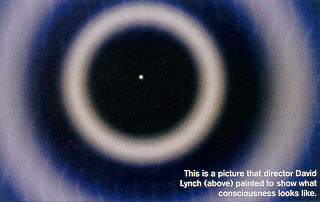
A significant event occurred in my life the day I learned that our human physiology, our body, is made of consciousness.

Consciousness???

“What???” I asked out loud in wonder.

I learned that our human physiology is so magnificent and complex, and so exquisite in its design and makeup, as to be wondrous beyond imagination. We are spun out of unbounded, infinite, eternal consciousness.

I learned that underlying all matter is a vast, unbounded, infinite and eternal field of consciousness called the Unified Field. I found out that modern science started taking this field seriously about 25 years ago and that all matter is unified at this level in a state of perfect symmetry, or balance. The entire universe emerges from this field in a process called “spontaneous sequential symmetry breaking.”

Are you still with me?

I also learned that there is another science called Vedic Science. This Vedic Science is ancient, and it has always talked of the Unified Field.

Interesting!

Veda, I learned, means “total knowledge.” The home of total knowledge is the Unified Field. It is also the home of all the laws of nature. The branches of Veda, 40 in total, make up the language of the Unified Field, the impulses of this eternal field.

I realized this Unified Field is quite an interesting place. It is not manifest and is full, meaning it is no thing, yet all things in potential. It manifests and permeates all things: the whole universe, everything, while still remaining full and not manifest.

Amazing!

Is this mind-boggling or what?

Now comes the hippest part. I have learned that any human being can “experience” the Unified Field.

Really?

Or: So what?

Why in the world would we care to experience the Unified Field?

First, another question.

Have you ever heard that most of us human beings use only 5 percent of our brain, our mind? Have you ever wondered what in the heck the other 95 percent is all about?

This is the beautiful part coming up.

The “experience” of the Unified Field actually unfolds “enlightenment”—higher states of consciousness culminating in Unity Consciousness, the highest state of consciousness. These higher states use that 95 percent of the brain. That is what the 95 percent is there for—to give us permanent, all-time enlightenment.

Now, what is enlightenment? If you were a light bulb, let’s say, your “glow” might light up your whole house and surrounding yard. In enlightenment, your “glow” would be unbounded, infinite and eternal. That would be some glow!

Enlightenment is fulfillment. Supreme fulfillment. Unbounded, infinite, eternal bliss, consciousness, intelligence, creativity, harmony, dynamic peace.

Enlightenment, I have learned, is our “full potential.” It is the birthright of every human being to enjoy enlightenment.

Is this good news? I think it is such good news.

In Vedic Science, the Unified Field is called “Atma.” Translated, that is “Self”—the Self of us all.

The Unified Field is not something foreign, or even something far away. It is right within each of us at the base of our mind, the source of thought. A great sage from the Himalayas, Maharishi Mahesh Yogi, brought a beautiful gift to our world in the form of Transcendental Meditation. Transcendental Meditation is an easy and effortless, yet supremely profound, technique that allows any human to dive within and experience that unbounded ocean of pure bliss, pure consciousness, the Unified Field, our Self.

It may be interesting for you to know that millions of people are practicing Transcendental Meditation all around the world. People from all religions, and all walks of life. Over 600 studies have been done in universities and research institutes validating the profound benefits of Maharishi’s Transcendental Meditation Program.

Having this kind of knowledge and technologies of consciousness available to us in this age is, in my mind, a significant event. Yet the “experience” of that Unified Field is the most significant event, because it unfolds what we truly are—totality.

David’s movies include Eraserhead, Dune, Blue Velvet and Mulholland Drive. He is looking forward to Creating World Peace Day, to be held mid-September at the Maharishi University of Management in Fairfield, Iowa (www.mum.edu).

Copyright 2004 Fairchild Publications, Inc.

Back to the David Lynch articles page.

Jane – May, 2004 – David Lynch’s Celeb Spiritual Report

Mike Love of the Beach Boys on Stories of Success

May 31, 2012

Here’s a good Interview With Mike Love of the Beach Boys posted May 29, 2012 on Stories of Success. He discusses how the band was formed, his creative output as a singer/songwriter, their stages of success, the impact of drugs and alcohol on their lives and careers, and more.

At about the 9:55 mark, Mike is asked the question of what kept him from getting caught up in drugs and alcohol, and the responsibility he had of acting as a role model. He answers by talking about his TM practice, how he was personally instructed by Maharishi Mahesh Yogi and later invited to join The Beatles and Donovan in Rishikesh. He continued with a discussion on karma and the results of our actions, why people choose to abuse drink and drugs and how different people react, finding one’s dharma or what you’re meant to do and enjoy doing the most, and persevering to fulfill your chosen career path. The video is posted on Vimeo: http://vimeo.com/43009744.

See this great article, Mike Love, Not War, written by Virginia McEvilley for the Iowa Source when The Beach Boys came to Fairfield, Iowa for an outdoor Labor Day concert, sponsored by the David Lynch Foundation, on Monday, September 7, 2009.

Related stories: Beach Boys’ Mike Love recharges at The Raj, Beach Boy found life saving cure in Fairfield, Beach Boys concert ‘fun, fun, fun’ for all, Q & A with Mike Love, and Maharishi Mahesh Yogi on History International Channel (November 2007).

The 8.15 train to Nirvana: How you can meditate your stresses away… even on the daily commute

May 23, 2012
The 8.15 train to Nirvana: How you can meditate your stresses away… even on the daily commute

By Marianne Power
12 May 12, 2012

Last summer I bumped into an old colleague. We hadn’t seen each other for years and it transpired that in the previous 18 months, her mother had died of cancer, her father had moved in with her and she had been made redundant.

Yet she seemed remarkably calm. How on earth was she coping? After joking about the healing power of gin, she admitted her secret: she had learned how to meditate.

We have all read about the healing powers of meditation. Medical research has found that it can reduce the risk of everything from heart disease to strokes, depression and insomnia – but this was the first time I had seen its benefits up close.

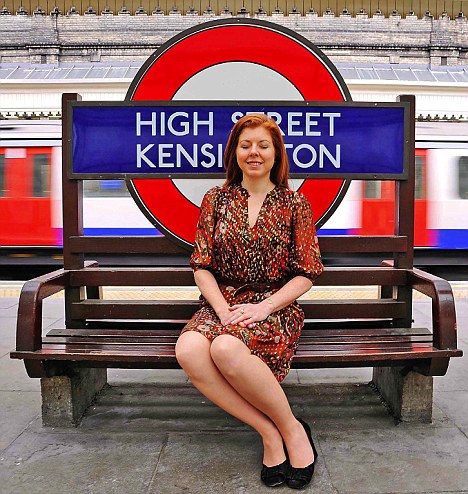
Down time: Marianne Power meditates as she waits for a Tube train in London

Soon I was meditating twice a day, too, even learning to fit it into train journeys to work or sneaking a few quiet minutes in a bathroom cubicle at the office.

Before I bumped into my colleague I was running on empty. By day I was stressed by silly things that made me snap at people.

By night I would try to unwind with too many hours of television and too many glasses of wine before lying awake in bed stewing over all my worries.

I was run-down, got every cold going and at my very lowest points was prescribed antidepressants. My friend recommended Transcendental Meditation, which is different from other forms of meditation.

Instead of focusing on your breathing, you are given a Sanskrit word, known as a mantra, that you repeat in your head. The idea is that the repetition of the sound calms your mind.

The practice was made famous by The Beatles, who became devotees after meeting its founder, Maharishi Mahesh Yogi, in the Sixties. Since then everyone from Clint Eastwood to William Hague and Nick Clegg has become a fan.

Latest research from Oxford University’s Department of Psychiatry has shown that meditation brings about neurological changes. After  a few months of meditation, the parts of the brain with a tendency to worry are switched off.

Clinical trials have proved that as a standalone treatment it can  prevent relapse of depression and is effective alongside medication.

But I was most interested in its effects in counteracting stress. And I can say that learning to meditate has changed my life.

At my first lesson I was given my mantra, which you don’t share with anyone, and told to close my eyes and repeat it again and again in my head. Straight away I was hooked.

There’s something about the sound vibration of the mantra going over and over in your mind that lulls you into a kind of trance. The repetition of the sound is like a lullaby.

You go into your own world and yet you are still aware of your surroundings. You’re neither awake, nor asleep, nor dreaming – just beautifully relaxed. It’s like a warm bath for your brain.

After that first lesson, I felt calm and focused and that night I enjoyed a longer, deeper sleep than I’ve had since I was a child. And I’ve been sleeping well ever since.

The more I meditate, the less I seem to be bothered by things. Situations that would once have sent me into a tailspin no longer have the same effect.

My heart doesn’t race in the way it once did; I have become more calm and rational; my concentration at work has also improved.

I think this is primarily because I am better rested and less stressed, but scans have shown that meditation actually increases the size of your hippocampus – the part of the brain associated with memory and learning. I also feel healthier.

I have had only one cold in the past seven months. And then there are the less tangible changes, the ones to your personality and relationships.

Friends have commented on the fact that I seem more relaxed. I  certainly feel more content, less inclined to snap or overreact.

So is this a miracle? Am I now the perfect person? Hardly. Like most of the good things in life, it takes work. Like going to the gym or eating well, you have to keep doing it even on days when you tell yourself you are too busy.

I meditate for 20 minutes morning and night. After breakfast, and then at 4pm – and on days when that’s not possible, on the train or in a taxi. Every little helps. It doesn’t matter whether I close my eyes for two minutes or 20, when I open them I feel better.

I have yet to experience the so-called ‘bliss’ that devotees talk about but I’m just so happy that I’ve found a tool that helps me perform well in the day and sleep better at night.

I wish I’d been taught this at school – it’s the best life skill I’ve ever learnt. But it’s not cheap.

When I turned up for the first open evening at my local TM centre (they’re all over the country), I was told that fees were charged according to income. I would have to  pay £490.

But I did it – and it was the best money I’ve ever spent.

uk.tm.org

Published by Associated Newspapers Ltd, part of the Daily Mail, The Mail on Sunday & Metro Media Group. Also published in Independent Online: The 8.15 train to Nirvana.

Here is a related article, The Power of Transcendental Meditation, by Julie Eagleton, another British journalist who also learned to meditate and wrote about it. Julie has covered arts & culture, fashion, food, health & beauty and travel. Find out more at http://www.julieeagleton.com.

Also see this article by Julie: Meditation Creativity Peace: A Documentary of David Lynch’s 16 Country Tour.