Posts Tagged ‘Maharishi Mahesh Yogi’

SIERRA: AMERICA’S COOLEST SCHOOLS: Maharishi University of Management

August 22, 2011

The Nonconformist Class | AMERICA’S COOLEST SCHOOLS

Going green may finally be “normal,” but some schools with eco-agendas remain miles from mainstream

By Tim McDonnell

Maharishi University of Management

Courtesy of Shane Ernest

The Beatles’ onetime spiritual adviser, the late Maharishi Mahesh Yogi (sometimes called the “giggling guru”), founded Maharishi University of Management, in Fairfield, Iowa, as a place for “consciousness-based education.” The school’s buildings face east and have a central nucleus, and rooms are aligned with the sun’s movement according to the strictures of an ancient Indian architectural style. The first U.S. university to offer a four-year degree in sustainable living, MUM balances modern clean technology and 5,000-year-old Vedic philosophy based on Sanskrit texts.

The dining hall serves food that’s entirely vegetarian and organic. To graduate, each student is required to have maintained a plot on the campus’s farm. Above, students celebrate the completion of their permaculture class with a feast made of ingredients harvested from their gardens.

Attending to the earth is hardwired into the school’s signature (and trademarked!) practice, Transcendental Meditation. From it, says Robbie Gongwer, the program developer for MUM’s Sustainable Living Center, “students get this subjective experience of an interconnectedness to life.”

DETAILS: critical eye: Meditation Nation

August 14, 2011

Meditation Nation

Power brokers no longer motivate or medicate—they meditate. How Transcendental Meditation returned as the new status symbol.

Photograph by Adam Voorhes
September 2011 Issue

A funny thing happened on the way to enlightenment. The quest got stripped of yogic posturing, Buddhist trappings, and even the last vestige of spirituality and turned into a search for the kind of clarity that might help us all in our worldly pursuits. Which is why movers and shakers are again embracing that seventies mainstay Transcendental Meditation. You’re likely to hear it spoken of reverentially in interviews: Russell Brand, whose wildman behavior was cartoonish in its intensity, credits TM with helping him to conquer his heroin, sex, and alcohol addictions. “After meditation,” he has said, “I felt this beautiful serenity and selfless connection.” And where celebrities venture (the latest wave of TM-ers includes the likes of Hugh Jackman and Naomi Watts), many of us are likely to follow. The rolls of practitioners have tripled in the past three years, according to the Transcendental Meditation Program, the practice’s national organization.

“The game-changer, I think, is David Lynch and his foundation,” says Dr. Norman E. Rosenthal, the Georgetown University psychiatry professor who wrote the recent best seller Transcendence: Healing and Transformation Through Transcendental Meditation. Lynch, the surrealist director of Twin Peaks, Blue Velvet, and Mulholland Dr., had been quietly practicing TM since, yes, the seventies, but about six years ago he came out of the closet, launching a foundation to promote the practice and later publishing a manifesto, Catching the Big Fish: Meditation, Consciousness, and Creativity.

It’s a process perfectly matched to our self-interested times—”no pain, but a lot of gain,” according to Rosenthal. Bob Roth, an executive director of the David Lynch Foundation, who taught TM to Brand and Moby, explains that when the mind has been calmed with the help of a mantra, a Sanskrit word given to each TM grad, it will effortlessly sink below the level of thought to “pure consciousness.” Practically speaking, sit in a chair, close your eyes, and silently repeat the mantra for 20 minutes. Once you get the hang of it, Lynch says, you cut the elevator cables of your normal-thinking mind to descend to a place that feels different. You may experience a connection with the universe or a mental light show, what Rosenthal calls “four-star graphic effects.” At the very least, you should be blissfully relaxed, which is the foundation of the health benefits that have been measured in the medical research amassed, much of it funded by the government. The deep tranquillity TM promotes quiets the body’s “fight or flight” stress response, lowering blood pressure and anxiety and combating depression.

Maharishi Mahesh Yogi, the so-called giggling guru, who hosted the Beatles and Mia Farrow, among others, was the innovator who stripped Hindu meditation practice of its religious baggage and repackaged it as a systematic, stress-reducing, creativity-building technique. Lynch, a disciple, is responsible for adding a fresh civic-mindedness to the game. His foundation aims to bring TM free of charge to those most in need of its calming effects—at-risk kids, prison inmates, veterans suffering from post-traumatic stress. That, of course, means fund-raising benefits, which means reeling in rich folk and entertainers (many introduced to TM by Lynch and Roth), all of which attracts media coverage and an increased brand awareness among those in the general public who might be willing to shell out $1,500 for the basic course.

“It was straight out of The Great Gatsby,” Rosenthal says of the poolside benefit party thrown this past June at the Malibu home of Juicy Couture cofounder Pam Levy and her TV-director husband, Jefery Levy. One imagines the vibes spreading to their neighbor Ryan Kavanaugh, CEO of Relativity Media, the freshly minted Converse-wearing, 36-year-old movie mogul who practices TM twice a day. Kavanaugh, who started out as a stockbroker, has leveraged his connections by allying with the New York hedge fund Elliot Associates, among other investors, giving his company the billions required to dominate Hollywood film production. But his secret weapon is his risk-assessment algorithm, a high-tech quantitative analysis of the big picture that he says allows him to make money even on box-office dogs.

As the New York hard-chargers who flock to the TM courses Roth teaches at the Center for Leadership Performance soon learn, this kind of success is not coincidental. According to published research, TM enhances neural activity in the part of the brain that houses the decision-making “executive center.” “The businesspeople say they’re more focused during the day,” Roth says. As do the other Gotham heavy hitters who’ve evangelized for TM and the Lynch Foundation, from Jerry Seinfeld and Heather Graham to Ben Foster and Howard Stern. Leave it to Mr. Katy Perry himself, speaking at a gala fund-raiser at the Metropolitan Museum of Art this past winter, to get at the essence of TM’s guilt-free marriage of creativity and commerce: “I literally had an idea drop into my brain the other day while I was meditating which I think is worth millions of dollars.”

Also on Details.com
Celebrity Om-Meter: The Top 10 Moments in Meditation History
Retreat, Relax, Recharge: Inside the World’s Best Spas
How to Avoid the Office Strain
Guy-Friendly Alternatives to Yoga

Prop Styling by Robin Finlay

A Transcendental Cure for Post-Traumatic Stress by David Lynch and Norman E. Rosenthal

July 13, 2011
THE WALL STREET JOURNAL OPINION JULY 13, 2011
A Transcendental Cure for Post-Traumatic Stress
One study of soldiers showed a 50% reduction in symptoms after eight weeks of meditation.

By DAVID LYNCH and NORMAN E. ROSENTHAL

War wounds come in many forms. Some are obvious, such as scars, gashes and amputations. Others, the psychological ones, are less visible but equally devastating. The numbers in this second group are staggering: The military’s latest mental health survey of combat troops in Afghanistan found that 20%—one in five—suffer from post-traumatic stress disorder.

People with combat-related PTSD often suffer from periods of emotional numbness and depression that may coexist or alternate with intense anxiety and delusional thinking. Their days may be afflicted by flashbacks to traumatic situations. Their nights are often disrupted by sleeplessness and nightmares, from which they awake drenched in sweat as though back on the battlefield.

Yet most veterans with PTSD do not receive adequate treatment for various reasons, including fear of stigma, a dearth of effective treatments, and insufficient government resources. Gen. Peter Chiarelli, vice chief of staff of the U.S. Army, recently acknowledged that, “The therapies used for treatment of brain injuries lag behind the advanced medical science employed for treating mechanical injuries.”

Clearly, there is a need for new, creative approaches: Transcendental Meditation, better known as TM, is a promising candidate. An ancient Vedic technique developed in India, TM was brought to the West in the late 1950s by Maharishi Mahesh Yogi. It involves sitting comfortably with eyes closed for 20 minutes twice a day while thinking a mantra. It does not require adherence to any religious belief system or ritual practices. Yet to date there are over 340 peer-reviewed papers describing the beneficial effects of TM on the mind and body.

lynch

The David Lynch Foundation recently hosted an event to help raise funds to teach TM to our wounded warriors returning home from Iraq and Afghanistan. We heard from veterans of three wars: Jerry Yellin, a fighter pilot in World War II who flew 19 missions over Japan; Dan Burks, who served in Vietnam; and David George, a veteran of Operation Iraqi Freedom. Despite differences in age and wartime experiences, these men had two things in common: All suffered terribly from PTSD, and all experienced tremendous relief from TM. Life became once again peaceful and even joyful for them.

What was clear from these men’s stories was how great a toll their symptoms took on their families, as well as on themselves. In a poignant video, Mr. George’s mother described the transformation of her son from a courteous young man into a hard-drinking, depressed and deeply disturbed veteran, who she feared would take his own life or someone else’s.

All that changed when Mr. George began to meditate on a regular basis. According to Ms. George, TM saved her son’s life.

In a study of Vietnam vets conducted by James S. Brooks and Thomas Scarano and published in the Journal of Counseling and Development in November 1985, TM outperformed the conventional psychotherapy of the day. More recently, a pilot study of five Iraq and Afghanistan veterans published in the June 2011 issue of Military Medicine showed a 50% reduction in PTSD symptoms after just eight weeks of practicing TM.

There is a scientific basis for the observed benefits of TM for combat-related PTSD. In several studies, TM has been shown to buffer fight-or-flight responses, which are thought to be overactive in people with PTSD, as evidenced by their hypervigilance, anxiety and exaggerated startle responses.

In addition, TM has been found to reduce blood pressure and decrease the risk of heart attacks and strokes—other conditions in which an overactive fight-or-flight response may play a role. In a similar manner, TM may modulate nervous system responses, thereby allowing affected veterans to relax and leave behind the traumas of war.

Regardless of how TM helps, the mounting evidence leads to one conclusion: If a simple, low-cost technique like TM can substantially alleviate the suffering of even some of the thousands of veterans afflicted with PTSD, how can we afford not to give it a try?

Mr. Lynch is a filmmaker and the founder of the David Lynch Foundation. Dr. Rosenthal is a clinical professor of psychiatry at Georgetown University Medical School and the author of “Transcendence: Healing and Transformation Through Transcendental Meditation” (Tarcher-Penguin, 2011).

Photo credit: Associated Press
Link to article: http://on.wsj.com/rg8tYC

WSJ: LETTERS: VA Meditating on Good Therapies, July 22, 2011

In “A Transcendental Cure for Post-Traumatic Stress” (op-ed, July 13) David Lynch and Norman E. Rosenthal pose a challenge for the federal agency entrusted with caring for our nation’s 23 million veterans: “If a simple, low-cost technique like TM can substantially alleviate the suffering of even some of the thousands of veterans afflicted with PTSD, how can we afford not to give it a try?” In fact, Transcendental Meditation has received substantial attention at the Department of Veterans Affairs, the Department of Defense and the National Institutes of Health. Indeed, meditation and other forms of complementary and alternative medicine are already used at VA to help veterans suffering from PTSD. We have embarked on a series of clinical investigations to evaluate all forms of meditation, TM among them, in order to determine whether this promising technique can produce results consistently for our patients, and which kind of meditation, from among several practiced widely today, would be most helpful to them. VA is beginning demonstration projects across the country in different care settings. We are looking for a simple, natural, culturally neutral and repeatable technique that can augment existing PTSD treatments. These studies require us to be open to new techniques for prevention and treatment, as well as structured in our approach to determining their value and efficacy. The studies already conducted, and those currently underway, are listed at http://tinyurl.com/3gx74o3.

The promising personal experiences mentioned in the article and the dedicated efforts of our VA, DoD and NIH team offer us all hope for finding more effective treatments for PTSD. We can’t afford not to.

W. Scott Gould

Deputy Secretary

DVA

Robert A. Petzel, M.D.

Under Secretary for Health

DVA

Washington

The Independent: Transcendental Meditation: Were the hippies right all along?

July 10, 2011


Transcendental Meditation: Were the hippies right all along?

For years, it has been ridiculed as a 1960s embarrassment. Now Transcendental Meditation is back in a big way. So were those hippies on to something all along?

By Laura Tennant
Sunday, 10 July 2011

Remember M-People’s 1995 Top 10 hit instructing you to “search for the hero inside yourself”? A decade-and-a-half on, it seems that things have changed – these days, it’s not so much a hero as a guru that many of us are hoping to internalise. For strange as it may sound, among those of us who seek to surf the zeitgeist, the most fashionable thinker of 2011 may turn out to be Maharishi Mahesh Yogi, the founder of the Transcendental Meditation movement – and the fact that he passed to a better place in 2008 doesn’t appear to have discouraged us one bit.

TM, as its followers call it, is rapidly moving from kooky margin to respectable mainstream thanks largely to a burgeoning body of scientific research which indicates that regular meditators can expect to enjoy striking reductions in heart attack, stroke and early mortality (as much as 47 per cent, according to one study). And the apparent benefits don’t stop there: according k to a pilot study just published in the US journal Military Medicine, veterans of the Iraq and Afghanistan wars showed a 50 per cent reduction in their symptoms of post-traumatic stress disorder after eight weeks of TM.

Meanwhile, educational establishments which introduce a “quiet time programme” – as did Visitacion Valley Middle School in San Francisco – report drops in fights and suspensions, increased attendance and improvements in exam results. In this country, the Maharishi School in Ormskirk, Lancashire, gets glowing reports from Ofsted and achieves exceptional academic results.

An estimated four million people now practise TM globally – 20 minutes twice daily, as per the Maharishi’s prescription – many of them over the course of many decades, and there are some famous, and rather surprising, names on the list. Clint Eastwood, for example, has been doing it for 40 years, a fact he vouchsafed via video link at a fund-raising dinner for the David Lynch Foundation, an organisation set up by the film-maker to teach TM to school children, soldiers suffering post-traumatic stress, the homeless and convicted prisoners. Other celebrity adherents include Paul McCartney, Russell Brand, Martin Scorsese, Ringo Starr, Mary Tyler Moore, Laura Dern and Moby.

TM reaches far into the rational and sceptical world, too; the American philosopher Daniel Dennett does it, as does Dr Jonathan Rowson, head of the Social Brain project at the Royal Society for the Encouragement of Arts, Manufactures and Commerce (RSA) and a chess grandmaster (more from them later). Now a psychiatrist with 30 years’ clinical experience, Dr Norman Rosenthal has written a book, Transcendence: Healing and Transformation through Transcendental Meditation, which gathers all the available evidence for TM and urges healthcare professionals to offer it to patients suffering from mental illnesses ranging from mild depression to bipolar disorder.

While the research on the health benefits of TM is fascinating, there’s another, more compelling, reason why meditation is in the air just now. Done consistently, it seems to offer some sort of corrective to modernity, a respite from anxiety and the ability to really, truly relax, without chemical assistance; a break from our constant, restless and often doomed aspirations to be thinner, richer and more popular on Facebook; the welcome discovery that happiness is to be found not in retail therapy, but within.

Those spiritual cravings explain why Rosenthal’s book is now riding high at number 14 on America’s Publishers Weekly non-fiction list. And according to TM UK’s official representative, David Hughes, there’s a similar surge of interest on this side of the Atlantic; figures are vague, but he reports that “there’s definitely an ongoing increase month by month” to the estimated 200,000 people who have learnt TM in the UK since 1960.

I first began to ponder the notion of meditation while writing a piece on solitude. While aloneness might not be a state that comes naturally to most humans, without it, mental-health experts believe, it is impossible to be creative or even really to know oneself. It was the sheerest coincidence that on the day I contacted TM’s UK website they were preparing for Dr Rosenthal’s press conference.

Click on this link to read the rest of the article: http://t.co/795LCEz.

According to David Hughes, TM is a not-for-profit, charitable and educational foundation which, once it has paid its teachers and covered its costs, ploughs its revenue back into outreach programmes in the developing world. It is certainly not shy about proselytising; but if its impact on public health is as great as Dr Rosenthal believes, one could argue it has a moral responsibility to spread its message. As for me, I’m seriously considering introducing my children to a stress- and anxiety-busting daily ritual that seems to do no harm and may well do a great deal of good.

For more information on the movement, visit t-m.org.uk

©independent.co.uk

A nicely edited version of this article was posted Tues Jul 12, 2011 in the Times of Oman: In search of a quiet time.

The New York Times: Look Who’s Meditating Now

March 19, 2011

Look Who’s Meditating Now

Evan Sung for The New York Times
POSTER BOY Russell Brand with David Lynch at the December Met fundraiser for Mr. Lynch’s foundation, which promotes Transcendental Meditation.

By IRINA ALEKSANDER
Published: March 18, 2011

RUSSELL BRAND, the lanky British comedian, has made a career of his outrageous antics. While a host at MTV UK, he went to work dressed up as Osama bin Laden. At the network’s annual music awards, he likened Britney Spears to a “female Christ.” And he was fired from the BBC after leaving raunchy messages on the voicemail of a 78-year-old actor, a comic bit that even his country’s then-prime minister felt compelled to denounce.

It is jarring then, to say the least, to hear Mr. Brand, 35, speaking passionately and sincerely about the emotional solace he has found in Transcendental Meditation, or TM. Yet there he was in December, onstage at the Metropolitan Museum of Art (as his new wife, the pop singer Katy Perry, waited backstage), describing how TM has helped him repair his psychic wounds.

“Transcendental Meditation has been incredibly valuable to me both in my recovery as a drug addict and in my personal life, my marriage, my professional life,” Mr. Brand said of the technique that prescribes two 15- to 20-minute sessions a day of silently repeating a one-to-three syllable mantra, so that practitioners can access a state of what is known as transcendental consciousness. “I literally had an idea drop into my brain the other day while I was meditating which I think is worth millions of dollars.”

Mr. Brand was the M.C. at a benefit for the David Lynch Foundation, an organization that offers TM at no cost to troubled students, veterans, homeless people, prisoners and others. Like many other guests in the room, Mr. Brand has been personally counseled by Mr. Lynch, the enigmatic film director, who has been a devout practitioner of TM, founded in 1958 by the spiritual leader Maharishi Mahesh Yogi, since its first wave of popularity in the late ’60s. That is when Mia Farrow, after her divorce from Frank Sinatra, joined the Beatles in the Maharishi’s ashram in Rishikesh, India; when George Lucas started meditating and was rumored to have based the Yoda character in “Star Wars” on the Maharishi (the resemblance is eerie); and when the talk show host Merv Griffin, after being introduced to the technique by his tennis buddy, the actor Clint Eastwood, invited the Maharishi to be on his show in 1975.

Since then, the celebrity endorsement, and therefore the enrollment numbers, had quieted down. That is, until the last three years when, according to the national Transcendental Meditation program, enrollment tripled.

At Trinity College in Hartford, the women’s squash league began meditating together after every practice last year. The Doe Fund, an organization that assists the homeless, has begun offering TM to its residents along with computer skills and job training. And Ray Dalio, the billionaire hedge-fund manager of Bridgewater, has long credited the success of his funds to his daily practice.

The Transcendental Meditation program attributes the spike to a series of recent studies that suggest TM can help reduce blood pressure and stress, and to the relatively recent affordability of TM. (The adult course, which had ballooned from $75 in the ’60s to $2,500 in 2007, dropped, because of the economy, to $1,500 in 2008.) No less important has been Mr. Lynch’s foundation, started in 2005, for which enlisted celebrities like Mr. Brand, interrogated often by news outlets about their diets and alternative lifestyle remedies, have been preaching about the technique.

“It’s like, imagine the ripples on top of an ocean,” Dr. Mehmet Oz, who meditates in an armchair in an enclave off his bedroom, said at Mr. Lynch’s benefit. “And I’m in a rowboat, reactively dealing with the waves and water coming into my boat. What I need to do is dive into the deeper solace, the calmness beneath the surface.”

The actress Susan Sarandon meditates once a day for 20 minutes in bed. “It helps me chill out and focus,” she said. (Ms. Sarandon said she doesn’t practice TM specifically, but was at the benefit to gather insight.)

The singer Moby, another guest, has meditated in the back of a taxicab. “Transcendental Meditation has given me a perspective on agitation,” he said. “That it’s a temporary state of mind and I don’t necessarily need to take it that seriously.” Moby said the technique helped him quit drinking more than a year ago. “I used to think that TM was for weird old hippies,” he added. “But then I heard that David Lynch was involved, and that made me curious.”

ON the afternoon before the benefit, Mr. Lynch, 65, arrived at the museum, holding hands with his wife, Emily Lynch, 32, and was escorted by a museum employee to a green room downstairs. Mr. Lynch, like a cartoon character, has maintained the same uniform for decades: a pressed white shirt under a boxy black suit and a hedge of gray hair. He scooped up a soggy egg-salad sandwich from a tray and explained what brought him to the practice.

“I was not into meditation one bit,” Mr. Lynch said, in his laconic Missoula, Mont., drawl that years of living in Los Angeles has failed to dilute. “I thought it was a fad. I thought you had to eat nuts and raisins, and I didn’t want any part of it.”

Mr. Lynch was persuaded by his sister, Martha, when he began having marital difficulties with the first of his four wives, Peggy, in the early ’70s. “I had a whole bunch of personal anger that I would take out on her,” he said. “I think I was a weak person. I wasn’t self-assured. I was not a happy camper inside. Two weeks after I started, my wife comes to me and says, ‘This anger, where did it go?’ I felt a freedom and happiness growing inside. It was like — poooft! — I felt a kind of smile from Mother Nature. The world looked better and better. It’s an ocean of unbounded love within us, so it’s real hard to get a conflict going.” (Still, a year later, the couple divorced.)

It’s easy to shrug off such utterances as hokey, New Age prattle — who can forget Jeff Goldblum’s flaky character in “Annie Hall” on the phone, complaining that he’d forgotten his mantra? — but less so when the person reciting it has dreamed up his most widely admired, vivid films on the days when he was dropping out of consciousness for at least 30 minutes a day.

“Artists like to say, ‘I like a little bit of suffering and anger,’ ” he said. “But if you had a splitting headache, diarrhea and vomiting, how much would you enjoy the work and how much work would you get done? Maybe suffering is a romantic idea to get girls, but it’s an enemy to creativity.”

A version of this article appeared in print on March 20, 2011, on page ST1 of the New York edition. It was also published Saturday, March 26, 2011, in the TheLedger.com: Transcendental Meditation: Celebrities, Recent Biological Studies Increase Interest in Discipline

‘Vedanta and yoga perfect match for certain American values’

January 31, 2011

‘Vedanta and yoga perfect match for certain American values’
2011-01-09 10:10:00

Chicago, Jan 9 (IANS) There has always been a pervasive but undocumented feeling that Indian philosophy, as manifest in Vedanta on the intellectual plain and yoga on the physical plain, has very significantly influenced the West in general and America in particular. That feeling now finds a meticulously constructed scholastic endorsement in the form of an important new book.

Author Philip Goldberg’s ‘American Veda – From Emerson to the Beatles to Yoga and Meditation, How Indian Spirituality Changed the West‘ (Harmony Books, 398 pages, $26) offers a comprehensive account of the inroads made by Indian philosophy since the early 19th century.

‘The combination of Vedanta and Yoga was a perfect match for certain American values: freedom of choice and religion, individuality, scientific rationality, and pragmatism.  They appealed especially to well-educated Americans who were discontent with ordinary religion and unsatisfied by secularism, giving them a way to be authentically spiritual without compromising their sense of reason, their consciences or their personal inclinations,’ Goldberg told IANS in an interview.

He said Indian teachers who came to the US were conscious of the openness of American society and they adapted the teachings accordingly.

Explaining the mainstreaming of Indian philosophy in the US, Goldberg said, ‘I think the remarkable growth of the ‘spiritual but not religious’ cohort of Americans would have been unthinkable without access to the practices derived from Hinduism and Buddhism.  In addition, the philosophy was presented so rationally that its premises could be regarded as hypotheses, and the practices were so uniform and so widely applicable that they lent themselves to scientific experimentation.’

The book begins with a claim that is deliberately designed to be an attention grabber. ‘In February 1968 the Beatles went to India for an extended stay with their new guru, Maharishi Mahesh Yogi. It may have been the most momentous spiritual retreat since Jesus spent those 40 days in the wilderness. The media frenzy over the Fab Four made known to the sleek, sophisticated West that meek, mysterious India had something of value. Our understanding and practice of spirituality would never be the same,’ Goldberg writes.

He points out that translated Hindu texts were very much a part of the libraries of John Adams, the second president of the United States and one of its most respected statesmen and political theorists, and Ralph Waldo Emerson, an eminent poet and essayist who led the transcendentalist movement in the mid-19th century. From there those ideas permeated to author and philosopher Henry David Thoreau and poet Walt Whitman among others.

In recounting Thoreau’s perspective about the Bhagavad Gita, Goldberg refers to a much quoted passage from the book Walden. Thoreau writes, ‘In the morning I bathe my intellect in the stupendous and cosmogonal philosophy of the Bhagavad Gita, since whose composition years of the gods have elapsed, and in comparison with which our modern world and its literature seems puny and trivial.’

The book has two distinct trends in support of the author’s primary contention about how Indian spirituality changed the West. One trend is at the operational level where words such as mantra, guru, karma and pundits have so seamlessly become part of the mainstream lexicon. The other trend is much deeper in terms of internalising the core values of Indian philosophy.  Asked if the people in the US are conscious of this, Goldberg said, ‘Some are conscious of it, and therefore grateful to the Indian legacy.  Others are not: it’s seeped into the American consciousness in subtle but profound ways.’

Goldberg also talks about the ‘Vedization of America’. On whether it can be attributed to the general secularisation/pluralisation significantly caused by the rise of agnostic information technologies, he said, ‘If you mean, could the trends I describe be attributed to the growth of pluralism and other social forces, independent of the Indian influence, it is very hard to say. Certainly, the combination of factors made for a perfect storm. I tend to think that the experiential practices of meditation and yoga, and the intellectual framework of Vedanta, accelerated, deepened and broadened what might have been an inevitable but amorphous evolution.’

On whether he apprehends any organized backlash or pushback against Indian philosophy, he said ‘Not a big one, but some of it is inevitable. There has always been a backlash from both mainstream religion – conservative Christians in particular – and the anti-religious left. Vivekananda faced up to it in 1893, and all the important gurus were confronted by it. Right now, there’s an anti-yoga campaign by some Christian preachers.  I’d be very pleased if my book becomes a lightning rod for such a controversy. Bring ’em on!’

On a movement in support of a ‘Christian yoga’ that may be gaining some ground Goldberg said, ‘That’s a more complicated issue than is often realised. The question, ‘Is yoga a form of Hinduism’ depends entirely on how one defines both yoga and Hinduism.  That there are people teaching Christian Yoga and Jewish Yoga strikes me as a backhanded compliment to one of the great glories of the Vedic tradition: its universality and adaptability. That having been said, the idea that yoga is ‘a Hindu tool,’ i.e., a form of stealth conversion, strikes me as a projection by Christians of their own messianic drive to convert the ‘heathen’. That conversion is not in the Hindu repertoire – and that the gurus and swamis and yoga masters are content to have their students become better Christians – is hard for many to comprehend.’

(Mayank Chhaya is a US-based writer and commentator. He can be contacted at m@mayankchhaya.net)

Huffington Post named American Veda one of the top ten religion books of 2010.

Listen to this KRUU FM interview with Cheryl Fusco Johnson on Writers’ Voices, Oct 12, 2012 http://www.kruufm.com/node/14325/node/14325.

UK: Meditation school to transfer to state sector

January 29, 2011

Education

Meditation school to transfer to state sector

By Richard Garner, Education Editor

Saturday, 29 January 2011

Britain is set to get its first state school dedicated to the values of transcendental meditation. A private school run by followers of the Maharishi Mahesh Yogi will transfer to the state sector in September.

The Maharishi School in Ormskirk, Lancashire, has been given the green light to be part of the first tranche of Education Secretary Michael Gove’s “free” schools.

Mr Gove announced yesterday that 35 “free school” applications had received the go-ahead. In all, 249 applications have been received by the Department for Education to join the scheme. Under the “free schools” policy, parents, teachers and charities can open schools – funded by the taxpayer.

Pupils at the Maharishi School – for four-to-16-year-olds – have three 10-minute every day. The school has smaller-than-average classes and just 80 pupils. It says meditation calms pupils, making it easier to learn, and claims it could double its numbers with state support. Head Derek Cassells said: “All scientific research shows transcendental meditation brings more balance to the brain… It helps with behaviour and improved relationships with other people.”

His school’s philosophy is that of the Maharishi, pictured, whose movement gained prominence in the 1960’s when The Beatles became converts.

Mr Gove said ministers hoped every new state school would be an academy or “free” school. He spoke ahead of a conference on “free” schools today when he will be accompanied by leaders of the Charter school movement in the United States – which is advising ministers on the “free” schools’ policy.

Charter schools do not recognise teacher unions, but Mr Gove said it would be up to individual school heads to decide if they do. US education experts said it was essential schools could “terminate” weak teachers.

Joel Klein, former chancellor of the New York City Department of Education, said that there must be “reasonable processes in place for terminating non-performing and under-performing teachers.”

What Rainer Maria Rilke inscribed on the copy of The Duino Elegies he gave his Polish translator

January 25, 2011

Inscription from Rilke about words and the essence of language. On the fifteenth of February, 1924, Rainer Maria Rilke inscribed these lines on the copy of The Duino Elegies he gave his Polish translator:

Happy are those who know:
Behind all words, the Unsayable stands;
And from that source alone,
the Infinite Crosses over to gladness, and us—

Free of our bridges,
Built with the stone of distinctions;
So that always, within each delight,
We gaze at what is purely single and joined.

Mentioned in Nine Gates: Entering the Mind of Poetry, Essays by Jane Hirshfield, page 56, in her chapter, The World is Large and Full of Noises: Thoughts on Translation (HarperCollins, 1997).

In this poem, Rilke is letting his translator know that he should just work with the spirit of the poem and not get hung up on translating it word for word, but to capture its essence in his own language.

There’s another message here: When we know the Infinite Unsayable Source of words, which is our own essential nature, it creates freedom from distinctions, like divisive judgments, self-imposed and on others, the fear of differences, and transforms us with the more harmonious unifying values of life. This is liberating and fulfilling. We begin to see things as they are, and enjoy their essence, enjoy our Self.

During our practice of the Transcendental Meditation technique, the mind effortlessly goes beyond words, to the source of thought; it transcends. The mind expands to its full dignity; it becomes saturated with bliss consciousness; and the body releases accumulated stresses; it becomes freer, more flexible. After meditation, our outlook is clearer, we’re happier, and naturally focus on the beautiful in everything and everyone. This brings us delight. It increases our capacity to love; we feel more at home in the world. TM founder Maharishi Mahesh Yogi reminds us that the world is as we are. The Talmud agrees: “We do not see things as they are, we see things as we are.” (Nine Gates, p. 119)

In closing, here is a multiple-haiku poem I wrote on the creative process, after hearing Maharishi discuss how the Infinite, wanting to know it’s own nature, collapses to a point, and then refers back to itself. This self-referral process continuously goes on within the unmanifest Infinite source—a singularity containing the togetherness of all possibilities. This self-interacting dynamics sequentially creates the primordial sounds of nature’s language, the Veda, which reverberate and manifest into the whole universe, the unity of all diversities, Nature’s poetry creating a universe. See Coalescing Poetry: Creating a Universe (in 7 haiku forms).

See a related poem mentioned in Nine Gates on this topic: Singing Image of Fire, a poem by Kukai, with thoughts on language, translation, and creation.

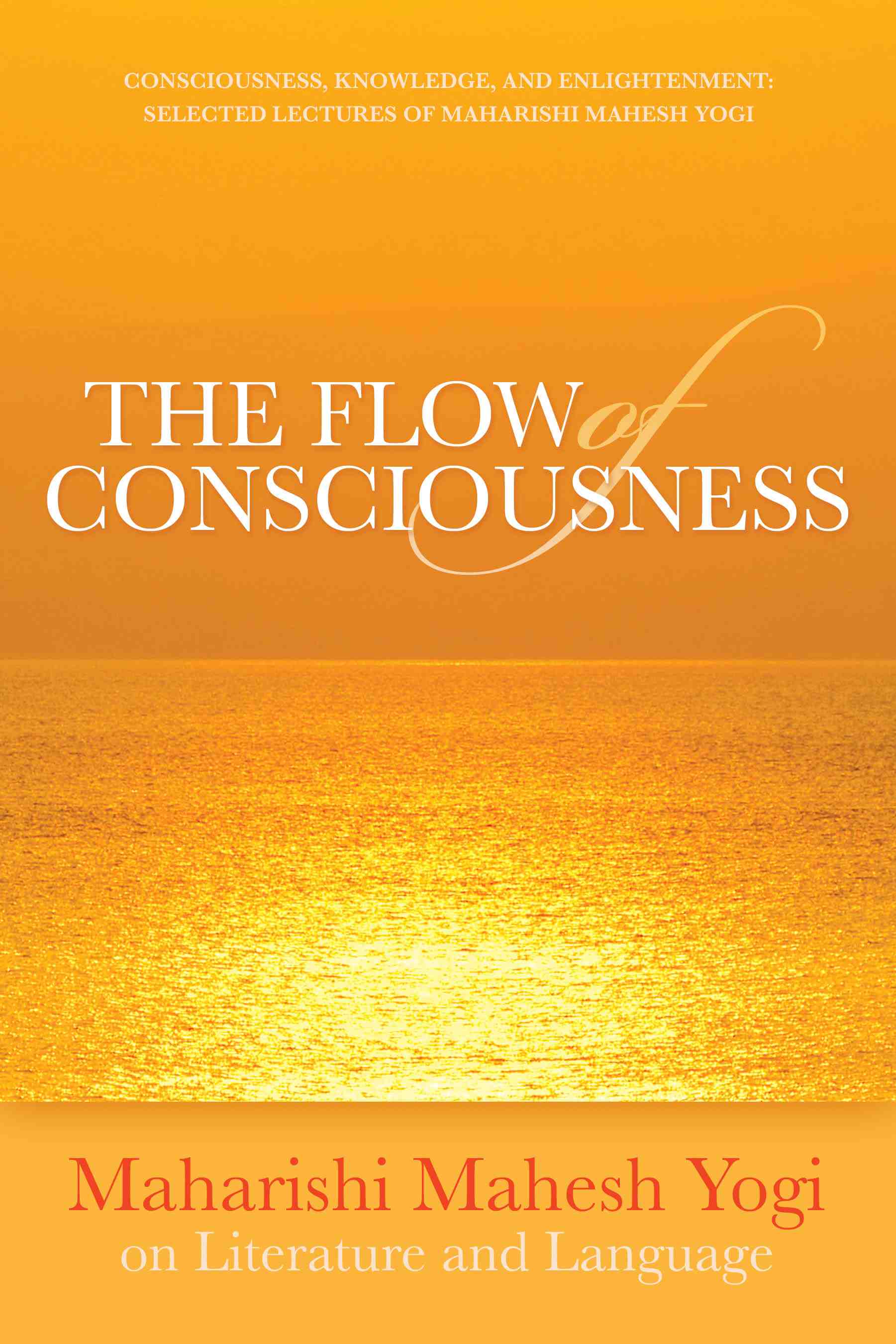
To learn more about the source of words, creation, both literal and literary, and their connection to consciousness, read: The Flow of Consciousness: Maharishi Mahesh Yogi on Literature and Language.

To learn more about Jane Hirshfield, read this wonderful interview: Pirene’s Fountain: Jane Hirshfield on Poetic Craft.

You may also enjoy reading Elizabeth Gilbert—Some Thoughts On Writing, Writers on Writing—What Writing Means To Writers, and one of my first poems, Writing—a poem on the writing process.

Rainer Maria Rilke’s poem, Buddha in Glory, reminds us of our eternal nature within. Another poem worth reading is Before He Makes Each One by Rainer Maria Rilke.

The Flow of Consciousness: Maharishi Mahesh Yogi on Literature and Language

November 3, 2010

THE FLOW OF CONSCIOUSNESS: Maharishi Mahesh Yogi on Literature and Language, 1971 to 1976, edited by Rhoda F. Orme-Johnson, Ph.D. and Susan K. Anderson, Ph.D.

For the first time, a selection of talks by Maharishi Mahesh Yogi, the founder of Maharishi University of Management, has been transcribed and published, with this volume on literature and language projected to be the first in a series publishing talks in many different disciplines. In response to MUM faculty talks on art, literature, government, education, and many other disciplines, Maharishi would give his profound insights into that discipline, a direction for research scholars, and a vision of how the study of consciousness would enrich and develop each area of academic inquiry and personal experience. A number of the talks were in response to presentations given at international symposia by leading scholars in their field, Nobel laureates, and such eminent professionals as R. Buckminster Fuller.

Over the years, Maharishi Mahesh Yogi recorded brilliant and inspiring lectures on the literary process, as well as critical theory and technique, emphasizing the relevance of the state of consciousness of both writer and reader. He explained how only from an expanded basis can the writer spontaneously experience and express refined emotions and ideas and only from such a basis can the reader hope to understand and enjoy such writings. Literature itself can be a means to evolve one’s consciousness through sounds, rhythms, and meanings, swinging the reader’s attention from concrete to abstract, purifying consciousness and producing bliss. A fully developed consciousness can express the ocean in a drop, and from that drop flows a river of meaning, power, and enjoyment.

Immersing oneself in the transcripts of Maharishi’s lectures allows readers to feel his presence, to hear his voice, his rhythms of speech, his humor, and to appreciate his skill as a teacher. His exposition of the power of poetry, particularly the poetry of the Veda, gives the reader a taste of his intellect and his profound understanding of language and literature. It is a journey through a great mind and an exploration of a topic familiar and beloved by all.

This volume is a valuable resource to teachers, students, and all readers of literature, to all those interested in higher human development and the literary process.

The 350-page book includes 14 talks given in the years 1971–76 and is available at Maharishi International  University Press.

The Review wrote an informative article, the first of six, in issue Vol. 26, #4, November 3, 2010, announcing the publication: First-Ever Book of Maharishi’s Lectures Explores Literature and Language.

MIU Press later offered The Flow of Consciousness with The Unmanifest Canvas as a discounted Art Book Combo.

Dean of Faculty Cathy Gorini spoke with Dr. Rhoda Orme-Johnson, the first interview in a new series on KHOE titled, “A Chat With The Dean.” This discussion focused on Dr. Orme-Johnson’s new book, “The Flow Of Consciousness,” transcripts of Maharishi Mahesh Yogi’s lectures. Drs. Gorini and Orme-Johnson settle into a warm discourse on the significance of Maharishi’s lectures, in particular, the field of literature. Recorded Oct 26, 2010. (mp3 47 mins, 16 MB)

(more…)

Radical Peace: People Refusing War, by William T. Hathaway

June 10, 2010

Radical Peace: People Refusing War

World peace depends on our collective consciousness. – William T. Hathaway

William T. Hathaway’s latest literary work, is a return to journalism. Radical Peace: People Refusing War, presents the first-person experiences of war resisters, deserters, and peace activists in the USA, Europe, Iraq, and Afghanistan. Just released by Trine Day, it’s a journey along diverse paths of nonviolence, the true stories of people working for peace in unconventional ways. The first, Chapter 1: The Real War Heroes, and last, Chapter 15: Conscious Peace, are both posted on OpEdNews.com.

William T. Hathaway is a political journalist and a former Special Forces soldier turned peace activist whose articles have appeared in more than 40 publications, including Humanist, the Los Angeles Times, Midstream Magazine, and Synthesis/Regeneration. He won a Fullbright grant to teach at universities in Germany, where he continues to reside. He is an adjunct professor of American studies at the University of Oldenburg. William and his wife also run a small TM center there.

Hathaway is the author of A World of Hurt (Rinehart Foundation Award), CD-Ring, and Summer Snow. He is currently working on WELLSPRINGS: A Fable of Consciousness, which focuses on applying Vedic knowledge to ecology. A selection of his writing is available at www.peacewriter.org.

William also spent 7 years, from 1987-1993, as an assistant professor in the Master’s in Professional Writing at MIU, now MUM. The last chapter of Radical Peace, Conscious Peace, discusses his TM practice, and the vision of possibilities it holds for world peace. You can click on the Chapter 15 link above or read it here:

I was sitting in full lotus, body wrapped in a blanket, mind rapt in deep stillness, breathing lightly, wisps of air curling into the infinite space behind my closed eyes. My mantra had gone beyond sound to become a pulse of light in an emptiness that contained everything.

An electric shock flashed down my spine and through my body. My head snapped back, limbs jerked, a cry burst from my throat. Every muscle in my body contracted — neck rigid, jaws clenched, forehead tight. Bolts of pain shot through me in all directions, then drew together in my chest. Heart attack! I thought. I managed to lie down, then noticed I wasn’t breathing — maybe I was already dead. I groaned and gulped a huge breath, which stirred a whirl of thoughts and images.

Vietnam again: Rotor wind from a hovering helicopter flails the water of a rice paddy while farmers run frantically for cover. Points of fire spark out from a bamboo grove to become dopplered whines past my ears. A plane dives on the grove to release a bomb which tumbles end over end and bursts into an orange globe of napalm. A man in my arms shakes in spasms as his chest gushes blood.

I held my head and tried to force the images out, but the montage of scenes flowed on, needing release. I could only lie there under a torrent of grief, regret, terror, and guilt. My chest felt like it was caving in under the pressure. I clung to my mantra like a lifeline to sanity. I was breathing in short, shallow gasps, but gradually my breath slowed and deepened, the feelings became less gripping, and I reoriented back into the here and now: my small room in Spain on a Transcendental Meditation teacher training course.

I lay on my narrow bed stunned by this flashback from four years ago when I’d been a Green Beret in Vietnam. I had thought I’d left all that behind, but here it was again.

I sat up and was able to do some yoga exercises but couldn’t meditate. Instead I took a walk on the beach. For the rest of that day and the next I was confused and irritable and could hardly meditate or sleep. But the following day I felt lightened and relieved, purged of a load of trauma, and my meditations were clear. My anxiety about the war was much less; the violence was in the past, not raging right now in my head.

Gradually I became aware of a delicate joy permeating not just me but also my surroundings. I knew somehow it had always been there, inhering deep in everything, but my stress had been blocking my perception of it. I felt closer to the other people on the course, connected by a shared consciousness. Then I started feeling closer to everything around me; birds and grass, even rocks and water were basically the same as me. Our surface separations were an illusion; essentially we were all one consciousness expressing itself in different forms. Rather than being just an isolated individual, I knew I was united with the universe, joined in a field of felicity. This perception faded after a few days, but it gave me a glimpse of what enlightenment must be like.

The whole experience was a dramatic example of what Maharishi Mahesh Yogi called “unstressing,” the nervous system’s purging itself of blockages caused by our past actions. Since my past actions had been extreme, the healing process was also extreme.

I had begun meditating in 1968, several months after returning from the war. I’d come back laden with fear and anger, but I had denied those emotions, burying them under an “I’m all right, Jack,” attitude. I was tough, I could take it, I was a survivor. Within certain parameters I could function well, but when my superficial control broke down, I would fall into self-destructive depressions. I finally had to admit I was carrying a huge burden of stress, and I knew I had to get rid of that before I could live at peace with myself or anyone else.

(more…)