Posts Tagged ‘David Lynch’

Transcendental Meditation @TMmeditation article in @THR on @DAVID_LYNCH

January 11, 2014

Here is an excellent article about Transcendental Meditation published in the latest issue of The Hollywood Reporter, part of a Health series on how stress effects celebrities and what they do to relieve it. This one is on David Lynch. Click on the title to see the original article with photos.

How David Lynch and His Hollywood Friends Are Bringing Back Transcendental Meditation

One of film’s darkest directors, with help from Jerry Seinfeld and Hugh Jackman, is shining a light by bringing meditation to everyone from PTSD sufferers to inner-city kids.

January 10, 2014 | by Seth Abramovitch

Call it the ultimate comeback. Transcendental meditation — which involves speaking a silent mantra to oneself for 20 minutes, twice daily — is an ancient practice that is now attracting some of Hollywood’s biggest names, who insist that its stress-relief benefits are nothing short of miraculous: Among its most powerful practitioners are Jerry Seinfeld, Hugh Jackman and Russell Brand — who all have become supporters of David Lynch and his plans to bring meditation to people in dire need of stress relief. A directing genius whose dark dreamscapes are littered with severed ears and plastic-wrapped homecoming queens, Lynch, 67, has morphed into one of the world’s most enthusiastic if unlikely TM cheerleaders.

Lynch first encountered TM in 1974, as he searched for ways to combat mounting anger and depression relating to his epic struggle to get his first feature, the mind-bending Eraserhead, to the big screen. “I had a weakness inside,” says Lynch from his Hollywood Hills studio, a splash of sunlight illuminating his famous white pompadour. “That kind of thing, in this business, you’re a sitting duck. You could get slaughtered.” It was then that he decided to try his hand at TM, an ancient practice revived by the late Maharishi Mahesh Yogi, an expat from India who rocketed to stardom during the 1960s as The Beatles‘ spiritual adviser. Lynch feared TM might dull his artistic edge, but he says the opposite happened — it helped him to access untapped fonts of creativity. He even goes so far as to credit the practice with potentially having saved his life: “I was even thinking at the time, ‘If I didn’t have this meditation, I might have seen that a way out was suicide.’ ”

The Twin Peaks mastermind hasn’t missed a single day of meditation in the 40 years since. In 2005, that devotion led him to found The David Lynch Foundation for Consciousness-Based Education and World Peace, a nonprofit that brings TM to inner-city students, veterans with post-traumatic stress disorder and victims of domestic violence. The foundation has taught the fundamentals to more than 500,000 at-risk candidates, and Lynch says the effects have been astonishing: “Before too long, they’re saying, ‘Thank you very much. I got my life back again.’ ” In celebration of Lynch’s birthday on Jan. 20, DLF Live, the foundation’s live-performance arm, is mounting a benefit at the El Rey Theatre, where Ringo Starr is set to receive the Lifetime of Peace & Love Award. Ben Harper and Ben Folds are slated to perform. And on Feb. 27, Dixie Chicks will headline a night at the Beverly Wilshire Hotel honoring record producer (and longtime TM practitioner) Rick Rubin. For the admittedly shy director, Hollywood’s ongoing love affair with TM offers a highly effective method of spreading the gospel. “Life gets better and better and better,” says Lynch of his 40-year journey. “That’s the long and the short of it.”

This Pret-a-Reporter story first appeared in the Jan. 17 issue of The Hollywood Reporter magazine.

@MaharishiU Dean of Faculty, Dr. Cathy Gorini, interviews author Steven Verney on MUM’s KHOE

January 2, 2014
Steve Verney Cathy Gorini

Steve Verney  Cathy Gorini

Author Steven Verney is interviewed by Dr. Cathy Gorini, Dean of Faculty at M.U.M. on the KHOE radio program “A Chat with the Dean.” Titled “The Best of all Possible Worlds” Steven Verney’s novel is based on his experiences as a teacher of Maharishi Mahesh Yogi‘s Transcendental Meditation.

Steven sprinkles gems of Maharishi’s knowledge before the reader along with threads of life-changing experiences many teachers of TM will relate to while going about the business of bringing enlightenment to the individual and the world and balancing life in the “real world.” Readers have found it difficult to put down this well-written book.

Click to listen: Steven Verney and Cathy Gorini – mp3 58 min, 16.8MB

A generous percentage of book sales will benefit the David Lynch Foundation teaching Transcendental Meditation to at-risk populations.

To find out more about Steven and his book, read this post and listen to an earlier interview on KRUU FM: Writers’ Voices interviews B. Steven Verney, author of “The Best of All Possible Worlds”.

Visit Steve’s new website one of his son’s designed for him http://steveverney.com and blog. Read the overview of the book and see the Xlibris Book Trailer: The Best of All Possible Worlds.

Steven is at work on his second book, about a lama that got away. The main protagonist is also a philosophy professor. I’ve read an excerpt and can’t wait to see the book when it comes out. If it’s anything like his first one, which I thoroughly enjoyed, then we’re in for another treat!

@JerrySeinfeld talks about @TMmeditation at David @LynchFoundation #ChangeBeginsWithin

January 1, 2014

On Tuesday, December 3rd, at the David Lynch Foundation‘s 5th Annual Change Begins Within Gala at the Conrad Hotel in New York City, Jerry Seinfeld took the stage to open the event. We were waiting for this to come out on YouTube. Jerry is absolutely brilliant! He opens with a funny diversion about Amazon and drones, and then segues to the main topic.

Jerry shares how he started Transcendental Meditation in college and has been practicing it for 41 years. But he reveals for the first time that he had only been meditating once a day instead of the twice-a-day instruction. Still, it was because of TM, he says, that he managed to keep it together during the nine years he was producing his successful hit show Seinfeld.

 “When I was doing the TV series in which I was the star of the show, the executive producer, the head writer, casting and editing, for 22 to 24 episodes on network television—not cable! Network—for 9 years. Okay? That’s a lot of work. And I’m a regular guy, pretty much. You know, I’m not one of these crazy people that has endless, boundless energy. I’m just a normal guy. But that was not a normal situation to be in. And so what I would do is every day when everybody would have lunch I would do TM [Transcendental Meditation] and then while we’d go back to work and then I would eat while I was working because I had missed lunch. But that is how I survived the 9 years, it was that 20 minutes in the middle of the day would save me.”

George Shapiro, Jerry’s manager and fellow meditator, had written into Jerry’s contract that he was to not do interviews or be disturbed during lunch hours, when he would go to his trailer during the taping of the Seinfeld show. Now we know why. What we didn’t know was that he was only doing it once a day, at that time. And look what he accomplished!

Jerry’s handling a lot these days, touring on weekends, producing his internet show, Comedians in Cars Getting Coffee, raising 3 young kids, and yet has the energy to enjoy it all, at 60, when he was thinking he should be slowing down. Meditating twice a day has transformed his life. Here’s the part where he mentions Bob Roth reminding him to do his morning meditation, at 6 mins, 54 secs, and what happened as a result.

By the way, David Lynch never missed his twice-daily TM during the over 40 years he’s been meditating. He also used to do his meditation (second), in private, on film sets when everyone else went to lunch.

Bob Roth interviewed Jerry Seinfeld for the new Sirius XM radio show on TM starting January 2014. Jerry is his first guest. David Lynch will also be on an episode of the show, as will other high-profile celebrities and expert guests.

New York is really the hub of American consciousness—media, finance, fashion, food, arts and entertainment. TM has created quite the buzz in the city. It’s a more peaceful and friendlier place to be in these days. 2014 holds much promise. May it bring us greater joy and success. Happy New Year!

Related stories:
George Stephanopoulos interviews Jerry Seinfeld & Bob Roth on the importance of Transcendental Meditation for PTSD
Renowned (TM) meditation teacher Bob Roth featured on The Third Metric and HuffPost Live
Alec Baldwin asks Jerry Seinfeld about learning Transcendental Meditation on Here’s The Thing
Style.com: David Lynch and Italo Zucchelli on their creativity and Transcendental Meditation
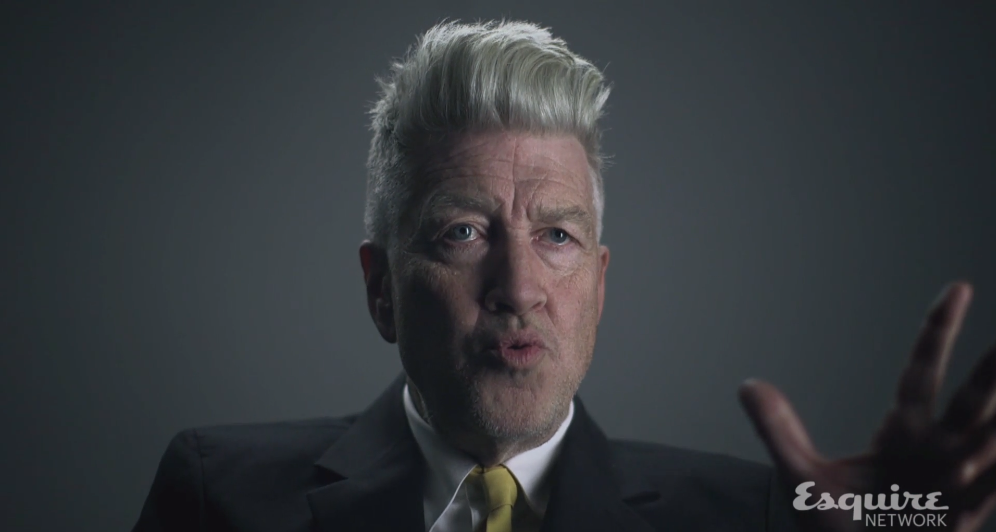
David Lynch on Esquire Network, How I Rock It, talking about Transcendental Meditation
David Lynch on meditation in the NewStatesman: Heaven is a place on earth
David Lynch speaks with Alan Colmes about his 16-country tour film Meditation Creativity Peace
Jerry Seinfeld and Howard Stern share stories about their Transcendental Meditation practice

Style.com: David Lynch and Italo Zucchelli on their creativity and Transcendental Meditation

December 25, 2013

Style.com: The Transcendentalists: David Lynch and Calvin Klein Collection’s Italo Zucchelli on their shared passions: creativity and Transcendental Meditation

By Matthew Schneier. Photographs by Olivia Malone
Published December 24, 2013

On a winding road high in the Hollywood Hills, not far from Mulholland Drive, is a Brutalist-looking concrete structure that’s equal parts manse and bunker. It’s the studio of David Lynch, and appropriately for his many pursuits—he is an auteur across media, from film and television to painting, music, self-help books, and coffee roasting—it has a variety of different spaces: a screening room, a recording studio, storage for his photographs and artwork, a kitchen with an industrial-grade espresso machine. (Lynch die-hards may recognize it as the house from Lost Highway.)

I’ve come here from New York, along with fashion designer Italo Zucchelli, to discuss one of Lynch’s abiding passions, Transcendental Meditation. The director established his own nonprofit, the David Lynch Center for Transcendental Meditation and World Peace, in 2005. He credits the practice with much of his success, and he’s devoted as much time to raising awareness of it as he has to virtually any of his other endeavors. His 2006 book, Catching the Big Fish, is dedicated to the subject.

Transcendental Meditation is an ancient practice, but its profile was raised in our era when the Beatles took it up in 1968, under the guidance of its twentieth-century guru, Maharishi Mahesh Yogi. It comes with, and rules out, no religion, faith, or creed, but because of its new-wave aura, it has largely bubbled away at the fringes of culture. Lately, however, it is experiencing a new boom. “In the last year, something tipped,” says Bob Roth, the affable executive director of The David Lynch Foundation for Consciousness-Based Education and World Peace. “If one [particular] thing happened, I haven’t seen it—and I’ve been on the front lines. But something happened, [because] I don’t have enough teachers to teach all the people in New York City who want to learn.”

TM has a very healthy celebrity fan base, which no doubt helps its public profile, and the foundation, which exists to provide scholarships to at-risk populations so they can learn the practice, including schoolchildren, survivors of domestic abuse, and military personnel, has taken advantage of that fact. Paul McCartney, a practitioner, performed at the foundation’s first benefit concert. Hugh Jackman and Jerry Seinfeld, Transcendental Meditators both, were honored at its most recent benefit gala, in December. Mario Batali and Martin Scorsese will both speak at its upcoming conference in February. The list of adherents is even longer. Ellen DeGeneres does it. Oprah does it. Ray Dalio, the founder of Bridgewater Associates, the world’s largest hedge fund, does it. And in the realm of fashion, so does Zucchelli, who is celebrating his tenth year as creative director of menswear for Calvin Klein Collection.

“It” is a relatively simple practice. It consists of devoting twenty minutes twice a day to meditating, which in the Transcendental iteration means silently chanting a Sanskrit mantra. (The mantra must be given by a teacher of Transcendental Meditation, as part of an instruction that can cost upwards of $1,000.) Devotees say that it combats stress, improves mood, and staves off illness and disease. Remarkably, science confirms much of this. The American Heart Association found in a study that Transcendental Meditation, alone among meditation practices it tested, reduces high blood pressure; other studies indicate it can improve functional capacity in patients with congestive heart failure. Over the past forty years, more than 300 studies have been published about the effects of the practice in peer-reviewed medical journals, and the National Institutes of Health and the Department of Defense have both given millions for further testing. While a quick Google search does turn up skeptics and critics—more of charlatan practitioners than of the practice itself—the tide seems to be now firmly in TM’s favor.

“In 1968, meditation was a fad,” says Roth. “In 2013, because of the research, Transcendental Meditation is being incorporated into the actual fabric of our culture.”

There’s something undeniably intriguing about the beatific bliss that Lynch and Zucchelli radiate—in the filmmaker’s case, in stark contrast to his dark, often violent work. I wanted to find out more about the connection they both draw between the practice and their creative lives. Below, condensed and edited, is a transcript of that free-flowing discussion.

Visit Style.com to read this intriguing interview and see the photos.

See David Lynch on Esquire Network, How I Rock It, talking about Transcendental Meditation.

(more…)

David Lynch on Esquire Network, How I Rock It, talking about Transcendental Meditation

December 21, 2013

How I Rock It: Filmmaker David Lynch & Transcendental Meditation

Filmmaker David Lynch describes how he develops and gains personal happiness and inner peace in his style and work through the art of Transcendental Meditation.

David describes his first blissful experience of transcending

David describes his first blissful experience of transcending

I tried to embed the video but it didn’t work in this space. Click here to see this short (2:20) impressive video on the Esquire TV Network website: It’s really good, as David would say.

In addition to the interview, some of the footage is taken from a pre-screening reception for the film, Meditation Creativity Peace, about David’s 16-Country tour, shown in the Billy Wilder Theater. Watch the hilarious, but informative, post-screening discussion with David Lynch, Russell Brand, and Bob Roth.

Read this lucid description by of his experiences with TM: Daily Reset – A Look Into Transcendental Meditation. And see The GQ Guide to Transcendental Meditation: The Totally Stressed-Out Man’s Guide to Meditation.

Related: Style.com: David Lynch and Italo Zucchelli on their creativity and Transcendental Meditation.

David Lynch on meditation in the NewStatesman: Heaven is a place on earth

November 1, 2013

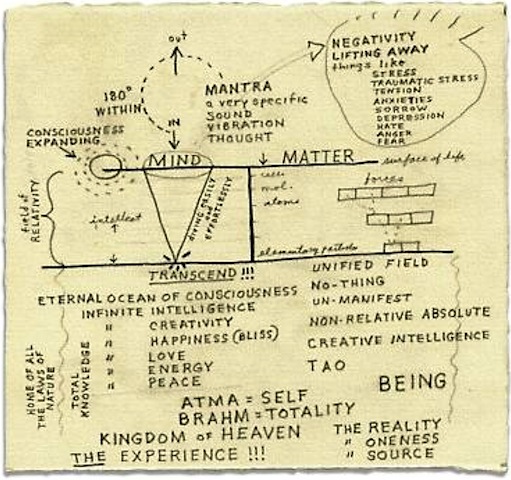
This week Russell Brand was guest editor of the UK’s NewStatesman, which came out October 24, 2013. He invited David Lynch to contribute an article on meditation. The diagram looks like it may be the same one David drew during an interview with a French journalist in Paris as he was explaining Transcendental Meditation to her. A large part of the article reads like a transcription of that brilliant explanation, which was woven throughout a documentary film made of David’s 16-country tour, Meditation Creativity Peace.

David Lynch on meditation: Heaven is a place on earth

Transcending is the only experience in life that gives total brain coherence. Any other thing we do utilises different small parts of the brain, this small part for painting, another small part for mathematics, that small part for playing the piano.
By David Lynch Published 31 October 2013 14:45

Mind and matter: Lynch’s diagram of Transcendental Meditation. Image: copyright David Lynch

Mind and matter: Lynch’s diagram of Transcendental Meditation.
Image: copyright David Lynch

What is Transcendental Meditation? What is transcending? Where do you go when you transcend? And what good is it to transcend? To help answer these questions, I’ve done a little drawing and you can refer to it from time to time. You will notice a line at the top of the drawing representing the surface of life. We live on the surface and see surfaces everywhere. This right side represents matter and the left side will represent mind. Mind and matter.

About 300 years ago, scientists started wondering: what was matter, what was wood, what was air, what was water, what was flesh, etc? And they started looking into matter and they began to find things – things that we now learn about in school. They found cells and molecules. They went deeper and found atoms; they went deeper and deeper, all the way down to the tiniest particles – the elementary particles.

They found four forces that act upon the particles. And on a deeper level, they found that the four forces became three. Some unification started. And, on a deeper level, the three forces became two. About 35 years ago, modern science, quantum physics, discovered the Unified Field at the base of all matter. This field is the unity of all the particles and all the forces of creation. This is a field of nothing, but the scientists say that out of this nothing emerges everything that is a thing. This Unified Field is unmanifest yet all manifestation comes from this field.

Ancient Vedic science, the science of consciousness, has always known of this field. Believers say that it is an eternal unbounded ocean of consciousness. And this consciousness has qualities. So this Unified Field, this ocean of consciousness, is a field of unbounded intelligence, unbounded creativity, unbounded happiness, unbounded love, energy and peace.

Transcendental Meditation is a mental technique, an ancient form of meditation brought back for this time by Maharishi Mahesh Yogi. It is a technique that allows any human being to dive within, through subtler levels of mind and intellect, and then transcend – that is experience, that ocean of pure consciousness at the base of all mind and matter – to experience this Unified Field within with those all-positive qualities.

In Transcendental Meditation you’re given a mantra. A mantra is a very specific sound vibration – thought. The mantra that Maharishi gives is like a law of nature designed for a specific purpose and that purpose is to turn the awareness 180 degrees from out, out, out to within, within, within. Once pointed within, one will dive easily and effortlessly. It is easy and effortless because the nature of the human mind is always to want to go to fields of greater happiness.

Each deeper level of mind and each deeper level of intellect has more and more happiness – charm, as they say. So the happiness growing is like a magnet that gently pulls us within. And at the border of intellect, one then transcends and experiences the transcendent, the Unified Field, the ocean of pure consciousness, the kingdom of heaven that lies within – the Tao, the home of total knowledge, being or divine being; Atma, meaning the Self, the Self with a capital “S”.

There’s a line we’ve all heard: “Know thyself.” This is the Self they’re talking about. This field is also known as Brahm, meaning totality. First seek the kingdom of heaven that lies within and all else will be added unto you. All else is totality.

Every time a human being transcends, they infuse some of this all-positive consciousness and they truly begin to expand whatever consciousness they had to begin with. There is a side effect to expanding consciousness, and that side effect is that negativity begins to recede. Things like stress, traumatic stress, anxieties, tension, sadness, depression, hate, anger, rage and fear start to lift away very naturally.

The analogy is: negativity is just like darkness. When this light of consciousness begins to truly expand, it is like being in a dark room with a light on a dimmer. As the light gets brighter, the darkness starts to go. And when the light is full on, there is no darkness. Likewise with the light of unity – consciousness – growing, negativity very naturally starts to recede, automatically and without you having to worry about it. This heavy weight of negativity lifting gives such a joyful feeling of freedom to a human being. So you could say the person practising Transcendental Meditation each day is infusing gold and getting rid of garbage.

Transcending is the key word!!! Transcending is truly experiencing that deepest eternal level of life. It is this experience that does everything good for a human being. Every human being has consciousness but not every human being has the same amount. The good news is, every human being has the potential for infinite consciousness. Every time you experience this ocean of consciousness within, you expand more and more consciousness and you are unfolding your full potential as a human being. The full potential of the human being is called enlightenment – infinite consciousness, infinite happiness, total fulfilment. Totality.

Transcending is a holistic experience, meaning that all avenues of life will start improving. The things that used to stress you will still be out there in the world but they will not be able to hit you so hard. You’ll still be able to feel sadness but the sadness won’t last so long. It will lift away more quickly. The same with anger; the anger will leave more quickly. It won’t stay with you and poison you and the environment. Fears begin to lift – you work in more and more freedom. This is a field of infinite creativity. You will see creativity and problem-solving start to expand. Through research, scientists know that IQ can go up because of transcending each day.

Happiness comes more and more and you feel good in your body and enjoy the doing of things more and more. The field within is a field of universal love. This universal love feeds personal love and relationships improve. This field within is a field of infinite energy. People today are so fatigued and here within each of us is an infinite amount of energy to fuel our work and play. There is infinite peace within and that is deep, deep contentment, harmony, coming up inside the human being. It is so beautiful.

Transcendental Meditation is, as I said, easy and effortless. Many people might think that because it is easy it is not as good as other meditation techniques. This is wrong thinking. Concentration forms of meditation, contemplation forms of meditation, will keep a human being hovering on the surface. There will be no transcending. And it is hard work and it is boring and the reward is not there.

Transcendental Meditation as taught by Maharishi Mahesh Yogi is a technique that has been here many times before and it is a blessing. It is the real thing. It works. Brain research scientists have found a wondrous thing. When a human being truly transcends, hooked up to an EEG machine, then the full brain gets engaged in concert. They call this “total brain coherence”.

Transcending is the only experience in life that gives this total brain coherence. Any other thing we do utilises different small parts of the brain, this small part for painting, another small part for mathematics, that small part for playing the piano, and so on. Scientists have always told us before that we use only 5 per cent or 10 per cent of our brain but transcending is an experience that utilises the full brain.

This shows us something of the relationship of the human being to this glorious Unified Field within. The more we transcend, the more this coherence stays with us and this eventually gives rise to higher states of consciousness, culminating with supreme enlightenment. On the EEG machine, Transcendental Meditation meditators are seen to transcend many times in each 20-minute meditation. Those meditators who practise concentration or contemplation forms of meditation do not transcend. They do not get the experience of that ocean of bliss consciousness, the Unified Field.

A ten-year-old child can practise this technique of Transcendental Meditation; a 110-year-old can do it, easily and effortlessly, and they will each get the experience they are yearning for. It is a sublime experience to transcend and feel that rejuvenation and that happiness and all those other all-positive qualities growing.

Transcendental Meditation is not a religion. People from all religions practise this technique and they see there is no conflict with their religion. On the contrary, they say they understand and appreciate their religion more because understanding and appreciation for all things grow by transcending each day. It is a technique for human beings, no matter what walk of life, what religion or where you are from. People who have experienced great suffering have gotten this technique and happily said, “Now I have my life back again.” The real story is: THE NATURE OF LIFE IS BLISS and THE INDIVIDUAL IS COSMIC.

Russell Brand’s article in this paper is about revolution. Revolutions are usually associated with violence or force. Transcendental Meditation leads to a beautiful, peaceful revolution. A change from suffering and negativity to happiness and a life more and more free of any problems. The secret has always been within. We just need a technique that works to get us there to unfold a most beautiful future.

Find out even more about Transcendental Meditation at: davidlynchfoundation.org.uk.

For American readers, visit www.tm.org and davidlynchfoundation.org.

See Russell Brand and David Lynch at LA Premiere of ‘Meditation, Creativity, Peace’ Documentary and related links to other videos and articles. Visit http://meditationcreativitypeace.com to see a preview of the film and where it may be playing.

This is an excellent interview: David Lynch speaks with Alan Colmes about his 16-country tour film Meditation Creativity Peace.

The NewStatesman article reads like a transcription from this film, which you can now see: “Meditation Creativity Peace”—A documentary of David Lynch’s 16-country tour during 2007–2009.

See an earlier article written by David Lynch published in Jane Magazine: Celeb Spiritual Report: One significant day in my life by David Lynch for Jane Magazine (May 2004).

How TM helped calm and center a young woman’s busy mind—inspiring article in new Irish magazine

October 11, 2013

A new magazine, Upside News, came out on Dublin’s north side in Ireland. Their website is still under construction, but here is a description on their Facebook page. They asked someone for an article on Transcendental Meditation.

John Burns

John Burns

Since Christine Ryan was the contact person, John Burns, Communications Director for TM in Ireland, persuaded her to write about her experience of the technique. John said he sent the editor an article he had written along with Christine’s TM experience and told him he thought what she had written was so good that he should use it instead if space was an issue. The editor got back to John and said that he would print Christine’s piece.

Good decision; it’s a fantastic personal account! When I asked John to tell me more about the author, he said, “Christine is training to be a school teacher. She is just someone who really appreciates her TM.” I asked John to send a picture of Christine, a PDF of the magazine article, and a link when it’s posted online, which I’ll add when they’re available. Here’s what she wrote:

“As a twenty-four year old trying to find your place in the world, weaving your way around the many forks in the road that separate all of the possible paths down which to venture, it can be hard to tease out your own true voice in an increasingly noisy world.

I am an introverted, intellectual, always-something-to-think-about child of the technological generation. It seems easy to assume I would have trouble turning my awareness away from words on a page, the lure of the internet, my mobile phone, the radio buzzing and the drilling noise vibrating from the neighbour’s house a few doors down where a posse of hard-working, bellowing construction workers are knocking down two walls in her house only to put six back up. But TM is natural and it is effortless, when you learn how to do it.

What TM gives me is stillness and silence. For twenty minutes twice a day, I go to a place of silence that already exists within me. It happens effortlessly and spontaneously. As a helpless analyser of all things, this initially seemed impossible for me to swallow but I very quickly discovered its truth. The noise of the world disappears and I arrive at a place of beautiful quiet.

TM is like diving into a pool of light that washes away dirt and darkness, and emerging fresh and invigorated. During my TM practice, I feel my body settle into a deep state of rest and an overwhelming sense of calm and stillness pervades it. I feel free from the shackles of stress and exhaustion. I experience a sense of unity and peace. Without any resolve to do so, this sense of wholeness and calm lingers on when my meditation has ended; the effects of my TM practice spontaneously ripple forward into my activity.

Almost seven months into my second year of practising TM, I feel greater clarity in my thinking; as a busy thinker this has been such a profound change that TM has brought me. My relationships are infused with a sense of ease now. My thinking is sharper, ideas flow more easily, and my energy is lasting and productive. I feel less uncertain about decisions to be made and a greater vibrancy in my creative endeavours.

As I continue to meditate, the effects grow stronger. My wonderful TM teacher, Ann, put it simply: “It’s like going to the gym,” she said. “You feel great for the first few weeks that you’re going, but if you stop going, you’ll lose the benefits bit by bit.” I may not get to the gym (or exercise for that matter!) every day, but sitting in a chair in my sweats, with messy un-brushed hair, allowing my mind to simply settle down to a place of profound stillness and emerging twenty minutes later energised and renewed—now that I can do!

I was never one to easily identify with, or apply, the principle of “go with the flow,” but as I continue to practise TM I edge all the more closer to fully understanding exactly what that means. TM has resigned stress and anxiety to a state out of tune with the natural rhythm and flow of my body and mind. It puts things into perspective. To connect with that constant centre of calm and stillness that lies within me, regardless of what is happening in my life, and to find that stillness lingering during activity has been one of the greatest joys of learning TM.

Visionary filmmaker, veteran meditator, and prolific speaker and activist for TM, David Lynch, said it best when he said: “TM is for human beings.” The truth of his words find significance in the shared experiences of the benefits of TM by meditators around the globe, young and old, from all religions and all walks of life, from those behind bars to those raised high on a platform called “celebrity.”

In the monthly group meditation meetings I meet meditators of all ages: veterans to novices, students to retirees and everything in between. In a world that breeds so much disconnection and discord, it is a joy to practice a simple technique that allows for an awareness of the integral similarity between us all.

TM recharges me mentally and physically. My morning and evening TM practice have become the pillars onto which I anchor my day. I can hear my own inner voice more clearly again and those forks in the road don’t loom quite so ominously now.”

Diane Vance reports on M.U.M.’s new David Lynch MA in Film for The Fairfield Ledger

August 14, 2013

M.U.M. adds master’s in film

By DIANE VANCE | Aug 14, 2013

The Maharishi University of Management debuts a new master’s degree this semester, The David Lynch MA in film.

The university has offered undergraduate filmmaking since 2007 in its Media and Communications Department and animation courses available in the Art Department for many years. It is now adding the next layer of learning.

“The graduate program is designed to take an idea to completion in a major project, with the possibility of publication,” said Gurdy Leete, co-chairman and associate professor of M.U.M.’s Media and Communications.

The course and fall semester begin Monday, and as with all M.U.M. courses, are taught in the block schedule of one course at a time.

“We’re expecting 20 to 25 students,” said Leete. “This program is about creating a supportive environment where artists connect with the audience. Students will have the opportunity to make deep connections in the film-making industry and gain recognition.”

The one-year, August to May course, includes curriculum in Advanced Narrative, Advanced Screenwriting, Acting for Film, The Frame, The Field, and from February to April an Advanced Video Media Project and then, The Media Market. Students who have not yet learned Transcendental Meditation will be taught the technique during the first few weeks of class.

About half the expected students have attended M.U.M. before.

“I’m excited about the group of students enrolled and how they will be producing great work,” said Stuart Tanner, co-chairman and assistant professor of M.U.M.’s Media and Communications. “The students will get a great deal out of working with one another and following the structure of the program. The goal is to produce a major piece of work.”

Tanner has had a glimpse of some of that work. The department offered a full scholarship for the master’s in film program based on applicants submitting a short film to compete for the scholarship.

Leete said the department received several dozens film submissions, which were all screened by the department faculty and program sponsors. The top six short films were then submitted to David Lynch, filmmaker, writer, artist, for viewing.

Tanner talked with Lynch by phone Tuesday for about 20 minutes.

“He really liked viewing the six shorts,” said Tanner. “Some of them were very accomplished pieces. He said when watching a film he watches for what stays with the viewer, what leaves a strong feeling. A short film doesn’t have a long time to develop that. He selected the film by Kinga Kulcsar as the scholarship winner because hers had that quality of making an impression, leaving the viewer with a feeling.

“I got to tell her last night that she won the scholarship.”

Tanner said the film will have a link at M.U.M.’s David Lynch MA in Film website filmschool.mum.edu in the near future.

Students in the master’s program also will visit with Lynch about filmmaking.

“We’re still working with David about his schedule,” said Leete. “Students will connect with him by Skype and at some point in the year the class will travel to Los Angeles for a couple of days and students will have a few question and answer sessions directly with him.”

Tanner said naming the program for David Lynch is a perfect fit for the program.

“He is the filmmaker’s film maker,” said Tanner. “He’s a fantastic person to be around. He is a role model and visionary with great integrity to his own vision. Putting his name on the program is perfect. It’s an idea that’s been bubbling away for a while and now it’s happening.”

Tanner said Lynch will be calling the classes throughout the year.

“And we will bring other insiders from the industry, we’ll bring other experts to the classes,” said Tanner.

Leete said the department is in contact with other industry people to connect with the program.

“Other luminaries in the field will connect by Skype, visit Fairfield and lead workshops or be available when we are in L.A.,” said Leete. “Schedules are always changing for people in film, but we expect quite an array of industry insiders from various fields to work with us.”

Not all students in the program will need to produce a major film. Many aspects of film will be studied and students may collaborate with one another to create a project. Students may screen write, direct, cast, design costumes and sets, or be special effects supervisor. Film also has an important business side and students may focus on setting up a media company.

“Students can create different products, it could be a film or a website of music videos,” said Leete. “The idea is to make a giant step forward and make it easier at the end of the program to work in the industry.”

“All we require is that film plays a significant part in the final project. The program is about having a year to go deeply into a creative experience that will transform both you and your career,” according to information on the program’s website.

Admission requirements include a bachelor’s degree in any subject, a resume, a portfolio of best work, including at least one film of any length created by the applicant, other creative work and special achievements. Applicants also have an interview with department faculty.

Published with permission from The Fairfield Ledger

Also reported in Indiewire: There’s a David Lynch MA in Film. Why is it in Iowa? Must students meditate? Burning questions, we’ve got answers: Besides Transcendental Meditation, What Does One Learn with the David Lynch MA in Film?

David Lynch speaks with Alan Colmes about his 16-country tour film Meditation Creativity Peace

August 8, 2013

banner-colmesLegendary Filmmaker David Lynch

Award-winning filmmaker David Lynch speaks with Alan Colmes about his 16-country tour, teaching millions of struggling people how to achieve peace through Transcendental Meditation. Click on the title to go to the website and listen to this dynamic and inspiring interview: [Video] Alan’s FASCINATING interview with legendary filmmaker David Lynch! and here: David Lynch On The Value Of Transcendental Meditation.

Watch the trailer for a new documentary film on David Lynch titled “Meditation Creativity Peace” | Russell Brand and David Lynch at LA Premiere of ‘Meditation, Creativity, Peace’ Documentary | Russell Brand and David Lynch at LA Premiere of ‘Meditation, Creativity, Peace’ Documentary | Enlightenment, The TM Magazine: Meditation Creativity Peace: How the David Lynch Foundation Brings Change from Within.

Visit the new website, Meditation Creativity Peace, for a list of upcoming and previous screenings: http://meditationcreativitypeace.com.

You may also enjoy this earlier article David Lynch wrote for Jane Magazine’s celeb issue: Celeb Spiritual Report: One significant day in my life by David Lynch for Jane Magazine (May 2004).
Celeb Spiritual Report: One significant day in my life by David Lynch for Jane Magazine (May 2004)

August 3, 2013

Here is an article I helped facilitate for David Lynch when we first started working with him, a year before the idea for the David Lynch Foundation was created under the dynamic leadership of Bob Roth, executive director for the Foundation. Up to this point David had kept his Transcendental Meditation practice private. When he made the decision to go public and help the TM movement he turned out to be a most unique and brilliant spokesman.

One event was a project to create world peace. We sent out our press release to the media and set up a NY press conference David would attend. Jauretsi Saizarbitoria, the entertainment editor for Jane magazine at the time, emailed back saying she was interested in David’s meditating and suggested he write an article for their special celeb issue on the topic: One significant day in my life. We mentioned it to him and he sent us an article of the day he learned that our human physiology, our body, was made of consciousness, which we forwarded to them. Knowing he was a painter, they also wanted to know what consciousness looked like to David. He sent a jpeg of an image he had created and they included it, giving him a whole page and titling it a Celeb Spiritual Report, with that announcement on the bottom right side of the magazine cover. It was published in their May, 2004 celeb issue. Jane was a popular woman’s magazine, published from 1997-2007. David posted the report on his website with other earlier David Lynch articles and interviews.

Here is David’s love of Maharishi’s Vedic knowledge explained in such a simple conversational tone that’s truly David Lynch. He’s actually a brilliant writer and speaker! They put the text on the bottom right of this photo. Here it is with the text underneath.

Jane – May, 2004
One significant day in my life

By David Lynch

This is a picture that director David Lynch (above) painted to show what consciousness looks like.

This is a picture that director David Lynch (above) painted to show what consciousness looks like.

A significant event occurred in my life the day I learned that our human physiology, our body, is made of consciousness.

Consciousness???

“What???” I asked out loud in wonder.

I learned that our human physiology is so magnificent and complex, and so exquisite in its design and makeup, as to be wondrous beyond imagination. We are spun out of unbounded, infinite, eternal consciousness.

I learned that underlying all matter is a vast, unbounded, infinite and eternal field of consciousness called the Unified Field. I found out that modern science started taking this field seriously about 25 years ago and that all matter is unified at this level in a state of perfect symmetry, or balance. The entire universe emerges from this field in a process called “spontaneous sequential symmetry breaking.”

Are you still with me?

I also learned that there is another science called Vedic Science. This Vedic Science is ancient, and it has always talked of the Unified Field.

Interesting!

Veda, I learned, means “total knowledge.” The home of total knowledge is the Unified Field. It is also the home of all the laws of nature. The branches of Veda, 40 in total, make up the language of the Unified Field, the impulses of this eternal field.

I realized this Unified Field is quite an interesting place. It is not manifest and is full, meaning it is no thing, yet all things in potential. It manifests and permeates all things: the whole universe, everything, while still remaining full and not manifest.

Amazing!

Is this mind-boggling or what?

Now comes the hippest part. I have learned that any human being can “experience” the Unified Field.

Really?

Or: So what?

Why in the world would we care to experience the Unified Field?

First, another question.

Have you ever heard that most of us human beings use only 5 percent of our brain, our mind? Have you ever wondered what in the heck the other 95 percent is all about?

This is the beautiful part coming up.

The “experience” of the Unified Field actually unfolds “enlightenment”—higher states of consciousness culminating in Unity Consciousness, the highest state of consciousness. These higher states use that 95 percent of the brain. That is what the 95 percent is there for—to give us permanent, all-time enlightenment.

Now, what is enlightenment? If you were a lightbulb, let’s say, your “glow” might light up your whole house and surrounding yard. In enlightenment, your “glow” would be unbounded, infinite and eternal. That would be some glow!

Enlightenment is fulfillment. Supreme fulfillment. Unbounded, infinite, eternal bliss, consciousness, intelligence, creativity, harmony, dynamic peace.

Enlightenment, I have learned, is our “full potential.” It is the birthright of every human being to enjoy enlightenment.

Is this good news? I think it is such good news.

In Vedic Science, the Unified Field is called “Atma.” Translated, that is “Self”—the Self of us all.

The Unified Field is not something foreign, or even something far away. It is right within each of us at the base of our mind, the source of thought. A great sage from the Himalayas, Maharishi Mahesh Yogi, brought a beautiful gift to our world in the form of Transcendental Meditation. Transcendental Meditation is an easy and effortless, yet supremely profound, technique that allows any human to dive within and experience that unbounded ocean of pure bliss, pure consciousness. the Unified Field, our Self.

It may be interesting for you to know that millions of people are practicing Transcendental Meditation all around the world. People from all religions, and all walks of life. Over 600 studies have been done in universities and research institutes validating the profound benefits of Maharishi’s Transcendental Meditation Program.

Having this kind of knowledge and technologies of consciousness available to us in this age is, in my mind, a significant event. Yet the “experience” of that Unified Field is the most significant event, because it unfolds what we truly are—totality.

David’s movies include Eraserhead, Dune, Blue Velvet and Mulholland Drive. He is looking forward to Creating World Peace Day, to be held mid-September at the Maharishi University of Management in Fairfield, Iowa (www.mum.edu).

Copyright 2004 Fairchild Publications, Inc.

(more…)