Billboard interview: Donovan Q&A: Catching Up With a Folk Rock Superman

April 12, 2012

In the three months since Donovan received the news that he will be inducted into the Rock and Roll Hall of Fame, he has stepped up his activity in front of the film, TV and music industries. He performed at  the Sundance Film Festival, made numerous private performances for music supervisors and delivered a sold-out chat and performance at L.A.’s Grammy Museum.

“Good Day L.A.,” the morning show of the Los Angeles’ FOX affiliate, devoted daily segments to Donovan during the last week of  March, culminating in a live performance on March 30. Next up is the induction ceremony on April 14, which will be followed by Sony Legacy’s release of “The Essential Donovan” on April 17. HBO will air the Hall of Fame ceremony/concert on May 5.

In an interview held at his daughter’s home in the Hollywood Hills, Donovan spelled out his plan for the Rock Hall concert. “‘Sunshine Superman’, I cannot not play, but I would like to preface it with an acoustic song, probably ‘Catch the Wind.’ We’ll follow with ‘Season of the Witch.’ It looks like Jim James of My Morning Jacket (will join in). We played together at Radio City for the meditation concert and I got on really well with him so I will have the younger generation there.”

The meditation concert he referred to was held in 2009 for the David Lynch Foundation that funds the teaching of Transcendental Meditation for school-age children. Donovan, who turns 65 in May, has been an avid supporter of the Lynch Foundation, contributing a track last year to “Download For Good: Music That Changes The World.” A copy of the CD was on the coffee table so our conversation, which would touch on  poets from the 18th century up through the Beat Generation, Bob Dylan and his last studio album, the underrated 2004 release “Beat Café,” began with TM.

Billboard: Last year we heard a new song from you, “Listen.” As one of the first and most visible people to experience TM in India, how has it affected your music?

Donovan: In the early days when the Beatles and I went to India and returned, we knew our fans should have it and then the world should have it. We needed it. Flash forward 35 years later (April 4, 2009) and Paul (McCartney) and Ringo (Starr) and Donovan and David Lynch are on the stage at Radio City Music Hall announcing to the world how schools have applied this meditation. Fear and anger and doubt have been subdued somewhat. It doesn’t mean that you’ll never be angry or filled with doubt again, but you won’t hold on to it —  all things the Maharishi spoke of. This one was designed to be very applicable to the Western way of thinking. My dream was to (figure out) how do we bring in a new generation of songwriters? As it progressed, I wrote songs with meditation in them. The Beatles wrote songs with meditation in them.

What was the first song you were aware of writing because of TM?

“Happiness Runs” is the most direct one, which I wrote while in India with the Beatles and one Beach Boy (Mike Love) and Mia Farrow. Before India in ’68 I was always looking for songs where people could sing along. It’s part of the job to be a poet, folk singer — children’s songs, rounds, circular songs. And so I made this circular song “Happiness Runs” and it directly references meditation because it says ‘happiness runs in a circular motion/thought is like a little boat upon the sea.’ Simple words, but profound. More rocking was the “Hurdy Gurdy Man.” In the 18th century the hurdy gurdy man played the instrument the hurdy gurdy and he traveled from town to town and he brought the news. So I related the hurdy gurdy man in the song to the teacher, the Maharishi, who brings us songs of love.

When you said meditation affected your songwriting, the first thing I thought of was “There is a Mountain.” What’s its origin?

It comes from a Zen haiku, but it is a koan as well — the clever question asked of the student by the Zen master. “First there is a mountain, then there is no mountain, then there is.” “The caterpillar sheds its skin/to find the butterfly within.” It’s very literal. If we could discard our skin, our hard husk of persona, it’s an obvious description that inside there is a softer human. I found (sayings) in old books and by putting them into songs, I hoped they would trigger a question in the listener. By giving it a rhythm it has an attraction — people were singing my lyrics not knowing what they were about.

On a certain level, you were far ahead of your time. Musicians of the last decade seem to understand you better than the musical community of the 1980s and ’90s. Have you sensed that?

I could sit cross-legged in front of 20,000 people and play solo with one guitar (in the early 1970s tours) and a pin could drop and (be heard). I assumed even then, that everything I was singing they knew. It was just a veil hiding it. That didn’t mean that the outside world would understand the Donovan magic or the songwriting. But I have been recognized, extraordinarily so, by the audience. We’re talking 17 top 100 singles, selling out all the great concert halls of the world — Sydney Opera House, Hollywood Bowl, Royal Albert Hall, Carnegie Hall. One gets recognized by one’s peers and journalists who have a lot of experience and have studied and know where the various parts of my music came from.

There were so many facets to your music – there was a dramatic change from “Catch the Wind” to “Cosmic Wheels” and that’s just 10 years. What made you want to be more than a folk singer and bring so many other elements into your music?

I’m a sponge. When I was younger I absorbed so much music and (the story) is always the same — passed on by an older Bohemian who has a house that becomes a crossroads for visitors. Such a one was in the town of St. Albans for me. Such a one was in Minnesota for Dylan. It’s where the older Bohemian says I know what you’re up to; you better spend a few days with my record collection. In it is everything – folk, jazz, blues, classical, baroque, spoken word. I was so fascinated that I absorbed all of the styles, even the antique music of Sicily, rare flamenco from 1928. It was fascinating to me that I started dressing my lyrics in all kinds of costumes musically. Many of my contemporaries had one or two styles — folk, blues. But when I did “Sunshine Superman,” begun in 1965 and finished in May 1966, and presented so many genres blended, it was a natural thing to me. It represented what the Bohemian said: all the cultures should share the planet. That meant be brave, break the rules and walk over the genre lines and blend. I could see how it made me difficult to pin down.

At the beginning of it all, though, was folk music.

It was. (As a young boy) all the relatives would come around, the room would be cleared and a chair would be put in the middle. And a slightly tipsy relative would be pushed into the chair to sing their one song. These songs I didn’t know at the time, were folk songs from the Scottish and the Irish, about the troubles and the migrations.  Only later, when I was 15, did I learn these were called folk songs. After that my father’s record collection of Sinatra and my mother’s Billie Holiday and five-piece jazz groups from the ’30s and musicals. When I was 15 ,that would be Everly Brothers and Buddy Holly and I’d collect all the records. At 16, I plugged into a (college) campus for nine months and became aware of the older Bohemians who introduced me to the jazz club, the folk club and the coffee house and the art school and soon the blues club. After that it was easy for me to fuse (styles); I just wanted to see how far it could go. The base is always the same – the guitar and the vocal.

At some point early on, you made the decision to write songs, which many folk singers of the early 1960s did not do.

I much more wanted to be recognized as a poet than as a musician. Poetry is still looked upon as something ineffectual, narcissistic. In actual fact, the Bohemian poets in the ’40s,  their mission was to return poetry to popular culture. When you bring a poet into popular culture, two lines from a poem can alter a whole nation, it can bring a government down. The beat poets were wrong when they thought poetry would come back on the wings of jazz. Some poets were improvising with jazz improvisers in clubs, but improvisational poetry only works within improvisational music. When folk jumped into bed with rock, the form of the folk ballad would allow the new lyric (to thrive), first with Bobby Dylan then with myself and Joni Mitchell, Leonard Cohen, Neil Young. The Beatles realized it, too. They were from the Irish tradition of social activism  (in poetry) but didn’t know it. I somehow knew it, because my father had brought me up reading poetry to me of social change.  Before I heard Woody Guthrie, my father was reading poems of social consciousness to me —  Wordsmith, Coleridge, Shelly. I got fired with the zeal that we could bring something (literate) to the fans of pop music to get their teeth into.

You arrived in the U.S. as a folkie but sign to Epic and become a rock star. A conscious decision?

It came to a boil in May 1965 when Joan (Baez), Bobby and I met (as documented) in (the film) “Don’t Look Back.” At the time, folk singers, classical and jazz musicians released albums, pop music went on 45s. I was a bit ahead, releasing a single. That bit of harmless plastic, the 45, I realized was cheap, available and millions of Baby Boomers bought them. There was already something going on that I was joining (socially conscious folk-rock music). But the folk singers rebelled,saying ‘We’re not plugging in our banjos and guitars.’ Nobody understood that folk could meet pop or rock.

It wasn’t until 2004 when you did “Beat Café” that you really exposed the importance of poets on your work. Why did you decide the time was right for that project?

I was exploring the Bohemian cooking pot that was going on when folk and jazz and poetry were mixing in these special hangouts. (Producer) John Chelew suggested that I and (the bassist) Danny Thompson (record). He said ‘That’s unique when you and Danny play a drone. I’ll pay for it. Come in and we’ll do the drone for an hour.’ Before I went in, I couldn’t do just a drone. We were recording at Capitol so I thought I’ll write a song for Danny that will be like Peggy Lee’s ‘Fever.’ I’ll get  a bass line going and I’ll write about when we used to play in the clubs. It was simple. We went into the studio and did the track. My wife, Linda, was in the studio. She knows her stuff and says there’s only one drummer who can join this thing, (Jim) Keltner. In came Jim. Set up his whole kit never knowing what it was about, having never played with Danny. He’s got the big kit set up and  I went (sings bass line). He looked at me laughed, ‘OK I’m in.’ And we sang about life in the beat cafes.

Good as the album is, the shows were even better – you mixed talk about poets and their affect on your writing.

San Francisco was particularly touching because Michael McClure was there. He jumped on stage and did (a poem). In New York, in Joe’s Pub, a girl stood up on a table and pumped it out. Nobody knew her. I took it on tour in the U.K., but it wasn’t the same. Before I took it on tour, I said it can only be in a small room, a  Bohemian café and there just aren’t enough of them.

You’ve been active this year, getting out to places such as the Sundance Film Festival to perform at the BMI Snow Ball and at the musical instrument trade show NAMM. What will come out of this activity?

The music supervisors have always been friends of mine and (publisher) Peermusic is introducing me to all these (projects). I would love to do a soundtrack with the right director – I have a love of cinema and by extension TV and commercials. I’m fascinated that Gibson wants to make me a custom cherry red J-45, which I used for every album up through 1969. It was stolen in 1970 — a fan walked into a stadium in 1970 and out with the J-45. It’s never been returned. I carried around the J-45 nostalgically as a second guitar while I played my new custom guitar, the moon shaped guitar designed by Tony Zemaitis. When Gibson heard there was a wanted poster out, they decided to make a guitar. To have a custom guitar and then possibly a line of guitars for my fans, that’s a lovely thing.

VIDEOS

These videos were embedded in the interview: “Catch the Wind” — 1964, “Cosmic Wheels” — 1972, and Bob Dylan And Donovan.

Donovan Tribute Week on Good Day L.A. All week they were saluting Donovan as he gets inducted into the Rock and Roll Hall of Fame. Watch the Interviews in their Video Player.

Donovan Tribute Week, Poe Performs “Season Of The Witch”

Eric Burdon “Spills The Wine” Saluting Donovan!

Jackie DeShannon “Puts A Little Love In Our Hearts”

Smothers Brothers’ Tommy Gives “Big-ups” to Donovan

Spencer Davis “Keeps On Running” and Salutes Donovan!

Donovan Week Continues With Tribute From Jon Anderson of “YES”.

The Essential…Donovan!! – Live On Good Day L.A.: interview and singing

Listen to WKSU: Scottish singer-songwriter looks back at his career with WKSU’s Bob Burford: Donovan still mellow as Rock Hall honors awaits

Visit http://www.donovan.ie/en/ for more interviews.

Related posts: Ode to Donovan by Meghan for Altavoz: Conan introduces Donovan while holding the DLF Music vinyl box-set “Music That Changes The World” | Donovan Inducted into Rock and Roll Hall of Fame | Donovan and Ben Lee on Good Day LADonovan GDLA and Off-Ramp Interviews | Donovan to be Named Icon at BMI London Awards | Mellow Fellow Donovan


Ode to Donovan by Meghan for Altavoz: Conan introduces Donovan while holding the DLF Music vinyl box-set “Music That Changes The World”

April 9, 2012

Meghan, Digital Promotions Guru for Altavoz Distribution, posted this Ode to Donovan on April 7, 2012.

Image
Conan O’Brien introduces Donovan while holding the David Lynch Foundation Music 34-artist vinyl box-set “Music That Changes The World.” (Cover art is a tree David Lynch had painted for Change Begins Within.)

The legendary folk-poprock singer and songwriter Donovan performed, two classics on Conan. The eclectic musician played “Sunshine Superman,” which aired live and kept “Season of the Witch” as a Conan web exclusive. The live performance also came at an opportune time before Donovan is inducted into the Rock and Roll Hall of Fame.

The talented British musician is one of the leading recording artists of his day. Best known for his laid-back track “Mellow Yellow,” which was released in 1967. Donovan produced a string of eleven Top 40 hits in a row from 1966 through 1969. In the past decade, Donovan completed a new album, Beat Café; a new box set, Try for the Sun: The Journey of Donovan; and a book, The Autobiography of Donovan: The Hurdy Gurdy Man. Now 65 years young, Donovan remains a prominent figure in the David Lynch Foundation for Consciousness-Based Education and World Peace with his 40-year interest in Transcendental Meditation.

“It is my great pleasure to announce the vinyl release of MUSIC THAT CHANGES THE WORLD on Record Store Day,” said Donovan. “As head of the Musical Wing of The David Lynch Foundation, I wish to thank all the amazing artists who have contributed. From the beginning, when The Beatles and I were writing songs to promote Maharishi’s meditation, it was always my dream to bring all the musical fraternity onto one great label to Promote True Peace. This day has arrived and now the world can know as we knew then, that change begins within.”

The episode aired on Wednesday, March 28, and Conan gave fans a sneak peak at the David Lynch Foundation Music, vinyl box-set cover of, “Music That Changes The World,” to be released on April 21, 2012. Donovan’s exclusive track “Listen,” is featured among the 34 assorted tracks from world-renowned artists.

Donovan represents the finest level of singer, songwriter, and performer, as a true icon of Rock and Roll super-fame. He continues to present his unique vision of peace, awareness and understanding in his lifestyle and music. Tune into the 27th Annual Rock and Roll Hall of fame induction ceremony on Saturday, April 14, 2012 to see Donovan accept this monumental achievement.

Donovan Performs His Classic “Sunshine Superman” – CONAN on

Web Exclusive: Donovan “Season Of The Witch” – CONAN on TBS

Also see Music That Changes The World out on Record Store Day 2012 posted by ⋅ February 6, 2012.

About Meghan, Digital Promotions Guru

Fascinated with all things related to music and public communications, Meghan Hayden is currently a junior in American University’s School of Communication and Marketing Department. Meghan adds spunky ideas, positivity, and an array of musical knowledge to the Altavoz intern team. Born and raised in Stuart, Florida, hobbies include boating and relaxing on the beach, often listening to the smooth reggae beats of Bob Marley, the Whalers, Jimmy Cliff, and Peter Tosh. Over the past 3 years, Meghan has actively shared her eclectic music taste as DJ Megmoney on her music blog. Over the years her passion for live music has brought her to eight DMB shows, Bonnaroo 2010, Basscenter 2011 and many more rocking venues. Amongst many artists, a few of her favorite include: The Black Keys, Phoenix, Ellie Golding, Beyonce, Rihanna, The xx, Adele, Florence the Machine, Zion I, and Foster the People. View all posts by Meghan, Digital Promotions Guru

2012 Rock and Roll Hall of Fame Inductee Donovan on Being Inducted On March 16, 2012, before appearing on the Rock and Roll Hall of Fame and Museum and Library & Archives’ panel at SXSW, 2012 Hall of Fame inductee Donovan spoke with the Rock Hall about being nominated and inducted into the Hall of Fame.

Donovan performing “Mellow Yellow” for Slacker RadioLegendary performer Donovan stopped by the Gibson Guitar Showroom in Austin TX during SXSW 2012 to perform for Slacker Radio. He is just now being inducted into the Rock & Roll Hall of Fame this year. Congratulations Donovan! For more on Donovan check out http://www.slacker.com/artist/donovan.

For more on Donovan posted on The Uncarved Blog search this archive. Visit http://www.donovan.ie/en/ for more interviews.

Billboard.com: Donovan Q&A: Catching Up With a Folk Rock Superman

Listen to WKSU: Scottish singer-songwriter looks back at his career with WKSU’s Bob Burford: Donovan still mellow as Rock Hall honors awaits

Watch the trailer for a new documentary film on David Lynch titled “Meditation Creativity Peace”

Meditation key to finding balance for Paralympian Daniel Westley — special to The Vancouver Sun

April 5, 2012
By TOM HILL, Special to The Sun April 4, 2012

Daniel Westley has been on so many podiums you’d think he’d been playing sports all his life. In fact, he had barely shown any interest in athletics until after a tragic accident forced doctors to amputate both of his legs.

While in the hospital, Westley happened to meet a young Rick Hansen who, years before raising millions for spinal cord injury research, introduced Westley to wheelchair athletics.

Westley was hooked. After being released from the hospital he started playing sports as much as possible, earning his spot in the 1988 Paralympic Games in Seoul, South Korea.

“I happened to get involved in 1988 and at that time they embraced disabled sports.” recalls Westley, who lives in New Westminster.

But as the Paralympic Games grew in size and popularity, so too did the pressure of training and competing on the world stage. Westley was now participating in both the summer and winter games in a wide range of sports that included everything from wheelchair racing to skiing.

“Any given day I was racing two and three times a day,” he explains. “It was a pretty high intensity to be competing at.”

To perform at the highest level, Westley relied on Transcendental Meditation, a technique that involves two 15- to 20-minute sessions each day and promises a clear and quiet calmness for its practitioners.

”It gave me a chance to settle down and recover from my training,” he says. “I thought that if I wanted to do really well, I’d have to rest really well.”

With his meditation keeping him centred, Westley certainly did do well, going on to win 12 Paralympic medals – four of which were gold medals – in five Paralympic Games.

And yet, for Westley, who now works in sales for a home medical equipment company, the positive influence of meditation extended far beyond sports and has helped him sustain a positive attitude in all facets of his life.

“If you really step into the moment and are really relaxed then the outcomes take care of themselves.”

See the excellent accompanying Sun video report: story.html?tab=VID.

Empowered Health airs Thursdays on CJDC at 11 a.m.; CHEK-TV Vancouver and Victoria, CFJC and CKPG at 7 p.m. and CHAT at 7:30 p.m. The show is broadcast Tuesdays on CFTK at 11:30 a.m. You can also view episodes online at vancouversun.com/empoweredhealth.

© Copyright (c) The Vancouver Sun

Related: Watch this inspiring Chek TV program: North of 49: A guide to the rest of your life: Former paralympian Daniel Westley talks about achieving balance in your life as you head North of 49 from Season 2, Episode 1.

Later reported in the TM Blog: Paralympic Medalist Daniel Westley Relies on TM to Ease Training Pressures

Yunus Emre says Wisdom comes from Knowing Oneself — a Singularity that contains the Whole

April 1, 2012

I tried to make sense of the Four Books*,
until love arrived,
and it all became a single syllable.

(*Torah, Psalms, Gospel, Quran, considered by Islamic tradition to be four Divinely revealed books.)

From #21, page 43, chapter II, The Way of Love, in The Drop That Became The Sea, Lyric Poems of Yunus Emre. Translated from the Turkish by Kabir Helminski and Refik Algan.

This theme of the single syllable, the first letter of the alphabet, containing everything, is reiterated in this poem #26, page 52, chapter III, Necessary Lessons, where wisdom is equated with Self-knowledge.

Wisdom comes from knowing wisdom.
Wisdom means knowing oneself.

If you do not know yourself,
what is the point of reading books?

The point of reading is to know something real.
Since you have read and do not know it,
reading is useless.

Don’t say, “I’ve read, I’ve learned.”
Don’t say, “I’ve worshipped a lot.”

If you don’t accept the Perfect Man,
all other works are futile.

The meaning of the Four Books is clear and complete.
It shows itself in the first letter, aleph.

If you don’t know what aleph is,
what do you know of reading?

You recite every syllable of the alphabet.
You say “Aleph,” but how little it means.

Yunus Emre says:
“Hey Hoja, you’ve made a thousand pilgrimages
but never been welcomed by a single heart.”

Read the rest of this entry »

Midwest Meditation: ingathering in rural Iowa, published in issue 12 of The PresenTense Group

March 30, 2012

“Small-town Iowa is not the place one expects to find a blossoming Jewish community. However, Fairfield is different from most Iowa towns.”

This opening statement to an excellent article about Fairfield Jews who meditate reiterates what Oprah Winfrey kept saying during her visit to Fairfield, Iowa—Jews, Christians, Muslims, people from different religions, who also meditate (Transcendental Meditation) find no conflict with their beliefs; they’re not practicing another religion. And for those who do practice their religion, this article shows there’s no confusion between the two, rather an enrichment. TM, they say, makes one a “better Jew.”

I enjoyed reading Midwest Meditation, a well-written article by James Edward Johnson, published in the Around the World section of Fall 2010-Issue 12, by The PresenTense Group: Fostering Innovation. It’s available online. Here it is reproduced for your reading enjoyment.

Small-town Iowa is not the place one expects to find a blossoming Jewish community. However, Fairfield is different from most Iowa towns. Much of its population began moving there in the mid-1970s, when the Maharishi International University (now Maharishi University of Management, or MUM) was founded. MUM is the learning and communal meditation center for the Transcendental Meditation (TM) Movement, in which members use TM techniques to achieve a deeply tranquil level of consciousness and a state of restful alertness.

Brent Willett, the executive director of the Fairfield Area Chamber of Commerce, explained that in the 30-plus years since the influx of TM practitioners, “Fairfield has become a melting pot of cultures and has developed a harmonious and dynamic model for community development.”

Among Fairfield’s population of 9,500, approximately 200 residents are Jewish, and nearly all of them are TM practitioners. When Jewish TM practitioners came to Fairfield, there was no established community, and the nearest synagogue was 25 miles away. Though they had not come for a Jewish community, they created one when they arrived. MUM was established on the former campus of Parsons College, where a Torah scroll was left behind by the college’s Hillel chapter. It was the first major asset of the Fairfield Jewish community.

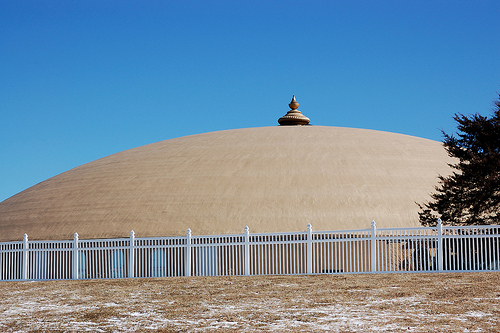
Today, the community holds most Kabbalat Shabbat services at Congregation Beth Shalom, a building that functioned as a Baptist church before the Jewish community purchased it in 1984. The unassuming synagogue looks like a place of Jewish prayer in any small Midwestern town. The ritual items and decorative symbols show no indication that most congregants are TM practitioners. Yet before Kabbalat Shabbat services, most Jews join communal meditation at one of Fairfield’s two gigantic golden domes.

The larger community of committed TM practitioners in Fairfield is disproportionately Hindu, due to the Hindu background of TM’s founder Maharishi Mahesh Yogi. Pictures of Hindu gods such as Rama and Ganesha appear in many places around Fairfield. Jewish TM practitioners explain with the regularity of a mantra that “TM is just a technique,” rather than a religious practice. “The important thing in the practice of TM is this experience of unbounded awareness. That reality is not a religious reality and has no connection with a specific religious tradition,” explained Rabbi Alan Green, who lives in Canada but has deep roots in Fairfield and is unofficially regarded by many as its rabbi. “Meditation was my chief inspiration for wanting to become a rabbi…I realized that this experience of unbounded awareness was the experience of God,” Green said.

“It’s like going to yoga class…it doesn’t mean that you are Hindu… You go on and go to shul afterwards,” said Kabuika Kamunga, a Jewish TM practitioner born in Kinshasa, Democratic Republic of Congo. She converted to Judaism after working as an au pair for a Jewish family and developed an interest in meditation from a TM practitioner “who was so calm … amid the family brouhaha” at a Passover Seder. In 2008, she went to MUM to get an MBA and learn meditation.

Robert Rabinoff, a frum Jewish TM practitioner, explains why the transition between Judaism and TM is so clean. “If you try and mix the two, both will suffer. But they’re pretty easy to not mix.”

Kamunga and Rabinoff both express the idea that TM makes one a “better Jew.” Each believes that TM prepares them for the kavanah (spiritual intention) of prayer, giving them the mindfulness for Jewish observance. Rabinoff explained, “TM makes the connection, opens the lines of communication. Our tradition tells you what to say.”

Joel and Joy Hirshberg’s home resembles those of other Jews who are serious meditators. A mezuzah greets one at the door. However, the house is built according to the principles of Sthapatya Veda, the architectural form based on the Maharishi’s teachings about natural law. Its entrance faces east, the direction of the rising sun. It has a kalash (cupola) on its roof, connecting the house to the cosmos, and a traditional vastu fence (picket fence) to define the homestead. The house has a Brahmasthan, an unobstructed center lit by a skylight, which gives the house wholeness.

When the couple hosts potluck dinners at their home on Shabbat, however, the space transforms into a typically Conservative minyan for services. Congregants read from Siddur Sim Shalom and recite much of the service in Hebrew. On many Shabbatot, cantor Haim Menashehoff, who grew up in Tehran, leads the congregation in Persian Jewish melodies as well as melodies common to American synagogues.

Anyone hoping for a service infused with the style of a kirtan mantra (a Sanskrit call-and-response chanting form) would be sorely disappointed. Tradition is alive and well in this otherwise nontraditional Jewish community.

Link to article: http://presentense.org/magazine/midwest-meditation.

A clarification from my side

Although the author wrote a very clear accurate article on this topic, he does make an inaccurate assumption—that most of the meditating community are Hindu because of TM’s founder, Maharishi Mahesh Yogi’s background—but this is just not the case.

Maharishi was a great scientist of consciousness. He taught a systematic method of meditation, a scientific understanding of it, and the nature and development of consciousness to its full potential. Is the theory of Relativity Jewish because Einstein discovered it? Is gravity English because Sir Issac Newton discovered it? Is genetics Catholic because Gregor Mendel discovered it? Maharishi’s cultural and religious background are separate from what he taught. In fact, he always said that Transcendental Meditation would allow people from different backgrounds to better understand and appreciate their own religion. That’s certainly been the case here as people from different faiths attend the church or temple, and in this case, synagogue, of their choice.

Actually, there are very few Hindus in Fairfield. But there are students from many different countries and faiths, including many from India and Nepal. The campus is multinational, like a miniature United Nations. Also, there are more restaurants per capita than San Francisco. For example, there are 3 Indian restaurants around the town square, including several Asian ones, not necessarily run by meditators. They all have posters on the walls from their religious and cultural heritage. So it is easy to imagine how the author could have come to such a conclusion.

There are, however, hundreds of Vedic Pandits from India who also practice TM that have been invited to help create world peace by adding their numbers to the overall effort. But they live completely separate from everyone on their own campus in Maharishi Vedic City, a few miles north of Fairfield, and are never seen in town. Oprah did meet with them during her visit here. It’s the last segment of her show.

Click here to see Video segments of Oprah’s Next Chapter on OWN: Oprah Visits Fairfield, Iowa—“TM Town”—America’s Most Unusual Town.

Video segments of Oprah’s Next Chapter on OWN: Oprah Visits Fairfield, Iowa—”TM Town”—America’s Most Unusual Town

March 30, 2012

Preview: Oprah Visits America’s Most Unusual Town Oprah spends the day in Fairfield, Iowa—one of the safest, greenest and most unusual communities in America. It’s the last place you’d expect to find two huge golden domes built for the thousands of residents who rush there to meditate twice a day. The full episode of Oprah’s Next Chapter aired on Sunday, March 25, at 9/8c.

Welcome to TM Town Fairfield is a quiet community nestled among the cornfields of Iowa. It’s also the center of the transcendental movement in the United States. Many of the 9,000 residents who live here meditate every day, including the Winer family. Watch as the Winers reveal why they left an affluent suburb outside of Atlanta to move to Fairfield. Plus, find out how the architecture of homes in Fairfield can improve a homeowner’s happiness.

The Architecture of TM Town Many homes in Fairfield, Iowa, are built in a style of architecture inspired by nature. Take a tour of one family’s home and learn about the theory behind its layout.

Fairfield’s One-of-a-Kind School The Maharishi School of the Age of Enlightenment uses “consciousness-based education” to teach children from kindergarten to 12th grade everything from college prep to spiritual awakening. Watch as Oprah tours the school and shares a meditation session with some of the older students.

16 Principles of the Science of Creative Intelligence The children at the Maharishi School of the Age of Enlightenment in Fairfield, Iowa, are learning life lessons it took Oprah decades to learn. Learn the 16 principles of the Science of Creative Intelligence for yourself.

Rush Hour in Fairfield, Iowa Rush hour in Fairfield, Iowa, is unlike any other town in America. Twice a day, residents stop what they’re doing and head to two giant golden domes to meditate. Watch as Oprah meets with the town’s mayor and a founder of a nearby community to learn more about the practice of Transcendental Meditation and then tours the Bagambhrini Golden Dome of Pure Knowledge for women.

Oprah Meets Iowa’s Pandits Pandits are professional meditators who practice Transcendental Meditation for hours a day in the name of world peace. For two to three years, many of these men from India devote their lives to this practice in the cornfields of Iowa. On the day Oprah visits, nearly 800 are in residence. They’ve never allowed television cameras to film them—until now. Watch as Oprah gets an unprecedented look into the life of a pandit.

Three excerpts from the show are posted on The Transcendental Meditation Program website — www.tm.org/oprah — Excerpt one: Oprah’s take on TM, Excerpt Two: Why our family meditates, and Excerpt Three: From Guns to TM.

The show, America’s Most Unusual Town, on Oprah’s Next Chapter, will rebroadcast Sundays, April 8 at 7:00 pm ET/6 CT and April 15, at 6 pm ET/5 pm CT. Last minute schedule changes do happen and so this info is updated.

Oprah’s Next Chapter America’s Most Unusual Town
Oprah spends the day in Fairfield, Iowa – one of the safest, greenest, and most unusual communities in America. It’s the last place you’d expect to find two huge, golden domes built for the thousands of residents who rush there to meditate twice a day. Read more: http://www.oprah.com/own-oprahs-next-chapter/Oprahs-Next-Chapter-Americas-Most-Unusual-Town

For more on Oprah’s Next Chapter visit http://www.oprah.com/OprahsNextChapter. Find OWN on TV at http://www.oprah.com/FindOWN.

Here’s an article posted on the TM Blog about the preliminary results of the show: TM’s Popularity Surges After Oprah’s TV Show.

To find out more about Fairfield and neighboring Maharishi Vedic City, visit http://discoverfairfield.org.

Transcendental Meditation: Good for Oprah and Start-ups, written by Peter Cohan for Forbes

March 27, 2012

Peter Cohan Peter Cohan, Contributor
I write from near Boston about startups and political economy
+ Follow on Forbes

Transcendental Meditation: Good for Oprah and Start-ups

Oprah Winfrey devoted her OWN show Sunday night to Transcendental Meditation (TM). But TM is not just for Oprah, it can help start-ups too.

At least that was the claim of Dr Sharda S. Nandram, Professor in Entrepreneurship at the University of Applied Sciences HAN, Associate Professor Entrepreneurship at Nyenrode Business University, and founder of Praan Solutions.

On March 21st, Nandram and I debated ”The Future of Entrepreneurship: Hungry start-upper vs Spiritual Entrepreneur” at EADA, a Barcelona business school. Nandram cited research in her talk that companies whose employees do TM have higher productivity.

Before getting into her remarks and my comments on them, it’s worth discussing what TM is and why it might help companies.

Twin Peaks director, David Lynch, is a fan and he claims that it turned him from an angry man into a happy one. As he told the Seattle Times, ”I was filled with an anger and sorrows and doubts and melancholy. And I took it out on my first wife. I made her life pretty much a hell. So I start transcendental meditation, and two weeks later she comes to me and says, ‘What is going on? This anger, where did it go?’”

The answer, it turned out, was TM. And for Lynch, his sister convinced him to take up the practice. According to Lynch, “One day my sister called, and she said she started TM, and I heard a change in her voice — more happiness, more self-assuredness. And I said, ‘This is what I want.’ Things lift away so naturally,” according to the Seattle Times.

For Nandram, start-ups benefit from TM specifically, and spirituality in general. Her talk on “spirituality and entrepreneurship” reflects her efforts to “see the person behind the entrepreneurs.” And she thinks “it is time to deepen the ‘inner box’, one may call intuition, reflective zone, inner sense, the area of mindfulness or authentic self.”

When my host, EADA professor Manuel Marin, asked me what I thought of the idea of spirituality and entrepreneurship my first thought was that I do not know what Nandram means by spirituality; however, I see two areas where things that might be related to spirituality factor into start-up strategy.

The first, as I posted March 25th, many entrepreneurs start companies not for money but to change the world. If entrepreneurs’ visions of what that world would look like end up improving life for other people, those start-up CEOs are using a kind of spirituality to attract and motivate top talent.

Furthermore, when entrepreneurs hire those people, they look for integrity. As I described in my book, Value Leadership, integrity means that people do what they say they will do. And in a start-up, integrity has a compelling business imperative — there is no time or money for people who can’t be trusted. That’s why it is so critical for company founders to conduct exhaustive due diligence on potential employees.

So I would argue that depending on your definition, start-ups that want to make the world a better place and hire people with integrity, do benefit from spirituality.

Moreover, if others get the benefits that David Lynch claims for TM, it’s worth investigating the notion that TM’s practice among a start-up’s employees could allow them to focus more on the task at hand, reduce their level of anger and distraction, and boost their productivity.

If such spirituality is good for business, bring it on.

Tall Poppies Magazine: Stress-free learning: Teaching children to meditate

March 26, 2012

The March 2012 issue of Tall Poppies, a magazine for the New Zealand Association for Gifted Children, contains an article, Teaching children to meditate, under Stress-free learning (pages 12-13). You can read the article with photos by downloading Tall Poppies: Stress Free Learning.

Teaching children to meditate

Stephen Benner explains how meditation is helping some New Zealand children to cope better with school.

Is it possible to make all kids smarter and happier than they are now?

Any teacher surveying the young faces of his or her class must often wonder why is it that certain students seem to understand the lessons more quickly and easily than the rest. All the children have two eyes, two ears and one brain – yet some young brains seem to work better than others.

Up until now, we have more or less accepted that the comprehension levels of a student are fixed. The accent in education has been on developing the quality of the information fed into those young brains, rather than developing the quality of the intelligence that is receiving that information.

Fair enough, because up until now there has been no reliable standard technology in the world of education for ‘upgrading the hardware’ within the cranium of each and every student. However, there is now a quiet revolution going on in a number of schools around the world that is challenging the notion of fixed intelligence and the inevitability of under-achievement.

This quiet revolution is being driven by the introduction of a simple, natural, mental technique utilised by all students and staff for a short period at the beginning and end of each school day. The technique is called Transcendental Meditation (TM for short), which has been available around the world in a standardised form for more than 50 years, although its origins go back to the ancient Vedic civilisation of India.

Since 1970, TM has been subjected to extensive scientific research; there is now a clear understanding of its effects both during the practice and as a result of the practice. During meditation, refined levels of mental activity are experienced with the outcome being greater ‘inner wakefulness’ and enriched brain functioning. Of interest to educators is the fact that EEG studies show that whole-brain functioning is enlivened during TM practice and that different parts of the brain begin to work in a more synchronous and orderly fashion. Higher levels of brain integration are associated with greater moral reasoning, emotional stability and decreased anxiety. Simultaneously, the physiology experiences a profound level of deep rest, whereby accumulated stress and tension is naturally alleviated, leaving one refreshed, relaxed and revitalised.

Over 340 peer-reviewed studies carried out at universities around the world have found a wide range of practical benefits resulting from the practice of TM, including increased creativity, focus, and memory; improved academic achievement; decreased stress, anxiety and depression; and greater happiness, coping ability and tolerance.

TM comes into the daily routine of a school in the first and last 15 minutes of the day during a period called Quiet Time, when students sit in their classrooms and practise the technique along with their teacher. Taught by qualified instructors, the programme is non-sectarian and is easily integrated into any public or private school curriculum. In our experience, when the programme is fully implemented, not only do the individual teachers and students flourish, but the entire school atmosphere becomes harmonious, happy, safe and conducive to learning.

As an example, when a South Auckland school decided to take on the TM Quiet Time programme a couple of years ago, the principal acknowledged that at that time the school was not a safe learning environment and was unable to provide appropriate strategies to manage the high levels of stress in the students’ lives. Lack of achievement was the norm, with only five per cent of students reaching the national standards for reading ability.

Since the introduction of the TM programme, there has been a major turnaround and the school now has a calm, peaceful environment. Teachers find the students interact with each other in a more positive fashion, and 49 per cent of students are now reaching or exceeding national standards in reading.

One staff member commented: ‘My students are focused and there is calmness about them. There has been a shift in their learning.’ In contemplating the beaming faces in front of her soon after the programme started, another teacher quipped: ‘Who are these kids . . . where has my class gone!’

By reducing the acute stresses that undermine learning and health, and by developing the full brain, the TM Quiet Time programme is a practical, highly effective approach to promoting learning readiness among students and thereby markedly improving their academic performance and success in life.

Do the claims stack up?

Sceptics query whether TM really works and say its effects are not scientifically proven. However, the New York Times recently reported the results of a study focusing on transcendental meditation, concentrated on a young healthy population.

The study, published in The American Journal of Hypertension, found that stressed-out college students improved their mood through TM, and those at risk for hypertension were able to reduce their blood pressure. It was carried out at American University in Washington, DC and included 298 students randomly assigned to either a meditation group or a waiting list.

Students who were at risk of hypertension and practiced meditation, reduced systolic blood pressure by 6.3mm of mercury and their diastolic pressure by 4mm of mercury on average, reported the Times.

It’s worked for us

Kataraina Nock, principal of Edmund Hillary School in Papakura, reflects on the changes engendered by teaching TM to her pupils.

Our school motto – bestowed by Sir Edmund Hillary at the official opening in 1963 – is ‘Aim High, Be Determined’. It presents a formidable challenge to all who have participated in the transformation process of turning around a school with a long history of failure. Now, in the sixth year of change, it is a much better place.

This is mainly attributable to the many people who have entered the gates with their hands up to help. They are all passionate, committed people who see a need and want to contribute. Among them is our Transcendental Meditation family, who began by training staff and later students. The Board, school, families and community have given their wholehearted support and the entire school has been practising the TM technique twice each day at school for the past two-and-a-half years. Yrs 1–5 students walk either inside or outside their classroom for five minutes with their eyes open and meditate. Students from Yrs 6–8 sit at their desks in the classroom, close their eyes and meditate for 12 minutes.

What have we noticed over those two-and-a-half years? The school is now a much more peaceful place most of the time. The number of incidents involving children in conflict has significantly reduced over time and there are no longer queues waiting to see the principal. Visitors make various comments about the tone of the school. Some say there is a feeling of ‘aroha’, others remark on how happy and friendly the children are. Those who know the history, comment on the remarkable change in the school environment.

Teachers report that students are more settled in class, have increased concentration and are doing their work better. This is evident in the changes in student achievement. In 2011, reading results school-wide showed some outstanding improvement. For example, in 2010, for Yr 4 Pacifika Boys, 87 per cent were below or well below the national standard, while 13 per cent were above. In 2011, for the same group, 86 per cent were reading at national standard and 14 per cent were above. As a result, by 2012 there were no children in this year group in need of additional learning support; they had moved from poor-achieving to high-achieving readers. The children themselves say they find it easier to study and they feel calmer, happier and less pressured.

Another significant difference now is the stability of staffing. Up until 2010, the recruitment and retention of quality teachers was a major issue. Now, in 2012, most of the teachers have been in the school for two years or more. All staff except for a new teacher this year have trained in TM.

We appreciate and value the opportunity we have been given as a result of the introduction of TM into Edmund Hillary School. We are aiming high and are determined to reach the top of the mountain, just as Sir Edmund Hillary did. Transcendental Meditation is helping us get there.

You can get more information at: www.stressfreeschools.org.nz

Tall Poppies is a quality magazine aimed at gifted children and their families, professionals in the field of gifted education, and the general public. It is published three times a year and posted to all NZAGC members (including overseas members) as part of their subscription.

America’s Most Unusual Town — Exclusive Webisodes from “Oprah’s Next Chapter”

March 26, 2012

America’s Most Unusual Town
Aired: 03/25/2012

About This Episode
Oprah spends the day in Fairfield, Iowa—one of the safest, greenest and most unusual communities in America. In the middle of corn country, it’s probably the last place you’d expect to find a dome and an evening traffic jam where thousands of the local population of 9,400 are headed to meditate.

Oprah’s journey begins at a unique school where twice-daily Transcendental Meditation (TM) is a mandatory part of the curriculum. Next, she visits the neighboring community of Maharishi Vedic City—named after the Indian guru who founded the TM movement. Here, nonorganic food is banned, and all houses face east, adhering to an ancient Indian architectural style that is said to bring peace and harmony to one’s surroundings. Maharishi Vedic City is also home to a top secret, 80-acre compound where 800 men from India live and spend eight hours a day meditating, chanting and studying. Cameras have never been allowed inside their community—until now.

Later, Oprah joins women from the community at the Golden Dome of Pure Knowledge for evening meditation—a powerful, energizing yet calming experience. Of that experience, Oprah says, “I walked away feeling fuller than when I came in, full of hope and a sense of contentment and deep joy, knowing for sure that in the craziness of the world that seems to bombard us at every angle, there is always the consistency of stillness.” http://www.oprah.com/own-oprahs-next-chapter/Oprahs-Next-Chapter-Americas-Most-Unusual-Town

Exclusive Webisodes:

The Architecture of TM Town:
Tour a family’s home built around the concept of nature-based architecture

Many homes in Fairfield, Iowa, are built in a style of architecture inspired by nature. Take a tour of one family’s home and learn about the theory behind its layout. http://www.oprah.com/own-oprahs-next-chapter/Exclusive-Webisode-The-Architecture-of-TM-Town-Video

16 Principles of the Science of Creative Intelligence
:
The 16 lessons Oprah says it took her decades to learn

The children at the Maharishi School of the Age of Enlightenment in Fairfield, Iowa, are learning life lessons it took Oprah decades to learn. Learn the 16 principles of the Science of Creative Intelligence for yourself. http://www.oprah.com/own-oprahs-next-chapter/Exclusive-Webisode-Sixteen-Principles-Video
Welcome to TM Town
Welcome to Fairfield! Meet a family who uprooted their entire lives to move here—and couldn’t be happier. Fairfield is a quiet community nestled among the cornfields of Iowa. It’s also the center of the transcendental movement in the United States. Many of the 9,000 residents who live here meditate every day, including the Winer family. Watch as the Winers reveal why they left an affluent suburb outside of Atlanta to move to Fairfield. Plus, find out how the architecture of homes in Fairfield can improve a homeowner’s happiness.
Fairfield’s One-of-a-Kind School
Take a tour of Fairfield’s one-of-a-kind school. The Maharishi School of the Age of Enlightenment uses “consciousness-based education” to teach children from kindergarten to 12th grade everything from college prep to spiritual awakening. Watch as Oprah tours the school and shares a meditation session with some of the older students.
Rush Hour in Fairfield, Iowa
Witness Fairfield’s nontraditional rush hour and learn more about what Transcendental Meditation means. Rush hour in Fairfield, Iowa, is unlike any other town in America. Twice a day, residents stop what they’re doing and head to two giant golden domes to meditate. Watch as Oprah meets with the town’s mayor and a founder of a nearby community to learn more about the practice of Transcendental Meditation and then tours the Bagambhrini Golden Dome of Pure Knowledge for women.
 
Oprah Meets Iowa’s Pandits
They meditate for hours each day in the name of world peace. Meet the pandits of Iowa
Pandits are professional meditators who practice Transcendental Meditation for hours a day in the name of world peace. For two to three years, many of these men from India devote their lives to this practice in the cornfields of Iowa. On the day Oprah visits, nearly 800 are in residence.  They’ve never allowed television cameras to film them—until now. Watch as Oprah gets an unprecedented look into the life of a pandit.
More on Transcendental Meditation

For a review of the show, see this HuffPost article by : Oprah’s Next Chapter: Meditation—In ‘America’s Most Unusual Town’.

Excerpts from the show will soon be available for streaming on http://www.tm.org/oprah.

Please refer to the OWN TV schedule on the website to see if the show will be airing again. The schedule is subject to change so continue to check the site for updates: http://www.oprah.com/own/tv-schedule/index.html. Also check the specific show section on Oprah.com/own to view the latest videos, and the FULL EPISODE section: http://www.oprah.com/own/episodes.html.

See this more recent post with all the Video segments of Oprah’s Next Chapter on OWN: Oprah Visits Fairfield, Iowa—”TM Town”—America’s Most Unusual Town.

Des Moines Register: Oprah in Iowa: Fairfield meditation segment airs Sunday

March 24, 2012


Oprah in Iowa: Fairfield meditation segment airs Sunday

By TODD ERZEN | FILED UNDER – News | 1:28 PM, Mar. 23, 2012

The media icon paid a stealthy six-hour visit to the Maharishi University of Management last October and will tell the country about her newfound devotion to Transcendental Meditation at 8 p.m. on Sunday as part of her new weekly series, “Oprah’s Next Chapter.”

Fairfield Mayor Ed Malloy, who took the media mogul on a tour of one of the university’s golden domes before she meditated there with about 400 other women, said Winfrey already had a working knowledge of Transcendental Meditation based on her experience with inner-city school systems.

The practice has been introduced there to children suffering from academic and behavioral problems with the help of Maharishi board of trustees member David Lynch, the television and film director whose private foundation promotes “Consciousness-Based Education and World Peace.”

“It’s had phenomenal results (in schools) and I think she became intrigued by that,” said Malloy, who has practiced Transcendental Meditation for 38 years. “Oprah’s bright and energetic and gregarious and thoughtful and provocative and we are honored and tickled to be featured by her in this way.”

Watch a sneak preview of the show

Sneak Preview: Oprah Visits America’s Most Unusual Town

Oprah spends the day in Fairfield, Iowa—one of the safest, greenest and most unusual communities in America. It’s the last place you’d expect to find two huge golden domes built for the thousands of residents who rush there to meditate twice a day. Watch a sneak preview; then tune in for the full episode of Oprah’s Next Chapter on Sunday, March 25, at 9/8c.


Transcendental Meditation first came to Fairfield by way of the Maharishi Mahesh Yogi, who gained international fame as the guru to the Beatles before transforming the bankrupt Parsons College property into his namesake university in 1974.

In 2001, the Maharishi’s followers incorporated their own town, called Maharishi Vedic City, about two miles north of Fairfield. Sales of non-organic food are banned and buildings are designed to follow principles the Maharishi established, such as facing east and featuring a golden roof ornament. About 1,300 people live there, and an estimated one-quarter of Fairfield’s 10,000 residents also practice Transcendental Meditation.

Winfrey has tried to make a similar impact on her employees by encouraging them to meditate twice during each work day.

Paul Chesnutt-Winer, who hosted Winfrey in his home and will be featured with his family on Oprah’s television show, said the practice of Transcendental Meditation could not have made a better friend.

“She’s an amazing combination of being a strong, executive woman and really a lot of fun,” he said.

See this earlier post by Todd Erzen on Mar 22, 2012 with links to a preview of the show and interview with Dr. Oz on Oprah’s visit to Fairfield and company-wide practice of the Transcendental Meditation technique. Fairfield sees itself through Oprah’s eyes on Sunday.

For information on Transcendental Meditation, visit www.tm.org.

Related articles: Chicago Sun-Times: Oprah will talk about transcendental meditation on OWN | The Fairfield Ledger:Fairfield readies for Sunday debut on Oprah network | OWN: Oprah Visits America’s Most Unusual Town, Sunday, March 25, 8 p.m. CT, 9-10 p.m. ET/PT | KTVO: Fairfield to be featured on Oprah Winfrey Network | Oprah writes in O Mag about her visit to TM Town and meditating with ladies in their Golden Dome | Some Reports on Dr. Oz’s Interview with Oprah about TM and her Next Chapter | Oprah meditates with ladies in MUM Golden Dome | Reports of Oprah’s visit to Fairfield, Iowa | Oprah says she and her staff meditate, enjoy a Quiet Time twice a day—Facebook Live interview. Also see The Iowan: Sizing Up Small Towns: Rethinking Success in Rural Iowa: Fairfield Thinks Inclusively.