The hauntingly beautiful music of Davy Spillane played on uilleann pipes and low whistle

March 21, 2016

When it comes to Celtic music, my favorite musician is Davy Spillane on uilleann pipes and low whistle. His music is hauntingly beautiful! It goes straight to the heart. Here are some of my favorites, and related covers.

Most of us in Fairfield know about this unique Irish instrument from Tim Britton who performs at various concerts in town. But hearing Midnight Walker really captured my attention! It’s how I discovered Davy Spillane.

I also found this amazing Tribute to Davy Spillane by Christelle Berthon playing Midnight Walker on both harmonica and recorder.

A beautiful lament played by Davy Spillane is Bill Whelan’s Caoineadh Cu Chulainn (The Cry Of Cú Chulainn), part of the Riverdance performance.

I heard Davy play May Morning Dew on a wind instrument. Intrigued, I wanted to know more about it and discovered the low whistle. You can see him play this nostalgic tune at the start of this video clip from a live concert by Moving Hearts, a band Davy had been a part of decades ago. The lucky crowd waited 20 years for this 2007 reunion concert! Astounding performance! It sounds a register higher than the recording, making it more haunting. A video was made of that historic concert called Moving Hearts Live In Dublin. It’s also on Spotify. The audio of May Morning Dew (6:05) from the record is posted on YouTube.

A shorter version (4:24) with video taped by someone in the audience is posted as Moving Hearts feat. Davy Spillane. The quiet intro was not recorded and the long audience applause at the end was cut short. The sound quality is obviously not as good as the professional recording, but it gives you an idea of what it looked and sounded like live from a lucky fan who recorded and shared it along with a few other tunes from that memorable concert. Be prepared to turn down the volume as it’s loud. 

Other artists’ versions

May Morning Dew is an old traditional song, which reminisces about the past. You can hear it sung by the great Irish singer Dolores Keane.

Here’s a newer version beautifully sung by Siobhan Miller with her amazing band taken from the forthcoming album All Is Not Forgotten.

She later posted this live version performed in Glasgow August 2020. The 9-song CD, All Is Not Forgotten, is now available on YouTube.

Added over 6½ years later: Karen Matheson sings ‘Crucán na bPáiste’ with a Gaelic band. Brendan Graham tells how the song chose him as a conduit. Truly beautiful and sad.

Added 7 years later: Jeff Beck Live 2022 played Midnight Walker, third tune in his Full Show at The Woodlands, TX. Jeff Beck played Mna Na Hereann with Celtic violinist Sharon Corr and an uilleann piper Live in London Aug 24, 2011. Jeff also played Women of Ireland (Mná na hÉireann) Live at Madison Square Garden 2013.

See this post created for him after he died: The virtuosity and versatility of Jeff Beck was unique among rock guitarists. One of the best!

I added this two and a half years later: Enjoy my favorite Jeff Beck pieces from Live at Ronnie Scott’s: Cause We’ve Ended As Lovers, Blanket featuring Imogen Heap, Where Were You.

Other amazing artists I’ve been inspired by and written about are also available in the Archive of the ‘Music’ Category on The Uncarved Blog.

— Written and compiled (citing sources) by Ken Chawkin for The Uncarved Blog.

Billy Collins interviews Sir Paul McCartney about writing songs, poems, Beatles music, and more

March 21, 2016

On October 23, 2014, Sir Paul McCartney visited Rollins College at the invitation of Rollins Winter Park Institute Senior Distinguished Fellow Billy Collins. In this interview Paul shares some interesting stories from his life as a Beatle, how he wrote songs with John Lennon and by himself. He answered students’s questions and concluded by singing Blackbird.

Nancy Shevell’s son, Arlen, Paul’s stepson, was a student at Rollins at the time. The following year, at Arlen’s private graduation party in May 2015, Paul had asked to sing with the local band Nancy had hired. Josh Walther and The Phase5 Band shared their amazement online!

I discovered some surprising connections between Nancy Shevell and Barbara Walters, and with Paul McCartney’s first wife, Linda McCartney. See Who Is Nancy Shevell, Paul McCartney’s New Wife?

You may be interested to read The Story Behind Paul McCartney’s Song: “Let It Be.” See other posts about Paul McCartney on The Uncarved Blog, and poems by Billy Collins, including video interviews and readings.

Ottumwa Courier photojournalist Rachel Leathe @courierrachel takes a tour of MUM @MaharishiU

March 19, 2016

Rachel Leathe, photojournalist for the Ottumwa Courier called to take a tour of Maharishi University. She had recently transferred to the Courier from Montana and was curious to visit the campus. Click here to see what she put together as it appeared online with 6 photographs from various campus locations. Click here to see 61 more photos at their online photo gallery. And here is a PDF of the article, which took up the back page of the Thursday, March 10, 2016 issue: A tour of MUM.

A tour of MUM

AmineKouider:RachelLeathe:The Courier

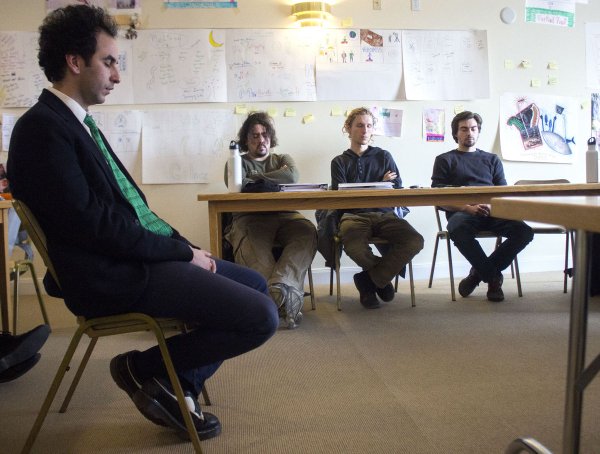
Amine Kouider, Science and Technology of Consciousness Instructor, meditates with his class before lunch on Feb. 23, 2016. This is the first class that these David Lynch Master Film students are taking and is also the first class that all students at MUM are required to take. RACHEL LEATHE/ THE COURIER

Walking around the Maharishi University of Management campus in Fairfield, you may imagine you’ve somehow been transplanted to a Buddhist temple or an Indian yoga retreat. You certainly wouldn’t expect to find yourself on a college campus in rural Iowa.

Maharishi Mahesh Yogi set up his first university on a small campus in Santa Barbara, CA in 1973. He dreamed of creating a new kind of university, one that not only offered a traditional education but also focused on what he called a “Consciousness-Based education.” One of the main features of this kind of education was Transcendental Meditation.

In 1973 Parsons College went bankrupt due to a myriad of issues including overspending, a sharp drop in enrollment, and a deep deficit. At the same time, Maharishi University was rapidly outgrowing its Santa Barbara campus and looking for a new home. In the summer of 1974, with the help of private benefactors, MUM was able to purchase the former Parsons College campus and move in.

Every new student at MUM is required to first take a class on TM. The class guides students through a seven-step learning process which explains the theory behind TM, the benefits of TM, and teaches students different techniques to help them meditate. Ken Chawkin, Publicist for MUM and TM practitioner for the last 49 years, says that “after meditation, one comes out recharged and more wide awake.” He says this is particularly beneficial to students because it makes them more receptive to what their teacher is saying.

International students make up a little over 75% percent of the MUM student body and on average represent about 85 different countries. MUM offers Bachelor’s, Master’s, and Doctorate degrees, similar to most other US colleges. However unlike most universities, nearly 70% of MUM’s students are pursuing their Master’s degrees.

Another unique aspect of MUM is that it operates on a block system. Instead of taking four or five classes at once, “which is very stressful,” Chawkin says, students “go much more deeply into that particular subject.” They attend this one class Monday through Friday, usually from 10 am to around 3 pm with a break for lunch and two daily meditations. Students are also usually expected to attend an additional Saturday morning class.

MUM campus dining services also sets MUM apart by only serving completely organic, vegetarian food. The kitchen receives a small portion of their food from the campus organic farm ran by Director of MUM Farms, Steve McLaskey, PhD. The rest of the produce they receive is from local organic farmers and from a couple outside providers. Executive Chef, Suresh Miller says that the biggest difficulty with an all organic, vegetarian menu is finding a wide variety of vegetables, “Like you can’t get asparagus in the winter time. Whereas meat you can buy all winter long, no problem.”

One Comment was posted so far by TLGreen:
Great article and gleaning of SE Iowa history. I moved to Fairfield in 2004 to attend MUM from Oregon. I was in a grad program at the [ ] and had no intention of changing schools…and then I came to visit Fairfield. I was so impressed by the level of regard to education, for students well being and for the commitment to organic food and lifestyle that my life was forever changed. I loved my experiences and studies at MUM – I was able to be that curious, motivated and engaged student that I longed to be, but struggled with the intense pressures of a traditional & unhealthy grad program.

See Rachel’s photo essay on the March Fairfield 1st Friday’s Art Walk.

Related: ABC News reports on Maharishi University in Iowa.

Anthony Howe’s 3-D kinetic metal sculptures will leave you mesmerized as they dance in the wind!

March 5, 2016

Metal sculptor Anthony Howe lives on Orcas Island in Washington state. He goes to great lengths to build the world’s most mesmerizing kinetic sculptures. Mr. Howe is featured on Great Big Story, a video network dedicated to sharing curious and compelling stories about the untold, overlooked and amazing humans, and the incredible things they do.

In this video, These Kinetic Sculptures Hypnotize You, Anthony explains his reasons for building these elaborate and involving wind sculptures.

What I’m trying to do with the work is cause people to stop whatever thought process they have in their head, and just for a moment, experience a different kind of reality, maybe more meditative. They work! They take people out of their, whatever nonsense is going on in their heads, puts them in a different place. It’s a feeling you get when you see something that is very beautiful or unusual. That’s what I’m trying to do with the work.

And he succeeds! You have to see these wind sculptures move to appreciate what he’s saying. How much more powerful though must it be to experience them in person! Yet, this video, with the editing, music, and voice-over, creates its own special effect. Expand it to full screen mode and enjoy! Same with the others posted or mentioned below.

I did more research and found this wonderful articlewrote forCOLOSSAL, which contains 3 moving GIFs and 3 videos: Hypnotic New Kinetic Sculptures by Anthony Howe.

Enjoy this inspiring video Elizabeth Rudge made called A Kinetic Mind. The music of Erik Satie’s Trois Gymnopédies fits perfectly into this dreamscape about the life and work of Anthony Howe.

The Creators Project: Anthony Howe’s 3D Kinetic Sculptures
“What matters is putting human feeling into your design.”

Laughing Squid, an art, culture & technology blog, posted this video feature by The Creators Project: Artist Anthony Howe Talks About His Stunning Wind Sculptures. They  also posted an earlier piece on Howe’s hypnotic sculpture work. Here’s the Vimeo description to this interview profile: Anthony Howe’s massive kinetic wind sculptures resemble alien creatures. Step inside Howe’s studio to learn how the awe-inspiring works are created, what makes a good wind sculpture and why Howe believes it’s important for his work to emulate human feeling.

Insider also posted a profile:

The Artist’s Website, Statement, YouTube, and Pinterest

Check out Anthony Howe’s website: www.howeart.net where his works of art are described as abstract, organic kinetic sculptures from various metals and polymers. His artist’s Statement clearly explains how and why he creates these pieces. That section also tells how he started out as a watercolor artist and evolved into the kinetic sculptor he is today.

Kinetic sculpture resides at the intersection of artistic inspiration and mechanical complexity. The making of one of my pieces relies on creative expression, metal fabrication, and a slow design process in equal parts. It aims to alter one’s experience of time and space when witnessed. It also needs to weather winds of 90 mph and still move in a 1-mile-per-hour breeze and do so for hundreds of years.

Click on any of the sculptures shown on his website and they will open up with details about each one and a video. He also has a few of them posted on his own YouTube channel at Anthony Howe. There are additional images and videos on Pinterest: Anthony Howe Sculpture.

“Meditation Creativity Peace”—A documentary of David Lynch’s 16-country tour during 2007–2009

March 3, 2016

Between 2007-2009 the iconic American director David Lynch made a series of trips to 16 countries in Europe and the Middle East to talk about Transcendental Meditation, Creativity, and Peace.

Wherever he went David was met by hundreds of fans and honored by several film societies. He spoke with heads of state, educators, the press, and local meditators inspiring them to form peace-creating groups.

Footage from these events was taken by film students and film institutes in cities on the tour and sent to David, who, along with his editor, turned it into the film titled, “Meditation Creativity Peace.”

Interwoven throughout the documentary is an excellent interview with a French journalist at an historic art studio in Paris where David goes to create his lithographs. Besides being a talented creative artist in various visual media, David is also an excellent teacher. The way in which he illustrates and explains how TM works and what it can do for us as human beings is absolutely brilliant!

The film premiered in various cities and countries to raise funds for the David Lynch Foundation to help teach Transcendental Meditation to at-risk students everywhere. Meditating celebrities joined David at the LA premiere. See some of the coverage and interviews below. The film is now posted on the DavidLynchFoundation YouTube channel for all to see: David Lynch – Meditation, Creativity, Peace; Documentary of a 16 Country Tour [OFFICIAL].

Here are a few related posts on this subject: David Lynch addresses Israelis on Skype call after they see his film Meditation Creativity Peace | David Lynch speaks with Alan Colmes about his 16-country tour film Meditation Creativity Peace | Russell Brand and David Lynch at LA Premiere of ‘Meditation, Creativity, Peace’ Documentary | David Lynch, Russell Brand, Bob Roth Q&A after screening Meditation, Creativity, Peace documentary at Hammer Museum | Watch the trailer for a new documentary film on David Lynch titled “Meditation Creativity Peace”.

This article beautifully complements the film: David Lynch on meditation in the NewStatesman: Heaven is a place on earth. It includes the diagram and reads like a transcription of David’s brilliant explanation woven throughout the documentary film. 

This earlier article is also very interesting: Celeb Spiritual Report: One significant day in my life by David Lynch for Jane Magazine (May 2004).

See a rare look at David Lynch in this documentary made by Richard Beymer: “It’s a Beautiful World.” New film shows David Lynch retracing Maharishi’s footsteps from North to South India and the start of the TM movement.

Read inspiring excerpts from an earlier post on David Lynch’s book, Catching the Big Fish: Meditation, Consciousness, and Creativity.

David’s explanations on TM & Creativity from the Documentary

The complete brilliant explanation that David gave the French interviewer about TM was incorporated in sections into the documentary. It was filmed at Idem Printing Studio in Paris, where David works on his own art projects. Someone later edited those segments together and added a background soundtrack in this video: David Lynch explains Transcendental Meditation. Several years later, this talk was posted minus the distracting music: David Lynch gives a profound description of Transcendental Meditation.

That brilliant answer David gave a film teacher’s question at the Majestic Theater in Boston shown in the documentary, of whether TM could help her and her students, has been excerpted and posted as: David Lynch on Consciousness, Creativity and the Brain (Transcendental Meditation).

It was later brilliantly animated to David’s voice as David Lynch On How Meditation Can Change Your Life–Transcendental Meditation & Creativity.

They were all included in this Spanish website, IDEAS, by Juan Carlos Sosa Azpúrua on noviembre 1, 2019: Lynch: Meditación trascendental.

Sr. Azpúra also posted recent videos of David Lynch receiving his honorary Oscar at the Governors Awards, with introductions by Isabella Rossellini, Laura Dern and Kyle MacLachlan, and David Lynch‘s short acceptance speech.

Great interview by Paul Zollo for American Songwriter: A Q&A With Director, Songwriter David Lynch, on David’s birthday, January 20, 2020.

There is hope for family caregivers burning out taking care of their elderly infirmed loved ones

February 18, 2016

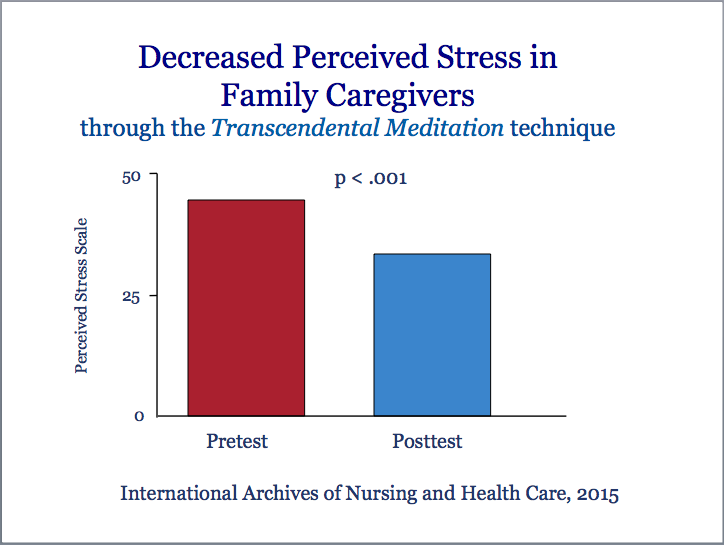
Millions of Americans looking after elderly infirmed family members at home suffer from impaired immune function, heart disease, and other factors resulting in a higher mortality rate. A new study finds Transcendental Meditation reduces stress in family caregivers.

Decreased Perveived Stress in Family Caregivers

Perceived stress was assessed using Cohen’s Perceived Stress Scale (PSS). Results showed significant reductions due to practice of the TM technique.

A pilot study published in International Archives of Nursing and Health Care (Volume 1, Issue 2) found the Transcendental Meditation technique helped reduce stress associated with care-giving over a two-month period. Research, involving 23 caregivers looking after a family member or friend with Alzheimer’s or other chronic medical conditions, found improvements in perceived stress, spiritual well-being and mood assessed by standard instruments. Qualitative evaluation suggested improvements in energy level and resilience and reduced psychosocial stress. Link: bit.ly/1oNH7kt.

See the EurekAlert! press release with graphs, links, and personal accounts from several caregivers looking after loved ones at home.

The study was funded by the David Lynch Foundation.

# # #

Increased spiritual well-being in family caregivers due to the TM technique

This scale shows an increase in caregivers’ spiritual well-being—a sense of meaningfulness in life and faith or optimism in the future—due to TM.

PRWEB: MUM Researchers Find Transcendental Meditation Reduces Stress in Family Caregivers. Researchers at Maharishi University and Kaiser Permanente Northwest found Transcendental Meditation reduced the stress associated with caregiving. A pilot study involving 23 caregivers taking care of a family member with Alzheimer’s or other chronic medical conditions experienced reduced perceived stress, improved well-being and mood over a two-month period.

http://www.prweb.com/releases/TMhelps/Caregivers/prweb13212998.htm

# # #

Some news reports: TMhome.com | Medical News Today | PsychCentral.

In related news, read about The first Transcendental Meditation elective course offered at a major US medical school, and this Excellent article on Transcendental Meditation written by Sarah Klein in Prevention Magazine.

Maharishi University places 23rd in top 30 great small colleges for certain personality types

February 18, 2016

Here is an interesting ranking of a select number of colleges based on a specific personality type. I’ll copy the introduction for you and include the description and ranking for Maharishi University of Management. MUM is in good company!

30 Great Small Colleges for ESTP Personality Types

Published February 2016

In this ranking, we focus on 30 great small colleges for the ESTP personality type.

About ESTP Personality Types

The ESTP Personality is referred to as “the Entrepreneur” and considered an Explorer. These are people who are smart, perceptive, energetic, bold and original. Some of their best attributes include their excellent sense of humor, their perception skills, and their excitement for life. They have an innate sense of when something, even something minute, is different. School can be a challenge for the ESTP learner, not because of a lack of intelligence, but rather their love of learning by doing. They are people who often subscribe to the motto “rules are made to be broken.” This Myers Briggs Personality type is a risk taker and loves to push boundaries. They can sometimes be seen as insensitive or impatient and their risk taking can lead to trouble. In some instances they can even be seen as defiant.

An ESTP loves to think on their feet and make decisions in the moment. They are extremely social people and love to network and use their social intelligence. Some of the careers for ESTP learners include sales, marketing, business, athletics or exercise profession, entrepreneurship, environmental studies, sustainability studies, coach, sports medicine and athlete. Typically the ESTP career is that of a leader, and not a subordinate.

Best Majors for the ESTP Personality

Each of the Myers Briggs Personality types has a number of career options that are best suited for their specific personality characteristics. ESTP’s may choose to major in a field where they can put their best skills to use. They will hone in on their social prowess and their quick thinking. They are people with naturally born business savvy and an innate ability to negotiate successfully with others. These traits are ideal for the ESTP majors of business, marketing, sustainability, environmental science, exercise or sport science and entrepreneurship.

Qualities or the Best College for the ESTP Personality

For each of the unique Myers Briggs personalities, there is a learning environment that will most ideally allow them to use their individual strengths and interests. For example, an ESTP will benefit from a learning environment that is not restrictive. A smaller learning environment is ideal so they have plenty of opportunities to put their natural leadership skills to work. A college with many opportunities to interact socially will also be a great college for ESTP learners. Those schools with opportunities to participate in athletics will be a huge benefit for ESTP athletes.

For information on how we selected these 30 schools, see the methodology statement at the end of the ranking.

#23 – Maharishi University of Management – Fairfield, Iowa

Maharishi University of Management Best ESTP CollegePoints: 9
University Website

Maharishi University of Management is a pioneering academic institution with great pride in their eminent quality of life. There are a number of unique elements that make this school one of the best for ESTP learners. Students can become active in many extra-curricular activities such as:

  • Helping provide sustainable organic produce in the vegetarian kitchen
  • Opportunities to meditate on campus
  • The ability for students to focus on their studies one at a time

For those non-traditional students who might be juggling work and school, or those who benefit from a more relaxed pace, this school could be an ideal choice. For more than 40 years, Maharishi University of Management (MUM) has forged the way with a cutting edge approach to learning, creating Consciousness-Based℠ education. All students and faculty at MUM practice the Transcendental Meditation® (TM) technique, a simple meditative technique. Research has shown that this meditative model leads to integrated brain functioning, increased creativity and intelligence, reduced stress, improved learning ability, improved academic performance (GPA), improved ability to focus, improved health, and many more. MUM offers bachelor’s, master’s, and PhD degrees in a wide range of traditional fields, such as business, media and communications, art, literature, education, and computer science. The school has also developed several new and exciting disciplines as well, including sustainable living and Maharishi Vedic Science.

ESTP majors with an interest in business can pursue a Bachelor of Arts (BA) or a Master of Business Administration (MBA). The BA in Business Administration program prepares students to be leaders in the private or public sectors. The MBA program prepares students to compete effectively in the job markets and to engage in high-level operational and strategic management teams.

ESTP majors with a passion for sustainability will thrive in the Master of Arts in Sustainable Living major program. MUM defines Deep Sustainability as:

  • Going beyond efficiency and substitution to radically re-design systems from the ground up
  • Creating deeply resilient communities, able to adapt to any disturbance
  • Promote individual and social transformation from the deepest level – the level of consciousness
  • Some of the unique features of this graduate level sustainability program include:
  • Enjoy a unique learning environment that enables every student to thrive
  • Work on student-driven projects integrated into each course
  • Move through the course sequence together with other students as a team
  • Cohort system

Enrollment: 1,454
Cost of Attendance: $18,784
Overall School Accreditation:
Northwest Commission on Colleges and Universities (NWCCU)
US News and World Report Ranking: Not Applicable
Inclusion on National Ranking Lists:
Best Colleges: 25 Best Colleges for Non-Traditional Students—Ranked #2
Number of ESTP Majors Available: 2

Excellent article on Transcendental Meditation written by Sarah Klein in Prevention Magazine

February 14, 2016

Preface: Electrical Analogies

Rosenthal_N

Norman Rosenthal

I find it fascinating that Norman Rosenthal and Jerry Seinfeld have come up with their own opposite electrical analogies to describe how Transcendental Meditation works — as both a surge protector and a battery charger!

People exposed to continual stressful trauma suffer from PTSD. Dr. Norman E. Rosenthal says Transcendental Meditation is like a surge protector against stress. First it calms the amygdala; it turns down that alarm bell where there no longer is a fire.

Jerry Seinfeld

Jerry Seinfeld

And equally important, TM acts as a buffer against future stressful reactions. The nervous system becomes more resilient to stressful stimuli; they’re no longer interpreted as such. The individuals have normalized.

Jerry Seinfeld compares TM to a phone charger for your whole body and mind. He reminds us how we charge our cellphones and then use them throughout the whole day. That’s what TM does for him. It sets him up for his day fully charged until his next TM session to recharge.

Prevention Magazine article on Transcendental Meditation

Bob Roth

Bob Roth

Rosenthal was interviewed and Seinfeld mentioned in an excellent article for Prevention Magazine by staff writer Sarah Klein. It’s nicely designed with graphics, photos and relevant links to cited studies and video clips.

Others interviewed were Bob Roth, executive director for the David Lynch Foundation, and Sandy Nidich, professor and researcher at Maharishi University of Management. Others referenced and linked to are Ellen Degeneres, Jim Carrey, and Oprah Winfrey.

Klein seems to understand her subject even though she probably has not experienced it. Her writing is clear and objective. She’s done her homework when it comes to the science, and integrates her interviewees remarks to full advantage. It’s a pleasure to read a TM article like this when someone gets it right!

Enjoy reading This Is Your Brain On Transcendental Meditation.

For information on Transcendental Meditation visit www.tm.org.

Transcendental Meditation at Prevention R3 Summit

A month before the Prevention Magazine article, Bob Roth was invited to give a talk on Transcendental Meditation at the 3rd annual Prevention R3 Summit. He spoke January 15, 2016, the opening night of the Summit, at ACL Live in The Moody Theater in Austin, Texas. Check the DavidLynchFoundation YouTube Channel for a description of his talk. Austin Art Examiner writer Nicolette Mallow was there and interviewed Bob Roth for her article on this self-transcending form of meditation that can transform people’s lives for the better.

In related news, read about The first Transcendental Meditation elective course offered at a major US medical school.

Jennie Gritz explored the use of TM in education in her article for The Atlantic: Quiet Time Brings Transcendental Meditation to Public Schools.

Haiku of Santa Barbara Riviera in the morning

February 13, 2016

My son takes photos of the changing panorama before him throughout the day and night looking out from the hills of the Santa Barbara Riviera. Today he posted this beautiful early morning image on Instagram. It inspired this haiku.

image

Photo by Nathanael Chawkin

Santa Barbara Riviera Haiku

mystical seascape
white waves rolling in to shore
morning mesa mist

© Ken Chawkin
February 13, 2016

See a haiku, Translation, inspired by a painting of Egrets by Australian artist Gareth Jones-Roberts. The poem was published in two poetry anthologies. Nathanael also likes that combination so I’m mentioning it.

About 6 years earlier, Nathanael had lived in San Leandro as an uchideshi. I had visited him there and witnessed his Sensei demonstrating Aikido, which inspired this tanka, My Son’s Sensei. Someone posted it with a tree that reflected the image in the poem. Nathanael happened to be visiting the dojo and sent it to me. Perfect fit!

The first Transcendental Meditation elective course offered at a major US medical school

January 30, 2016

The January 2016 issue of Chicago Medicine, (Vol 119, issue 1), a publication of the Chicago Medical Society and the Medical Society of Cook County, published two related articles on the Transcendental Meditation technique and medical education. This is the first time TM has been offered as an elective course for medical students in a major US medical school! http://ssom.luc.edu/meditation

How This Happened
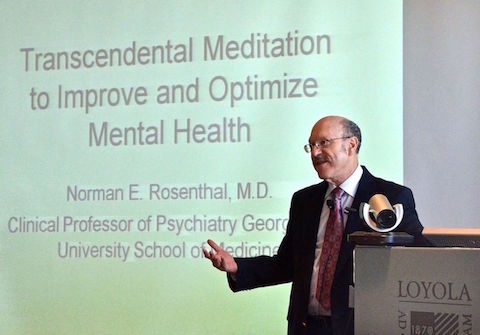
Dr. Norman Rosenthal speaks on TM at Stritch small

I asked TM Teacher Carla Brown how this came about and she explained the back story. Stritch alumnus James Bray MD had sent a letter to his colleague, Dean Linda Brubaker MD, urging her to host George Washington University clinical professor of psychiatry, Norman Rosenthal. Dr. Rosenthal’s talk about the Transcendental Meditation technique and its impact on health moved Linda and Vice Dean of Education Gregory Gruener to invite Duncan and Carla Brown to teach them and their students to meditate. Stritch School of Medicine is the medical school affiliated with Loyola University Chicago.

Since that time a team of MDs and TM teachers have guided Stritch students. The program really took off when Richard Carroll MD, ScM, FACC, joined Duncan and Carla Brown and Deans Gregory Gruener MD and Aaron Michelfelder MD.

“Dr. Carroll helped us create a flexible, blended curriculum,” said Carla. “Students start the TM technique throughout the year as they are free to do so and are able to either attend the five classes given by leading doctors and researchers held throughout the year, or review one or more classes on-line.”
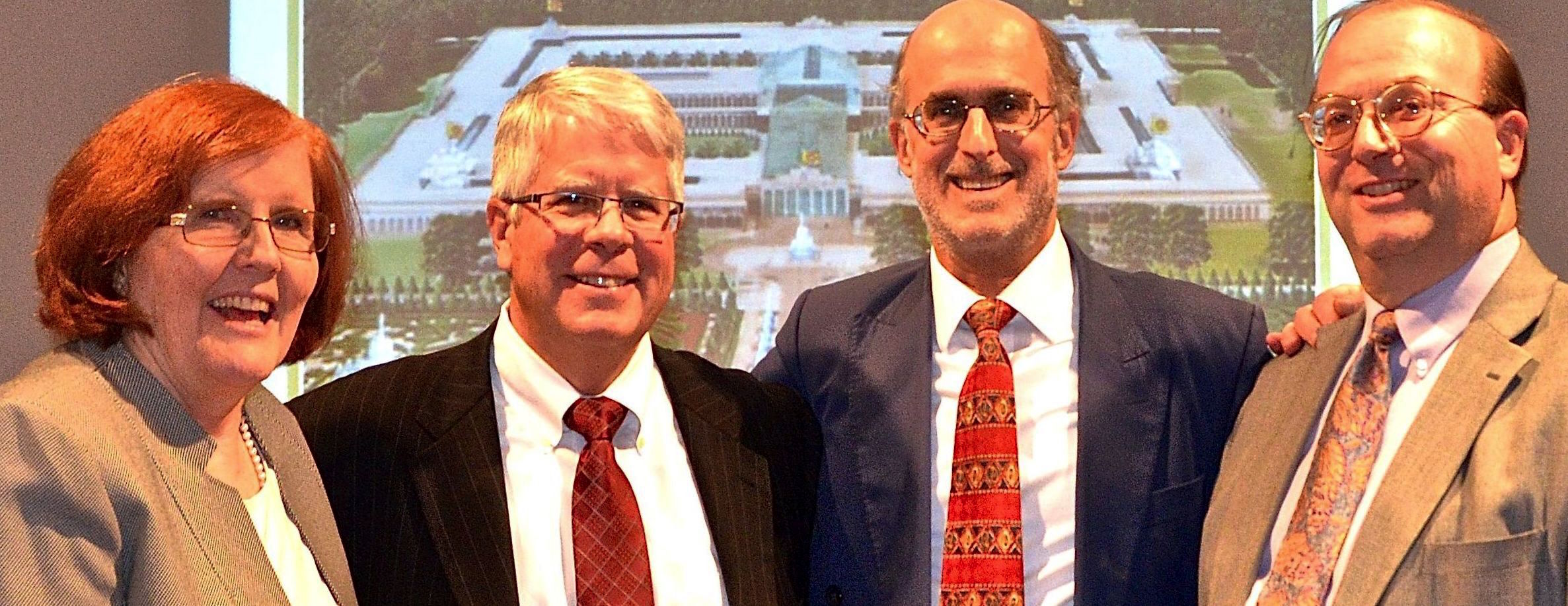
C. Brown,R. Carroll, R. Schneider, D. Brown

Dr. Carla Brown, Dr. Richard Carroll, Dr. Robert Schneider, Duncan Brown

In this picture Dr. Carla Brown, Dr. Richard Carroll and Duncan Brown welcome Robert Schneider MD, FACC (second from right). Dr. Schneider is director, Institute for Natural Medicine and Prevention, Maharishi University of Management, and has led CVD experts and medical researchers from around the country in conducting NIH-funded research over the last 20 years.

Chicago Medicine TM Articles

The first article, Physician, Heal Thyself: Stritch School of Medicine students give new meaning to the adage, was written by Carla L. Brown, EdD, and Gregory Gruener, MD. Students at the Stritch School of Medicine learn about the science and methodology behind the Transcendental Meditation technique in the first TM elective course offered at a major medical school in the United States.

Carla L. Brown, EdD, is an adjunct professor at the Stritch School of Medicine and director of the Center for Leadership Performance, Chicago. Gregory Gruener, MD, MBA, is vice dean for education, and the Ralph P. Leischner, Jr., MD, Professor of Medical Education, and professor and associate chair of the department of neurology at Stritch. The authors conclude with Implications for Patients and Physicians.

Our experience with beginning years of MDED-400 is that students can easily take control of their own wellness by gaining deep rest and improving brain functioning with twice daily TM practice. Attending physicians and students report that TM has added balance to their lives.

Having TM as a tool means our students can recommend something that they know will help, based upon their own experience and upon substantial evidence. They can avoid burnout and maintain their enthusiasm for practicing medicine. They can also become the role models we all aspire to be. Our students have demonstrated that we can join them in restoring our own balance, enthusiasm, and mastery.

The medical profession is in desperate need of support. We’re told, “Physician, heal thyself.” But how? Stritch students have demonstrated that TM might just be the prescription to help answer this charge, by making our profession a more rewarding experience while also offering something of great value for our patients.

Maura Tresch, MDThe second article, The Supporting Science: Multiple studies show the Transcendental Meditation technique can reduce stress, anxiety and cardiovascular disease risk, was written by Maura Tresch, a student who graduated from the program and is now a global health scholar and family medicine resident at St. Vincent’s Medical Center in Jacksonville, Florida. She ends her article with this valuable advice: Take Care of Yourself.

By recommending TM we can inoculate our patients against stress and its associated effects. With TM we do not “manage” stress—we get rid of it. With the stress gone, the health of the body and mind can improve. This is the essence of preventive medicine.

I have been told that “you cannot help others before you help yourself.” When we take an airplane flight, the stewardess tells us that in the event of an emergency, we are to put on our own oxygen mask before we help someone else. To properly care for my patients, I must first care for myself so that I can give them my best possible attentive mind.

Click here to read both articles on pages 22-27. The first one describes the Stritch TM elective, launched in 2014-2015, how the course came about, some of the structure and content, and guest lecturers. It contains photos and some amazing anecdotes from former students now practicing physicians who benefited from TM in challenging circumstances.

Editor’s note: The Chicago Medical Society advocates for 17,000 Chicagoland physicians and their 5 million patients. This issue was mailed to 9,000 physicians, available to patients in their waiting rooms.

Media Response

NPR – WBEZ – The Morning Shift

On Wednesday, February 24, 2016, Chicago NPR station WBEZ’s Tony Sarabia interviewed Dr. Carla Brown and med student Dani Terrell on The Morning Shift. Here is the interview with the lead-in on SoundCloud. Their website introduces this 4th segment of their show: How Loyola’s Meditating Med Students Are Transcending Stress.

The Stritch School of Medicine at Loyola University is the first major medical school in the country to offer a class in Transcendental Meditation. We talk to course instructor Dr. Carla Brown and second-year medical student Danielle Terrell about the class, why it’s being offered, and how the students are using the TM technique to manage the stress and workload of their demanding educational program. [Listen here.]

It’s not easy to get into medical school. Carla said 10,000 students apply to Stritch School of Medicine. They are whittled down to 6,000 and 10%, or 600, are selected for interviews, with only 160 admitted. So Dani represents the cream of the crop!  Listen to her comments in this 15-minute interview.

PBS – WTTW – Chicago Tonight

On Thursday, February 25, 2016, WTTW (PBS 11) Chicago Tonight host Phil Ponce spoke with Linda Brubaker, MD, Dean of Loyola University’s Stritch School of Medicine; Carla Brown, TM Teacher and adjunct professor of the Physician Wellness Program; and Danielle Terrell, a 2nd year med student, about this topic. Watch this impressive interview here.
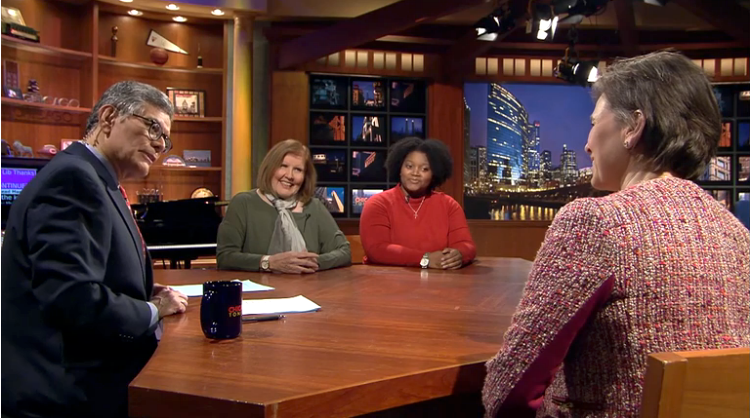
Chicago Tonight-Physician Heal Thyself

Phil Ponce, Carla Brown, Danielle Terrell, Dean Linda Brubaker, MD.

Phil starts by asking Dean Brubaker why the Stritch School of Medicine decided to introduce this course, and she replies that “this is really a no-brainer” for them, ‘there’s no risk to this,” that they want their “students to learn self-care so that they can become resilient doctors, and Transcendental Meditation is one of the things that can help them get there. We want to bring them to their highest potential in spirit, mind, and body, and this hits all of those.”

Thinking it may be an odd course to be teaching at a medical school, Phil asks the Dean how colleagues at other schools are reacting. If anything, she says, they’re getting a lot of calls and emails asking, “Where can I learn this? How can I get on the bandwagon?” She explains, “They see the benefits in our students, staff, and faculty; it has made a big difference at our medical school. This is a core of how we teach our students self-care. And who wouldn’t want a doctor who’s taking good care of themselves, and has more to give to their patients?”

Dean Brubaker elaborates more when Phil asks why the medical profession is so stressful. She tells him it’s “high-stakes work” to properly diagnose, treat, and help patients get well. “It takes a lot of technical skill, a lot of cognitive skill, and continuous learning for the 25, 35, 45 years that you’re practicing as a physician. That’s a long time to be in a high-stakes situation. And it’s important that you learn self-care so that you don’t burnout, that you remain resilient, that you exhibit outstanding professionalism the whole time you practice as a physician.”

Here was the original introduction (PDF), and the newly updated PDF of that show segment. Click the title to see this stellar 12-minute interview: Loyola University Offers Medical Students Meditation to Combat Stress

UPDATES

Members who attended the July meeting of the Association of American Medical Colleges, Vancouver 2016, each received copies of the Chicago Medicine articles. All incoming and existing medical students at LUC/SSOM will receive copies as well. Both students and faculty have been learning TM, and more will start in the next school year.

On August 22, 2016, the Loyola University Health System Newsroom seemed to follow my lead by boldly issuing this press release: LOYOLA FIRST MEDICAL SCHOOL IN COUNTRY TO OFFER ELECTIVE IN TRANSCENDENTAL MEDITATION  an accomplishment they should really be proud of!

A similar situation in military education is taking place at Norwich University. See Norwich University, oldest private U.S. military college, benefits from Transcendental Meditation.

In related news: There is hope for family caregivers burning out taking care of their elderly infirmed loved ones. Also read this Excellent article on Transcendental Meditation written by Sarah Klein in Prevention Magazine. Posted Oct 31, 2017: Central Saanich Police Service and Area Police Officers Benefit from #TranscendentalMeditation.

On September 16, 2017, David Orme-Johnson, PhD gave the first talk in this year’s lecture series to medical students enrolled in the TM program at Loyola University Chicago’s Stritch School of Medicine. He delivered a two-part presentation. Part 1: The Effects of TM on Brain and Cognitive Processes, and Part 2: Effects of TM on the Autonomic Nervous System and Health. Dr. Orme-Johnson reviewed a large body of research showing TM as a powerful tool that can help medical students and doctors reduce stress and improve their ability to assimilate large amounts of information. Click on this title to read his comprehensive presentation filled with graphics: What does 47 years of research tell us about the Transcendental Meditation technique?

On October 15, 2018, the Catholic Health Association of the United States published this excellent article in Catholic Health World: Medical students learn meditation to counter stress, promote physician wellnessSave

On January 20 and 27, 2021, Dr Tony Nader, MD, PhD, made presentations at LOYOLA University Chicago Stritch School of Medicine via Zoom: 1) Psychiatry Grand Rounds, Loyola University, for medical doctors and health care professionals: Effectiveness of the Transcendental Meditation Technique for Dissolving Stress and Improving Health and 2) The Purpose of Meditation: Physician Wellness through the Transcendental Meditation Technique.

On February 13, 2023, Dr. Tony Nader Q&A with Medical Students. In this episode, Dr. Nader answers questions from medical students at Loyola University Chicago Stritch School of Medicine. He’s joined by Fred Travis, the Director of the Center for Brain, Consciousness, and Cognition at Maharishi International University, and Richard J. Carroll MD, ScM, FACC.