Archive for the ‘Writing’ Category

INSPIRATION, a poem by Nathanael Chawkin

January 25, 2012

“Be patient, listen quietly, the writing will come. The voice of the writing will tell you what to do.” — Donald M. Murray, America’s writing teacher.

I came across a poem my son Nathanael wrote 20 years ago, a month after he turned eleven. A few weeks into the school year, his Grade Six teacher at Maharishi School gave the students a writing assignment. Their homework was to write a poem for class the next day. The pressure was on. I don’t recall much of the details, but I do remember Nathanael saying he had a problem with this. We discussed it. He felt strongly that you couldn’t force a poem into existence; it had to come naturally, from inspiration. I agreed and suggested he express that idea somehow in his poem. He was determined to send his teacher a message. What he wrote blew me away. He was inspired!

INSPIRATION

A poem comes naturally,
Not forced, not assigned, not sought for.
A poem should be inspired,
Not under pressure, surely not, for,
A poem is spontaneous, creative. How?
It is the nature of the poem to slip out.
That’s what you must allow.
So sit back and relax
For you must be patient,
And of course, do not rush.
A poem comes naturally,
Here it comes,
Hush.

© Nathanael Chawkin
September 24, 1991

This idea of allowing, even encouraging writing to come spontaneously reminds me of a poem written by William Stafford—A Course in Creative Writing, in response to educators at a conference expecting writing instructors to clearly spell out how and what their students should write, and by implication, to praise or blame them accordingly. This left no room for students, or their teachers, to express their own creativity, and no guidance to help them find their own voice, something that was not part of their methodology.

Stafford was about process, not necessarily product, and acted more as a facilitator than an instructor. He tried hard to not offer any praise or blame, fearing students would then write to please him and not themselves. He also avoided giving students any grades in his classes. I think they would grade themselves or each other based on their evaluation of their work. You can imagine the frustration this must have caused the administration. He was considered an odd ball, a heretic to the status quo at that time. But that would change. His approach would start a revolution in the teaching of creative writing.

This poem, William Stafford—You and Art, speaks volumes about the writer who is open to “making mistakes” and following his own voice down new paths of expression. It’s a beautiful description of the maturation of an artist and the source of inspiration. You can read more William Stafford poems on my blog.

Another great exponent of teaching writing was Donald M. Murray.  A journalist, Murray was invited to teach journalism at the University of New Hampshire. He admittedly knew nothing about teaching, but was obviously an accomplished writer, having won the Pulitzer Prize for editorial writing in 1954 at the age of 29. So he looked to his own process as a writer and broke it down into the different stages he would go through to end up with a polished piece of writing.

One of Murray’s earliest books, Learning By Teaching, is a selection of articles on writing and teaching. It’s filled with examples of the steps he would go through as a writer, writing and rewriting to gain clarity; the stages of teaching he evolved through, from lecturer, to modeler, to facilitator, to getting out of the way; and quotes about writing by other writers. We used it as our textbook in a workshop to become writing facilitators. We learned how to conduct writing conferences to help students with their writing. The course taught me a lot about the craft of writing, the different stages, from pre-writing, to draft, to rewriting, editing, to final draft, and the teaching of it.

A comprehensive book on Murray and his work was published October 2009 by Heinemann: The Essential Don Murray: Lessons From America’s Greatest Writing Teacher. I love the opening quote from the book’s press release: New book offers lessons from writing teacher Don Murray. It affirms my son’s sentiment: “Be patient, listen quietly, the writing will come. The voice of the writing will tell you what to do.” — Don Murray.

Murray helped Donald Graves with his writing. Graves started a revolution by watching how young children wrote in school. He brought what he had learned from Murray into the classroom and taught teachers how to become writers themselves, then how to apply this approach with their students. Read this excellent article by Kimberly Swick Slover about Graves called The Write Way. It also mentions how Murray turned him into a writer. Same thing in this excellent video interview with Donald H. Graves and Penny Kittle.

Now creative writing classes are student-centered and process-oriented, with teachers openly modeling their own process as writers, and facilitating students to do the same, allowing and enabling them to become genuine writers, from draft to publication.

Although I never had the opportunity to meet or study with either Murray or Stafford, both were seminal influences. They acted as a guide from the side, not a sage from the stage. They taught about writing as writers and poets in classes, workshops, and through their articles, interviews, books and poems. I thank them for helping me, and thousands of other writers and teachers, to better understand the writing process.

Here is one of my first poems on the subject, Writing—a poem on the writing process. After the poem, I add a short piece about Murray and Stafford. I would share these poems and thoughts with Nathanael. It seemed to have gone deeply into him. Like father, like son.

Other inspiring posts about writing are: Writers on Writing–What Writing Means To Writers, Elizabeth Gilbert—Some Thoughts On Writing, and Words of Wisdom on Writing from Literary Lights. You may also enjoy Burghild Nina Holzer inspires us to write and discover who we are and what we have to say.

Also see A Tanka about my son’s Aikido teacher.

A new post: The perils of praise or blame for young writers. New ways to help students find their own voice.

Singing Image of Fire, a poem by Kukai, with thoughts on language, translation, and creation

January 2, 2012

We read in Genesis that creation came into being with the first utterance: “Let there be light.” So sound came first, then light, followed by forms. Interestingly, the seemingly nonsensical phrase, abracadabra, a magician says when performing a trick, derives its meaning from the ancient biblical language, Aramaic: abraq ad habra, which means, “I will create as I speak.” I discovered that on page 170 of Poemcrazy: Freeing Your Life with Words, a delightful book on finding and writing poetry in many creative simple ways, by Susan Wooldridge, writer, poet and teacher.

This poem by Kukai says a lot about language, creation, consciousness, and our integral relationship to things.

Singing Image of Fire

A hand moves, and the fire’s whirling takes different shapes,
Triangles, squares: all things change when we do.
The first word, “Ah,” blossomed into all others.
Each of them is true.

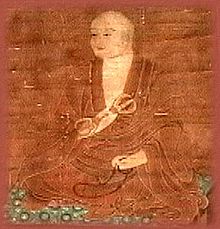
This poem on language, translation, and creation, the pictorial/written representation of vocal sounds and meanings, was written by Kūkai (空海), also known posthumously as Kōbō-Daishi (弘法大師 The Grand Master Who Propagated the Buddhist Teaching), 774–835, a Japanese monk, civil servant, scholar, poet, artist, and founder of the Shingon or “True Word” school of Buddhism. He allegedly developed the system using Chinese characters to write Japanese words. The word “Shingon” is the Japanese reading of the Kanji for the Chinese word Zhēnyán (真言), literally meaning “True Words”, which in turn is the Chinese translation of the Sanskrit word mantra (मन्त्र). The concern was to be as true as possible when translating texts, to have and use the right word when describing something. The Sanskrit language had this perfect one-to-one correspondence between name and form.

The poem was mentioned in Nine Gates: Entering the Mind of Poetry (HarperCollins, 1997) by Jane Hirshfield, a classic collection of essays about the mysterious ways poetry comes to us. In her chapter, The World is Large and Full of Noises: Thoughts on Translation, she highlights this theme with What Rainer Maria Rilke inscribed on the copy of The Duino Elegies he gave his Polish translator.

When I read that line in Kukai’s poem, about the first word, “Ah,” blossoming into all others, and each of them being true, it reminded me of what Maharishi Mahesh Yogi says about the first sound of creation, “A”, how it represents infinity collapsing to a point, “K”, and through its own sequential self-interacting dynamics, creates the whole alphabet, words, verses of Rk Veda, the whole Vedic literature, and their subsequent forms, the universe. This is part of Maharishi’s Apaurusheya Bahashya, the unwritten commentary of the Veda, unfolding itself and commenting on itself to itself. Apaurusheya Bhashya: Rk Veda is said to be nitya, eternal, and apaurusheya, uncreated. Maharishi explains that the sequential unfoldment of Rk Veda is its own uncreated, or unmanifest, commentary on itself, rather than that of an individual making an ‘external’ commentary on Rk Veda.

See Maharishi’s Apaurusheya Bhashya discussed in Everything is made of Vedic Sounds by William F. Sands, PhD. Also see Modern Science and Vedic Science: An Introduction by Kenneth Chandler, PhD.

In his Introduction to Maharishi Vedic University, Maharishi gives us a comprehensive cosmic perspective on the role Sanskrit, the language of Nature, plays in the process of creation. Through the self-interacting dynamics of pure consciousness, the Self, or Atma, reverberates within itself and creates the eternal uncreated sounds of the Veda, its own language, which in turn express themselves into forms—the individual body, Sharir, and the cosmic body, Vishwa. The eternal Silence and its own inherent Dynamism, evolve all parts of itself constantly referring them back to their source. He says it’s a start-stop process of Infinity collapsing to a point, referring it back to Itself, and evolving the next sequential sound, and subsequent form. Full realization, or enlightenment, comes when one comprehends all of creation: Atma, Veda, Sharir, Vishwa, Brahman, or Totality, as the full potential of one’s own consciousness. Aham Brahmasmi. I am totality.

On Page 65 Maharishi writes, “The basic process of change, this basic process of transformation, continuously maintains the momentum of evolution of different levels of expression, creating different levels of manifestation upholding the process of evolution.

“It is this that promotes the eternally self-referral dynamics of Samhita into the sequential evolution of sound, speech, forms of speech in alphabets, words, phrases, verses etc., with corresponding material forms. This process continues eternally, resulting in the ever-expanding universe.” (Samhita is the togetherness of Rishi, Devata, Chhandas; knower, process of knowing, and known.)

I’ve written a poem about this process in Coalescing Poetry: Creating a Universe, (into haiku forms).

To learn more about the source of words, creation, both literal and literary, and their connection to consciousness, read: The Flow of Consciousness: Maharishi Mahesh Yogi on Literature and Language.

Also see: Before He Makes Each One by Rainer Maria Rilke.

Nine years later I posted: Japanese culture: poetic aesthetics, artistry, and martial arts, inspired me to write haiku and tanka.

Words of Wisdom on Writing from Literary Lights

December 30, 2011

Maria Popova

Maria Popova – Maria Popova is the editor of Brain Pickings, a curated inventory of miscellaneous interestingness. She writes for Wired UK and GOOD, and spends a shameful amount of time on Twitter. All Posts | Email Popova

What sleep and plagiarism have to do with the poetry of experience and the experience of poetry
 
advicetowritersresize.jpg

I recently stumbled upon a delightful little book called Advice to Writers, “a compendium of quotes, anecdotes, and writerly wisdom from a dazzling array of literary lights,” originally published in 1999. From how to find a good agent to what makes characters compelling, it spans the entire spectrum of the aspirational and the utilitarian, covering grammar, genres, material, money, plot, plagiarism, and, of course, encouragement. Here are some words of wisdom from some of my favorite writers featured:

“Finish each day before you begin the next, and interpose a solid wall of sleep between the two. This you cannot do without temperance.” ~ Ralph Waldo Emerson

“Begin with an individual and you find that you have created a type; begin with a type and you find that you have created—nothing.” ~ F. Scott Fitzgerald

“Don’t ever write a novel unless it hurts like a hot turd coming out.” ~ Charles Bukowski

“Breathe in experience, breathe out poetry.” ~ Muriel Rukeyser

“A short story must have single mood and every sentence must build towards it.” ~ Edgar Allan Poe

“You never have to change anything you got up in the middle of the night to write.” ~ Saul Bellow

“Immature poets imitate; mature poets steal.” ~ T. S. Eliot

“Fiction is a lie, and good fiction is the truth inside the lie.” ~ Stephen King

“Good fiction is made of what is real, and reality is difficult to come by.” ~ Ralph Ellison

“The problem with fiction, it has to be plausible. That’s not true with non-fiction.” ~ Tom Wolfe

“You cannot write well without data.” ~ George Higgins

“Listen, then make up your own mind.” ~ Gay Talese

“Find a subject you care about and which you in your heart feel others should care about. It is this genuine caring, not your games with language, which will be the most compelling and seductive element in your style.” ~ Kurt Vonnegut

“Write without pay until somebody offers pay; if nobody offers within three years, sawing wood is what you were intended for.” ~ Mark Twain

brainpickingslogo.jpg

This post appears courtesy of Brain Pickings, an Atlantic partner site.

Image credit: Knopf

This article available online at: http://www.theatlantic.com

Here’s a good resource of Writers on writing – an updated reading list of 70 notable meditations by Bradbury, Didion, Sontag, Hemingway & more http://j.mp/1huxG1S posted by Maria Popova @brainpicker.

A Haiku on The Heart of Haiku

December 18, 2011

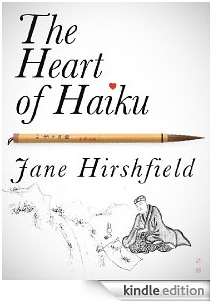
This week I discovered and posted the Interview from FROGPOND with Jane Hirshfield on The Heart of Haiku. I had read Nine Gates: Entering the Mind of Poetry by Jane Hirshfield, a classic collection of essays about the mysterious ways poetry comes to us, and had thoroughly enjoyed it. So this first Kindle Single by Jane on haiku looked very enticing.

On Friday night, after reading a free sample of The Heart of Haiku, named “Best Kindle Single of 2011,” I decided to purchase this 29-page essay about the life and poetry of Matsuo Bashō, recognized as the master of concise, compelling Japanese haiku. I downloaded the free App from Amazon, then bought the $0.99 Kindle Single. It loaded instantly. I signed in, and started reading. It was that simple.

Saturday I took my computer with me when I went to visit my friend Sali. I explained what I had done, showed her what the essay looked like in the Kindle Cloud Reader on my computer, how it allowed me to select the look of the page, (I chose Sepia), change the size of the font and length of the lines, highlight and make notes. I continued reading, aloud to Sali, where I had left off at home. We were fascinated!

Bashō had discovered the earlier Chinese and Japanese poets, wrote renga, tanka, and haiku, became a poet and teacher, studied Zen and Taoism, indulged his senses, then lived like a monk roaming the countryside. We appreciated the beauty, simplicity and depth of his poetry, and the skill of Jane Hirshfield’s erudite explanations, herself a poet, teacher, and practitioner of Zen. It seemed appropriate for her to explain where Bashō was coming from. Hirshfield had collaborated with Mariko Aratani, her co-translator for the classical-era tanka poets in The Ink Dark Moon.

It was dinner time and the other residents were already eating their meal. An aide brought in Sali’s tray, but we were enjoying the story so much I just kept on reading and lost track of the time. I happened to mention that and realized I was speaking out what could easily become a haiku. Sali has that effect on me; she’s my muse! So here’s the haiku on reading The Heart of Haiku to Sali.

A Haiku on The Heart of Haiku

We forgot to eat
Reading The Heart of Haiku
It can fill you up

Also see the excellent Poetry Foundation biography on Jane Hirshfield, including poems, articles and more; Pirene’s Fountain: Jane Hirshfield on Poetic Craft; and What Rainer Maria Rilke inscribed on the copy of The Duino Elegies he gave his Polish translator. You can find some of my own haiku and tanka under My Poems.

— — —Save

Twelve years later I discovered Pebbles – Brief poems by Jane Hirshfield posted on March 6, 2023 by briefpoems. In this excellent post, the blogger mentions this Amazon Kindle single under the subheading of Matsuo Bashō and goes on to explain this about the title.

Jane Hirshfield was unhappy with the title: my title was Seeing Through Words: Matsuo Basho, an Introduction. I think that tells you quite a lot about how I see this piece: I would never myself have made such a grand claim for it as The Heart of Haiku does. 

You can read a pdf of the short book posted by The Haiku Foundation: Seeing Through Words: Matsuo Bashō.

Interview from FROGPOND with Jane Hirshfield on The Heart of Haiku

December 15, 2011

where the writers are

Interview from FROGPOND with Jane Hirshfield on The Heart of Haiku

Blog Post by Jane Hirshfield – Oct.25.2011 – 6:22 am

The new issue of the Haiku Society of America’s excellent FROGPOND journal is out. The following interview appears there.

“At the Heart of The Heart of Haiku: An Interview with Jane Hirshfield”

This interview was conducted by email in August, 2011.

CE: Thank you, Jane, for agreeing to this interview. I think your Kindle Single, The Heart of Haiku, will be of interest to many haiku poets, as will your comments about this essay. You have a long history of printed publications, and you have described yourself previously as someone who is not especially comfortable with computer technology. What prompted you to circulate The Heart of Haiku as a Kindle Single?

JANE: Thank you—I appreciate the chance to talk about this with what I see as this piece’s most natural audience, the haiku community.

Bringing this piece out as a Kindle Single was an experiment—I had never read an e-book myself before this came out. I have to admit, I don’t really like reading on-screen. But many others do, and mostly I did this because the description for the Single program fit exactly what I had: an essay-lecture too long for publication in any magazine, but not long enough for a formal printed book. I had thought about expanding it into a regular book—but I’d have needed to polish many more of the new translations I’d done (with the invaluable help of Mariko Aratani, my co-translator for the classical-era tanka poets in The Ink Dark Moon), and I’d also have needed to round the book more fully. I do now wish I had put some back matter into even this Single—a “further resources” section, for instance. But I never could quite decide to expand it, the piece stayed on my desk, and when the suggestion to submit this to the new Kindle Singles program came up, I took it almost on impulse. I didn’t actually expect them to accept it—it’s by far the most literary thing on their list so far. And then from acceptance to publication was dizzyingly fast—two weeks, including their copyediting, which was, by the way, very good. So I didn’t have any time for anything but the quickest final pass.

You know, Basho himself might have been one of the first to buy an iPad or Kindle. He was never without the books of earlier Chinese and Japanese poets he loved, and I imagine would have been happy to carry less weight in his knapsack. He was, throughout his life, both practical and what’s now called “an early adopter”—haiku anthologies were the first broadly popular printed books in Japan, so Basho, who published in them and also brought one out himself, was participating in the leading-edge technology of his time. One thing I muse over in The Heart of Haiku is that Basho, today, might have been the first person to take You Tube videos and turn them into a true art form. What he did feels comparable to that, to me.

There are so many superb books on Basho already, I’m not sure the world needs another. That was always one of my hesitations about turning this into a book. I do retain all the rights, and will quite likely include this in my next book of essays. That way it will reach more people who don’t already know about haiku—which is what I first wrote it to do. And the Kindle Single did do that—a truly startling number of people have bought it so far, in only two months. I’m sure it helps that it costs only 99 cents, and can be downloaded onto any computer almost instantly. I hope some of them may continue to pursue that curiosity further.

CE: I understand that this project began as a presentation for the 2007 Branching Out series of poetry lectures held in public libraries around the country, a program co-sponsored by the Poetry Society of America and Poets’ House. How would you characterize your initial audience? How much did you revise the presentation before it was published by Amazon? For instance, to what extent was this project originally conceived of as a way to help people better understand and appreciate haiku as readers or as casual writers of haiku-like poems? Do you feel that the current version is at least as much directed toward those who already write haiku as it is toward the initial audience?

I was asked by the Branching Out program to give a talk for the general public—for people who might not have read much poetry, let alone haiku. I tried to do that—to find ways to open the field to newcomers—but poetry is a universal language, whose very point is that it does not simplify; it expands, saturates, investigates, faces many directions at once. I tried to make the original talk something that would be interesting to both kinds of audience—new, and informed—and truly, there isn’t that much of a gap. You’re always a beginner, entering a poem. A poem asks an original, unjaded presence, some state that includes both informed awareness and the erasure of preconception.

I have polished the piece quite a lot since the original lecture, but that’s just what I do with anything I write, poetry or prose. I’d gone over it again just this past February, when I was asked to lecture on Basho at a Japanese university. As to whether I changed it to make it more useful for serious writers of haiku, no, not specifically. I myself don’t make that strong a distinction between looking at poetry as a writer and as a reader. Every serious writer needs also to read alertly, with a real depth of attention—both her or his own work, and the work of others; and every act of reading a poem is a recreation of the original energies of its writing—that is what a poem is: not a record of thought, experience, emotion, realization, but a recipe for its own reenactment.

CE: You have extensive knowledge about poetry in general and haiku in particular, including a knowledge of the history of haiku in English. Where do you see this book fitting in among some of the other work on haiku in English (for instance, Eric Amann’s The Wordless Poem; R. H. Blyth’s Haiku in 4 volumes; Harold G. Henderson’s Haiku in English; and William J. Higginson and Penny Harter’s The Haiku Handbook to name just a few foundational texts in this field)?

And where do you see this essay fitting in among other considerations specifically focused on Basho’s life and work (Robert Aiken’s A Zen Wave; Haruo Shirane’s Traces of Dreams; Makoto Ueda’s Basho and His Interpreters come to mind among others)?

Those books are indispensable, and many were part of my own introduction to haiku and, I’ll add, to poetry as a whole: the first book of any kind I ever bought for myself, at age eight, was a Peter Pauper Press book of translated Japanese haiku. We should add also the many translations of Basho’s poetry now in print. I recommend them all—I think that to understand anything, especially when there are large leaps of culture and time and translation involved, the most accurate understanding comes from looking at multiple sources. There is no single “best” authority. If you can’t read Basho, Issa, Buson, or Yosano Akiko in the original, then reading them through many eyes is best.

As for how my contribution fits in, The Heart of Haiku was retitled by Amazon when they took it for the Kindle Singles program; my title was Seeing Through Words: Matsuo Basho, an Introduction. I think that tells you quite a lot about how I see this piece: I would never myself have made such a grand claim for it as “The Heart of Haiku” does. My piece is introductory, not exhaustive, and its angle of entrance is historical, through Basho, not haiku in general, though to read Basho you have to understand what haiku are, and how they work, and what they can hold at their best. Basho himself, though, is a perennially useful lens, since haiku as we now know it was so radically changed by Basho, generally described as its “founder,” even though the form existed before him. For current, American writers of haiku, The Heart of Haiku is really a way to look back to the rootstock, to refresh their relationship with how haiku was first conceived by its extraordinarily radical and continually evolving founding figure. Basho himself was concerned with so many of the issues that current haiku writers are concerned with—how to write in this moment’s language and perception, how to learn from the past without being bound by it, how to use haiku as a tool not only for expression but for the navigation of a life. I still read Sappho and Homer, I still read Su Tung Po and Dante, and I still read Basho and Issa and Buson. These are wellspring poets for me. Basho’s teachings about writing are as relevant and provocative now as they were when he was alive. “Poetry is a fan in winter, a fireplace in summer.” “To learn of the pine, go to the pine.” “Don’t imitate me, like the second half of a melon.” His navigation of the creative life and poverty, his restless curiosity, his losses, even his death was exemplary, really—Basho’s last spoken words take the point of view of the flies his students were trying to chase from the room. They show how supple and compassionate a poet’s sense of existence can be.

CE: The Ink Dark Moon, it’s been said, helped inspire what’s become a working community of tanka writers, both in the U.S. and in Australia. How do you see  your role here, as a poet, translator, and teacher?

JANE: I might not have published this Basho piece at all, except that people who’d heard it or read it in manuscript kept telling me both that they loved the translations and that it does bring something new to the table. That it was helpful. That’s my hope for anything I do, though I write my own poems outside of any hope, or intention, beyond the needs of that particular poem and moment. I translated Basho’s haiku freshly mostly because I found I couldn’t use other people’s translations for the original talk—not because they weren’t good, just because, once you’ve done some translating, you understand how much more intimate an entrance to a poem that is. I am tremendously lucky that my old co-translator, Mariko Aratani, agreed to re-join me for this project. As a teacher of poems, I’ve been investigating the deep workings of poetry for almost forty years now, both Japanese and Western. I believe in the happy accidents of cross-fertilization and that different traditions have always informed one another. There are two essays in Nine Gates: Entering the Mind of Poetry that talk about Japanese poetics and translation. My interest is always the same: in how poems work, precisely, in why they affect us they do, and in bringing in whatever background helps us read more vulnerably, openly, accurately, and deeply. I think this is especially needed for haiku. We teach haiku to third graders, but in fact it’s an art form that requires some real initiation to be truly practiced or read. Haiku are the most immediate of art forms in one way, but in another, they are slip knots that you need to know the knack of, to untie fully.The more I learn about haiku, the more I feel how much I have not yet learned. It is bottomless, really. Any good poetry is.

CE: In your essay, you address the wide popular interest in non-literary haiku and you specifically reference the thousands of haiku written about Spam (“Spamku”) and posted online. You foreground that, “… to write or read with only this understanding is to go back to what haiku was before Basho transformed it: ‘playful verse’ is the word’s literal meaning. Basho asked for more: to make of this brief, buoyant verse-tool the kinds of emotional, psychological and spiritual discoveries that he experienced in the work of earlier poets. He wanted to renovate human vision by putting what he saw into a bare handful of mostly ordinary words, and he wanted to renovate language by what he asked it to see.” To what extent do you find contemporary English-language haiku poets continuing to follow this approach?

It seems to me that the best contemporary haiku writers are in Basho’s lineage, and Issa’s and Buson’s. This is of course my own definition of “best.” It’s fine that many poets do other things as well. But the central work of poetry is the same everywhere—from Sappho to Akhmatova, Tu Fu to Frank O’Hara, lyric poets magnify and enlarge and open our relationship to our lives, to the lives of others, and to the world.

Your consideration of Basho’s overall output of haiku leads to an intriguing claim about the impact transparent seeing can have. You state, “Basho’s haiku, taken as a whole, conduct an extended investigation into how much can be said and known by image. When the space between poet and object disappears, Basho taught, the object itself can begin to be fully perceived. Through this transparent seeing, our own existence is made much larger.” Would you please elaborate on how this type of seeing enlarges our existence?

I’ve come to feel that every good poem does this, not only haiku. The exchange currency of the imagination is fundamentally transformative and empathic. The current thinking in neuroscience is that this recreation of other within self has something to do with mirror neurons, but poets have known the alchemies of empathy from the beginning. Permeability is how image works, how metaphor works. Every time we take in an image in a poem, we become for an instant that image. Reading “mountain,” I become for that moment everything I know of mountainness—its steepness, its insects, its largeness, its seeming immobility punctuated by streams or rockslide, what it asks of the legs that travel it, what it asks of the breathing, of the eyes, what it tells us of abidingness and perspective, of distance and scale.  Any time we take in a poem’s held experience, we become that experience. The experience of a poem is not “about” life—it is life. And so taking in a good poem, our lives are expanded by that poem’s measure. One of the great paradoxes of haiku is that the measure of taken-in meaning can be so large, from a vessel so small, and how meaning in haiku can reach in almost any direction. A haiku can puncture our human hubris, or can remind us that we too are going to die. It can pierce us with the beauty of spareness or open us to the futility of ambition. It can evoke humor, memory, grief. It can, at times, do all these things at once.

CE: You also note that “…the haiku presents its author as a person outside any sense of the personal self.” Do you see contemporary English-language haiku presenting the authors as people outside a sense of the personal self? What might the author gain from striving to experience and write haiku in this manner?

JANE: I recently judged a haiku competition and was a bit startled by the frequency of the pronoun “I” in one form or the other, and by the strong presence of personal life that was in them, including in those I chose as the winners. In some cases, I wondered if the pronoun might have been there to fill in the count, since these were haiku written in the traditional 5-7-5. But I think it runs deeper, and is more a reflection of how poetry in general is written in America today.

Basho studied both Taoism and Zen, and his relationship to poetry reflected that. Basho once said that the problem with most haiku was that they were either subjective or objective. A student asked him, “Don’t you mean too subjective or objective?” Basho answered, simply “No.” I share Basho’s Zen training and interests, and I see poetry as, in part, a mode of perception by which we can slip the shackles of single view and single stance. I think that is one of poetry’s tasks in our lives, to liberate us from narrow, overly pointed seeing. A good poem never says or holds only one thing.

This opening into broader ways of perceiving does happen in poems that include “I” and personal circumstance, I should add. And on the other side, I think it a misconception to believe that all haiku ae somehow supposed to be “objective,” and impersonal. Poetry reflects inner experience and understanding. The most objective haiku I can think of is Buson’s: “Spring rain,/ the belly of the frog/ is not wet.” This is not a metaphor for anything other than what it holds, the awareness of rain so gentle that it does not drip down to or splash up to even something so near as the frog’s belly. And yet, reading that haiku, I feel it, in body and in spirit; I feel appreciation for the action of the small and the subtle, for the wetness of the frog’s back and the grass tips’ thirst. To have such an experience is to step outside of ego, but not outside our experience of life on this earth, a life with rain, shared with other creatures. And this modest, homely, silent frog is something that emerged into Japanese poetry with haiku—in earlier Japanese poems, we know frogs by their voices, not by their skin’s dryness or wetness. Frogs’ calling is an image of our own longing, desire, and courtship, of the small sounds we ourselves make amid the vast dark. Buson’s silent frog, or Basho’s in his famous “Old pond,/ frog jumps in/ the sound of water,” these are different. Frog is frog, water is water, the sound of their meeting is completely itself, part and whole neither vanish nor are separate. This seems to me something worth noticing, worth storing in repeatable words, worth practicing. Isolation is real, the solitude of the self is real, but interconnection is equally real. A good haiku keeps us in the particular and multiple, not the generic. It stops us from leaning too far in any direction.

Thank you again, Jane, for participating in this interview and providing additional insights into your essay, The Heart of Haiku.
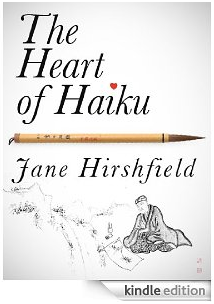
NOTE: Jane Hirshfield’s The Heart of Haiku is available from Amazon.com as a $.99 Kindle Single, and can be read on any computer or smart phone, not only Kindles, with a free download. A new book of poetry, Come, Thief, has also just been published, by Knopf.

Keywords:, , , , , , , ,
———–
Also see A Haiku on The Heart of Haiku; the excellent Poetry Foundation biography on Jane Hirshfield, including poems, articles and more; Pirene’s Fountain: Jane Hirshfield on Poetic Craft; and What Rainer Maria Rilke inscribed on the copy of The Duino Elegies he gave his Polish translator.

Ten years later On Being with Krista Tippett interviewed Jane Hirshfield on The Fullness of Things, which I discovered today, March 6, 2023, in Pebbles – Brief poems by Jane Hirshfield posted by Brief Poems.

God? ~ Dr. Evan Finkelstein

December 7, 2011

God? ~ Dr. Evan Finkelstein

Some say there is one God; some say there are many Gods, some that there is no God at all.

What does this have to do with the price of beans in China? Not much. Unless you were God, then, according to some, You would be the beans, You would be the price, and You would be China. And, even when people referred to You as “You” they would have to capitalize the Y. That’s pretty special treatment.

Some people destroy in the name of “their” God and are convinced that they are doing the right thing. Others think those people are crazy and that God (“their” God, not the God of the crazy people) will certainly punish the destroyers for their wicked deeds.

Obviously, the God of those people can’t be as great as “our” God; if He/She were, then those people wouldn’t be doing those insane things. Why can’t they just come over to our God? And see the “true” Light? Then, everything would be so much better (at least, from that point of view).

For thousands of years, there have been arguments, wars, inquisitions, trials, immolations, excommunications and on and on, related to the existence and nature of God: what is the right way to envision God?

Does He, or maybe She, sit on a large fancy throne high up in the clouds somewhere in heaven surrounded by angels and other assorted celestial beings? And, how did they get that heavy throne to stay up in the sky? Well, it’s God, man, He/She can do anything!

Well, if He/She can do anything why can’t my team get into the Superbowl? Is He/She deaf? Can’t God hear my prayers? Is Green Bay, Wisconsin closer to heaven than Chicago, Illinois? Or, do they just yell louder? Does this mean that God has preferences? Does He/She just like some of us better than others of us? Is it the way we dress? Our cologne? Our mouthwash? Was it something we said?

And if God is omnipresent why can’t we see Him/Her?

I mean God should be a lot easier to find than our glasses or car keys. Some saints claimed to experience God; others said those saints were nuts and that God is a just a hallucination of their imagination. Some contend God doesn’t exist at all. Life just came into being of its own; we don’t know exactly how it first started; it just did that’s all, just be quiet and pass the chips.

And some say that God is supposed to be omniscient about the past, present, and future. He/She knows everything you’re going to do before you do it. So, do we have free will or not? If God already knows, then isn’t everything already predestined? So is free will fake? An illusion? Are we just a bunch of wind-up toys that can’t find the key nor meet our winder? Some of us fall off the table and some of us don’t, but there’s no rhyme or reason why? Or is there rhyme and reason, but few, if any, can figure it out? Not poets, nor logicians. Maybe, those that think they figured it out start religions or, at least, health spas.

And, what is this whole thing about suffering? Some say that God is all merciful and all loving and omnipotent. If He/She is that way, why is so much of the world in turmoil? Why are there so many tears and fears? Can’t God control His/Her own show?

If not, then where’s the omnipotence? If God can, then where’re all the love and the mercy? Or, do we bring the suffering on ourselves by doing things we shouldn’t and perhaps God’s just shaking His/Her cosmic head thinking: “I really wish they’d stop doing that! Well, in time they’ll learn; if I do it all for them, they’ll never develop.”

And what about Justice? Some say God is like a completely fair and impartial judge. He/She rewards the just and punishes the wicked. Well bad things certainly do happen to good people. At least, many would say they are good people and the things that happened to them were bad. Would God not agree? Does He/She perhaps see things we don’t? Or, is reincarnation true and these good folks are just currently reaping what they have sown in some past not so good life? This could explain a lot of seeming inequities, if it were true.

Maybe there is order and justice in the world; maybe it is being run by an all-knowing, all-powerful, all-loving and intelligent existence, but who really knows?

Maybe it’s all just an empty nothing that came from nowhere and is going to nowhere, but it sure, sometimes, dresses fancy and makes a lot of noise trying to figure things out and find its way! Maybe that’s what God is, the actual process of living.

During my life-search, in 1969 I learned the practice of Transcendental Meditation and something opened up to me inside; it was an experience of simplicity, peace and a sweet feeling of “knowingness,” it felt very good and it occurred many times during my years of practice. These days, when my mind rumbles on, as it sometimes will, about all these theological and philosophical questions, I just have to laugh because it’s just so funny that one can know without knowing. Yes, as strange as it may seem, one can know without knowing.

Lao Tzu put it this way in part of Verse 1 of the Tao Te Ching:

A mind free of thought,
merged within itself,
beholds the essence of Tao
A mind filled with thought,
identified with its own perceptions,
beholds the mere forms of this world.

Buddha put it this way:

Then Subhuti asked: “What does enlightenment mean?”

The Buddha replied: “Enlightenment is a way of saying that all things are seen in their intrinsic empty nature, their Suchness, their ungraspable wonder. Names or words are merely incidental, but that state which sees no division, no duality, is enlightenment.” Prajnaparamita

Subhuti asked: “Is it possible to find perfect wisdom through reflection or listening to statements or through signs or attributes, so that one can say ‘This is it’ or Here it is?’”

The Buddha answered: “No, Subhuti. Perfect wisdom can’t be learned or distinguished or thought about or found through the senses. This is because nothing in this world can be finally explained, it can only be experienced, and thus all things are just as they are. Perfect wisdom can never be experienced apart from all things. To see the Suchness of things, which is their empty calm being, is to see them just as they are.” Ashtasahasrika

Maharishi Patanjali in his Yoga Sutras put it this way:

“Yoga is the complete settling of the activity of the mind.”

David put it this way in the biblical Psalms:

“Be still and know that I am God.”

The Sufi Farid Al-Din ‘Attar expressed it like this:

The heart is the dwelling place of that which is the Essence of the universe within the very heart and soul is the very Essence of God. Like the saints, make a journey into your self; like the lovers of God cast one glance within. As a lover now, in contemplation {sustained experience} of the Beloved be unveiled within and behold the Essence. Form is a veil to you and your heart is a veil. When the veil vanishes, you will become all light.

The Sufi Mahmud Shabistari put it this way:

“In that presence “I” and “we” and “you” do not exist. “I” and “you” and “we” and “He” become one: since in the unity there is no distinction, the Quest and the Way and the Seeker become one.”

The Christian mystic John Ruusbroec said it like this:

“There the soul is simple, spotless, and pure, empty of everything. In this pure emptiness the Father reveals his divine resplendence, which neither reason nor senses, neither rational observation nor distinctions can attain.”

The Cabbalist Rabbi Joseph Gikatilla expressed it this way:

The depth of primordial Being is called Boundless. Because of its concealment from all creatures above and below, it is also called Nothingness…. Its existence cannot be grasped by anyone other than it. Therefore, its name is “I am becoming.”

Maharishi Mahesh Yogi put it this way:

“Once the mind gets to the transcendence, it knows Itself. It’s not the mind that knows Being; Being knows Itself. As long as there is some activity, we say “mind”; when activity subsides, it’s pure awareness. It is not knowing; it is Knowingness.”

“Being is known on the level of Knowingness, not the level of thinking.”

Anyway, some thoughts about God and going beyond them—happy journey!

_______________________________________________________________________

Dr. Finkelstein is professor of Comparative Religion and Maharishi Vedic Science at Maharishi University of Management. He has written articles that identify the common ground inherent in many of the ancient wisdom traditions. He has taught numerous courses on the universal principles that can be located in Hinduism, Taoism, Confucianism, Buddhism, Judaism, Christianity, and Islam.

God? was first published in on Nov 30, 2011.

Also see: Buddha and Meditation by Dr. Evan Finkelstein. And this related article: You Are God: Who? … Me? By William T. Hathaway.

HUFFPOST: David Lynch: Why I Meditate

November 22, 2011
David Lynch
Award-winning director, writer, producer

Why I Meditate

Posted: 11/22/11 08:23 AM ET

Dear HuffPost Friends,

I’ve been asked to write something about meditation today. A question was, “Why do I meditate?” I practice Transcendental Meditation as taught by Maharishi Mahesh Yogi. Before I started TM, I looked into many different kinds of meditation, and something about each of them said they weren’t for me. When I heard about Transcendental Meditation from my sister who had started, I liked what she told me in relation to all the other forms I had looked into. And as I’ve said, I’d heard a change in my sister’s voice. I heard more happiness and more self-assuredness. And I said, “I want this Transcendental Meditation.”

I guess people start meditation for many different reasons, but each person who starts will get the benefit they are looking for, and many other benefits as well. I became interested in meditation because I heard a phrase, “True happiness is not out there. True happiness lies within.” And this phrase had a ring of truth to me, but the phrase doesn’t tell you where the within is, nor how to get there.

One day it hit me that meditation would be the way to go within.

The beauty of Transcendental Meditation is that it gives effortless transcending. It is not a trying form of meditation, not concentration, nor contemplation. It is a unique form of meditation, a mental technique, an ancient form of meditation brought back by Maharishi for this time.

At the base of all matter and all mind there is an eternal field, which is beyond the field of relativity — it is non-relative, absolute. This field has many names. For quantum physicists it is called the Unified Field. It is also known as The Transcendent, Being, The Source, Totality, Ocean of Pure Bliss Consciousness, The Self. This field is that level of life, which has always been, it is, and will be forever.

When a human being truly transcends and experiences this deepest level of life, they’re able to infuse some of that consciousness and begin to expand whatever consciousness they had to begin with. All of us human beings have consciousness, but not every human being has the same amount. The potential for each of us is infinite consciousness, enlightenment, total fulfillment, infinite bliss, liberation.

Tied to consciousness are all-positive qualities, intelligence, creativity, happiness, love, energy, power and peace. With the regular practice of Transcendental Meditation, a person can transcend many times in each meditation and really see huge life-transforming benefits. Those all-positive qualities grow more and more each day. And the side effect is that negativity begins to receded. Stress, anxiety, tension, sorrow, depression, hate, anger and fear begin to lift and this is such a great sense of freedom for the human being. All the stressful things are still out there, all the negative things are still out there, but because the all-positive things are still growing, those negative things have less and less power to hurt us.

For me, I felt so much relief from this heavy weight of negativity lifting. And as I say, I felt the suffocating rubber clown suit of negativity dissolving, and it was such a feeling of bright freedom. I got more and more happiness in the doing of things, ideas seemed to flow more freely. I felt more energy for the work and I began to see other people as people I liked more and more. I felt healthier and more comfortable in my body. The whole world looked better.

There is an expression, “The world is as you are.” I think it means that it can be the same old world, but when we change — in a more positive way — that same old world looks better and better.

The David Lynch Foundation for Consciousness Based Education and World Peace was started to raise money to give the technique of Transcendental Meditation to any student who wanted it anywhere in the world. So far we have helped 250,000 students learn this technique and get the benefits. The foundation has also branched out to funding programs for prisoners, prison guards, children suffering from child prostitution, the homeless, Native Americans suffering from diabetes and alcoholism, veterans suffering with Post Traumatic Stress Disorder. And it’s always the same. No matter what the suffering is or how much stress or torment there is, when people get this technique they get happier. They start feeling better. They start seeing that suffering lift and they say they get their lives back and see a good future.

It’s a human being thing to transcend. Many people have transcended without a technique, but they don’t know how it happened. Transcendental Meditation is a technique that gives a person an opportunity to transcend — first time, every time.

There are so many programs in the world to help people. But unfortunately most of them are surface solutions, and surface solutions will never work. They’ll never address the deep torment, suffering, anger or hate inside the person. When a person can transcend and infuse those all-positive qualities from that beautiful field of pure consciousness within, it’s like cleaning the machine and infusing it with gold.

Einstein said you can’t solve a problem at the level of the problem, you have to solve it from beneath the problem. We can’t get deeper than the Unified Field — The Ocean of Consciousness, Being. This field is also known as the Kingdom of Heaven, which lies within. Think about it, how beautiful it is to sit quietly, close the eyes, start a technique and visit the Kingdom of Heaven each day.

Veterans suffering from Post Traumatic Stress Disorder, from what I’ve heard, are not getting the help that truly lets them have their lives back, which truly relieves their suffering in a real way. Now there have been testimonials from veterans who have gotten the technique of Transcendental Meditation, and it is beautiful to hear their stories of how this has saved their life and helped the lives of their friends and family.

Maharishi revived a great technique, which is a blessing to human beings. Take advantage of it, make hay while the sun shines.

Your friend,

David

How The Uncarved Blog got its name

November 7, 2011

How The Uncarved Blog got its name by Ken Chawkin

Some readers have asked me about the name of my blog, what it means, and how I came up with it. When I explain it to them they say I should write it down for others to see. So I just added it to the About section, and have also decided to include is as its own post. Here it is:

Heather Hartnett at the David Lynch Foundation, encouraged me to set up my own blog and post all the TM-related articles I was sending around. So, when I thought of the word, blog, it reminded me of the word, block, the uncarved block specifically, a term from Taoism that means the uncreated pure potentiality from which all things are created, the Tao, the source of the 10,000 things. It also reminded me of the unmanifest pure Creative Intelligence Maharishi talks about in his Science of Creative Intelligence, the field of pure potentiality; also the Unified Field of all the Laws of Nature, the Veda within Atma, Sutratma, the Self. And since ‘block’ and ‘blog’ sounded so similar, I thought it was a clever poetic way of coming up with a name.

I first read about the uncarved block in a wonderful book, Creativity and Taoism, by Chang Chung-Yuan. In it he described how the Taoist artist, a sculptor in this case, used to meditate, fast, purify himself first, and then go into the forest to find the right tree that for him contained the vision of what he was called to create. He would take that block of wood back to his studio and carve it out. Think Michelangelo freeing the statue from the marble he was carving.

Same message in the Bhagavad Gita translated and commented on by Maharishi Mahesh Yogi, the founder of the Transcendental Meditation program and Maharishi University of Management: Transcend, Be, then act; and, established in Being perform action. Established in the Self, act in tune with Natural Law. Then you’ll be more successful in actualizing whatever inspired vision, or idea, you had that motivated you to create, whether it’s a poem, a painting, a piece of sculpture, or a blog post.

I certainly enjoy blogging, and glad I started. It’s a fun creative process using digital words, images, and sounds, to carve out something meaningful for myself and hopefully my readers. Of course, there’s so much more one can do in terms of the look and functionality of a blog. That takes up even more time, so I’ll leave that up to the good folks at WordPress.com to keep coming up with more ways to improve the experience, both for bloggers and readers. Enjoy exploring The Uncarved Blog, and thank you for visiting!

And in case you were wondering what the small colored abstract square you see next to the link in your finder at the top left, or on the right next to my comments, is all about, it’s one of Ken West’s photos, used as the blog picture, or icon, for The Uncarved Blog. Here is the complete photo © 2008 Kenneth G. West Jr.. Click on it and it will open up in a larger format. I chose it for its beauty and abstract quality; it can mean different things. For more information and links to a video and photo gallery, check out this blog post: Ken West and his unique landscape photographs are featured on IPTV show Iowa Outdoors.

Author Veteran Jerry Yellin To Sign Four Books Proceeds To Benefit Operation Warrior Wellness

October 14, 2011

Jerry Yellin will be doing a book signing on Saturday evening, November 5, from 7:30-8:30 at the Fairfield Library meeting room. Receipts from the sale of his four books will benefit Operation Warrior Wellness, a division of the David Lynch Foundation. Here is an article promoting this event written by Jerry’s son, Steven Yellin. Jerry’s books are listed at the end of this article.

A WWII P-51 Pilot Talks About Healing His Soul Through Meditation

On March 7, 1945, Jerry Yellin, a current resident of Fairfield, Iowa landed on a small strip of land in the middle of the Pacific Ocean. For the next six months he saw sights that would haunt him for the next 35 years.

The strip of land was Iwo Jima.

28,000 soldiers died on Iwo Jima. Had the American commanders known in advance how many casualties there were going to be in taking that island, they never would have invaded. Jerry was a P-51 fighter pilot who strafed the island for the Marines, and then flew 19 missions over Japan.

When Jerry returned to the States, he took those memories and images of what he saw on Iwo Jima with him. Everyday and many horror-filled dreaded nights, he relived the images of war. Time passed, the memories did not.

Though he didn’t die on Iwo, the memories of Iwo were slowly killing him. Then in 1975 Jerry learned the Transcendental Meditation program. Slowly, the memories of war started to fade from his mind. For the first time, he started to reconnect with himself on a deep level and experience the joys of life that were absent for so long. Though he had married a wonderful woman and had four great sons, he couldn’t really feel the flow of life until he learned to meditate. Years later, he said unequivocally that TM saved his life.

Last year, a friend of his called and said that her son was having a difficult time adjusting from the many military tours of duty he had done. Jerry met with him and as a former soldier that had seen combat, tried to console him. It didn’t work. Two weeks later that young man committed suicide. A little known fact is that more soldiers commit suicide each month than die in combat in Iraq and Afghanistan.

Jerry was devastated because he knew exactly what this young soldier experienced. He felt that something had to be done to prevent these kinds of suicides and the ruined lives of soldiers caused by Post-Traumatic Stress. So he contacted the David Lynch Foundation, a non-profit organization that has been teaching Transcendental Meditation to at-risk youth around the world since 2006. They immediately said they were interested and Operation Warrior Wellness was launched.

Since then Jerry has talked about OWW to military groups all over the country. The response has always been the same—this is an organization that needs to be successful because the problem is so acute. “We send our young men and woman to fight,” says Jerry, “and then, when they return, we can’t really help them integrate into society successfully, because what they saw and heard are so devastating to their souls.”

The four books Jerry Yellin will be signing are:

The Resilient Warrior, Healing the Hidden Wounds of War: stories of veterans of war who suffer from Post Traumatic Stress and how Transcendental Meditation helps cure them.

Of War and Weddings, A Legacy of Two Fathers: an autobiographical story of one American and one Japanese soldier who hated each other in their youth and came to be family by the marriage of their two youngest children in 1988.

The Blackened Canteen: a true story of 23 Americans who were killed on June 20, 1945, and the Japanese man who buried their remains in a common grave next to the 2000 Japanese citizens their bombs helped to kill.

The Letter: literary fiction about a powerful American Senator who goes through life hating people of different religions only to find out that his birth mother and father were everything he hated.

###

The David Lynch Foundation teamed up with Donna Karan’s Urban Zen Foundation on June 7, 2011, to garner support for their shared goal: to help veterans who are suffering with Post-Traumatic Stress reclaim their lives. In this video, former WWII captain and fighter pilot Jerry Yellin speaks out about the horrors of returning to civilian life after experiencing the trauma of combat—and how he overcame the hidden wounds of war through the practice of Transcendental Meditation. More articles on Jerry Yellin are posted here on this blog.

Click here to download a beautifully-designed poster announcing the book-signing event.

Upcoming Event: David Lynch Foundation launches Veteran’s Day national meditation initiative

See Huffington Post: What Meditation Did for Me: A War Vet’s Story | Wall Street Journal: A Transcendental Cure for Post-Traumatic Stress by David Lynch and Norman E. Rosenthal | Medication or Meditation for Veterans with PTSD?

At last—the truth about Frankenstein

August 19, 2011

This is one of my favorite poems, written by a good friend and a fine poet, Bill Graeser. The title now links to his new website where the poem has since been divided into seven stanzas. 

What You May Not Know About Frankenstein

Although he had not the hands to crochet, the patience to build birdhouses or the nerve to push a hook through a worm in the hope of pulling a fish from the sea, he did write poems and wrote often and late into the night.  Was it pain that made him write?  The pain of all those stitches, of shoes that despite their size were still too small?  Was it psychological pain of social non-acceptance?  Or the electricity that years later still snapped between his fingers?

No, it was simply what his brain wanted to do, the brain they dug up and sowed into his head, it was just grave-robbing luck.  At poetry readings, where everyone is welcome, he read his poems sounding like a man who having fallen into a well and cried out for years was now finally being heard.

Like this there are many so-called monsters with poems to share.  The same is true of angels, of gangsters, shepherds, anyone who fits words together like body parts, revises, revises again, until magically, beautifully, lightning leaps from the pen and the poem opens its eyes, sits up from the page, staggers into the world, and whether it is seen as monster, or friend, it is alive, every word it says is real and it comes not from the grave, but from the sky.

© Bill Graeser

Also see Bill Graeser memorializes Ansel Adams in his award-winning poem “Magic Light”.

In an interview for the Fall 2001 issue of Paris Review, George Plimpton asks US Poet Laureate Billy Collins to describe what it takes to be a poet.

(more…)