Archive for the ‘Writing’ Category

Billy Collins suggests more creative ways to respond to poetry than analyzing it to death

March 18, 2015

The New York Times calls Billy Collins “the most popular poet in America.” In his poem, Introduction to Poetry, the former two-term U.S. Poet Laureate (2001-2003) suggests more creative ways to respond to poetry than analyzing it to death. This blog post also reveals how Collins writes and teaches poetry. It may surprise you.

Introduction to Poetry

I ask them to take a poem
and hold it up to the light
like a color slide

or press an ear against its hive.

I say drop a mouse into a poem
and watch him probe his way out,

or walk inside the poem’s room
and feel the walls for a light switch.

I want them to waterski
across the surface of a poem
waving at the author’s name on the shore.

But all they want to do
is tie the poem to a chair with rope
and torture a confession out of it.

They begin beating it with a hose
to find out what it really means.

The Apple that Astonished Paris © 1988, 1996

Listen to Billy Collins read his poem, Introduction to Poetry.

Billy Collins speaks to English teachers in this poem who look at poetry as something to be analyzed and dissected. They teach their students to try to find out what a poem means instead of emotionally responding to it. To make his point, Collins amusingly suggests ways students might approach and experience a poem, instead of “beating it with a hose to find out what it really means.”

Writing and Teaching Poetry

Collins reveals more about his writing process and how he teaches poetry when answering a question from a middle school English teacher. He acknowledges the search for meaning in a poem, but when he writes a poem, meaning is the furthest thing on his mind. He’s just trying to get to the next line, and the next, to finally arrive at the ending.

Basically when you’re teaching poetry, despite that poem (Introduction to Poetry), you’re talking about meaning. We’re basically extracting meaning from the poem. And I realized at some point, that when I wrote a poem, meaning was the last thing on my mind. I never gave it a thought.

Basically, in a poem, I’m just trying to find the next line. I’m trying to find a way for the poem to go. And I’m trying to get to some destination. I’m not thinking about, ‘What’s the poem about, or meaning?’ Or, I’m not thinking of, ‘How will people write study questions about this poem and make any sense out of it?’

So I try to bring some of that into my teaching. I try to substitute for the question, ‘What does a poem mean?’ the question, ‘How does a poem go?’ ‘How does a poem get where its going?’ (It goes from the beginning to the end, maneuvering through shift points along the way, in search of a destination.) A poem is always searching for its own ending. And that’s what poets are thinking about. It’s not a search for insight, particularly. It’s a search to be over with.

PBS NewsHour’s Jeffrey Brown interviewed Billy Collins on their Poetry Series about his new collection, Aimless Love: New and Selected Poems. “I knew that poets seemed to be miserable,” said Collins about his younger self, yearning to fit in. While he admits he “faked a miserable character” at the start of his career, he’s since embraced his sense of humor. Poet Billy Collins on humor, authenticity and ‘Aimless Love’

William Stafford on Writing Poetry

William Stafford was Poetry consultant for the Library of Congress in 1970, what a Poet Laureate was called before they created the office. He was named Poet Laureate of Oregon from 1975-93. Stafford’s style of writing and teaching was process-oriented. He gave no praise or blame to his students’ writing. He encouraged English teachers and writing students to be innocent when writing poetry, without any preconceived notions of how it should go, and to be open to discovering the unexpected turns a poem could take on the way to its own completion.

Stafford was very open to spontaneity and receptivity when writing poetry. He said most teachers would spell out what a piece of writing should look like, and expected their students to reproduce the same. This product-oriented approach left no room for the imagination. “They want a wilderness with a map.” But, he asks, “how about errors that give a new start?” Errors, he said, “make a music that nobody hears. Your straying feet find the great dance,” and “stumbling always leads home.” That’s how he wrote poems, early every morning. Enjoy reading these William Stafford poems, A Course in Creative Writing, and You and Art.

My Own Experience as a Writer

I agree with Collins and Stafford that the creative process is a mystery, and coming to the end of a poem is a wonderful relief, especially when I see it finishing itself. It also surprises me with what it’s about, sometimes revealing a deeper meaning at the end than imagined. This meaningful sense of completion is why writing poetry can be so fulfilling.

Two early meta-poems describe this process: Writing—a poem on the writing process, and Sometimes Poetry Happens: a poem about the mystery of creativity. Two early poems I’d written that surprised me with their endings are, As Above So Below, and later, Pine Cone Trees.

My son Nathanael Chawkin wrote a poem called INSPIRATION, an outcome from the first homework assignment in his Grade Six Literature class. He felt strongly that you couldn’t force a student to write a poem; it had to come on its own accord. The poem innocently and profoundly expresses the spontaneity of the poetic process. I also added information with links after his poem about the writing process you may find interesting.

Update

Just added a part two: Billy Collins discusses the value of getting to the end of a poem and what can happen afterwards. Enjoy the poetic genius and humor of Billy Collins reading his poem “January in Paris” and Billy Collins humorously disagrees with Heraclitus showing how to go into the same water twice.

The Library of Congress Web Guides: Billy Collins: Online Resources.

— Written and compiled (citing sources) by Ken Chawkin for The Uncarved Blog.
Scott Cawelti: It’s about time for “Quiet Time”

January 12, 2015

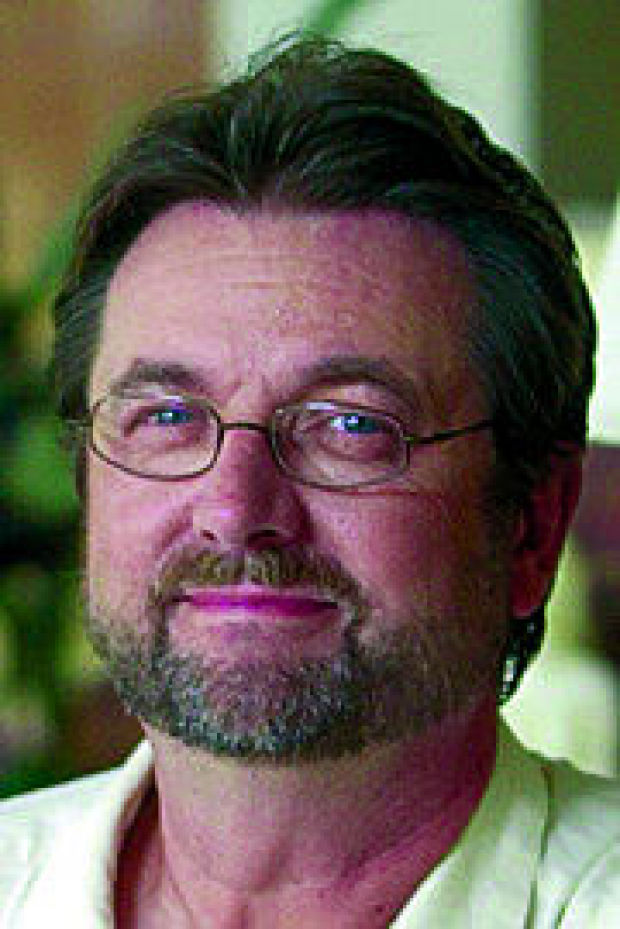
This Quiet Time article appeared in the Waterloo-Cedar Falls Courier. It is published here with permission from the columnist, Scott Cawelti, a retired professor of English at the University of Northern Iowa, freelance writer and musician. Contact him at cawelti@forbin.net. Click here to see Scott Cawelti BIO. Photo by Doug Hines.

It’s about time for “Quiet Time”

January 11, 2015 6:00 am  • 

Nothing succeeds like success, as they say, and I’m here to report two genuine successes. One is small, the other large, a possible game-changer.

The small success involves my own daily meditation practice. It began over 30 years ago and continues to this day.

As a young assistant professor teaching anywhere from 90 to 250 students in three classes, struggling with writing conference papers, grading piles of student essays, meeting with students, attending multiple faculty committees, facing constant pressure to do more and do better, I was stressed. I mean, stressed out, exhausted, short-tempered and chronically anxious. I was staying afloat, but barely.

In those days, Cedar Falls had a Transcendental Meditation Center down on Third and Main streets, and a couple of friends each recommended I try TM.

Scott Cawelti

Scott Cawelti

I did, and it worked. Within a few days of twice-daily meditation, I began feeling relaxed, then peaceful, then downright blissed out. Well, not quite, but close.

And it continued. No one was more surprised than I.

Over the years I’ve attended meditation workshops, modified my practice slightly, and still continue meditating twenty minutes, twice a day. It has made all the difference in my stress level, and I’m still alive, well and pushing 72.

I’m convinced regular brain-quieting has given me more, and better, years. That’s what meditation does, by the way: quiets our always-buzzing brains.

I recommend some form of meditation for anyone who feels overwhelmed with pushes and pulls beyond their control. If it worked for me, it will work for you.

Beyond my own small life, there’s a much larger meditation success story that recently made national news.

At Visitacion Valley Middle School in San Francisco, they began a program in 2007 of twice-daily “quiet time” breaks for the entire school. This particular school sits in a rough, even violent, neighborhood. Attendance, academic scores and teacher and student retention were dismal.

Teachers and students alike hated the chaos of school days. In other words, the school made no progress toward anything but failure.

Now, after over seven years, they can judge Quiet Time’s success. It’s been dramatic, schoolwide and heartening. This is how David Kirp, a professor of public policy at Berkeley, describes the results:

“In the first year of Quiet Time, the number of suspensions fell by 45 percent. Within four years, the suspension rate was among the lowest in the city. Daily attendance rates climbed to 98 percent, well above the citywide average. Grade point averages improved markedly. About 20 percent of graduates are admitted to Lowell High School – before Quiet Time, getting any students into this elite high school was a rarity. Remarkably, in the annual California Healthy Kids Survey, these middle school youngsters recorded the highest happiness levels in San Francisco.”

Amazing but true. Kirp continues:

“On the California Achievement Test, twice as many students in Quiet Time schools have become proficient in English, compared with students in similar schools where the program doesn’t exist, and the gap is even bigger in math. Teachers report they’re less emotionally exhausted and more resilient.”

Incidentally, students are not forced to practice TM. They can simply close their eyes, daydream, nap — as long as they’re quiet during those two 15-minute periods.

Parents must give permission if they want their child to learn the meditation technique.

I can hear objections: wasting valuable school time, returning to hippie-dom, imposing a religious practice in a state school. All of these seem to be satisfactorily answered, since the program’s success with the parents’ permission for seven years speaks for itself.

Best of all, Quiet Time costs virtually nothing, and it affects whole schools so positively (based on real data) it’s at least worth a look.

My own small success story offers unqualified support.

Much more power to them.

# # #

Quiet Time at Visitacion Valley Middle School

Principal James Dierke first implemented the Quiet Time Program at Visitacion Valley Middle School in San Francisco. As a result of his school’s dramatic turnaround he was selected NASSP National Middle School Principal of the Year in 2008. Principal Dierke wrote an article about it (a Quiet Transformation) for Leadership, a publication of the Association of California School Administrators. He concluded, “I retire with the lowest blood pressure I have had in 10 years and a great optimism about our ability to realize this vision for education.”

NBC Nightly News reports on the Quiet Time Program

NEW VIDEO: With the successful transformation of Visitacion Valley Middle School several schools in the San Francisco Unified School District also incorporated the meditation-based Quiet Time Program with amazing results. Cynthia McFadden visited both Visitacion Valley Middle School and Burton High School and filed a report on December 30, 2014 for NBC Nightly News: San Francisco Schools Transformed by the Power of Meditation. Visit the David Lynch Foundation for more on the Quiet Time program in schools.

Edutopia reported on Quiet Time at Visitacion Valley Middle School

David Markus, former Editorial Director of Edutopia, had visited the school and produced this report: Risking Peace at a Troubled School. Below is the video: How Daily Meditation Improves Behavior. Here is another video on the school’s program: Meditation in San Francisco School Improves Learning. 

World-famous classical guitarist @SharonIsbin says #TranscendentalMeditation “helped make me the person that I am.”

January 7, 2015

Sharon Isbin: Seeking Out Serenity

Classical guitarist Sharon Isbin has been a trailblazer for both female musicians, and the guitar’s place in the world of classical music. A winner of two Grammys, she is the director of guitar programs at the Juilliard School and at the Aspen Music Festival. Liz Robbins interviewed Ms. Isbin for The New York Times and wrote this fascinating article on the world’s greatest classical guitarist: Sharon Isbin: Seeking Out Serenity. The Jan 2, 2015 Sunday Routine featured photos, other aspects of her life, and a short video of Sharon playing guitar. The article was well-written and richly put together. This part took me by surprise:

I have done Transcendental Meditation since I was 17 years old. I do 20 minutes in the morning and 20 minutes in the afternoon. I really believe it has helped make me the person that I am. Because it is an extraordinary way to release stress and allow it to dissolve, so that you can focus on what you want to focus on, and have your energy towards very positive things.

Sharon Isbin: Cosmic Performer

An earlier insightful article written by Linda Egenes for Enlightenment, The Transcendental Meditation Magazine (Issue 7) sheds more light on this topic: An Interview with Sharon Isbin: The Monet of Classical Guitar. Knowing that Sharon had been practicing TM since she was 17 years old, Linda asked how it had benefited her life, especially performing in front of live audiences. Her amazing reply reveals an enlightened performer.

As a musician, TM enhances my mental stamina, memory, concentration, and ability to learn. It puts me in touch with my innermost creative core and enables its expression through music. Most importantly, it facilitates instant access to a state of “cosmic immersion,” that feeling of being in the flow, or in “the zone.”

Sharon IsbinWhen I perform onstage, I enter a state of being very similar to the one I enter daily when practicing TM. It’s a sense of communion with the energy of the universe, the audience, the composer, and the music—without ego or interference. It’s a feeling of unity between me and the listeners, a sense of “oneness” in which we are all experiencing the beauty of the music together. That sensation is one of the reasons live performances can be so powerful—everyone is focused and transported, and the experience is unique and in the moment, never to be replicated.

Guitar Passions: Sharon Isbin & Friends

Linda also asked Sharon questions about her musical influences and her work as a performer, teacher and collaborator, in particular about her new CD at the time, (August 30, 2011) Guitar Passions: Sharon Isbin & Friends. This promotional video shares music and interviews with Sharon and Steve Vai; in studio with Nancy Wilson (Heart) and Stanley Jordan; previews with Steve Morse, Paul Winter, Rosa Passos, Romero Lubambo, and Thiago de Mello.

Documentary Film: Sharon Isbin: Troubadour

Sharon Isbin is also featured in a new documentary film that came out towards the end of last year, and is still being aired on public television: Sharon Isbin: Troubadour. The one-hour documentary produced by Susan Dangel (2014), includes guests Martina Navratilova, Michelle Obama, Joan Baez, Steve Vai, Stanley Jordan, Garrison Keillor, David Hyde Pierce, Janis Ian, Lesley Gore, Mark O’Connor, Tan Dun, John Corigliano, Christopher Rouse, Joan Tower, Leonard Slatkin, Thiago de Mello, Paul Winter, and more, with Isbin’s performances showcased from international concert stages to the GRAMMYs and White House.

American Public Television presents the national broadcast on nearly 200 public television stations in the US Nov 2014 – March 2015. Video Artists International will release it on DVD/Blu-ray with added performances. See http://www.sharonisbintroubadour.com for screenings, broadcast, and release information.

Sharon Isbin on The Leonard Lopate Show

Today, Wed, January 7, 2015, WNYC’s Leonard Lopate interviewed Sharon Isbin about the program: A New Documentary On The Acclaimed Classical Guitarist, Sharon Isbin (16:33). Leonard asks Sharon about her Transcendental Meditation practice at the 10:50 mark. She answers at 11:08–12:20. Leonard mentions Julliard School inviting Sharon to head up a guitar department in their Music division and asks if Transcendental Meditation is part of the program. At the request of the David Lynch Foundation, Sharon did invite teachers to introduce the TM technique to Julliard faculty, staff, and students, offering to make it available for free. Listen to the interview here: http://www.wnyc.org/story/sharon-isbin.

Visit Sharon Isbin’s website, www.sharonisbin.com, for more information: biography, press, music, videos, tours, and more.

A poem in a movie inviting you to be who you are

January 2, 2015

I recently enjoyed watching Words and Pictures, a 2013 film about a male English teacher and a female art instructor who form a rivalry that ends up galvanizing students in a competition to decide the most effective way to communicate, using words or pictures. This battle between mind and heart, ideas and feelings, is also about self-discovery, expressing one’s creativity, and the blocks that get in the way. Cleverly written by Gerald Di Pego, a one-time English teacher, and faithfully directed by Fred Schepisi, it stars Clive Owen, Juliette Binoche, and Bruce Davison. Visit their website for more info: http://wordsandpicturesthemovie.com.

I especially liked the quotes about writing and art, the word vs. the image. A poem by Mary Oliver was supposed to be featured in the film. They never said which one but kept waiting for permission to use it. By the time the answer came in, no, it was too late, and they had to come up with a replacement. The pressure was on screenwriter Gerald Di Pego. Being a poet himself, and seeing how this was his screenplay, the muse inspired him, and he wrote this very vivid and appropriate poem, just in time. Juliette Binoche liked it, which came as a relief to him and the director. I found it online and wanted to share it with you. The poem plays a central role, but you’ll have to see the film to find out who wrote it and how it’s used.

WHO ARE YOU?

I am a small poem
On a page with room
For another.

Share with me
This white field,
Wide as an acre
Of snow, clear
But for these tiny
Markings like the
Steps of a bird.
Come. Now.

This is the trough
Of the wave, the
Seconds after
Lightning, thin
Slice of silence
As music ends,
The freeze before
The melting. Hurry.

Lie down beside me.
Make angels. Make devils.
Make who you are.

As you can see, the poem invites you to create and become who you are, from that gap, the transitional point of possibility, and to share in the experience with another. Here’s a poem I wrote after a special painting class that seems relevant: ArtWords—poem about a creative awakening.

Interestingly, the Special Features part of the DVD revealed that Juliette Binoche, an artist in her own right, offered to do all of the paintings herself, which thrilled both writer and director. Because her character is dealing with physical challenges due to her medical condition, she had to paint in different styles, from portraiture to more abstract. Binoche enjoyed the added challenge and it possibly influenced her own future work.

Here is the official Words and Pictures – International Trailer (2014) HD.

When it comes to romantic movies, here are some of my favorite films where love transcends time.

Canadian Connection: These shoes are made for walking

The featurette also confirmed for me where they had made the film. The story is set in a New England prep school, but was actually shot at St. George’s School, an independent boarding and day university-preparatory school for boys in Vancouver, British Columbia, Canada, a.k.a., Hollywood North.

I recognized the location, and it reminded me of a story I had heard on a local CBC radio talk show during my stay there. The guest was an English teacher who taught at St. George’s School. One of the topics being discussed was meeting famous people. Listeners called in to share their stories and the teacher related an unusual event that had recently happened to him.

He had gone shopping at a well-known store for comfortable walking shoes. He settled on a particular pair and the sales clerk told him it was a popular item. She said someone famous had been in that morning and purchased a similar pair. She left to find out the name of the celebrity, but got sidetracked with another customer, so he left.

He put on his new shoes and, as was his routine every day after lunch, he went for a walk in the woods next to the school property. While walking along the path, eyes downcast, he saw a pair of shoes just like his, coming his way. Looking up he saw someone he never would have expected to see, especially in the forest. He pointed at him in surprise trying to say his name, but it came out as gibberish. The person mimicked him sputtering his name. It was Robin Williams! I think he was in town at that time filming Jumanji.

They had a wonderful walk and talk together. Robin had asked him what he did for a living and where he worked, which was something he could identify with having played an English teacher at an elite boys prep school in Dead Poets Society. When they reached the edge of the forest, there was Robin’s stretch limousine parked on the street waiting for him. He invited the teacher into the car saying they would drop him off at the school.

Now this man was not the most popular teacher at the school. When they pulled up, he got out of the limo, and all heads turned to look at him. Then Robin lowered the darkly tinted window, stuck his head out, and thanked the teacher for a wonderful time. All the kids’ jaws dropped! And from that day on he was the coolest person at school. Thank you, Robin! God Bless you, wherever you are.

I later found this August 5, 2024 Vanity Fair article b: “He’s Absolutely Extraordinary”: Remembering Robin Williams On the 10-year anniversary of Robin Williams’s untimely passing, we asked more than 20 of his costars, collaborators, and friends—including Billy Crystal, Matt Damon, Ben Stiller, Al Pacino, Sally Field, Jeff Bridges, and Julianne Moore—for their favorite memories of this kind, playful, and uniquely intelligent artist.

— Written and compiled (citing sources) by Ken Chawkin for The Uncarved Blog.

Winding up the year with inspiration from Hafiz

December 29, 2014

We are coming to the end of the year 2014. It seemed like a rough one for many, personally, and collectively for the world. I’ve finished reading A Year With Hafiz: Daily Contemplations, translated by Daniel Ladinsky. There is usually one poem a day per page. It was a gift from friend and author Steven Verney. Here are 3 poems towards the end of the book, end of the year, that talk about endings, and, in a way, new beginnings. May they inspire you as we transition into the new year, and for some, into a new life in 2015.

A Prayer I Sometimes Say

It is the Beloved who is revealed in every
face, sought in every sign,

gazed upon by every eye, worshipped in
every object that is adored, pursued in the
visible and in the unseen.

Not a single one of His creatures, not a
single one, my dears, will

fail to someday find the divine Source
in all of its primordial and glorious nature.

And be forever united with the Infinite,
because that—God—is really you.

Muhyiddin Ibn ‘Arabi, look what your
words have become—the restoration of
Truth, the regeneration of Life itself.

December 23, page 391

* * * * *

The Tender Mouth Of The Earth

What will the burial of my body be? The
pouring of a sacred cup of wine into the earth’s

tender mouth and making my dear sweet lover
laugh one more time.

What is the passing of a body? The glorious
lifting of the spirit into the sacred arms of the

Sky, and making existence smile, one more, one
more time.

December 28, page 396

* * * * *

A River Understands

I used to know my name. Now I don’t. I
think a river understands me.

For what does it call itself in that blessed
moment when it starts emptying into the
Infinite Luminous Sea,

and opening every aspect of self wider than
it ever thought possible?

Each drop of itself now running to embrace
and unite with a million new friends.

And you were there, in my union with All,
everyone who will ever see this page.

December 29, page 397

* * * * *

One poem about a river is beautifully told by William Stafford in his poem, Ask Me, where he looks to the stillness in the river to inform him, and the person asking him about his life, and, in a way, the creative process in the moment. Another poem of his, Something That Happens Right Now, also leaves you with a similar unbounded feeling as this last Hafiz poem does.

See other inspiring poems by Hafiz, translated by Ladinsky, posted here.

Poetry helps us imagine what it’s like to be human. ~ Mark Strand (1934–2014)

December 5, 2014

Mark Strand, former U.S. poet laureate (1990-1991) and winner of the Pulitzer Prize for Poetry (1999), felt strongly that writing and reading poetry could make us better human beings. “Poetry helps us imagine what it’s like to be human,” he said in an Inscape interview last year.

Percy Bysshe Shelley had famously said, “Poets are the unacknowledged legislators of the world.” When Mark Strand was asked what he thought the function of poetry was in today’s society, he replied: “It’s not going to change the world, but I believe if every head of state and every government official spent an hour a day reading poetry we’d live in a much more humane and decent world. Poetry has a humanizing influence. Poetry delivers an inner life that is articulated to the reader.”

Indeed, especially if they were as transformed by poetry as Mark Strand, who wanted to feel himself “suddenly larger . . . in touch with—or at least close to—what I deem magical, astonishing. I want to experience a kind of wonderment.”

Last week, one of my poet friends, Roger Pelizzari, emailed me about the passing of Mark Strand, and included a favorite poem of his, My Name. Roger included a link to an earlier Paris Review interview: Mark Strand, The Art of Poetry No. 77, with his friend Wallace Shawn, from which I’ve included interesting excerpts.

I was surprised and sorry to hear the news of Strand’s passing and checked the Paris Review for an update. I found Memoriam Mark Strand, 1934–2014, under The Daily by Dan Piepenbring, and sent it to Roger.

Media from around the world published Obituaries reviewing the Canadian-born, American poet’s accomplished literary career. The LA Times described Mark Strand as “a revelatory poet who addressed love and death in his poems, but in radically lyrical, revelatory ways.”

This poem is filled with the wonderment he sought, and seems a fitting memorial, prophetically written in the poet’s own magical words.

My Name

Once when the lawn was a golden green
and the marbled moonlit trees rose like fresh memorials
in the scented air, and the whole countryside pulsed
with the chirr and murmur of insects, I lay in the grass,
feeling the great distances open above me, and wondered
what I would become and where I would find myself,
and though I barely existed, I felt for an instant
that the vast star-clustered sky was mine, and I heard
my name as if for the first time, heard it the way
one hears the wind or the rain, but faint and far off
as though it belonged not to me but to the silence
from which it had come and to which it would go.

(more…)

@David_Lynch’s MA in Film program @MaharishiU encourages creativity cultivated by consciousness

October 12, 2014

Des Moines Register’s Kyle Munson profiles the David Lynch MA in Film at Maharishi University of Management in Fairfield and Vedic City, Iowa.

On Thursday, October 9, 2014, I hosted The Register’s Iowa journalist Kyle Munson and photographer Mary Willie. Kyle had contacted me during the week because of David Lynch’s announcement to produce 9 new episodes of Twin Peaks for Showtime. This seemed to be the tipping point to finally visit our Masters Program in Film in David Lynch’s name. For information on the David Lynch MA in Film at MUM, visit http://filmschool.mum.edu.

Kyle said his report would appear this weekend. I checked online Saturday night to find Kyle’s video and Mary’s photos about MUM’s DLMA, both in an article: Vedic City film school program enters 2nd year. This is how it appears in the Sunday Register.

The title may appear to be a bit confusing since the David Lynch MA in Film is part of Maharishi University of Management, based in Fairfield, Iowa. But the graduate film department classrooms and offices are located in Headley Hall in neighboring Maharishi Vedic City.

As a result they’ve now retitled the article to read: Munson: David Lynch and the ‘Twin Peaks’ of Iowa. The article starts out referencing one of the most famous lines from David Lynch’s iconic TV series, Twin Peaks.

It’s easier to find a “damn fine cup of coffee” here than in other Iowa towns two or three times the size.

At least a few top-notch coffee shops surround the town square — not to mention a vast array of vegetarian and organic cuisine far beyond the staple pork tenderloin or rural fixture of “Taco Tuesday.”

It’s all part of the familiar plotline about how Fairfield, pop. 9,447, has evolved in the last 40 years into a surprising cosmopolitan oasis on the prairie thanks to the global influx of followers of the late Maharishi Mahesh Yogi. They practice Transcendental Meditation (TM) — at least 20 minutes twice a day — as a means to promote peace and unlock their creativity. They have trekked here since the Maharishi University of Management (MUM) was founded on the former Parsons College campus as a center of “consciousness-based education.”

Kyle interviews Joanna Plafsky, the one who created the program; John Raatz, the new executive director who also brought Jim Carrey to give this year’s commencement address; as well as some of the students who came from far and wide for the graduate film program, including the international scholarship winner, Agnes Baginska, whose film was selected by David Lynch himself. Agnes posted a scan of the full article on her website and her Facebook Timeline Photos. Read the rest of the article here. Click on these titles to see the video and photos.

Kyle Munson’s Iowa: David Lynch starts film school in Iowa

David Lynch starts film school in Iowa

The David Lynch MA in Film at the Maharishi University of Management in Fairfield and Vedic City began a year ago. The second year of the “Twin Peaks” filmmaker-focused curriculum is underway. Kyle Munson/The Register

16 photos: David Lynch film school in Vedic City, Iowa

16 photos - David Lynch film school in Vedic City, Iowa

Fairfield Iowa is the home of David Lynch’s MA film program which encourages creativity cultivated by consciousness at Maharishi University of Management Thursday, Oct. 9, 2014. Mary Willie/The Register

I already put some of the photos up on my Pinterest account, which go on Twitter. Also posted the links to the photos and the video on Google+ and Twitter. Even though I officially retired, I could not pass up this PR OP! 🙂

Related news: Fairfield Creatives Get Started.

DLMA Students & Faculty Participate in Music Video Production

Months later some of our students participated in a music video for Kid Moxie singing the hauntingly beautiful “Mysteries of Love” written by David Lynch and composed by Angelo Badalamenti. The film premiered at The Music of David Lynch fundraiser. Noisey/VICE broke the news, launching the video with photos. Watch ‘Twin Peaks’ Composer Angelo Badalamenti’s Eerie Video for “Mysteries Of Love” with Kid Moxie. See a press release with the video and more production stills: David Lynch Music Tribute Continues with Online Music Video Premiere.

Burghild Nina Holzer inspires us to write and discover who we are and what we have to say

August 20, 2014

When it comes to writing and creativity, one book I highly recommend is A Walk Between Heaven and Earth: A Personal Journal on Writing and the Creative Process by Burghild Nina Holzer. It’s all about finding your own voice, your own truth, that’s been building up inside you, waiting to be revealed, to yourself, to others.

I found it in a Women in Print bookstore in Vancouver, BC, Canada. This author and writing facilitator turns her book on the creative process into a journal thereby demonstrating what she is teaching. She shares personal observations about her life, the world around her, and how she encourages her students to write.

Read this book and you’ll be inspired to express yourself in writing. There is a beautiful excerpt on the back cover, edited down from the original, that reads:

Talking to paper is talking to the divine. Paper is infinitely patient. Each time you scratch on it, you trace part of yourself, and thus part of the world, and thus part of the grammar of the universe. It is a huge language, but each of us tracks his or her particular understanding of it.

Here is the full description under the journal entry 4:30 P.M. on page 55.

Talking to paper is talking to the divine. It is talking to an ear that will understand even the most difficult things. Paper is infinitely patient. It will receive small fragment after fragment of a large network you are working on, without you yourself knowing it. It will wait out decades for you to put together the first faint traces of your own code, a code you might have understood as a small child but which you are now gathering on a new level of understanding. The white paper is waiting. Each time you scratch on it, you trace part of yourself, and thus part of the world, and thus part of the grammar of the universe. It is a huge language, but each of us tracks his or her particular understanding of it.

I later posted another excerpt from her book: B. Nina Holzer’s final entry in her journal shows us how she is an innocent instrument for writing.

A recent post on the writing experience is intimately expressed in this lovely poem, “Morning Prayer,” by Deborah J. Brasket.

I’ve posted earlier entries on writing you may also find worthwhile: Writing—a poem on the writing process; INSPIRATION, a poem by Nathanael Chawkin; Elizabeth Gilbert—Some Thoughts On Writing; Writers on Writing–What Writing Means To Writers; Words of Wisdom on Writing from Literary Lights; and A poem in a movie inviting you to be who you are.

Charles Bukowski sang the life victorious, thanks to his having learned Transcendental Meditation

August 17, 2014

I first posted this wonderful poem by Charles Bukowski in the summer of 2014 and later found out that he had learned Transcendental Meditation towards the end of his life. So I’ve updated it in early 2021 with three different sources behind this story.

a song with no end

when Whitman wrote, “I sing the body electric”

I know what he
meant
I know what he
wanted:

to be completely alive every moment
in spite of the inevitable.

we can’t cheat death but we can make it
work so hard
that when it does take
us

it will have known a victory just as
perfect as
ours.

“a song with no end” by Charles Bukowski (1920-1994), from The Night Torn with Mad Footsteps. © Black Sparrow Press, 2001. (On Amazon)

he apparently loved meditation

Towards the end of a Dec 31, 2006 New York Times article, David Lynch’s Shockingly Peaceful Inner Life, Alex Williams writes: The filmmaker sees no contradiction between inner harmony and external edginess. “I heard Charles Bukowski started meditation late in his life,” Mr. Lynch said, referring to the poet laureate of Skid Row, who died in 1994. “He was an angry, angry guy, but he apparently loved meditation.”

meditation allowed him to be creative in his later months

In this 89.3 KPCC interview Bukowski’s wife said that he lost some ground after being diagnosed with leukemia at age 73. He got it back with transcendental meditation. “It allowed him to open up a space within himself to say these words about himself dying,” said Linda Bukowski. “These later poems, death poems, are so acute and so awake and aware and I think that had a lot to do with how meditation allowed him to be creative in his later months and write these poems, that I still cannot read.”

I checked with a friend who has taught TM to many celebrities and she replied: “I instructed Charles (or Hank as he liked to be called) and his wife, Linda, a few years before he passed away. He was a lovely man at that time of his life. I wonder if he was meditating when he wrote this beautiful piece.”

That’s probably how David Lynch would have known since they’re longtime TM friends. She later emailed to say that she had taught Bukowski around 1992. So based on this information and what Linda had said, chances are this poem could have been written during those final years of his life while he was meditating regularly.

a related post

Cartoon wisdom from Karl Stevens appears in this week’s print edition of The New Yorker. Time Out Boston wrote on the back of his book, Failure, “Karl Stevens may be the closet thing to a Charles Bukowski equivalent working in comic art. Except Stevens is way classier….” When Stevens was working on Failure, “I was struggling with alcoholism which I think was where the comparison lies. I stopped drinking a couple months before beginning to learn TM. Obviously the practice was crucial to helping me focus on living a cleaner life. ”Peace of mind and heart arrives when we accept what is.”

accepting what is

William Butler Yeats wrote about The Coming Of Wisdom With Time. It seems to have come to Bukowski toward the end of his life. See his full quote posted on NITCH’s Instagram. Only now did I realize who Karl Stevens was quoting!

“I have been alone but seldom lonely. I have satisfied my thirst at the well of my self and that wine was good, the best I ever had, and tonight sitting staring into the dark I now finally understand the dark and the light and everything in between. Peace of mind and heart arrives when we accept what is: having been born into this strange life we must accept the wasted gamble of our days and take some satisfaction in the pleasure of leaving it all behind. Cry not for me. Grieve not for me. Read what I’ve written then forget it all. Drink from the well of your self and begin again.”

— Written and compiled (citing sources) by Ken Chawkin for The Uncarved Blog.
Another “death poem” was found and posted: Charles Bukowski’s poem The Laughing Heart instructs us to find the light and improve our life. I added more content about his learning TM towards the end of his life.

Emily Dickinson’s Solitude is Vedic Nivartatwam

August 17, 2014

Emily Dickinson beautifully, concisely describes the transcendental self-referral value of true inner solitude by realizing her unbounded Self.

There is a solitude of space
A solitude of sea
A solitude of death, but these
Society shall be
Compared with that profounder site
That polar privacy
A soul admitted to itself —
Finite infinity.

When Emily admits the self to the Self, she reiterates the Vedic injunction to transcend, retire, Nivartatwam, into that infinitely silent, Shivam, infinitely peaceful, Shantam, undivided, Advaitam, fourth, Chaturtham, state of consciousness, Atma, the Self.

Emily Dickinson succinctly describes the eternal nature of Love in this short but powerful poem.

Derek Walcott had his own way of describing this return to love, to one’s Self, in Love after Love.

Read how Emily Dickinson wanted her poems to look on the page, described in Rebecca Mead’s Back of the Envelope in The New Yorker: Poesy Dept. | January 27, 2014 Issue. See Emily D.-envelope poems.

Related poem: For Emily Dickinson the brain is wider than the sky and deeper than the sea—a finite infinity.

Famous Poets and Poems lists 1779 of Emily Dickinson’s poems!