Archive for the ‘Poetry’ Category

John Glenday’s poem, Concerning the Atoms of the Soul, illuminates and nourishes the mind

March 3, 2018

Concerning the Atoms of the Soul

by John Glenday

Someone explained once how the pieces of what we are
fall downwards at the same rate
as the Universe.
The atoms of us, falling towards the centre

of whatever everything is. And we don’t see it.
We only sense their slight drag in the lifting hand.
That’s what weight is, that communal process of falling.
Furthermore, these atoms carry hooks, like burrs,

hooks catching like hooks, like clinging to like,
that’s what keeps us from becoming something else,
and why in early love, we sometimes
feel the tug of the heart snagging on another’s heart.

Only the atoms of the soul are perfect spheres
with no means of holding on to the world
or perhaps no need for holding on,
and so they fall through our lives catching

against nothing, like perfect rain,
and in the end, he wrote, mix in that common well of light
at the centre of whatever the suspected
centre is, or might have been.

(Soul Food: Nourishing Poems for Starved Minds,
ed. by Neil Astley and Pamela Robertson-Pearce)

Related poems worth seeing: Rainer Maria Rilke’s poem, Buddha in Glory, reminds us of our eternal nature within; and Fishing For Fallen Light: A Tanka inspired by David Lynch and Pablo Neruda. Another poem recently added from Soul Food is Thomas Merton’s Song for Nobody. And later Two profound poems by Stephen Levine: in the realm of the passing away & millennium blessing.

Rainer Maria Rilke’s poem, Buddha in Glory, reminds us of our eternal nature within

March 3, 2018

Michaela‘s website, The Living Room, posted this entry on the German poet Rainer Maria Rilke. She says, “Rilke wrote the poem Buddha in Glory at the time he worked as a secretary for the sculptor Auguste Rodin, who he admired very much. He lived in Rodin’s house and was fascinated with a statue of the Buddha in front of his guest quarters. Buddha in glory is one of three poems and it said that Rilke perceived them, sitting in quiet meditation in front of the Buddha statue in Rodin’s garden.”

Buddha in Glory

by Rainer M Rilke

Center of all centers, core of cores,
almond self-enclosed, and growing sweet–
all this universe, to the furthest stars
all beyond them, is your flesh, your fruit.

Now you feel how nothing clings to you;
your vast shell reaches into endless space,
and there the rich, thick fluids rise and flow.
Illuminated in your infinite peace,

a billion stars go spinning through the night,
blazing high above your head.
But in you is the presence that
will be, when all the stars are dead.

To see all three poems in this collection, in German and in English, visit Luke Fischer and his post: Rilke and the Buddha: Three Translations.

Other poems by Rilke posted on The Uncarved Blog are: What Rainer Maria Rilke inscribed on the copy of The Duino Elegies he gave his Polish translator and Before He Makes Each One by Rainer Maria Rilke.

Advice from Letters to a Young Poet is quoted in Sue Monk Kidd on empathy and the purpose and power of literature to enter the common heart. And in this post: Rainer Maria Rilke and Carl Jung on learning how to live with life’s unanswerable questions.

Related: Fishing For Fallen Light: A Tanka inspired by David Lynch and Pablo Neruda. Also see: John Glenday’s poem, Concerning the Atoms of the Soul, illuminates and nourishes the mind.

A white owl hunting in and out of the snow helps Mary Oliver see death as spiritual transformation

January 13, 2018

snowyowl-mandel

White Owl Flies Into And Out Of The Field

Coming down
out of the freezing sky
with its depths of light,
like an angel,
or a Buddha with wings,
it was beautiful
and accurate,
striking the snow and whatever was there
with a force that left the imprint
of the tips of its wings–
five feet apart–and the grabbing
thrust of its feet,
and the indentation of what had been running
through the white valleys
of the snow–

and then it rose, gracefully,
and flew back to the frozen marshes,
to lurk there,
like a little lighthouse,
in the blue shadows–
so I thought:
maybe death
isn’t darkness, after all,
but so much light
wrapping itself around us–

as soft as feathers–
that we are instantly weary
of looking, and looking, and shut our eyes,

not without amazement,
and let ourselves be carried,
as through the translucence of mica,
to the river
that is without the least dapple or shadow,
that is nothing but light–scalding, aortal light–
in which we are washed and washed
out of our bones.

House of Light, 1990 © Mary Oliver

See this remembrance of Mary Oliver with links to more of her poems.

The ideas and imagery of light and dark that Mary Oliver uses remind me of William Stafford’s poem, Rx Creative Writing: Identity, where he describes “then that bone light belongs inside of things. You touch or hear so much yourself there is no dark. You know so sure there burns a central vividness.”

— Written and compiled (citing sources) by Ken Chawkin for The Uncarved Blog.

Growth Haiku written by @kenchawkin and his son Nathanael Chawkin @integralsensei

November 26, 2017

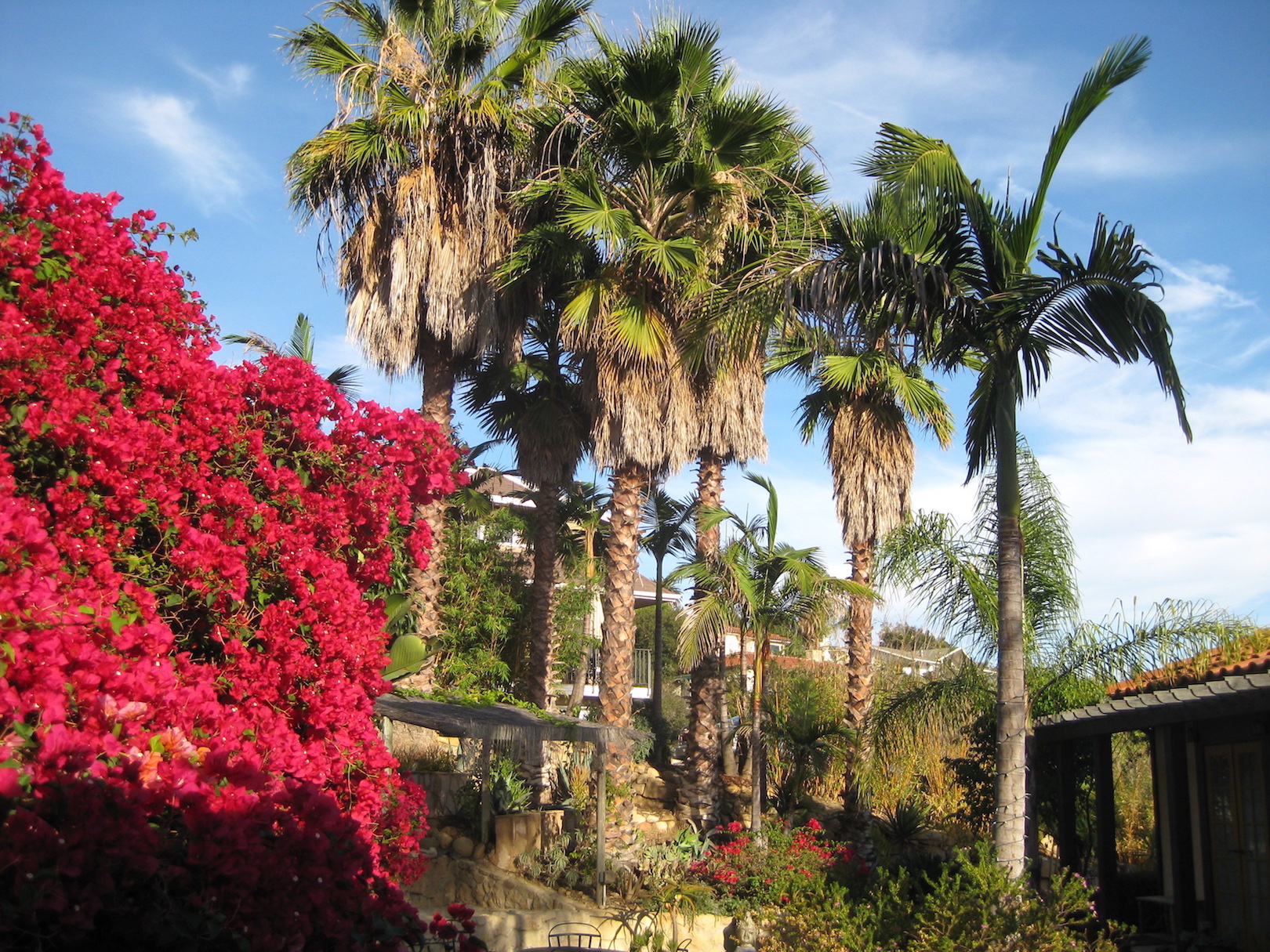
The vegetation in Santa Barbara is varied and lush, with many exotic succulent plants, beautiful flowering bushes, and tall trees. I share my admiration for them as we drive through the city. Nathanael comments: “A tree can only grow as high as its roots go deep.” I write it down and start converting the idea into the first two lines of a haiku. I tell him we need a third line to complete it. After pondering the question for a moment, he recalls a universal phrase from the somatic arts (yoga, dance, martial arts) that his friend and coaching colleague LeeAnn Mallory had shared with him: “Root to rise.” I turn it into the last line to complete this short poem on a basic principle of growth.

Trees for Growth Haiku

Growth Haiku

Trees can only grow
as high as their roots go deep
Root yourself to rise

© Ken and Nathanael Chawkin
Santa Barbara, California
Thanksgiving Day
November 23, 2017

Maharishi always talked about developing 200% of life—100% inner spiritual development and 100% outer material accomplishments. We both say, “Water the root to enjoy the fruit.” Nathanael quotes the SCI Principle, “Outer depends on Inner.” I remember an early analogy: To erect a tall building you have to first dig a deep foundation. It’s similar to: First pull the arrow back on the bow to hit the target. Meditate then act. Established in Being, perform action.

Nathanael does more than just meditate to develop his inner life and establish it on a firmer foundation for living mindfully. Self-inquiry with The Work, various martial arts, and playing classical piano are ways he better understands and integrates himself as a person. He uses an integral approach to inform his work as a martial arts instructor (Integral Martial Arts) and a leadership coach and organizational development consultant (Palæstra).

NB: Nathanael also helped edit this post—a father and son collaboration.

Related: Growth, a spontaneous haiku/tanka @kenchawkin.

Dawn in Santa Barbara — Haiku by @kenchawkin

November 23, 2017

I’m here in Santa Barbara, California visiting my son Nathanael and his girlfriend Evangeline for the Thanksgiving holiday. They live high up in the hills of the Riviera overlooking this beautiful city and the ocean. The panoramic views are spectacular! It’s like living in a constantly changing painting. My first visit a year and a half ago resulted in a spontaneous haiku. Early one morning, Nathanael excitedly invited me out onto the balcony to watch the predawn colors. It inspired this haiku.

Dawn in Santa Barbara inspires haiku

Dawn in Santa Barbara
Haiku by Ken Chawkin

Golden glow of light
Brightening the morning sky
The sun is rising

Happy Thanksgiving!

Ken Chawkin

Nathanael posted 6 photos of that sunrise and of me taking pictures of it posted on his Instagram. Their wonderful friend Jada Delaney also posted photos and a video of that same sunrise on her Instagram.

1st anniversary of my India trip to spread Sali’s ashes on the Narmada River, visit Bijouri campus and Maharishi Vedic Pandits at the Brahmasthan

November 12, 2017

This is the one-year anniversary of the start of my trip to India. A year ago today, I boarded a very long non-stop flight from Chicago to New Delhi. After clearing customs I went to an airport bank to change some money. It took a while, but a driver who had been sent to pick me up waited to take me to a Holiday Inn, where I finally crashed. The next morning another driver took me to the airport for a flight to Jabalpur. My sister and brother-in-law where there to welcome me when I arrived, which was very nice. We then traveled to the holy Narmada River, to fulfill the prime purpose of my long journey.

As it turned out, November 14, 2016 was a very significant day in three major religious traditions at this celebratory time of year. We hired a boatman, and after some special prayers, I spread Sali’s ashes on this peaceful celestial river as he rowed the boat towards and around a small Mother Narmada Temple at the foot of the Gwari Ghat.

This took place during the late afternoon on a Monday, a moon day, but the largest full moon in 70 years, the supermoon! It was highly significant, worthy of Sali’s spiritual merit she had earned offering a lifetime of one-pointed devoted service to Maharishi Mahesh Yogi, founder of the Transcendental Movement. Some of his ashes had been spread at this holy place as well.

See more details in last year’s post I wrote 3 weeks after returning home: An early attempt at some kind of closure with a poem on Sali’s passing and auspicious times. You can read the many inspiring tributes that were given at the October 5th memorial service, about her brilliant mind, kind heart, and good nature.

It was evening by the time we arrived at the Bijouri Campus in the Brahmasthan of India. During my 3-week stay there I would meet many wonderful meditators and sidhas from different countries around the world who came for the Maharishi India Courses, to meditate and enjoy the recitations of the Maharishi Vedic Pandits. It was a very healing atmosphere to settle into. Just what I needed, thanks to my family.

Traditional Indian Greeting

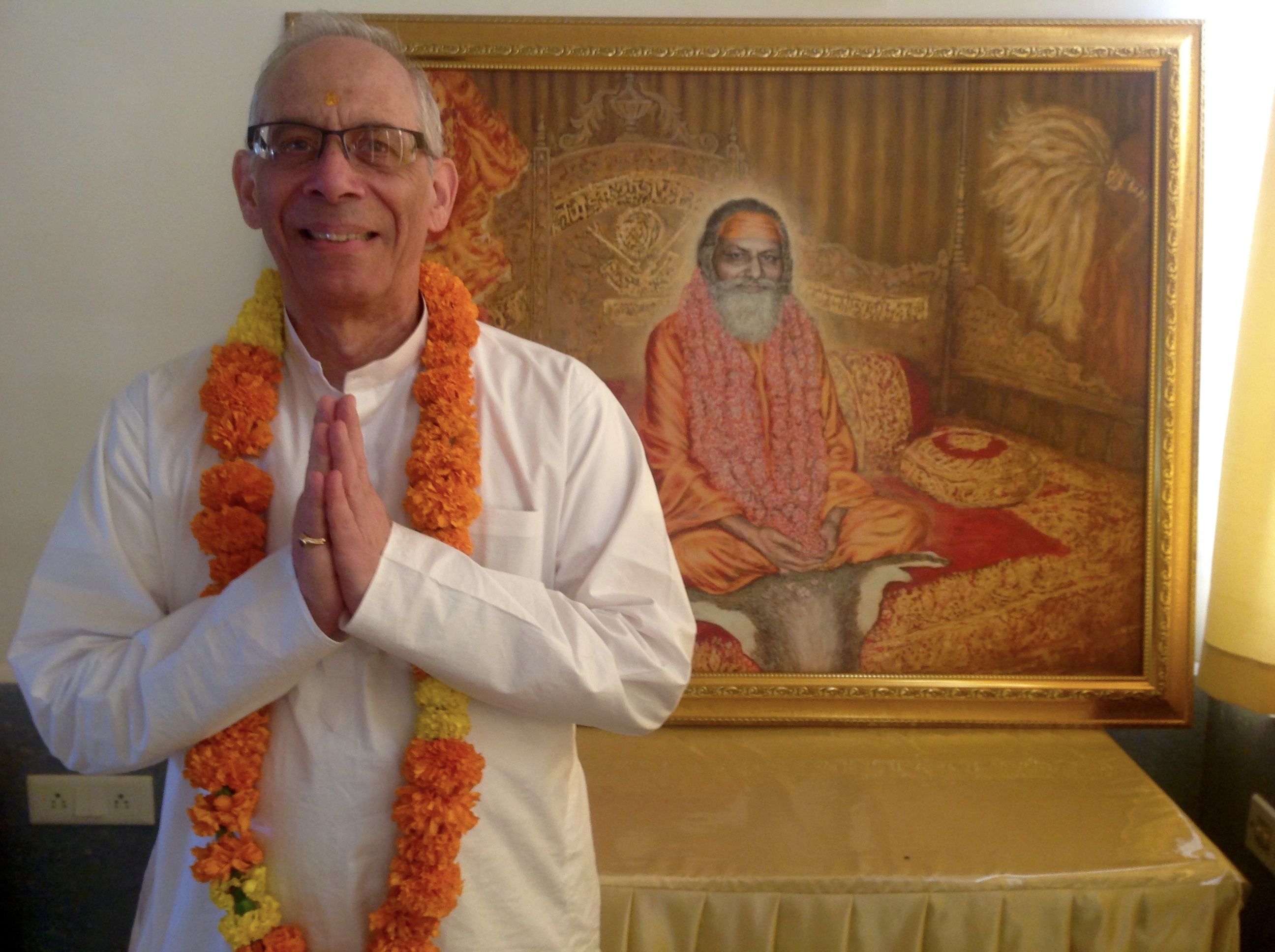
To start our course, we were each given a special welcome by the Maharishi Vedic Pandits and garlanded with flowers. Here is a photo of me, taken last year, November 16, 2016, after that warm reception.

Kenny at the Brahmasthan Nov 16, 2016

I purposefully stood in front of a large beautiful painting of Guru Dev, Maharishi’s master. I had purchased a print of this latest painting of Guru Dev the previous summer, having seen it featured at Art Fifty Two in Fairfield during a reception for the artist and her work. I had taken a photo of Frances Knight at the gallery standing in front of the original painting. You can also see part of a large Holy Tradition painting on the back wall behind her, one of many she had painted in the past.

Visiting the Maharishi Vedic Pandit Campus

On one of our trips we were taken to the geographical center of India known as the Brahmasthan. We shared a short group meditation and took photographs. And once a week we were driven to the Maharishi Vedic Pandit campus to hear 1,500 pandits recite Atirudrabhishek, an ancient Vedic performance to create world peace.

Sitting there with my eyes closed listening to the powerful Vedic recitation, I started to feel a deeply relaxing peacefulness growing inside my body. Soon, much to my surprise, I started to smile, then chuckle! I felt an inner happiness welling up within me that was totally unexpected. This bliss was a welcome contrast, a relief from the grief I was carrying around with me, mourning the loss of my sweetheart. This profound experience was worth the long tiring trip over there!

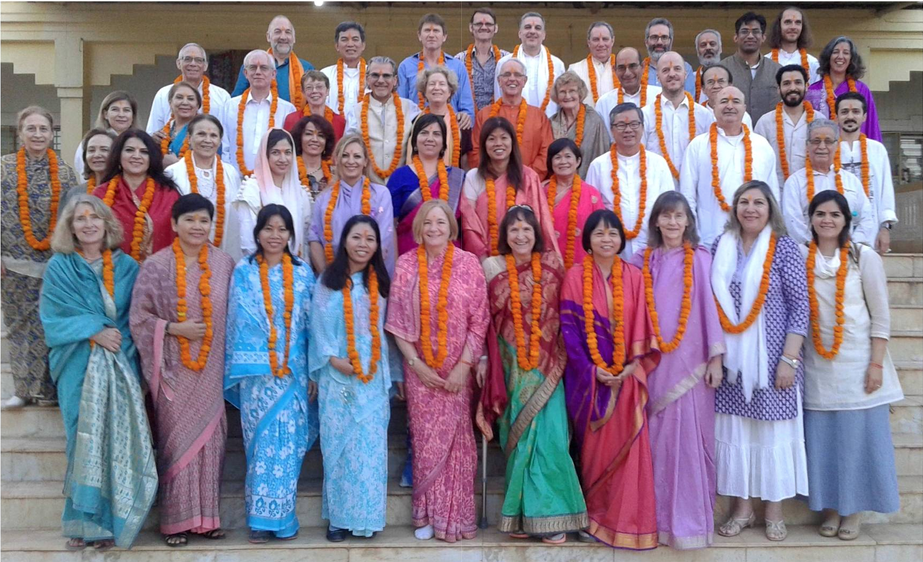
Group photo at pandit campus Nov 25, 2016

We put on traditional Indian clothing for these special occasions and posed for a group photo before boarding the buses back to our campus. I am standing in the upper second-to-last row on the far left. The course participants came from England, Ireland, USA, Canada, several European and Asian countries, Israel, Australia, and many from Iran. We were a diverse and harmonious group.

Now that I finally transferred all of my photos from my iPad onto my computer, I could post some of them related to this story. Who knows, maybe other photos will spark new stories.

Added June 28, 2019: Poem for Sali—An Undying Love—heals the heart.

— Written and compiled (citing sources) by Ken Chawkin for The Uncarved Blog.

Lisel Mueller’s poetry offers us Hope

November 3, 2017

“Hope” is a beautiful poem by Lisel Mueller, published in Alive Together: New and Selected Poems by LSU Press; First edition (October 1, 1996).

Hope
By Lisel Mueller

It hovers in dark corners
before the lights are turned on,
it shakes sleep from its eyes
and drops from mushroom gills,
it explodes in the starry heads
of dandelions turned sages,
it sticks to the wings of green angels
that sail from the tops of maples.

It sprouts in each occluded eye
of the many-eyed potato,
it lives in each earthworm segment
surviving cruelty,
it is the motion that runs the tail of a dog,
it is the mouth that inflates the lungs
of the child that has just been born.

It is the singular gift
we cannot destroy in ourselves,
the argument that refutes death,
the genius that invents the future,
all we know of God

It is the serum which makes us swear
not to betray one another;
it is in this poem, trying to speak.

I also love Lisel Mueller’s poem, “Monet Refuses the Operation,” about French Impressionist Claude Monet: Failing eyesight or spiritual insight: a poet’s interpretation of a master artist’s vision.

Still Sali Haiku—the persistence of love over grief

October 15, 2017

Grief persists after the loss of a close friend, but so does love. In time, grief recedes and love predominates. Here is a haiku for my sweetheart: Still Sali. I see that ‘still’ has both meanings: continuing and stillness.

                         Still Sali Haiku
                (You are still in my heart)

             The love is still there
           Our souls are still connected
                   But I still miss you

                  © Ken Chawkin
                    Oct 13-15, 2017
                    Fairfield, Iowa

A tanka remembering Sali and her gift to me on the one-year anniversary of her passing

October 1, 2017

During difficult times, and Sali’s final days, we were helped by the kind staff from Hospice Compassus. After Sali passed, they continued to offer me support with their bereavement program throughout the year. On the one-year anniversary of her death they sent me a letter and a brochure, Journey Through Grief: Looking back at your first year. They encourage “Grief journaling and all forms of writing as an important and helpful tool for healing.” They offered helping prompts to those grieving to get started with these two Reflective Questions.

As you look back at the past twelve months:

1. When thinking about the life of the person that you’ve lost to death, what — of themselves — have they given you to help you move through the rest of your life?

2. During your walk through grief, what have you learned about yourself that will assist you in moving forward?

I had been writing in a journal all along, and posted some entries and many poems. After reading these questions I was moved to write a haiku, then extended it to this tanka. I will give more thought to these questions and write something later, but wanted to post this tonight to mark the one-year anniversary of Sali’s passing.

Tanka for Sali
A remembrance of you and your gift to me

What you did for me
Was draw Love out of my heart
And into our lives

It completely transformed me
To become a better man

Oct 1, 2017
One year after Sali’s passing
© Ken Chawkin
Fairfield, Iowa

This entry, 9 months after her passing, reviews our relationship and what it meant: For Us—a tanka honoring Sali and what we shared. I also updated the entry Celebrating the Glorious Life of Sally Monroe Peden, which contains newer descriptions about Sali by friends who spoke at her Memorial Service. There are many beautiful tributes there, and now, halfway down, you’ll see today’s date, October 1, 2017, with new entries from David and Rhoda Orme-Johnson, Kate Ross, and later Rannie Boes.

This new post, added November 12, 2017, is relevant: 1st anniversary of my India trip to spread Sali’s ashes on the Narmada River, visit Bijouri campus and Maharishi Vedic Pandits at the Brahmasthan.

Eleven months are her passing I posted: ‘In Our Loving Eyes’ a poem by @kenchawkin remembering a special love with Sally Peden.

Added June 28, 2019: Poem for Sali—An Undying Love—heals the heart.

— Written and compiled (citing sources) by Ken Chawkin for The Uncarved Blog.

Leonard Cohen said there’s a crack in everything — how the light gets in. It came through him and lit up a broken humanity.

September 10, 2017

True to the end, Leonard Cohen‘s work charted the arc of his career, between life and death (Sept 21, 1934 – Nov 7, 2016). His search for redemption also influenced his fans. Cohen’s evolving understanding of life, beautifully expressed through his music, shone a light through the cracks of a broken humanity in a dark suffering world. He never claimed to have found all the answers, but seemed to have reached a kind of inner peace toward the end of his life, between himself and his God.

There is a repeated stanza in one of his songs, Anthem, that conveys the redeeming acceptance of light illuminating the darkness, compassion and love overcoming bigotry and hatred: “Ring the bells that still can ring/ Forget your perfect offering/ There is a crack in everything/ That’s how the light gets in.”

There may be a crack in everything, but how does the light get in—from without, or is it released from within? I’ve often thought about the profundity of those lines, and there have been many interpretations of what he may be implying. See mine below.* I think he sang about finding that divinity within and among our broken humanity. I wrote this tanka in honor of Leonard Cohen.

Leonard Cohen’s music lit up a dark world
A tanka in honor of the poet by Ken Chawkin

Leonard Cohen said
There’s a crack in everything
How the light gets in

It came through him and lit up
a broken humanity

Of course there is a kind of irony here when he says, “Forget your perfect offerings,” since he labored for months, sometimes years, on getting the lyrics to his songs perfect. At some point, though, he must’ve given up, admitted his imperfection, and sent them out into the world. As Leonardo da Vinci once said: Art is never finished, only abandoned. Other famous artists and writers have said and done the same thing.

Artistic Genius—Two Creative Approaches

There is a story about Leonard Cohen and Bob Dylan. They happened to be in Paris at the same time and decided to meet at a certain café. During their conversation, Dylan, one of the first to sing Cohen’s song “Hallelujah” in his concerts, asked Cohen how long it took him to write it. Cohen was embarrassed to tell him the truth so he lied and said 2 years. Then Leonard asked Bob how long it took him to write “I And I“, and he replied 15 minutes. I think he said he wrote it in the back of a cab. Cohen later told this story to an interviewer and confessed that it took him more like 5 years to write that song. He never could complete it, even after 30 verses! Their styles reflect the different philosophical approaches of ‘first thought, best thought’ versus ‘revise, revise, revise’.

You can read the fascinating history of that song in Alan Light’s book, The Holy or the Broken: Leonard Cohen, Jeff Buckley, and the Unlikely Ascent of “Hallelujah”. Malcolm Gladwell, in Season 1, Episode 7 of his Revisionist History podcast, discusses the history of “Hallelujah” with Alan Light. That segment starts at 21:35 and explains how this obscure song was first covered by only a few artists 15 years after Cohen had recorded it. The theme is about two kinds of artists—those who seem to create spontaneously, and others who labor for a very long time—the differences between Mozart and Beethoven, or Picasso and Cezanne. It first aired July 28, 2016. Later added on YouTube March 8, 2023 starting at 18:13. Also listen to BBC – SOUNDS – Soul Music – Series 20 – Hallelujah. First broadcast on BBC Radio 4 in April 14, 2015. (27:50)

During Leonard Cohen’s final public appearance at the Canadian consulate in Los Angeles on October 13, 2016, the day Bob Dylan was awarded the Nobel Prize in Literature, he was asked what he thought about that and said: “To me, it’s like pinning a medal on Mount Everest for being the highest mountain.”

Hallelujah: Leonard Cohen, a Journey, a Song

I later read the Guardian article (6-29-2022) that this book served as the basis for the new documentary Hallelujah: Leonard Cohen, A Journey, A Song. Directed and produced by Dayna Goldfine and Dan Geller, the film takes both a micro and macro view of the song and Cohen, along with their respective and deeply intertwined places in culture. See ‘More than a song’: the enduring power of Leonard Cohen’s Hallelujah. In a new documentary, fans and experts explore the legacy of a song originally shunned before becoming a timeless classic.

I saw this documentary at the FilmScene in Iowa City (Saturday, August 6, 2022). It was very well put together. The ending moved me to tears. Netflix later offered it: Hallelujah: Leonard Cohen, A Journey, A Song

See Leonard Cohen’s website www.leonardcohen.com with links to more.

I tweeted (9-19-2107) Leonard Cohen’s biographer, Sylvie Simmons, asking her what he meant about the light getting in through the cracks, and she pointed me to Allan Showalter’s Cohencentric website and a post about it. He transferred it to his new website: “The light is the capacity to reconcile your experience, your sorrow, with every day that dawns” Leonard Cohen On The Light In Anthem.

Leonard later spent time in Bombay, India having conversations with Ramesh Balsekar, a teacher of Advaita Vedanta. It made a profound impression on him; his life-long depression had finally lifted. He also befriended an Indian gentleman, a fan, Ratnesh Mathur. You can read about their relationship and see photos in these posts that were transferred to Allan Showalter’s new website in his Leonard Cohen section: Leonard Cohen, India, & Me By Ratnesh Mathur; Leonard Cohen’s Spiritual Sojourn In India By Ratnesh Mathur; and Unpublished Photos Of Leonard Cohen (And Unidentified Companion) In India – With Ratnesh & Sangeeta Mathur. BBC reported: When the light got in for Leonard Cohen.

Murals mark 1-year anniversary of Leonard Cohen’s death

Montreal murals of Leonard Cohen

Montreal murals made by Gene Pendon (l) and Kevin Ledo (r)

November 7, 2017 is the 1-year anniversary of Leonard Cohen’s death. To personally commemorate this date, Sylvie Simmons tweeted a picture of herself standing in front of a large mural of Leonard Cohen painted by Kevin Ledo on the side of a 9-storey Montreal building close to where Leonard kept a home. It was the center piece for the fifth Mural International Public Art Festival in June. CBC Arts interviewed Kevin Ledo while he was working on it: Montreal Remembers Leonard Cohen With This Massive Mural. The Montreal Gazette’s Bill Brownstein had written an article about the making of it. He also mentions another mural, a tribute to Leonard Cohen made by artist Gene Pendon, which was painted on the side of a 20-storey downtown building, as part of Montreal’s 375th billion dollar birthday bash. The Globe and Mail described them in detail: Leonard Cohen and a tale of two Montreal murals. ET Canada reported on the official inauguration today, a year after Cohen’s passing. Josée Cloutier posted photos of both murals in one tweet, shown above. 

CBC broadcaster Eleanor Wachtel tweeted that the photograph of Leonard Cohen, which served as the basis for the large downtown mural, was taken by his daughter Lorca. Interesting that Leonard named his daughter after the famous Spanish poet Federico García Lorca, who had greatly influenced his work. See: Leonard Cohen on Federico García Lorca: “His books taught me that poetry can be pure and profound – and at the same time”

The M.A.C.’s Exhibition on Leonard Cohen: A Crack in Everything

The Guardian published Leonard Cohen: A Crack in Everything – Montreal’s tribute to its favourite son. The new exhibition was conceived as part of the city’s 375th anniversary celebrations – but has morphed into a thorough investigation of all things Cohen. On 9 November, the Musée d’art contemporain de Montréal (AKA the Mac) will open the doors to Leonard Cohen : une brèche en toute chose/A Crack in Everything, a tribute to the artist, poet and musician, filled with multi-disciplinary works inspired by Cohen’s songs of life. This special exhibition at the Montreal Museum of Contemporary Art will conclude 9 April 2018.

The show takes its title from Cohen’s song Anthem, which contains the famous line “There is a crack in everything, that’s how the light gets in.” The song also inspired artist Kara Blake’s piece for the show, an immersive installation called The Offerings. “The song apparently took Cohen 10 years to craft and is just one example of his many artistic offerings that get inside the beautifully flawed nature of being human,” says Blake. “I wanted my piece to present visitors with a sampling of the creativity, wit and insight Cohen has gifted us with.”

Julia Holter contributed a cover of Cohen’s Take This Waltz, which will play on rotation in the Listening Room. “I enjoyed getting into the feeling of this passionate, seductive, demented waltz,” says Holter, who incorporated field recordings she made during a visit to the Greek island of Hydra, where Cohen had a home. “Being there was incredible,” she says.

For Holter, being invited to contribute to the show is the perfect way for her to give back to an artist she was introduced to as a child and who inspired her love of poetry. “What was special about Leonard Cohen’s work was its calm mystery. I think that can be an inspiration to the world right now,” she says. “The world needs this subtle beauty right now.”

And of course, who could ever forget Suzanne, Leonard’s mysterious poetic song that started it all, thanks to Judy Collins who wanted to cover it right after she heard Leonard sing it to her. It launched his career as a singer-songwriter. The song was inspired by Suzanne Verdal, the then estranged wife of his friend, sculptor Armand Vaillancourt. Read Suzanne’s 1998 BBC Radio 4 interview

Leonard Cohen biographer Sylvie Simmons

As part of the week’s celebrations, Eleanor Wachtel interviewed Sylvie Simmons on CBC Books Writers and Company, for broadcast on Sunday, November 12, 2017: Remembering Leonard Cohen: biographer Sylvie Simmons on Montreal’s beloved poet.

I enjoyed reading Sylvie’s wonderful biography, I’m Your Man: The Life of Leonard Cohen. It will be published next year in a new French edition with an added afterword that will be included in a revised English edition by McClelland & Stewart.

The afterword is Cohen’s response to the question about what was the driving force that propelled his output. Simmons calls it Traveling Light, and quotes Cohen’s answer in this interview for The Senior Times: Biographer Sylvie Simmons pays tribute to Montreal’s favourite son.

Leonard Cohen was very active towards the end of his life. Due to his declining health he tried to bring as many projects to completion as possible. One of them was his last album, You Want It Darker, produced by his son Adam Cohen. A new poetry book, The Flame, will be released next year.

The Flame: Poems Notebooks Lyrics Drawings

On Oct 1, 2018 CBC q host Tom Power interviewed Adam Cohen on the legacy of his father Leonard Cohen. It’s been almost two years since the passing of Leonard Cohen, but we’re about to hear from the legendary singer and poet again. The Flame is a posthumous collection of his final writing that features never before published poems that Leonard Cohen wrote in the final few years of his life. The day before it’s release, Adam Cohen returns to q to talk about mourning his father’s life and and celebrating his legacy on the morning of the book’s release.

*My reply to Quora question about the crack and the light

Quora posted this question: What did Leonard Cohen mean by his lyrics: “There is a crack, a crack in everything/ That’s how the light gets in?” About a dozen people posted their suggestions. Here is my reply:

I agree with a number of interpretations posted here, quoting William Blake, the Kabbalah, and other esoteric sources, to explain what Leonard Cohen may be referring to in that line. They all make good sense to me. I also think that the light, of clarity, understanding, call it what you will, comes from within, not without. Metaphorically we may imagine light coming into a dark broken place from outside. But it can also light up the darkness from inside, if one knows how to turn on the switch. Another interpretation then, is no matter how broken, incomplete we are, with the proper approach, meditation technique, one can transcend, go beyond our limitations and just Be, experience that unbroken inner light of pure consciousness. With repeated exposures to one’s inner divine nature, the outer vessel, our body, can begin to heal, mend the broken cracks, and become whole. One way to experience this inner and outer development is with the regular practice of Transcendental Meditation.

Speaking of cracks and light, the Japanese art of kintugi turns damaged bowls into something even more beautiful. See my Japanese style poem, kintsugi tanka: japanese pottery inspires poetry.

This Canadian writer used the same metaphor, but from a different perspective: Richard Wagamese bravely entered the cracks in his life to reveal the hidden gold buried within.

New information on this topic later found and added

I recently discovered a quote by Rumi, which led me to believe this is where Leonard may have received the idea of the light entering the crack. Rumi wrote: “The wound is the place where the Light enters you.”

In the documentary, Andrea Bocelli – The Power of Silence, the interviewer quotes Rumi to Andrea. Here, ‘wound’ replaces ‘crack’, and he changes ‘you’ to ‘the heart’, but the idea is the same. It seems more intimate. “The wound is the place where the Light enters the heart.” They discuss the notion of the value of suffering and he asks him, “When did the light enter your heart? When did that light strike Andrea?” 

Andrea gives him an unexpected, beautiful, religious answer. “So the vision of Rumi the philosopher that you quoted is very interesting and I agree with what he says. In my case I didn’t think it was a wound, not such a painful wound that opened up and allowed the light to enter. No, I think the light entered my heart thanks to the grace of God.”  

He asks him, “Are you happy?” and Bocelli replies, “I am happy, yes, but more importantly, I am serene. To me happiness is a transitory condition and it can sometimes be a bit dangerous; whereas being serene is a state of mind that can be consolidated and it can stay with us forever.”  

Speaking of the Light entering us, see Marie Howe’s poem, Annunciation.

Additional interviews, documentaries, a new film, and album

Leonard Cohen SONGS FROM THE LIFE OF LEONARD COHEN, a 1988 documentary filmed in London, Paris, Hydra, Athens and New York.

“LEONARD” – Adrienne Clarkson – Leonard Cohen Documentary, 1989. Leonard Cohen tells Adrienne Clarkson about his original idea of making a living: “I don’t want to work for pay, but I want to be paid for my work.

In 1991 media mogul Moses Znaimer inducted Leonard Cohen into the Canadian Music Hall of Fame at The JUNO Awards in Vancouver. Leonard gave a brilliant and humorous acceptance speech.

In 2006, Adrienne Clarkson narrated a retrospective of Leonard Cohen’s work and movingly inducted him into the Canadian Songwriters Hall of Fame. In his acceptance speech, Cohen said: “If I knew where the good songs came from, I’d go there more often.” He humbly went on to say “that we shuffle behind our songs into the Hall of Fame, shuffle awkwardly, not quite believing that we wrote them, but happy that you do,” which elicited laughter and massive applause.

k.d. lang agreed to pay tribute to the legendary singer-songwriter with a rendition of his beloved song, “Hallelujah.” She had never performed the song for Cohen and “was excruciatingly nervous” knowing he would be in the audience. She received a standing ovation, and as the credits began to roll, she ran down the stage steps towards Leonard to offer him her reverence and appreciation. He rose to meet her and they warmly, respectfully embraced. Cohen’s partner, singer Anjani Thomas, looked at Cohen and said, “Well, I think we can lay that song to rest now! It’s really been done to its ultimate blissful state of perfection.” He agreed. A few years later, in a CBC interview, Cohen recalled that performance and said, “that really touched me.” He was asked about the history of that song, and said, “the only person who seemed to recognize the song was Dylan.” During her world tour in 2008, lang gave a beautiful performance of the song backed by the BBC Concert Orchestra in a concert filmed at St. Luke’s Church in London. And two years later, lang sang Leonard Cohen’s “Hallelujah” at the Vancouver 2010 Olympics Opening Ceremony. It was spectacular!

Interview with Leonard Cohen and Anjani Thomas | SVT/NRK/Skavlan, 2007. Asked if we are able to make a change for the better, Leonard discusses where catastrophes start and where we need to change: “The real weapons of mass destruction are the hardened hearts of humanity.

In 2008, Leonard Cohen was inducted into the Rock & Roll Hall of Fame. Read the Hall of Fame Essay by Anthony DeCurtis: Leonard Cohen.

Leonard Cohen on Q TV (CBC exclusive). To celebrate Q’s 2nd anniversary — poet, novelist, songwriter, legend…a special exclusive feature interview with Leonard Cohen… recorded at his home in Montreal. Posted Apr 15, 2009.

How I Got My Song, Leonard Cohen’s speech at the Oct 21, 2011 Prince of Asturias Awards, posted by Allan Showalter. Cohen humbly and with great appreciation, tells the story of his cultural indebtedness to Spain.

LEONARD COHEN : His Last Interview (COMPLETE), September 2016, ​by David Remnick from The New Yorker.​

The Globe and Mail’s Robert Everett-Green also wrote about Leonard Cohen’s Montreal: refuge and escape. Published October 14, 2016. Updated April 10, 2018.

Marianne & Leonard: Words of Love

The poem, Days of Kindness, read by Leonard Cohen, concludes the 2019 film, Marianne & Leonard: Words of Love, an in-depth look at the relationship between Leonard and his Norwegian muse Marianne Ihlen.

Listen to CBC Radio’s As It Happens interview Marianne’s close friend, filmmaker Jan Christian Mollestad, the week she died: So long, Marianne. Leonard Cohen’s final letter to his muse. At Marianne’s request, Jan had conveyed a message to Leonard that she was dying. He wrote back to her, the subject of the interview. There is also a link to Leonard Cohen’s Facebook page with Jan’s reply to Leonard, saying his letter to Marianne gave her deep peace of mind, and described her peaceful passing to him.

Jan Christian Mollestad was one of the executive producers on the film. He had posted a video celebrating Marianne’s 80th birthday that previous year on Hydra, including Adam Cohen singing “So long, Marianne” in Oslo, and Marianne and Judy Collins enjoying singing “Famous Blue Raincoat” together.

November 22, 2019 brings the release of the first posthumous Leonard Cohen album, Thanks For the Dance. For the nine-track LP, Cohen’s son, Adam, took leftover sketches and poems from his father’s 2016 LP, You Want it Darker, and fleshed them out with the assistance of Beck, Damien Rice, The National’s Bryce Dessner, and others. Following last month’s teaser track, “The Goal”, “Happens to the Heart” has now been released as the album’s first official single.

November 30, 2016 Rolling Stone published a retrospective of his life: Leonard Cohen: Remembering the Life and Legacy of the Poet of Brokenness. June 2020 Pocket republished it with permission.

Jan 18, 2021, Award-winning writer Michael Posner speaks with Banyen Books & Sound about his new biography: Leonard Cohen, Untold Stories.

February 24, 2022, The Guardian published Leonard Cohen: previously unpublished novel to be released in autumn. Written in 1956, A Ballet of Lepers will be published alongside other short fiction and a radio play from Cohen’s early career.

June 29, 2022, The Guardian published ‘More than a song’: the enduring power of Leonard Cohen’s Hallelujah. In a new documentary, fans and experts explore the legacy of a song originally shunned before becoming a timeless classic.

July 7, 2022, Directors Dan Geller and Dayna Goldfine, and head of the Cohen estate/Executive Producer Robert Kory discuss HALLELUJAH: Leonard Cohen, A Journey, A Song at the Rock & Roll Hall of Fame. This was the first RRHF screening and discussion since the covid pandemic had shut them down for a year. See the 42-minute video.

Speaking of The Coming of Wisdom in Time, as William Butler Yeats put it, Leonard Cohen came to a similar realization when he said: “The older I get, the surer I am that I’m not running the show.” 

This Google search lists recorded interviews. This resource, The Leonard Cohen Files, is a tribute to the music and poetry of the Canadian singer-songwriter-poet-novelist Leonard Cohen. Launched in 1995 in Finland by Jarkko Arjatsalo, the extensive website contents also has a Leonard Cohen Forum, a meeting point for members and fans with the latest news about Leonard. I later found Jarkko’s September 2012 Interview with Sylvie Simmons.

I later found this video posted on YouTube by AirGigs on Jan 18, 2022: 10 Pearls Of Wisdom From Leonard Cohen. In this episode we look at his thoughts on success, writing, talent and much more.

Apr 9, 2024, Contra Costa JCC presented, Leonard Cohen: Untold Stories. Award-winning writer, playwright, journalist, and author of seven books, Michael Posner, joined the Under One Tent audience online on Tuesday, April 9, 2024. He introduced the third volume of his book, “Leonard Cohen: Untold Stories,” a must-read for fans of Leonard Cohen.

May 26, 2024, I posted For Carlos Santana, the purpose of playing music is creating holy moments, and Leonard Cohen did.

November 21, 2024: CBC: Sting, Courtney Love, k.d. lang and others celebrate Leonard Cohen’s life in stunning concert documentary. Leonard Cohen: If It Be Your Will, a new concert documentary featuring stunning performances and tributes. The article includes two video excerpts from the show. It aired Nov 20 and can now be streamed, but only in Canada.

To see other inspiring artists featured on The Uncarved Blog, scroll through the Archive of the ‘Music’ Category.

— Written and compiled (citing sources) by Ken Chawkin for The Uncarved Blog.