Last week I received an invitation from Ananda Kesler to the official opening of her art exhibit, “Longing for Another Realm,” at the Art Center of Burlington. I passed it on to my friend Bob Saar who writes for The Hawk Eye, and introduced them via email.
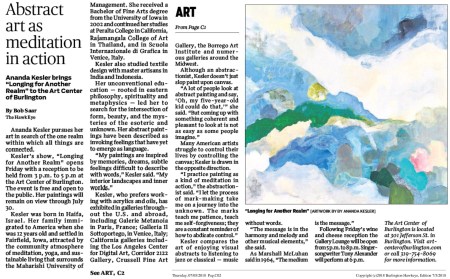
Intrigued, Bob went to the Art Center to interview Ananda as she was putting up her paintings for the show. They shared a deep conversation and he wrote an amazing piece for the newspaper. Titled “Abstract art as meditation in action,” it made the cover of the WEEKEND Section C1, Thursday, July 5, 2018. Bob was kind enough to put it together in a PDF for us to share. I know the print is small, but if you can expand your page (command and shift +), the text will become easier to read.
The opening sentence really captures the essence of Ananda and her work. It is the essential message, the seed containing the whole tree: “Ananda Kesler pursues her art in search of the one realm within which all things are connected.”
Bob discovers Ananda’s eclectic upbringing, starting in Israel and immigrating with her family to Fairfield, Iowa when she was 12 years old. She told him about her education. Ananda attended MSAE, started college at MUM, then switched to U of I where she graduated with a BFA. She continued her studies in art and textiles at various art schools in California, Thailand, and Italy. Her work has been featured in many shows and articles.
Bob mentions the meditating Fairfield community and MUM and writes, “Her unconventional education — rooted in eastern philosophy, spirituality and metaphysics — led her to search for the intersection of form, beauty, and the mysteries of the esoteric and unknown. Her abstract paintings have been described as invoking feelings that have yet to emerge as language.”
I like how Bob set up the topic of control in life and in painting, and how Ananda’s approach is the opposite. This idea illuminates her practice. Towards the end of the article she explains: “I practice painting as a kind of meditation in action,” from which he derived the title for the article.
She then describes what the process does for her: “I let the process of mark-making take me on a journey into the unknown.” This next part surprised me: “The marks teach me patience, teach me self-forgiveness; they are a constant reminder of how to abdicate control.”
Enjoy this brilliantly written and insightful article.
Ananda’s description of her process, and the difference between feelings expressed in art, which are pre-verbal, and words, remind me of an experience I had during an intuitive art class I had taken years ago in Vancouver, Canada. See ArtWords—poem about a creative awakening.
A related topic, on the difference between words and art, is played out in the movie, Words and Pictures. The story, set in a New England prep school, was actually shot at St. George’s School, an independent boarding and day university-preparatory school for boys in Vancouver, British Columbia, Canada, a.k.a., Hollywood North. A poem, Who Are You?, is central to the film. I posted it, with the movie trailer, and a magical coincidence told by an English teacher from that school on a radio talk show I had heard while living there. See A poem in a movie inviting you to be who you are, to find out the connection, and what famous actor he meets while walking in the woods during a lunch break.
KYOU FOX 15.1 News Story, Wednesday, 2/14/2018, MUM Film Class
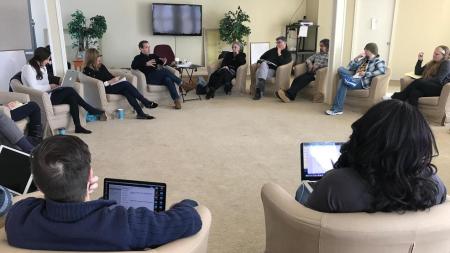
Maharishi University of Management offers a program called the David Lynch MFA in Screenwriting…and for 10 days… 16 students from Maine to California …are staying in Fairfield with dreams of one day being able to share their writing with the world…
16 students met with producer Michael Rauch Sunday afternoon at the Maharishi University of Management./KTVO
FAIRFIELD, IOWA — Meditate and create. That’s the main focus of the Maharishi University of Management’s David Lynch Screenwriting Program.
Sixteen students are currently enrolled in this two-year masters in fine arts program. Over the course of 10 days, they’ll go through intensive training and meet with well-known producers and executives in the business.
Dorothy Rompalske is the program’s director. She says teaching Transcendental Meditation is what makes this course so special.
“We use Transcendental Meditation in order for the students to sort of dive within and find material that they feel really passionate about, writing about,” said Rompalske.
And the meditation seems to really be working for the students.
“One of the scripts I wrote pretty much all came through meditation. And it’s such a different way of thinking that I wasn’t used to, so it’s just opened a lot more creativity,” said student Josh Lee.
Saturday, students had the chance to meet with Michael Rauch, who’s produced various TV shows such as ‘Royal Pains’ and ‘Beautiful People.’
Rauch answered questions and talked about what it’s really like to be a writer and work in this industry.
“To sit down and get the actual information on how to do it, how they pitch, how the process is, it’s really a unique and valuable experience,” said student Tracy Flannigan.
While the David Lynch screenwriting program is only a year old, Rompalske says she hopes to see it grow over the next few years.
“I think we’re such a different model than what people are used to, so we’ll have hopefully even more students next time around,” said Rompalske.
MUM is currently accepting applications for the program.
Have you ever heard of Eva Cassidy, or heard her sing? Eva Marie Cassidy (February 2, 1963 – November 2, 1996) was an unpretentious humble girl from small town Bowie, Maryland. She worked hard with her mother in their nursery growing flowers and plants. But Eva also sang. She had the voice of an angel, and delivered songs with purity, passion, and power. She accompanied herself on guitar, and also sang with a band. She would immerse herself in the words, she “connected to the lyric” and lived the songs. Her voice communicated directly to the hearts of her listeners. Rarely was there a dry eye in the place.
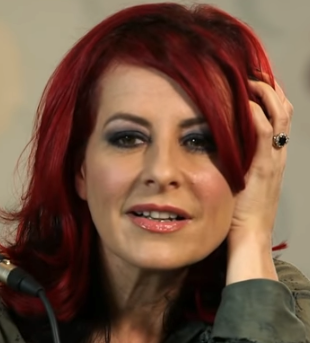
In the film Eva Cassidy: Timeless Voice, Carrie Grant, a British vocal coach who worked with top recording artists in the UK and US, was amazed when she heard Eva’s voice. After listening to Over The Rainbow, she said, “I cannot imagine what Eva Cassidy was thinking of when she chose to make it sound the way it does. But it’s just genius!” She describes how she redefines the song in unexpected ways, “yet for some reason it just works.”
She also explained the effect that Eva’s voice had on listeners. “She sounds like she’s singing just to you. And that is what makes it so intimate. And that becomes even more profound once you know she’s no longer alive. Because it’s haunting. And it’s personal.”
Eva sang the songs that she liked, regardless of genres, which is why record companies would not sign her during the days of manufactured music. They couldn’t slot her into a specific category. She sang blues, jazz, gospel, folk, old standards, and more. At first she was extremely shy, didn’t care for stage presence or how she dressed. With the help of local musicians she performed at Blues Alley, a local jazz spot in Georgetown, Maryland. One of her shows was later recorded. She sold two locally produced CDs out of the trunk of her car. You can listen to Live At Blues Alley on Spotify.
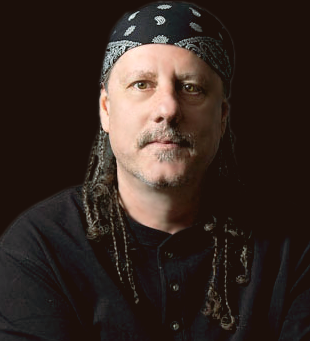
We might wonder how her singing was recorded in the first place when no company would sign her. One comment on Ain’t No Sunshine explained that the world owes Chris Biondo a debt of gratitude. Chris worked as a bassist, guitarist, keyboardist, recording engineer, and producer. He owned a studio in the 80s and 90s, and Eva would come in for session work. He recognized her ability, and said he “would just roll tape and stay out of her way.” At one point they were romantically involved. Chris “was the one who recognized her transcendent, ageless genius.”
In 1986 Chris began recording the then-unknown singer Eva Cassidy. For the next ten years he worked with Eva to develop her as a recording artist, producing most of her recordings available today. In the years since Eva’s death in 1996, her recordings have sold more than 10 million copies and achieved international renown, including three albums that reached number one in the UK charts. Chris has received numerous Gold and Platinum records in the U.S. and internationally for his work with Eva.
Bill Straw of Blix Street Records signed her up and continues to release and reissue her music, like the 20th anniversary of the new 32 track/2CD Nightbird album, The Best Of Eva Cassidy, Simply Eva, and eight other collections listed there that you can sample.
Sting himself was blown away when he heard her rendition of his song. He put a copy of her Songbird CD into record producer David Foster’s hands who quoted him saying, “‘If you want to hear the greatest version of my song ever’—he didn’t say it in an egotistical way—he said, ‘listen to Fields Of Gold with this girl, it’ll change your life.’ And her voice is life-changing, she’s that spiritual.” I love that song and remember hearing it on an airplane’s music channel during a flight. It was astounding! I had to find out who this singer was.
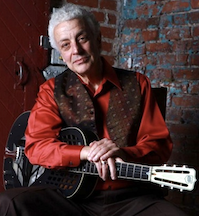
Another singer-songwriter who was overwhelmed by Eva Cassidy singing one of his songs was award-winning acoustic bluesman Doug MacLeod. During an interview he was asked: “Your songs have been recorded by many artists, so which are your favorite interpretations?” He said he had a couple of favorites, and that Eva Cassidy’s version of Nightbird was one of them. He told the story of how he first heard Eva sing when his wife put on her CD in the car. He said it moved him so much, “I pulled over to the side of the road and I was weeping.” When people ask him to play Nightbird, he tells them that “if they want to hear THE version, she is the one to listen to.” Read the whole interesting story in the highlighted comment Harvey Bobb posted to Eva Cassidy – Nightbird.
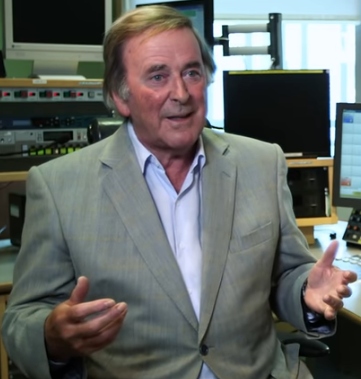
A relatively unknown singer in America at the time, somehow her music made its way across the Atlantic. From the first time Sir Terry Wogan, a BBC radio broadcaster, listened to Eva sing, he knew “she was an outstanding talent.” He said, “It was pure sound. A bell-like voice. She had this perfect pitch.” He couldn’t wait to play it on the radio. His was the most listened to program in the country at the time. It created a huge response from many of their seven million listeners wanting to know who she was. Unfortunately they found out that she had died two years earlier of cancer at the young age of 33.
When Mark Hagon, a Top of the Pops BBC (TOTP2) producer at the time, agreed to play that homemade video of Eva Cassidy singing Over The Rainbow, people kept calling in for weeks wanting to know her name. The listening public created a demand for her music. It was a groundswell! Sales of her CDs went from a hundred thousand to over a million in the UK. “Radio broke it. Television exploded it.”
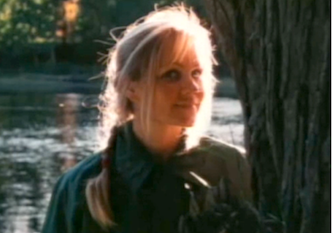
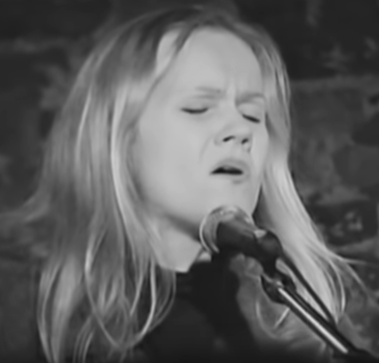
Cropped screensaver taken from the video of Eva Cassidy singing Over The Rainbow at Blues Alley, Georgetown, DC, January 3, 1996.
At one point five of her CDs became top sellers at the same time, a feat usually held by the Beatles and Rolling Stones. She was then discovered back home in the USA. ABC Nightline in Washington, DC researched and produced The Eva Cassidy Story (18:40). It was shown in many countries around the world and within a week of it airing her CDs went to the top of the local charts.
In Timeless Voice, Terry Wogan concluded, “You’d have to say about Eva Cassidy that her talent was pretty timeless. The voice has a quality of timelessness about it. Anytime you would hear it, whether it was thirty years ago, or thirty years from now, it’ll still be worth listening to, and still strike a responsive chord in most people’s hearts.”
Mick Fleetwood of Fleetwood Mac who knew Eva said, “She was brilliant. She had the magic. And I call it, It. She had It!”
Eva Cassidy: 25 years ago, a little known singer, Eva Cassidy, and her producer scraped together enough money to record a gig and self-produce an album. This is the story of one night – 3rd January 1996 – at a jazz club in Georgetown, Washington D.C., a set of recordings that almost never happened, and the extraordinary success that followed told by her band members who played with her that night. No one could have imagined that the audio and video recordings from that night would prove to be the foundation of her unparalleled posthumous worldwide success.
The main question posed in the 2016 sci fi film Arrival is, If you could see your whole life from start to finish, would you change things?
When mysterious spacecraft touch down across the globe, Colonel Weber (Forest Whitaker) recruits Dr. Louise Banks (Amy Adams), a renowned linguist, and Dr. Ian Donnelly (Jeremy Renner), a theoretical physicist, to try and communicate with the Aliens and find out why they have landed on Earth. Dr. Banks races against time to decipher their intent. As tensions mount between fearful governments, she discovers the Aliens’ true purpose and, to avert global war, takes a chance that could threaten her life, and quite possibly humanity. This mesmerizing masterpiece has a mind-blowing ending that will leave you wondering what happened and how.
That’s the external story, but the essential message of this movie is more internal. It’s about love, determinism and choice.
Based on the award-winning science fiction novella, Story of Your Life, by Ted Chiang, it was convincingly transformed into a screenplay by Eric Heisserrer. Having read the book and been moved by it, director Denis Villeneuve wondered how it could be turned into a science fiction film, a genre he had been thinking about for years. When he received the script he decided he finally had to make this film, but with Amy Adams in the lead as Dr. Louise Banks. Even though she was taking a break from filmmaking, after reading the script, she was in. Everyone involved with making the film read the book and loved the story.
In the opening scenes we learn that Professor Louise Banks is losing her daughter Hannah to a rare disease. As a child, Hannah asks her mother how she chose her name. Louise tells her she has a special name, because it is a palindrome. It’s spelled and read the same way, forwards and backwards.
This is a clue that may help you make sense of certain events in the film that appear as flashbacks. Or are they flashforwards? Yet, in retrospect, it’s not the beginnings and endings that are important to Louise, but how she lived her life, the choice she made to love, regardless of the outcome.
Watching this movie was a right-brain experience; it’s non-linear. Dr. Banks goes through changes as she learns the Alien language. Their images communicate ideas in circles without reference to tense or time. Comprehending their language transforms Louise’s brain. She begins to experience the events in her life from a less sequential, more holistic perspective.
This is reality parsed and put together from a female perspective. She is the only one who can save the situation when she finally understands why the Aliens are here. The other challenge now is communicating it to a male-dominated world intent on destroying itself. This Chinese quote is another important clue: “In war there are no winners, only widows.”
Towards the end of the film, having collaborated with and seen how brilliant, brave, and compassionate Louise has been throughout their encounter with the Aliens, and the Army, Ian realizes he’s fallen in love with her. As much as he was amazed by his encounters with the Aliens, his “greatest surprise” he tells her, “is you.”
To love is human. It takes us out of our time, because Love Is Eternal. It always Is. We participate in It. If we are lucky enough. I wrote this as a comment to my son who purchased the film and sent me the link. I couldn’t help turning it into a tanka.
After watching “Arrival” (2016)
To love is human
It takes us out of our time
Love Is Eternal
You can now rent or buy Arrival on Prime Video, or watch it Free with ads on YouTube Movies & TV. After seeing the movie twice, this article and these videos will help you make better sense of it all.
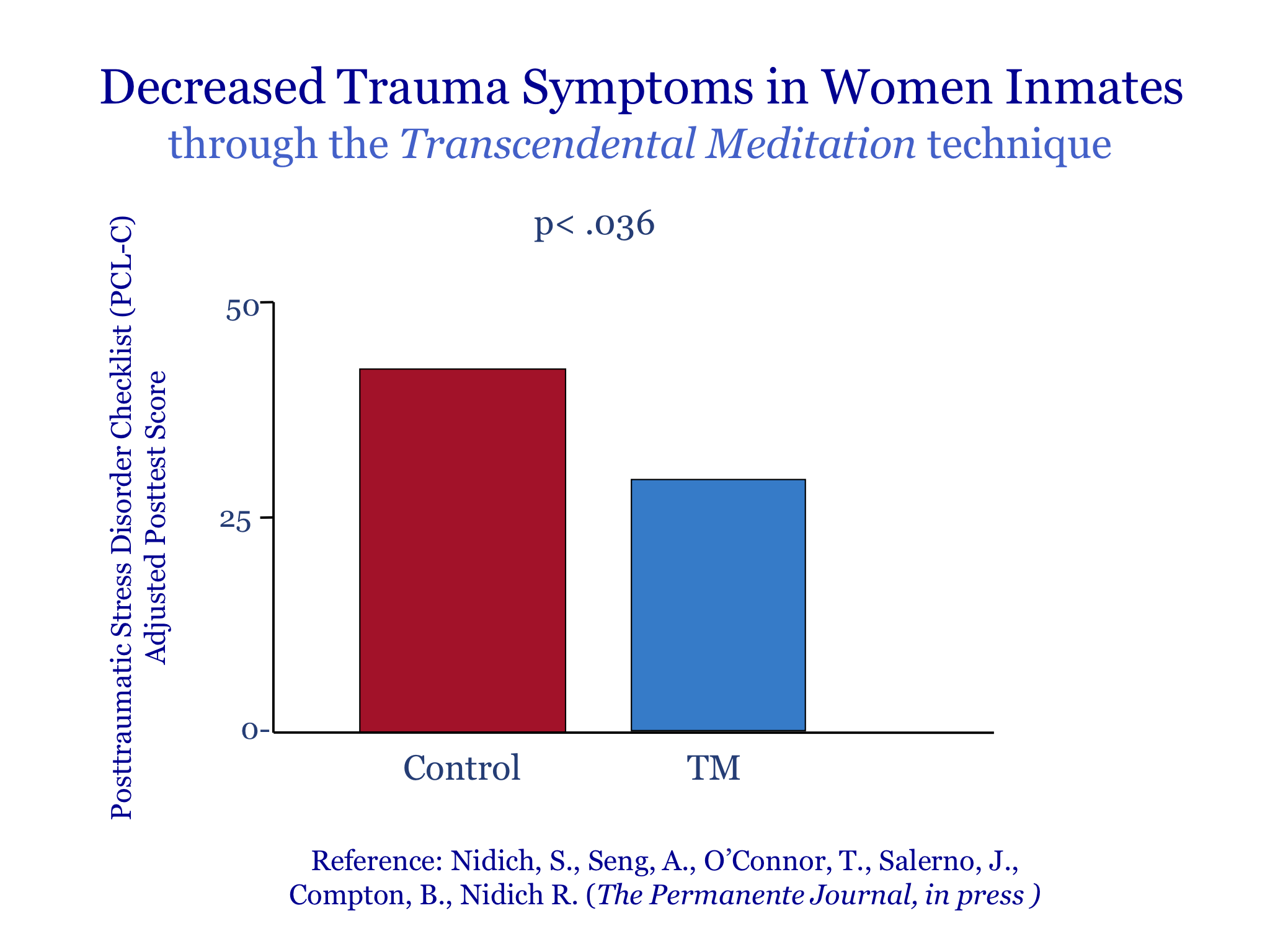
The results showed that after four months of practicing the Transcendental Meditation technique, the women inmates in the meditation group had significant reductions in total trauma symptoms, including intrusive thoughts and hyperarousal compared with controls. Trauma symptoms were measured using the Posttraumatic Stress Disorder Checklist-Civilian (PCL-C).
‘This study is a valuable addition to the research literature in women’s mental health, showing a natural and effortless alternative approach to reducing trauma symptoms,” said lead author Dr. Sanford Nidich, director of the Center for Social and Emotional Health at Maharishi University of Management. “It further replicates an earlier randomized controlled trial with Transcendental Meditation (TM) in male prison inmates suffering from high levels of trauma symptoms. Previous studies have shown reduced trauma in other populations, including veterans and African refugees with the TM program.”
Comments from the subjects
Those practicing Transcendental Meditation in their prison cells said they felt a lot better—less stressed, with a greater sense of inner freedom and resilience. Read some of the dramatic changes in their own words, and more details about this study in the press release.
According to Charles Elder, MD, Kaiser Permanente, Northwest, “A principle advantage of the TM technique is a time-tested, standardized intervention protocol…. Once taught the Transcendental Meditation technique, an individual can use the skill for the duration of his or her life, as a stress management tool, providing ongoing benefits across a range of domains. In addition to helping the inmate cope with the stress of incarceration, there is a range of additional ‘side benefits,’ ranging from reduced recidivism to improved cardiovascular health.”
Premiered last year at SXSW, with a theatrical run this spring, and now on DVD, Paul Dalio’s first full-length feature film, Touched With Fire, is a love story between two bipolar poets that reveals the relationship between illness and creativity.
Dalio was inspired by Kay Redfield Jamison’s book, Touched with Fire: Manic-Depressive Illness and the Artistic Temperament, which explores the link between great art and bipolar disorder. He read that many famous writers, poets, and artists suffered from this mania and may have produced their work because of it. Their genius was touched with fire.
This was a welcome relief for Paul who had become bipolar. He now saw himself no longer in clinical terms as a social outcast without a cure, but as a creative artist who was dealing with a neurological imbalance.
The most well known example of that heightened state was Vincent Van Gogh’s Starry Night. The painting is a kind of leitmotif throughout the film, even materializing as a literal hallucination by the main characters.
Reflecting on his own experience of being bipolar, Paul wanted people suffering with the illness, and those concerned with their health, to better understand what they are going through, that they are not necessarily crazy, perhaps gifted, and to help remove the stigma associated with the disease.
He compares the manic highs and depressive lows of the disease to the seasons. The film’s palatte of colors reflects the changing emotions within and between the main characters. Attempts to control these mood swings with drugs create deadening side effects, part of the conflict within their relationship.
In his Huffington Post blog, Touched With Fire, Paul asks: How much more receptive would a patient be to treatment if the patient was told that the treatment was to nurture a gift they had, instead of terminate a disease they had?
Director Dalio gave author/psychologist Kay Redfield Jamison a role in the film as herself, to explain how the right balance of medication can help rather than hinder a manic personality. Marco is concerned that the medications are stopping him from feeling any emotions, and is destroying his creativity. From her own experience, Kay shares with them how “medication can tamp the fire down a bit without losing that gift.” She tells him, with the right dosage, which takes time, she became even more productive than before becoming bipolar.
Cast and Crew
Paul Dalio wrote, directed, edited and scored Touched With Fire, his feature-film debut starring Katie Holmes and Luke Kirby, with other performances by Griffin Dunne, Christine Lahti and Bruce Altman.
Paul’s longtime friend, Jeremy Alter, produced the film, along with Kristina Nikolova, Paul’s wife and fellow student at the NYU Film School, who convinced him to make this semi-autobiographical film. Their teacher, Spike Lee, is the executive producer.
The brilliant acting in this passionately moving film is intensely engaging. Holmes (Carla) and Kirby (Marco) play two poets with bipolar disorder whose art is fueled by their emotional extremes. When they meet in a treatment facility, their chemistry is instant and intense driving each other’s mania to new heights. They pursue their passion, which breaks outside the bounds of sanity, swinging them from fantastical highs to tormented lows until they ultimately must choose between sanity and love. Watch the official trailer.
Comments from the Critics
The New York Times Critic’s Pick wrote: “Luke Kirby and Katie Holmes boldly meet the challenge of playing bright, high-strung artists. An extraordinarily sensitive, nonjudgmental exploration of bipolar disorder and creativity.” Read the Review: ‘Touched With Fire,’ a Love Story Between Two Bipolar Poets.
This is a powerful film! We witness their struggles from the inside out. More reviews are listed on the film’s website.
The Role of Poetry in the Film
In one of the interviews from the Special Features of the DVD, Paul Dalio talks about the value of poetry in his life, and for the main characters in the film. “It was only when I met my wife that my heart became more tender, and I actually started reading poetry, which I never did, and I started writing poetry.”
Paul describes the transforming power of poetry to heal and create beauty. He speaks from his own personal experience as someone who has dealt with the ups and downs of this disorder while trying to become a writer, composer, and filmmaker. The film is an amazing testament to his artistic achievement! See his bio under Cast & Crew for more details.
“Poetry at its best has the deepest expression of being in the worst hell, and having no choice but to bring some kind of aesthetic meaning to it, and some kind of beauty to it, just to even cope with it. (and) Only by being forced down there to such a hell are you forced to bring that much beauty to that hell, and in the process it becomes a healing. And so it was natural how it wove itself into the film, as these two characters use it to cope with their psychosis, and to deal with coming out of their situation.”
Charlie Rose: ‘Touched With Fire’ (Feb. 4, 2016) Director and writer Paul Dalio, actor Luke Kirby, and psychologist Kay Jamison discuss the movie “Touched with Fire” and the connections between bipolar disorder and creativity. (18:51) Paul does mention his use of medication and meditation, which he elaborates upon in this next video.
At a David Lynch Foundation-hosted screening of the film, Paul opened up about his own struggles with bipolar and how pivotal the practice of Transcendental Meditation has proved to be in living a happy, healthy, and creatively rich life. “TM is the difference between surviving with bipolar and thriving with bipolar. I never stopped meditating, without fail,” he says. “That’s when my doctor, Norman Rosenthal, witnessed the power of TM and was so blown away he decided to do a study on the effects of TM.” Paul was responsible for Dr. Rosenthal restarting his long-lapsed TM practice, which led to the publication of two best-selling books on the subject. Visit NORMAN ROSENTHAL, MD for details. See Thriving with Bipolar – A Conversation with Writer/Director Paul Dalio.
Video of Marbling Art Animation of Starry Night and Van Gogh
Check out this amazing video on marbling art animation of Starry night and a Van Gogh self-portrait: Van Gogh on Dark Water Animation. The Turkish artist is Garip Ay, and the ancient technique of painting on water to marble paper is called Ebru.
The Unexpected Math Behind Van Gogh’s “Starry Night”
Physicist Werner Heisenberg said, “When I meet God, I am going to ask him two questions: why relativity? And why turbulence? I really believe he will have an answer for the first.” As difficult as turbulence is to understand mathematically, we can use art to depict the way it looks. Natalya St. Clair illustrates how Van Gogh captured this deep mystery of movement, fluid and light in his work. Visit TED-Ed for more.
Fast forward: A new study found that the skies in Van Gogh’s “Starry Night” align with current models of atmospheric turbulence. NBC News’ Ellison Barber spoke with astrophysicist Adam Frank on the science behind the iconic swirly sky. See this fascinating and revealing report: New research finds Van Gogh’s ‘Starry Night’ skies align with physics.
Don McLean’s song to “Vincent” (Starry, Starry Night)
Don McLean’s compassionate acknowledgement in song to “Vincent” (Starry, Starry Night), was used with images of Vincent Van Gogh’s paintings, and lyrics to the song, in this beautiful video compiled by a YouTuber who uploaded it to explain his love of Van Gogh’s art to a dear friend whose first language is not English. The video has been seen over 71 million times with thousands posting comments! He never imagined it would have received so many views and comments, and is glad he was able to share it. Not many dry eyes are left after hearing/seeing it.
Between 2007-2009 the iconic American director David Lynch made a series of trips to 16 countries in Europe and the Middle East to talk about Transcendental Meditation, Creativity, and Peace.
Wherever he went David was met by hundreds of fans and honored by several film societies. He spoke with heads of state, educators, the press, and local meditators inspiring them to form peace-creating groups.
Footage from these events was taken by film students and film institutes in cities on the tour and sent to David, who, along with his editor, turned it into the film titled, “Meditation Creativity Peace.”
Interwoven throughout the documentary is an excellent interview with a French journalist at an historic art studio in Paris where David goes to create his lithographs. Besides being a talented creative artist in various visual media, David is also an excellent teacher. The way in which he illustrates and explains how TM works and what it can do for us as human beings is absolutely brilliant!
David’s explanations on TM & Creativity from the Documentary
The complete brilliant explanation that David gave the French interviewer about TM was incorporated in sections into the documentary. It was filmed at Idem Printing Studio in Paris, where David works on his own art projects. Someone later edited those segments together and added a background soundtrack in this video: David Lynch explains Transcendental Meditation. Several years later, this talk was posted minus the distracting music: David Lynch gives a profound description of Transcendental Meditation.
My son takes photos of the changing panorama before him throughout the day and night looking out from the hills of the Santa Barbara Riviera. Today he posted this beautiful early morning image on Instagram. It inspired this haiku.
Photo by Nathanael Chawkin
Santa Barbara Riviera Haiku
mystical seascape
white waves rolling in to shore
morning mesa mist
See a haiku, Translation, inspired by a painting of Egrets by Australian artist Gareth Jones-Roberts. The poem was published in two poetry anthologies. Nathanael also likes that combination so I’m mentioning it.
About 6 years earlier, Nathanael had lived in San Leandro as an uchideshi. I had visited him there and witnessed his Sensei demonstrating Aikido, which inspired this tanka, My Son’s Sensei. Someone posted it with a tree that reflected the image in the poem. Nathanael happened to be visiting the dojo and sent it to me. Perfect fit!
On November 28, 2007, Maharishi Mahesh Yogi, founder of the Transcendental Meditation technique, was featured in a biographical documentary on the International History Channel. ITN Factual, a UK-based production company, was commissioned by A&E to produce it.
During an interview with the folks at TMhome I had mentioned it, but they wanted to save it for a second article by itself. That article was published this week along with the complete film, which aired 8 years ago this coming weekend. Some of you may have seen it, or heard about it but never got see it. Well, now you can.
Previously unseen historical footage of Maharishi had been located and edited segments were provided to the producer/director Fiona Procter. Some of the people I had arranged to be interviewed for the film were David Lynch, Donovan, Mike Love, Bob Roth, Theresa Olson, Alan Waite, Bevan Morris, and John Hagelin. Jerry Jarvis was included when the producer was in Los Angeles.
Sally Peden was also interviewed for the film but did not make final cut. However, she provided additional valuable information for the producer to better understand and appreciate the scope of Maharishi’s contribution to the world. Parts of that interview were transcribed and included in the article on how the film came to be made. Read the complete article and watch the film on the TMhome website: International History Channel documentary on Maharishi Mahesh Yogi: How it was made: The story behind the film. The film is also posted on The Uncarved Blog.

 In the film
  We might wonder how her singing was recorded in the first place when no company would sign her. One comment on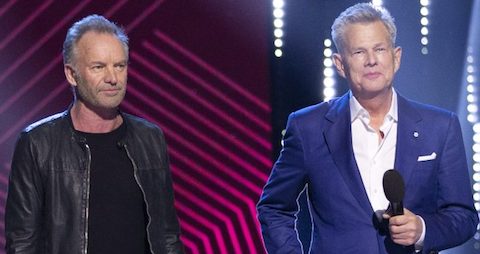
 In Timeless Voice, Terry Wogan concluded, “You’d have to say about Eva Cassidy that her talent was pretty timeless. The voice has a quality of timelessness about it. Anytime you would hear it, whether it was thirty years ago, or thirty years from now, it’ll still be worth listening to, and still strike a responsive chord in most people’s hearts.”

 Premiered last year at SXSW, with a theatrical run this spring, and now on DVD, Paul Dalio’s first full-length feature film,

 The Uncarved Blog