Archive for the ‘David Lynch Foundation’ Category

Pathways Magazine: Taking Care Of The Student – The Forgotten Element In Education

February 18, 2011

Taking Care Of The Student – The Forgotten Element In Education

The surgeon general said that America is swimming in an ocean of stress. If this is true, our children are drowning in it. ~ Robert Roth, Vice President of the David Lynch Foundation

A teacher of a Montgomery County high school describes the 7:30 AM morning: kids with hoods pulled over their eyes, practically sleepwalking. At their desks, students are slumped over, exhausted – sleep deprived.

A school counselor describes a student whose deep anxiety constricts her ability to understand a basic math concept, and another student whose pressure to succeed is so intense that anxiety escalates into insomnia, depression, and feelings of suicide.

In most schools in our country, the student himself, and his instrument of learning – his physiology – are being ignored. We are experiencing – possibly promoting – epidemics of sleep deprivation and stress in our schools, and in the general public. Not only do we not pay attention to students’ physical health, we do the opposite: impose physical and mental strain – sometimes to the breaking point – often with serious, long-term results for both physical and emotional health.

In this article, we look at some recommendations and programs addressing this problem. We begin with refreshing our understanding of the goal of ideal education. Next we look at sleep deprivation, stress, anxiety, and related problems of ADHD and depression, and the impact on student health and learning. Next, advice by professionals who work in this field of stress and adolescence will be presented. Finally, we look at promising examples where recommendations are successfully implemented: a school in D.C., the Ideal Academy Public Charter School, experiencing remarkable results by incorporating “Quiet Time” into the daily routine; and breakthrough research on ADHD and “Quiet Time” from several middle schools.

WHAT DOES EDUCATION REALLY MEAN?

All that lies before us and all that lies behind us are tiny matters compared to what lies within us. ~ Emerson.

Education comes from the Latin root ‘educere’, meaning to ‘draw out from within’ or to ‘lead forth’. ‘Education’ means something other than filling up the mind with information. Socrates said, “Education is the kindling of a flame, not the filling of a vessel.” It involves cultivating the
student’s inner genius, innate intelligence, creativity, consciousness.

Quite clearly the two great things for which we aim are the improvement of intelligence and the deepening and the extension of the feeling of friendliness and love. ~ Aldous Huxley

A student truly being educated is not merely learning information. He is cultivating the quality of his awareness: becoming more awake, clear, creative. He is developing his character: virtues of friendliness, helpfulness, compassion. And cultivating a love of learning and sense of vitality: feeling interested, enthusiastic, capable, confident.

The qualities we often find in great people – flexibility, curiosity, energy, receptivity to new ideas, and lovingness – are first found in children and then maintained through adulthood. ~ Dr. Melanie Brown, Attaining Personal Greatness: One Book for Life

But what are we doing to cultivate these qualities in our students? It seems clear that we often forget the meaning and goal of education.

Click on the above title for a Google docs quick view of the entire article, including photos, and/or download the PDF of Taking Care Of The Student – The Forgotten Element In Education, originally printed in the Winter 2009 issue of Pathways Magazine, Washington, DC.

San Francisco Bay Area News: From time-out to quiet time: meditation comes to SF schools

February 12, 2011

Education

From time-out to quiet time: meditation comes to SF schools

By Natalie Jones on February 10, 2011 – 5:01pm

Innovative ideas are often born in California. This is the home of Silicon Valley, after all. But, that spirit of innovation isn’t limited to finding more ways to plug in to the world of high tech. Innovation also means finding ways to disconnect from it all. This kind of innovation is taking place in three San Francisco public schools that have started school-wide meditation programs. The hope is that a little quiet time and mindfulness will help facilitate learning.

It’s all paid for with private money, and one school says it’s seeing results. Natalie Jones reports on how it works.

*     *     *

NATALIE JONES: Middle schools do not tend to be quiet places. For many people, middle school is hard enough in the best of circumstances. For students growing up in rough neighborhoods or dealing with difficult family issues, it can be especially stressful.

That’s why four years ago, James Dierke, principal of Visitacion Valley Middle School in San Francisco, decided to implement a meditation program for the entire school to see if it would help students and teachers deal with stress and focus on schoolwork.

JAMES DIERKE: There’s individual stresses of just being a teenager, there’s family stress, there’s community stress, and all those things multiply within a person. So this is something that everyone can do and doesn’t require a tremendous amount of effort on their part but has great results.

The program is called Quiet Time, and it teachers students the practice of Transcendental Meditation.

PA SYSTEM ANNOUNCEMENT: Please excuse this interruption, teachers and students, please prepare for Quiet Time, please prepare for Quiet Time.

Mr. Tagaloa’s homeroom is getting ready for the morning meditation session – they do fifteen minutes at the beginning of their school day, and fifteen minutes at the end.

VAO TAGALOA: Going to start our Quiet Time, let’s start by sitting up straight…close the eyes….let’s enjoy.

The dozen or so 8th graders in the room turn to face front, shut their eyes, and stay that way for a full fifteen minutes, without breaking the silence or fidgeting.

Visitacion Valley is one of the more challenged schools in the district – about two thirds of its students were getting free or reduced lunch last year, and the percentage of students proficient in basic subjects is lower than both the district-wide and the state-wide percentage.

In the last three months alone, there have been two homicides and more than a hundred assaults within just a mile radius of the school. Principal Dierke compares growing up in the neighborhood to living a war zone.

DIERKE: A lot of our kids come down with post-traumatic stress, just like you would if you lived in Iraq. So it’s hard to turn that off when you come in the school building when you sit down and try to study.

Post-traumatic stress is a hard thing to combat, but there are signs that Quiet Time is effective. Since the program started, test scores have gone up a little bit, attendance rates have gone up a little bit, and suspension rates have gone down, although the changes are only by a few percentage points. Most of the evidence of the program is anecdotal. Students and teachers participate willingly and say it’s helpful for them, and surveys that school has done return positive feedback. Though not everyone was enthusiastic at the beginning.

TRISTAN: Well, when they first took me in to train, I wasn’t so sure about the program…

Tristan is an 8th-grader, and has been doing meditation at school since 6th grade.

TRISTAN: But when I started to get into it and started to do it every day I noticed that it really helped me because I was sort of a trouble child, and then when I started to meditate I started to become a leader, I got good grades, so it was really helpful.

Students do have the option of doing something else quiet, such as reading, but Principal Dierke says only a few have chosen to do that. He’s also had strong support from parents.

DIERKE: In the last four years that we’ve been involved in this, I haven’t had one negative parent complaint.

The program, which for this school year costs about $175,000, is funded almost exclusively by the David Lynch Foundation, an organization set up by the filmmaker David Lynch, who’s known for surreal films such as Mulholland Drive and the TV series Twin Peaks. The organization’s goal is to provide Transcendental Meditation in schools and communities that could benefit from stress reduction. The rest of the funds come from private donations, which pay for 3.5 full time staff members who are trained to teach meditation. They spend their time teaching new students, helping returning students remember how to use the method, and training the teachers.

Two other schools in San Francisco are also trying the program – Everett Middle School and John O’Connell High School. They haven’t been doing it as long as Visitacion Valley, but they’re all hoping that meditation can create a refuge for students who wouldn’t otherwise have one.

For Crosscurrents, I’m Natalie Jones.

Natalie Jones is a reporter with the UC Berkeley Graduate School of Journalism.

So, what do you think about meditation for school kids? Would you be behind that? Let us know at 415-264-7106, or send us an email.

Related Tags

Also mentioned on sfist: David Lynch Helps S.F. Schools Meditate, and in SCOPE, Stanford School of Medicine, under Alternative Medicine: Meditation in the classroom: Program helps at-risk kids.

Also see: The San Francisco Examiner—Meditation program mends troubled Visitacion Valley Middle School

And: New research shows Transcendental Meditation improves standardized academic achievement

And the TM Blog report with video: “Meditation mends troubled school in San Francisco” – SF Examiner

And here’s a wonderful report from the The George Lucas Educational Foundation (GLEF): Edutopia: SF School Uses TM to Overcome Problems.

PTSD and Transcendental Meditation mentioned in Military Times publications

January 22, 2011

Post-Traumatic Stress Disorder (PTSD) and the Transcendental Meditation (TM) technique were reported in all four Military Times publications in the last 30 days. The Gannett Govt Media Corp publications: Air Force Times, Marine Corps Times, Army Times, and Navy Times, published an article, December 27, 2010, page 3, in their Off Duty section, WatchList: Things You Should be Tracking titled: Transcending trauma: Group hopes to teach 10,000 vets to meditate. It discussed the David Lynch Foundation’s recent launch of Operation Warrior Wellness

Although it is a well-written and positive article, Dr. Matthew Friedman, executive director of the Department of Veterans Affairs National Center for PTSD, was quoted as saying: “There are no published randomized clinical trials testing transcendental meditation for PTSD.”

Col. (Dr.) Brian M. Rees, Army Reserve, and David Leffler, (PhD) coauthored a Letter to the Editor, published Friday, Jan 21, 2011 in the Marine Corps Times and the Navy Times on page 5 in Opening Shots. The letter, Meditation studied in ’85, informed Dr. Friedman of a random assignment study of Vietnam veterans published in the peer-reviewed Journal of Counseling and Development. The study found the Transcendental Meditation technique to be effective against PTSD. Significant reductions in emotional numbness, anxiety, startle response, depression, alcohol consumption, insomnia, and family problems, and improvements in sleep and obtaining/keeping employment, were noted, and 70% of the meditators reported they no longer required the services of the veteran’s center.

An omitted section of the original letter discussed a new pilot study by Rosenthal J, Grosswald SJ, Ross R, and Rosenthal N, titled: “Effects of Transcendental Meditation (TM) in Veterans of Operation Enduring Freedom (OEF) and Operation Iraqi Freedom (OIF) with Post Traumatic Stress Disorder (PTSD): A Pilot Study,” 2010 (in review). In this study, Iraq and Afghanistan veterans experienced a 50% drop in PTSD symptoms by the 4th week, with greater improvements by the 2nd and 3rd months. The study is summarized in Jerry Yellin and Sarina Grosswald‘s new book, The Resilient Warrior: Healing the Hidden Wounds of War (2011). Drs. Rosenthal and Grosswald also discuss this devastating problem and the promising results of their pilot study in the video: Reduction of PTSD Symptoms in Veterans with Transcendental Meditation.

Here is the original version of the Rees-Leffler letter: Meditation Effective PTSD Treatment. David Leffler, executive director of the Center for Advanced Military Science (CAMS), provides more information on TM and PTSD at: http://davidleffler.com/combat-stress-solution.html.

See this powerful personal account: Veteran Dan Burks on Overcoming the Stresses of War with Transcendental Meditation.

And these reports: Dec 14, 2010, Military.com, Celebs, Vets Promote Meditation for PTSD, Dec 15, 2010, On Patrol, Fighting PTSD with Transcendental Meditation, and Jan 5, 2011, Veterans’ Children, Making Transcendental Meditation Available to Veterans.

See Launching ‘Operation Warrior Wellness” — VIDEO HIGHLIGHTS Bringing TM to Veterans suffering from PTSD.

Also see Jerry Yellin: Healing the Hidden Wounds of War, WW II veteran publishes The Resilient Warrior: Healing the Hidden Wounds of War and Jerry Yellin discusses Operation Warrior Wellness.

Some articles on David Lynch, Jan 20, 2011, David’s 65th birthday

January 20, 2011

David Lynch, (Non-)Musician: The L.A. Weekly Interview

By Gustavo Turner Thursday, Jan 20 2011

[Music Ed.’s Note: On January 31st, David Lynch will release an expanded edition of his recent single “Good Day Today”/”I Know” on the Sunday Best label. The collection features remixes by several prominent electronic artists and special packaging by renowned UK designer Vaughan Oliver (of 4AD fame).

Check out also our selected David Lynch discography (including instructions for the perfectly Asymmetrical David Lynch mixtape) and our exclusive interview with Vaughan Oliver about the “Good Day Today”/”I Know” single.]

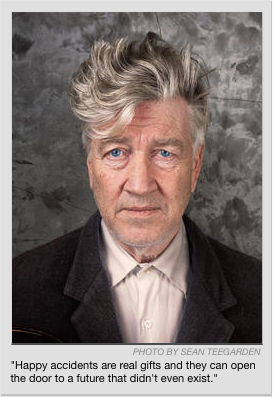
Here’s David Lynch‘s recipe for success, taken from his inspiring little manual Catching the Big Fish: “Try to get a job that gives you some time; get your sleep and a little bit of food; and work as much as you can. There’s so much enjoyment in doing what you love.”

This philosophy, plus a healthy helping of Transcendental Meditation, of which he remains a vocal advocate, allowed Lynch to become an intriguing visual artist, with works in painting, collage, cartooning, photography and art-film. Later, this approach helped him make the mysterious jump into Hollywood filmmaking, where he remains one of the few working heirs to the great surrealist auteurs of cinema.

And it’s a philosophy that Lynch is now applying with renewed focus to yet another art form: music. Anyone familiar with his film work has long figured out that Lynch is a genuine sound freak: Witness the uncanny industrial soundscapes of Eraserhead, the unforgettable aural stampede that elevates The Elephant Man, his 180-degree redefinition of Bobby Vinton and Roy Orbison in Blue Velvet, the groundbreaking romanticism of the Twin Peaks score, the jagged, deranged edges of Lost Highway and, especially, his covert beatnik musical Wild at Heart. It wouldn’t be much of a stretch to say he possesses the keenest ears among all major living Hollywood directors.

Lynch soon will be relaunching his website, davidlynch.com, as a way to broadcast the result of a series of musical collaborations (or “combos,” as he likes to call them) with other artists, under the supervision of his personal engineer and main partner in sound, Dean Hurley, at the filmmaker’s prolevel home studio, Asymmetrical Studio.

Hurley says the website “will feature unreleased singles, experiments and instrumentals created through the years,” including the legendary Thought Gang project, a full album of noir avant-jazz recorded alongside the Twin Peaks: Fire Walk With Me soundtrack by Lynch and longtime associate Angelo Badalamenti.

We met Lynch for a conversation about his music at his luminous homebase/art studio in the Hollywood Hills. (The italics below are an attempt to convey Lynch’s distinctive manner of speaking, an infectious way to share his enthusiasm. In Lynch’s world, some things are not just great, they’re “really, really, really great.”)

DAVID LYNCH: I’m not a musician, but I play music. So it’s a strange thing.

Click on this link to read the complete interview, page 1, January 20, 2011, published in the LA Weekly News on David’s 65th birthday http://bit.ly/dVOWWA.

Also see flavorwire: 65 Things You Didn’t Know About David Lynch | Moviefone: Lunch Break: Happy Birthday, David Lynch! | Houston Press Blog: The Best of David Lynch on the Web. And two days later from Vanity Fair’s James Wolcott’s Trance and Transcendence.

Veteran Dan Burks on Overcoming the Stresses of War with Transcendental Meditation

January 18, 2011

Veteran Dan Burks on Overcoming the Stresses of War with TM

DavidLynchFoundation | December 12, 2010

Transcription: “December 18th 1967 – Newsweek, five days after my birthday. This is a story called ‘The Days Work.’ And this is my unit, we went out and got ambushed, and this is me doing my job. We were attacked at this place called Buddha. That fight went on for two weeks. The first night I killed 14 people. There were 25 hundred of them, 250 of us. The next morning in front of my fighting position there were 18 of our men dead. So this is very, very, very distressing, and it creates huge amounts of distress in your system.”

“Later in the magazine there’s this… this is an article Maharishi Mahesh Yogi and a couple guys in my platoon, one of them got the magazine and came running over and said ‘Burks, you gotta read this!’ So I did. And I said, ‘I’m going to do that….’ Because it talks about stress release, about becoming a whole person.”

“The next part of the story is about getting home. And that’s a whole big deal, because things changed. All of a sudden you’re in a different culture. They don’t understand you. They have no idea. They don’t understand that you’re always still in the rubber plantation in the jungle. You’re always on an adrenalin high. You’re looking to protect your buddies, you’re looking to protect yourself and you’re looking to kill the enemy.”

Help us heal our Veterans – http://www.davidlynchfoundation.org

See two other videos: AFP: Meditation soothes war veterans and 50% reduction in PTSD symptoms within 4 weeks of Veterans practicing Transcendental Meditation.

See AFP’s How Clint Eastwood keeps his cool, Meditation May Ease PTSD for Vets, and watch highlights of the David Lynch Foundation‘s Operation Warrior Wellness press conference and the second annual Change Begins Within benefit gala.

Israeli Actress and Author Meital Dohan Interviews TM exponent Bob Roth

January 18, 2011

Talking Miracles with Israeli Actress and Author Meital Dohan
By Meital Dohan | Tuesday, January 18, 2011 12:25 PM ET

The very sexy and very spiritual actress and philanthropist talks with Bob Roth, executive director of The David Lynch Foundation.

Hello y’all…. I was honored to be asked to do a radio show called Loud Miracles on WOMEN’S RADIO and a blog by Tonic, and I decided to talk with you guys about Miracles — not like hoki poki abra cadabra style, but more about Miracles which make this life worth living.

I launched the first episode of my radio show with a very special guest named Bob Roth, someone whom I consider to be a miracle worker for his 40 years of contribution to the world of meditation.

Bob serves as the executive director to the David Lynch Foundation, started by the great filmmaker David Lynch who has a mission to provide scholarships for underprivileged and at risk kids all over the world to learn Transcendental Meditation. Bob also serves as the executive director of the nonprofit Transcendental Meditation Organization. You can read more about Bob’s work involvement by clicking on the links below.

I met Bob at a charity event a few months ago and he immediately began talking to me about Transcendental Meditation. He was very passionate about TM and I was very curious because I had tried so many things to improve my well being before. In other words, how to stay alive without jumping off a bridge or going to an asylum.

I was initially very skeptical about trying something new because I feel that are so many people out there promising to change your life. However, I did end up taking Bob’s advice and trying TM. I loved it and it has been part of my life, twice a day for 15 minutes, ever since. And of course, since my show is about miracles, I asked Bob to share his thoughts on miracles, which were very unique and inspiring.

Me: So I have the pleasure to have you as the first guest on the show. And the show is about miracles. And I wanted to hear if you believe in miracles at all.

Bob: First of all, I’d like to begin by reading this great quote from the great Catholic saint, Saint Augustine. And he said about miracles: “Miracles are not contrary to nature but only contrary to what we know about nature.” And my feeling is that there is no such thing as a miracle. There are just deeper realities and deeper manifestations of the ultimate reality. And what we perceive to be a miracle is actually just an expression of an infinite network and fabric of Divine Life or nature’s existence. But the same intelligence that can create, not just all the infinite life forms on this earth, but think of all the planets and galaxies and infinite numbers. So that intelligence can do lots of things that we don’t understand. So I don’t know that the word “miracle” means something that is unreal. I think there are just very real things that are very profound that sometimes pop up and let us see them.

I wanted to give Bob enough time to describe the magic of Transcendental Meditation. Bob describes it in the best way when he compares our minds to the ocean.

Bob: If you take an ocean, you will see that there are waves on the surface and then there are 20-foot high waves and then a mile in depth of the ocean. The waves on the surface are a tiny little thing compared to the mile long depth of the ocean. And the active thinking mind, all the millions of things we have to do, are just the surface of the mind. But the mind is profoundly deep and silent in its depth. TM is a simple technique that allows the attention of the mind to turn inward. So we are not just stuck on the surface of the wavy mind. And the mind naturally begins to effortlessly settle down to experience quieter levels of thought. And then there are times when we experience the deepest level of the mind, the source of thought, when we transcend even the finest thought and we experience our big Self. The land of pure miracle.

Me: I am fascinated by [TM] and the effects of it. I was so taken by this technique that now we are talking about bringing more awareness to it and bringing it to people that serve in the Israeli Army. For me, your role is definitely to bring magic and miracles to other people’s lives.

Bob: Let’s say all of us are 100-watt bulbs. But stress and fatigue and tension and strain and doubt and disappointment and rejection, all of the stresses are like dust and dirt on the light bulb. And we don’t glow. It’s there. It’s inside of us. TM doesn’t create anything that isn’t already there. It just washes off that dirt and dust and we can shine the way we want to shine.

Me: What is the source of the technique?

Bob: TM has its origins in the oldest continuous tradition of meditation known. It predates Buddhism, Hinduism… It predates all the ‘isms’. It’s just a science of consciousness. It has been handed down from teacher to student, from teacher to student, throughout time. And the most recent custodian that everyone knows about at this time is Maharishi Mahesh Yogi who brought TM to the world about 50 years ago. And I was very fortunate to spend some time with him. He taught me to become a teacher of TM.

I loved the way Bob’s explanations were so beautifully simple.

Listen to my first show to hear the complete, wonderful message from Bob Roth who was taught TM by the master himself, Maharishi Mahesh Yogi.

 Listen to other interviews by Meital Dohan posted on The Uncarved Blog.
 

* Are you a miracle worker? Perhaps you know someone who is a miracle worker. Meital would love to hear your story. She would like to interview some more miracle workers for her show! She invites you to post suggestions or stories on her Facebook Page: http://www.facebook.com/MeitalDohan
* To learn more about TM, visit their website at www.DavidLynchFoundation.org
* To learn more about Meital Dohan, visit her website at www.meitaldohan.com

Meital has moved on but her interviews are posted on SoundCloud.

Added July 16, 2019: Meital Dohan on Transcendental Meditation.

50% reduction in PTSD symptoms within 4 weeks of Veterans practicing Transcendental Meditation

January 18, 2011

Reduction of PTSD Symptoms in Veterans with Transcendental Meditation

DavidLynchFoundation http://www.davidlynchfoundation.org/

Norman Rosenthal, M.D. (Clinical Professor of Psychiatry, Georgetown University Medical School): Over half a million of our veterans from Iraq and Afghanistan are suffering from Post Traumatic Stress Disorder. These are people who have been exposed to violence on the battlefield serving for our country. And, as one of my patients said, it can happen once in your life but a hundred times in your mind. The echos linger on.

Sarina Grosswald, Ed.D. (Cognitive Learning Specialist): With traumatic stress it’s really some enormous stress that’s more than the body can process, and it leaves a big impression on your brain. The estimates are that at least 30% of returning veterans are experiencing PTSD and really the estimates are that it’s probably much greater than that. I think that maybe as many as 50% who are experiencing these symptoms aren’t actually even seeking help.

Dr. Rosenthal: They get bombarded on a daily basis by memories and flashbacks and it’s a shocking statistic that 18 veterans every day commit suicide.

Dr. Grosswald: We’ve lost more to suicide than actually have been lost in combat. That’s the first time ever.

Dr. Rosenthal: One thing that we who are interested in Transcendental Meditation are seeking is could TM be one of the answers or one of the ways in which we can treat PTSD?

Dr. Grosswald: We put together a pilot study with returning veterans from the OEF-OIF war, which is the Iraq/Afghanistan war, and what we saw was for these young men there was, within 4 weeks, a 50% reduction in the PTSD symptoms. That’s pretty dramatic, I don’t think there’s anything that shows that level of response that quickly.

Dr. Rosenthal: Because of TM’s ability to settle down the nervous system, to quiet it down, to slow down the fight-or-flight response, I believe it is a very promising direction for us to explore. I think it’s definitely something we should be trying and testing and studying.

See AFP: Meditation soothes war veterans

AFP: Meditation soothes war veterans

January 14, 2011

AFP-TV: Meditation soothes war veterans

Since the start of the Iraq war, record numbers of American soldiers are being diagnosed with post-traumatic stress disorder, which they carry from the battlefield into civilian life. One therapy being proposed to help them to overcome the illness is Transcendental Meditation, and some returning soldiers say it has saved their lives.


Watch this excellent two-minute English video produced by Agence France Presse, also posted in French by rajafelix.

See AFP’s How Clint Eastwood keeps his cool, Meditation May Ease PTSD for Vets, and watch highlights of the David Lynch Foundation‘s Operation Warrior Wellness press conference and the second annual Change Begins Within benefit gala. Also see new video on 50% reduction in PTSD symptoms within 4 weeks of Veterans practicing Transcendental Meditation.

CBC: David Lynch, Meditation and The Troops

December 19, 2010

Friday December 17, 2010

Interview: David Lynch, Meditation and The Troops

If you were sentient in the early 90s, you probably heard about a little show called Twin Peaks.

And chances are you’ve heard of its creator, David Lynch, director of the films The Elephant Man, Blue Velvet and Mulholland Drive.

But what you may not know is David Lynch is just as committed to the practice of Transcendental Meditation as he is to his art. And through his foundation, he’s been helping at-risk populations learn the practice.

This week, along with Clint Eastwood and a host of researchers, David Lynch launched Operation Warrior Wellness — a program to teach meditation to soldiers suffering from Post-Traumatic Stress Disorder.

Take a listen to his interview with Brent Bambury. Click here to listen on the Day 6 blog.

Meditation May Ease PTSD for Vets

December 19, 2010

Health Stories Meditation May Ease PTSD for Vets

Tuesday, December 14, 2010 7:59 AM

Hollywood A-listers including Clint Eastwood joined grizzled U.S. military veterans Monday to promote what they called the near-miraculous powers of meditation in overcoming war stress.

The event in New York drew an unlikely alliance ranging from fashion designer Donna Karan to traumatized veterans of World War II, Vietnam, and Iraq.

Uniting them was a belief that transcendental meditation, dubbed TM for short, is the cheapest, most effective, and medication-free way of healing people who have suffered severe stress in war and any other extreme experience.

“I’m a great supporter of transcendental meditation. I’ve been using it for almost 40 years now. I think it’s a great tool for anyone to have,” said Eastwood, best known for playing violent, hardened characters on screen.

The fund-raising event at the Metropolitan Museum of Art in New York was organized by experimental filmmaker David Lynch, whose Foundation for Consciousness-Based Education and World Peace encourages meditation along the lines espoused by famed guru Maharishi Mahesh Yogi.

Lynch said his project, named “Operation Warrior Wellness,” aims to train 10,000 veterans in the art of finding inner peace.

Critics have cast doubt on the value of meditation for treating psychological disorders.

But Lynch said there are “a lot of misunderstandings about meditation.”

The director of “Blue Velvet” and “Mulholland Drive” said the technique can help everyone from disruptive school pupils to soldiers with post-traumatic stress disorder, or PTSD.

PTSD is an increasingly high-profile problem among servicemen returning from Afghanistan and Iraq, a large number of whom are believed to fear revealing their disorder to military health staff.

Vietnam vet Dan Burks gave a moving account of the mental scars he carried after a battle in which he says he killed Vietnamese soldiers and lost many of his own troops.

PTSD, he said, “is a wound. It takes your life away, just like losing a limb.”

“But guess what: You can get rid of it,” he said, describing his life after discovery of transcendental meditation as “the difference between heaven and hell.”

Another veteran, World War II pilot Jerry Yellin, told the fund-raiser that for three decades after the end of the war against Japan he “found no satisfaction in life in anything I did.”

At age 51, he took up TM and says he found peace. “We have the ability to teach young people who are suffering tremendously … young people who are in a foreign land,” he said of today’s veterans.

One of those, a former infantry soldier in Iraq, said TM “cleared the skies and I could tell where I was going.”

“I felt this warm groovy feeling,” he said. “It just gets better and better.”

The star-studded event hosted by Lynch also saw testimonials from Karan and British comedian Russell Brand.

Brand said he had suffered severe stress from his much-publicized sex-and-drugs addictions and also found solace in TM.

“I felt love, sort of love for myself but also love for everyone else,” he said in a rambling speech delivered in his trademark hyper-energized style.

“I am a human being and it is applicable to all human beings. Someone, everyone can draw from it.”

Skeptics may question whether war veterans already unwilling to speak about their mental problems will embrace regular meditation. Lynch says they can.

“Clint Eastwood is about as macho as they get and he’s been meditating longer than I have,” he told The Wall Street Journal.

“We’re behind this technique and we think it can help veterans reclaim their lives and save themselves, their families, and their friendships.”

Copyright AFP

Newsmax is one of the nation’s leading news sites; and AFP, Agence France Presse, is one of the world’s major news services. This AFP story was picked up by hundreds of news markets around the world.