My daughter Shara and her husband Toby live on Lopez Island, WA. On Feb 12, Toby took this photograph of their buddha statue covered in snow. About a foot tall, it’s located in their back yard near the clifftop seats overlooking the ocean. It’s quite the view! I visited them in June 2017. Toby said: “We had quite a bit of snow here, it was really lovely just for that week.” He recently added the photo to his impressive collection on social media. I was inspired to write him a winter haiku on this first day of spring!
a winter haiku
wrapped in white silence contemplating nothingness the buddha ascends
If you suddenly and unexpectedly feel joy,
don’t hesitate. Give in to it. There are plenty
of lives and whole towns destroyed or about
to be. We are not wise, and not very often
kind. And much can never be redeemed.
Still, life has some possibility left. Perhaps this
is its way of fighting back, that sometimes
something happens better than all the riches
or power in the world. It could be anything,
but very likely you notice it in the instant
when love begins. Anyway, that’s often the
case. Anyway, whatever it is, don’t be afraid
of its plenty. Joy is not made to be a crumb.
These two poems by Mary Oliver describe the nurturing effect of rainwater in nature deep within the body of the earth and inside her own.
LINGERING IN HAPPINESS
After rain after many days without rain, it stays cool, private and cleansed, under the trees, and the dampness there, married now to gravity, falls branch to branch, leaf to leaf, down to the ground
where it will disappear—but not, of course, vanish except to our eyes. The roots of the oaks will have their share, and the white threads of the grasses, and the cushion of moss; a few drops, round as pearls, will enter the mole’s tunnel;
and soon so many small stones, buried for a thousand years, will feel themselves being touched.
At Blackwater Pond the tossed waters have settled after a night of rain. I dip my cupped hands. I drink a long time. It tastes like stone, leaves, fire. It falls cold into my body, waking the bones. I hear them deep inside me, whispering oh what is that beautiful thing that just happened?
Both of these poems remind me of this short poem by William Stafford.
B.C.
The seed that met water spoke a little name.
(Great sunflowers were lording the air that day; this was before Jesus, before Rome; that other air was readying our hundreds of years to say things that rain has beat down on over broken stones and heaped behind us in many slag lands.)
Quiet in the earth a drop of water came, and the little seed spoke: “Sequoia is my name.”
I long to be the empty, waiting, pure, speechless receptacle.
From a young age, Mary Oliver loved the great poets—Wordsworth, Whitman, Emerson and Thoreau. They were her companions. She was destined to become a great poet herself.
To commune with the muse is every poet’s wish, and she succeeded. A keen, patient observer of nature, Oliver honored the creatures around her through her poetry. To do them justice she always strove to be an “empty, waiting, pure, speechless receptacle.”
Go easy, be filled with light, and shine.
Nature was her teacher. When she was among the trees, she felt uplifted by them. “I would almost say that they save me, and daily.” Sometimes sensing her low self-esteem, they would tell her to “Stay awhile.” She would see the light flowing from their branches.
They would remind her, “It’s simple,” and encourage her, “and you too have come into the world to do this, to go easy, to be filled with light, and to shine.” And she did! These two poems track part of her journey.
BLUE IRIS
Now that I’m free to be myself, who am I? Can’t fly, can’t run, and see how slowly I walk. Well, I think, I can read books.
……………“What’s that you’re doing?” the green-headed fly shouts as it buzzes past.
I close the book.
Well, I can write down words, like these, softly.
“What’s that you’re doing?” whispers the wind, pausing in a heap just outside the window.
Give me a little time, I say back to its staring, silver face. It doesn’t happen all of a sudden, you know.
“Doesn’t it?” says the wind, and breaks open, releasing distillation of blue iris.
And my heart panics not to be, as I long to be, the empty, waiting, pure, speechless receptacle.
— Mary Oliver, Blue Iris: Poems and Essays (2006), Devotions (2017)
WHEN I AM AMONG THE TREES
When I am among the trees, especially the willows and the honey locust, equally the beech, the oaks and the pines, they give off such hints of gladness. I would almost say that they save me, and daily.
I am so distant from the hope of myself, in which I have goodness, and discernment, and never hurry through the world …..but walk slowly, and bow often.
Around me the trees stir in their leaves and call out, “Stay awhile.” The light flows from their branches.
And they call again, “It’s simple,” they say, “and you too have come into the world to do this, to go easy, to be filled with light, and to shine.”
— Mary Oliver, Thirst (2006), Devotions (2017)
Mary OIiver read When I Am Among The Trees (22:08) and Blue Iris (26:48) among other well-known poems on Oct 15, 2012 at the 92nd Street Y for her new poetry book, A Thousand Mornings.
Visit her official website maryoliver.com for her books of Poetry, Prose, and her Bio, which lists her books and awards, and includes a special Tribute. On September 23, 2019, thousands of fans came together at the 92nd Street Y in New York and online via livestream for A Tribute to Mary Oliver. Friends and fellow writers read from the work of Mary Oliver, who died January 17, 2019. It was recorded and later posted March 27, 2020 on YouTube. Watch this extraordinary event led by Coleman Barks, Secretary Hillary Rodham Clinton, Eve Ensler, Bill Reichblum, Maria Shriver, Lisa Starr, Lindsay Whalen, and John Waters. It was sponsored by the 92nd Street Y, the Academy of American Poets, Penguin Press, and the Poetry Society of America.
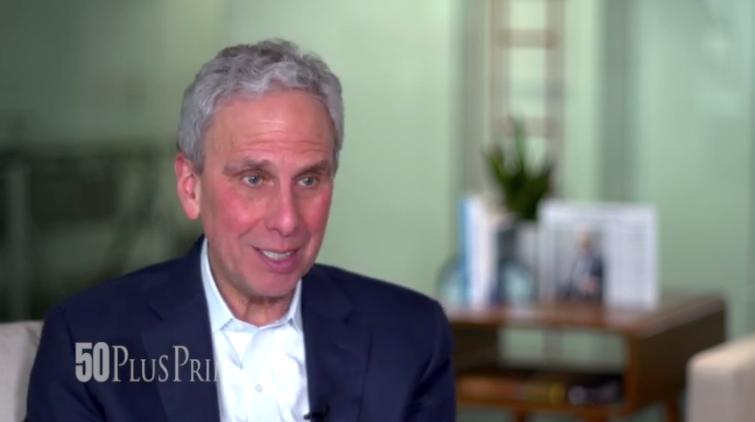
50PlusPrime with Tony Fama is the national TV News Magazine for Baby Boomers celebrating the lives of the 108-million Americans age 50+. Tune in this weekend for a 30-minute special on Bob Roth @meditationbob and the David Lynch Foundation (DLF) with Tony Fama on @50plusprime. They talk about Transcendental Meditation (TM) and how it can bring more creativity, peace, and equanimity to your day.
This episode airs on AXS TV, Saturday, March 9, at 8:30am ET, and Sunday, March 10 at 11:30am ET, and in New York City on Sunday at 1:30pm on WABC 7. It was published on the 50PlusPrime TV News Magazine for Baby Boomers YouTube channel Thursday, March 7, 2019.
Tony Fama interviews Bob Roth about his trajectory since he was a young person to today as co-founder of the David Lynch Foundation teaching TM in 35 countries around the world. The show shares excerpts of DLF interviews with students, veterans, and celebrities, like Ellen DeGeneres and Jerry Seinfeld.
In his enthusiastic introduction to the show, Tony says, “This guy’s a product of the sixties, and he’s just a cool cat!” He asks Bob why he’s the go-to-guru for the rich and famous. Bob tells him no one is immune from stress, even the wealthy and famous. They talk among themselves. TM, he tells him, is not a luxury. “It’s a medical intervention, it’s a medicine. It’s a way to reduce stress and wake up the brain.” It makes sense. It cuts healthcare costs, makes you and your employees happier. It’s “a gift of rejuvenation; it’s a gift of awakening; it’s a gift to yourself.”
Tony covers a New York City gala where celebrities like Phil Donahue, Marlo Thomas, and Orin Synder discuss how Roth, having taught them TM, has enhanced their lives. The show includes clips from Paul McCartney and Ringo Starr talking with David Lynch on why they support the work of the Foundation in benefiting at-risk kids and US military veterans.
At the same time, stress is real, and if we have headaches, or if we can’t sleep, or if we’re depressed we can’t get out of bed, that stops us from being able to fulfill our desires, to grow. And so, in one simple process of just accessing this field of calm that lies within, we eliminate the buildup of stress, and we unlock that full creative potential of the brain, so we can be more creative and more resilient, and do the things we want to do.
To get a feeling for what Mary Oliver heard and how it affected her, listen to this video, Voices: Common Loon, before reading her poem, The Loon.
THE LOON
Not quite four a.m., when the rapture of being alive
strikes me from sleep, and I rise
from the comfortable bed and go
to another room, where my books are lined up
in their neat and colorful rows. How
magical they are! I choose one
and open it. Soon
I have wandered in over the waves of the words
to the temple of thought.
…………………………………And then I hear
outside, over the actual waves, the small,
perfect voice of the loon. He is also awake,
and with his heavy head uplifted he calls out
to the fading moon, to the pink flush
swelling in the east that, soon,
will become the long, reasonable day.
……………………………………………….Inside the house
it is still dark, except for the pool of lamplight
in which I am sitting.
……………………………I do not close the book.
Neither, for a long while, do I read on.
— Mary Oliver, What Do We Know (2002), Devotions (2017)
Bob Roth effectively explains the differences between the two popular meditation approaches—mindfulness and transcendental. He described it as deep meditation, what Maharishi used to call it, which became Transcendental Deep Meditation, then Transcendental Meditation, or TM.
I also found it ironic that this was written by writers over 60 for their demographic—the generation that took to Maharishi and his teachings in droves in the 1960s. Obviously many have forgotten about that and may now be discovering TM for the first time, but from a more scientific perspective. So glad the pragmatic Bob Roth presents TM to the world in the down-to-earth way that he does! I corrected a few typos and capitalized Transcendental Meditation, as it should be. Here they are.
Transcendental Meditation takes off with over-60s
Mindfulness and meditation have hit the zeitgeist in recent years, with everyone from Oprah to businessman and housewives singing their praises and crediting the practice with reducing stress levels and anxiety.
While meditation is a term most people are familiar with these days, it’s a particular branch of the calming technique, called Transcendental Meditation (TM), that’s really piqued the interest of the world’s elite.
TM focuses on a deep parts of the mind and is said to be so effective that actor Hugh Jackman enlisted the teachings of TM expert Bob Roth to ease his stress and help his young son cope with anxiety.
Roth, one of the world’s leading experts in TM, recently spoke to Starts at 60 about the many health benefits of the practice and the thousands of people he has taught, including Oprah Winfrey, Ellen DeGeneres, Paul McCartney and Gwyneth Paltrow, to embrace the calming technique throughout his 45-year career.
While there are many different types of meditation around, transcendental focuses on the deep parts of the mind, Roth explains.
“There are mindfulness approaches to meditation which are more on the surface, how to think, how to walk, how to talk, how to act, how to breathe, many different things like that,” he said. “Transcendental is deep meditation, it means it accesses a level of the mind, a quiet, calm level of the mind’s stillness that already exists within everyone.”
TM focuses on thinking inwards rather than outwards and through practice, people have the ability to overcome stress, tension and fatigue and anxiety.
While Roth admits that like many people he was sceptical at first when he first discovered TM in his youth, but quickly changed his mind when he began to see “immediate results”. He also cites “20 peer-reviewed studies that show that TM reduces high blood pressure better than anti-hypertensive medications, without the side effects of anti-hypertensive medications”.
“And that’s research that was published by the US National Institute of Health and research done at Harvard Medical School and published in the American Medical Association’s top journal. It’s very real, when we’re talking about TM, we’re not talking about something on the fringe. It may be an unusual word, but the reality is it’s an established medical tool,” he added.
While he has a black book filled with clients, most of Roth’s clients are ‘everyday’ people, many of them over 6o.
“So an older person who is either in retirement or moving towards retirement or can’t retire but is under a lot of pressure, it’s a wonderful tool to get rid of stress and wake up the brain so we have more energy to do the things we need to do,” he said.
He added that it’s important for people to work TM into their lives and not to use it as a replacement for medication.
“In the toolbox of an older person, there should be many tools that we can draw upon to help us deal with the very real, very deadly epidemic of stress, that we’re all living in,” he said.
“Let’s say you have high blood pressure, you wouldn’t just go online and say, ‘here’s some magic potion online and some recipe and I’m going to take it because it’s going to help my blood pressure’,” he said. “No, you look at stuff that works. Same as meditation, you should look at the research that shows that it works.”
To help the most sceptical, Bob recently released a book called Strength in Stillness. He said that he wanted the book to help people with questions and to make sense of something that people may not be familiar with. “I’m not pushing this on anybody. People should decide for themselves. I wrote the book so people could make an informed decision,” he said.
“The beautiful thing about Transcendental Meditation is you can be 100 per cent sceptical and it works just as well. You can be sceptical about electricity, but when you turn on a light switch, the light goes on.”
Strength in Stillness is currently available in book stores and as an eBook online.
Transcendental Meditation saved Hugh Jackman’s family from anxiety
In an age when mindfulness and practising the art of stillness has become more popular than a bowl full of kale, one particular form of meditation seems to stand out from the crowd: Transcendental Meditation.
The unique form of meditation, which goes beyond mindfulness to produce a deeper and long-lasting sense of peace, has been around for more than 40 years, but has recently shot to the top of the popularity heap thanks to a host of celebrity clients and a rock star teacher.
Bob Roth has taught the likes of Oprah Winfrey, Ellen DeGeneres, Paul McCartney and Gwyneth Paltrow, but his favourite client thus far is The Greatest Showman himself, Hugh Jackman.
“Hugh Jackman and his wife Deborra-Lee Furness are just wonderful,” Roth told Starts at 60. “Down to earth, they have two children, I know the family well. I consider them my friends.”
Roth has been working with the Jackman clan for years and his teachings have been particularly useful for Hugh and Deborra-Lee’s son, Oscar, who suffered from anxiety.
“I taught Oscar to meditate,” Bob revealed. “He’s now 17 and I taught him when he was 12. They have a daughter, Ava, who I think I’m going to teach next year.”
Jackman has praised Roth’s work in the past and said his teachings on how to calm the mind did wonders for Oscar’s mental health.
Bob Roth pictured with Hugh Jackman and Deborra-Lee Furness. (Getty)
Bob’s really helped us and our son, who was a stressed, anxious kid,” the actor said.
Slightly different to regular forms of meditation, TM focuses on the deep parts of the mind and accesses the quiet, calm and still parts of the brain that exist inside everyone. While it’s a hit with celebrities, Roth’s main clients are ‘everyday’ people, many of them over 60, who are looking for a way to ease stresses and invigorate the mind.
“They run out of energy and they just feel like they don’t have the energy they once had,” he said of his older students. “They’re more vulnerable to aches and pains and illnesses because the immune system is compromised, memory maybe isn’t as clear, and from a long life.”
He said there’s a strong correlation between the kinds of issues his regular students and more high-profile students face.
“Being known by a lot of people does not make you immune from worrying about a sick child or stopping you from staying awake at night because you’re worried about things in your career or your partner,” he said. “They have the same feelings, just like us. They have more money, to what? Buy more sleeping pills?”
Despite his popularity amongst some of Hollywood’s favourite stars, he said he owes his credibility to word-of-mouth. “You can’t seek out a celebrity. You can’t go, ‘I want to teach Tom Hanks’. They live in their own world and it’s almost like a bubble. And they talk to each other a lot,” he said.
More recently, Roth worked with Jackman’s The Greatest Showman co-star Zac Efron who was experiencing some personal issues on set. “So I’ve sort of become the go-to guy for meditation,” he explained. “But I should make a point – I’ve taught maybe 30 or 40 well-known actors. I’ve taught thousands of regular people.
“It’s not, ‘oh this is a 20-year-old veteran’ or ‘this is Hugh Jackman’, really and truly, I see in their eyes, they’re looking for something to help them navigate through life.”
Roth’s book Strength in Stillness is currently available in book stores and online.
###
You can see Bob Roth’s global book launch with Hugh and Deboora-Lee introducing Bob about 26 minutes into the third video posted here. Bob also interviews comedian Jerry Seinfeld who has been meditating since he was a college student. The video starts with quotes from celebrity meditators, followed by Good Morning America’s Robin Roberts and George Stephanopoulos interviewing Bob about his book.
Nurses can better cope with the burnout that’s endemic to the profession by practicing the Transcendental Meditation® technique, according to a new study published today in the Journal for Nurses in Professional Development. After four months of practice, standardized assessments found that nurses in the study had reductions in “compassion fatigue” and burnout, and increases in compassion satisfaction and resilience. The study highlights the importance that self-care plays for professional development and longevity in nursing. (EurekAlert!) (PubMed)
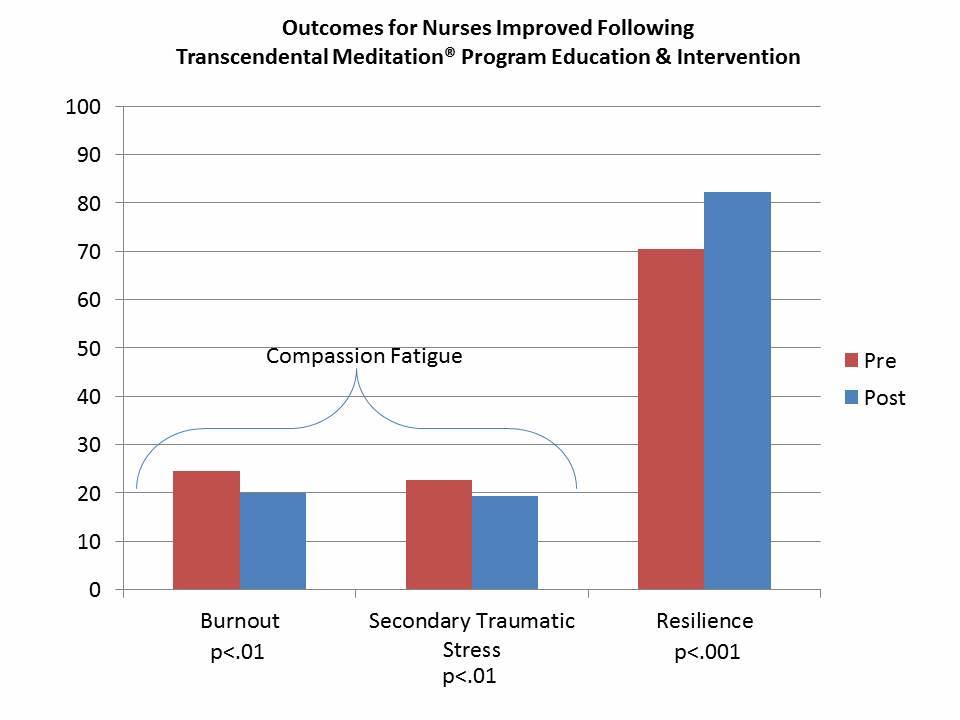
After 4 months of practicing Transcendental Meditation, a group of 27 nurses experienced an 18% reduction in burnout (“compassion fatigue”), a 16.9% increase in resilience, and a 9.2% increase in compassion satisfaction.
Research suggests that self-care for nurses is important for professional development
The Transcendental Meditation technique helped to reduce “compassion fatigue” and burnout in a group of 27 nurses while also improving resilience according to a study published today in Journal for Nurses in Professional Development (Mar/Apr 2019, Vol 35, Issue 2).
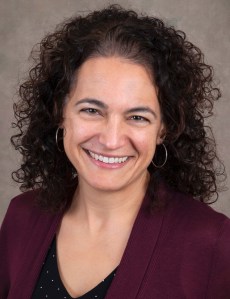
Jennifer Bonamer
Standardized assessments showed a significant improvement after four months of practice.
“For years I watched nurses struggle to care for their patients and themselves,” said lead author Jennifer Bonamer, PhD, RN-BC, AHN-BC, Nursing Professional Development Specialist at Sarasota Memorial Health Care System in Florida. “Working with people who are suffering trauma eventually takes a toll and produces what’s come to be called ‘compassion fatigue.'”
Study included mostly Registered Nurses
Dr. Bonamer searched the literature for self-care methods that could help nurses cope with burnout and hypothesized that Transcendental Meditation would help relieve compassion fatigue in nurses and improve their ability to bounce back from the challenges of work.
Most of the 27 nurses in the study were Registered Nurses working directly with patients. They had been working as nurses 15.7 mean years, and in their current practice area for an average of 6.5 years.
Standardized assessments quantify benefits
The researchers used the Professional Quality of Life Scale, which includes a 30-item survey that measures compassion satisfaction and compassion fatigue on a 5-point scale. After four months of practicing Transcendental Meditation, the nurses experienced a 9.2% increase in compassion satisfaction and 18% reduction in burnout.
Resilience was measured via the Connor-Davidson Resilience Scale, a 25-item survey with statements that reflect resilient perspectives. It also uses a 5-point scale. Again, after four months of Transcendental Meditation, the nurses experienced a 16.9% increase in resilience.
“These surveys are widely used with demonstrated validity and reliability,” Dr. Bonamer said. “They demonstrated quantitatively what the nurses reported: they felt better and enjoyed their work more.”
Increasing importance of self-care techniques in nursing
There is an increasing trend toward appreciating the necessity of helping nurses in their careers by taking active steps to use self-care techniques to build resilience.
“We need to invest in our nursing staff and ensure that they have rewarding careers while also providing the best possible care for their patients,” Dr. Bonamer said. “The Transcendental Meditation technique is one step that we could take. A variety of studies have shown its effectiveness in reducing stress and promoting health and well-being.”
RNs practice TM for self-care at Sarasota Memorial Health Care System
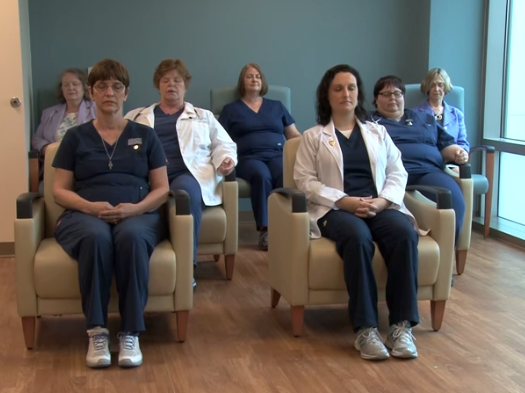
The nurses learned Transcendental Meditation from two certified teachers over a four-day period. They then practiced it for 20 minutes twice a day, though their demanding schedules sometimes made it challenging to fit it in. The technique is typically practiced once in the morning and then again in the late afternoon. In this video, Nourishing the Caregiver from Within, nurses describe the benefits they are receiving from the TM Program.
Previous qualitative study also found a benefit
The present study is the second of two that have used the Transcendental Meditation technique as a modality to improve the well-being of nurses. A study published in 2018 in International Journal for Human Caring reported the experience of RNs in graduate school who practiced Transcendental Meditation for four months. The qualitative study entailed the students keeping a journal and then the researchers used Giorgi’s descriptive phenomenological method to examine their journals.
The results showed that graduate students were more present and balanced, and experienced enhanced job performance. They also enjoyed greater feelings of bliss, peace, and integrity.
About the Transcendental Meditation Technique
Transcendental Meditation is a simple, natural technique practiced 20 minutes twice each day while sitting comfortably with the eyes closed. It is easily learned, and is not a religion, philosophy, or lifestyle. It doesn’t involve concentration, control of the mind, contemplation, or monitoring of thoughts or breathing. The practice allows the active thinking mind to settle down to a state of inner calm. For more information visit www.tm-women.org/nurses.
Study: Self-Care Strategies for Professional Development: Transcendental Meditation®; Reduces Compassion Fatigue and Improves Resilience for Nurses, Jennifer (Rheingans) Bonamer, PhD; Catherine Aquino-Russell, PhD. DOI: 10.1097/NND.0000000000000522
Photo credits: Jennifer Bonamer—Sarasota Memorial Health Care System; meditating nurses and graph—Transcendental Meditation for Women.
Alliance for PTSD Recovery interviewed Amy Ruff, Director of Transcendental Meditation for Nurses. She discusses the challenges of nurse burnout and traumatic stress and the need for greater resilience.
Tues, Feb 19, 2019: A study published in Psychological Reports showed that after 3.5 months of practicing Transcendental Meditation (TM), most of the 34 tertiary-level students at Maharishi Institute (MI)—all of whom were initially diagnosed with PTSD by mental health professionals—went below clinical thresholds as measured by standard assessments. Students also experienced relief from depression. A comparison group from University of Johannesburg (UJ) with the same diagnosis received no treatment and showed no change in their symptoms.
College students diagnosed with PTSD at Maharishi Institute (MI) and University of Johannesburg (UJ) were tested at 15, 60 and 105 days. After 3.5 months, the MI group practicing Transcendental Meditation (TM) went below clinical thresholds, while controls at UJ showed no change.
A very high percentage of young people in South Africa suffer from post-traumatic stress disorder (PTSD) and depression. A college that offers the Transcendental Meditation (TM) technique to its students found this approach helped reduce their symptoms.
A study published today in Psychological Reports showed that after 3.5 months of practicing Transcendental Meditation (TM), most of the 34 tertiary-level students at Maharishi Institute (MI)—all of whom were initially diagnosed with PTSD by mental health professionals—went below clinical thresholds as measured by standard assessments. The students also experienced relief from depression.
A comparison group of 34 students from the University of Johannesburg (UJ) suffering from PTSD and depression received no treatment and continued to show no change in their symptoms throughout the study.
High levels of PTSD
An international research team of seven scientists and psychologists conducted the study. At the start, students at MI and UJ had a score of 44 or more on their PCL-C test and a clinician’s verification of PTSD. A score above 44 indicates likely PTSD and below 34 indicates that one is below the PTSD threshold.
Symptoms included nightmares, flashbacks to traumatic events, anxiety, fear, and hyper-vigilance. They also reported emotional numbness, anger, and violent behavior, as well as abuse of drugs and alcohol. PTSD is a chronic, debilitating condition that may last a lifetime if not treated effectively.
The study showed a rapid and significant reduction of symptoms in the test group, according to lead author Dr. Carole Bandy, professor of psychology at Norwich University, America’s oldest military college. Results were stable over time.
“A high percentage of young people in South Africa, especially those living in the townships, suffer from PTSD,” said co-author Michael Dillbeck, researcher in the Institute for Science, Technology, and Public Policy at Maharishi University of Management, Fairfield, Iowa. “To become successful students and productive members of society, they absolutely need help dealing with the symptoms of post-traumatic stress disorder. Our study shows, that after 3 months of meditation, this group, on average, was out of PTSD. It offers a way for others to effectively deal with this problem.”
Our study shows, that after 3 months of meditation (TM), this group, on average, was out of PTSD. It offers a way for others to effectively deal with this problem.”
High levels of PTSD are prevalent in South Africa
Up to 25% of the population in South Africa suffers from PTSD, according to Dr. Eugene Allers, past-president of the South African Society of Psychiatrists. Estimates put the same figure in the USA at 8%.
Several recent scientific studies show that adolescents and children in South Africa may be exposed to relatively high levels of traumatic experiences, particularly witnessing or experiencing violence of a criminal or domestic nature, associated in turn with estimates of post-traumatic stress disorder (PTSD) ranging from 8% to 38% (Ensink, Robertson, Zissis & Leger, 1997; Pelzer, 1999; Seedat, van Nood, Vythilingum, Stein & Kaminer, 2000; Suliman, Kaminer, Seedat & Stein, 2005).
UJ students assessed by expert NGO
The South African Depression and Anxiety Group (SADAG), the largest mental health NGO in SA, which assists more than 180,000 people each year, interviewed and tested UJ students suffering from PTSD. They were also tested for depression, since it often accompanies PTSD and can in fact be considered a component of PTSD.
Students were only invited to join the study if they met two criteria for having PTSD: a score indicating PTSD on the PCL-C paper test and the opinion of a trained psychologist. Re-testing was 15, 60 and 105 days after baseline testing.
MI students find relief
At 15 days into the study, Maharishi Institute students showed a significant drop of more than 10 points in their PTSD symptoms after learning Transcendental Meditation. They also found relief from depression, judged by Beck Depression Index scores.
Re-testing was also carried out at 60 days and 105 days of their TM practice. By 105 days, the average group score for the MI students was below the PTSD threshold of 34, according to the paper tests. The UJ students showed no significant reduction in symptoms—neither depression nor PTSD. They received no support of any kind.
A binary logistical regression analysis for the effect of TM practice on PTSD PCL-C diagnosis 105 days after instruction was also highly significant, with 7 likely PTSD and 27 unlikely for the experimental group and 30 likely and 4 unlikely for the comparison group.
First study of its kind
This is the first study of its kind to show how Transcendental Meditation can reduce PTSD in college students. “This study shows that there are new tools available for professionals to add to their tool bag,” says Zane Wilson, Founder and Chairman of SADAG.
This is the first study of its kind to show how Transcendental Meditation can reduce PTSD in college students.
Transcendental Meditation® is a simple, natural technique practiced 20 minutes twice each day while sitting comfortably with the eyes closed. It is easily learned, and is not a religion, philosophy, or lifestyle. It doesn’t involve concentration, control of the mind, contemplation, or monitoring of thoughts or breathing. The practice allows the active thinking mind to settle down to a state of inner calm. For more information visit https://www.tm.org.
Ref: Bandy, C, Dillbeck, M., Sezibera, V., Taljaard, L., de Reuck, J., Wilks, M., Shapiro, D., Peycke, R. (Psychological Reports. on-line: February, 2019) Reduction of PTSD in South African University Students Using Transcendental Meditation Practice. DOI: 10.1177/0033294119828036 | US National Library of Medicine & National Institutes of Health: PubMed
Sheila Moschen asked me to read 3 of my love poems for a Valentine Day’s Show on her KHOE radio program, Let Your Heart Sing. This 38-minute show (#56) aired on Monday and Tuesday this week at 1:00 and 7:00 pm, and will soon go into her archive. The last musical selection Sheila played was the beautiful love song, Longer, by Dan Fogelberg (at 33:05) [Lyrics]. The 3 short poems, about a special relationship I shared with my sweetheart Sally Peden, complete the show (at 36:34).
UPDATE: The show also replayed the following year on Valentine’s Day, Wednesday, February 12, 2020 with new links on OneDrive and YouTube.
Added February 18, 2024: This Sunday, Sheila Moschen’s Valentine’s Day show was being rebroadcast on KHOE. After she had signed off, station manager James Moore came on air to share the sad news of Sheila’s passing. Her daughter had contacted him to say that her mother had passed on January 15. James spoke about her considerable contribution to the radio station. Sheila provided a platform for the many fine local musicians and poets. On February 15, The Recorder posted the Sheila Moschen Obituary.
I was shocked to hear this news. I emailed James to relay my surprise and to thank him for his high praise of Sheila. He thanked me and said:
Sheila was a joy to work with and a real treasure for Heaven on Earth radio. That’s why I’ve chosen to continue broadcasting her rich content.
She told me recently that creating the LET YOUR HEART SING shows was one of her very favorite things in life, a highlight, in fact. Her commitment to uplifting hearts and minds, enriching life, and focus on local creatives with timely seasonal offerings was always a joy to broadcast.
She will be missed but grateful to be able to keep her beautiful work in rotation.
All the best,
James
He later sent me an mp3 of what he said on the show.



 The Uncarved Blog