Archive for the ‘Education’ Category

Meditation May Lower BP and College Stressors

November 19, 2009

Meditation May Lower BP and College Stressors

By Joene Hendry
November 18, 2009

NEW YORK (Reuters Health) – If the stresses of college have put you at risk for high blood pressure, try transcendental meditation.

Blood pressure fell among college students who spent about 20 minutes at least once a day to reach the “restful alertness” state of transcendental meditation, Dr. Sanford I. Nidich, at Maharishi University of Management Research Institute in Maharishi Vedic City, Iowa, and colleagues report.

Their study, in the American Journal of Hypertension, found meditating students also had “reduced psychological distress, anxiety, and depression,” Nidich told Reuters Health in an email.

He and colleagues randomly assigned 298 healthy students with and without high blood pressure to transcendental meditation training or to a training wait list. The students, 40 percent men, were just under 26 years old on average and attended universities in and around Washington, D.C.

Among the 207 students still participating in the study 3 months later, those in the meditation group had slight reductions in blood pressure, while the wait-listed students had slight increases in average blood pressure from the start of the study.

The meditating students also showed greater reductions in overall mood disturbances, anxiety, depression, anger, and hostility, and better coping skills compared with baseline measures and wait-listed students.

Nidich’s team further assessed a subgroup of 48 meditating and 64 wait-listed students who initially had high blood pressure (above 130 over 85 millimeters of mercury) or were at risk for high blood pressure.

In this high-blood-pressure-risk group, the meditating students had blood pressures that were lower, on average, than at the start of the study, while the wait-listed students had increases in blood pressure.

Nidich and colleagues also found these “significant reductions” in blood pressure correlated with lower measures of psychological distress and greater coping measures.

The researchers suggest their findings warrant further investigations into the potential health benefits of longer-term transcendental meditation in college students.

SOURCE: American Journal of Hypertension, December 2009

Copyright 2009 Reuters News Service. All rights reserved. This material may not be published, broadcast, rewritten, or redistributed.

AU College Students Reduce HBP, Anxiety, and Depression Through Transcendental Meditation

November 18, 2009

At-Risk College Students Reduce High Blood Pressure, Anxiety, And Depression Through Transcendental Meditation

The Transcendental Meditation® technique may be an effective method to reduce blood pressure, anxiety, depression, and anger among at-risk college students, according to a new study to be published in the American Journal of Hypertension, December 2009.

The Transcendental Meditation Program, a widely-used standardized program to reduce stress, showed significant decreases in blood pressure and improved mental health in young adults at risk for hypertension,” said David Haaga, PhD, co-author of the study and professor of psychology at American University in Washington, D.C.

This study was conducted at American University with 298 university students randomly allocated to either the Transcendental Meditation technique or wait-list control over a three-month intervention period. A subgroup of 159 subjects at risk for hypertension was analyzed separately. At baseline and after three months, blood pressure, psychological distress, and coping ability were assessed.

For the students at risk for developing hypertension, significant improvements were observed in blood pressure, psychological distress and coping. Compared to the control group, students practicing the Transcendental Meditation program showed reductions of 6.3 mm Hg in systolic blood pressure and 4.0 mm Hg in diastolic blood pressure. These clinically significant reductions are associated with a 52% lower risk for development of hypertension in later years.

The findings are timely. Today, an estimated 18 million students are dealing with mental health issues on college campuses. Statistics from colleges nationwide indicate there has been a 50% increase in the diagnosis of depression, and more than twice as many students are on psychiatric medications as a decade ago. According to recent national surveys of campus therapists, more students than ever are seeking psychiatric help on college campuses all across the United States.

“This is the first randomized controlled study to show in young adults at risk for hypertension reductions in blood pressure that were associated with changes in psychological distress and coping,” said Sanford Nidich, EdD, lead author and senior researcher at the Institute for Natural Medicine and Prevention at Maharishi University of Management. “Previous research has shown that psychological distress such as anxiety, depression, and anger contribute to the development of hypertension in young adults,” said Dr. Nidich.

College students are particularly prone to psychological distress caused by interpersonal and social problems, pressures to succeed academically, financial strains, and uncertain futures. For the entire sample in this study, there was a significant improvement in students’ mental health.

“Hypertension is a common risk factor for cardiovascular disease in adulthood. Yet, decades of research show that high blood pressure begins in youth. This well-controlled clinical trial found that blood pressure can be effectively lowered in students with a stress-reducing intervention. This has major implications for the prevention of hypertension, heart attacks and strokes in adulthood,” said Robert Schneider MD, FACC, specialist in clinical hypertension, Director of the Institute for Natural Medicine and Prevention and study co-author.

This study was supported, in part, by a Specialized Center of Research Grant from the National Institutes of Health–National Center for Complementary and Alternative Medicine, and by the Abramson Family Foundation, David Lynch Foundation, and other private donors.

Facts on Stress and Young Adults

Hypertension affects approximately one-third (33%) of the US adult population.

College-age individuals with blood pressure (BP) elevated beyond the optimal range are three times more likely to develop hypertension than normotensives.

Psychological distresses such as anxiety, depression, and anger/hostility have been found to contribute to the development of hypertension in young adults.

In 2007, around 15% of students reported having been diagnosed with depression at some point in their lives — up from 10% in 2000.

Maharishi University students get academic credit for daily Transcendental Meditation (TM) practice

November 13, 2009

NewsBlaze

Published: November 12,2009
Send to a friend
Letter to the Editor
AddThis

Response to “Hindus Laud University of Colorado-Boulder Over Meditation Center”

Hindus Laud University of Colorado-Boulder Over Meditation Center

It seems that UCB is just starting to catch on. MUM, Maharishi University of Management, located in Fairfield, Iowa, has offered CBE, Consciousness-Based education, for 35 years, where students, faculty, and staff all practice TM, the Transcendental Meditation technique, twice a day.

Students receive RC credit, research in consciousness, as part of their curriculum. Meditation rooms are made available for students to practice their twice-daily non-religious TM technique. And there are two large golden domes over 25,000 square feet each, one for men and one for ladies, where students, faculty, staff, and meditating townspeople all gather twice a day, morning and evening, to practice TM and the TM-Sidhis program, including Yogic Flying, for world peace.

These ancient meditative practices revived by the founder, Maharishi Mahesh Yogi, dramatically lower stress-related risk factors and increase clarity and orderliness in brain functioning. The results show up in students’ academic and athletic performances as well as improved individual and social well-being. Students are happier and more productive, and don’t resort to alcohol or drug abuse, or express violent behavior.

For those who wish to worship according to their own faith, students attend multi-denominational services in town, and a room is also available for Muslim students who wish to use their prayer rugs to pray. MUM’s diverse student population of over 1000 comes from over 65 different countries this year. And enrollment is growing as more and more discover what this unique university has to offer.

All food is organic vegetarian, some of it grown locally in the university’s large green houses. Visit http://www.mum.edu or come for a Visitors Weekend. One of the most popular Visitors Weekends is the annual David Lynch Weekend. Also check out the David Lynch Foundation website for details.

Ken Chawkin
Media Relations Director
Maharishi University of Management
The David Lynch Foundation
E: kchawkin@mum.edu
W: http://www.mum.edu
W: http://www.davidlynchfoundation.org
B: https://kenchawkin.wordpress.com

Natural Solutions: Meditation for Minors

November 5, 2009

naturalsolutions


Published:10/01/2009

Meditation for Minors

By Cara MacDonald

Here’s a shocker: One of the film industry’s most brilliant minds once felt anything but brilliant. While working on his breakout film Eraserhead in the mid-’70s, David Lynch had “everything I could ever want to make the film—the best equipment, the best place to live … but I wasn’t happy; I felt a kind of hollowness.” He began practicing Transcendental Meditation (TM), which let him connect to a creativity within that has inspired him throughout his career. In 2005, he created the David Lynch Foundation, which offers scholarships to schools to fund instruction in TM with the hopes of reducing stress and increasing well-being and creativity in children. Natural Solutions talked to Lynch about how meditation changed his world—and why he wants to pass it on.

On meditation and creativity:
I like to say that ideas are like fish. The small fish swim on the surface but the big fish swim at the depths of the ocean. TM expands your conscious mind so you can catch the really big ideas.

On how meditation affects his films:
It allows me to effortlessly “dive within” and experience that ocean of creativity, intelligence, happiness, love, and dynamic peace. Mulholland Drive was first shot as a television pilot; the executive hated it and turned it down. I had the chance to make it a feature film, but I didn’t have all of the ideas. I went into meditation and after about 10 minutes, ssssst! The ideas came like a string of pearls.

On what inspired him to bring TM to schools:
I attended a high school play put on by meditating students at Maharishi School in Fairfield, Iowa, and I was totally amazed at how bright and shiny, how natural and powerful, how much “themselves” these students were. Then I heard about the terrors of modern education, how afraid children are to even go to school because of the violence, drugs, and stress. So I wanted to do what I could to offer meditation to any student anywhere in the world.

On how TM helps kids succeed in school:
It’s done for 10 to 15 minutes twice a day as part of the school’s “quiet time” program. Everyone in the school benefits. I hear all the time about a child getting Ds and Fs, close to being expelled, and then he or she learns to meditate and, within a few weeks or months, she is getting As and Bs. The schools are transformed from being literally hellholes of violence and fear to centers of learning and creativity. That’s the report we get from principals and parents.

On why meditation is vital for a child:
It’s important for everyone to meditate, not just children. But think about how great it is to start your life developing your full creative potential, and growing in enlightenment, brightness, happiness, inner strength, intelligence, creativity, and dynamic peace.
—Cara McDonald

How to introduce meditation to your kids:
• Encourage downtime and regular exercise to trigger the relaxation response. • Educate yourself before considering meditation for your child. Check out tm.org for free workshops that explain the TM concept. • Visit davidlynchfoundation.org for school grant and scholarship information.

© 1999-2009 Natural Solutions: Vibrant Health, Balanced Living/Alternative Medicine/InnoVision Health Media

Fourth Annual David Lynch Weekend for World Peace and Meditation Taking Place in Iowa

October 31, 2009

paste-logo

Fourth Annual David Lynch Weekend for World Peace and Meditation Taking Place in Iowa

Published at 1:48 PM on October 30, 2009

By Emily Riemer

David Lynch, signature director of quintessentially dark, sometimes confusing, occasionally erotic, often non-linear films, is also a representative for world peace and meditation. The Oscar-nominated filmmaker and his David Lynch Foundation will present the fourth annual David Lynch Weekend at Maharishi University of Management in Fairfield, Iowa on Friday, Nov. 13 through Sunday, Nov. 15.

Lynch will be the keynote speaker at the conference, and other presenters range from 1960s pop star Donovan to quantum physicist and Maharishi professor John Hagelin (who ran for U.S. president three times with the Natural Law Party). The weekend is aimed at those “interested in creativity, film, art, sustainable living, organic agriculture, brain development, consciousness, meditation, natural medicine, renewable living, peace.” Attendees are encouraged to “take part in a greater conversation about the creative process, alternative education and ways to live a better life.”

The David Lynch Foundation was established in 2005 and, according to its website, has provided millions of dollars to fund and implement the teaching of Transcendental Meditation techniques to students worldwide. The DLF credits the techniques with reducing ADHD and other learning disorders, anxiety, depression, and substance abuse, calling them stress reducing programs that “improve creativity, brain functioning, and academic performance.”

Maharishi University is an appropriate location for such a conference. The undergraduate and graduate university centers around “consciousness-based education” of Transcendental Meditation, sustainability, peace and natural health.

Beyond his forays into transcendentalism, David Lynch is best known as the director of films such as Mulholland Drive and the TV show Twin Peaks.

Got news tips for Paste? Email news@pastemagazine.com.

RushPRNews: Meditation: Effective New Aid for Students with ADHD

September 26, 2009

RushPRNews: Meditation: Effective New Aid for Students with ADHD

Shared via AddThis

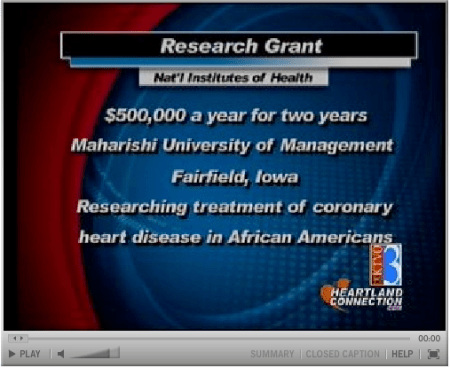
KTVO 3: M.U.M. Gets $1 Million Research Grant

September 26, 2009

MUM gets $1 million research grant

Friday, September 25, 2009 at 6:37 p.m.

FAIRFIELD, IOWA — University Receives $1 Million NIH Grant for Mind-Body Medicine Research

The National Institutes of Health recently awarded a grant of $500,000 per year for two years for research on the Transcendental Meditation® technique in the treatment of coronary heart disease in African Americans.

The research is a collaboration between Maharishi University of Management Research Institute’s Center for Natural Medicine and Prevention and Columbia University Medical School in New York.

The funding comes from the American Recovery and Investment Act, via the NIH-National Heart, Lung and Blood Institute.

About 21,000 applications were submitted to NIH for these specific funds, with just 3% receiving grants.

“This recent achievement continues to place MUM Research Institute and its research on the Transcendental Meditation technique and Maharishi Vedic MedicineSM programs in an elite category in academic medicine,” said project director Robert Schneider, M.D., F.A.C.C., and dean of the Maharishi College of Perfect Health.

The research will compare the effectiveness of cardiac rehabilitation with and without the Transcendental Meditation program, especially after a heart attack. The study will utilize positron emission tomography (PET) to image and quantify changes in heart disease in the patients.

The Center for Natural Medicine and Prevention team includes Sanford Nidich, EdD, Carolyn King, PhD, Maxwell Rainforth, PhD, John Salerno, PhD, Marilyn Ungaro, Laura Alcorn, and Linda Heaton.

See video: http://bit.ly/13D7d4

KTVO Medical News

Video on the David Lynch Foundation

September 22, 2009

How David’s Foundation Started

This 3 minute video premiered at the “Change Begins Within” benefit concert at Radio City Music Hall in New York City on April 4th, 2009. The video provides a compelling introduction to the purpose and goal of the David Lynch Foundation, which is to provide scholarships for one million at-risk youth to meditate—students who are struggling to learn and live in an atmosphere of intense stress, disease, and violence.


Meditation: Effective New Aid for Students with ADHD

September 14, 2009

David Lynch Foundation
Office of ADHD and Other Learning Differences

714 19th St. S. • Arlington, VA • 703-823-6933 • ADHD-TM.org • sgrosswald@tm.org
Contact: Ken Chawkin, 641-470-1314, kchawkin@mum.edu

Meditation: Effective New Aid for Students with ADHD

National conference to showcase research and classroom experience during National ADHD Public Awareness Month

WEDNESDAY, SEPTEMBER 30 • 12:00 NOON (ET)
Webcast online at ADHD-TM.org http://adhd-tm.org

A panel of physicians and scientists will report on the benefits of a simple meditation practice for aiding students diagnosed with ADHD during a national medical webinar, which will be hosted by the David Lynch Foundation on Wednesday, September 30, 12 noon (ET).

The webinar, which comes on the final day of National ADHD Public Awareness Month, will report on published research on the effects of the Transcendental Meditation technique for improving academic achievement and executive brain function while reducing learning disorders, anxiety, depression, metabolic syndrome, diabetes, and heart disease.

Conference panelists

Sarina Grosswald, Ed.D. George Washington University-trained cognitive learning specialist; lead researcher on a pioneering study on the Transcendental Meditation technique and ADHD; and Executive Director of the David Lynch Foundation’s Office of ADHD and Other Learning Differences.

Norman E. Rosenthal, M.D. Senior Researcher in Psychiatry and Psychobiology for 20 years at the National Institute of Mental Health; currently Clinical Professor of Psychiatry at Georgetown University; and Medical Director of Capital Clinical Research Associates in Bethesda, MD.

William Stixrud, Ph.D. Clinical Neuropsychologist and Director of William Stixrud and Associates, specializing in the evaluation and treatment of children, adolescents, and adults with learning, attention, and/or social/emotional difficulties; Assistant Clinical Professor of Psychiatry at the George Washington University Medical Center.

Over 50% reduction in stress and anxiety, and improvements in ADHD symptoms

One recent study, published in the December 2008 issue of the peer-reviewed Current Issues in Education followed a group of 10 middle school students with ADHD who were practicing the Transcendental Meditation technique twice a day in school. After three months, researchers found over 50% reduction in stress and anxiety, and improvements in ADHD symptoms.

“The effect was much greater than we expected,” said Sarina J. Grosswald, Ed.D., a George Washington University-trained cognitive learning specialist and lead researcher on the study. “The children also showed improvements in attention, working memory, organization, and behavior regulation.”

Grosswald said that after the in-school meditation routine began, “teachers reported they were able to teach more, and students were able to learn more because they were less stressed and anxious.”

Prior research shows ADHD children have slower brain development and a reduced ability to cope with stress.

Stress interferes with learning

“Stress interferes with the ability to learn—it shuts down the brain,” said William Stixrud, Ph.D., a Silver Spring, Maryland, clinical neuropsychologist and co-author of the study.

“Medication for ADHD can reduce the symptoms for some children, but it is marginally or not effective for others. Even for those children who show improved symptoms with the medication, the improvement is often insufficient,” Stixrud said.

According to the Centers for Disease Control, almost 50% of the 4.5 million children (ages 4-17) in the United States diagnosed with ADHD are on ADHD medication—and the majority of those on medication stay on it in adulthood. Stixrud said there is growing concern about the health risks and side effects associated with the common ADHD medications, including mood swings, insomnia, slowed growth, and heart problems. In 2006 the FDA required manufacturers to place warning labels on ADHD medications, listing the potential serious health risks.

These high risks and growing concerns are fueling parents’ search for alternatives that may be safer for their kids.

“There is already substantial research showing the effectiveness of the TM technique for reducing stress and anxiety and improving cognitive functioning among the general population,” Dr. Grosswald said. “What’s significant about our findings is that among children who have difficulty with focus and attention, we see the same results. TM doesn’t require concentration, controlling the mind or disciplined focus. The fact that these children are able to do TM and do it easily shows us that this technique may be particularly well suited for children with ADHD.”

The David Lynch Foundation is a nonprofit, 501(c)(3), which has provided more than $7 million in scholarships to teach Transcendental Meditation to over 100,000 at-risk students throughout the United States, Latin America, the Middle East, and Africa.

###

Additional resources

1. Transcendental Meditation reduces ADHD symptoms among students: New study Dissatisfaction with medication spurs interest in meditation

2. Transcendental Meditation buffers students against college stress: Study Research at American University shows meditating students react better to stress, are less fatigued, have more ‘integrated’ brains

3. New study shows Transcendental Meditation improves brain functioning in ADHD students A non-drug approach to enhance students’ ability to learn

4. Girls with ADHD more prone to depression, anxiety than boys; meditation helps

5. TM improves brain function in ADHD students

INDIAN COUNTRY TODAY: Sustainability quest: Tribes to gather for conference of meditation and renewal

September 11, 2009

Indian Country Today

Sustainability quest

Tribes to gather for conference of meditation and renewal

By Rob Capriccioso

Story Published: Sep 15, 2009

FAIRFIELD, Iowa – Organizers are preparing for a unique gathering of tribal elders, leaders and members to focus on building sustainable communities through meditation, renewable energy, organic agriculture and cultural preservation.

The event, billed as the “International Conference on Building Healthy, Sustainable American Indian Communities,” is largely being put together by the Hocak Elders Council, the Ho-Chunk Elders Advisory Council, the David Lynch Foundation and members of the Winnebago Tribe of Nebraska.

It will be held at the Maharishi University of Management in Fairfield, Iowa Sept. 25 – 27. Planners expect hundreds of participants to attend.

“We are very excited to be able to help offer this one-of-a-kind experience,” said Bob Roth, vice president of the David Lynch Foundation, which focuses on spreading scientifically-proven stress-reduction Transcendental Meditation technique to at-risk youth.

The meditation techniques focus on regular, quiet reflection times aimed at reducing stress and its harmful health impacts.

Studies have shown the methods to have health benefits, such as curbing behavioral disorders in youth and reducing the need for insulin in those with Type 2 diabetes.

Planners with the foundation are using the conference as a platform to highlight their commitment for the past three years to a project called the “Model American Indian Community Initiative” on the Winnebago Reservation.

The project strives to help at-risk youth relieve stress through meditation. It has achieved some promising results which conference organizers are eager to share.

John Boncheff, an event organizer who co-directs the Winnebago project, said Indian youth in the program are not only doing better in school, they are absent less and have a better chance of graduating.

Esteemed Indian leaders have taken note. Joe A. Garcia, president of the National Congress of American Indians; Robert Cook, president of the National Indian Education Association; Lucille Echohawk, a strategic planner for Casey Family Programs; and Kevin Skenandore, acting director of the Bureau of Indian Education are scheduled to attend and present at the sustainability gathering.

The Pine Ridge Reservation in South Dakota and the Passamaquoddy Tribe of Maine have started similar projects, hoping for equally positive results. Planners said many more tribal leaders have requested information.

Roth said it has been an honor to see more tribes get involved and for Native Americans to teach each other the benefits of healthy meditation and its similarity to some traditional spiritual beliefs.

Prosper Waukon, a leader with the Hocak Elders Council and a citizen of the Winnebago Tribe, said the project has also attracted keen interest from his tribe’s elders.

In 2007, Waukon said several older tribal members took a trip to Maharishi University to learn about transcendental meditation, which the institution strongly promotes. Many were suffering from debilitating side effects of diabetes and wanted to understand ways to meditate to improve their well-being.

Some of the elders have since been able to dramatically better their health outcomes, and some rely much less on diabetes medications, Waukon said.

“Many elders found there was something missing with medication alone. Using meditation to relieve stress ended up helping them connect with traditional ways. It has been a win-win situation.”

As a part of studying the elders’ progress, IHS has contributed $560,000 to the project in in-kind testing services. They are hopeful that IHS may end up promoting the program to more tribes in the future upon seeing positive results.

Information about the elder diabetes program will also be highlighted at the conference.

Waukon said the event won’t just be about promoting sustainability through meditation. It will also feature sessions on organic farming, wind and solar energy development and cultural preservation.

“These are areas of sustainability that all connect to each other,” he said, adding that experts in the various fields will be in attendance.

Boncheff would like the conference to raise awareness of the Winnebago project’s success and to see what can be done to take it to the next level. He is hopeful that at least seven more tribes launch similar sustainability projects by next year.

For people who can’t afford to attend the conference, it will be Web cast online. Registration information and more details are also available online.

On February 1, 2012, Indian Country Today published an article, Transcendental Meditation Combating Diabetes in Indian Country, by Mary Annette Pember.