Archive for the ‘Education’ Category

“There’s no other building like this going up in the nation, or in the world for that matter, that we know of.”

April 21, 2010

MUM to Erect Walls of New Off-the-Grid Building on Earth Day

Sustainable Living Center Will Be Unique in the Country

Press Conference and Earth Day Event Scheduled for 12:45 p.m. April 22

On Earth Day, April 22, the walls and the roof will go up on Maharishi University of Management’s new Sustainable Living Center — a building that will set a new standard for green building in America by being completely off the grid with respect to electricity, heating and cooling, water, and waste.

The Sustainable Living Center has been designed to meet the Living Building Challenge, the highest standard for sustainable design and green building in the world. It will be one of the first three to achieve this. And it will be unique because it will be the first to combine that standard with the standards of LEED Platinum certification, Building Biology, and Maharishi Vedic Architecture.

“There’s no other building like this going up in the nation, or in the world for that matter, that we know of,” said nationally known green building expert Mike Nicklas, who co-designed the building and whose company Innovative Design has designed over 4000 buildings that use renewable energy solutions.

Whole Tree Post and Beam Construction

Construction will proceed quickly on Earth Day because the structure uses Whole Tree post and beam techniques. The walls will be tilted up and roof trusses placed on them.

The entire shell of the building should be completed within about a week, and the building is expected to be ready for occupation in late fall.

A Building That Teaches

The Sustainable Living Center will serve students in the university’s Sustainable Living major. It will have classrooms, workshop, meeting room, greenhouse, kitchen, research lab, recycling center, and offices, as well as east and west covered verandas and a porch on the north.

It has been designed as a building that teaches. In addition to embodying sustainability, it will allow students to monitor performance and energy efficiency and make adjustments.

“The Sustainable Living Center will be a living, evolving building,” said David Fisher, head of the MUM Sustainable Living Department, who helped plan the building. “The building itself is an educational tool, not just a passive one like most classroom buildings. It will provide participatory education where students will be continually adding to, or altering, the building and grounds as well as systematically checking its effectiveness.”

Off the Grid

The Sustainable Living Center will be completely off of the energy and utility grid. Every feature will exemplify healthy and sustainable green building — and will be geared to teaching those principles.

Construction uses all non-toxic materials from local sources (as defined by the Living Building Challenge requirements). All energy will be provided from solar panels on the building and from an outside wind turbine. Rainwater catchment will be the complete source of the building’s water, with purification of drinking water via ultraviolet technology. Wastewater will be treated onsite using a constructed wetland. Natural daylighting will illuminate the entire interior. Geothermal technology will assist with heating and cooling.

An Embodiment of Sustainability That’s Feasible and Practical

This achievement is remarkable because none of the systems in the building are new or experimental, according to construction manager Dal Loiselle. “The Sustainable Living Center is being constructed using ‘state-of-the-shelf technologies,” he said. “This building proves that we can meet our environmental goals for our built environment with the materials, technologies, and green building protocols we already possess.”

A Community Oriented Toward Sustainability

Sustainability has become a major focus at Maharishi University of Management, which has long used techniques for living in harmony with natural law, including the Transcendental Meditation technique and other Vedic technologies including Vedic Architecture. The University has filed a climate action plan to be 100% carbon neutral by 2020 as part of the American College and University Presidents Climate Commitment.

Fairfield, too, has taken a strong direction toward sustainability, hiring a sustainability coordinator and moving ahead with various initiatives. In 2009, MSN.com named Fairfield Mayor Ed Malloy as one of the nation’s 15 greenest mayors — alongside the mayors of New York, Seattle, San Francisco, Chicago, and Salt Lake City.

“Our city will benefit enormously by having this building on the campus of MUM as a demonstration of a new standard of design and will reinforce our commitment in Fairfield to changing the culture towards a more sustainable future,” Mayor Malloy said.

The Sustainable Living Center has also benefited from material donations by nationally recognized leaders in green building materials: Gerdau AmeriSteel, Pittsburgh Corning and United States Gypsum Corporation, as well as from Green Building Supply of Fairfield, IA.

• • •

A press conference will be held on Earth Day, April 22, at 12:45 p.m. at the site of the Sustainable Living Center construction just north of the MUM library on Highway 1.

Available for media interviews: Sustainable Living department head David Fisher, construction manager Dal Loiselle, Fairfield Mayor Ed Malloy, and associate design architect Jon Lipman.

The Building will also be a showcase for the public, and will feature meeting rooms, a real-time energy and renewable systems monitor, and displays of materials and building systems featured in the building to showcase partnerships with leading technologies and materials manufacturers.  For more information please contact: Marco Sunseri @ 641-472-7000 x2449.
My Son’s Sensei: A Tanka about my son’s Aikido teacher

April 21, 2010

My Son’s Sensei
A tanka about my son’s Aikido teacher

Rooted to the ground
She repels her attackers
Flowing, not moving.

In storms, trees bear great burdens
Bending, not breaking.

—Ken Chawkin

(more…)

DLF.TV Documentary: Saving the Disposable Ones

April 2, 2010
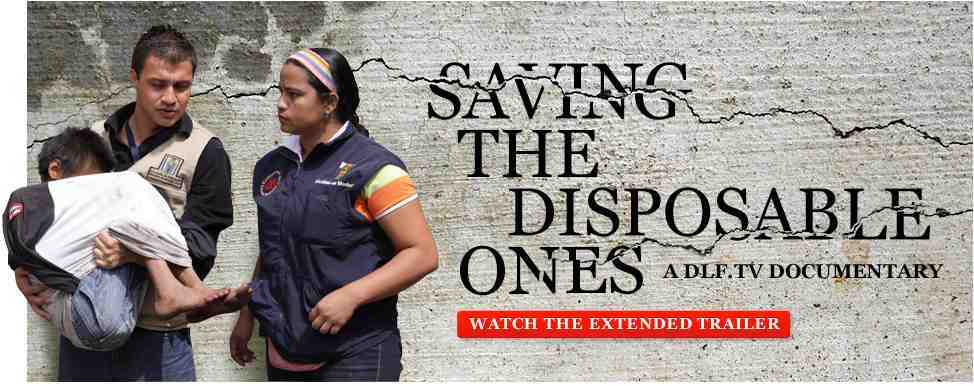
Saving the Disposable Ones

THE PROJECT

“The street children in Colombia are called ‘the disposable ones’ and they live and sometimes die on the streets. These children are unloved, unwanted, and endure abuse on many levels. Colombians are a kind and generous people but crime related to cocaine trafficking has made cities such as Medellin among the most violent in the world. Surviving on the streets is a harsh business. Children as young as six fall into prostitution and many escape the torments of their existence by sniffing glue.” — Stuart Tanner, Director

IT DOESN’T HAVE TO BE THIS WAY

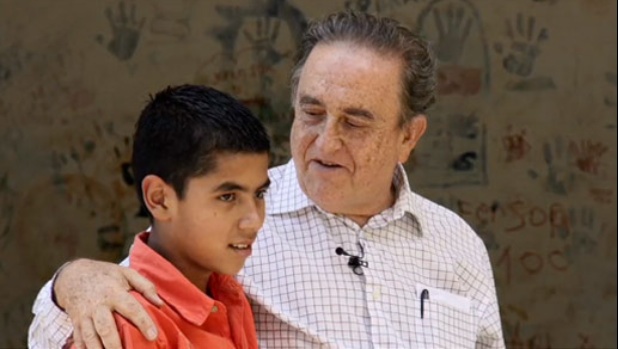
As Stuart reveals in his deeply moving new film, there is a Catholic priest in Colombia, Father Gabriel Mejia, who has worked quietly to provide street children relief from their struggle for survival and support to create a better life for themselves.

Starting in Medellin in the mid-1980’s, Father Gabriel opened the first Center de Hogares Claret: a place where children could come for a good meal and a safe place to sleep. In the late 1980’s, he traveled to the United States where he learned Transcendental Meditation. He knew immediately that he had found the answer to the overwhelming stress the children suffered from living on the streets. As the power of the drug cartels waned, the number of Father Gabriel’s orphan shelters increased. Now, in 2010, there are 47 shelters under Father Gabriel’s direction, which are spread across all of Colombia. His center of operations in Medellin is the former home of Pablo Escobar, the now deceased drug lord.

“In the rough part of Medillin there is an orphan center where children as young as six years old can come to seek solace,” Stuart recalls. “At the center the children can shower and get a good meal. The children are free to come and go as they wish. There is no pressure on them to stay; it is an open house. Father Gabriel has learned through his work with the street children that the desire to move away from their life on the streets must come from within the children themselves. Many of the children are addicted to sniffing glue or gasoline so the process of becoming free of this dependency is a difficult and gradual one. As part of their rehabilitation the children learn to meditate. This is combined with gentle guidance from Father Gabriel and other members of the Foundation.”

As Stuart’s film documents, over time an extraordinary transformation in the lives of the children takes place. They are freed from the torments they endured living on the streets, recover from their drug addictions and begin to gain an education. “The Foundation established by Father Gabriel embodies the wisdom, patience and knowledge that is required to rescue the ‘disposable’ children, restore their rights, their dignity and offer them a much brighter future,” Stuart says.

“The basic therapy is love. Love is the imperial medicine for any illness or disorder. When a child feels they are welcome, when a child feels an educator is concerned about them, the child who came from violence and hostility of the streets, from being mistreated and who became aggressive, they change. The child changes.”

“When a child starts to practice Yoga every day, morning and afternoon. When a child closes the eyes and begins to meditate, when a child practices the Sidhis, they open themselves up to a field of infinite possibilities, as Maharishi says. The world opens for the child. And then the child discovers their essential nature, which is love.

“I think that we’re all committed to transforming the world we’re all living in. We have to leave a better world than the one we found. I believe in solidarity. I believe the solution is within every person. Within each one of us there is a sanctuary, and the moment we take refuge there, we can enter it. Solutions come from every person. When we put them together, there are many solutions. We must globalize love.” Father Gabriel Mejia

The David Lynch Foundation

The David Lynch Foundation has currently provided over 120,000 scholarships around the world including tens of thousands in Latin America. The proceeds from this premiere will go towards the David Lynch Foundation programs in Latin America, including Father Mejia’s Foundation, providing meditation instruction to at-risk populations. The program is offered on a voluntary basis, at no cost to the school or organization. Visit davidlynchfoundation.org for more information on programs and initiatives.

SUPPORT AT-RISK YOUTH

The David Lynch Foundation has currently provided tens of thousands of scholarships in Latin America. The proceeds from this film will go towards DLF programs in Latin America, including Father Mejia’s Foundation.

online
WORLD PREMIERE
April 8, 2010, 7:45pm
Fairfield, IA
Watch the extended #trailer
See Saving the Disposable Ones: World Premiere Poster for David Lynch Foundation Documentary along with longer clips from the film.

See the Saving the Disposable Ones article by Linda Egenes in Issue 11 of Enlightenment: The Transcendental Meditation Magazine.

We can now watch “Saving the Disposable Ones” at this site.

TM activates DMN, the brain’s “ground state”

March 4, 2010

A new EEG study conducted on college students at American University found they could more highly activate the default mode network, a suggested natural “ground state” of the brain, during their practice of the Transcendental Meditation technique. This three-month randomized control study is published in a special issue of Cognitive Processing dedicated to the Neuroscience of Meditation and Consciousness, Volume 11, Number 1, February, 2010.

Specifically, the study found the TM technique:

  • Produces a unique state of “restful alertness,” as seen in the markedly higher alpha power in the frontal cortex and lower beta and gamma waves in the same frontal areas during TM practice.
  • Creates greater alpha coherence between the left and right hemispheres of the brain suggesting the brain is working as a whole.
  • Enhances an individual’s sense of “self” by activating what neuroscientists call the “default mode network” in the brain. (This is considered the natural ground state of the brain, glimpsed by neuroscientists during eyes-closed rest but more fully activated during Transcendental Meditation practice.)

“The finding of significant brain wave differences between students practicing the Transcendental Meditation technique and those simply resting with their eyes closed is especially convincing because subjects were randomly assigned to conditions, and testing was conducted by a researcher unaware of the experimental condition to which the subject had been assigned,” said David Haaga, Ph.D., coauthor and professor of psychology at American University.

“Research has already shown that simply closing one’s eyes and relaxing increases the default mode. A significant additional finding of this new study is that activity in the default mode increases during TM compared to simple eyes-closed rest,” said Fred Travis, Ph.D., lead author and director of the Center for Brain, Consciousness, and Cognition at Maharishi University of Management. “Different meditation techniques entail various degrees of cognitive control. Thus, activation patterns of the default mode network could give insight into the nature of meditation practices.”

Previous published research, funded by the NIH, shows TM practice decreases high blood pressure, atherosclerosis, cholesterol, stroke, and heart failure.

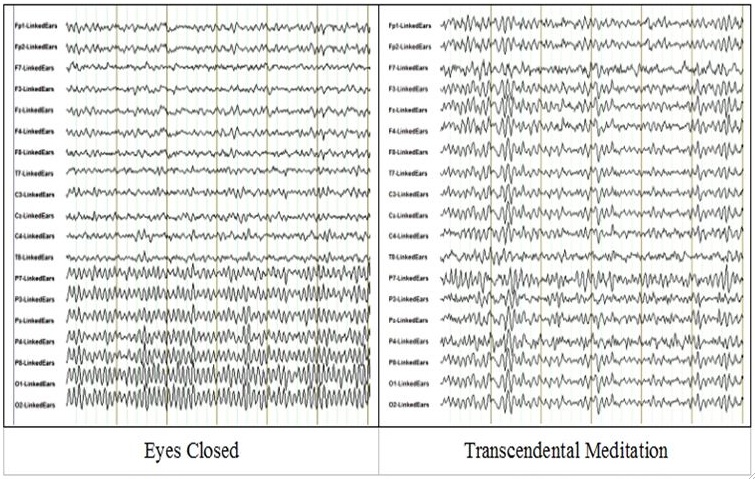
Comparative EEG Tracings

These raw EEG tracings during eyes-closed rest (left) and Transcendental Meditation (right) represent 18 tracings over 6 seconds. The top tracings are from frontal sensors; the middle tracings are from central sensors; the bottom tracings are from parietal and occipital sensors [back]. Note the high-density alpha activity in posterior leads during eyes-closed rest, and the global alpha bursts across all brain areas during Transcendental Meditation practice.

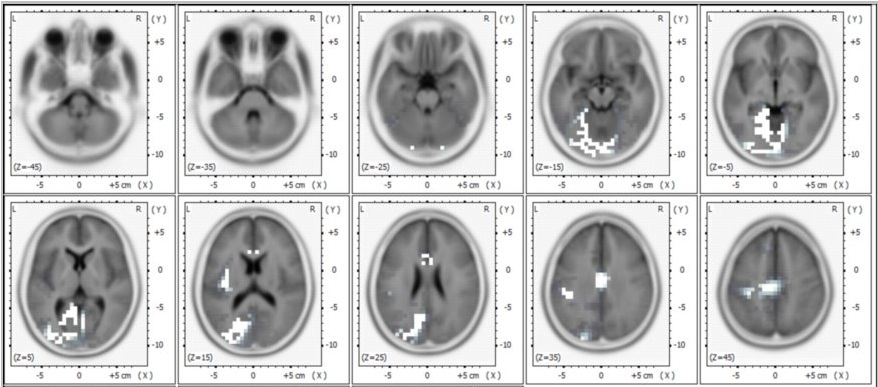
eLORETA Images of Significance Differences

These are eLORETA images of sources of alpha EEG during TM compared to eyes-closed rest in the default mode network (the white areas).

Images credit: Cognitive Processing, Volume 11 (2010), Issue 1

Article title: A self-referential default brain state: patterns of coherence, power, and eLORETA sources during eyes-closed rest and Transcendental Meditation practice, DOI: 10.1007/s10339-009-0343-2. Also on PubMed.

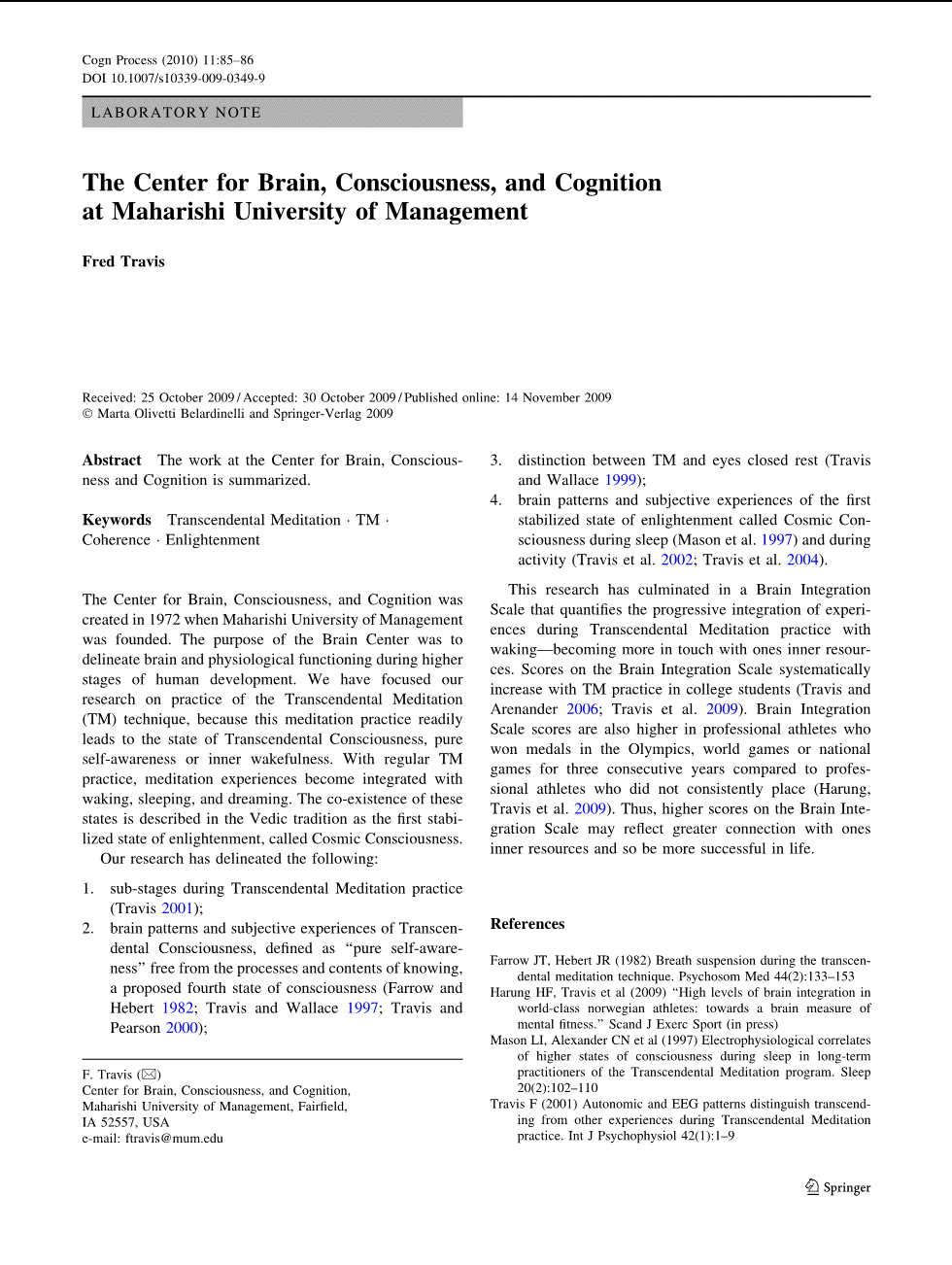
Laboratory Note: The work of the Center for Brain, Consciousness, and Cognition at Maharishi University of Management is summarized and featured in this same issue:

Girls with ADHD more prone to depression, anxiety than boys; meditation helps

February 23, 2010

DAVID LYNCH FOUNDATION
Office of ADHD and Learning Differences
70 Broad Street, New York, NY 10004
Tel: (703) 823-6933 • sgrosswald@tm.org

Girls suffer from delayed ADHD diagnosis, more prone to depression than boys
Meditation helps alleviate stress, reduce symptoms

A growing number of experts say the number of children with ADHD is greater than estimated because girls are often under-diagnosed. There are also differences in symptoms between the genders. “Girls are more likely to have the attentional type of ADHD, which can lead to difficulty in paying attention and focusing, rather than to disruptive behavior, which is more indicative of the behavior of boys with ADHD,” says Sarina J. Grosswald, Ed.D., a George Washington University-trained cognitive learning specialist who heads up the David Lynch Foundation’s education and health outreach to girls. “As a result, the ADHD diagnosis may be missed in as many as 50% to 75% of girls. On average, girls are diagnosed 5 years later than boys. As girls move into adolescence, those with ADHD are more likely to have clinical depression or anxiety disorders.”

A study published in the American Journal of Psychiatry’s online edition of January 15, 2010 followed 187 6- to 18-year-old girls with and without ADHD over an 11-year period. Reporting on this long-term study, Reuters Health pointed out that girls with the disorder were more likely than their peers to develop depression, anxiety, eating disorders, or other psychiatric problems by the time they reached adulthood.

Concerns about ADHD medications

While in some cases a child cannot function without medication, there is growing concern about the health risks and side-effects associated with the common ADHD medications, including mood swings, insomnia, tics, slowed growth, and heart problems.

A new study, the first of its kind, released February 17, 2010 by the Government of Western Australia’s Department of Health, found that “long-term use of drugs such as Ritalin and dexamphetamine may not improve a child’s social and emotional well-being or academic performance.” The chair of the Ministerial Implementation Committee for Attention Deficit Hyperactivity Disorder in Western Australia said in the Department’s press release, “We found that stimulant medication did not significantly improve a child’s level of depression, self perception or social functioning and they were more likely to be performing below their age level at school by a factor of 10.5 times.”

“Medication for ADHD is very effective for some children, but it is marginally or not effective for others. Even for those children who show reduced symptoms with the medication, the improvement is often insufficient or accompanied by troubling side-effects,” said William Stixrud, Ph.D., a Silver Spring, Maryland, clinical neuropsychologist.

Stress interferes with ability to learn

“Virtually everyone finds it difficult to pay attention, organize themselves and get things done when they’re under stress,” explained Stixrud. “Stress interferes with the ability to learn—it shuts down the brain. Prior research shows ADHD children have slower brain development and a reduced ability to cope with stress.” added Stixrud.

The Transcendental Meditation (TM) technique may be an effective and safe non-pharmaceutical aid for treating ADHD, according to a recent study published in the online peer-reviewed journal Current Issues in Education.

The pilot study was conducted in a private K-12 school for children with language-based learning disabilities. Participation was restricted to 10 students, ages 11-14, who had pre-existing diagnoses of ADHD. About half of the students were on medication. The students meditated at school in a group for 10 minutes, morning and afternoon. After three months, researchers found over 50% reduction in stress and anxiety, and reduced ADHD symptoms in the entire group.

Stixrud, co-author on the TM-ADHD study, said, “It stands to reason that the TM technique, which reduces stress and organizes brain function, would reduce ADHD symptoms.”

Meditation improves classroom experience

“The effect was much greater than we expected,” said Sarina Grosswald, lead researcher on the study. “A 50 % reduction in anxiety and depression symptoms is dramatic,” she explained. “This can be especially valuable for girls who are more prone to these types of symptoms. The children also showed improvements in attention, working memory, organization, and behavior regulation. After the in-school meditation routine began, teachers reported they were able to teach more, and students were able to learn more because they were less stressed and anxious.”

Grosswald added, “There is substantial research showing the effectiveness of the TM technique for reducing stress and anxiety, and improving cognitive functioning among the general population. What’s significant about these new findings is that among children who have difficulty with focus and attention, we see the same results. TM doesn’t require concentration, controlling the mind or disciplined focus. The fact that these children are able to do TM, and do it easily, shows us that this technique may be particularly well suited for children with ADHD.”

Parents pleased with results

Andy and Daryl Schoenbach’s daughter was diagnosed with ADHD in second grade. Like most ADHD children she was taking medication. “The medication helped but had mixed results—she still lost focus, had meltdowns, and the medications affected her sleep and appetite,” said Andy, who lives with Daryl in Washington D.C. “She was not performing close to her potential and we didn’t see the situation improving. So at the end of seventh grade when her doctor recommended increasing the medication, we decided it was time to take a different course—stopping the medication and using Transcendental Meditation.”

“The results were quite remarkable,” Daryl said. “The twice daily meditations smoothed things out, gave her perspective, and enabled her to be in greater control of her own life when things started falling apart. It took some time, but it gradually changed the way she handled crises and enabled her to feel confident that she could take on greater challenges—in her own words, ‘climb a mountain.’”

“Everyone noticed the change,” Andy added.

Ongoing research

A soon-to-be-published second study on TM and ADHD shows that after 3 months of practice the TM group demonstrated more efficient brain functioning (as measured by EEG) compared to the control group during a difficult visual-motor task. The TM group also showed improvements in language skills on a cognitive performance test.

Students reported that they felt calmer, less stressed, and better able to concentrate on their schoolwork. They also said they were happier since they started TM.

###

For interviews, contact Dr. Grosswald
Bio available upon request

Sarina J. Grosswald, Ed.D.
Executive Director
Office of ADHD and Learning Differences
David Lynch Foundation
(703) 823-6933
sgrosswald@tm.org
sfschools@tm.org

FACT SHEET

Attention Deficit Hyperactivity Disorder (ADHD)

· The Center for Disease Control reports that nearly 50% of the 4.5 million children (ages 4-17) in the United States diagnosed with ADHD are on ADHD medication—and the majority of those on medication stay on it in adulthood.

· The rate of prescriptions for Attention Deficit Hyperactivity Disorder in the U.S. has increased by a factor of five since 1991—with production of ADHD medicines up 2,000 percent in 9 years.

· The commonly used drugs for ADHD are stimulants (amphetamines). These drugs can cause persistent and negative side-effects, including sleep disturbances, reduced appetite, weight loss, suppressed growth, and mood disorders. The side-effects are frequently treated with additional medications to manage insomnia or mood swings. Almost none of the medications prescribed for insomnia or mood disturbances are approved by the Food and Drug Administration (FDA) for use with children.

· The long-term health effects of ADHD medications are not fully known, but evidence suggests risks of cardiac disorders and sudden death, liver damage and psychiatric events. It has also been found that children on long-term medication have significantly higher rates of delinquency, substance use, and stunted physical growth.

The Transcendental Meditation Technique

· The Transcendental Meditation technique is an effortless technique practiced 10-20 minutes twice a day sitting comfortably with the eyes closed.

· TM is not a religion or philosophy and involves no new beliefs or change in lifestyle.

· Over 350 peer-reviewed research studies on the TM technique confirm a wide range of benefits for mind, body and behavior.
· Several studies have compared the effects of different meditation practices and found that Transcendental Meditation provides deeper relaxation and is more effective at reducing anxiety, depression and hypertension than other forms of meditation and relaxation. In addition, no other meditation practice shows the widespread coherence throughout all areas of the brain that is seen with Transcendental Meditation.

· The Transcendental Meditation technique is taught in the United States by a non-profit, educational organization.

· More information can be obtained by calling 888-LEARN-TM or visiting www.ADHD-TM.org, www.AskTheDoctors.com, or www.TMEducation.org.

###

NB: After posting this article, a new study came out on July 26, 2011: New study shows Transcendental Meditation improves brain functioning in ADHD students: A non-drug approach to enhance students’ ability to learn.

A random-assignment controlled study published today in Mind & Brain, The Journal of Psychiatry (Vol 2, No 1) found improved brain functioning and decreased symptoms of attention-deficit/hyperactivity disorder, ADHD, in students practicing the Transcendental Meditation® (TM) technique. The paper, ADHD, Brain Functioning, and Transcendental Meditation Practice, is the second published study demonstrating TM’s ability to help students with attention-related difficulties.

See TM improves brain function in ADHD students, also reported in the TM Blog: New study finds TM boosts brain functioning and helps students with ADHD.

And this new important related article posted in The Huffington Post on meditation helping kids get off ADHD drugs came out in Jan 6, 2012: ADHD Drug Shortage: Can Meditation Fill the Gap? 

Stories from war: a writing workshop for military veterans

February 9, 2010

Stories from war

By MIKE KILEN • mkilen@dmreg.com • February 8, 2010

A writing workshop for military veterans was a tough sell. Grants were denied and help was hard to come by.

Maybe Emma Rainey’s idea was pie-in-the-sky.

But she had been a military kid who moved every year and didn’t know what was buried inside her war veteran father.

She had discovered writing later in life. The tiny, lithe former dancer enrolled at the University of Iowa and commuted from Fairfield, where she and four daughters moved with her husband from the West Coast so he could engage in Maharishi’s Transcendental Meditation. She lost the child custody battle after their divorce five years ago; it shattered her.

“Writing kept me sane,” Rainey said. “Writing is the space between holding it in and speaking.”

Then 18 months ago, during her commute to her graduate non-fiction writing classes, Rainey heard radio reports from Iraq and Afghanistan, already heartbroken by endless print stories on returning veterans’ struggles.

“One day I read one too many,” she said.

Few were interested in her idea: Writing could help the vets and studies show its positive therapeutic effects. She plowed ahead, anyway, and decided to pay for the free workshop out of her own pocket.

But John Mikelson, an advisor at the University of Iowa Veterans Center, was sold.

“A writing workshop in the city of literature seemed like a no-brainer,” he said. “Most vets have wonderful stories bottled up inside them. But getting them from their head to a pen is difficult.”

He helped get the word out to vets; one whom helped put up a Web site. UI’s Distance Learning Site offered space for the weekend workshop. Teaching assistants and professors offered to help teach writing.

Rainey’s 82-year-old father heard about it and wrote her an e-mail the week before the Jan. 15 Vets Midwestern Writing Workshop.

“Would you be interested in what an old Korean War vet had to say?”

“He tried sending the attachment 10 times before finally sending it snail mail,” Rainey said.

She opened the two-page piece. It was the story of his ship, blasting the coast of Korea and the backfire in turret number one. The siren. The 30 men lying dead. His men.

“He wrote about going back in the room with the body parts everywhere,” Rainey said.

She picked up the telephone to call him. He didn’t want to talk about it. Writing was a gap that was safe.

“Writing is the space between where they can get this out,” she said.

Any lingering doubts that the idea was good were over.

Forty men and women from all over the country, ages 20s to 70s, showed up for the workshop in Iowa City. They had questions and doubts, too. One said he wasn’t up to any “pissing contest” for most horrible story. Another wondered if it was just going to be a group therapy session.

But as they broke up into classes on style and characterization, poetry and point of view, description and dialogue, the weekend unfolded in a unique blend of sharing deep emotions and the art of communicating them well. The time flew by.

Eddie Allen, 64, of Iowa City arrived with no writing experience and little contact with veterans. After ruminating over his own experience for years, he wanted to hear others.

Events long buried surfaced, both big and small. Refusing a drink from his best buddy in Vietnam on the last day he would see him. What the war did to him over the next 38 years.

“I grew up in Oklahoma and went to Sunday school. All the sudden you are a soldier and then a warrior,” he said. “It’s a different mindset and even though you are not a warrior anymore it affects the way you do things for the rest of your life.”

He found poetry there. Writing instructors, counselors and other vets helped.

“It was like liquid love. There were no barriers between ages or professions,” Rainey said. “The most shocking thing to me was how uplifting it was. I thought it would be sad.”

It lifted her spirits to see a Vietnam vet sit for an hour with a published poet, talking words.

In the process, Rainey said, they could unburden themselves from the stories.

“The physical act of writing it down gives them permission,” she said. “Their story takes on its own energy and they can let it go without being bitter or shattered.”

Some moved from writing nothing but a grocery list to writing poems or essays. Given the tools, they could now find the right words.

The hum of the helicopter was still in their heads.

Or the shouting. Army veteran Mary Chavez of Reinbeck remembered the shouting. She grew claustrophobic on an overseas truck convey, which was forced to stop and let her out. Her superior screamed in her face about the danger she could cause.

She remembered the scream back home when her boss at work did the same after she made a mistake. She ran to the supply closet and sat there for hours.

“Writing it down helped detoxify some of the trauma,” Chavez said. “I was able to see it from a different perspective and it weakened the strength of it from my memories.”

Jon Kerstetter of Iowa City was already working on a book.

He was deployed three times to Iraq from 2003 to 2005 as part of a medical battalion with the Iowa National Guard.

He broke his ankle, then dislocated his shoulder. The injuries were worse than he first thought and he had 10 surgeries. One caused a debilitating stroke that required extensive cognitive therapy.

He had to give up his job as an Iowa City physician.

“I’m using writing as one of my vehicles for rehab,” he said.

“The telling of it is not so simple because they are complicated emotions. When you are writing something as tragic as war, you have to get involved. You have to relive the story.”

But it helped him purge. It helped him understand the complexities of combat.

“Soldiers have a predefined task and you keep your eyes on the task,” he said. “When you come away and have time to reflect, you understand how complex it is. You realize you are not all that powerful. It’s a machine that all has to work.”

Rainey had even fewer doubts after the weekend was over.

“Poetry amazed me,” a vet wrote on her workshop evaluation. “My pen writes poetry!”

She hopes to take the workshop to other cities, maybe even now land grants. Distance Learning officials were so impressed they kicked in the $1,500 of expenses for the weekend.

“There is a gap in understanding between vets’ experience and the population,” Rainey said. “That gap needs to be closed. We don’t know if we don’t hear their voices.”

A check arrived in the mail one day to go toward workshop expenses. It was from her father.

“He knew why I was doing it,” she said.

Register reporter MIKE KILEN tells the stories of Iowans across the state. Contact him at mkilen@dmreg.com

JOHN GAPS III / THE REGISTER

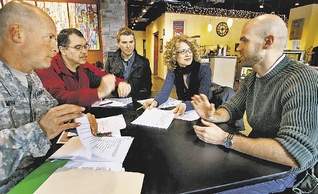
Writing instructor Emma Rainey (top right corner) goes over a paper as she meets with armed services veterans.
Writing instructor Emma Rainey looks to Luke Huisenga as he talks about his poetry with (left to right) Brian Smith, Dr. Jon Kerstetter and Luke Sheperd. She meets with armed services veterans to help them write creatively about their experiences at an Iowa City coffee shop.
Rainey talks with Luke Huisenga (foreground) as Luke Sheperd listens. “Writing is the space between where (vets) can get this out,” she said.

‘This is my aircraft, my office’

Following is a sample of a book worked on during the workshop by Jon Kerstetter, MD, COL, Iowa Army National Guard, retired.

Often, just before sunrise, I used to walk the flight line where the aircraft were waiting just at the edge of the runway, perfectly aligned, standing at attention. The rising sun would paint colors on their shapes. I would smell the JP-8 jet fuel, smell the hints of metallic oil and let my eyes feast on all that is military; on all the sun-colored, olive-drab, gray-green shapes, the dark browns and the dusty whites of military markings. The colors were like flowers in the desert. I could name each aircraft by the pattern of its colors, its faded spots and stains, and by its scattered chips of military CARC (Chemical Agent Resistant Coating) paint. I used to love to watch the morning pre-flights of the crew. Watch the checks and movements about the aircraft. Soldier ants at war. Occasionally, I would walk up and just touch one of the helicopters and let my hand move across the skin, feeling the rivets, the sand-scarred paint, feeling the door handle or the cockpit seams. I would breathe in the morning smells, the aircraft smells, the war smells, and be taken on a sort of mental excursion that drew me close to the familiar and nearer to the battle: the sights and sounds of army aviation, military medicine, rescue, resupply, interdiction, attack and medevac. This ritual would function like a liturgy of sorts, so that when I was finished I felt restored in faith, restored in my role as a soldier and as a flight surgeon. It made me bold to the point that I would lay claim on the aircraft – on the mission. This is my aircraft. No other doc in the entire Army has this aircraft. It belongs to me. It’s my office. It’s where I go to war.

Comments for

Stories from war

kennyji wrote:

Powerful article, Mike, on the cathartic effect of writing. Thank you. Reminds me of something Jesus said in the Gospel of Thomas. “If you bring forth what is inside you, what you bring forth will save you. If you don’t bring forth what is inside you, what you don’t bring forth will destroy you.”

2/9/2010 12:10:18 AM

Fairfield’s Sustainable Living Coalition Builds Green Educational Center

January 22, 2010

Dec 23, 2009 01:39PM

All for intelligent design: Sustainable Living Coalition draws from nature’s wisdom

By Linda Egenes


Submitted
The Sustainable Living Coalition built this 1,200-square-foot straw-bale, post-and-beam barn as a main classroom and administrative space.

It started in 2004 when a few people in Fairfield were looking for a sponsor for an environmental conference.

“We decided to form our own non-profit and called it the Sustainable Living Coalition,” says Diana Krystofiak, a founding board member of the SLC. “The goal was to combine people from different sectors to create a more sustainable Fairfield, which could then become a model for other communities.”

From the start, a driving force behind the SLC’s vision and educational initiatives was Lonnie Gamble, who with permaculture expert Grover Stock, began teaching a ten-week permaculture course called Big Green Summer. Hundreds of interns trained with Gamble and Stock, living in Gamble’s home. But Gamble and his wife, Valerie, couldn’t donate their time, money and home to educate interns indefinitely. A campus was needed.

A permaculture demonstration site

Fast forward to the fall of 2009. It’s a warm November day at the newly inaugurated SLC campus on the north edge of Fairfield. Briggs Shore and Frank Cicela, two administrators, are there.

Shore, a 27-year-old dynamo who trained as an SLC intern and was hired last year as administrative coordinator, is clearly passionate about her job.

“We bought the land in 2006 with a grant from Iowa’s Great Places,” she says.

The purpose of the campus, she explains, is to become a working permaculture farm and educational center with classes and internships.

Shore explains, “permaculture is a way to take the principles of intelligent design, found in nature, and apply it to absolutely everything in your life — how you get your food, water, shelter, heat (and) power, and (how you) dispose of waste.”

Cicela adds, “we want this to be a model, to establish best practices for natural building and rural farming that people can take back to their own communities.”

At age 40, Cicela brings a wealth of experience to the SLC, having established a similar nonprofit called Sustainable Indiana, and shows remarkable dedication by taking an unpaid leave from his job at Clipper Wind Power in Cedar Rapids to spend every other week working for the SLC.

Shore points to the 1,200-square-foot straw-bale, post and beam barn that is the main classroom and administrative space for the campus. “We broke ground in January 2009,” she says.

The building is functional but awaiting funds for plastering the outer walls, covering the gravel floor with flagstone and completing a five-room dormitory loft. It was erected in just four months with the help of an Amish construction crew for the foundation and dozens of volunteers who provided the massive man hours necessary for straw-bale building.

“We’re completely off the grid, and we provide our own power and water,” says Shore. She points to the rain catchment system, ten photovoltaic solar panels and one-kilowatt wind turbine that supply electricity and high-speed Internet. “We’re high-tech while being sustainable, rustic while still being modern.”

A spirit of collaboration

“One of our missions is to partner with other people and organizations,” says Cicela.

Collaboration takes many forms. The campus adjoins and makes use of two other sustainable sites for its workshops: the Abundance Eco Village and the Mullenneaux extended-family acreage, which includes three sustainable cob, straw and clay homes.

“We’re a few off-the-grid communities who happen to be close together and really good friends,” explains Shore.

Other collaborators include Grinnell College and Maharishi University of Management.

A vision for the future

Future projects include building four-season dormitory space to house 50 interns, a hospitality center, an elderhostel, underground cisterns to store drinking water from the rain catchment system, wetland waste management system, permaculture food forest, edible landscaping, and seed money to extend educational offerings.

But ambitious as these plans are, Gamble sees a more visionary goal. “The SLC is a way to foster ecological, micro-enterprises,” he says. As an example, the SLC bought equipment and loaned it to help a local baker get started, and launched the Edible Cityscapes Project, an eco-business that sells fruit trees and provides free labor to plant them properly.

Another project in the works: a micro-enterprise center, to help fund sustainable businesses. And the SLC is providing land and sponsorship to a John Jeavons mini-farm center, one of three in the U.S. to be established this spring.

For more information about the SLC, contact Briggs Shore at briggsshore@gmail.com or visit sustainablelivingcoalition.org.

Linda Egenes is a book author and freelance writer. She lives in Fairfield, Iowa.

Radish magazine is published by Small Newspaper Group and distributed by Moline Dispatch Publishing Co., L.L.C., 1720 5th Ave., Moline, IL 61265

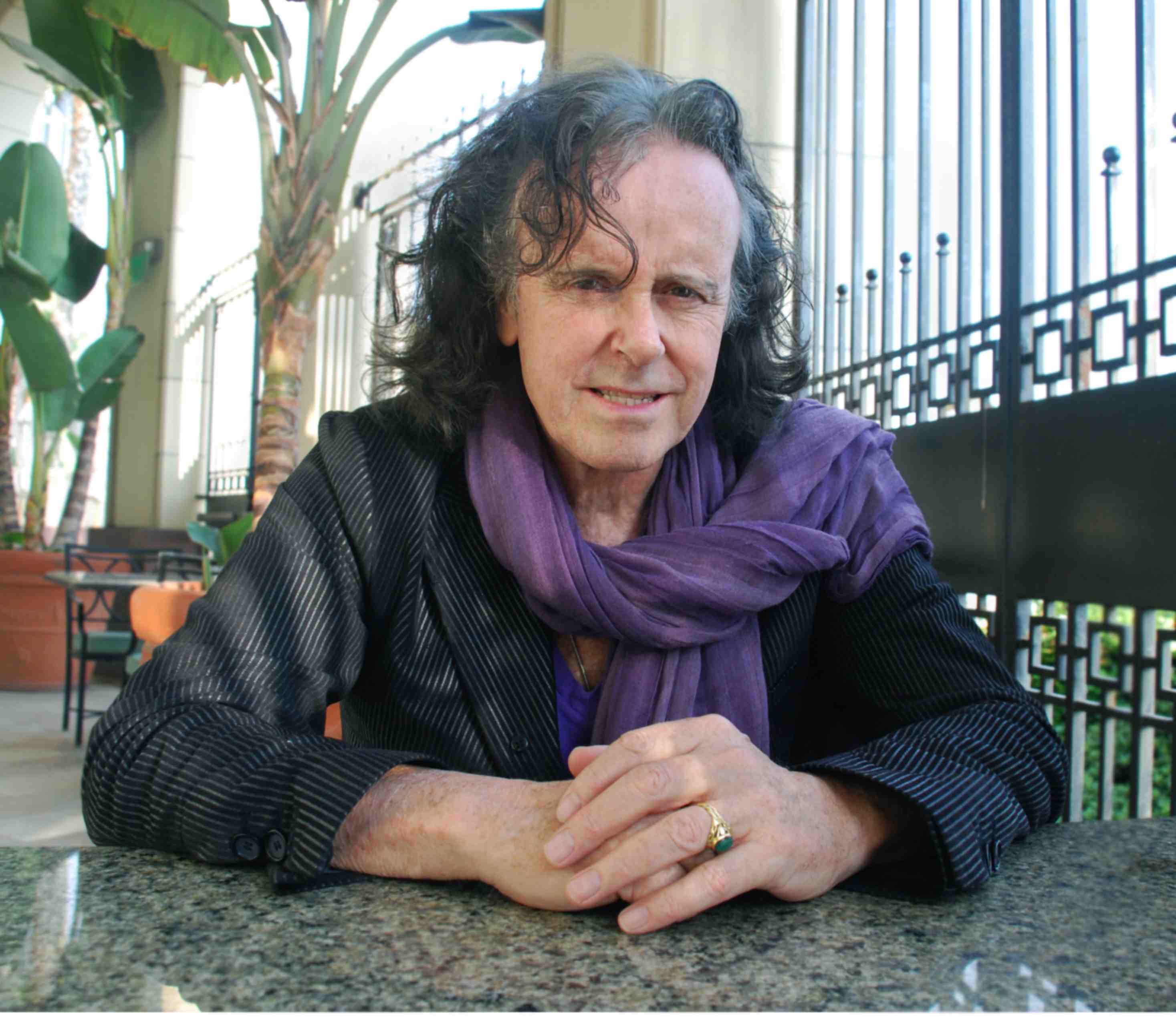
DONOVAN to Perform Free Online Benefit Concert

January 22, 2010

DONOVAN IN CONCERT LIVE ON THE WEB SUNDAY

Donovan will be giving a concert at Munich’s Cuvilliés Theater as the start of his activities on the Social Web; the performance will be streamed live on Donovan.ie

Donovan is inviting fans and the online community to watch his sold-out concert live on the Internet this Sunday. He will perform his hit songs and cult classics as well as showcasing songs from his new work RITUAL GROOVE as a run up to his forthcoming world tour 2010/2011. Special guest will be talented musician Claudia Koreck, one of the hottest newcomers in Germany.

The show will be streamed live Sunday, January 24, at 8:30 p.m. CET worldwide thanks to the professional live streaming technology and video production of TV1.EU, and a true broadband connection by BT, British Telecom. This World Wide Charity Concert is to benefit ‘Schools Without Stress’ (Germany). Also see DLF.TV, and the David Lynch Foundation. http://twitter.com/DAVID_LYNCH

The Link to the Live Stream will be on Donovan’s new Website http://www.donovan.ie/live. News of the free live webcast concert is also on Donovan’s Facebook and Twitter pages. His fans just love the idea of streaming the concert! http://www.facebook.com/DonovanOfficial & http://twitter.com/donovanofficial.

“Donovan fans worldwide now have the opportunity to take part in an extraordinary concert experience directly from their computers at home. While watching the concert Donovan’s Online Friends can share their experience on facebook or twitter”, says Monty C. M. Metzger, CEO of the Social Media Marketing Agency, Ahead of Time. http://twitter.com/montymetzger

This “Social Media for Social Activism” musical event will support the charity project “Schule ohne Stress” (Schools without Stress) and will increase awareness about the positive effects of the Transcendental Meditation (TM) technique on creativity, intelligence, brain functioning and academic performance.

The legendary folk-rock pop troubadour Donovan began his career as an itinerant folk musician and created acoustic hits like Catch The Wind, Colours, Mellow Yellow, and Buffy Saint Marie’s Universal Soldier.  Other megahits include Jennifer Juniper, Sunshine Superman, Hurdy Gurdy Man, Season of the Witch, There is a Mountain, Atlantis, and other beautiful songs, which appeared on later albums, like Sutras, produced by Rick Rubin.

Dr. Donovan Leitch is a Green-Activist and received a Doctor of Letters from the University of Hertfordshire, an honorary medal as “Officer of Arts & Letters” by the French government, and was named BMI Icon in 2009.

Donovan was one of the few artists to collaborate on songs with the Beatles, contributing lyrics and vocals to the song Yellow Submarine. Donovan influenced Paul McCartney, John Lennon, and George Harrison in their guitar styles, and during his career played with folk music greats Pete Seeger, Joan Baez, and Bob Dylan, as well as rock musicians Jimmy Page of Led Zeppelin and Brian Jones of the Rolling Stones.

This is Donovan’s first global World Wide Web performance—a musical historic event. The concert is sold out! Viewers wishing to join Team DONOVAN and make a donation are invited to visit betterplace.org. Donations start from 1 Euro! http://www.betterplace.org/groups/donovan

ABC Nightline News Report on TM, M.U.M., Maharishi Vedic City, and David Lynch in Iowa

January 8, 2010

A positive Iowa news report for your enjoyment and edification. (Postponed again, sorry.) Just aired last night, July 5, 2010. http://bit.ly/cDxWqj


http://abcnews.go.com/Nightline/transcendental-meditation-vedic-city-iowa/story?id=9218475

Transcendental Meditation Thrives in Iowa
Adherents of Transcendental Meditation Have Called Hawkeye State Home Since ’70s
By John Berman and Maggie Burbank
Jan. 8, 2010

When you think of Iowa, you think of cornfields, you think of caucuses, you think of old-fashioned country-living.

Chances are, you don’t think of meditation <http://abcnews.go.com/Entertainment/popup?id=7249295>  and communal living.

Welcome to Maharishi Vedic City, Iowa — the only city in the country built on the tenets of transcendental meditation <http://abcnews.go.com/Health/MindMoodNews/story?id=7263240> , for meditators, by meditators.

Meg and Erik Vigmostad moved here from St. Louis in 1982.

“We wanted to come to a meditating community,” said Meg Vigmostad. “We had two children at the time, one of them was an infant, and we felt like it was the best place to bring up our children <http://abcnews.go.com/Health/MindMoodNews/story?id=7263240> .”

Watch the full story tonight, Jan 8, 2009 on “Nightline” <http://abcnews.go.com/nightline>  at 11:35 p.m. ET

Vigmostad acknowledged that the couple’s families thought they were “crazy” for making the move. Crazy, because those words, “transcendental meditation,” sound, well, different. Many people first heard of transcendental meditation, or TM, in the 1960s, when the Beatles started following Maharishi Mahesh Yogi, the official founder of TM.

“Transcendental meditation is a simple technique practiced for about 15-20 minutes sitting comfortably in a chair with the eyes closed,” said Bob Roth, a national director of the TM program. “It allows the body to get a profound state of rest while the mind just settles down and experiences a state of inner wakefulness, inner calm, inner coherence.”

The followers of Mahesh Yogi — mostly from East and West Coast universities — moved to Iowa en masse in 1974 to set up their own college, the Maharishi University of Management. The group chose Iowa because that is where they could find the land.

Now the settlement features two huge domes, one for men and one for women, with residents streaming in to meditate together twice a day.

But at the university and in the city, the commitment to Vedic principles of natural law and balance, derived from ancient Sanskrit texts, goes far beyond meditation. The community has banned the sale of nonorganic food within its boundaries. And that’s not all.

“The primary characteristics of Vedic architecture, the most obvious one, is that ideally, buildings face east, the direction of the rising sun,” said Jon Lipman, the country’s leading Vedic architect.

‘Greater Happiness’
Lipman says the buildings at the university and most new houses in town are constructed in line with ancient precepts.

“Just like the organs in the human body, there is a right place for different kinds of functions within a building,” Lipman said.

“And so, a kitchen is typically in one location. A living room in a house is typically in another location.”

Every Vedic building has a silent core known as a Bramastan, which is lit by a skylight and is never walked on. Lipman claims miraculous effects.

“The results are that, families find that their lives are improved, that there’s greater family harmony, that there is greater financial success, there’s greater happiness,” said Lipman. “There are many many cases where members of a family had disharmony between them, and it dissolved when they moved into a Vedic home. There are many cases where even such things as chronic diseases were abated by moving into a Vedic home.”

Lipman said “it’s a real challenge” to be poor, unhappy or unhealthy if you live in a Vedic building.

The Vigmostads live in a Vedic house, and seem like happy customers.

“It feels harmonious, it feels orderly, there’s a lot of silence here that was definitely not in our other house that we owned,” said Meg Vigmostad.

The talk of order and inner peace might sound unbelievable. But it is also the work of Vedic City to make it all … believable. Fred Travis, director of a university facility called the Center for Brain Consciousness and Cognition, demonstrated an EEG monitor of neurological electrical activity that he said shows that TM makes the brain more organized.

“What this is measuring is the electrical activity of the brain,” Travis explained as a member of the community hooked up to the machine sat and meditated.

“You see this one going up and down?” Travis said, pointed to a gauge. “Look at the one next to it. It goes up and down in a similar way. This is called coherence. When the similarity of two signatures are very close, it suggests those two parts of the brain are working together.

Neurologist Gary Kaplan, a proponent of TM, said such “coherence” will bring happiness, success — even world peace.

“What we notice is that this electrical activity becomes more harmonious or coherent between left and right hemispheres,” Kaplan said. “There have been studies that have documented that the TM technique, when practiced in large groups, seems to have some effect on society in general, whether it’s in war-torn areas where people are sitting to meditate together, or in high-crime areas that the trends reverse when you have larger groups meditating together.”

David Lynch and TM
It is a lot to digest — but then you don’t really have to. The TM followers insist they are not a cult. They all have normal jobs, for the middle of Iowa, and they are not out to recruit you. They just want you to know the option is there.

Famed filmmaker David Lynch spends a lot of time in Vedic City. He started the David Lynch Foundation, which, in the last four years, has provided scholarships for over 100,000 kids to learn to meditate for free in schools across the country.

“It’s not a religion. It’s not against any religion, it’s not mumbo-jumbo. It truly does transform life,” Lynch told ABC News. “Kids come to school and they meditate together for 15 minutes in the morning. And before they go home they meditate for 15 minutes. A lot of them come from, you know, bad situations, and so this gives them this thing you know, at the beginning and the end of the day, the rest of the time you just watch the violence stop. Watch relationships improve. Watch happiness in the hallways, in the classroom, watch creativity flow more and more, watch that heavy weight that we are living under gently lift away.”

“Nightline” was told there wasn’t enough time to properly learn transcendental meditation on a short trip to Vedic City. But to get a feeling of the Vedic way of life, we did visit the Ayurveda Health Spa in Vedic City — the leading spa of its kind in the country. Ayurveda is a system of health and healing involving food and behavior that originated in India thousands of years ago.

“We take your pulse, we put three fingers on the right hand,” explained Mark Toomey, an Ayurvedic health expert at the spa. “And it’s what I would say is like plugging into the inner intelligence of the body.”

Toomey said he can learn a lot from feeling a person’s pulse. He demonstrated on our correspondent.

“It’s a strong pulse,” Toomey said. “That means that, good expression of intelligence. It’s clear. Your pulse has a little bit of tension there, so maybe you’re working a little too hard, too many deadlines.”

Next up was the Shirodhara treatment.

“So what we’re going to be doing is pouring this oil for about 20 minutes on your forehead, in a continuous stream,” said Toomey. “Your job is just to relax and enjoy.”

And what’s so wrong with that? In Vedic City, they have made that their way of life … in the middle of Iowa.

“We really have all we need here,” said Meg Vigmostad. “You can go to a city anytime. But this is sort of a haven, you know? And it’s a place of comfort, and community.”

Copyright © 2010 ABC News Internet Ventures
——————————————————–

Here are two of my favorite famous relevant quotes on understanding truth and accepting the changes they bring for the better—a paradigm shift.

All truths are easy to understand once they are discovered;
the point is to discover them.
— Galileo Galilei (1564–1642)

All truth passes through three stages.
First, it is ridiculed. Second, it is violently opposed.
Third, it is accepted as being self-evident.
— Arthur Schopenhauer (1788-1860)

The New York Times: Can Meditation Curb Heart Attacks?

November 20, 2009

HEALTH

November 20, 2009, 12:47 pm

Can Meditation Curb Heart Attacks?

By RONI CARYN RABIN

Richard Patterson for The New York Times
Recent research suggests transcendental meditation may be good for the heart.

When Julia Banks was almost 70, she took up transcendental meditation. She had clogged arteries, high blood pressure and too much weight around the middle, and she enrolled in a clinical trial testing the benefits of meditation.

Now Mrs. Banks, 79, of Milwaukee, meditates twice a day, every day, for 20 minutes each time, setting aside what she calls “a little time for myself.”

“You never think you’ve got that time to spare, but you take that time for yourself and you get the relaxation you need,” said Mrs. Banks, who survived a major heart attack and a lengthy hospitalization after coronary artery bypass surgery six years ago.

“You have things on your mind, but you just blot it out and do the meditation, and you find yourself being more graceful in your own life,” she said. “You find out problems you thought you had don’t exist — they were just things you focused on.”

Could the mental relaxation have real physiological benefits? For Mrs. Banks, the study suggests, it may have. She has gotten her blood pressure under control, though she still takes medication for it, and has lost about 75 pounds.

Findings from the study were presented this week at an American Heart Association meeting in Orlando, Fla. They suggest that transcendental meditation may have real therapeutic value for high-risk people, like Mrs. Banks, with established coronary artery disease.

After following about 200 patients for an average of five years, researchers said, the high-risk patients who meditated cut their risk of heart attacks, strokes and deaths from all causes roughly in half compared with a group of similar patients who were given more conventional education about healthy diet and lifestyle.

Among the roughly 100 patients who meditated, there were 20 heart attacks, strokes and deaths; in the comparison group, there were 32. The meditators tended to remain disease-free longer and also reduced their systolic blood pressure by five millimeters of mercury, on average.

“We found reduced blood pressure that was significant – that was probably one important mediator,” said Dr. Robert Schneider, director of the Institute for Natural Medicine and Prevention, a research institute based at the Maharishi University of Management in Fairfield, Iowa, who presented the findings. The study was conducted at the Medical College of Wisconsin in Milwaukee, in collaboration with the institute.

An earlier study of high-risk Milwaukee residents, many of them overweight or obese, also found transcendental meditation, along with conventional medications, could help reduce blood pressure. Most of those in the study had only high-school educations or less, about 40 percent smoked and roughly half had incomes of less than $10,000 a year.

The participants found transcendental meditation easy to learn and practice, Dr. Schneider said.

“Fortunately, it does not require any particular education and doesn’t conflict with lifestyle philosophy or beliefs; it’s a straightforward technique for getting deep rest to the mind and body,” he said, adding that he believes the technique “helps to reset the body’s own self-repair and homeostatic mechanism.”

Dr. Schneider said other benefits of meditation might follow from stress reduction, which could cause changes in the brain that cut stress hormones like cortisol and dampen the inflammatory processes associated with atherosclerosis.

“What is it about stress that causes cardiovascular disease?” said Dr. Theodore Kotchen, associate dean for clinical research at the Medical College of Wisconsin. “Hormones, neural hormones, cortisol, catecholamines — all tend to be elevated in stress. Could they in some way be contributing to cardiovascular disease? Could a reduction in these hormones with meditation be contributing to reduction in disease? We can only speculate.”

Another recent study focusing on transcendental meditation, published in The American Journal of Hypertension, focused on a young healthy population. It found that stressed-out college students improved their mood through T.M., and those at risk for hypertension were able to reduce their blood pressure. Dr. Schneider was also involved in that study, which was carried out at American University in Washington and included 298 students randomly assigned to either a meditation group or a waiting list.

Students who were at risk of hypertension and practiced meditation reduced systolic blood pressure by 6.3 millimeters of mercury and their diastolic pressure by 4 millimeters of mercury on average.