Archive for the ‘Art’ Category

David Lynch on meditation in the NewStatesman: Heaven is a place on earth

November 1, 2013

This week Russell Brand was guest editor of the UK’s NewStatesman, which came out October 24, 2013. He invited David Lynch to contribute an article on meditation. The diagram looks like it may be the same one David drew during an interview with a French journalist in Paris as he was explaining Transcendental Meditation to her. A large part of the article reads like a transcription of that brilliant explanation, which was woven throughout a documentary film made of David’s 16-country tour, Meditation Creativity Peace.

David Lynch on meditation: Heaven is a place on earth

Transcending is the only experience in life that gives total brain coherence. Any other thing we do utilises different small parts of the brain, this small part for painting, another small part for mathematics, that small part for playing the piano.

By David Lynch Published 31 October 2013 14:45
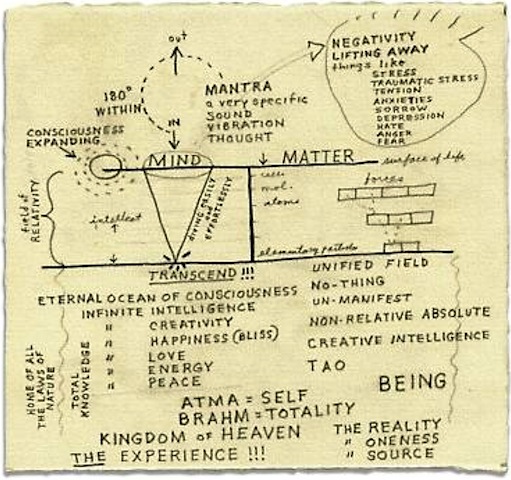
Mind and matter: Lynch’s diagram of Transcendental Meditation. Image: copyright David Lynch

Mind and matter: Lynch’s diagram of Transcendental Meditation.
Image: copyright David Lynch

What is Transcendental Meditation? What is transcending? Where do you go when you transcend? And what good is it to transcend? To help answer these questions, I’ve done a little drawing and you can refer to it from time to time. You will notice a line at the top of the drawing representing the surface of life. We live on the surface and see surfaces everywhere. This right side represents matter and the left side will represent mind. Mind and matter.

About 300 years ago, scientists started wondering: what was matter, what was wood, what was air, what was water, what was flesh, etc? And they started looking into matter and they began to find things – things that we now learn about in school. They found cells and molecules. They went deeper and found atoms; they went deeper and deeper, all the way down to the tiniest particles – the elementary particles.

They found four forces that act upon the particles. And on a deeper level, they found that the four forces became three. Some unification started. And, on a deeper level, the three forces became two. About 35 years ago, modern science, quantum physics, discovered the Unified Field at the base of all matter. This field is the unity of all the particles and all the forces of creation. This is a field of nothing, but the scientists say that out of this nothing emerges everything that is a thing. This Unified Field is unmanifest yet all manifestation comes from this field.

Ancient Vedic science, the science of consciousness, has always known of this field. Believers say that it is an eternal unbounded ocean of consciousness. And this consciousness has qualities. So this Unified Field, this ocean of consciousness, is a field of unbounded intelligence, unbounded creativity, unbounded happiness, unbounded love, energy and peace.

Transcendental Meditation is a mental technique, an ancient form of meditation brought back for this time by Maharishi Mahesh Yogi. It is a technique that allows any human being to dive within, through subtler levels of mind and intellect, and then transcend – that is experience, that ocean of pure consciousness at the base of all mind and matter – to experience this Unified Field within with those all-positive qualities.

In Transcendental Meditation you’re given a mantra. A mantra is a very specific sound vibration – thought. The mantra that Maharishi gives is like a law of nature designed for a specific purpose and that purpose is to turn the awareness 180 degrees from out, out, out to within, within, within. Once pointed within, one will dive easily and effortlessly. It is easy and effortless because the nature of the human mind is always to want to go to fields of greater happiness.

Each deeper level of mind and each deeper level of intellect has more and more happiness – charm, as they say. So the happiness growing is like a magnet that gently pulls us within. And at the border of intellect, one then transcends and experiences the transcendent, the Unified Field, the ocean of pure consciousness, the kingdom of heaven that lies within – the Tao, the home of total knowledge, being or divine being; Atma, meaning the Self, the Self with a capital “S”.

There’s a line we’ve all heard: “Know thyself.” This is the Self they’re talking about. This field is also known as Brahm, meaning totality. First seek the kingdom of heaven that lies within and all else will be added unto you. All else is totality.

Every time a human being transcends, they infuse some of this all-positive consciousness and they truly begin to expand whatever consciousness they had to begin with. There is a side effect to expanding consciousness, and that side effect is that negativity begins to recede. Things like stress, traumatic stress, anxieties, tension, sadness, depression, hate, anger, rage and fear start to lift away very naturally.

The analogy is: negativity is just like darkness. When this light of consciousness begins to truly expand, it is like being in a dark room with a light on a dimmer. As the light gets brighter, the darkness starts to go. And when the light is full on, there is no darkness. Likewise with the light of unity – consciousness – growing, negativity very naturally starts to recede, automatically and without you having to worry about it. This heavy weight of negativity lifting gives such a joyful feeling of freedom to a human being. So you could say the person practising Transcendental Meditation each day is infusing gold and getting rid of garbage.

Transcending is the key word!!! Transcending is truly experiencing that deepest eternal level of life. It is this experience that does everything good for a human being. Every human being has consciousness but not every human being has the same amount. The good news is, every human being has the potential for infinite consciousness. Every time you experience this ocean of consciousness within, you expand more and more consciousness and you are unfolding your full potential as a human being. The full potential of the human being is called enlightenment – infinite consciousness, infinite happiness, total fulfilment. Totality.

Transcending is a holistic experience, meaning that all avenues of life will start improving. The things that used to stress you will still be out there in the world but they will not be able to hit you so hard. You’ll still be able to feel sadness but the sadness won’t last so long. It will lift away more quickly. The same with anger; the anger will leave more quickly. It won’t stay with you and poison you and the environment. Fears begin to lift – you work in more and more freedom. This is a field of infinite creativity. You will see creativity and problem-solving start to expand. Through research, scientists know that IQ can go up because of transcending each day.

Happiness comes more and more and you feel good in your body and enjoy the doing of things more and more. The field within is a field of universal love. This universal love feeds personal love and relationships improve. This field within is a field of infinite energy. People today are so fatigued and here within each of us is an infinite amount of energy to fuel our work and play. There is infinite peace within and that is deep, deep contentment, harmony, coming up inside the human being. It is so beautiful.

Transcendental Meditation is, as I said, easy and effortless. Many people might think that because it is easy it is not as good as other meditation techniques. This is wrong thinking. Concentration forms of meditation, contemplation forms of meditation, will keep a human being hovering on the surface. There will be no transcending. And it is hard work and it is boring and the reward is not there.

Transcendental Meditation as taught by Maharishi Mahesh Yogi is a technique that has been here many times before and it is a blessing. It is the real thing. It works. Brain research scientists have found a wondrous thing. When a human being truly transcends, hooked up to an EEG machine, then the full brain gets engaged in concert. They call this “total brain coherence”.

Transcending is the only experience in life that gives this total brain coherence. Any other thing we do utilises different small parts of the brain, this small part for painting, another small part for mathematics, that small part for playing the piano, and so on. Scientists have always told us before that we use only 5 per cent or 10 per cent of our brain but transcending is an experience that utilises the full brain.

This shows us something of the relationship of the human being to this glorious Unified Field within. The more we transcend, the more this coherence stays with us and this eventually gives rise to higher states of consciousness, culminating with supreme enlightenment. On the EEG machine, Transcendental Meditation meditators are seen to transcend many times in each 20-minute meditation. Those meditators who practise concentration or contemplation forms of meditation do not transcend. They do not get the experience of that ocean of bliss consciousness, the Unified Field.

A ten-year-old child can practise this technique of Transcendental Meditation; a 110-year-old can do it, easily and effortlessly, and they will each get the experience they are yearning for. It is a sublime experience to transcend and feel that rejuvenation and that happiness and all those other all-positive qualities growing.

Transcendental Meditation is not a religion. People from all religions practise this technique and they see there is no conflict with their religion. On the contrary, they say they understand and appreciate their religion more because understanding and appreciation for all things grow by transcending each day. It is a technique for human beings, no matter what walk of life, what religion or where you are from. People who have experienced great suffering have gotten this technique and happily said, “Now I have my life back again.” The real story is: THE NATURE OF LIFE IS BLISS and THE INDIVIDUAL IS COSMIC.

Russell Brand’s article in this paper is about revolution. Revolutions are usually associated with violence or force. Transcendental Meditation leads to a beautiful, peaceful revolution. A change from suffering and negativity to happiness and a life more and more free of any problems. The secret has always been within. We just need a technique that works to get us there to unfold a most beautiful future.

Find out even more about Transcendental Meditation at: davidlynchfoundation.org.uk.

For American readers, visit www.tm.org and davidlynchfoundation.org.

See Russell Brand and David Lynch at LA Premiere of ‘Meditation, Creativity, Peace’ Documentary and related links to other videos and articles. Visit http://meditationcreativitypeace.com to see a preview of the film and where it may be playing.

This is an excellent interview: David Lynch speaks with Alan Colmes about his 16-country tour film Meditation Creativity Peace.

The NewStatesman article reads like a transcription from this film, which you can now see: “Meditation Creativity Peace”—A documentary of David Lynch’s 16-country tour during 2007–2009.

See an earlier article written by David Lynch published in Jane Magazine: Celeb Spiritual Report: One significant day in my life by David Lynch for Jane Magazine (May 2004).

Celeb Spiritual Report: One significant day in my life by David Lynch for Jane Magazine (May 2004)

August 3, 2013

Here is an article I helped facilitate for David Lynch when we first started working with him, a year before the idea for the David Lynch Foundation was created under the dynamic leadership of Bob Roth, executive director for the Foundation. Up to this point David had kept his Transcendental Meditation practice private. When he made the decision to go public and help the TM movement he turned out to be a most unique and brilliant spokesman.

One event was a project to create world peace. We sent out our press release to the media and set up a NY press conference David would attend. Jauretsi Saizarbitoria, the entertainment editor for Jane magazine at the time, emailed back saying she was interested in David’s meditating and suggested he write an article for their special celeb issue on the topic: One significant day in my life. We mentioned it to him and he sent us an article of the day he learned that our human physiology, our body, was made of consciousness, which we forwarded to them. Knowing he was a painter, they also wanted to know what consciousness looked like to David. He sent a jpeg of an image he had created and they included it, giving him a whole page and titling it a Celeb Spiritual Report, with that announcement on the bottom right side of the magazine cover. It was published in their May, 2004 celeb issue. Jane was a popular woman’s magazine, published from 1997-2007. David posted the report on his website with other earlier David Lynch articles and interviews.

Here is David’s love of Maharishi’s Vedic knowledge explained in such a simple conversational tone that’s truly David Lynch. He’s actually a brilliant writer and speaker! They put the text on the bottom right of this photo. Here it is with the text underneath.

Jane – May, 2004
One significant day in my life

By David Lynch

This is a picture that director David Lynch (above) painted to show what consciousness looks like.

This is a picture that director David Lynch (above) painted to show what consciousness looks like.

A significant event occurred in my life the day I learned that our human physiology, our body, is made of consciousness.

Consciousness???

“What???” I asked out loud in wonder.

I learned that our human physiology is so magnificent and complex, and so exquisite in its design and makeup, as to be wondrous beyond imagination. We are spun out of unbounded, infinite, eternal consciousness.

I learned that underlying all matter is a vast, unbounded, infinite and eternal field of consciousness called the Unified Field. I found out that modern science started taking this field seriously about 25 years ago and that all matter is unified at this level in a state of perfect symmetry, or balance. The entire universe emerges from this field in a process called “spontaneous sequential symmetry breaking.”

Are you still with me?

I also learned that there is another science called Vedic Science. This Vedic Science is ancient, and it has always talked of the Unified Field.

Interesting!

Veda, I learned, means “total knowledge.” The home of total knowledge is the Unified Field. It is also the home of all the laws of nature. The branches of Veda, 40 in total, make up the language of the Unified Field, the impulses of this eternal field.

I realized this Unified Field is quite an interesting place. It is not manifest and is full, meaning it is no thing, yet all things in potential. It manifests and permeates all things: the whole universe, everything, while still remaining full and not manifest.

Amazing!

Is this mind-boggling or what?

Now comes the hippest part. I have learned that any human being can “experience” the Unified Field.

Really?

Or: So what?

Why in the world would we care to experience the Unified Field?

First, another question.

Have you ever heard that most of us human beings use only 5 percent of our brain, our mind? Have you ever wondered what in the heck the other 95 percent is all about?

This is the beautiful part coming up.

The “experience” of the Unified Field actually unfolds “enlightenment”—higher states of consciousness culminating in Unity Consciousness, the highest state of consciousness. These higher states use that 95 percent of the brain. That is what the 95 percent is there for—to give us permanent, all-time enlightenment.

Now, what is enlightenment? If you were a lightbulb, let’s say, your “glow” might light up your whole house and surrounding yard. In enlightenment, your “glow” would be unbounded, infinite and eternal. That would be some glow!

Enlightenment is fulfillment. Supreme fulfillment. Unbounded, infinite, eternal bliss, consciousness, intelligence, creativity, harmony, dynamic peace.

Enlightenment, I have learned, is our “full potential.” It is the birthright of every human being to enjoy enlightenment.

Is this good news? I think it is such good news.

In Vedic Science, the Unified Field is called “Atma.” Translated, that is “Self”—the Self of us all.

The Unified Field is not something foreign, or even something far away. It is right within each of us at the base of our mind, the source of thought. A great sage from the Himalayas, Maharishi Mahesh Yogi, brought a beautiful gift to our world in the form of Transcendental Meditation. Transcendental Meditation is an easy and effortless, yet supremely profound, technique that allows any human to dive within and experience that unbounded ocean of pure bliss, pure consciousness. the Unified Field, our Self.

It may be interesting for you to know that millions of people are practicing Transcendental Meditation all around the world. People from all religions, and all walks of life. Over 600 studies have been done in universities and research institutes validating the profound benefits of Maharishi’s Transcendental Meditation Program.

Having this kind of knowledge and technologies of consciousness available to us in this age is, in my mind, a significant event. Yet the “experience” of that Unified Field is the most significant event, because it unfolds what we truly are—totality.

David’s movies include Eraserhead, Dune, Blue Velvet and Mulholland Drive. He is looking forward to Creating World Peace Day, to be held mid-September at the Maharishi University of Management in Fairfield, Iowa (www.mum.edu).

Copyright 2004 Fairchild Publications, Inc.

(more…)

Article on the multi-talented Lanny Shuler: artist, consultant, surfboard designer, and TM instructor

June 9, 2013

What’s going on in that purple building?

You might have noticed Shuler Surfboards before – it’s located in a purple building south of Seaside at milepost 24 on U.S. Highway 101.

Lanny Shuler, owner of Shuler Surfboards, rides the waves of creativity in business and in life

Thursday, June 6, 2013 8:00 am

Article and photos by DWIGHT CASWELL for COAST WEEKEND: ARTS & ENTERTAINMENT: COASTAL LIFE.

I can’t tell you how many times I’ve driven by that purple building just south of Seaside. The sign by the side of U.S. Highway 101 says “Shuler,” and the windows are lined with surfboards. I always wonder, “A surfboard factory in Seaside?”

My curiosity finally got the best of me, and I stopped by. What I found surprised me. Yes, there are surfboards being made here – custom-made, state-of-the-art boards – but there’s a lot more going on. There’s an artist, a materials consultant to Corning and Dow, a creativity consultant to Nike, a Transcendental Meditation (TM) instructor.

From the outside, the building doesn’t seem large enough to house all those people, and it couldn’t if not for the fact that all those people are one: Lanny Shuler, who has been doing all those things on the North Coast since relocating here in 1983.

Shuler grew up in West Long Beach and Huntington Beach, Calif., where he learned to surf at the age of 7 and built his first surfboard 10 years later. “We were water kids,” he says of his childhood friends, “so surfing was a natural thing to pursue, and I was never attracted to organized sports. It was easier to just go surfing, to have fun even if I wasn’t with friends.” Surfing was, at the time, an outsider sport. “This was before the Beach Boys,” he says, “and before ‘Gidget,’” the first surfing movie, made in 1959. “That was the beginning of cultural awareness of surfing,” he continues, “but I was never interested in surfing culture.”

As a young man in 1972, Shuler moved to Astoria to help his father, Don, build a commercial fishing boat, eventually moving back to southern California to make and lose a fortune in real estate. He studied art and architecture in school and began to practice TM, a mantra-based meditation technique that is practiced twice daily for 15 to 20 minutes. Through TM, Shuler found an inner peace and wakefulness, and he left formal education to study under TM founder Maharishi Mahesh Yogi, eventually becoming a certified TM teacher.

In 1983, having discovered that “a simpler life was more to my liking,” he returned to Oregon, just in time to catch the wave of windsurfing tourism in the Columbia Gorge. In addition to his surfboard business in Seaside, Shuler opened Shuler Sailboards in the Gorge and discovered that building both sailboards and surfboards gave him a more diverse outlet for innovation and creativity, as he constantly modified and reinvented his cutting edge board designs.

Shuler’s innovations with resins, fiberglass and foam led to consultancy work with Dow Chemical and Owens Corning. Word of Shuler’s creativity also got around to Nike’s product development team, called the “Innovation Kitchen,” prompting their visit to the purple building for inspiration on long-term maintenance of creativity. Shuler credits TM for his daily charge of inspiration and enthusiasm in new ideas, and his capacity to incorporate them into his career. Since that first meeting he has been invited to the Nike Campus to bolster employee creativity through lectures and TM lessons.

Shuler stresses that “It is a challenge for everyone to have many dimensions and diversities to integrate into one’s life, many demands into one combined fulfilling experience.”

The latest aspect of Shuler’s diversity is his return to art. “My art interests have often fallen aside to other priorities,” says Shuler. “Regardless, whenever I applied artwork on my surfboards, people would take notice.”

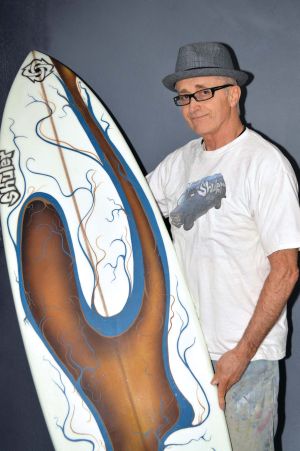
Lanny Shuler with a sample of his surfboard art.As an art student Shuler was uninspired painting on flat surfaces, but his enthusiasm returned when he began painting the sculptural form of his surfboards. “I found inseparability between my color interests and the three dimensionality of the surfboards I was painting on. Without my intending it, my art had become more challenging and engaging.”

Shuler’s “relationship with the aesthetic of the three dimensional form” also resulted in his art becoming more abstract. “It’s much less calculated and more intuitive, and there is a more intimate relationship with the creative silence of my daily meditation, with inner restful alertness and more abstract consciousness.”

Shuler is now working on a gallery show of paintings on what he calls “nonfunctional painted sculptures that can’t be surfed on.” He explains, “My surfboards have always been painted sculptures, but because they were functional, their value was mostly perceived in the terms of sporting equipment rather than higher valued art. That’s changing now.”

Which is not to say that he is abandoning functional surfboards. In fact, he is introducing an entirely new type of board designed to allow novices and experienced surfers alike to more easily develop their surfing skills and have more fun surfing in a variety of conditions.

The new boards and Shuler’s art will soon make an appearance on a redesigned website, www.shulersurfboards.com, and stay tuned for the next dimension of Lanny Shuler’s multifaceted life.

© 2013 Coast Weekend.

House Beautiful: living in a remarkable Maharishi Vastu retirement home on Saltspring Island, BC

April 25, 2013

House Beautiful: The gift of constraint
Grania Litwin / Times Colonist
April 18, 2013

This slideshow requires JavaScript.

It’s the home of Vincent and Maggie Argiro, natives of the States who had heard about the friendly island and decided to build a remarkable retirement home there.

Based on an ancient form of Indian architecture — called Maharishi Sthapatya Veda, or Vastu — the home is designed to increase occupants’ health and happiness.

It certainly feels calming and harmonious the moment you enter through the lotus flower gate, cross a lavender-edged terrace and step into the two-storey glass foyer.

The L-shaped building is reflected in an L-shaped pool, and the entire house is oriented to the cardinal directions. Light floods into every room from east and west, through interior and exterior windows, as well as skylights — perhaps one reason the house is supposed to boost clarity and creative thinking.

“A vastu house is said to be a fortune-creating house too,” said Vincent, who seems pretty creative already.

He is a world leader in three-dimensional, advanced visualization software design. His Vital Images Inc. — now a division of Toshiba Medical — produces medical-imaging software, a diagnostic tool used in hospitals worldwide by radiologists, cardiologists, oncologists and other specialists needing to explore inside the body.

In the couple’s home, everything from orientation and proportion to property slope and relationship to nearby bodies of water is governed by vastu design. By great good fortune, soon after arriving on the island, they found an ideal 3.8-hectare site with panoramic views stretching from Mount Baker to Black Tusk in the Garibaldi Range 132 kilometres away.

Designer Everest Lapp said it was a very demanding project. “Siting the building was difficult, as it had to be within a certain envelope with very particular dimensions. Everything was very detailed and exacting.

“In some cases, we had to move a wall a quarter of an inch. Even the rockwork was redone at one point. I’d never done a fireplace like this before, with a high window in the back. I didn’t even know it was possible.”

There were compensations, though.

“The Argiros* are amazing people with so much depth, and although their expectations were very high and it was super-challenging, creating this house has enriched my career,” Lapp said.

“I sometimes wondered if it would come together, but there is no doubt in my mind that Vincent can do anything he wants. He is very, very bright.”

The 3,800-square-foot home has a feeling unlike anything she has experienced, Lapp said. “There is an energy — something ethereal about it.”

Vincent knew a designer called Everest would be up for the challenge.

“She is a former national mountain-biker and snowboarder and I heard there was no slope she couldn’t go down,” he joked, adding he likes challenges, too.

“I read a book years ago with a quote I’ve always remembered: ‘Constraints are gifts to creative people.’ It’s been my maxim and guiding principle all my life,” said the innovator, who is still an active consultant and mentor to other entrepreneurs — and an electric-vehicle buff who has a Tesla Roadster and a Model S, both of which were the first of their kind in B.C.

“In this architecture, we had to follow the rules exactly, the tolerances were very small, up to 1/16th of an inch,” he explained. “But we could be very creative within them.”

Maggie said their island builder, originally from Switzerland, was very precise, too, and really got on board.

“This house was absolutely the toughest I’ve ever built, and I was up there more than two years,” said Robert Huser.

“A lot of the stuff you just don’t see … all the floor joists, for instance, had to be ripped down. A 2×10 is actually 2×9.5, and we had to make them 2×8-and-three-eighths. But the Argiros are great people and it was cost-plus [pricing].”

The owners used as many local craftspeople and materials as possible, said Maggie, who designed the glass catwalk with Lapp. It’s made of kiln-cast, textured glass fabricated in the Vancouver Glass Studio of Joe Berman on Granville Island. A totem beside the stairs was commissioned from First Nations carver Doug LaFortune, depicting eagles and sea otters.

“There is a great spirit in this house,” said Maggie, noting that during construction, there were many coincidences. Time and again, just when they needed something, it would appear: A container of wood, originally headed for Japan, suddenly became available; a barn full of rare wood was discovered at the 11th hour.

The house has hydronic in-floor heat, a forced-air system used mainly for ventilation, a high-efficiency heat pump for hot water and a backup propane generator.

“We need the generator when the power goes out; it can be out for three or four days up here,” said Vincent, and 80 per cent of the lights are LED, which use 80 per cent less energy than incandescent bulbs.

The eco-friendly home is filled with small details, such as a small deck with outdoor shower off the master bath, and a ladder to a rooftop perch. “It’s my cubbyhole,” Vincent said. “You know the old song Up On The Roof? Well I have that bug. I love sitting up there.”

Hanging on the stairway wall is a massive marble slab from an area of southern France famous for Paleolithic cave paintings. “There are amazing iron deposits near Lascaux and when I saw this piece, I immediately thought: That is nature’s painting and it should not be cut up for countertops.

“It weights 800 pounds and hanging it was the most dangerous, demanding part of this whole building.”

Vincent devised stainless-steel rails for it to sit in and a framework of aircraft aluminum bolted onto a reinforced wall.

Maggie’s favourite haunt is the kitchen she designed.

“For years I worked in a postage-stamp-sized kitchen,” said the former home economist, who worked for Continental Mills, testing and developing recipes. “So this is wonderful.

“My main thing is workflow and efficiency. You come in with groceries, put them in the refrigerator, wash and prep them here, chop here, cook here, choose the dishes here, serve here. It works beautifully,” she said, moving clockwise around the area. Her island includes a baking centre with tin-lined drawers.

The commercial fan above her Wolf range was tricky to install at the large window, but she wanted to enjoy the view and check on her outdoor Italian pizza oven.

Vincent is most proud of the “smart home” technology he programmed himself.

“The house has a whole set of rhythms that adjust the lights and thermostats every day, every season. This nervous system shuts down all non-essential power at night, or when we’re on holiday.

“Almost all the wires go dead. The whole house is de-energized, so radiation of all kinds drops dramatically when we sleep, and the house idles at less than 500 watts.”

Vincent explained they took their time finding a place to retire in their mid-50s and toyed with the idea of building a home in Minneapolis, “but it never felt right. Then we heard about Saltspring, this magical community of talented and special people.”

They love the island and their peaceful new house.

“It’s as if there are no walls, no ceilings,” said Maggie. “You feel that nothing stands between you and nature.”

This demanding Saltspring Island home brings out the best in creative design and artisans. The Argiro home is the 5th video, Saltspring Lotus, in a series called, House Beautiful, published by Debra Brash, April 20, 2013 for timescolonist.com.

© Copyright 2013

At the time of this article Vincent Argiro was a trustee of Maharishi University of Management. Vincent and Maggie Argiro were major donors of M.U.M.’s Argiro Student Center.

Grania Litwin is the daughter of Eileen Learoyd, a columnist at the same newspaper who helped Maharishi establish TM in Canada.

kintsugi: japanese pottery inspires poetry

April 11, 2013

This poem was inspired by a tweet from @RobertYellin The art of making broken pottery more beautiful, kintsugi. pic.twitter.com/Q1ZLWzWQs

I replied @kenchawkin Wow! What a metaphor for turning obstacles into opportunities. Life’s lessons build character.

I thought about it and made it into a haiku, then a tanka, and sent it as another reply to his tweet.

I also thought it was appropriate for a piece of Japanese pottery to have inspired a poem in one of the forms of Japanese poetry. I don’t speak Japanese but am reading kintsukuroi as having five syllables.

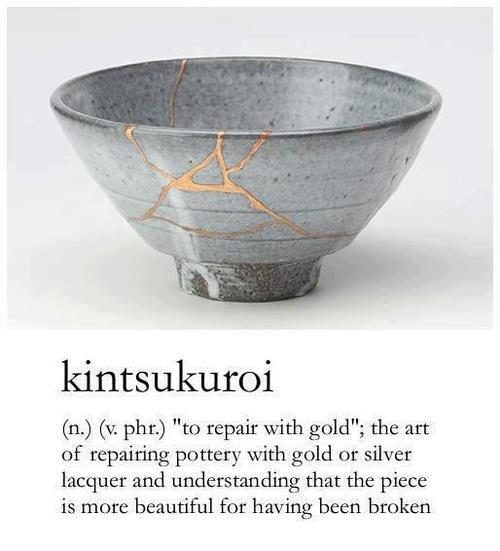
Here is a link to Wikipedia explaining kintsugi or kintsukuroi. Read the explanation under the picture of the piece of pottery, then the poem.

kintsugi

kintsugi tanka

kintsukuroi
turning obstacles into
opportunities

life’s lessons build character
what was broken is now whole

Robert Yellin was featured on this blog before. See Takumi is not ‘lost in translation’ in this beautiful film about Japan’s diverse artisan tradition.

Speaking of cracked things, Leonard Cohen said there’s a crack in everything—how the light gets in. It came thru him & lit up a broken humanity.

Same for this Canadian writer, but from a different perspective: Richard Wagamese bravely entered the cracks in his life to reveal the hidden gold buried within.

Another post on this theme: William Stafford’s poetry lightened his life having woven a parachute out of everything broken.

I later put this related post together: Japanese culture: poetic aesthetics, artistry, and martial arts, inspired me to write haiku and tanka.

Craig Pearson interview and articles on awakened consciousness, transcendence and enlightenment

February 22, 2013

Since the theme of The Uncarved Blog deals with Transcendental Meditation, consciousness & enlightenment, and poetry, I’d like to introduce someone to you who has been studying these ideas in great people’s lives for some time now and has complied them all in a book.

Craig Pearson-EECraig Pearson, Ph.D., is the author of the forthcoming book, The Supreme Awakening, Experiences of Enlightenment Throughout Time — And How We Can Cultivate Them. He has spent many years researching the expression of higher states of consciousness in the writings of great philosophers, saints, scientists, artists, and writers. 

Dr. Pearson is the Executive Vice-President of Maharishi International University in Fairfield, Iowa. He has served the University in a variety of roles over the past 33 years, (42 years, updated 2022) including Dean of Faculty, Dean of Students, Director of Maharishi University of Management Press, Director of Freshman Composition, and Professor of Professional Writing.

In this interview for Issue 5 of Enlightenment Magazine, Linda Egenes asks Craig Pearson about humanity’s age-old quest for enlightenment. Dr. Pearson highlights his answers with examples of exceptional people throughout history who had described experiences of higher states of consciousness. It was originally titled, The Quest for Enlightenment: Transcendence in the Lives of Great Seers and Thinkers. Linda also posted the text of the article on her blog. It was later republished in the newer Enjoy TM News, The Transcendental Meditation magazine: Exploring Higher States of Consciousness, the Ultimate Goal of Meditation. How to cultivate the state of enlightenment

Some of the people mentioned in the article are available in a list of quotes complied on the TM Blog in an Author Archive. Click on each quote and it will take you to an article about each one, and many more.

Enlightenment: What is the relationship of enlightenment and human potential?

Dr. Pearson: Enlightenment is a term that has been used for thousands of years, in traditions east and west, to refer to the most fully developed expression of human potential, far beyond the ordinary.

Enlightenment: How common is it?

Dr. Pearson: Although this extraordinary experience has been described by individuals in different cultures over the millennia and is celebrated in the world’s spiritual traditions, it seems to be exceedingly rare. But obviously it lies within the realm of human potential.

Enlightenment: What has Maharishi contributed to the understanding of enlightenment?

Dr. Pearson: Maharishi Mahesh Yogi is often credited with reintroducing the concept of enlightenment in a systematic manner in our modern age. He has put forward a comprehensive understanding of enlightenment that embraces the great traditions and thinkers who have described this experience across time. Maharishi was also the first to promote scientific investigation into enlightenment, bringing the phenomenon of spiritual development into the arena of modern science.

Enlightenment: How does Maharishi describe enlightenment?

Dr. Pearson: For Maharishi, enlightenment is the ultimate development of one’s inner potential as a human being. It means being established in the highest state of human consciousness.

Enlightenment begins with experiencing the reality of your innermost Self as unbounded and eternal and being established at that level. This means the consciousness of an enlightened person is no longer subject to the ups and downs of emotions, mind, and body but steadfast, anchored in inner silence.

Enlightenment brings the ultimate unfoldment of one’s creativity and intelligence. It means living in harmony with all the laws of nature and easily fulfilling your desires. It means being of maximum use to yourself and others and creating a powerfully nourishing effect in one’s environment.

At the highest stage, enlightenment means experiencing the universe as the expression of your unbounded Self. It is a state of perpetual freedom and bliss, supreme fulfillment.

Enlightenment: Can we relate this in any way to our day-to-day experience?

Dr. Pearson: Although this vision of human development may seem idealistic, we have all had experiences in this direction. Some days we just feel happier inside, more appreciative of others—life is easier, fuller, richer, and more rewarding. We may have moments of enhanced mental clarity or heightened levels of creativity, when we surprise ourselves with how quickly the solution to a problem may come. Athletes sometimes experience the zone—periods of peak performance that are effortless and euphoric.

At these times we are using a bit more of our potential. But enlightenment is far, far more than this. It goes far beyond just having a good day. People who have had experiences of enlightenment report that words simply cannot capture the sublimity of the experience.

Enlightenment: You have researched how individuals from different historical epochs and different parts of the world have shared this same experience. Can you talk about that?

Dr. Pearson: In traditions throughout time we find remarkably similar descriptions of this extraordinary experience of human life lived to its fullest—in the writings of great philosophers, religious figures, artists, scientists, and writers, as well as in the great religious traditions of the world. The terminology may vary from tradition to tradition and age to age. But when you have the clear and precise description of enlightenment provided by Maharishi, it becomes easy to appreciate what these people are talking about.

Enlightenment: So the experience is universal?

Dr. Pearson: Yes. And the recognition that many have shared this experience throughout history is not new either. Some scholars have called it the perennial philosophy or the primordial tradition. The perennial philosophy holds that although various spiritual and philosophical traditions appear different on the surface, at their core all traditions share common, universal principles.

Enlightenment: What are these universal principles?

Dr. Pearson: The perennial philosophy has three basic tenets: (1) Underlying the diversity of the world is a field of unity. (2) We can subjectively experience this field of unity deep within us. (3) The purpose of life is ultimately to experience and live this inner, divine reality of life.

This inner field goes by different names. Laozi called it the Tao. Plato called it the Good, the One, and the Beautiful. Aristotle called it Being. The Greek-Roman philosopher Plotinus called it the Infinite. In Judaism it is called Ein Sof, in Christianity the kingdom of heaven within. In more modern times, Ralph Waldo Emerson called it the Oversoul.

These different names are not referring to mere philosophical or spiritual ideals. They point to the inner reality of life—a reality that can be experienced directly and, when experienced, brings fulfillment beyond words.

Enlightenment: How does Maharishi talk about this inner field?

Dr. Pearson: Maharishi characterizes it as an unbounded field of pure consciousness, an all-pervading ocean of creativity, intelligence, and bliss, beyond space and time. Maharishi asserts, moreover, that this field of pure consciousness is identical with the unified field of natural law that modern physics describes mathematically. Thus the inner field that gives rise to all our thoughts and feelings is the same field that gives rise to the entire universe.

Enlightenment: And we can experience this inner field of pure consciousness?

Dr. Pearson: Every human being has the natural ability to experience this field. It simply requires “diving within,” allowing the mind to settle inward, beyond the thinking process. This is called transcending.

People throughout history have described and celebrated this experience. It is a simple and natural experience—but by most accounts seems to be rare and fleeting. People have lacked a technique for experiencing it systematically. This is the gift Maharishi has given us—the Transcendental Meditation technique, a simple, natural, effortless procedure by which anyone can dive within at will.

Until Maharishi started teaching in the West, the understanding of how to transcend had for the most part been lost. The Transcendental Meditation technique, which has its origin in the ancient Vedic tradition, provides direct experience of pure consciousness. It is easy to learn and practice, validated by hundreds of scientific research studies, and practiced by millions of people throughout the world.

Read the rest of this fascinating article, which includes experiences from Rabindranath Tagore; Alfred, Lord Tennyson; Hakuin Ekaku; and a woman known as Peace Pilgrim.

Many other experiences have also been written up by Dr. Pearson and posted on the TM Blog. Here they are, from recent to earlier posts:

‘Freedom and Self-Realization’: Excerpts from Jack Forem’s book on TM
Howard Thurman: Experiencing “the Great Silence” within us
Rabbi Abraham Isaac Kook: Connecting with the “deep soul”
The Buddha: Rapturous Joy Transcending Any Other
Meister Eckhart: It is in the purest thing that the soul is capable of
D.H. Lawrence: Sitting in a Timeless Stillness
St. John of the Cross: Transcending all knowledge
William Wordsworth: We are laid asleep in body, and become a living soul
Emily Dickinson: The Soul’s Superior instants
Albert Einstein: There is Neither Evolution nor Destiny; Only Being
Zhuangzi: Why don’t you try wandering with me to the Palace of Not-Even-Anything
St. Teresa: A state of great quiet and deep satisfaction
Johannes Brahms: In tune with the Infinite
Rumi: I have passed beyond all thoughts
Plato: And this state of the soul is called wisdom
Jesus: The kingdom of God is within you
Henry David Thoreau: We become like a still lake of purest crystal
Ralph Waldo Emerson: Within man is the soul of the whole; the wise silence; the universal beauty
Walt Whitman: The luminousness of real vision
Alfred, Lord Tennyson: A state of transcendent wonder
Helen Keller: I feel the flame of eternity in my soul
Laozi: His mind becomes as vast and immeasurable as the night sky
 

Update: Craig Pearson’s book, The Supreme Awakening, is now available. Executive Vice President Dr. Craig Pearson was interviewed on KHOE’s “A Chat With The Dean” by Dr. Cathy Gorini on his new book, “The Supreme Awakening – Experiences of Enlightenment Throughout Time, and How You Can Cultivate them.”

Listen to a presentation Dr. Pearson gave in Dalby Hall on the book, which was recorded for broadcast by KHOE.

Listen to Dr. Pearson on KRUU FM, Writers’ Voices recorded Feb 21, 2014.

Listen to Craig Pearson on KRUU FM show, Writers’ Voices, discussing his new book, The Supreme Awakening.

Here is a video of Dr. Pearson’s recent presentation on his book, The Supreme Awakening, in Dalby Hall on the MUM campus seen on the MaharishiUniversity channel.

Craig Pearson has since updated his book with new entries. Here is an informative interview by Jeanne Ball, April 20, 2016, in the Huffington Post: The Supreme Awakening: What Did Buddha, Emerson, Einstein and Saint Teresa Have in Common?

Guest blogger and author William T. Hathaway reviews Craig Pearson’s book, The Supreme Awakening.

Other talks on this topic by Craig Pearson are available in this MIU Webinar at Dalby Hall published in Enjoy TM News and this interview on TM Talks.

Mar 4, 2024: Simplest State‘s Ron Decter interviewed Craig Pearson, Author: “The Supreme Awakening: Experiences of Enlightenment Throughout Time”.

Canadian artist Greg Thatcher goes to Painswick every summer to paint its famous yew trees

August 23, 2012

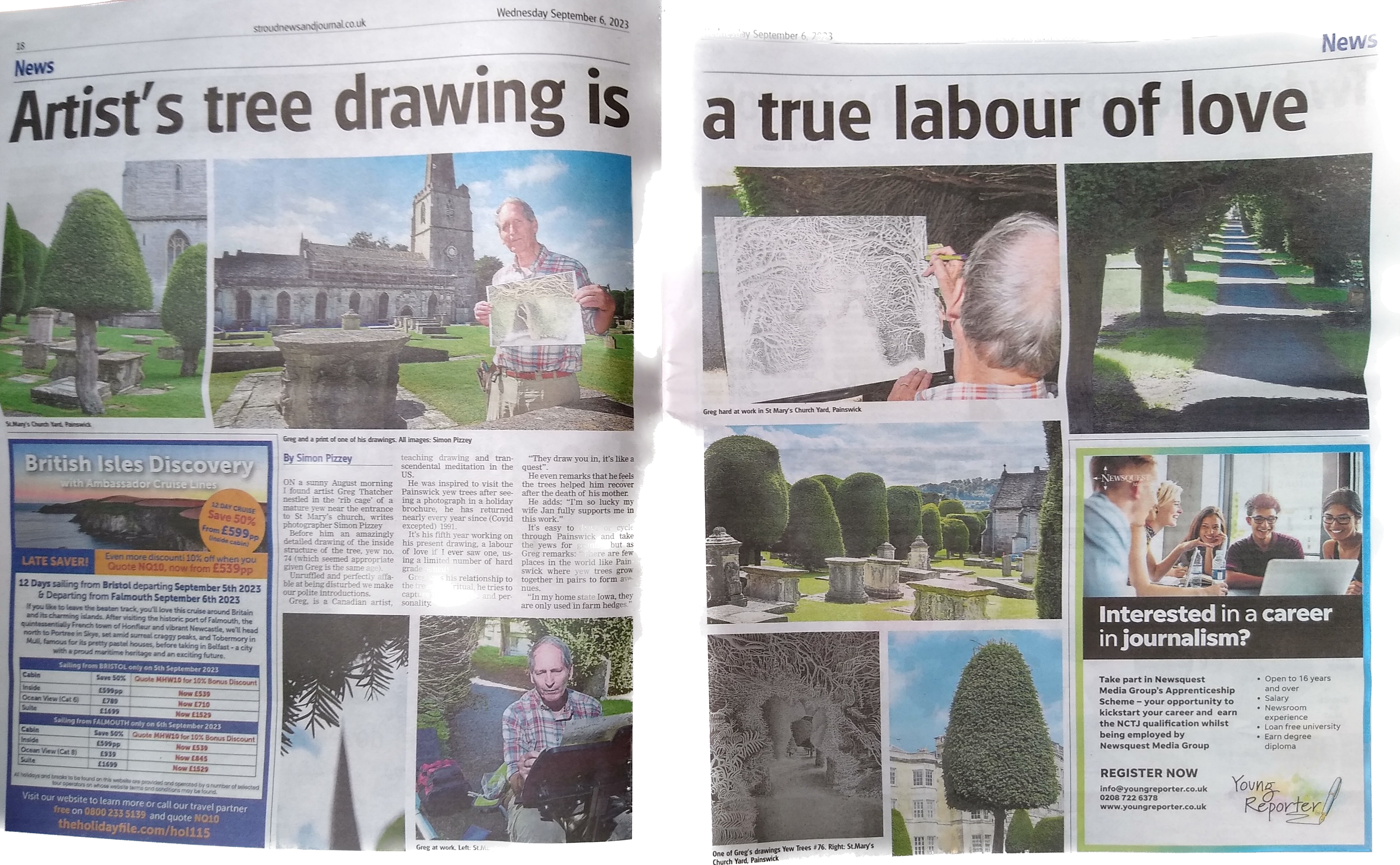
Stroud News and Journal, 4:00pm Tuesday 7th August 2012 in News Canadian artist travels to Painswick every year to paint its famous yew trees by Hayley Mortimer, Reporter. Includes a galley of 5 photos.

A CANADIAN artist has travelled to Painswick to paint its famous yew trees.

Greg Thatcher, 63, who lives in Iowa, has been painting the trees at St Mary’s Church for more than 20 years and works on location from June to August every year.

The yew trees were planted in the Middle Ages and Mr Thatcher says they form the most beautiful yew tree avenues in the world.

He first saw them in a travel brochure while working in Lancashire in 1991.

At first, he worked from photographs but after visiting the churchyard he was inspired by the different shapes and intricate details.

Mr Thatcher said: “I have been drawn to them. I just keep seeing deeper and deeper levels of where I can start. It is an ongoing relationship.

“The process is very stimulating and nourishing to my creativity and imagination.

“Even after 20 years I am still finding more angles and more information to work with.

“I love Painswick and enjoy coming back each year. My trips have been pivotal to my career. It has given me access to a unique and inspiring landscape.”

Mr Thatcher spends between six and eight hours a day working on the drawings and many take more than 350 hours to complete.

He and his wife stay a mile away from the churchyard so Mr Thatcher can cycle to and from the site every day.

Mr Thatcher teaches art and art history to children aged 13 to 17 in a small school in Iowa.

He has a bachelor of fine art from the University of Victoria and a masters in painting and drawing from the University of Saskatchewan.

A series of drawings of the yew trees has been exhibited in the United States, Canada, England and France and his work hangs in corporate and private collections across the world.

For more information go to www.gregthatchergallery.com.

You can see photos of Greg, the trees, and his drawings in the online article bit.ly/Rg2k25, and in a pdf of Inspiration found under the boughs.

###

Later Additions

Canadian artist returns to Painswick.

Artist inspired by Painswick yew trees will share his skills at class.

February 25, 2020: Iowa Public Radio News: New Exhibit Explores The “Sacred” Beauty Of Yew Trees. On this edition of Talk of Iowa, host Charity Nebbe is joined by Fairfield-based artist Greg Thatcher, who has been making art inspired by yew trees for more than 30 years. Thatcher talks about his “Sacred Yew” exhibit at the Greater Des Moines Botanical Garden and his multi-decade relationship with a single grove of yew trees in a small English town. (Listen: 17 minutes)

August 20, 2023: Artist’s labour of love records Painswick’s yew trees by Simon Pizzey for Stroud News. See a layout of the article.

Takumi is not ‘lost in translation’ in this beautiful film about Japan’s diverse artisan tradition

March 8, 2012

Takumi: Japan’s Artisan Tradition

I think you’ll find this beautiful video both informative and fascinating. It’s a documentary about traditional Japanese artisans hosted by Robert Yellin, an American living in Japan who’s become a ceramics expert.

Some of you may know Steven Yellin. Robert happens to be one of his brothers. And you probably remember hearing their father, Jerry Yellin, talk about his WW II experiences as a young fighter pilot who, years later, would make peace with his enemy after one of his sons, Robert, had gone to Japan for a year and ended up marrying a Japanese girl, whose father had also been in the war. See Jerry Yellin: Healing the Hidden Wounds of War and Jerry Yellin discusses Operation Warrior Wellness.

Robert Yellin has been living in Japan since 1984. He fell in love with the art of Japan, especially Bizen pottery, and the concept of Wabi-sabi, the aesthetic of things in life being imperfect, impermanent, and incomplete, yet each with their own unique natural beauty captured in a work of art. His passion and broad knowledge of Japanese pottery led him from collector, to columnist and author, to ceramics art gallery owner.

The Robert Yellin Yakimono Gallery offers some of the finest works available in Japan online at JapanesePottery.com or at his gallery located near the Silver Pavilion (Ginkakuji) in a magnificent old Sukiya-style home in Kyoto. You can read some of his articles on Japanese pottery in various magazines, including a ceramics column in The Japan Times.

Robert also authored a beautiful book about sake utensils that was later translated into English as Ode to Japanese Pottery. Read the rave reviews listed on his sister website from the Clay Times and Ceramics Today, and check out his Japanese Pottery Blog.

When Steve Jobs came to Japan and wanted to learn about Japanese pottery, he asked for Robert Yellin to be his guide. With this video, Robert inspires thousands of viewers about Japan’s cultural treasures.

This slideshow requires JavaScript.

Takumi: Japan’s Artisan Tradition is one of five short episodes in a series called Japan: Fascinating Diversity. Five presenters—well-known foreign specialists with extensive knowledge and insight on Japan—guide viewers to intriguing destinations, introducing them to Japan’s fascinating culture and heritage along the way.

They also take viewers to the Tohoku region of northeastern Japan, which was devastated by the Great East Japan Earthquake and Tsunami of March 11, 2011. The people of Japan are continuing their tireless reconstruction efforts, which shows every sign of recovery. The film’s goal is to help viewers around the globe rediscover the appeal of Japan.

In this episode of the series, Robert explores the diverse forms of Takumi with veteran artisans, savoring samples of Japan’s pottery, indigo dyeing and lacquer ware traditions. His tour also includes a visit to a museum, a tea house, and ends in a Ryokan, a traditional Japanese inn.

For an American, Robert knows a lot about Japanese culture. He even speaks and moves like a native; his intonations and mannerisms are Japanese—refined and respectful.

With his expertise in Japanese ceramics, Robert acts as a cultural ambassador, helping to give a boost to Japanese tourism for the Ministry of Foreign Affairs by inspiring people from all over the world to visit.

I truly enjoyed watching this beautiful short documentary film. I think you will too. Robert sums it up nicely when he says, “It’s been an amazing journey. Every place we visited there’s been something new to learn. It’s been a joy to see how people still create handmade beauty in different regions. All the beauty in Japan—it’s all based on this spirit of craftsman, or Takumi. And that really is the foundation—what Japan has to offer the world.”

Click the title to see this beautiful video (17:48) on the MOFA YouTube channel. Japan: Fascinating Diversity (Takumi: Japan’s Artisan Tradition) © 2012 Ministry of Foreign Affairs of Japan

Related post: kintsugi: japanese pottery inspires poetry

This interview was streamed live on Aug 11, 2020: Deep-Dive Into Appeal of Japanese Pottery with Robert Yellin. Also join Robert on an online tour he gave for Kyoto Journal of Japanese ceramic art in Kyoto at the Robert Yellin Yakimono Gallery. Follow him on Instagram @ry_yakimono_gallery_kyoto. More listed on https://linktr.ee/ryygkyoto.

Watch the trailer for a new documentary film on David Lynch titled “Meditation Creativity Peace”

February 9, 2012

“Meditation Creativity Peace”

“Meditation Creativity Peace” is David Lynch Foundation Television’s compelling new documentary film featuring exclusive, candid footage from David Lynch’s 16-country tour around the world when he spoke to government leaders, film students, and the press during 2007 and 2008. David’s unique, free-styling demeanor grabs your attention from the very beginning of the film. David has also selected deeply insightful quotes from great thinkers and revered texts throughout history, which reveal how the practice of meditation, developing creativity, and enjoying true inner peace are the birthright of everyone. As David says in the documentary, “Transcendental Meditation is for human beings—it doesn’t matter where you live.” Watch the trailer for this new documentary film here: Meditation Creativity Peace.*

About the David Lynch Foundation

The David Lynch Foundation, a 501(c)(3) organization, was established in 2005 to fund the implementation of scientifically proven stress-reducing modalities including Transcendental Meditation, for at-risk populations such as underserved inner-city students; veterans with PTSD and their families; American Indians suffering from diabetes, cardiovascular disease, and high suicide rates; homeless men participating in reentry programs striving to overcome addictions; and incarcerated juveniles and adults. The Foundation also funds university and medical school research to assess the effects of the program on academic performance, ADHD and other learning disorders, anxiety, depression, substance abuse, cardiovascular disease, post-traumatic stress disorder, and diabetes.

Related Websites and Posts

David Lynch Foundation http://www.davidlynchfoundation.org
Operation Warrior Wellness http://www.operationwarriorwellness.org
David Lynch Foundation Music http://davidlynchfoundationmusic.org
David Lynch Foundation Television http://dlf.tv
Transcendental Meditation http://www.tm.org
Click here for DLF Featured Past Events

Announcements and Reviews: Julie Eagleton: Meditation Creativity Peace: A Documentary of David Lynch’s 16 Country Tour | BlackBook: David Lynch’s Transcendental Meditation Documentary Gets a New York Premiere | New York Times: David Lynch Double Bill | Gothamist: David Lynchian Events Happening All Over NYC This Weekend | Yelp: An Evening with the Work of David Lynch, from Transcendental Meditation to Eraserhead

Related articles: HUFFPOST: David Lynch: Why I Meditate | Meditation for Students: Results of the David Lynch Foundation’s Quiet Time/TM Program in San Francisco Schools | Replay of David Lynch Foundation Launch of Operation Warrior Wellness Los Angeles | Third Annual David Lynch Foundation Benefit Gala | David Lynch gives $1M to teach vets meditation | David Lynch donates $1 million in grants through his foundation to teach veterans to meditateRussell Brand Does Stand-Up for Transcendental Meditation | What do Stephen Collins, Ellen DeGeneres, Russell Brand, Russell Simmons, David Lynch and Oprah have in common?

New related posts: Russell Brand and David Lynch at LA Premiere of ‘Meditation, Creativity, Peace’ Documentary, and David Lynch, Russell Brand, Bob Roth Q&A after screening Meditation, Creativity, Peace documentary at Hammer Museum. Enlightenment, The TM Magazine, reported on the LA Premiere: Meditation Creativity Peace: How the David Lynch Foundation Brings Change from Within. David Lynch speaks with Alan Colmes about his 16-country tour film Meditation Creativity Peace.

*Visit the new website, Meditation Creativity Peace, for a list of upcoming and previous screenings. You can also ask your local TM Center if they have a copy and plan to show it. http://meditationcreativitypeace.com

You can now see the film “Meditation Creativity Peace”—A documentary of David Lynch’s 16-country tour during 2007–2009.

ArtWords—poem about a creative awakening

January 7, 2012

Ever tried painting? I mean the creative kind, not just painting the walls of your apartment. During my last year (1998), living in Vancouver, BC, Canada, one of my friends gave me the gift of an art class with Anita Nairne, an intuitive artist and teacher. She had been studying with Anita and I was impressed with the transformation in her artwork. At the time Anita was promoting her classes as Paint with your Angels. I found her website and she now calls her Intuitive Painting workshops & classes Creative Awakening.

Painting From The Inside Out

Anita is like a midwife to your artistic instincts. It was an unforgettable experience. She gave me a large white gessoed piece of thick art paper stock, brushes, and acrylic paints, and told me to just cover it with paint, anyway I liked. Without realizing what was happening, I found myself freely, intuitively brushing blotches of paint all over the paper. I was having fun. At one point she took the paper and put it up on the wall under lights and asked me what I saw. She would outline those shapes with chalk, or erase them, depending on what I thought was there. Much to my surprise, the edges of those blotches looked like facial profiles. She returned the artwork and showed me how to accentuate and bring out the faces. At one point, I realized I was ‘painting’ a sort of visual biography of my life, ‘recognizing’ some of the people I had loved, and who had loved me, or at least attempts at loving.

Feelings Not Thoughts

During this process my active thinking mind was not involved—a rare occurrence for someone who’s used to working with words all the time to express himself. I was now creating from a deeper, quieter, more intuitive place within me. I was painting from my heart. I was painting feelings, and they were telling me something! That realization blew my mind. Automatically the words started to form in my mind to describe what had just happened. Below is a poem from that experience.

ArtWords

The artwork informs
The canvas reveals
The mind then knows
What the heart feels

The faces in the painting
The pictures of my life
Where love was a saviour
Where love caused much strife

This process uncovers
Those parts of our lives
To show us the truth
To make us more wise

It’s possible to know
It’s possible to forgive
I’ll never forget you
As long as I live

© Ken Chawkin

I returned for two more classes. I was taking a new direction in my life and was getting ready to leave town in a few months to join the Purusha group in North Carolina. During my last class, I guess that sense of impending movement and transformation, the anticipated travel and making a new beginning, was trying to express itself on paper. I ended up painting a brightly colored phoenix bird at the top, flying eastward. Prophetic!

Here is a related poem featured in a film about verbal vs visual creativity: A poem in a movie inviting you to be who you are.