Posts Tagged ‘Transcendental Meditation’

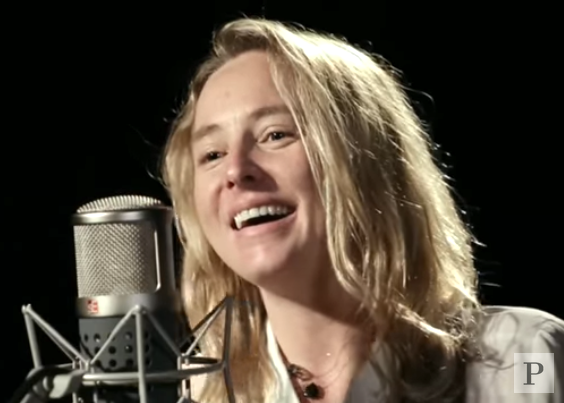
Lissie @lissiemusic and her connections to Twin Peaks, Fairfield and #TranscendentalMeditation

May 11, 2019
Lissie at Paste Studio NYC live from The Manhattan Center
Streamed live on Feb 28, 2018

I heard an interview this week (May 8, 2019) on Iowa Public Radio’s Talk of Iowa with Charity Nebbe. She spoke with singer/songwriter Lissie. During the conversation her connections to Twin Peaks, Fairfield and TM came up. Listen to Singer Lissie On Ditching The West Coast For Life On An Iowa Farm.

I had never heard of her and was impressed with her powerful voice and candid nature. She can sometimes sound like Stevie Nicks or Adele. Listen to this Fleetwood Mac cover of Dreams and you’ll understand why.

Around 9 minutes in she talks about a peace she found in Mt. Pleasant at her great-grandmother’s funeral. She carried it with her to California and always came back to visit family. Then she says, “I went to Fairfield and took a TM course, Transcendental Meditation.” We checked and verified that Lissie had learned TM in June 2014.

Lissie says the same thing in a video with this Des Moines Register article from Aug. 15, 2017: An Iowa musician was featured on one of this summer’s favorite TV shows. They’re referring to Twin Peaks.

They embed the video from Oct. 11, 2016: Folk musician Lissie escapes back home to Midwest. After leaving the Quad Cities area for the fast-paced lifestyle in Los Angeles, Folk-style musician Lissie discovered an Iowa farm was better for her soul than the fast lanes of Southern California.
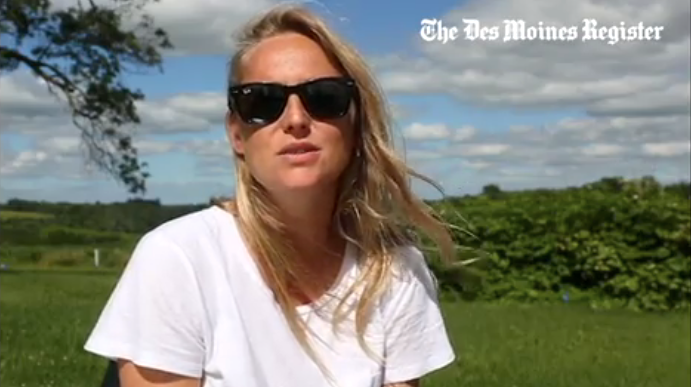
I’ve been to Fairfield to learn Transcendental Meditation.

Lissie says: “I spent my time growing up in Iowa. I had this kind of romanticized dream or idea that some day I’ll have a farm in Iowa. I visited the Bridges of Madison County. My mom and I took a road trip and we went to John Wayne’s house. You know, like I’ve done some things in Iowa. I’ve been to Fairfield to learn Transcendental Meditation. And I’ve just always had this soft spot for Iowa.”

Lissie identifies as a Midwesterner from the Heartland and says how much she loves Iowa, describing all the reasons why. It’s where her heart belongs. Looks like she found her roots and is at peace with herself.

I mentioned this to Erin Skipper (The Light That Seeks You). She said, “David Lynch is a fan and had her be a Roadhouse performer on Twin Peaks.”

Dean Hurley, the show’s music director, and a collaborator since 2005, said she “is an incredibly emotive performer who completely embodies her music and gives everything. Lissie was definitely one of the acts that David wanted involved from the beginning. He’s been a big fan of hers for years and discovered her by a series of videos she posted on YouTube covering Lady Gaga, Metallica, etc.” (See others including Bonnie Raitt and Bob Dylan.)

In that interview, The Music of Twin Peaks: The Return: Lissie, Dean further explains what David looks for in a musical performance when realizing his ideas for the series. He blends intense music, emotion and acting, so the power of Lissie’s music fulfills that for him.

He said “David doesn’t attend a lot of concerts, but when she came through LA years back, he wanted to go. I can’t emphasize how rare that is for him to want to go out to a show.”

He added, “An artist like Lissie thrives in the live performance arena, she’s one of these people that almost can’t be contained on a recording because she’s the fullest realization of herself live.”

Lissie was invited to sing a certain song to close out Part 14 of Season 3, but she suggested Wild West instead, which turned out to be a better fit. You can hear it on “Twin Peaks – Music From The Limited Event Series” – Track 15, Lissie – Wild West (Roadhouse Mix). Here is the Official Audio version from her new album Wild West. She posted it on her YouTube channel: Lissie – Wild West (Twin Peaks version). She posted a clip from the show on her Instagram: Lissie – Wild West – Twin Peaks: The Return.

See the Update below where Lissie explains how she and David connected, how she learned TM in Fairfield, Iowa, then went to have coffee and talk with him in LA, and ultimately received an email from him asking her if she wanted to be part of the new Twin Peaks.

I enjoyed this short video profile on iHeartRadio: Lissie – Artist Stories – Interview (2016) – Part 1 and Part 2. It starts with her intention: “I would like to be successful with my music, but it’s about more than that, it’s about, like figuring out what my purpose for being on this planet is.”

This is an interesting description from that interview: With a career that has seen her open for renowned artist Lenny Kravitz an early supporter, Tom Petty, and even been asked to perform at Ashton Kutcher and Demi Moore’s wedding, Lissie has had a wealth of incredible experiences that have made her the confident and determined artist she is today.

This is also worth watching: Lissie On Staying True To Herself At The Patch. From Cali to Iowa: Lissie keeps it Lissie. Join her at The Patch as she performs “Ojai” and “Don’t You Give Up On Me” and talks about giving in to her ambitions, not giving them up.

Verse 2 of Ojai is pure poetry; so succinct yet says so much!

I miss the seasons, I miss the land
I miss them for reasons I don’t understand
I took it all for granted
I bloomed where I was planted

She sums up her approach: “You know, I’m not trying to do anything. I’m not trying to be cool. I’m not trying to ever have a fresh sound or a cool look for an image. I’m just singing songs about my life in the most heartfelt genuine way I can, and I’m gonna be moving on to more songs very soon. And it’s as simple as that.”

I wonder if some of these developments may have come about after she learned TM? Lissie had the courage to trust and act on her inner yearnings and is happier for it. She followed her heart and is now living her life on her own terms.

Lissie has a new album out: When I’m Alone: The Piano Retrospective: https://lissie.lnk.to/WIATW. Here’s the title song with lyrics.

Lissie – When I’m Alone (Piano Version) [Lyric Video]

Here are 3 examples of the first song on the album—Don’t You Give Up On Me—the official video with her band, a live version with her guitarist in the studios of 89.3 The Current, and on this new album as a Piano Version. Listen to her on Spotify, YouTube and VEVO.

It’d be nice if she decided to visit and play Fairfield one day. Some of us are reaching out to her. She’s on tour, so we’ll see if anything happens.

Update: Now that I’ve been finding and listening to more of her performances and interviews on YouTube, I noticed Lissie mentions again her learning TM in Fairfield, in last year’s BUILD interview, and also says it’s where Maharishi University is located in Iowa.

Further into the interview she’s asked how she got into Twin Peaks, and extends what Dean Hurley had mentioned about David Lynch going to see her in concert. “We ultimately ended up talking on the phone and he came to my show. He’s really into TM, so after I had been in Iowa to take this TM course, I had reached out, and ended up joining him at his home and drinking coffee and catching up on life. And so we just stayed in touch over the years and he’s just been very supportive and kind to me. So I think it was 2015, I got an email, ‘Hey would you want to be on the new Twin Peaks?’ So of course, like yes, that’s amazing, like this legendary status. Ya, he wanted me to be a part of it, and I performed in episode (14) for Twin Peaks!”

Further Update: A little over 7 months later I would finally get to hear Lissie perform in person. A strong supporter of Bernie Sanders, Lissie had posted on her Instagram that she was going to open for him at the Steamboat Senior Center in Burlington, Iowa on Saturday night, and then at the Bridge View Center in Ottumwa the following night, Sunday, December 15, 2019.

I drove with a friend to the Ottumwa event. We sat up close to a makeshift stage in the lobby area surrounded by rows of chairs. When she sang, I felt my head tingling! Wish fulfilled. After she left the stage, I introduced myself, that I was from Fairfield, Maharishi University, mentioned her TM teacher, her meeting David Lynch, what he thought of her as an artist, and that I felt the same way.

I asked her what it was like when David invited her to perform in Twin Peaks, The Return. She was driving at the time and had to pull over to the side of the road to read his message. What an unexpected surprise!

Lissie said David’s friendship and support did a lot for her self-esteem. David’s like that. He recognizes talent when he sees it. He’s given several unknown artists a chance to shine, drawing out their best performances that would launch their careers. Naomi Watts comes to mind.

Of course in Lissie’s case, she was already a fully formed exciting artist, as Dean Hurley explained in his interview. What David did was offer her a legendary venue to perform in and be heard by a much larger audience!

None of this fame seems to have gone to Lissie’s head. She’s very down to earth, accessible. I found her to be very friendly, quite lovely actually. She introduced me to her sister Annika, who took our picture. Here is a cropped closeup of one of them. Looking forward to Lissie visiting us some time next year.
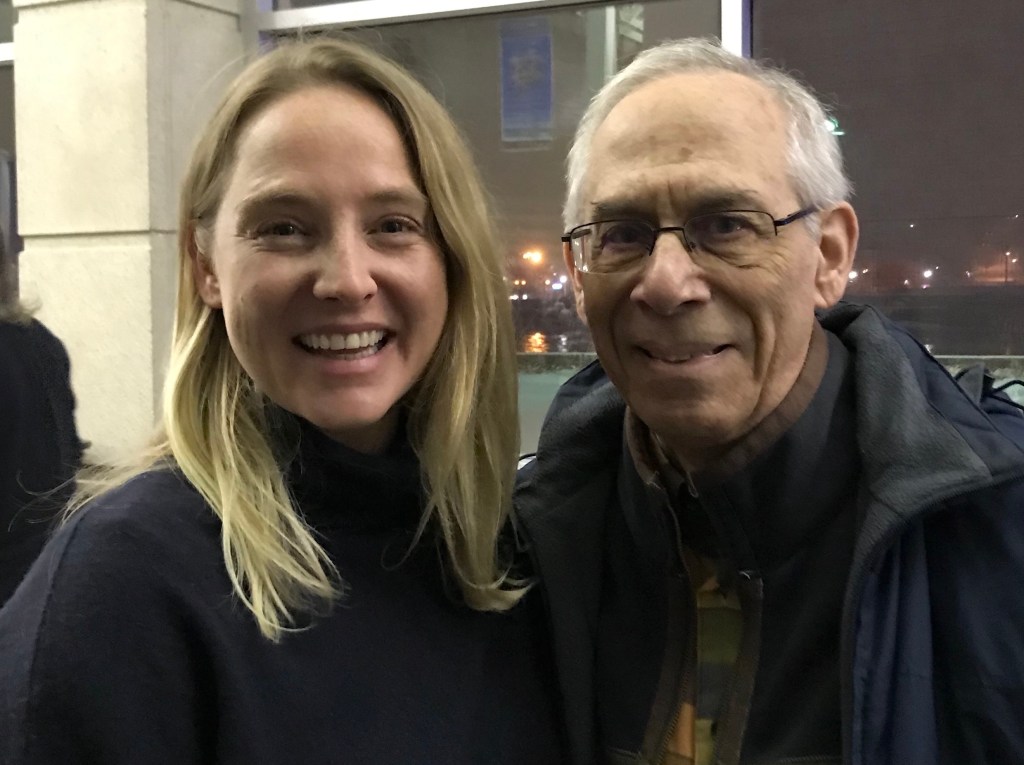
Meeting Lissie at the Bridge View Center in Ottumwa after her opening for Bernie Sanders on Sunday, December 15, 2019

New addition: Don Henley and Lissie use the same approach to writing songs—don’t force it and wash the dishes!

Newer addition: Feb 19, 2021: @ipondrnetwork posted a short video profile of Lissie today on her farm in NE Iowa. This musician didn’t know she was missing something. Until now. Musician @lissiemusic migrated back to the Midwest after spending time in California, and was surprised to find how creatively fulfilled she felt there. The pandemic has afforded her more time to enjoy her new home and appreciate the passing of the seasons. Lissie also posted a clip from it on her Instagram. See the full 5:09 minute video here.

Winter Holiday addition: Saturday, Dec 18, 2021: A Holiday Winter’s Eve Concert with Lissie. Just in time to kick-off the season, Lissie returned to The Parkway Theater for a very special holiday performance which was filmed and will be streaming for you. Join in for a festive show of holiday classics and some of Lissie’s originals accompanied by piano. Lissie will be live-chatting during the premiere on Dec. 18 at 1pm PT / 3pm CT / 4pm ET / 9pm UK time – come say hi! If you can’t watch the premiere you can watch the stream On Demand through December 26th. Get your tickets: https://bit.ly/lissiexmas.

New Album: Sept 2022: Lissie’s new album, Carving Canyons, is out now and she’s on tour starting in Norway. While there she collaborated with Darling West for a new Family Session where they recorded a beautiful cover of Fleetwood Mac’s “Dreams.”

She’s been doing interviews to promote the album. Here are a few: The XS Noize Podcast: Lissie on her new American-tinged indie folk album Carving Canyons and Voice Of America’s Border Crossings: Lissie where she also sings a few songs. VOA reaches 100 countries in multiple languages.

I follow her on Twitter (https://twitter.com/lissiemusic), which is how I discovered those podcasts. Visit her website (https://lissie.com) for tour dates, recent videos and more.

Posts on other great musical artists

Discover and enjoy the amazing soulful voice of young Angelina Jordan. It is jaw-dropping great! || My Mind by YEBBA at Sofar will blow your mind! || The hauntingly beautiful voice of Eva Cassidy || Colin Hay’s song—I Just Don’t Think I’ll Ever Get Over You—is so relevant during these tough times || Leonard Cohen said there’s a crack in everything—how the light gets in. It came thru him & lit up a broken humanity. || Hafiz said to leave something in the marketplace, and Jesse Winchester sure did before he left us. || The hauntingly beautiful music of Davy Spillane played on uilleann pipes and low whistle || Bill Evans’s Peace Piece is musical onomatopoeia || Bobby Hutcherson plays Bouquet with Ron Carter and Herbie Hancock at One Night with Blue Note

— Written and compiled (citing sources) by Ken Chawkin for The Uncarved Blog.
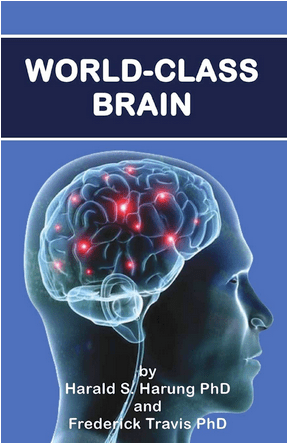
MUM @maharishiuni professors explore secrets of world-class performers in World-Class Brain book

March 26, 2019

What Do the Brains of World-Class Performers have in Common?

The brains of world-class performers are different from the brains of average performers. No surprise there. But what is surprising is that regardless of whether these top performers are athletes, musicians, or CEOs, their brains share one feature that makes them stand out: More integrated functioning. A world-class brain works in a more coherent, relaxed, wakeful, and efficient way.

A new book tells the story of these top performers and offers an easy-to-read introduction to the research showing that their brain function is different. This short book also describes other features that these top performers have in common, such as intensely happy and fulfilling peak experiences and a greater moral sense. Readers also learn how they, too, can effortlessly develop greater brain integration.

New Book Explores Secret of World-Class Performers

World-Class BrainA new book coauthored by former MUM professor Harald Harung of Oslo Metropolitan University and professor Fred Travis offers an easy-to-read account of the defining characteristic of world-class performers – an integrated brain – and how one can develop it.
Titled, World-Class Brain, the 130-page book begins by outlining the results of three studies: on Olympic athletes, top managers, and symphony orchestra musicians. These top performers were found to have high levels of brain integration according to EEG measurements.

The book then explains in simple terms what brain integration means and presents various ways to increase it, such as playing a musical instrument, exercising, and meditation.

The authors then discuss the research on the Transcendental Meditation technique showing that it is the most effective way to develop high levels of brain integration.

The book goes into detail about peak experiences associated with brain integration in the several groups of subjects. It then discusses research on long-term practitioners of Transcendental Meditation who are experiencing higher states of consciousness and describes the defining characteristics of these higher states.

The final two chapters explain the research showing that brain integration can affect organizations and all of society.

World-Class Brain: A Textbook Teaching Tool

Co-author Harald S. Harung described editor Jim Karpen‘s great contribution to the book, “which mainly had two components: The smooth progression of chapters and ideas, and making the language very easy, enjoyable, and readable.”

Co-author Fred Travis, director of the Center for Brain, Consciousness, and Cognition, and dean of the Graduate School at Maharishi University of Management, said they used the structure of the book’s chapters to structure how the knowledge was taught to MBA students in China.

Dennis Heaton, professor and dean of the College of Business Administration at Maharishi University of Management, said, “I’m using World-Class Brain with my MBA and PhD students, and they really appreciate how readable it is. The authors have written about the key to top performance in a way that’s interesting and easy to understand. In addition, in the later chapters the book does an excellent job of distilling decades of research and theory, including higher states of consciousness.”

The book is available on Amazon.

Visit Dr. Harung’s website for a list of English articles and YouTube videos of their research on top performers: www.harvest.no.

Visit Dr. Travis’ website for the mission of the Brain Center, presentations, books and videos, and more: drfredtravis.com.

Related articles: Research breakthrough: High brain integration underlies winning performances | What do world-class athletes, top-level managers, musicians, and TM meditators have in common? | New study highlights unique state of “restful alertness” during Transcendental Meditation | Dr. Fred Travis at GIBS: Mind-Brain Development for Excellence and TM Develops Brain Coherence

#TranscendentalMeditation teacher Bob Roth @meditationbob profiled on @50PlusPrime

March 10, 2019

50PlusPrime with Tony Fama is the national TV News Magazine for Baby Boomers celebrating the lives of the 108-million Americans age 50+. Tune in this weekend for a 30-minute special on Bob Roth @meditationbob and the David Lynch Foundation (DLF) with Tony Fama on @50plusprime. They talk about Transcendental Meditation (TM) and how it can bring more creativity, peace, and equanimity to your day.

The Teacher Helping 50+ Celebrities Find Success in Peace

This episode airs on AXS TV, Saturday, March 9, at 8:30am ET, and Sunday, March 10 at 11:30am ET, and in New York City on Sunday at 1:30pm on WABC 7. It was published on the 50PlusPrime TV News Magazine for Baby Boomers YouTube channel Thursday, March 7, 2019.

Tony Fama interviews Bob Roth about his trajectory since he was a young person to today as co-founder of the David Lynch Foundation teaching TM in 35 countries around the world. The show shares excerpts of DLF interviews with students, veterans, and celebrities, like Ellen DeGeneres and Jerry Seinfeld.

In his enthusiastic introduction to the show, Tony says, “This guy’s a product of the sixties, and he’s just a cool cat!” He asks Bob why he’s the go-to-guru for the rich and famous. Bob tells him no one is immune from stress, even the wealthy and famous. They talk among themselves. TM, he tells him, is not a luxury. “It’s a medical intervention, it’s a medicine. It’s a way to reduce stress and wake up the brain.” It makes sense. It cuts healthcare costs, makes you and your employees happier. It’s “a gift of rejuvenation; it’s a gift of awakening; it’s a gift to yourself.”

Tony covers a New York City gala where celebrities like Phil Donahue, Marlo Thomas, and Orin Synder discuss how Roth, having taught them TM, has enhanced their lives. The show includes clips from Paul McCartney and Ringo Starr talking with David Lynch on why they support the work of the Foundation in benefiting at-risk kids and US military veterans.

Bob Roth on 50PlusPrime TV News Magazine for Baby Boomers

At the end, as the credits roll, Bob Roth sums up the main point of what TM can do for us in a stressful world.

At the same time, stress is real, and if we have headaches, or if we can’t sleep, or if we’re depressed we can’t get out of bed, that stops us from being able to fulfill our desires, to grow. And so, in one simple process of just accessing this field of calm that lies within, we eliminate the buildup of stress, and we unlock that full creative potential of the brain, so we can be more creative and more resilient, and do the things we want to do.

Bob Roth interviewed for Starts at 60 during Strength in Stillness book launch in Australia

March 6, 2019

Starts at 60 Writers is an Australian-New Zealand-based group of writers over sixty. Bob Roth did many interviews during his book tour there last year to promote his #1 best-selling Strength In Stillness: The Power of Transcendental Meditation.

Starts at 60 did an excellent interview that resulted in two great articles published in their Mental Health section on Friday and Saturday, March 16 & 17, 2018: Transcendental Meditation saved Hugh Jackman’s family from anxiety and Transcendental Meditation takes off with over-60s.

Bob Roth effectively explains the differences between the two popular meditation approaches—mindfulness and transcendental. He described it as deep meditation, what Maharishi ​used to call it, which became Transcendental Deep Meditation, then Transcendental Meditation, or TM.

I also found it ironic that this was written by writers over 60 for their demographic—the generation that took to Maharishi and his teachings in droves in the 1960s. Obviously many have forgotten about that and may now be discovering TM for the first time, but from a more scientific perspective. So glad the pragmatic Bob Roth presents TM to the world in the down-to-earth way that he does! I corrected a few typos and capitalized Transcendental Meditation, as it should be. Here they are.

Transcendental Meditation takes off with over-60s

Mindfulness and meditation have hit the zeitgeist in recent years, with everyone from Oprah to businessman and housewives singing their praises and crediting the practice with reducing stress levels and anxiety.

While meditation is a term most people are familiar with these days, it’s a particular branch of the calming technique, called Transcendental Meditation (TM), that’s really piqued the interest of the world’s elite.

TM focuses on a deep parts of the mind and is said to be so effective that actor Hugh Jackman enlisted the teachings of TM expert Bob Roth to ease his stress and help his young son cope with anxiety.

Roth, one of the world’s leading experts in TM, recently spoke to Starts at 60 about the many health benefits of the practice and the thousands of people he has taught, including Oprah Winfrey, Ellen DeGeneres, Paul McCartney and Gwyneth Paltrow, to embrace the calming technique throughout his 45-year career.

While there are many different types of meditation around, transcendental focuses on the deep parts of the mind, Roth explains.

“There are mindfulness approaches to meditation which are more on the surface, how to think, how to walk, how to talk, how to act, how to breathe, many different things like that,” he said. “Transcendental is deep meditation, it means it accesses a level of the mind, a quiet, calm level of the mind’s stillness that already exists within everyone.”

TM focuses on thinking inwards rather than outwards and through practice, people have the ability to overcome stress, tension and fatigue and anxiety.

While Roth admits that like many people he was sceptical at first when he first discovered TM in his youth, but quickly changed his mind when he began to see “immediate results”. He also cites “20 peer-reviewed studies that show that TM reduces high blood pressure better than anti-hypertensive medications, without the side effects of anti-hypertensive medications”.

“And that’s research that was published by the US National Institute of Health and research done at Harvard Medical School and published in the American Medical Association’s top journal. It’s very real, when we’re talking about TM, we’re not talking about something on the fringe. It may be an unusual word, but the reality is it’s an established medical tool,” he added.

While he has a black book filled with clients, most of Roth’s clients are ‘everyday’ people, many of them over 6o.

“So an older person who is either in retirement or moving towards retirement or can’t retire but is under a lot of pressure, it’s a wonderful tool to get rid of stress and wake up the brain so we have more energy to do the things we need to do,” he said.

He added that it’s important for people to work TM into their lives and not to use it as a replacement for medication.

“In the toolbox of an older person, there should be many tools that we can draw upon to help us deal with the very real, very deadly epidemic of stress, that we’re all living in,” he said.

“Let’s say you have high blood pressure, you wouldn’t just go online and say, ‘here’s some magic potion online and some recipe and I’m going to take it because it’s going to help my blood pressure’,” he said. “No, you look at stuff that works. Same as meditation, you should look at the research that shows that it works.”

To help the most sceptical, Bob recently released a book called Strength in Stillness. He said that he wanted the book to help people with questions and to make sense of something that people may not be familiar with. “I’m not pushing this on anybody. People should decide for themselves. I wrote the book so people could make an informed decision,” he said.

“The beautiful thing about Transcendental Meditation is you can be 100 per cent sceptical and it works just as well. You can be sceptical about electricity, but when you turn on a light switch, the light goes on.”

Strength in Stillness is currently available in book stores and as an eBook online.

Transcendental Meditation saved Hugh Jackman’s family from anxiety

In an age when mindfulness and practising the art of stillness has become more popular than a bowl full of kale, one particular form of meditation seems to stand out from the crowd: Transcendental Meditation.

The unique form of meditation, which goes beyond mindfulness to produce a deeper and long-lasting sense of peace, has been around for more than 40 years, but has recently shot to the top of the popularity heap thanks to a host of celebrity clients and a rock star teacher.

Bob Roth has taught the likes of Oprah Winfrey, Ellen DeGeneres, Paul McCartney and Gwyneth Paltrow, but his favourite client thus far is The Greatest Showman himself, Hugh Jackman.

“Hugh Jackman and his wife Deborra-Lee Furness are just wonderful,” Roth told Starts at 60. “Down to earth, they have two children, I know the family well. I consider them my friends.”

Roth has been working with the Jackman clan for years and his teachings have been particularly useful for Hugh and Deborra-Lee’s son, Oscar, who suffered from anxiety.

“I taught Oscar to meditate,” Bob revealed. “He’s now 17 and I taught him when he was 12. They have a daughter, Ava, who I think I’m going to teach next year.”

Jackman has praised Roth’s work in the past and said his teachings on how to calm the mind did wonders for Oscar’s mental health.

Bob Roth pictured with Hugh Jackman and Deborra-Lee Furness
Bob Roth pictured with Hugh Jackman and Deborra-Lee Furness. (Getty)

Bob’s really helped us and our son, who was a stressed, anxious kid,” the actor said.

Slightly different to regular forms of meditation, TM focuses on the deep parts of the mind and accesses the quiet, calm and still parts of the brain that exist inside everyone. While it’s a hit with celebrities, Roth’s main clients are ‘everyday’ people, many of them over 60, who are looking for a way to ease stresses and invigorate the mind.

“They run out of energy and they just feel like they don’t have the energy they once had,” he said of his older students. “They’re more vulnerable to aches and pains and illnesses because the immune system is compromised, memory maybe isn’t as clear, and from a long life.”

He said there’s a strong correlation between the kinds of issues his regular students and more high-profile students face.

“Being known by a lot of people does not make you immune from worrying about a sick child or stopping you from staying awake at night because you’re worried about things in your career or your partner,” he said. “They have the same feelings, just like us. They have more money, to what? Buy more sleeping pills?”

Despite his popularity amongst some of Hollywood’s favourite stars, he said he owes his credibility to word-of-mouth. “You can’t seek out a celebrity. You can’t go, ‘I want to teach Tom Hanks’. They live in their own world and it’s almost like a bubble. And they talk to each other a lot,” he said.

More recently, Roth worked with Jackman’s The Greatest Showman co-star Zac Efron who was experiencing some personal issues on set. “So I’ve sort of become the go-to guy for meditation,” he explained. “But I should make a point – I’ve taught maybe 30 or 40 well-known actors. I’ve taught thousands of regular people.

“It’s not, ‘oh this is a 20-year-old veteran’ or ‘this is Hugh Jackman’, really and truly, I see in their eyes, they’re looking for something to help them navigate through life.”

Roth’s book Strength in Stillness is currently available in book stores and online.

###

You can see Bob Roth’s global book launch with Hugh and Deboora-Lee introducing Bob about 26 minutes into the third video posted here. Bob also interviews comedian Jerry Seinfeld who has been meditating since he was a college student. The video starts with quotes from celebrity meditators, followed by Good Morning America’s Robin Roberts and George Stephanopoulos interviewing Bob about his book.

Transcendental Meditation Reduces Compassion Fatigue and Improves Resilience for Nurses

February 27, 2019

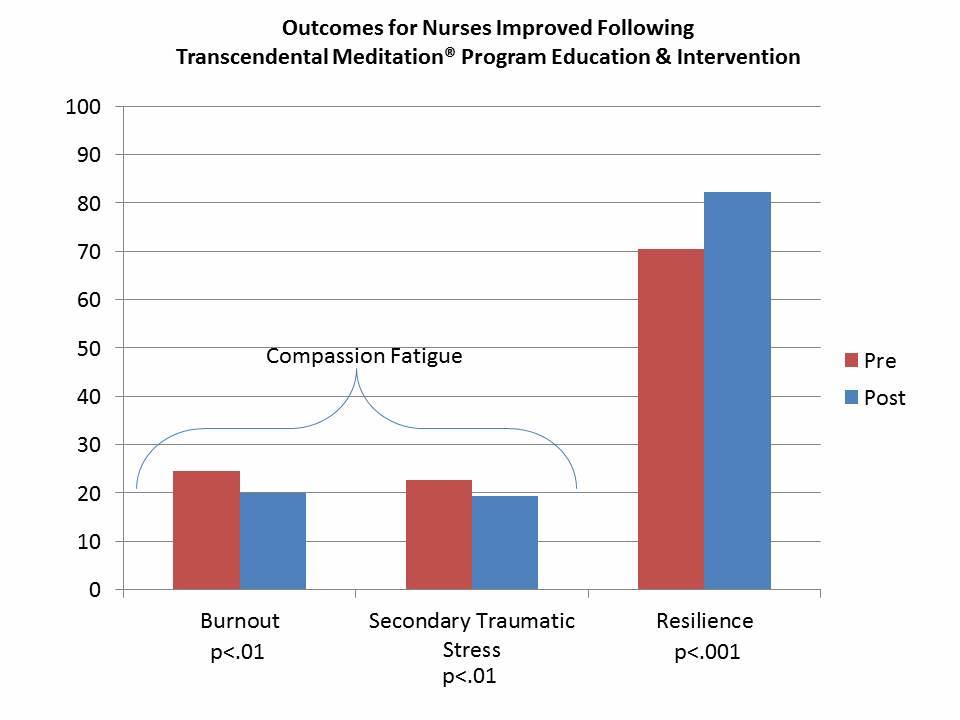
Nurses can better cope with the burnout that’s endemic to the profession by practicing the Transcendental Meditation® technique, according to a new study published today in the Journal for Nurses in Professional Development. After four months of practice, standardized assessments found that nurses in the study had reductions in “compassion fatigue” and burnout, and increases in compassion satisfaction and resilience. The study highlights the importance that self-care plays for professional development and longevity in nursing. (EurekAlert!) (PubMed)

TM Outcomes for Nurses-Reduced Compassion Fatigue and Increased Resilience

After 4 months of practicing Transcendental Meditation, a group of 27 nurses experienced an 18% reduction in burnout (“compassion fatigue”), a 16.9% increase in resilience, and a 9.2% increase in compassion satisfaction.

Research suggests that self-care for nurses is important for professional development

The Transcendental Meditation technique helped to reduce “compassion fatigue” and burnout in a group of 27 nurses while also improving resilience according to a study published today in Journal for Nurses in Professional Development (Mar/Apr 2019, Vol 35, Issue 2).

Jen Bonamer, PhD, RN-BC, NPD (cropped)

Jennifer Bonamer

Standardized assessments showed a significant improvement after four months of practice.

“For years I watched nurses struggle to care for their patients and themselves,” said lead author Jennifer Bonamer, PhD, RN-BC, AHN-BC, Nursing Professional Development Specialist at Sarasota Memorial Health Care System in Florida. “Working with people who are suffering trauma eventually takes a toll and produces what’s come to be called ‘compassion fatigue.'”

Study included mostly Registered Nurses

Dr. Bonamer searched the literature for self-care methods that could help nurses cope with burnout and hypothesized that Transcendental Meditation would help relieve compassion fatigue in nurses and improve their ability to bounce back from the challenges of work.

Most of the 27 nurses in the study were Registered Nurses working directly with patients. They had been working as nurses 15.7 mean years, and in their current practice area for an average of 6.5 years.

Standardized assessments quantify benefits

The researchers used the Professional Quality of Life Scale, which includes a 30-item survey that measures compassion satisfaction and compassion fatigue on a 5-point scale. After four months of practicing Transcendental Meditation, the nurses experienced a 9.2% increase in compassion satisfaction and 18% reduction in burnout.

Resilience was measured via the Connor-Davidson Resilience Scale, a 25-item survey with statements that reflect resilient perspectives. It also uses a 5-point scale. Again, after four months of Transcendental Meditation, the nurses experienced a 16.9% increase in resilience.

“These surveys are widely used with demonstrated validity and reliability,” Dr. Bonamer said. “They demonstrated quantitatively what the nurses reported: they felt better and enjoyed their work more.”

Increasing importance of self-care techniques in nursing

There is an increasing trend toward appreciating the necessity of helping nurses in their careers by taking active steps to use self-care techniques to build resilience.

“We need to invest in our nursing staff and ensure that they have rewarding careers while also providing the best possible care for their patients,” Dr. Bonamer said. “The Transcendental Meditation technique is one step that we could take. A variety of studies have shown its effectiveness in reducing stress and promoting health and well-being.”

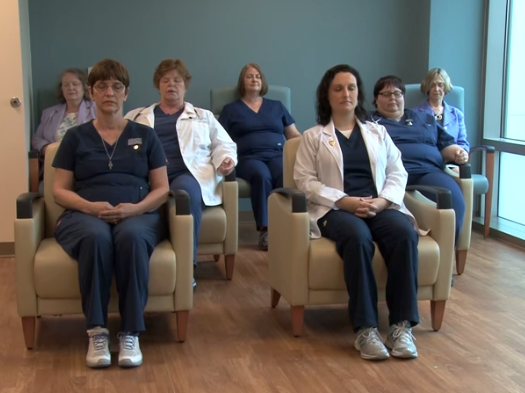
RNs practice TM for self-care at Sarasota Memorial Health Care System

RNs practice TM for self-care at Sarasota Memorial Health Care System

The nurses learned Transcendental Meditation from two certified teachers over a four-day period. They then practiced it for 20 minutes twice a day, though their demanding schedules sometimes made it challenging to fit it in. The technique is typically practiced once in the morning and then again in the late afternoon. In this video, Nourishing the Caregiver from Within, nurses describe the benefits they are receiving from the TM Program.

Previous qualitative study also found a benefit

The present study is the second of two that have used the Transcendental Meditation technique as a modality to improve the well-being of nurses. A study published in 2018 in International Journal for Human Caring reported the experience of RNs in graduate school who practiced Transcendental Meditation for four months. The qualitative study entailed the students keeping a journal and then the researchers used Giorgi’s descriptive phenomenological method to examine their journals.

The results showed that graduate students were more present and balanced, and experienced enhanced job performance. They also enjoyed greater feelings of bliss, peace, and integrity.

About the Transcendental Meditation Technique

Transcendental Meditation is a simple, natural technique practiced 20 minutes twice each day while sitting comfortably with the eyes closed. It is easily learned, and is not a religion, philosophy, or lifestyle. It doesn’t involve concentration, control of the mind, contemplation, or monitoring of thoughts or breathing. The practice allows the active thinking mind to settle down to a state of inner calm. For more information visit www.tm-women.org/nurses.

Study: Self-Care Strategies for Professional Development: Transcendental Meditation®; Reduces Compassion Fatigue and Improves Resilience for Nurses, Jennifer (Rheingans) Bonamer, PhD; Catherine Aquino-Russell, PhD. DOI: 10.1097/NND.0000000000000522

Photo credits: Jennifer Bonamer—Sarasota Memorial Health Care System; meditating nurses and graph—Transcendental Meditation for Women.

Locally, The Fairfield Weekly Reader published an article on the study: Transcendental Meditation reduces compassion fatigue and improves resilience.  The Iowa Source published an article by Amy Ruff, RN, National Director of Transcendental Meditation for Nurses: Helping the Helpers: Reducing Burnout Among Nurses. MUM’s The Review reported: Study Shows Benefit for Nurses.

Alliance for PTSD Recovery interviewed Amy Ruff, Director of Transcendental Meditation for Nurses. She discusses the challenges of nurse burnout and traumatic stress and the need for greater resilience.

Linda Egenes wrote Nurses Need Nourishing Too: New Research Shows TM Reduces Compassion Fatigue.

Western New York Physician: Rochester & Buffalo Issue Vol 2, 2018 published an article (pages 15 & 16) by Amy Ruff, RN BSN: New Study: Transcendental Meditation Reduces Compassion Fatigue and Improves Resilience for Nurses. Here’s a PDF of the article.

Podcast: Kathy’s Corner: TM for Nurses – Interview with Amy Ruff, RN | May 2019. Kathy and Amy discuss the value of caring for the caregivers.

New Study published December 11, 2023 in Journal of Nursing Administration: New study shows Transcendental Meditation significantly reduced PTSD and anxiety in frontline nurses during COVID-19 pandemic by more than half over a 3-month period.

New study shows Transcendental Meditation reduces PTSD in South African college students

February 20, 2019

Tues, Feb 19, 2019: A study published in Psychological Reports showed that after 3.5 months of practicing Transcendental Meditation (TM), most of the 34 tertiary-level students at Maharishi Institute (MI)—all of whom were initially diagnosed with PTSD by mental health professionals—went below clinical thresholds as measured by standard assessments. Students also experienced relief from depression. A comparison group from University of Johannesburg (UJ) with the same diagnosis received no treatment and showed no change in their symptoms.

IMAGE

College students diagnosed with PTSD at Maharishi Institute (MI) and University of Johannesburg (UJ) were tested at 15, 60 and 105 days. After 3.5 months, the MI group practicing Transcendental Meditation (TM) went below clinical thresholds, while controls at UJ showed no change.

A very high percentage of young people in South Africa suffer from post-traumatic stress disorder (PTSD) and depression. A college that offers the Transcendental Meditation (TM) technique to its students found this approach helped reduce their symptoms.

A study published today in Psychological Reports showed that after 3.5 months of practicing Transcendental Meditation (TM), most of the 34 tertiary-level students at Maharishi Institute (MI)—all of whom were initially diagnosed with PTSD by mental health professionals—went below clinical thresholds as measured by standard assessments. The students also experienced relief from depression.

A comparison group of 34 students from the University of Johannesburg (UJ) suffering from PTSD and depression received no treatment and continued to show no change in their symptoms throughout the study.

High levels of PTSD

An international research team of seven scientists and psychologists conducted the study. At the start, students at MI and UJ had a score of 44 or more on their PCL-C test and a clinician’s verification of PTSD. A score above 44 indicates likely PTSD and below 34 indicates that one is below the PTSD threshold.

Symptoms included nightmares, flashbacks to traumatic events, anxiety, fear, and hyper-vigilance. They also reported emotional numbness, anger, and violent behavior, as well as abuse of drugs and alcohol. PTSD is a chronic, debilitating condition that may last a lifetime if not treated effectively.

The study showed a rapid and significant reduction of symptoms in the test group, according to lead author Dr. Carole Bandy, professor of psychology at Norwich University, America’s oldest military college. Results were stable over time.

“A high percentage of young people in South Africa, especially those living in the townships, suffer from PTSD,” said co-author Michael Dillbeck, researcher in the Institute for Science, Technology, and Public Policy at Maharishi University of Management, Fairfield, Iowa. “To become successful students and productive members of society, they absolutely need help dealing with the symptoms of post-traumatic stress disorder. Our study shows, that after 3 months of meditation, this group, on average, was out of PTSD. It offers a way for others to effectively deal with this problem.”

Our study shows, that after 3 months of meditation (TM), this group, on average, was out of PTSD. It offers a way for others to effectively deal with this problem.”

High levels of PTSD are prevalent in South Africa

Up to 25% of the population in South Africa suffers from PTSD, according to Dr. Eugene Allers, past-president of the South African Society of Psychiatrists. Estimates put the same figure in the USA at 8%.

Several recent scientific studies show that adolescents and children in South Africa may be exposed to relatively high levels of traumatic experiences, particularly witnessing or experiencing violence of a criminal or domestic nature, associated in turn with estimates of post-traumatic stress disorder (PTSD) ranging from 8% to 38% (Ensink, Robertson, Zissis & Leger, 1997; Pelzer, 1999; Seedat, van Nood, Vythilingum, Stein & Kaminer, 2000; Suliman, Kaminer, Seedat & Stein, 2005).

UJ students assessed by expert NGO

The South African Depression and Anxiety Group (SADAG), the largest mental health NGO in SA, which assists more than 180,000 people each year, interviewed and tested UJ students suffering from PTSD. They were also tested for depression, since it often accompanies PTSD and can in fact be considered a component of PTSD.

Students were only invited to join the study if they met two criteria for having PTSD: a score indicating PTSD on the PCL-C paper test and the opinion of a trained psychologist. Re-testing was 15, 60 and 105 days after baseline testing.

MI students find relief

At 15 days into the study, Maharishi Institute students showed a significant drop of more than 10 points in their PTSD symptoms after learning Transcendental Meditation. They also found relief from depression, judged by Beck Depression Index scores.

Re-testing was also carried out at 60 days and 105 days of their TM practice. By 105 days, the average group score for the MI students was below the PTSD threshold of 34, according to the paper tests. The UJ students showed no significant reduction in symptoms—neither depression nor PTSD. They received no support of any kind.

A binary logistical regression analysis for the effect of TM practice on PTSD PCL-C diagnosis 105 days after instruction was also highly significant, with 7 likely PTSD and 27 unlikely for the experimental group and 30 likely and 4 unlikely for the comparison group.

First study of its kind

This is the first study of its kind to show how Transcendental Meditation can reduce PTSD in college students. “This study shows that there are new tools available for professionals to add to their tool bag,” says Zane Wilson, Founder and Chairman of SADAG.

This is the first study of its kind to show how Transcendental Meditation can reduce PTSD in college students.

Thirteen previous studies utilizing Transcendental Meditation showed reductions in PTSD on Congolese war refugees, US war veterans, and male and female prisoners.

###

About the Transcendental Meditation Technique

Transcendental Meditation® is a simple, natural technique practiced 20 minutes twice each day while sitting comfortably with the eyes closed. It is easily learned, and is not a religion, philosophy, or lifestyle. It doesn’t involve concentration, control of the mind, contemplation, or monitoring of thoughts or breathing. The practice allows the active thinking mind to settle down to a state of inner calm. For more information visit https://www.tm.org.

Funding for the study was provided by David Lynch Foundation and PTSD Relief Now Corporation (African PTSD Relief), two US 501c3 charities.

Ref: Bandy, C, Dillbeck, M., Sezibera, V., Taljaard, L., de Reuck, J., Wilks, M., Shapiro, D., Peycke, R. (Psychological Reports. on-line: February, 2019) Reduction of PTSD in South African University Students Using Transcendental Meditation Practice. DOI: 10.1177/0033294119828036 | US National Library of Medicine & National Institutes of Health: PubMed

EurekAlert! | ZME Science | Medical News Today | PsychCentral | OMTimes: New Hope for Trauma Victims by David H Shapiro | many more

MGFC reviewed this new study, including previous research in this area, and interviewed co-authors, research coordinator David Shapiro, and Maharishi Institute chairman Richard Peycke: 80% of Students Free of PTSD in 105 Days with Transcendental Meditation.

See this recent study: #TranscendentalMeditation as good as or better than ‘gold standard’ when treating veterans with #PTSD. See other TM studies and articles on PTSD posted on this blog.

OMTimes: Transcendental Meditation Reduces PTSD (May 11, 2019).

College life can be destructive to student health. Panel of experts offer evidence-based solutions.

February 3, 2019

VIEW EMAIL ANNOUNCEMENT WITH ALL IMAGES

Young girl touching her face with hands, like a tree

Is College Bad For Your Brain?
How the epidemic of stress on college campuses
is destructive to student health–and what can be done about it
 

LIVE EVENT 
Friday February 8th • 7:30 pm CT 
Dalby Hall, MUM Campus, Fairfield, Iowa
 

GLOBAL WEBCAST 
Wednesday, February 13th • 4:00 pm ET

Webcast link: https://www.mum.edu/changemakers-event-2019

Young girl touching her face with hands, like a tree

Mental health challenges, substance abuse and poor lifestyle choices undermine student learning outcomes and successful college experiences. This webinar will explore disruptive solutions and highlight a unique university that is reversing this trend by placing stress-busting meditation at the core of its curriculum.

The statistics are sobering: 75% of college students report feeling stressed and 39% of college freshmen report symptoms of anxiety or depression.  Suicidal ideation in students has doubled over the last 10 years, 40% of college students binge drink, and there is a 30% rise in requests for mental health support.

Is there an antidote to this potentially lethal epidemic on college campuses? The David Lynch Foundation (DLF) and Maharishi University of Management (MUM) are cohosting a major conference, “Is College Bad For Your Brain?” to offer evidence-based, disruptive solutions to college students and educators alike on Friday, February 8 on the MUM campus in Fairfield, Iowa. The conference will be then webcast on Wednesday, February 13. A distinguished panel of thought-leaders—neuroscientists, educators, psychologists and students–will convene to explore the destructive impact of college stress on mental and physical health and what can be done about it.

Young girl touching her face with hands, like a tree

Gregory Gruener MD, Vice Dean for Education and neurology professor at Loyola University Chicago Stritch School of Medicine, has developed a cutting-edge wellness program in the highly stressful environment of medical school. “A lot of studies show that as many as 50 percent of medical students and residents exhibit symptoms from stress that can develop into burnout, so we’re trying to help students focus on wellness for themselves by teaching skills that they can take with them, skills they will need to be effective physicians.”

Young girl touching her face with hands, like a tree

To counteract this trend and help students better manage their stress, Dr. Gruener and Adjunct professor at Loyola Stritch, Carla Brown EdD, established the first elective course in Transcendental Meditation (TM) to be offered at a major medical school. Drs. Gruener and Brown will speak (via Skype) about the benefits medical students have been experiencing in their program since it’s inception in 2014.

Young girl touching her face with hands, like a treeClinical neuropsychologist William Stixrud, Ph.D. will also address the conference. Author of The Self-Driven Child, Stixrud has worked closely with students to help them manage their stress and become more proactive in creating success in college and in life.  Stixrud commented on the problem in his recent New York Times op-ed, When a College Student Comes Home to Stay.
“As we see it, there are two critical issues at hand.  First, college life is a highly deregulated environment with inconsistent sleep patterns and diets, little structure, and an abundance of binge-drinking, pot-smoking, and abuse of stimulants like Adderall.  Second, students haven’t been given control of their own lives until way too late.  It may be just too much to ask students to go from parental control to near-total freedom.”  In addition to healthy lifestyle changes, the most effective antidote that Dr. Stixrud has found to relieve the problem is the regular practice of the stress-reducing Transcendental Meditation technique.

Young girl touching her face with hands, like a treeHeart transplant specialist and Chief Informatics Officer for the U.S. Navy, Hassan Tetteh, M.D., brings a unique medical perspective to the issue.  After two tours of duty in Iraq, and as Command Surgeon for the National Defense University, which trains the elite officers in the military, Tetteh saw firsthand the effects of stress in these high-stakes, life-and-death environments.  But after several personal life-altering experiences in the military, he found a calling to heal others, in particular, by helping them to cultivate a deeper mind-body connection.  His favorite John Steinbeck quote captured this feeling, “A sad soul can kill you quicker than a germ;” and added, “Identifying the goals, beliefs and human connections that enrich our souls can be just as essential to healthy living as any medical treatment.”
2019_01_changemakers-2_travisMUM neuroscientist Fred Travis, Ph.D., will report on new research showing that meditating students display a “brain signature” indicating greater resiliency, adaptability and coherence in the face of stress. MUM offers students a Brain Integration Progress Report using a Brain Integration Scale to begin to assess the effects of their college experience on brain functioning. Dr. Travis will conduct a live EEG demonstration at the conference highlighting the differences between a brain under stress and a brain during TM.
Young girl touching her face with hands, like a tree“As experts search for a solution to the effects of stress on learning, one common theme seems to emerge: mind-body practices such as Transcendental Meditation work,” says MUM Dean of Faculty and co-founder of the Institute for Research on Consciousness and Human Development, Vicki Alexander Herriott. “MUM is already a global leader in the field because its educational curriculum and campus culture has made Transcendental Meditation (TM) central to the life of the student—and teacher. This conference will showcase why.”

MUM Student Body President, T. Chevonne added, “The best thing in my life is my TM practice.  It has helped me see past doubts and fears into the infinite realm of possibilities.  I am more confident and outspoken than I’ve ever been, and anxiety is a distant memory to me.”

For more information and a list of speakers and panelists visit: https://www.mum.edu/changemakers-event-2019.

Organizer Michael Sternfeld wrote an excellent article on this second Changemakers event published in the February issue of The Iowa Source Magazine: Is College Bad For Your Brain? MUM also posted this short video promo.

Watch Changemakers: Is College Bad For Your Brain? • Part 1Part 2. You can also see the 10 individual talks now posted at the event page.

###

Related: The first Transcendental Meditation elective course offered at a major US medical school | Catholic Health World reports on medical students learning Transcendental Meditation to counter stress, promote physician wellness


Sharad Kharé @kharecom interviews Bob Roth @meditationbob, CEO @LynchFoundation, on TM

January 31, 2019

Legacy documentarian Sharad Kharé interviewed Bob Roth, CEO of the David Lynch Foundation, and produced this impressive piece: In dialogue with Bob Roth, A gift of Meditation. Bob shares stories of how his journey started and what the David Lynch Foundation is doing globally for adults and children with TM. Below is the article with video of his visit posted on Thrive Global. Thank you, Sharad, for giving us permission to share your wonderful story with our readers. See his author bio for more.

sharad kharé and bob roth

Legacy documentarian Sharad Khare with Bob Roth, David Lynch Foundation

The idea that something so simple can help you and your entire life seems so unreal. But it is very real and its available to you right now.

When I started meditation a few years back, I found it tough, I gave up many times, but something kept bringing me back. Like anything in life, practice allows for growth and mastery. While I am not a master by any means, I now understand the strength of meditation in my daily because of many mentors and friends. Friends like Bob.

I first met Bob a few years back when my meditation coach introduced us. I flew to New York to shoot my first interview with him in 2015. He was welcoming, kind and totally candid. Since then I have continued to connect with Bob by updating him on my work and my practice. He has always had an open door to my ideas, and I thought it was time to update the world on what he was working on.

Bob had released his book “Strength in Stillness: The Power of Transcendental Meditation”, which is a guide that shares the power of how TM can calm the mind body and spirit.

In our interview Bob shares stories of how this journey started and what TM is doing for adults and children globally.

To learn more of Bob’s incredible work, please check out davidlynchfoundation.org.

See Sharad’s interview with Bob in the video below.

— Published on January 30, 2019

To learn more about Digital Journalist, Legacy Documentarian, Curator, and Curious Soul Sharad Kharé, visit http://www.kharecom.com.

See the result of their first meeting: Digital storyteller Sharad Kharé speaks with David Lynch Foundation executive director Bob Roth.

See more interviews with Bob Roth about his book, Strength in Stillness, posted on The Uncarved Blog.

Michael Braunstein shares his fascinating story of how he learned #TranscendentalMeditation

January 15, 2019

Michael Braunstein wrote a great article for The Reader’s Heartland Healing Magazine in Omaha on Jan 13, 2019. It’s a fascinating story of how he learned about Transcendental Meditation when he worked as a recording engineer in a studio where famous musicians like Paul McCartney and George Harrison showed up. But more specifically from a meditating musician some of you may remember from the early days at MIU. Enjoy reading Meditate. Your Mind Wants To.

Let’s get something straight right out of the box: You do not have to sit funny in order to meditate. All that is necessary to meditate is to learn it correctly then apply it. Since learning Transcendental Meditation in 1984, I have meditated in airports, hospital waiting rooms, sitting in the stands at soccer games, in the lobby of a busy Manhattan office building, on mountain tops and in quiet, darkened spaces wafting with incense, all with unequivocal success. Meditation doesn’t require special needs. Look, meditation is a natural state of mind that the mind craves. It’s healing. It’s transformative. And it’s easy. All you have to do is learn it correctly.

All About the Bass. You can’t start a tracking session without the bass player and the bass player was late. So I was on my knees in the studio dressing cables and doing busywork as we waited. A bass guitar case plopped on the floor right in front of me. I looked up. I stammered, “You must be the…  bass… player.” The hesitations came because the “bass player” was Paul McCartney.

It was back in my LA days as a recording engineer. During the next 14-plus hours of cutting a track, McCartney’s demeanor impressed me. Accustomed to over-amped and often crazy rock ‘n’ rollers in those days, I will never forget his gentle presence and the restrained command he offered the session. The details of the recording session are unimportant but the impression he made on me as a person remained powerful. A few months later, working on a different record with George Harrison, I observed the same sense of centered-ness and clarity.

Another musician I worked with had a similar demeanor in the studio. Readers wouldn’t recognize his name but he, Harrison and McCartney share a common link. This third musician had an even deeper effect on my life. He was the ultimate catalyst that made me decide I wanted to learn how to meditate.

My Two Cents. Ron Altbach was executive producer of a major live concert album and television broadcast I engineered. It starred the Beach Boys, America, Ringo, Hank Williams, Jr., Julio Iglesias, Three Dog Night and a host of others. It was a complex project and required a lot of technical expertise both on the day of recording and in post-production. Some of the problem-solving techniques of the day included me standing around in the control room with my techie assistants mulling solutions. As we geniuses would banter about which way to proceed, on more than one occasion, from the back of the room came a quiet and unassuming comment, usually along the lines of, “What if you…? Would that work?” The speaker was Ron. And each time he was right.

After two or three of his successful suggestions, I said to him, “Ron, you’re not an engineer or tech. How are you coming up with these solutions? Where’s that coming from? You seem to see things in a clear overview.” His answer was simple: “I think because I meditate, I’m able to assess situations more clearly.”

We talked about the meditation he learned, Transcendental Meditation, and it stuck with me. Three months later I learned TM at the Beverly Hills TM Center on 3rd Street. It took four sessions over 5 days and was easy. It wasn’t free or even cheap to learn. But it may go down as the most valuable thing I ever spent money on. Extrapolated over the 34 years since, it’s worked out to about two cents a day. And it’s becoming a better deal everyday.

Read the rest of this article in Heartland Healing at The Reader.

(more…)

Chris Hardwick in conversation with Bob Roth @meditationbob on #TranscendentalMeditation

January 13, 2019

What you are about to listen to is not necessarily an interview, but a mutually engaging and intelligent conversation between podcast host Chris Hardwick and guest Bob Roth. This 81-minute balanced discussion was recorded on Dec 21, 2018 for ID10T. You can listen to it here.

Chris chats with Transcendental Meditation teacher and head of The David Lynch Foundation Bob Roth to discuss the foundational aspects of TM, why it’s important to calm the chatter in your mind, and how his non-profit work at the Foundation is paving the way to help at-risk youth. His book is entitled, “Strength In Stillness: The Power of Transcendental Meditation” and his radio show “Success Without Stress” on SiriusXM Indie.

A selection of press, television, radio, and podcast interviews with Bob Roth about his best-selling TM book are posted on The Uncarved Blog.