


Combating Stress in Police Work
By: John Theobald, M.S.
Former N.Y.P.D. Officer and Former Professor of Criminal Justice at the New York Institute of Technology
With: David Leffler, Ph.D.
Executive Director, Center for Advanced Military Science (CAMS)
Introduction
In 1965 I was a member of the New York City Police Department, assigned to a specialized anti-crime unit. In this capacity, I saw firsthand the types of stressors police officers were subject to, and the maladaptive ways in which many dealt with them. I subsequently left the department and returned to college and then graduate school. I eventually started a criminal justice program through the continuing education department of the New York Institute of Technology. The program grew, and in the 1970s reached an enrollment of 12,000 police officers from various police agencies across the New York metropolitan area.
At that time it was becoming increasingly clear that the stress factor in police work was manifesting in high rates of divorce, alcohol abuse, suicides, and other acting-out behaviors. Having experienced it firsthand, I was determined to seek some method that could help ameliorate this situation.
I began to research the various stress-reduction methods available. The Transcendental Meditation® program appeared to be the best approach because it was widely available, could be practiced anywhere at any time, and had unparalleled success at addressing these personal problems faced by police. Research indicated that Transcendental Meditation (TM®) practice could help alleviate the negative effects of stress. It was clear that the TM technique would also increase awareness of potentially dangerous situations, preparing anyone for any possible outcome.
Shortly after learning the TM technique, I noticed the marked reduction in my own stress levels, and decided to make this opportunity available to the students in the college program. It was only later, when many police officers were practicing the TM technique, that I fully realized how beneficial it truly was.
I arranged through centers in the ten metropolitan counties to teach any police officers who wanted to learn. At this time, college courses were offered in various police precincts and other locations throughout the New York Metropolitan area. Introductory TM lectures were offered at some of these locations, with interested officers going to their individual TM centers to learn the practice. Word spread to their associates and about 6,000 police officers learned to meditate.
Feedback from students was received for many years, both in the college program and, in some cases, years later, by individual police officers who said they were “still TM-ing.” Comments from students consistently indicated overwhelmingly positive results. One of the most common reports was an increase in their shooting scores. Others reported feeling more aware, especially in life-threatening situations. This is important because in an effort to protect and save lives, law enforcement officers may sometimes resort to using deadly force.
For example, there was a story of an officer and his partner who were called to a situation in a very dangerous part of New York City. While walking in an alley, they were ambushed. A shot rang out, and his partner fell wounded to the ground. This officer drew his revolver and quickly shot five assassins, killing four and disabling the fifth. He later reported if it were not for his regular TM practice, he would have been killed. Despite the overwhelming odds against him, the policeman said he was able to maintain his composure under fire. He skillfully and accurately shot his weapon during this dangerous and highly stressful situation. (The revolvers used by New York area police at that time could only fire six rounds, so the situation was much more critical than it would be in modern times where weapons can fire fifteen or more rounds.)
Read the entire article at: http://www.police-writers.com/articles/combating_stress_in_police_work.html
This article was published in India, USA, Somalia, Ethiopia, South Korea and Australia in The World News: The International News Magazine, The Mangalorean, Mareeg, The Seoul Times, Ethiomedia.
 Transcendental Meditation: What Is It and How Does It Work?
By Therese Borchard
 Being that my job is to feature and review books on psychology, spirituality, and especially the intersection between the two, I receive my share of books on meditation. And as a person who has been trying to meditate for two years, but who just can’t seem to get the hang of it, I always open the cover a tad sinister, looking for a magic bullet.
The book Transcendence: Healing and Transformation Through Transcendental Meditation was on my decline stack until I read the short bio on Norman Rosenthal, M.D. and became intrigued. He’s a clinical professor of psychiatry at Georgetown Medical School. He conducted research at the National Institute of Mental Health. And he was the one who first described and diagnosed seasonal affective disorder (SAD). Ironically, I knew of him through my good friend Michelle, who had been one of the case studies for him on SAD.
So, with those credentials I opened the book and began to read stories that inspired me and gave me hope that one day I might be a meditator too.
Rosenthal won my trust in that he clearly states in the introduction that Transcendental Meditation is not a stand-alone treatment for emotional disorders, especially when effective treatments are available and work (if not full proof). He writes, “The fact is that no single treatment works every time for any given set of symptoms. We often have to try several different medications or treatment approaches before we find the right mix. I am suggesting that TM should be part of that mix, especially when conventional approaches prove unsatisfactory.” Rosenthal would in no way advise a person to go off his meds and try this type of meditation. However, he believes that practicing it can be the difference between a life of coping and a life of living.
Before reading Rosenthal’s book, I was unaware of the ways different kinds of meditations activate neurons in distinct regions of the brain. For example, Mindful Meditation increases the activity of neurons not only in certain emotional areas of the brain, but also in frontal regions, which are responsible for decision making and other functions. In Transcendental Meditation, there is a more global effect. Characteristic brain wave patterns are seen in many different parts of the brain, so the meditator has a better chance of experiencing the effects of meditation long past the meditation session.
What, exactly, is this Transcendental Meditation? Rosenthal writes:
Transcendental Meditation is always taught one-on-one, at least initially, by a teacher who is a longtime meditator trained not only to instruct new students and provide follow-up, but also to customize the approach for each student. Initial instruction has seven steps: two lectures and a personal interview with a certified teacher, then four teaching sessions on four consecutive days. Each session lasts about ninety minutes. Ideally, the fledgling meditator then follows up with the teacher, perhaps weekly for the first month and monthly thereafter. These thirty-minute “checking” sessions give students a chance to ask questions and make sure their technique is still on track, so they will derive the maximum benefit.
Basically, TM is a nonreligious practice that involves sitting comfortably for twenty minutes twice a day, while using a silent mantra, or nonverbal sound, to attain a profound state of aware relaxation. And just like yoga or martial arts, says Rosenthal, in order to learn it correctly, you need ongoing guidance with a teacher.
A profound gift of TM is that regular practice increases brain wave coherence, meaning that the frequencies of brain waves in different parts of the brain work together as a result of TM. In seasoned meditators, brain wave coherence can be found throughout the day, not only during meditation. Electroencephalograms (EEG) indicate that TM calms the brain while organizing the prefrontal brain regions so that meditators can improve their focus, decision-making, and job performance.
Especially enlightening to me were Rosenthal’s chapters on how TM can help treat acute anxiety, major depression, and bipolar disorder. This psychiatrist and some of his colleagues obtained a grant to study TM in a group of bipolar patients. In the study, eleven people received immediate TM training, while fourteen people were placed on a wait list. Both groups continued with their previous medical treatments. A few from the TM group reported a drop in manic symptoms, however, depressive symptoms were especially relieved, as stated in the patient reports but also upon inspecting the results of TM by Rosenthal and his team. Explains Rosenthal:
Several patients reported increased calmness, improved focus, and improved ability to stay organized and set priorities–no surprise, given TM’s known effects on the prefrontal cortex. TM helped bipolar patients improve their executive function, just as it did for people with anxiety disorders and ADHD… All in all … our study study suggests that TM might be very helpful for bipolar patients. In fact, all the clinicians who worked on the study are now referring certain of their bipolar patients, particularly those with residual depression, for TM training–along with their other treatments.
Check out Rosenthal’s book, Transcendence, for more information on the science and benefits of Transcendental Meditation.
Therese J. Borchard is Associate Editor at Psych Central, where she regularly contributes to World of Psychology. She also writes the daily blog, Beyond Blue, on
Beliefnet.com. Therese is the author of Beyond Blue: Surviving Depression & Anxiety and Making the Most of Bad Genes and The Pocket Therapist. Subscribe to her RSS feed on Psych Central or Beliefnet. Visit her website or follow her on Twitter @thereseborchard.
APA Reference
Borchard, T. (2011). Transcendental Meditation: What Is It and How Does It Work?. Psych Central. Retrieved on September 14, 2011, from http://psychcentral.com/lib/2011/transcendental-meditation-what-is-it-and-how-does-it-work/

Last reviewed: By John M. Grohol, Psy.D. on 13 Jul 2011
Published on PsychCentral.com. All rights reserved.
High Medical Costs Decrease 28 Percent after 5 Years of Transcendental Meditation Practice
According to a study published this week in the September/October 2011 issue of the American Journal of Health Promotion (Vol. 26, No. 1, pp. 56-60), people with consistently high health care costs experienced a 28 percent cumulative decrease in physician fees after an average of five years practicing the stress-reducing Transcendental Meditation technique compared with their baseline. Both between and within group comparisons were statistically significant. This study has major policy implications.
In most populations, a small fraction of people account for the majority of health care costs. In the U.S., the highest spending 10% in the general population incurred 60% to 70% of total medical expenditures annually. In the Medicare population, the highest spending 5% incurred 43% of total Medicare costs, and the highest spending 25% of seniors accounted for 85% of total expenses. A large number of these people have consistently high medical bills over many years. (References in article, available upon request.)
Chronic stress is the number one factor contributing to high medical expenses. Stress reduction may help reduce these costs.
This new study compared the changes in physician costs for 284 consistent high-cost participants—142 Transcendental Meditation practitioners with 142 non-practitioners, over five years in Quebec, Canada. The non-TM subjects were randomly selected from Quebec health insurance enrollees with the same age, sex, and region to match the TM participant profiles. The TM participants decided to begin the technique prior to choosing to enter the study. In the year before the intervention began, there were no significant differences between the groups in payments to physicians.
During the five-year assessment period, the TM group’s annual rate of change in payments declined significantly (p = 0.004), while the comparison group’s payments showed no significant changes. After the first year, the TM group decreased 11%, and after 5 years, their cumulative reduction was 28% (p = 0.001).
The primary measure for assessing the effectiveness of TM practice in decreasing medical costs was the fees paid by the Quebec health insurance agency to private physicians in all settings for treating study participants. In Canada and U.S., physician payments have been 20% of national health expenditures. This study’s results are important because doctors’ decisions determine most medical expenses: tests, prescription drugs, hospitalization, surgery, and other treatments.
The paper’s sole author, Robert E. Herron, Ph.D., is an independent researcher, and director of the Center for Health Systems Analysis. Dr. Herron was the first to describe the impact of the Transcendental Meditation technique on health care costs.
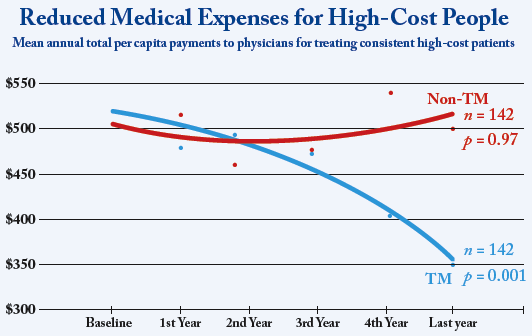 This chart shows the mean annual total per capita payments to physicians for treating consistent high-cost patients. The TM group’s physician expenses decreased by 28% over five years. The above trend lines show the general behavior of the physician fees for the two groups from the pre-intervention Baseline year through the 5 years of the study. All dollar values were adjusted for inflation and were expressed in constant 1992 Canadian dollars. P-values show the significance of the comparison of Baseline and Last Year for each group.
This study’s findings were similar to earlier ones. In a previous Canadian study, the TM group exhibited reduced medical expenses between 5% and 13% relative to comparison subjects each year for 6 consecutive years.
In a subsequent Canadian study of senior citizens, the TM group’s five-year cumulative reduction for people aged 65 years and older relative to comparison subjects was 70%. (See Meditation for Seniors May Lower Health Costs.)
In a sample of American health insurance enrollees, the TM participants had reduced rates of illness in all disease categories. An eleven-year, cross-sectional study in Iowa found that subjects age 45 and over who practiced the TM technique had 88% fewer hospital days compared with controls. Their medical expenditures were 60% below the norm.
Other studies, including randomized clinical trials, indicate the TM technique can improve physical and mental health, decrease tobacco use, reduce substance abuse, and decrease other unhealthy habits and risk factors that lead to chronic disease and costly treatments.
“This article has major policy significance for saving Medicare and Medicaid without cutting benefits or raising taxes,” said Herron. “Almost no intervention for cost containment has decreased medical expenditures by 28% over 5 years from a baseline. Now, it may be possible to rescue Medicare and Medicaid by adding coverage for learning the Transcendental Meditation technique.”
ADDENDUM
Americans are suffering from soaring levels of chronic stress due to economic problems, home foreclosures, high unemployment and underemployment, and lack of health insurance, which contributes to numerous health problems they cannot afford to treat.
The Huffington Post reported in May that U.S. health care costs per family more than doubled in nine years. Milliman, Inc., a premier global consulting and actuarial firm, released the results of their 2011 Milliman Medical Index, which measures the total cost of health care for a typical family of four covered by a preferred provider organization (PPO). The 2011 MMI cost is $19,393, an increase of 7.3% over 2010, which is the lowest annual rate of increase in more than a decade. Yet even though the rate of increase is the lowest in recent memory, the increase in total dollars—$1,319 in 2011—is the highest in the history of this study. Even with a historically low annual rate of increase, health care costs for American families reached $19,393 in 2011. In 2010, the average employee paid $8,008 for his family’s health care, up from $3,634 in 2002. To view the complete 2011 Milliman Medical Index, download the report.
At a time when health care costs are continuing to rise, the studies of Herron and his colleagues demonstrate that a natural preventative approach could help curb rising health care costs. Benjamin Franklin once said: “An ounce of prevention is worth a pound of cure.” Another way of saying it today would be, “An ounce of prevention costs considerably less than a pound of cure!”
The Transcendental Meditation Program
The Transcendental Meditation technique is an effortless procedure practiced 10-20 minutes twice a day sitting comfortably with the eyes closed.
TM is a simple natural mind-body practice that does not involve changes in personal beliefs, philosophy or lifestyle.
Over 350 peer-reviewed research studies on the TM technique confirm a wide range of benefits for mind, body and behavior.
Several studies have compared the effects of different meditation practices and found that Transcendental Meditation provides deeper rest and relaxation, and is more effective at reducing anxiety, depression and hypertension than other forms of meditation and relaxation. In addition, no other meditation practice shows the widespread coherence throughout all areas of the brain that is seen with Transcendental Meditation.
The Transcendental Meditation technique is taught in the United States by a non-profit, educational organization.
More information can be obtained by calling 888-LEARN-TM or visiting www.tm.org or www.AskTheDoctors.com.
Source: EurekAlert!
Also see: PsychCentral: TM Can Reduce Health Care Costs | TM Blog: New study: TM Reduces Health Care Costs by 28%
Fairfield Resident Helps Veterans Recover
Posted September 9, 2011 10:50 pm
by Kathleen Serino/SourceMedia Group News
FAIRFIELD – Meditation is the best medicine for military veterans, some say.
Filmmaker David Lynch is set to announce on Sunday a $500,000 matching grant to teach Transcendental Meditation to veterans and active military with Post-Traumatic Stress Disorder (PTSD), according to a news release from Operation Warrior Wellness, an outreach campaign sponsored by the David Lynch Foundation.
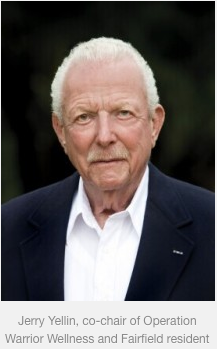 Lynch is inviting major donors to match the grant, which he hopes will be met by Veteran’s Day, Nov. 11, the release says. And Hollywood actors like Russell Brand and Paul McCartney are responding, said Jerry Yellin, co-chair of the initiative that he helped create in March 2010.
Yellin, a World War II veteran, Fairfield resident and author of “The Resilient Warrior, Healing the Hidden Wounds of War,” said he is currently giving four free presentations to 150 veterans in Minnesota on behalf of the campaign.
The 87-year-old said he suffered from PTSD for 30 years before he found Transcendental Meditation (TM), and now talks to veterans, active soldiers and their families about his story and how much it helped him recover.
“These guys are doing exactly what they should be doing and I hope they get their funding,” said Norman Rosenthal, MD, psychiatrist and clinical professor at Georgetown University.
Rosenthal, 61, a researcher on TM and PTSD said, “This very gentle technique had a very powerful effect within a month.”
“It relieves stress, and all of these guys have gone through stress. Big time,” said Yellin of the TM technique.
Yellin said his outreach continues with wife, Helene, and Vietnam veteran Dan Burks, also from Fairfield, to visit military bases, academies and other military organizations.
This entry was posted in War and tagged David Lynch, Fairfield Iowa, Jerry Yellin, Operation Warrior Wellness. Bookmark the permalink.
Responses:
Ken Chawkin says:
September 10, 2011 at 10:39 am
Thank you, Kathleen, for this inspiring and hopeful story. For more information, visit http://www.operationwarriorwellness.org/.
Also see: Star Tribune: Meditation brings peace to war vets | Medication or Meditation for Veterans with PTSD? | The Chippewa Herald: Soldiers with PTSD may benefit from meditation technique | WEAU13News: Veterans learn about meditation for treating post traumatic stress (includes video) | TwinCities.com Pioneer Press: Ruben Rosario: Recovered veteran’s latest mission: helping those like him | Global Good News: Health: Recovered veteran’s latest mission: helping those like him | Stars and Stripes: Celebrities push for transcendental meditation to treat PTSD
 National Office • 654 Madison Avenue • Suite 806 • New York, NY 10065 Tel: 212-644-9880 • OperationWarriorWellness.org
MEDICATION OR MEDITATION
FOR VETERANS WITH PTSD?
Filmmaker David Lynch Announces $500,000 Matching Grant
to Teach Transcendental Meditation to 10,000 Veterans
Iconic filmmaker David Lynch will announce this September 11 a $500,000 matching grant to be used to teach the Transcendental Meditation technique to 10,000 veterans with post-traumatic stress disorder (PTSD) and their families.
Lynch is inviting philanthropists and foundations to match the offer by Veterans Day, November 11, 2011.
Hollywood directors Clint Eastwood, Martin Scorsese, and George Lucas, as well as Dr. Mehmet Oz, Paul McCartney, Jerry Seinfeld, and Russell Brand have joined Lynch in support of the outreach.
Lynch’s veteran’s initiative comes from Operation Warrior Wellness (OWW), a division of the David Lynch Foundation, a 501(c)(3) nonprofit established in 2005 to bring Transcendental Meditation to at-risk populations.
Jerry Yellin, a distinguished World War II fighter pilot and national co-chair of Operation Warrior Wellness, said the need is urgent for Lynch’s initiative. “We are in a crisis of epidemic proportions. More soldiers died from suicide last year than died in combat. This is unconscionable. We must give our active duty personnel and our veterans something more than a handful of pills to help them overcome the nightmare of PTSD. Research shows Transcendental Meditation is the best way to go.”
Ed Schloeman, a Marine Vietnam service disabled veteran and national co-chair of Operation Warrior Wellness, says Americans need to help their military, now: “I call on civilian America to support the men and women who are returning from Iraq and Afghanistan—alive but wounded. Let’s come together for our military, as they have come together for us.”
Evidence-Based Meditation
According to Norman Rosenthal, M.D., psychiatrist, clinical professor of psychiatry at Georgetown University Medical School, and author of the New York Times bestseller, Transcendence, research on the Transcendental Meditation technique on OEF-OIF veterans as well as Vietnam veterans demonstrates its effectiveness for reducing symptoms of PTSD—and treating a number of the disorders associated with the illness. Findings include:
• Reduced PTSD: 40 to 50 percent reduction in PTSD symptoms, including depression, anxiety, flashbacks, and insomnia (see PTSD)
• Greater resiliency: Reduced stress levels and quicker recovery from stress (see Resiliency to stress)
• Reduced cardiovascular disease: Decreased blood pressure, harmful cholesterol, and atherosclerosis; and a 47 percent reduction in cardiovascular-related mortality (see Cardiovascular disease)
• Decreased substance abuse: Decreased smoking, alcohol, and drug abuse (see Substance abuse)
• Decreased medical expenditures: 14 percent reduction in annual medical expenditures, as compared to the norm (see Decreased healthcare utilization)
“Operation Warrior Wellness is giving our dedicated service men and women a meditation technique that is a traumatic stress buster—it’s not hocus-pocus,” said David Lynch. “When they get this simple, effortless technique they will get their lives back.”
Operation Warrior Wellness is working with veterans’ service organizations, army bases, and military colleges to bring Transcendental Meditation to active duty personnel and veterans and their families.
• For more information on how to contribute to the matching grant campaign of Operation Warrior Wellness, please contact Heather Hartnett at 212-644-9880, or email Heather@OperationWarriorWellness.org.
• Veterans of four wars, from WWII to the present, launched the OWW initiative in December 2010. Researchers and celebrities joined founding veterans Jerry Yellin, Ed Schloeman, and Col. Brian Rees, MD, at a press conference and inaugural gala event at the Metropolitan Museum of Art in New York City.
• In June this year, CNN anchor, Candy Crowley, hosted an event honoring the initiative at American University in Washington, DC. Crowley concluded: “The initial research offers so much hope: reduced anxiety, depression, hypervigilance, and insomnia, as well as reductions in substance abuse, violent behavior, and suicidal tendencies—better than many things being tried and at far less a cost.”
• For recent press coverage of Operation Warrior Wellness visit the OWW News and Archives.
• More news coverage, including interviews, and the NYC OWW launch at Urban Zen, is also available on this blog’s archive.
• To arrange press interviews with leaders of Operation Warrior Wellness, please contact Steve Yellin at 641-455-9999, or email Steven@OperationWarriorWellness.org.
News Reports: Steve Marinucci, Paul McCartney Examiner: Paul McCartney lends support to 9/11 TM veterans outreach | The PR Newswire press release, Medication or Meditation for Veterans With PTS?, was also posted by: The Sacramento Bee | MarketWatch | DigitalJournal.com | Hola Arkansas | SunHerald.com | SYS-CON Media | RedOrbit | MedIndia | Virtual Press Office: Filmmaker David Lynch Announces $500,000 Matching Grant to Teach Transcendental Meditation to 10,000 Veterans | SourceMedia Group: Kathleen Serino for Eastern Iowa News Now: Fairfield Resident Helps Veterans Recover (more articles listed there) | Odewire: Diving deep with David Lynch | Wall Street Journal: A Transcendental Cure for Post-Traumatic Stress by David Lynch and Norman E. Rosenthal | Huffington Post: What Meditation Did for Me: A War Vet’s Story.
Power brokers no longer motivate or medicate—they meditate. How Transcendental Meditation returned as the new status symbol.

A funny thing happened on the way to enlightenment. The quest got stripped of yogic posturing, Buddhist trappings, and even the last vestige of spirituality and turned into a search for the kind of clarity that might help us all in our worldly pursuits. Which is why movers and shakers are again embracing that seventies mainstay Transcendental Meditation. You’re likely to hear it spoken of reverentially in interviews: Russell Brand, whose wildman behavior was cartoonish in its intensity, credits TM with helping him to conquer his heroin, sex, and alcohol addictions. “After meditation,” he has said, “I felt this beautiful serenity and selfless connection.” And where celebrities venture (the latest wave of TM-ers includes the likes of Hugh Jackman and Naomi Watts), many of us are likely to follow. The rolls of practitioners have tripled in the past three years, according to the Transcendental Meditation Program, the practice’s national organization.
“The game-changer, I think, is David Lynch and his foundation,” says Dr. Norman E. Rosenthal, the Georgetown University psychiatry professor who wrote the recent best seller Transcendence: Healing and Transformation Through Transcendental Meditation. Lynch, the surrealist director of Twin Peaks, Blue Velvet, and Mulholland Dr., had been quietly practicing TM since, yes, the seventies, but about six years ago he came out of the closet, launching a foundation to promote the practice and later publishing a manifesto, Catching the Big Fish: Meditation, Consciousness, and Creativity.
It’s a process perfectly matched to our self-interested times—”no pain, but a lot of gain,” according to Rosenthal. Bob Roth, an executive director of the David Lynch Foundation, who taught TM to Brand and Moby, explains that when the mind has been calmed with the help of a mantra, a Sanskrit word given to each TM grad, it will effortlessly sink below the level of thought to “pure consciousness.” Practically speaking, sit in a chair, close your eyes, and silently repeat the mantra for 20 minutes. Once you get the hang of it, Lynch says, you cut the elevator cables of your normal-thinking mind to descend to a place that feels different. You may experience a connection with the universe or a mental light show, what Rosenthal calls “four-star graphic effects.” At the very least, you should be blissfully relaxed, which is the foundation of the health benefits that have been measured in the medical research amassed, much of it funded by the government. The deep tranquillity TM promotes quiets the body’s “fight or flight” stress response, lowering blood pressure and anxiety and combating depression.
Maharishi Mahesh Yogi, the so-called giggling guru, who hosted the Beatles and Mia Farrow, among others, was the innovator who stripped Hindu meditation practice of its religious baggage and repackaged it as a systematic, stress-reducing, creativity-building technique. Lynch, a disciple, is responsible for adding a fresh civic-mindedness to the game. His foundation aims to bring TM free of charge to those most in need of its calming effects—at-risk kids, prison inmates, veterans suffering from post-traumatic stress. That, of course, means fund-raising benefits, which means reeling in rich folk and entertainers (many introduced to TM by Lynch and Roth), all of which attracts media coverage and an increased brand awareness among those in the general public who might be willing to shell out $1,500 for the basic course.
“It was straight out of The Great Gatsby,” Rosenthal says of the poolside benefit party thrown this past June at the Malibu home of Juicy Couture cofounder Pam Levy and her TV-director husband, Jefery Levy. One imagines the vibes spreading to their neighbor Ryan Kavanaugh, CEO of Relativity Media, the freshly minted Converse-wearing, 36-year-old movie mogul who practices TM twice a day. Kavanaugh, who started out as a stockbroker, has leveraged his connections by allying with the New York hedge fund Elliot Associates, among other investors, giving his company the billions required to dominate Hollywood film production. But his secret weapon is his risk-assessment algorithm, a high-tech quantitative analysis of the big picture that he says allows him to make money even on box-office dogs.
As the New York hard-chargers who flock to the TM courses Roth teaches at the Center for Leadership Performance soon learn, this kind of success is not coincidental. According to published research, TM enhances neural activity in the part of the brain that houses the decision-making “executive center.” “The businesspeople say they’re more focused during the day,” Roth says. As do the other Gotham heavy hitters who’ve evangelized for TM and the Lynch Foundation, from Jerry Seinfeld and Heather Graham to Ben Foster and Howard Stern. Leave it to Mr. Katy Perry himself, speaking at a gala fund-raiser at the Metropolitan Museum of Art this past winter, to get at the essence of TM’s guilt-free marriage of creativity and commerce: “I literally had an idea drop into my brain the other day while I was meditating which I think is worth millions of dollars.”
Also on Details.com
Celebrity Om-Meter: The Top 10 Moments in Meditation History
Retreat, Relax, Recharge: Inside the World’s Best Spas
How to Avoid the Office Strain
Guy-Friendly Alternatives to Yoga
Also mentioned here: “MEDITATION NATION: How Transcendental Meditation returned as the new status symbol” –Details magazine
————-
Also listen to an excellent interview with Norman Rosenthal and Jenny Crwys-Williams on South Africa’s 702 Talk Radio. Click to download Podcast. It’s mentioned in this post: Meditation for Health, Happiness and Spirituality.
Click on these links and you’ll be inspired as I was by the amazing results of the TM-Quiet Time Program in some San Francisco schools:
Schools Students and teachers speak about their experiences with TM-Quiet Time Program in San Francisco schools. http://t.co/D0QJtvf
Laurent Valosek, director of the Center for Wellness and Educational Achievement, discusses the implementation and results of the TM-Quiet Time Program in the San Francisco Unified School District. http://t.co/dAfYdTw
James Dierke, Principal of Visitacion Valley Middle School in San Francisco, presents research findings on the TM-Quiet Time Program. http://t.co/m4INjFT
David Lynch, founder of the David Lynch Foundation, gives an inspiring address to educators about experiences with the Transcendental Meditation program. (Q & A with Bob Roth). http://t.co/6IZOggu
See the complete presentation of Meditation for Students: Results of the David Lynch Foundation’s Quiet Time/TM Program in San Francisco Schools
New study shows Transcendental Meditation improves brain functioning in ADHD students
A non-drug approach to enhance students’ ability to learn
A random-assignment controlled study published today in Mind & Brain, The Journal of Psychiatry (Vol 2, No 1, pp. 73–81) found improved brain functioning and decreased symptoms of attention-deficit/hyperactivity disorder, ADHD, in students practicing the Transcendental Meditation® (TM) technique. The paper, ADHD, Brain Functioning, and Transcendental Meditation Practice, is the second published study demonstrating TM’s ability to help students with attention-related difficulties.
 The first exploratory study, published in Current Issues in Education, followed a group of middle school students diagnosed with ADHD who meditated twice a day in school. After 3 months, researchers found over 50% reductions in stress, anxiety, and ADHD symptoms. During the study, a video was made of some students discussing what it felt like to have ADHD, and how those experiences changed after 3 months of regular TM practice.
In this second study, lead author, neuroscientist Fred Travis, PhD, director of the Center for Brain, Consciousness and Cognition, joined principal investigator Sarina J. Grosswald, EdD, a George Washington University-trained cognitive learning specialist, and co-researcher William Stixrud, PhD, a prominent Silver Spring, Maryland, clinical neuropsychologist, to investigate the effects of Transcendental Meditation practice on task performance and brain functioning in 18 ADHD students, ages 11-14 years.
The study was conducted over a period of 6 months in an independent school for children with language-based learning disabilities in Washington, DC. The study showed improved brain functioning, increased brain processing, and improved language-based skills among ADHD students practicing the Transcendental Meditation technique.
A local TV news station reported on the study in-progress during the first 3 months.
What was Measured
Students were pretested, randomly assigned to TM or delayed-start comparison groups, and post-tested at 3- and 6-months. Delayed-start students learned TM after the 3-month post-test.
EEG measurements of brain functioning were taken while students were performing a demanding computer-based visual-motor task. Successful performance on the task requires attention, focus, memory, and impulse control.
In addition, students were administered a verbal fluency test. This test measured higher-order executive functions, including initiation, simultaneous processing, and systematic retrieval of knowledge. Performance on this task depends on several fundamental cognitive components, including vocabulary knowledge, spelling, and attention.
Theta/Beta Power Ratios and ADHD
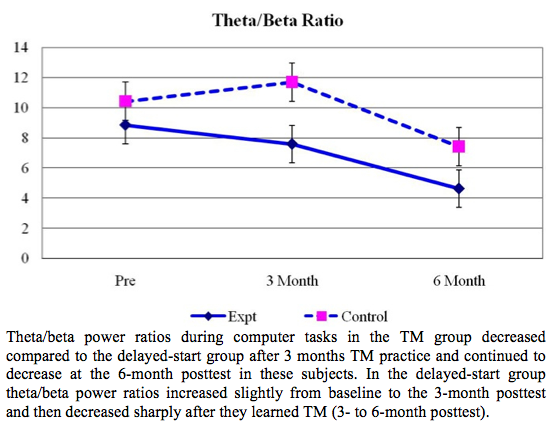 Using EEG measurements, the relationship of theta brain waves to beta brain waves can be diagnostic of ADHD. Dr. Joel Lubar of the University of Tennessee has demonstrated that the theta/beta ratio can very accurately identify students with ADHD from those without it.
While theta EEG around 4-5 Hz is commonly associated with daydreaming, drowsiness, and unfocused mental states, theta EEG around 6-8 Hz is seen when one focuses on inner mental tasks, such as memory processing, identifying, and associating.
“In normal individuals, theta activity in the brain during tasks suggests that the brain is blocking out irrelevant information so the person can focus on the task,” said Dr. Travis. “But, in individuals with ADHD, the theta activity is even higher, suggesting that the brain is also blocking out relevant information.”
“And when beta activity, which is associated with focus, is lower than normal,” Travis added, “it affects the ability to concentrate on task for extended periods of time.”
“Prior research shows ADHD children have slower brain development and a reduced ability to cope with stress,” said Dr. Stixrud. “Virtually everyone finds it difficult to pay attention, organize themselves and get things done when they’re under stress,” he explained. “Stress interferes with the ability to learn—it shuts down the brain. Functions such as attention, memory, organization, and integration are compromised.”
Why the TM Technique
“We chose the TM technique for this study because studies show that it increases brain function. We wanted to know if it would have a similar effect in the case of ADHD, and if it did, would that also improve the symptoms of ADHD,” said Dr. Grosswald.
Dr. Stixrud added, “Because stress significantly compromises attention and all of the key executive functions such as inhibition, working memory, organization, and mental flexibility, it made sense that a technique that can reduce a child’s level of stress should also improve his or her cognitive functioning.”
The Transcendental Meditation technique is an effortless, easy-to-learn practice, unique among categories of meditation. “TM does not require concentration, controlling the mind or disciplined focus—challenges for anyone with ADHD,” Grosswald added.
There is substantial research showing the effectiveness of the TM technique for reducing stress and anxiety, and improving cognitive functioning among the general population. “What’s significant about these new findings,” Grosswald said, “is that among children who have difficulty with focus and attention, we see the same results. The fact that these children are able to do TM, and do it easily, shows us that this technique may be particularly well-suited for children with ADHD.”
Transcendental Meditation produces an experience of restful alertness, which is associated with higher metabolic activity in the frontal and parietal parts of the brain, indicating alertness, along with decreased metabolic activity in the thalamus, which is involved in regulating arousal, and hyperactivity.
With regular practice, this restfully alert brain state, characteristic of the TM technique, becomes more present outside of meditation, allowing ADHD students to attend to tasks. “In a sense,” Dr. Travis said, “the repeated experience of the Transcendental Meditation technique trains the brain to function in a style opposite to that of ADHD.”
Improved Brain Functioning
During the practice of the Transcendental Meditation technique, coherence is found across different EEG frequencies. After meditation, the brain utilizes this increased functioning ability to support the performance of a task in an integrated manner.
Three months of TM practice resulted in significant decreases in theta/beta ratios and increased verbal fluency. This translates into improved executive function and more efficient cognitive processing.
During the first 3 months of the study, the theta/beta ratios of the control group (delayed start) actually increased. After learning, and practicing TM for 3 months, this group experienced dramatic decreases in theta/beta ratios and increased verbal fluency as well.
Student and Parent Surveys
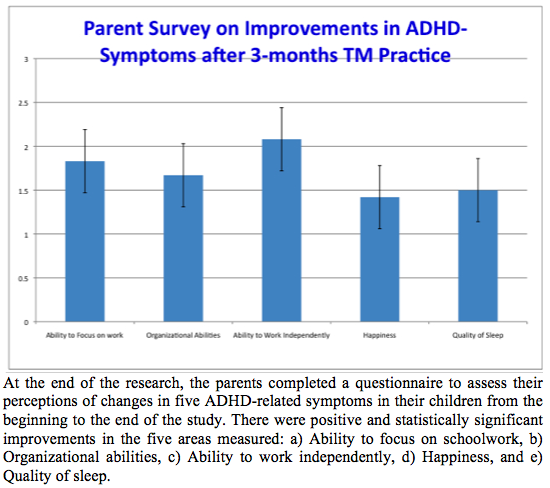 Students reported that the TM technique was enjoyable and easy to do. They felt calmer, less stressed, and better able to concentrate on their schoolwork. They also said they were happier since they started TM. This correlated with reports from the parents.
At the end of the research, the parents completed a questionnaire to assess their perceptions of changes in five ADHD-related symptoms in their children from the beginning to the end of the study. There were positive and statistically significant improvements in the five areas measured: a) Ability to focus on schoolwork, b) Organizational abilities, c) Ability to work independently, d) Happiness, and e) Quality of sleep.
Promising Results
The combined results were significant. There was a 48% reduction in the theta/beta power ratios and a 30% increase in brain coherence after the 6-month period. Studies have shown that pharmaceuticals decrease theta/beta power ratios by 3%, and neurofeedback by 25%.
“These are very encouraging findings,” said Dr. Stixrud. “Significant improvement in the theta/beta ratio without medication and without having to use any expensive equipment is a big deal, as is significant improvement in student happiness and student academic functioning reported by the parents.”
“While stimulant medication is very beneficial for some of my clients with ADHD,” Stixrud added, “the number of children who receive great benefit from medicine with minimal side-effects is relatively small. The fact that TM appears to improve attention and executive functions, and significantly reduces stress with no negative side-effects, is clearly very promising.” Stixrud said he hoped these findings would lead to more research on the use of TM with children and adolescents.
In conclusion, these findings warrant additional research to assess the impact of Transcendental Meditation practice as a non-drug treatment for ADHD, and to track meditating students’ improved academic achievements.
The study was funded by a grant from the David Lynch Foundation.
###
FACT SHEET
Attention-Deficit/Hyperactivity Disorder (ADHD)
The Transcendental Meditation Technique
Source: EurekAlert!
Some Media Coverage: PhysOrg.com: New study shows Transcendental Meditation improves brain functioning in ADHD Students, PsychCentral.com: Transcendental Meditation Lessens Kids’ ADHD Symptoms, eMaxHealth: Transcendental Meditation Improves ADHD Symptoms, Academic Skills, ADHD/ADD Natural Remedy Report: New study shows Transcendental Meditation improves brain functioning in ADHD students, GGN-Education News: New study shows Transcendental Meditation improves brain functioning in ADHD students, Part 2, Part 3, Part 4, Part 5; The Times of India: Transcendental meditation for the brain, Health24: Meditation boosts brain functioning, RedOrbit: New Study Shows Transcendental Meditation Improves Brain Functioning In ADHD Students, The Behavioral Medicine Report: Transcendental Meditation Improves Brain Functioning In Students With ADHD, Science News Line medicine, Science Codex, Transcendental Meditation Blog: New study finds TM boosts brain functioning and helps students with ADHD, GoodTherapy.org: Children with ADHD May Benefit from Transcendental Meditation, and many others.
By DAVID LYNCH and NORMAN E. ROSENTHAL
War wounds come in many forms. Some are obvious, such as scars, gashes and amputations. Others, the psychological ones, are less visible but equally devastating. The numbers in this second group are staggering: The military’s latest mental health survey of combat troops in Afghanistan found that 20%—one in five—suffer from post-traumatic stress disorder.
People with combat-related PTSD often suffer from periods of emotional numbness and depression that may coexist or alternate with intense anxiety and delusional thinking. Their days may be afflicted by flashbacks to traumatic situations. Their nights are often disrupted by sleeplessness and nightmares, from which they awake drenched in sweat as though back on the battlefield.
Yet most veterans with PTSD do not receive adequate treatment for various reasons, including fear of stigma, a dearth of effective treatments, and insufficient government resources. Gen. Peter Chiarelli, vice chief of staff of the U.S. Army, recently acknowledged that, “The therapies used for treatment of brain injuries lag behind the advanced medical science employed for treating mechanical injuries.”
Clearly, there is a need for new, creative approaches: Transcendental Meditation, better known as TM, is a promising candidate. An ancient Vedic technique developed in India, TM was brought to the West in the late 1950s by Maharishi Mahesh Yogi. It involves sitting comfortably with eyes closed for 20 minutes twice a day while thinking a mantra. It does not require adherence to any religious belief system or ritual practices. Yet to date there are over 340 peer-reviewed papers describing the beneficial effects of TM on the mind and body.

The David Lynch Foundation recently hosted an event to help raise funds to teach TM to our wounded warriors returning home from Iraq and Afghanistan. We heard from veterans of three wars: Jerry Yellin, a fighter pilot in World War II who flew 19 missions over Japan; Dan Burks, who served in Vietnam; and David George, a veteran of Operation Iraqi Freedom. Despite differences in age and wartime experiences, these men had two things in common: All suffered terribly from PTSD, and all experienced tremendous relief from TM. Life became once again peaceful and even joyful for them.
What was clear from these men’s stories was how great a toll their symptoms took on their families, as well as on themselves. In a poignant video, Mr. George’s mother described the transformation of her son from a courteous young man into a hard-drinking, depressed and deeply disturbed veteran, who she feared would take his own life or someone else’s.
All that changed when Mr. George began to meditate on a regular basis. According to Ms. George, TM saved her son’s life.
In a study of Vietnam vets conducted by James S. Brooks and Thomas Scarano and published in the Journal of Counseling and Development in November 1985, TM outperformed the conventional psychotherapy of the day. More recently, a pilot study of five Iraq and Afghanistan veterans published in the June 2011 issue of Military Medicine showed a 50% reduction in PTSD symptoms after just eight weeks of practicing TM.
There is a scientific basis for the observed benefits of TM for combat-related PTSD. In several studies, TM has been shown to buffer fight-or-flight responses, which are thought to be overactive in people with PTSD, as evidenced by their hypervigilance, anxiety and exaggerated startle responses.
In addition, TM has been found to reduce blood pressure and decrease the risk of heart attacks and strokes—other conditions in which an overactive fight-or-flight response may play a role. In a similar manner, TM may modulate nervous system responses, thereby allowing affected veterans to relax and leave behind the traumas of war.
Regardless of how TM helps, the mounting evidence leads to one conclusion: If a simple, low-cost technique like TM can substantially alleviate the suffering of even some of the thousands of veterans afflicted with PTSD, how can we afford not to give it a try?
Mr. Lynch is a filmmaker and the founder of the David Lynch Foundation. Dr. Rosenthal is a clinical professor of psychiatry at Georgetown University Medical School and the author of “Transcendence: Healing and Transformation Through Transcendental Meditation” (Tarcher-Penguin, 2011).
Photo credit: Associated Press
Link to article: http://on.wsj.com/rg8tYC
WSJ: LETTERS: VA Meditating on Good Therapies, July 22, 2011
In “A Transcendental Cure for Post-Traumatic Stress” (op-ed, July 13) David Lynch and Norman E. Rosenthal pose a challenge for the federal agency entrusted with caring for our nation’s 23 million veterans: “If a simple, low-cost technique like TM can substantially alleviate the suffering of even some of the thousands of veterans afflicted with PTSD, how can we afford not to give it a try?” In fact, Transcendental Meditation has received substantial attention at the Department of Veterans Affairs, the Department of Defense and the National Institutes of Health. Indeed, meditation and other forms of complementary and alternative medicine are already used at VA to help veterans suffering from PTSD. We have embarked on a series of clinical investigations to evaluate all forms of meditation, TM among them, in order to determine whether this promising technique can produce results consistently for our patients, and which kind of meditation, from among several practiced widely today, would be most helpful to them. VA is beginning demonstration projects across the country in different care settings. We are looking for a simple, natural, culturally neutral and repeatable technique that can augment existing PTSD treatments. These studies require us to be open to new techniques for prevention and treatment, as well as structured in our approach to determining their value and efficacy. The studies already conducted, and those currently underway, are listed at http://tinyurl.com/3gx74o3.
The promising personal experiences mentioned in the article and the dedicated efforts of our VA, DoD and NIH team offer us all hope for finding more effective treatments for PTSD. We can’t afford not to.
W. Scott Gould
Deputy Secretary
DVA
Robert A. Petzel, M.D.
Under Secretary for Health
DVA
Washington
 The Uncarved Blog