Posts Tagged ‘Transcendental Meditation’

Transcendental Meditation Effective Antidote to Record Stress Levels in School Students

November 16, 2011

Transcendental Meditation Effective Antidote
To Record Stress Levels in School Students
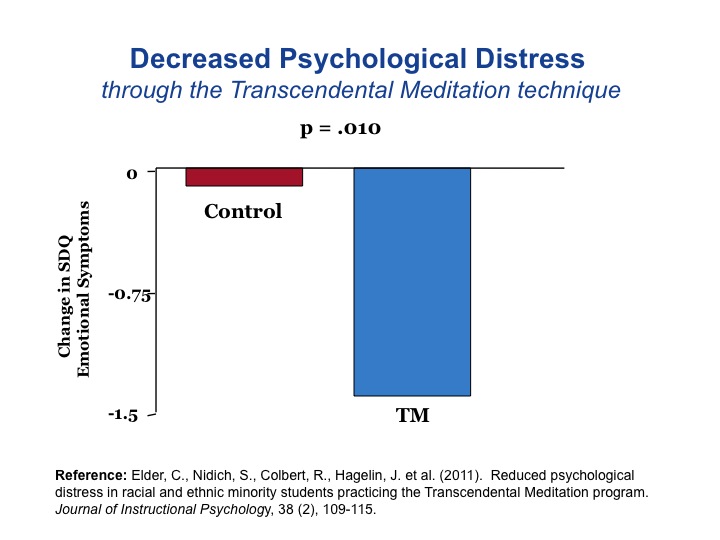
This graph shows a 36 percent reduction in psychological distress in 106 at-risk racial and ethnic minority students practicing the Transcendental Meditation technique compared to controls over a period of 4 months (p=.010). Significant decreases were also found in trait anxiety and depressive symptoms.

With record levels of student stress reported in a recent UCLA survey, can a simple stress-reducing meditation technique be a viable solution?

A new study published in the Journal of Instructional Psychology found the Transcendental Meditation (TM) technique significantly decreased psychological distress in public school students. The study, conducted with at-risk minority secondary school students, showed a 36 percent reduction in overall psychological distress. Significant decreases were also found in trait anxiety and depressive symptoms.

Rising Stress Levels Affect Emotional and Physical Health

The percentage of students in the UCLA survey reporting good or above-average high school emotional health dropped from 55.3 percent in 2009 to 51.9 percent in 2010. This marks the lowest level within the past 25 years.

Dr. Charles Elder, MD, lead author of the TM study, and investigator at Kaiser Permanente Center for Health Research, emphasized the important implications of the findings on reduced stress. “It is vital that we start addressing the high levels of emotional stress being reported by high school and college students. Decreased stress can have a positive impact on mental health, and can also reduce the risk for hypertension, obesity, and diabetes—major risk factors for heart disease,” explained Dr. Elder.

Educational research has also linked student stress to negative school behavior and poor academic performance.

Promising Findings for Education

“These new findings on reduced stress, along with the recent research on academic achievement gains, hold tremendous promise for public education,” said Sanford Nidich, EdD, principal investigator, and professor of education at Maharishi University of Management. “There is a growing body of evidence showing Transcendental Meditation to be an easy to implement, value-added educational program that promotes emotional health and increases academic achievement in at-risk students,” said Dr. Nidich.

A total of 106 secondary school students, 87% racial and ethnic minorities, took part in the study. Results showed that over a four-month period, students practicing Transcendental Meditation as part of their schools’ Quiet Time program exhibited significant reductions in psychological distress factors compared to controls.

According to James Dierke, 2008 National Association of Secondary School Principals—National Middle School Principal of the Year, “Stress is the number one enemy of public education, especially in inner-city schools. It creates tension, violence, and compromises the cognitive and psychological capacity of students to learn and grow. The TM/Quiet Time program is the most powerful, effective program I have come across in my 39 years as a public school educator for addressing this problem. It is nourishing children and providing them an immensely valuable tool for life. It is saving lives.”

The study was supported by the David Lynch Foundation.

Study Facts

  • This study evaluated change in psychological distress factors in students practicing the Transcendental Meditation program compared to non-meditating controls. A total of 106 students (68 meditating and 38 non-meditating students), took part in the study. The study included students from four public secondary schools.
  • Eighty-seven percent were racial and ethnic minority students, including 26% Hispanic, 25% African American, and 19% American Indian.
  • The Transcendental Meditation program was practiced in class twice a day as part of the schools’ Quiet Time program for four months prior to posttesting.
  • The Transcendental Meditation program was taught in the context of school-wide Quiet Time programs in which students voluntarily chose the Quiet Time program in which they wanted to participate.
  • Transcendental Meditation is a simple, natural, effortless technique that allows the mind to settle down and experience a silent yet awake state of awareness, a state of “restful alertness.” Practice of this stress-reduction program does not involve any change in beliefs, values, religion, or lifestyle.
  • Compared to eyes-closed rest, research has found that Transcendental Meditation practice is characterized by decreased activation or arousal of the autonomic nervous system, as reflected in decreased breath rate and lower sympathetic nervous system activity. The Transcendental Meditation program has been shown to increase electroencephalographic (EEG) brain integration and coherence, especially in the frontal area of the brain, responsible for higher-order processing.
  • Other published research on high school and college students has shown reduced psychological distress, improved positive coping ability, decreased blood pressure, reduced cardiovascular reactivity to stressful stimuli, reduced absenteeism, and decreased school suspensions.
  • Results of the current study indicated significant reductions in overall psychological distress (p=.010) and trait anxiety (p=.035) compared to controls. Within-in group differences in depressive symptoms were found for meditating students (p=.003).

Source: EurekAlert!

Reported on: Science Codex, sciencenewslinemedicine, PsychCentral: Meditation May Help Ease School Stress, Times of India: Beat stress with transcendental meditation (IANS), The Behavioral Medicine Report: Transcendental Meditation Significantly Decreased Psychological Distress In Public School Students, among others.

TM Blog: New research finds TM helps ease school stress, Ken Chawkin.

See related study: New research shows Transcendental Meditation improves standardized academic achievement.


Global Peace Initiative: 13 Questions and Answers with Ramani Ayer

November 6, 2011

Global Peace Initiative: 13 Questions & Answers with Ramani Ayer

Ramani Ayer, former Chairman and CEO of The Hartford Financial Services Group (USA), Chairman of the Brahmananda Saraswati Foundation Development Council

1. What is the Global Peace Initiative?

Ramani: It is a powerful, practical, scientific, and highly cost-effective initiative to reduce violence and conflict in the world. We call it a “brain-based approach to peace.”

2. What do you mean by a “brain-based approach to peace?” And how is it different than other approaches to reduce conflict and terrorism?

Ramani: I think the approach is different because conventional approaches to reducing social violence don’t address the underlying cause which is acute societal stress—whether its political, ethnic, or religious. All of our behavior is directly linked to brain functioning. We know now how stress impacts the brain. It shuts down the prefrontal cortex—the CEO of the brain. Everyone has heard of the “fight or flight” response. Stress can also over stimulate the amygdala, the brain’s “fear center,” causing fear-driven, and aggressive, violent, antisocial behavior. Acute stress on a societal scale impacts the brain and behavior of everyone in society, and that fuels crime and social violence. The brain-based approach to peace solves the problem on a deeper level.

3. How does it work?

Ramani: It is actually simple to understand. Extensive scientific research shows that an easy to learn, evidence-based meditation practice, revived by Maharishi Mahesh Yogi from the Vedic Tradition of India called Transcendental Meditation (TM) dramatically reduces acute individual stress and its deleterious effects on brain and behavior in a far more effective way then other methods. Equally important, TM and its advanced procedures called the TM-Sidhi program activate the prefrontal cortex and different areas of the brain, while deactivating the amygdala—the fear center of the brain. Research has shown it to be highly effective in treating acutely stressed individuals –even difficult cases such as soldiers with PTSD and prisoners in jail.

4. I can understand how meditation works to reduce stress in a person, but how does it reduce societal violence?

Ramani: I do not think it is surprising that if you reduce stress on an individual level, it causes a corresponding reduction of stress on the societal level. But what is surprising, and what has been shown by extensive research, is that a small proportion of a population practicing TM and the TM Sidhi program in a group produces a significant reduction in social stress, and crime and violence. To understand how it actually works, one has to turn to a “field model of consciousness” in which consciousness, at its deepest level, is a field that underlies and connects individuals throughout society.

5. Isn’t a “field model of consciousness” beyond our current theories?

Ramani: It may seem to be, but such a theory is consistent with the latest findings of physics, physiology and neuroscience. In any such model the peace promoting influence of a group will grow as the square of the size of the group. This is what makes the  “brain-based approach to peace” practical. It only takes about 9000 individuals—the square root of 1% of the world’s population practicing the TM and TM-Sidhi program in a group in one place to create an effect large enough to significantly reduce global violence and conflict.

6. Is there any proof?

Ramani: Yes. To date there have been over 50 demonstration projects and 23 scientific studies that confirm the effectiveness of the “brain-based approach to peace.” This research has been carefully scrutinized by independent scholars and published in top academic journals. The demonstration projects have been conducted in many parts of the world including those most prone to violence, such as the Middle East. What the demonstrations show is a dramatic reduction in violence, crime, and war and increased peace and positivity in society. As far as I am aware, there is no approach to create peace that has been so thoroughly tested and rigorously established.

7. Have any of these demonstrations been conducted in India?

Ramani: The first sustained global demonstration project of this approach was held in India from 1987-1990. It involved a group of 7,000 highly trained Maharishi Vedic Pandits from India. The group was located for several years in Noida, outside Delhi.  During the time of the demonstration there were historic, unprecedented, totally unexpected changes in the world: the fall of the Berlin Wall, the end of apartheid, end of the Cold War. It was an amazing time for our world family.

8. Why did the demonstration end?

Ramani: Quite simply, we ran out of funds to support the large group of Maharishi Vedic Pandits. Today, with a larger world population than the 1980’s, in order to create and maintain this peaceful effect on a global scale will require a permanent group of 9000 Vedic experts in one place. This is the square root of one percent of the world’s population, which is a formula derived from science. To endow such a group requires a fund of about $1.1 billion—which is negligible when compared to the 8 trillion cost of global violence in 2010.

9. Why was a large group of Vedic Pandits from India used to create the effect of peace? Could not any group practicing TM and the more advanced TM-Sidhi program create the effect?

Ramani: Yes, any sufficiently large group of properly trained advanced meditation experts can create this coherent and peaceful effect. But the Maharishi Vedic Pandits, who also practice Transcendental Meditation and its advanced techniques, have a crucial advantage. As beneficiaries of their great family traditions for centuries, these Vedic Pandits have learned how to recite in Sanskrit specific peace-promoting sounds from the level of the Unified Field, the Transcendent—sounds that Maharishi describes as “reverberations of Natural Law.” Through this precise art and science of Vedic recitation, the Vedic Pandits amplify the peace-creating effect. It is for this reason that Maharishi said, “When the Vedic Families of India are able to uphold their tradition of daily recitation of the Vedas from the transcendental level of consciousness then the whole world enjoys peace.”

10. Are there any efforts underway now to build and maintain a large group of Vedic experts?

Ramani: Yes. Maharishi Mahesh Yogi, the founder of this Vedic Peace Technology and the Global Peace Initiative, created in the geographical center of India (near Jabalpur) a 1,700-acre campus for Vedic Pandits. Currently, there are 1,500 Vedic experts in residence there. And very fortunately, in America, at Maharishi Vedic City in Iowa, there is a second campus with about 1,000 Vedic Pandits.  Our goal is to raise the number to 9,000 Vedic experts in India and 1,250 Vedic experts in the USA. This will complete the first phase of the Global Peace Initiative. Subsequent phases will focus on creating additional groups of Vedic experts sufficient to focus specifically on individual countries.

11. What is the money used for that is being raised?

Ramani: Donations from around the world principally are received by The Brahmananda Saraswati Foundation (BSF), a tax-exempt (501c3) organization in the U.S and it’s sister organization in Europe that shares its goals and mandate. The foundation is independently audited. Maharishi established the trust in the name of his Guru, Swami Brahmananda Saraswati, to create a permanent financial basis for peace for the world. The funds are used to create infrastructure on the campuses, train the Vedic experts (which takes years to do), and then pay the Vedic experts an appropriate salary.

12. What kind of training do the Vedic Pandits receive?

Ramani: It is a very thorough training that takes place in three phases. The first phase is in the local villages; the second phase is in regional centers; and the third phase is in the national centers established throughout India. It is important to note that those who complete the training receive academic degrees from Maharishi Vedic Vishwa Vidyalaya, a statutory University established by the government of Madhya Pradesh in India. In the past Maharishi’s organization has actually trained about 50,000 of these Vedic experts, but never been able to maintain them in a group.

13. You were CEO of one of the largest financial firms in the world. How did you get involved in this initiative?

Ramani: I personally had benefited in my own life by practicing Transcendental Meditation. It helped me in so many ways as an individual. And when I met Maharishi, and I saw his deep concern for the future of the world and how he had worked most of his life to create this opportunity for mankind, I really felt I should do whatever I could to see his work come to fruition. Most people don’t even think world peace is possible, that it’s a dream. But I am convinced we now have a scientific, practical, and reliable way to use mankind’s most ancient knowledge, the Veda, to usher in a new destiny for mankind. It’s a very big thing—historic—and it is a joy to be part of the global efforts. As Indians who cherish the Vedic tradition in our hearts, we should feel very proud that this great knowledge has given us a practical means to create peace in the world.

For more information, visit www.GlobalPeaceInitiative.org and www.VedicPandits.org.

See: Chandrika Tandon Concert to Benefit 1000 Maharishi Vedic Pandits Launches Global Peace Initiative and Chandrika Tandon Benefit Concert in Iowa Helps Launch Global Peace Initiative.

Chandrika Tandon Concert to Benefit 1000 Maharishi Vedic Pandits Launches Global Peace Initiative

November 5, 2011

Chandrika Tandon Concert to Benefit 1000 Maharishi Vedic Pandits Launches Global Peace Initiative

Chandrika Krishnamurthy Tandon, a 2011 Grammy nominee for world music, will perform a benefit concert Sunday, November 6, at the Sondheim Center for the Performing Arts in Fairfield, Iowa, as the grand finale of the Vedic Visitors Weekend taking place November 4-7.

Sponsored by the Global Peace Initiative, the Vedic Visitors Weekend will offer influential Indo-American leaders a taste of one of the most Vedic communities in North America — Maharishi Vedic City, just north of the campus of Maharishi University of Management in Fairfield, Iowa.

“This special concert will launch the Global Peace Initiative, an intensified global effort to establish large, permanent groups of Maharishi Vedic Pandits in India and America,” said Raja John Hagelin. “These two groups will create an unshakable foundation for lasting peace and the fulfillment of Maharishi’s great legacy for the world.”

A world-renowned performer, Ms. Tandon is known for music that celebrates the grace in our innermost selves. The concert will be a major production, with Ms. Tandon bringing her seven-piece ensemble from New York City.

She will also be joined by some of Fairfield’s finest musicians, including Rick Stanley, Tim Britton, Werner Elmker, and more.

“Chandrika’s soulful and refined music matches the expansive mission of the Global Peace Initiative,” said event producer Michael Sternfeld. Ms. Tandon was trained by masters in Hindustani, Carnatic, South American, and jazz traditions. Her album Soul Call has topped world music charts and garnered great acclaim, including a Grammy nomination.

Ms. Tandon was recently instructed in the Transcendental Meditation program. Proceeds from the concert will go to help support the Vedic Pandits.

“This event also presents a special opportunity for our community to express their heartfelt appreciation to the Maharishi Vedic Pandits for all they do to nourish our community and the world on so many levels,” said Maureen Wynne, chief development officer of the Global Peace Initiative.

The concert will be Sunday, November 6, at 7:45 p.m. at the Sondheim Center for the Performing Arts in the Fairfield Arts & Convention Center.

General admission is $15, and $8 for MUM students, faculty, and staff. Tickets are available at the Sondheim box office, online at http://www.FairfieldACC.com, and by phone at 641-472-2787.

Dozens of Indo-American leaders are expected for the weekend. They will enjoy a tour of Maharishi Vedic City, including Maharishi Vastu® homes, the Maharishi Vedic Observatory™, and the Maharishi Vedic Organic AgricultureSM  program.

They will also visit the Maharishi Vedic Pandit campus and have the opportunity to attend classes at Maharishi University of Management.

————
Also reported in Iowa Association of Private Colleges and Universities: Grammy Nominated Musician Performs at MUM.

See: Global Peace Initiative: 13 Questions and Answers with Ramani Ayer, Chandrika Tandon Benefit Concert in Iowa Helps Launch Global Peace Initiative.


Jeffrey Abramson: Transcending Green

October 25, 2011

Jeffrey Abramson: Transcending Green

Jeffrey Abramson gave an excellent speech on the value of Vedic architecture at the May, 2011 Garrison Institute’s Symposium on Climate, Buildings, and Behavior. In addition to constructing a LEED platinum certified office building, Jeffrey wanted to go beyond green, and incorporated Vedic architectural design principles in The Tower Companies new head office at 2000 Tower Oaks Boulevard in Rockville, MD. The Tower Companies mission is to create eco-progressive spaces that transcend traditional approaches to the built environment.

Employees spend many long hours at work and represent a major cost in running any business. In his talk, Jeffery explains why it makes good business sense to invest in the health and well-being of his employees by not only providing a work environment built in accord with natural law, but also offering them the Transcendental Meditation program. These progressive approaches helped reduce stress, improved morale, increased output, reduced health insurance costs, and improved the company’s bottom line. Below is the video and description posted by the Garrison Institute.

Uploaded by GarrisonInstitute on Jul 1, 2011
At the Garrison Institute’s 2011 Climate, Buildings and Behavior Symposium, Jeffrey Abramson of Tower Companies describes his company’s building practice rooted in Vedic architecture. He posed the question, can we get people to think and act in a way that is spontaneously in accord with natural law by employing architecture and design that is in accord with natural law?

The answer to happiness lies within us. In the grips of the recession some TM can help, writes Barry Egan of The Independent

October 23, 2011

Health

The answer to happiness lies within us

In the grips of the recession some Transcendental Meditation can help, writes Barry Egan

Sunday, October 23, 2011

If there ever was a time that Ireland needed a little spirituality it is surely now.

Wise men of thought (wiser than the dour, sourpuss economists who seem to get off on telling us the bad times are only going to get badder) have long told us that meditation is a more substantial reality than that which we normally take to be reality. Many people are searching for a more meaningful existence, and Transcendental Meditation (TM) is providing the answer for some; myself included, my mum was dead a year last Sunday and TM helped me through some if not all of that darkness.

Next Tuesday, Transcendental Meditation Ireland will try to answer the need for something deeper in a country and a people shaken by recession with the public launch of the new TM website.

“It’s obvious that many people in Ireland have become very disillusioned with life,” influential TM teacher Noel O’Neill told me. “The material dream that had been held up to them has been pulled out from under their feet and many are left with nothing but debts and a life-long mortgage. Even the people who are not financially crippled are facing ever increasing levels of stress. TM is becoming increasingly recognised as a means of dealing with these stressful situations. When we practise TM we become aware of an inner aspect of our lives, a silent level of our minds which is untouched by the chaos going on around us. We discover a sense of happiness which is dependent on nothing else but ourselves, we become more self-reliant and don’t let our situation overwhelm us,” Noel says, adding that the new site — www.tm-ireland.org — contains endorsements of TM by the likes of David Lynch, Paul McCartney, Clint Eastwood, Jerry Seinfeld and a whole host of Irish TM luminaries like Dr Donn Brennan.

Hollywood actress Eva Mendes credits TM with having a positive effect on her career. In a recent interview, she spoke of the virtues of TM.

“I’m actually huge into meditation, Transcendental Meditation, and that really helps create not only a sense of balance, but serenity and a calm state of mind. It helps me deal with life’s ups and downs,” she says.

She also spoke of the influence of Hollywood director David Lynch’s book on TM and creativity, Catching the Big Fish, and how the technique has helped her as an actor.

“All aspects of life improve with TM — mental, physical and spiritual,” says Noel. “The research is there for anyone to see. Now we need a new formula for living life. We are ‘human beings’, it’s the aspect of ‘being’ that has been ignored in life. We are only aware of the surface values of life, our happiness is dependent on outside things, how much we get paid, how big your house is etc, but as we now know all these things are subject to very rapid change.

“Being, the silent field of creativity that lies deep within everyone, however, is not subject to change, and it is this aspect of life, this side of our nature that we experience and enliven when we practise TM. True lasting happiness can only come from within us.”

Noel says that there is an upsurge in interest in TM worldwide. “Oprah Winfrey surprised the ladies of Fairfield, Iowa, who practise Maharishi Mahesh Yogi‘s Transcendental Meditation when she meditated with them last Wednesday evening,” he says.

Drogheda GP Dr Alan Moran says he looked into TM, and saw how relaxed it left people, how it lowered blood pressure, and left people with an overall feeling of calmness and wellness. Their thoughts were clearer, they slept better and seemed to adjust to life’s ups and downs better.

“Daily I meet people who I feel could benefit from TM I see them suffering in large and small ways from worries and annoyances that they have allowed under their skins. People ask if I do TM, I say it’s a bit like a stockbroker who comes across a fund which is doing really well, is stable, and has a long history of doing well and paying dividends to those who are part of it. Would that stockbroker then buy shares in that fund?”

Noel O’Neill adds that the new Irish site will give up-to-the minute details of all the latest research on TM.

The site will also include details about a new book by internationally respected psychiatrist, Norman E Rosenthal, Transcendence: Healing and Transformation through Transcendental Meditation.

“The site will answer any commonly asked questions,” says Noel, who will speak at its public launch at 3pm on Tuesday in Buswells Hotel, Dublin, along with Dr Donn Brennan GP, Dr Joe Hayden (TM Ireland national director) and TM teacher John Burns.

More information on TM can be obtained by visiting www.tm-ireland.org or by contacting Noel O’Neill at 012845742/0861946792 or noeloneill@tm-ireland.org.

Originally published in http://shar.es/bhJQg

————–
Also listen to an excellent interview with Norman Rosenthal and Jenny Crwys-Williams on South Africa’s 702 Talk Radio. Click to download Podcast. It’s mentioned in this post: Meditation for Health, Happiness and Spirituality.

Reports of Oprah’s visit to Fairfield, Iowa

October 22, 2011

Oprah visits Maharishi School, Fairfield

Fairfield (IA) Ledger

By DIANE VANCE, Ledger staff writer | Oct 20, 2011
“It was a tremendous honor to have Oprah Winfrey here even for a brief visit,” said Richard Beall, director of Maharishi School. “We’ve been in communication for some time about this visit; it’s hard to believe it’s actually happened.”

Oprah came to the kindergarten through 12th grade private school around 11:30 a.m. Wednesday on a planned visit. She brought an entourage of film and production crews.

Fairfield Police Chief Julie Harvey said Oprah’s visit included her trip to Maharishi School, a visit to the campus of Vedic scholars (the pundits in Maharishi Vedic City), a visit to a private residence, coffee at Cafe´ Paradiso and meditating in the women’s dome. She left Fairfield airport about 6:30 p.m.

Beall escorted Oprah around Maharishi School to the places she had indicated an interest in visiting. The crews mostly went separate, pre-assigned ways, he said.

“She had an opportunity to watch the children’s meditation,” said Beall. “Then she participated in meditation with older students.

“She talked briefly with all of the high school students, boys and girls. She selected a few students to interview more closely,” said Beall. “All together, she interviewed about 10 students.”

Beall said a lot of cameras were around, but they all belonged to Oprah’s people. It was Oprah’s request to not have publicity about her visit.

“I was so busy, I didn’t really think about photos,” said Beall. “If Oprah’s people release any of the photos, then we’ll have some.”

All MSAE staff were told not to bring cameras or gifts to school, another source reported.

“She’s an absolutely remarkable person,” said Beall. “She’s clearly passionate – and compassionate of others.”

Oprah left the school around 1 p.m.

About three hours later, she was seen around Fairfield’s square.

“My wife Linda and I were driving over to pick up The Ledger in the late afternoon,” said Ralph Messerli this morning by phone. “We saw a commotion, a bunch of people clustered on the sidewalk near George’s Pizza. My wife said, ‘that looks like Oprah!’ and I said, ‘yeah, right.’

“We saw a parking space and started to pull in. Police Chief Julie Harvey was standing nearby and motioned us to go ahead and pull in,” said Messerli. “Then I see a gal who looks like Oprah. It was Oprah! She was talking with Fairfield folks, shaking hands and letting people take pictures with her.”

The Messerlis stayed in their car, observing.

“After she took some pictures, she walked over to our car, stuck her hand in to shake ours,” said Messerli. “We said some nice things and chatted briefly. It was pretty informal.”

Messerli said they don’t watch the Oprah show normally, but have caught a few now and then.

“She’s certainly made her impact,” he said. “She’s quite a lady.”

Married Maharishi University of Management students, Baruti and Mina KMT-Sisouvong had taken an afternoon walk and stopped at Cafe´ Paradiso about 4:15 p.m.

“I ordered a wonderful organic, raw, chocolate cheese cake,” said Baruti by phone today. “My wife and I sat down to enjoy our coffee and cake – and in walked Oprah.”

Two bodyguards and a few staff accompanied her.

“She saw my sweatshirt and made a connection,” said Baruti.

He was wearing a Morehouse College, Atlanta, sweatshirt.

“She let out a ‘Moor-house’ in the way it’s said around campus,” said Baruti. “She got it right. It was fun. We talked a little about Morehouse College, my awards from there and my mentors, Dr. Franklin and Dr. Carter. Oprah asked Mina and I how we came to be in Fairfield.”

Baruti is a doctoral candidate and Mina is in the graduate program to earn a master’s degree in Vedic Science at M.U.M.

“One of the nice things about Fairfield is people are very respectful here,” said Baruti. “Who ever we might see around town, we stay respectful. Those of us at Cafe´ Paradiso got to have a little time, sharing afternoon coffee.

“Oprah sat down, people came up to speak with her and she was very friendly and welcoming. She ate and drank, and visited. It was very nice.

“Later, I talked about the experience with Tom Morgan, who was also there,” said Baruti. “It’s a little strange to admire someone for some time, then meet her casually in everyday life. I’m getting ready to call my mentors in Atlanta and share with them.”

An M.U.M. employee shared her experience in an email Wednesday night:

“I walked [along the sidewalk to the dome for evening meditation] behind Oprah tonight. I didn’t realize it was her until she turned around near the gate and greeted us.

‘Hi ladies,’ she said. ‘Are you coming here from work? From home?’

Some of us responded ‘work,’ others ‘home.’

‘Work? Home? Homework?’ Oprah said, then laughed.

We were all going to the women’s Golden Dome, a meditation hall here at M.U.M. Oprah recently learned Transcendental Meditation and wanted to experience meditating together with hundreds of women, so she joined us.

It was a very sweet experience. The room seemed to be filled with more love and bliss than usual.

My daughter, 19, especially enjoyed being there. It seems the younger generation were more excited about having her here; the college-aged were chatting away animatedly about it.

My daughter’s comment afterwards, ‘I got to meditate with Oprah in the dome and my sister didn’t. I’m gonna rub it in her face!’

###

See this earlier post where: Oprah says she and her staff meditate, enjoy a Quiet Time twice a day—Facebook Live interview

Other reports of Oprah’s visit to Fairfield include:

KTVO: Oprah and her jet land in southeast Iowa | Oprah Jets into Fairfield and Meditates | Oprah Winfrey Meditated in Fairfield Iowa tonight with other Transcendental Meditation Meditators | associated content from Yahoo | The Associated Press: Chicago Tribune: Oprah travels to Iowa school for group meditation |KGAN CBS 2 News: Oprah travels to Iowa school for group meditation|Washington Examiner | The Republic: Oprah travels to Iowa school for group meditation, talks to students about spiritual journey, includes a Comment by Jean Welch Tobin: Oprah was so appreciative and eloquent about Transcendental Meditation. She commented on her experience of practicing the TM technique with close to 500 other women – over 2000 people if you consider everyone in the community. She said, “That was amazing, that was truly amazing!” | The Washington Post: Oprah Winfrey meditates with women in Iowa, talks to students about her spiritual journey | The Huffington Post: Winfrey meditates with women during Iowa visit | WHO-TV: OPRAH VISIT: Oprah travels to Iowa school for group meditation | TheCelebrityCafe.com: Oprah meditates in Iowa, and more.

The Fairfield Weekly Reader, October 27 – November 2, 2011. Oprah visits the Fairfield Square
“It was great to spend time with Oprah. She is so excited about Fairfield and the peaceful energy she felt while here.”

—filmmaker Zappy Zapolin

Here’s a PDF of a follow-up article in the Nov 23, 2011 Fairfield Ledger: Oprah’s network to air Fairfield footage.

Here’s a link to a report in the MUM Review: Oprah Visits Campus; Program to Air Early Next Year on OWN.

Here’s a report in the Maharishi School News: Oprah Winfrey Visits Maharishi School

Follow-up piece in the Fairfield Ledger, March 19, 2012: Oprah’s Fairfield show set to air Sunday night

See NPR: Fairfield, Iowa: Where ‘Art Belongs To Everyone’

The Hawk Eye: Nurses heal themselves

October 17, 2011

Nurses heal themselves

Nurses use TM to help cope with stressful profession.

Monday, October 17th, 2011

John Lovretta/The Hawk Eye
From left, Terry Arellano of Burlington, Anne Dietrich of Fairfield, Amy Ruff of Fairfield, Mona Smith of Burlington and Adrienne Pelton of Fairfield gather Thursday for their weekly group practice of transcendental meditation at the Transcendental Meditation Center, 409 N. Fourth St. in Burlington. The center soon will start classes specifically targeted at nurses.

By WILLIAM SMITH
wsmith@thehawkeye.com

It’s no secret nurses often sacrifice their physical and mental health for the sake of their patients. Amy Ruff of Fairfield, who became a registered nurse 39 years ago, can attest to that.

“Being a new nurse was very stressful, and I started to realize that it was affecting my health,” she said.

Ruff was working at an intensive care unit in New Jersey at the time, and six months after she started the job, she saw a poster for a transcendental meditation lecture. Once she learned the process of TM, Ruff noticed an immediate change in her life.

“I was calmer at work, I could prioritize better, and I had more energy at the end of the day,” she said.

Ruff and her fellow TM instructors, Adrienne Pelton and Anne Dietrich, will lead a lecture dedicated to introducing nurses to TM next Wednesday at the Transcendental Meditation Center in Burlington. Their goal is to provide stress relief and higher quality of living for those who sacrifice it during their work.

“If you can think, you can meditate,” Ruff said.

The Transcendental Meditation Center in Burlington was founded last year by the TM instructors and Terry Arellano, who owns the Social Services Building the center is housed in. She said if the TM classes prove to be popular among area nurses and nurses-in-training, she will refurbish the sleeping rooms of the third floor of the building so they can act as dormitories for the female nurses.

“There will be a shortage of nurses in the United States, especially as the baby boomers age,” she said.

Learning TM is a seven-step, four-day process that requires a couple of hours of practice each day. The technique involves shutting your eyes and staying calm, allowing the mind to be free and without concentration.

Once the technique is learned, it requires much less commitment, and practitioners usually meditate twice a day for 20 minutes at a time. The Transcendental Medication Center in Burlington also has weekly group meditation sessions that coincide with sessions in Fairfield.

The idea to target area nurses came from Brandman University in Irvine, Calif., which offers continuing education credits for nurses who study TM. Arellano and Dietrich are working with Southeastern Community College about a possible relationship between the Transcendental Meditation Center and the school.

Ruff said more than 6,000 studies from 250 medical schools and universities have validated the health benefits of TM, which include increased coherence and reduced blood pressure. The practice also has been linked to decreased rates of heart disease, according to a study at the Medical College of Wisconsin in Milwaukee in collaboration with the Institute for Natural Medicine and Prevention at Maharishi University of Management in Fairfield.

Mona Smith, who has been practicing TM since 1969, said the practice allows her to live medication free. She recently attended her 50th high school reunion, and classmates could not believe she was able to live so healthy without the aid of medication.

“When I mentioned the natural ways I’ve trained, they tried to laugh it off,” she said. “People continue to underplay the naturalness of it.”

According to particle physicist John Hagelin, who is the director of the Transcendental Meditation movement in the United States, the practice can be life-changing. He stresses TM is not a religion or philosophy, it’s just a technique.

“The TM technique is the world’s most widely practiced, extensively researched and broadly prescripted program for the reduction of stress, the prevention of disease and the promotion of health,” he said.

The lecture is free and open to the public and will be 1:30 p.m. and 7:30 p.m. Oct. 26 at the Transcendental Meditation Center, 409 N. Fourth St.

For more information on learning TM locally, call the center at (319) 850-3276. Learn more at www.tm.org.

David Lynch Foundation launches Veteran’s Day national meditation initiative

October 14, 2011

David Lynch Foundation launches Veteran’s Day national meditation initiative

Veteran’s Day falls on 11.11.11. and the David Lynch Foundation is hosting a national meditation initiative for veterans.

The charitable organization is teaming up with online fundraising network Crowdrise, to raise funds for its veteran’s outreach – Operation Warrior Wellness – which has the goal of providing stress-reducing Transcendental Meditation to 10,000 veterans who suffer from post-traumatic stress and their families.

Here’s how it works: Donate $11 or more to Operation Warrior Wellness on Crowdrise and you are automatically entered to win the Warrior Wellness Gift Pack – which includes the Operation Warrior Wellness commemorative coin, OWW t-shirts and hoodies, and books by the iconic filmmaker David Lynch, the NY Times bestselling author Dr. Norman Rosenthal, and WWII fighter pilot Jerry Yellin. The value of the gift pack is approximately $200.

Recent published research has shown a 50% reduction in PTSD symptoms among meditating veterans, as well as greater resiliency, reduced cardiovascular disease, decreased substance abuse and decreased medical expenditures.

Russell Brand, Clint Eastwood, Martin Scorsese, Donna Karan, Candy Crowley, and many decorated veterans have partnered together in support for Operation Warrior Wellness. Explained Vietnam veteran Dan Burks, “The experience I had from Transcendental Meditation basically saved my life.”

To make a donation to the Operation Warrior Wellness Veteran’s Day Campaign and enter the give-away please visit: crowdrise.com/operationwarriorwellness.

For more information on the David Lynch Foundation’s veteran’s initiative, please visit operationwarriorwellness.org.

See: Finding Her Son Again – Julia George and Iraq Veteran David George:

Also see: Medication or Meditation for Veterans with PTSD?, Author Veteran Jerry Yellin To Sign Four Books Proceeds To Benefit Operation Warrior Wellness, Huffington Post: What Meditation Did for Me: A War Vet’s Story, Wall Street Journal: A Transcendental Cure for Post-Traumatic Stress by David Lynch and Norman E. Rosenthal.

Author Veteran Jerry Yellin To Sign Four Books Proceeds To Benefit Operation Warrior Wellness

October 14, 2011

Jerry Yellin will be doing a book signing on Saturday evening, November 5, from 7:30-8:30 at the Fairfield Library meeting room. Receipts from the sale of his four books will benefit Operation Warrior Wellness, a division of the David Lynch Foundation. Here is an article promoting this event written by Jerry’s son, Steven Yellin. Jerry’s books are listed at the end of this article.

A WWII P-51 Pilot Talks About Healing His Soul Through Meditation

On March 7, 1945, Jerry Yellin, a current resident of Fairfield, Iowa landed on a small strip of land in the middle of the Pacific Ocean. For the next six months he saw sights that would haunt him for the next 35 years.

The strip of land was Iwo Jima.

28,000 soldiers died on Iwo Jima. Had the American commanders known in advance how many casualties there were going to be in taking that island, they never would have invaded. Jerry was a P-51 fighter pilot who strafed the island for the Marines, and then flew 19 missions over Japan.

When Jerry returned to the States, he took those memories and images of what he saw on Iwo Jima with him. Everyday and many horror-filled dreaded nights, he relived the images of war. Time passed, the memories did not.

Though he didn’t die on Iwo, the memories of Iwo were slowly killing him. Then in 1975 Jerry learned the Transcendental Meditation program. Slowly, the memories of war started to fade from his mind. For the first time, he started to reconnect with himself on a deep level and experience the joys of life that were absent for so long. Though he had married a wonderful woman and had four great sons, he couldn’t really feel the flow of life until he learned to meditate. Years later, he said unequivocally that TM saved his life.

Last year, a friend of his called and said that her son was having a difficult time adjusting from the many military tours of duty he had done. Jerry met with him and as a former soldier that had seen combat, tried to console him. It didn’t work. Two weeks later that young man committed suicide. A little known fact is that more soldiers commit suicide each month than die in combat in Iraq and Afghanistan.

Jerry was devastated because he knew exactly what this young soldier experienced. He felt that something had to be done to prevent these kinds of suicides and the ruined lives of soldiers caused by Post-Traumatic Stress. So he contacted the David Lynch Foundation, a non-profit organization that has been teaching Transcendental Meditation to at-risk youth around the world since 2006. They immediately said they were interested and Operation Warrior Wellness was launched.

Since then Jerry has talked about OWW to military groups all over the country. The response has always been the same—this is an organization that needs to be successful because the problem is so acute. “We send our young men and woman to fight,” says Jerry, “and then, when they return, we can’t really help them integrate into society successfully, because what they saw and heard are so devastating to their souls.”

The four books Jerry Yellin will be signing are:

The Resilient Warrior, Healing the Hidden Wounds of War: stories of veterans of war who suffer from Post Traumatic Stress and how Transcendental Meditation helps cure them.

Of War and Weddings, A Legacy of Two Fathers: an autobiographical story of one American and one Japanese soldier who hated each other in their youth and came to be family by the marriage of their two youngest children in 1988.

The Blackened Canteen: a true story of 23 Americans who were killed on June 20, 1945, and the Japanese man who buried their remains in a common grave next to the 2000 Japanese citizens their bombs helped to kill.

The Letter: literary fiction about a powerful American Senator who goes through life hating people of different religions only to find out that his birth mother and father were everything he hated.

###

The David Lynch Foundation teamed up with Donna Karan’s Urban Zen Foundation on June 7, 2011, to garner support for their shared goal: to help veterans who are suffering with Post-Traumatic Stress reclaim their lives. In this video, former WWII captain and fighter pilot Jerry Yellin speaks out about the horrors of returning to civilian life after experiencing the trauma of combat—and how he overcame the hidden wounds of war through the practice of Transcendental Meditation. More articles on Jerry Yellin are posted here on this blog.

Click here to download a beautifully-designed poster announcing the book-signing event.

Upcoming Event: David Lynch Foundation launches Veteran’s Day national meditation initiative

See Huffington Post: What Meditation Did for Me: A War Vet’s Story | Wall Street Journal: A Transcendental Cure for Post-Traumatic Stress by David Lynch and Norman E. Rosenthal | Medication or Meditation for Veterans with PTSD?

The Norwich Guidon: Rooks experiment with meditation

October 8, 2011

Rooks experiment with meditation

By Thomas Carson
Norwich Guidon Staff Writer
Published: Tuesday, October 4, 2011

Norwich University has received a $40,000 grant from Foundations of America to conduct a study on how to lower stress among rooks. One rook platoon is using Transcendental Meditation (TM) twice a day, every day, to see if meditating helps, according to Dr. Peg Meyer, director of academic achievement and educational effectiveness.

“The big thing about the TM practice is that it is an individual tool, people will say, ‘What about a team performance or a platoon performance’ but it is really about what it does for you,” said Shelby Wallace, the director for student success. “I have been TM’ing for almost a year now this December, and it has definitely helped with a level of prioritization.”

“I can handle situations in a more effective way, and reduce my stress, so I have seen a lot of positive results in a personal and professional way,” said Wallace.

Last February, Norwich conducted a study with the men’s lacrosse team to test TM.

“The spring study was more or less an intro for the university to take a cross section of students, staff and faculty who were trained, as well to learn a little more about the TM practice to understand if this was something that we wanted to do,” said Wallace.

After seeing good results, Meyer, Wallace and President Richard W. Schneider went to New York to meet with the David Lynch Foundation to get trained in TM and to see its effects firsthand.

After receiving the grant, Norwich sent out emails to the rooks of 4th Company, 3rd Platoon, asking if they would participate.

Twenty-eight rooks volunteered.

“I received an email, I volunteered, and now I am apart of this great study,” said Frank Ruscito, an 18-year-old freshman study of war and peace major from Rome, N.Y. “I feel it has worked better than I expected.”

“I see other people falling asleep (in class), and I am energized and focused,” Ruscito said. “I’m doing much better in my classes than I expected.”

The 4-3 platoon cadre are trained in TM and do it with the platoon, as well as by themselves when needed to. The rooks are free to meditate whenever they please as well. The platoon meditates at 0800 and between 1620 and 1630 as a platoon.

“My stress levels are down. As far as academics, everything seems to be clicking very well,” said Scott Heimann, a 18-year-old freshman computer security major from Colorado Springs, Colo. “I do believe with the help of the TM, my rookie knowledge is sticking very well.” Heimann added, “I strongly believe that I will continue TM after rookdom.”

“It has helped me with my academics tremendously. I feel more alert, I can focus better on my homework,” said Timothy Hunter, a 18-year-old freshman biology major from Stratham, N.H. Hunter also described how the effects of the TM helped him with his rookie knowledge, and how it relieved the stresses of balancing the rook environment and school work.

All the rooks who were interviewed said TM should be done by everyone; and that they will continue doing TM.

“I feel more organized, I feel I have more energy, I’m more productive, and it helps relieve stress,” said Madison Dupouy, a 22-year-old senior physics major from Saratoga Springs, N.Y.

Dupouy went to a dinner for people interested in this new study. After discovering that TM actually helped him with his academics, his stress and his energy level, Dupouy decided to get involved as one of the cadet officers who will oversee the study.

“I have always been interested in meditation,” said Brandon Jennings, a 21-year-old senior history major from Gales Ferry, Conn. Jennings found out about the study, and when he tried it for himself he noticed an improvement in his energy levels, organization habits and his academics.

“I took 23 credits with two seminar classes last semester, and I got a 3.407 GPA for the semester,” said Jennings. These good results got him interested in being a part of the study, and he became one of the officers in charge.

Related: