Published over a year ago, this report on Transcendental Meditation, by the ABC’s Catalyst in Sydney, Australia, takes an objective look at the uniqueness of the practice, and its personal and health benefits. One skeptical physician says most people would sooner pop a pill to lower their blood pressure than waste time meditating. But, based on the scientific research, the American Heart Association now recommends that physicians may safely prescribe only TM for those patients who want to lower their blood pressure naturally, instead of taking long-term costly medications with potentially harmful side effects.
Dr. Robert Schneider’s tour in Australia and New Zealand educating physicians on the value of TM for heart health
Dr. Robert Schneider, MD, FACC, a leading medical researcher on the application of Transcendental Meditation for heart health, toured Australia and New Zealand in the fall of 2013. He presented the breakthrough scientific research findings of TM’s ability to reduce heart attack, stroke and early death by about 50%.
Dr. Schneider also mentioned the AHA statement, based on meta-analyses of data on different relaxation and meditation techniques, that physicians could only recommend TM to their patients wanting to naturally lower their HBP. You can see a video clip from a presentation made at Macquarie University Hospital in Sydney, Australia.
While making presentations in New Zealand, Dr. Schneider appeared on NZTV’s Breakfast ONE News program explaining how TM improves heart health, and the response from the medical community. You see that lively interaction here.
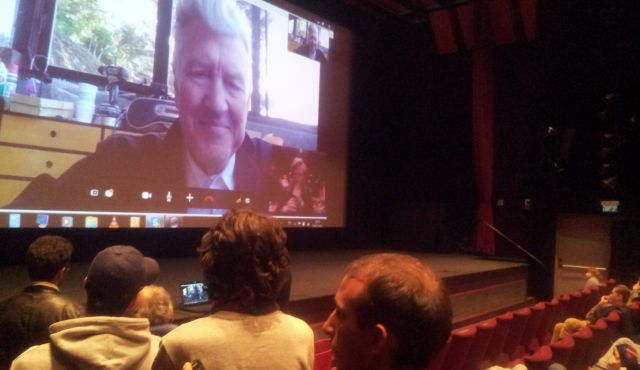
Here is an article in the Israeli paper Haaretz about a film on David Lynch’s 16-country tour made several years ago. One of the countries he had visited was Israel. The film was shown at the Tel Aviv Cinematheque Monday night, January 20, 2014, David’s 68th birthday. David also connected with the audience after the film via Skype to answer questions.
Real peace isn’t just the absence of war the legendary director tells Israeli filmgoers via Skype, and sets the record straight on the ‘Twin Peaks’ rumors.
Article and photo by Avshalom Halutz | Jan. 22, 2014 |12:54 PM
David Lynch speaks to Israeli moviegoers via Skype, on Monday
Moviegoers might associate director David Lynch with wailing babies, dead women in plastic bags and severed ears, but the audience at the Tel Aviv Cinematheque Monday night got nothing but peace and positivity from the man responsible for the perversity in films like “Blue Velvet,” “Eraserhead” and “Mullholland Drive.”
It was the Israeli premiere of the documentary “Meditation, Creativity, Peace,” which follows Lynch’s tour through 16 countries in Europe and the Middle East. The main topic: Transcendental Meditation.
Most of the documentary was shot by film students. The movie, which was edited by Noriko Miyakawa, was completed in 2012 and is in theaters across the United States now. It offers a fascinating glimpse into the creative process of one of history’s great filmmakers.
After the screening, Tel Avivians were treated to a Skype conversation with Lynch himself, who was celebrating his 68th birthday. He answered questions at length on meditation, cinema and creativity – and the Mideast conflict.
The documentary begins with Lynch’s visit to Israel in 2007, when he met with President Shimon Peres and thousands of enthusiastic film students. It opens with Lynch speaking to the camera while holding a jelly doughnut.
“This is a doughnut,” Lynch says. “It is very sweet, and very good. But if you’ve never tasted a doughnut, you wouldn’t really know how sweet and how good a doughnut is …. Transcendental Meditation is like that. Transcendental Meditation gives an experience much sweeter than the sweetness of this doughnut. It gives the experience of the sweetest nectar of life: pure bliss consciousness.”
The film then spends 70 minutes following Lynch on his tour. He explains how Transcendental Meditation, which he has been practicing morning and evening for 40 years, has changed the way he thinks and creates.
Lynch doesn’t lecture, he goes straight to the Q&A. So the film is mostly questions by film students and his take on topics like his love for Franz Kafka’s “Metamorphosis,” how to write a script, and living a more positive life.
During a session in Edinburgh, one questioner asks how he dares talk about meditation and world peace after visiting Israel, and how meditation can help Palestinians living under Israeli occupation. Lynch answers that people are similar all over the world, and that he was happy to meet Israeli film students, Peres and the mayor of Haifa. He wasn’t at all ashamed to visit Israel.
But the trip to Israel had a special objective: to achieve regional peace by establishing “peace groups” that would practice meditation and effect change.
Take it from the Maharishi
When Lynch appeared on the cinematheque’s big screen live via his home computer, the audience sang “Happy Birthday” and followed with an ovation. It’s not every day Israelis interact with giants like Lynch, though the birthday boy remained humble throughout.
One questioner wanted to know if Lynch considered his visit to Israel a failure given that there was still no peace. Lynch mentioned the father of Transcendental Meditation, Maharishi Mahesh Yogi.
“I think the journey was to plant some seeds. And those seeds are still there, and they do need some watering, for sure. They say that Maharishi is the man who revived the science of consciousness and the technologies of consciousness,” Lynch said.
“One of the technologies of consciousness is Transcendental Meditation, a mental technique that any human being can take, and which allows any human being to transcend, to dive within and experience that unbounded eternal level of life. This unbounded eternal level of life is also a field of infinite unbounded peace.”
This peace has always been there, it just needs enlivening, Lynch said.
“Maharishi brought out the technologies of the peace-creating group – a group of human beings practicing the Transcendental Meditation that enliven the field of unity, this field of peace within, so powerfully that it can bring peace up in the field of diversity and raise collective consciousness,” he said. It can make people feel happier and more harmonious.
“And they say when real peace comes it is because this field within has been enlivened in the field of diversity. You can say it’s unity in the midst of diversity. I was telling all the people in Israel that I met: Start a peace-creating group for Israel, enliven that field of unity, get real peace.”
According to Lynch, “A peace treaty is a piece of paper on the surface of life. It does not address the hate, the anger, the torment inside the human beings. We want peace and here is a technology to truly bring real peace, and real peace is not just the absence of war – real peace is the absence of all negativity.”
Lynch was also asked about the situation in Israel compared to other conflicts around the world.
“The situation in Israel exists in lots of places: People just don’t get along. Surface cures will never work. Never work. If you want to get rid of that negativity that causes disputes you need to enliven that field of unity and peace that has always and forever been there,” he said.
“This is the big, big, big secret: Get to work, help form a peace-creating group for Israel and watch what happens, it will be so beautiful. It’s the real thing. Get to work and make this thing happen.”
When asked if he liked any new Israeli movies, Lynch said he didn’t have time to watch films lately. He said he didn’t understand how Martin Scorsese had the time to watch every movie that exists and still have the time to make more films than him.
Many questioners tried to pry information from Lynch about his next projects; they were eager to see more of his work. One brought up the rumor about a new version of “Twin Peaks,” the cult TV series from the early 1990s.
“Rumors are just rumors. There have always been rumors about things. So there is no real truth to it,” said Lynch.
“I don’t know where these rumors come from, but I think they were based on some misunderstanding of what’s going on. It’s true that there will be a new Blu-ray [disc] of ‘Twin Peaks,’ including the pilot, first season and second season. And there will be some special things that haven’t been seen before. That’s about all I can say.”
Below is a Teaser: “Meditation, Creativity, Peace” – David Lynch 16 Country Tour Documentary posted on the DavidLynchFoundation YouTube channel.
Meditation, a simple yet deep-rooted technique that helps you think better, control your emotions with finesse and even makes you a better person. First practiced in India, meditation is a method carried down through the ages. It was first mentioned in the Vedas and is well-known in India as a doorway to nirvana. But now the Americans have woken up to its benefits.
According to study carried out by Fred Travis, director of the centre for brain, consciousness, and cognition at Maharishi University of Management in the US, physiological measures and first-person descriptions of transcendental experiences and higher states have only been investigated during practice of the Transcendental Meditation (TM) technique.
After analysing descriptions of transcendental consciousness from 52 people practicing TM, Travis found that they experienced ‘a state where thinking, feeling, and individual intention were missing, but self-awareness remained’. A systematic analysis of their experiences revealed three themes – absence of time, space and body sense.
‘This research focuses on the larger purpose of meditation practices – to develop higher states of consciousness,’ explained Travis. With regular meditation, experiences of transcendental consciousness begin to co-exist with sleeping, dreaming and even while one is awake.
This state is called cosmic consciousness in the Vedic tradition, said the paper published in the journal Annals of the New York Academy of Sciences. Whereas people practicing TM describe themselves in relation to concrete cognitive and behavioural processes, those experiencing cosmic consciousness describe themselves in terms of a continuum of inner self-awareness that underlies their thoughts, feelings and actions, added the paper.
‘The practical benefit of higher states is that you become more anchored to your inner self, and, therefore, less likely to be overwhelmed by the vicissitudes of daily life,’ said Travis. TM is an effortless technique for automatic self-transcending, different from the other categories of meditation – focused attention or open monitoring.
It allows the mind to settle inward beyond thought to experience the source of thought – pure awareness or transcendental consciousness. This is the most silent and peaceful level of consciousness – one’s innermost self, said the study.
Wondering what it is? Here is all you need to know about the TM technique
Transcendental Meditation?
Also called the TM technique, Transcendental Meditation is a simple practice one does for 20 minutes twice in a day. All you need to do is sit comfortably and close your eyes. This meditation technique is not a religion, philosophy or lifestyle, it is simply a way to reach self-development.
This technique allows your mind to settle and gives you a chance to experience pure awareness, also known as transcendental consciousness. It allows you to experience the most silent and peaceful level of consciousness – your innermost self. It also allows your brain to attain deep rest helping you be more efficient and betters your cognitive functions.
Where did this technique originate?
About 50 years ago, Maharishi Mahesh Yogi introduced Transcendental Meditation to the world. Maharishi Mahesh Yogi is considered the representative of Vedic tradition in our day and age. This form of meditation helped in restoring knowledge and helps people experience a higher state of consciousness. The most important aspect of this technique is that it is still practiced with the same technique and principles as it was when the Vedas were first written, giving it maximum effectiveness.
How do I learn?
The TM technique has local teachers who will guide you through the process. It consists of seven steps after which one can practice the TM technique on their own.
Benefits of the TM technique
The TM technique is known to calm your mind, directly affecting the stress that your brain experiences on a daily basis. According to the experts, practicing the TM technique regularly helps in developing total brain control, thereby making you more equipped to deal with every day stress. It indirectly reduces the production on hormones that are commonly produced when one is stressed and thereby stops the damage that is normally produced.
Apart from all this, a calm mind and body is the best way to protect your body from cardiovascular stress. The TM technique also has great benefits for students, it helps improve their memory, IQ and helps them fight stress.
Overview of research on individuals experiencing higher states of consciousness published in Annals of the New York Academy of Sciences
Today, millions of Americans say they practice some form of yoga and/or meditation. It’s become a health fad. Yet the goal of these practices seems unknown or elusive to many practitioners — transcendence.
Fred Travis, PhD, is the Director of the Center for Brain, Consciousness, and Cognition at Maharishi University of Management
The paper is based on a presentation Dr. Travis was invited to give at “Advances in Meditation Research” (AMR), a meeting of the nation’s top meditation researchers, which took place a year ago at the New York Academy of Sciences New York City.
In his paper Dr. Travis explains that different meditations have different effects, and that meditation can lead to nondual or transcendental experiences, a sense of self-awareness without content.
However, after a search of the scientific literature he reported that physiological measures and first-person descriptions of transcendental experiences and higher states have only been investigated during practice of the Transcendental Meditation® (TM) technique.
TM is an effortless technique for automatic self-transcending, different from the other categories of meditation — focused attention or open monitoring. It allows the mind to settle inward beyond thought to experience the source of thought — pure awareness or Transcendental Consciousness. This is the most silent and peaceful level of consciousness — one’s innermost Self.
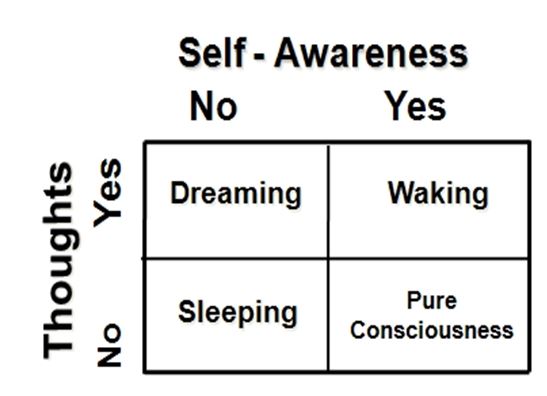
This figure, a 2 X 2 table, compares subjective and objective experiences during waking, sleeping, dreaming, and pure consciousness. As seen in this table, waking state contains a sense of self and mental content — thoughts and perceptions. In contrast, during pure consciousness (Transcendental Consciousness), there is only Self-awareness, without any sense of time, space, and body awareness.
Dr. Travis discusses a study of descriptions of Transcendental Consciousness from 52 subjects practicing the Transcendental Meditation technique and found that they experienced “a state where thinking, feeling, and individual intention were missing, but Self-awareness remained.” A systematic analysis of their experiences revealed three themes: absence of time, space, and body sense.
Specific physiological changes are associated with this subjective experience of Transcendental Consciousness. These include changes in breath rate, skin conductance, and EEG patterns.
Dr. Travis further explains that with regular meditation, experiences of Transcendental Consciousness begin to co-exist with sleeping, dreaming, and even while one is awake. This state is called Cosmic Consciousness, in the Vedic tradition. The paper presents first-person accounts followed by an overview of the physiological patterns associated with Cosmic Consciousness.
Whereas control subjects describe themselves in relation to concrete cognitive and behavioral processes, those experiencing Cosmic Consciousness describe themselves in terms of a continuum of inner self-awareness that underlies their thoughts, feelings, and actions.
In addition, the Cosmic Consciousness subjects showed the EEG patterns seen during Transcendental Consciousness along with the EEG patterns when they were asleep, and during waking tasks. This leads to higher scores on the Brain Integration Scale developed by Dr. Travis.
Dr. Travis suggests that such higher states of consciousness can be seen as normal developments beyond the classic stages described by Piaget. One simply needs a technique to experience transcendence and thereby facilitate the development of these states. The practical benefit of higher states, he says, is that you become more anchored to your inner Self, and therefore less likely to be overwhelmed by the vicissitudes of daily life.
“This research focuses on the larger purpose of meditation practices — to develop higher states of consciousness,” explained Dr. Travis. “This paper is the outgrowth of meetings at Esalen and the Institute for Noetic Sciences to chart the future of meditation research.”
The Annals of the New York Academy of Sciences is the oldest continuously published scientific serial in the United States and among the most cited of multidisciplinary scientific serials worldwide. Established in 1823, the Annals is the premier publication of the Academy, offering volumes of review articles in special topical areas and proceedings of conferences sponsored by the Academy as well as other scientific organizations. You can find out more about them here: http://www.nyas.org/whatwedo/publications/annals.aspx.
Here is an excellent article about Transcendental Meditation published in the latest issue of The Hollywood Reporter, part of a Health series on how stress effects celebrities and what they do to relieve it. This one is on David Lynch. Click on the title to see the original article with photos.
One of film’s darkest directors, with help from Jerry Seinfeld and Hugh Jackman, is shining a light by bringing meditation to everyone from PTSD sufferers to inner-city kids.
January 10, 2014 | by Seth Abramovitch
Call it the ultimate comeback. Transcendental meditation — which involves speaking a silent mantra to oneself for 20 minutes, twice daily — is an ancient practice that is now attracting some of Hollywood’s biggest names, who insist that its stress-relief benefits are nothing short of miraculous: Among its most powerful practitioners are Jerry Seinfeld, Hugh Jackman and Russell Brand — who all have become supporters of David Lynch and his plans to bring meditation to people in dire need of stress relief. A directing genius whose dark dreamscapes are littered with severed ears and plastic-wrapped homecoming queens, Lynch, 67, has morphed into one of the world’s most enthusiastic if unlikely TM cheerleaders.
Lynch first encountered TM in 1974, as he searched for ways to combat mounting anger and depression relating to his epic struggle to get his first feature, the mind-bending Eraserhead, to the big screen. “I had a weakness inside,” says Lynch from his Hollywood Hills studio, a splash of sunlight illuminating his famous white pompadour. “That kind of thing, in this business, you’re a sitting duck. You could get slaughtered.” It was then that he decided to try his hand at TM, an ancient practice revived by the late Maharishi Mahesh Yogi, an expat from India who rocketed to stardom during the 1960s as The Beatles‘ spiritual adviser. Lynch feared TM might dull his artistic edge, but he says the opposite happened — it helped him to access untapped fonts of creativity. He even goes so far as to credit the practice with potentially having saved his life: “I was even thinking at the time, ‘If I didn’t have this meditation, I might have seen that a way out was suicide.’ ”
The Twin Peaks mastermind hasn’t missed a single day of meditation in the 40 years since. In 2005, that devotion led him to found The David Lynch Foundation for Consciousness-Based Education and World Peace, a nonprofit that brings TM to inner-city students, veterans with post-traumatic stress disorder and victims of domestic violence. The foundation has taught the fundamentals to more than 500,000 at-risk candidates, and Lynch says the effects have been astonishing: “Before too long, they’re saying, ‘Thank you very much. I got my life back again.’ ” In celebration of Lynch’s birthday on Jan. 20, DLF Live, the foundation’s live-performance arm, is mounting a benefit at the El Rey Theatre, where Ringo Starr is set to receive the Lifetime of Peace & Love Award. Ben Harper and Ben Folds are slated to perform. And on Feb. 27, Dixie Chicks will headline a night at the Beverly Wilshire Hotel honoring record producer (and longtime TM practitioner) Rick Rubin. For the admittedly shy director, Hollywood’s ongoing love affair with TM offers a highly effective method of spreading the gospel. “Life gets better and better and better,” says Lynch of his 40-year journey. “That’s the long and the short of it.”
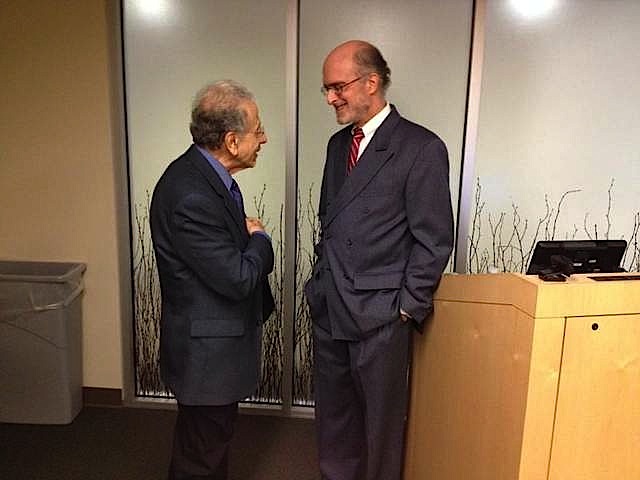
Dr. Francois Abboud, left, talks with Dr. Robert H. Schneider, who spoke with medical staff at University of Iowa Hospitals and Clinics Tuesday about how the practice of Transcendental Meditation can reduce the risk of heart disease and lower blood pressure. / Sara Agnew / Iowa City Press-Citizen
If you want to reduce your risk of cardiovascular disease and lower your blood pressure without taking medication, Dr. Robert H. Schneider has a suggestion: Transcendental Meditation.
Schneider says he has been involved in studies that show this type of meditation can reduce the rate of death from cardiovascular disease by 30 percent and from cancer by 40 percent.
The key is you need to know the “techniques” of Transcendental Meditation to experience the benefits — sitting with your eyes closed for 10 minutes won’t cut it.
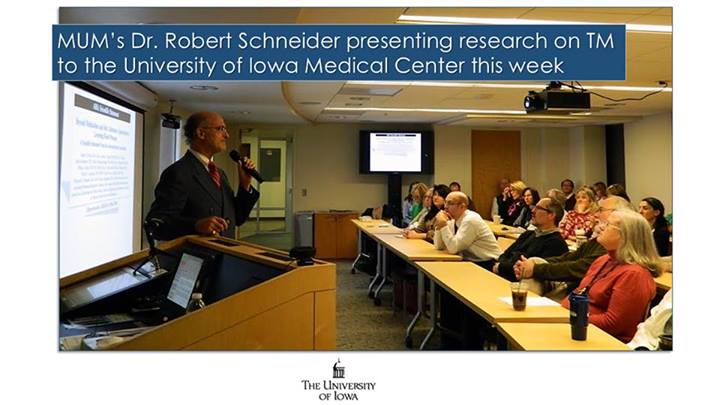
That’s the message Schneider shared with about 40 hospital personnel Tuesday during an hourlong presentation called MIND-BODY-HEART: Evidence for Meditation in Hypertension and Cardiovascular Disease at University of Iowa Hospitals and Clinics. It was his first visit with staff and doctors at UIHC.
“It was breakthrough,” he said of his visit.
Schneider is director of the Institute for Natural Medicine and Prevention and dean of medical programs at Maharishi University of Management in Fairfield. As a physician and scientist, Schneider has spent the past 30 years researching evidence-based natural approaches for treating heart disease, high blood pressure, stress and other cardiovascular factors. Over the past 20 years, he has received more than $20 million in research grants from the National Institutes of Health for his natural approaches to treating heart disease.
Schneider said TM is an effortless technique for “automatic self-transcending.” It allows your mind to settle inward beyond thought to experience the source of thought — pure awareness. This is the most silent and peaceful level of consciousness and what many who practice TM call your innermost self.
“It takes a technique that you learn in an eight-hour course,” Schneider said. “Once you have the technique, it happens quite easily.”
Schneider said humans have an “inborn ability” to practice this type of meditation.
“But we have lost this simple and natural technique,” he said.
Schneider said much of his research about the correlation between mind and body were affirmed last June when the American Heart Association announced that Transcendental Meditation is the only meditation practice that has shown to lower blood pressure. In addition, AHA reported lower blood pressure through TM is associated with substantially reduced rates of death, heart attack and stroke.
Ultimately, Schneider said the AHA recommended that TM be recommended for consideration as an alternative treatment for individuals with blood pressure greater than 120/80 mm Hg.
Schneider said he learned about TM 40 years ago as a college student.
“I was always interested in how we can tap into the body’s own cell repair and healing abilities,” he said. “I thought I’d try it and see if it works.”
He read the research and gave TM a try.
“I found I could study better and learn better and had more energy,” Schneider said.
Later, when he was a fellow in hypertension at the University of Michigan Medical School, Schneider took an interest in the connection between the brain and heart.
“I thought maybe we could use the brain to lower blood pressure,” he said.
Schneider believes his years of research on managing the mind-body connection is paying off as organizations such as the AHA begin recognizing the benefits of TM.
During his presentation at UIHC, Schneider highlighted a 2012 study that showed blacks with heart disease who practiced TM regularly were 48 percent less likely to have a heart attack, stroke or die from all causes compared with blacks who attended a health education class over more than five years.
Those practicing TM also “lowered their blood pressure and reported less stress and anger,” Schneider said.
Schneider is interested in researching how TM can be used to help military veterans recover from post-traumatic stress disorder.
Dr. Francois Abboud, the namesake of UI’s Cardiovascular Research Center, asked, “How will I know if I am meditating correctly?”
Linda Rainforth, a certified TM teacher from Iowa City, said people who are practicing TM reach a “deep, deep level of silence and stillness” in which they experience an “expansion of the mind.”
One listener wondered whether men or women followed through most consistently in practicing TM during research studies.
“Men and women both get results,” Schneider said. “But in some of our studies, there was slightly more compliance with the women.”
If you go
Learn more about Transcendental Meditation by attending one of the following presentations by certified teachers in TM. All presentations will be at the Iowa City Public Library, meeting room E.
• 7:30 to 8:30 p.m. Thursday.
• 3 to 5 p.m. Saturday.
• 6:30 p.m. Jan. 16.
TM sessions also can be by appointment by calling Iowa City Transcendental Meditation Program at 936-1986, 641-472-0827 or 641-919-7282. For more information, go to www.tm.org.
Dr. Robert Schneider was also interviewed by Steve Smith on KMCD’s MUM Spotlight Show about the American Heart Association’s recommendation of Transcendental Meditation to lower high blood pressure. He also reported on his visit to UI’s Medical Center. Steve asked some great questions. It was a lively discussion. Listen here: http://fairfieldiowaradio.com/audio/spotlight%201-9.mp3. (20:45)
Author Steven Verney is interviewed by Dr. Cathy Gorini, Dean of Faculty at M.U.M. on the KHOE radio program “A Chat with the Dean.” Titled “The Best of all Possible Worlds” Steven Verney’s novel is based on his experiences as a teacher of Maharishi Mahesh Yogi‘s Transcendental Meditation.
Steven sprinkles gems of Maharishi’s knowledge before the reader along with threads of life-changing experiences many teachers of TM will relate to while going about the business of bringing enlightenment to the individual and the world and balancing life in the “real world.” Readers have found it difficult to put down this well-written book.
Steven is at work on his second book, about a lama that got away. The main protagonist is also a philosophy professor. I’ve read an excerpt and can’t wait to see the book when it comes out. If it’s anything like his first one, which I thoroughly enjoyed, then we’re in for another treat!
On Tuesday, December 3rd, at the David Lynch Foundation‘s 5th Annual Change Begins Within Gala at the Conrad Hotel in New York City, Jerry Seinfeld took the stage to open the event. We were waiting for this to come out on YouTube. Jerry is absolutely brilliant! He opens with a funny diversion about Amazon and drones, and then segues to the main topic.
Jerry shares how he started Transcendental Meditation in college and has been practicing it for 41 years. But he reveals for the first time that he had only been meditating once a day instead of the twice-a-day instruction. Still, it was because of TM, he says, that he managed to keep it together during the nine years he was producing his successful hit show Seinfeld.
“When I was doing the TV series in which I was the star of the show, the executive producer, the head writer, casting and editing, for 22 to 24 episodes on network television—not cable! Network—for 9 years. Okay? That’s a lot of work. And I’m a regular guy, pretty much. You know, I’m not one of these crazy people that has endless, boundless energy. I’m just a normal guy. But that was not a normal situation to be in. And so what I would do is every day when everybody would have lunch I would do TM [Transcendental Meditation] and then while we’d go back to work and then I would eat while I was working because I had missed lunch. But that is how I survived the 9 years, it was that 20 minutes in the middle of the day would save me.”
George Shapiro, Jerry’s manager and fellow meditator, had written into Jerry’s contract that he was to not do interviews or be disturbed during lunch hours, when he would go to his trailer during the taping of the Seinfeld show. Now we know why. What we didn’t know was that he was only doing it once a day, at that time. And look what he accomplished!
Jerry’s handling a lot these days, touring on weekends, producing his internet show, Comedians in Cars Getting Coffee, raising 3 young kids, and yet has the energy to enjoy it all, at 60, when he was thinking he should be slowing down. Meditating twice a day has transformed his life. Here’s the part where he mentions Bob Roth reminding him to do his morning meditation, at 6 mins, 54 secs, and what happened as a result.
By the way, David Lynch never missed his twice-daily TM during the over 40 years he’s been meditating. He also used to do his meditation (second), in private, on film sets when everyone else went to lunch.
Bob Roth interviewed Jerry Seinfeld for the new Sirius XM radio show on TM starting January 2014. Jerry is his first guest. David Lynch will also be on an episode of the show, as will other high-profile celebrities and expert guests.
New York is really the hub of American consciousness—media, finance, fashion, food, arts and entertainment. TM has created quite the buzz in the city. It’s a more peaceful and friendlier place to be in these days. 2014 holds much promise. May it bring us greater joy and success. Happy New Year!
Style.com: The Transcendentalists: David Lynch and Calvin Klein Collection’s Italo Zucchelli on their shared passions: creativity and Transcendental Meditation
By Matthew Schneier. Photographs by Olivia Malone
Published December 24, 2013
On a winding road high in the Hollywood Hills, not far from Mulholland Drive, is a Brutalist-looking concrete structure that’s equal parts manse and bunker. It’s the studio of David Lynch, and appropriately for his many pursuits—he is an auteur across media, from film and television to painting, music, self-help books, and coffee roasting—it has a variety of different spaces: a screening room, a recording studio, storage for his photographs and artwork, a kitchen with an industrial-grade espresso machine. (Lynch die-hards may recognize it as the house from Lost Highway.)
I’ve come here from New York, along with fashion designer Italo Zucchelli, to discuss one of Lynch’s abiding passions, Transcendental Meditation. The director established his own nonprofit, the David Lynch Center for Transcendental Meditation and World Peace, in 2005. He credits the practice with much of his success, and he’s devoted as much time to raising awareness of it as he has to virtually any of his other endeavors. His 2006 book, Catching the Big Fish, is dedicated to the subject.
Transcendental Meditation is an ancient practice, but its profile was raised in our era when the Beatles took it up in 1968, under the guidance of its twentieth-century guru, Maharishi Mahesh Yogi. It comes with, and rules out, no religion, faith, or creed, but because of its new-wave aura, it has largely bubbled away at the fringes of culture. Lately, however, it is experiencing a new boom. “In the last year, something tipped,” says Bob Roth, the affable executive director of The David Lynch Foundation for Consciousness-Based Education and World Peace. “If one [particular] thing happened, I haven’t seen it—and I’ve been on the front lines. But something happened, [because] I don’t have enough teachers to teach all the people in New York City who want to learn.”
TM has a very healthy celebrity fan base, which no doubt helps its public profile, and the foundation, which exists to provide scholarships to at-risk populations so they can learn the practice, including schoolchildren, survivors of domestic abuse, and military personnel, has taken advantage of that fact. Paul McCartney, a practitioner, performed at the foundation’s first benefit concert. Hugh Jackman and Jerry Seinfeld, Transcendental Meditators both, were honored at its most recent benefit gala, in December. Mario Batali and Martin Scorsese will both speak at its upcoming conference in February. The list of adherents is even longer. Ellen DeGeneres does it. Oprah does it. Ray Dalio, the founder of Bridgewater Associates, the world’s largest hedge fund, does it. And in the realm of fashion, so does Zucchelli, who is celebrating his tenth year as creative director of menswear for Calvin Klein Collection.
“It” is a relatively simple practice. It consists of devoting twenty minutes twice a day to meditating, which in the Transcendental iteration means silently chanting a Sanskrit mantra. (The mantra must be given by a teacher of Transcendental Meditation, as part of an instruction that can cost upwards of $1,000.) Devotees say that it combats stress, improves mood, and staves off illness and disease. Remarkably, science confirms much of this. The American Heart Association found in a study that Transcendental Meditation, alone among meditation practices it tested, reduces high blood pressure; other studies indicate it can improve functional capacity in patients with congestive heart failure. Over the past forty years, more than 300 studies have been published about the effects of the practice in peer-reviewed medical journals, and the National Institutes of Health and the Department of Defense have both given millions for further testing. While a quick Google search does turn up skeptics and critics—more of charlatan practitioners than of the practice itself—the tide seems to be now firmly in TM’s favor.
“In 1968, meditation was a fad,” says Roth. “In 2013, because of the research, Transcendental Meditation is being incorporated into the actual fabric of our culture.”
There’s something undeniably intriguing about the beatific bliss that Lynch and Zucchelli radiate—in the filmmaker’s case, in stark contrast to his dark, often violent work. I wanted to find out more about the connection they both draw between the practice and their creative lives. Below, condensed and edited, is a transcript of that free-flowing discussion.
Visit Style.com to read this intriguing interview and see the photos.
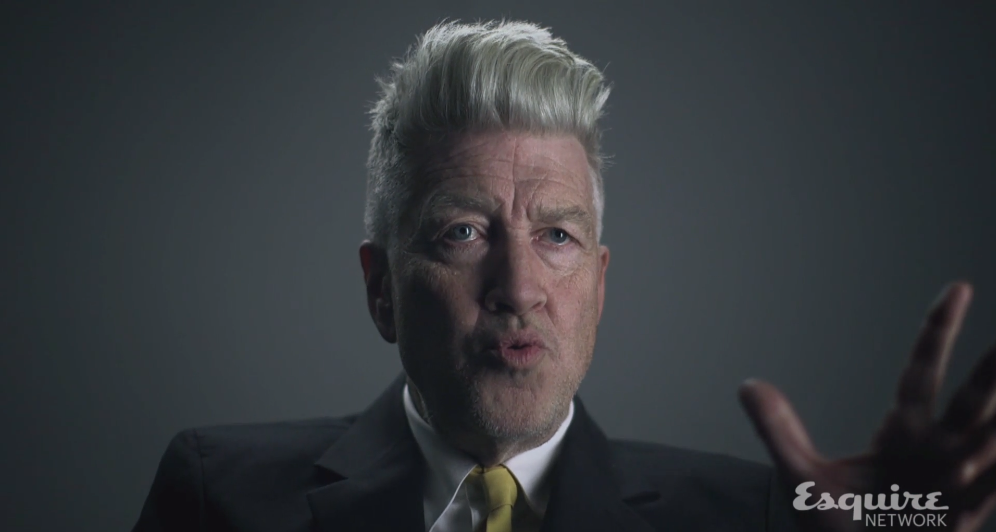
Filmmaker David Lynch describes how he develops and gains personal happiness and inner peace in his style and work through the art of Transcendental Meditation.
David describes his first blissful experience of transcending
I tried to embed the video but it didn’t work in this space. Click here to see this short (2:20) impressive video on the Esquire TV Network website: It’s really good, as David would say.
In addition to the interview, some of the footage is taken from a pre-screening reception for the film, Meditation Creativity Peace, about David’s 16-Country tour, shown in the Billy Wilder Theater. Watch the hilarious, but informative, post-screening discussion with David Lynch, Russell Brand, and Bob Roth.


 The Uncarved Blog