In meditation last morning, a thought came that I was “in search of my own doing.” My life is the result of choices, of things I did and did not do that cannot be undone. Life goes on, and I am still wondering what I should be doing with the rest of my life.
Then I thought of my children and their attempts to make sense of their lives, to fulfill their destiny. So, I wrote this philosophical tanka about being and becoming.
Searching For The Meaning of Your Life
Your destiny is
A search for your own doing
What your life will mean
But doing starts with being
Only then can you become
…
Yogastah kurukarmani
Established in Being, perform action
I’m reminded of what Krishna said to Arjuna on the battlefield of life — to perform his duty and fight. But he also gave him the technique for skill in action — to first transcend, to Be (Ch 2, V 45); and then, established in Being, to perform action (Ch 2, V 48).
So “meditate and act” is the formula for success in life. Do what comes naturally and brings you bliss. And if life sometimes stretches you in ways you’re not comfortable with, keep meditating and acting, and you will have grown stronger in the process, becoming more of yourself.
Bob Roth, executive director of the David Lynch Foundation, appeared on this week’s Fox 5 WNYW Good Day New York morning newscast* with Rosanna Scotto and Greg Kelly to talk about Transcendental Meditation. Rosanna’s friends were telling her about it, and she was interested in learning. So she invited the in-demand TM teacher to the show.
Bob explained how easy and effortless it is to learn and practice TM, and how different it is from other more difficult approaches. He also described some of the many scientific published research studies showing improvements in health, education, and rehabilitation.
He emphasized TM wasn’t just for the needy or wealthy segments of society. Everyone could benefit from it. People from every walk of life were practicing it — military personnel, Wall Street brokers, educators, physicians, housewives, students, anyone dealing with today’s stressful challenges. More than just relaxation, he said TM gives you more energy, focus and drive to get things done.
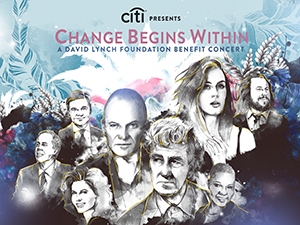
Rosanna asked about the work of the Foundation and the upcoming concert. Bob described the various DLF projects helping different at-risk sectors of society, and announced the November 4th Change Begins Within Benefit Concert at Carnegie Hall.
Proceeds from the event will benefit the David Lynch Foundation’s Meditate New York initiative to provide Transcendental Meditation instruction at no cost to 10,000 at-risk New Yorkers, including underserved youth, veterans with post-traumatic stress, and women and children who are victims of domestic violence.
*This morning news show originally aired on Tuesday, Oct. 13th, 2015. You can watch the 10-minute interview in a larger format from the Fox 5 archive HERE and at the TM Blog.
Rosanna Scotto attended the DLF benefit concert and talked with Greg Kelly about it on Good Day New York.
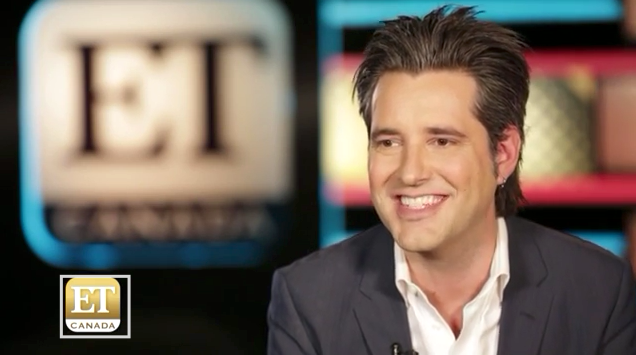
ET Canada correspondent and Radio host Roz Weston shares how Transcendental Meditation helped him become a better professional broadcaster. Roz Weston first learned broadcasting while interning with the Howard Stern Show. “The lesson that I took away from that is that success at that level is about being professional.” Today he co-hosts his own morning show on Toronto’s KISS 92.5 FM and interviews many top celebrities for ET Canada.
Read this Special to The Globe and Mail: Radio host Roz Weston finds success in meditation and professionalism. I really enjoyed this article. It’s filled with sound professional advice and tips on how to be an authentic interviewer. And for someone who works 13-hour days, it also says a lot about the sustaining power of Transcendental Meditation! The article was published Sunday, Aug. 16, 2015. I posted the introduction and the section on his TM practice. ET Canada posted this on their YouTube Channel: Roz Weston: Behind The Story.
As a correspondent on ET Canada, Roz Weston has interviewed A-listers like George Clooney and It Girls like Amy Schumer. When he’s not working the red carpet, the former Howard Stern intern is the co-host of Kiss 92.5 radio morning show The Roz and Mocha Show. It’s a hectic schedule, which is why Weston takes twenty minutes out of every day to meditate. Here, he shares some of the secrets to his success, including why he would happily interview Alec Baldwin every day.
The secret to boundless energy in 20 minutes
A few years ago I was feeling very overwhelmed by the pace of my life and the responsibilities I had. I was looking for something and I didn’t know what. I heard about Transcendental Meditation [a form of “relaxed awareness” meditation founded by the Maharishi Mahesh Yogi in the mid-1950s and practiced by notables such as Jerry Seinfeld and Oprah Winfrey] from a friend. I’m not a religious person at all, so it was nothing to do with that. It was first described to me as yoga for your mind. You shut everything down, you go deep and when you come out of it you have so much energy. It is a literal recharge. In the middle of the day when we all break for lunch, my colleagues all go to the cafeteria and I go to my dressing room and meditate for 20 minutes and then I’m good to go. A 13-hour workday with five hours’ sleep is not a problem. It’s not like the kind of meditation where you sit cross-legged and clear your head of all thoughts. Thoughts come into your head and they sit there and you let them go and you go deeper and deeper. I now have the ability to deal with issues, thoughts, information so much more effectively than I did before. I no longer feel overwhelmed. I used to feel overwhelmed every second of the day.
Roz had a desire to learn about Transcendental Meditation and wasn’t sure how to do it properly. So, in September 2013, they welcomed the most calm relaxing guest in Roz & Mocha history! They interviewed actor, comedian, and Certified Toronto TM teacher Lucie Guest about Transcendental Meditation on KiSS 92.5.
As you just read, Roz did finally learn TM and benefited greatly from it. This June, he was invited to meet Amy Schumer, Judd Apatow, Dave Attell, Vanessa Bayer, Mike Birbiglia, and Colin Quinn—members of the TrainWreck Comedy Tour who were performing at Massey Hall. They were donating VIP tickets to the David Lynch Foundation to help bring Transcendental Meditation to at-risk teens and abused women who suffer from trauma and toxic stress. Roz also met with DLF Executive Director Bob Roth.
Speaking of Alec Baldwin, you can listen to him on his WNYC talk show, Here’s The Thing, asking Jerry Seinfeld how he found out about and learned Transcendental Meditation.
And since Roz interned at The Howard Stern Show, you may also enjoy eavesdropping on Howard and Jerry sharing their own TM stories. They seemed to have learned around the same time on Long Island. Much to Jerry’s surprise, Howard shares with him how his mother’s life was turned around after learning TM, how she took him to the local Center to learn to meditate, and how Howard had actually interviewed Maharishi twice. Fabulous!
I enjoyed watching Be You, an impressive little film documenting the life-transforming power of Transcendental Meditation in one of the schools of the APC, a UK educational alternative for socially-challenged students in need of individual support.
The West Sussex Alternative Provision College is one of four hundred pupil referral units in the United Kingdom, which caters specifically for pupils who are not currently in mainstream education for various reasons. This school offers young people with emotional and behavioral issues a new chance to succeed.
Be You is a start-up, grass-roots, not-for-profit organization founded by Ricky Reemer and Kitty de la Beche. It sets out to transform the lives and prospects of young people who struggle to fulfill their potential within the school system by teaching them valuable life skills and techniques.
The Be You project opened the way for the introduction of Transcendental Meditation to the teachers and pupils in this specialized Unit. With the support of the Be You, the pupils were encouraged to continue their daily practice of TM over a full school year.
Valerie is a great writer. She’s colorful, direct, and pulls no punches. Her effervescent personality shines through the amazing stories she shares with her readers, awakening them to their own inherent greatness.
The book is divided into short easy-to-read chapters packed with practical insightful wisdom. It’s also an inspirational testimony to the transformational power of TM, and I am enjoying reading every word of it!
Valerie sent us this intro to her story.
Awakening to Me
In 2011, I woke up and realized everything I thought I knew was wrong.
~ Valerie Gangas
For as long as I can remember, I have been running. Waking up in the morning and running to the gym. Running to the hospital to support my mother, who battled cancer for 13 years. Running to my job, managing an extremely busy Chicago restaurant/bar. Running from boyfriend to boyfriend. Running from one social event to another. Running to deal with the pressures modern women face to be perfect, to get the job done right, to be a caretaker, to look good—let’s face it: to be Wonder Woman.
Then one day, I was forced to stop running.
In late 2010, the restaurant I’d managed for 15 years was sold . . . but it turned out to be a weird sort of blessing, in that I got to spend day and night with my beautiful mother who, by Thanksgiving that year only had a couple of months left on the planet.
All of this time, I had been on a steady diet of double espressos, bottles of Cabernet and late nights eating steaks, cooked rare. (Did I mention I don’t eat meat?)
I was losing my mind as I watched her slowly slip away. I’d had a bad case of insomnia for years, my depression was deepening, and the distractions I’d held up like masks were no longer working well . . . make that, at all.
My mom passed away on January 25, 2011. And my world went black.
After she died, I felt like I’d died right along with her. I was out of a job, suicidal and completely unhealthy. My “diet”—mainly fueled by booze and caffeine—had caught up with me. I was the thinnest I’d been since high school, and my nerves were on fire. And it was like Groundhog’s Day—every night was the same scene. Go to bed, wake up at 3 a.m., stare at the ceiling, my thoughts reeling, feeling like complete crap, until I had to get up a couple hours later. Then my “day cycle” would start again. Down some caffeine, make myself workout (I had to fit in my cocktail dresses, duh!) and then never stop throughout the workday, ‘til I collapsed later that night.
Reflecting back, thoughts of suicide regularly arose in my mind. I didn’t feel like I could go on without my mom, who’d been my best friend. Clearly, I was a broken woman. Yes, I had been seeing a therapist and was trying to get my head above water. But nothing seemed to be working. My suicidal thoughts were getting stronger and stronger. I had gone so far as to ask my aunt and uncle to take my dog (I couldn’t bear messing up her little life), and I didn’t get a new car when my lease was up . . . because people who are going to kill themselves don’t need a car. I also wrote out my will.
Yep, I was gearing up to end my life.
One particularly horrible day I was on my knees in the shower, when I just collapsed and screamed out, “God, Mom, anyone, please help me kill myself or please save me!” In that moment, I completely surrendered. I was nothing. I was no one. And I completely gave myself and my fate over to God.
A week later, a friend suggested I learn Transcendental Meditation (TM). My only hope, at the time, was that I would be able to get some sleep. I hadn’t read anything about meditation, hadn’t thought about it or even wondered about it. But I was in such a dark place, one morning I made the call.
Within days, I borrowed that same friend’s car and drove to a Transcendental Meditation center in Chicago. The home which doubled as a TM center had a feeling of calm I couldn’t quite put my finger on—the air seemed lighter, somehow, and the view was all lake. Even upon entering the center’s lobby, I felt a bit calmer. Huh, I thought, these people who work here are super different. They were so chilled and completely filled with love . . . it was immediately clear to me they were there to help me. My next thought was, I’m here, so I might as well learn how to do this.
I sat down with my teacher and after a short, but beautiful ceremony, I was given my “mantra”—a sound she said my awareness would naturally follow, as it subsided into the depths of silence in my mind. When we both closed our eyes, I easily and effortlessly said the mantra to myself less than five times . . . and just like that, I was gone. I dove into a part of my body and mind I never knew existed—boundless, limitless and totally awesome. Yes-sir, something major had just happened . . . but soon I was discovering I’d only glimpsed the tip of the iceberg.
Driving home down Lake Shore Drive, I immediately began noticing how the world seemed so much different to me than it had on my way to the center. The colors all around me were more vivid, the sounds of the birds felt like sweet music to my ears, I seemed to be connected to all of the trees I saw . . . and above all, I felt happy. But, my mind called out to me, Is this really happening?! Do I really feel happy? How? Why?What the hell?
Fortunately, the essence of that experience stuck and stayed, and I came to find it was in fact “real”—that in twenty minutes, my whole life had changed. I woke up and realized everything I thought I knew was wrong. My life was no longer defined by outer circumstances. I was having a direct experience of what I have come to know as my true Self.
I cannot explain what followed . . . you know, the why of it. Within weeks of learning to meditate, I was standing in front of Oprah Winfrey, explaining how her newfound TM practice was going to make her limitless and boundless. Now, one would think standing in front of one of the most powerful women in the world would cause some serious butterflies in the stomach. But this wasn’t my experience. In that moment, when I stood at the front of the room and described my journey to her, I could only “see” her. The fame and the power didn’t exist. I was only concerned with helping the beautiful human in front of me the only way I knew how . . . with honesty, passion and a dash of humor.
I walked out of Harpo Studios that Friday morning and knew I was about to head down a very different life path. My soul and heart were breaking open and I was watching the right words leave my lips before my mind could even think them. I felt the power of the whole universe in my little body. That day, I decided to give everything I had to try to bring peace and goodness to the world. To do my part.
It has actually taken me the past few years to really understand this new way of living: that is, from the inside out. I felt compelled to write in my journal every night. I mean, the realizations I was having were just too profound not to write them down. I turned what I wrote about into a manuscript . . . and today I am proud to say I have just published my first book, Enlightenment Is Sexy: Every Woman’s Guide To A Magical Life. I’ve also started a brand I love and have continued to speak about consciousness, happiness, freedom, and above all, Transcendental Meditation.
Learning to meditate saved my life . . . but it also gave me more than I could have ever dreamt of: awakening to the real me.
###
George Foster of Foster Covers, with help from wife Mary, designed the colorful cover! Order the book on Amazon and read the nice comments.
Here’s a photo of the three of them during Valerie’s book-signing at Health & Wholeness on a 1st Friday’s Art Walk in Fairfield, Iowa.
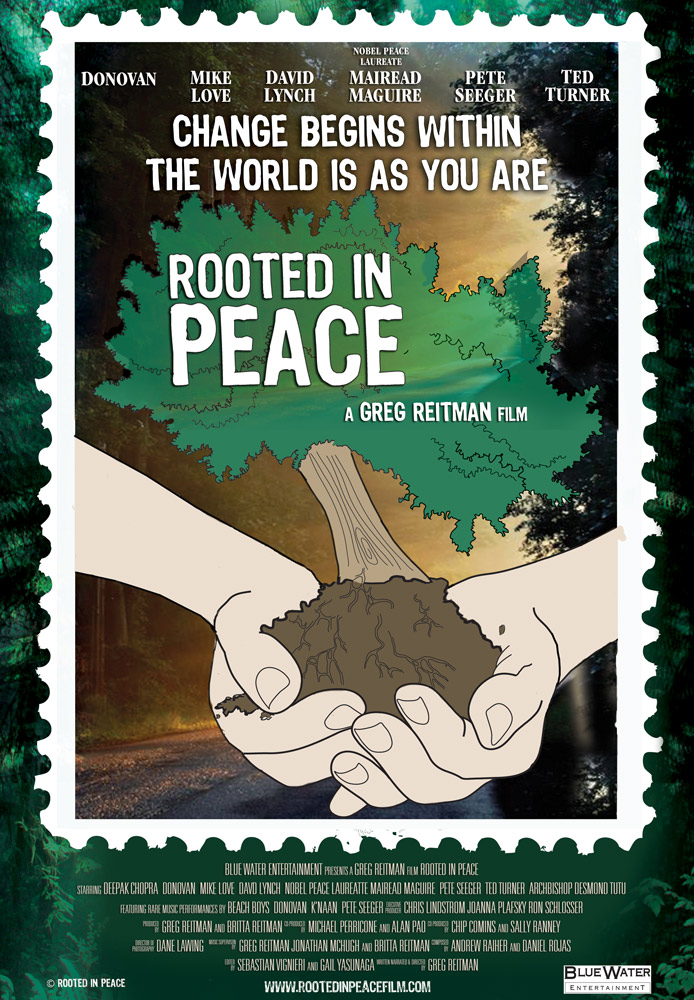
More screenings are coming up this summer for Hollywood director Greg Reitman’s documentary feature film.
Martha’s Vineyard Film Society
This month, Martha’s Vineyard Film Societywill present ROOTED in PEACE on Wednesday, July 15, 2015, at 7:30pm. There will be a special post-screening Q&A with director Greg Reitman.
In early August the film will premiere in Fairfield, Iowa. Read how this Hollywood filmmaker came to Fairfield for a Beach Boys concert, returned for a David Lynch Weekend at MUM, learned TM and more, in the July issue of the Iowa Source in their All About FAIRFIELD section: Getting Rooted In Peace: Green Producer Greg Reitman Brings New Documentary to Sondheim for Iowa Premiere. Here is a PDFof the print version.
Included in the film are interviews from those visits with filmmaker David Lynch; musicians Donovan and Mike Love; Bob Roth, executive director of the David Lynch Foundation; and Fred Travis, director of Maharishi University’s Center for Brain, Consciousness, and Cognition; as well as historical footage of Maharishi Mahesh Yogi, founder of the Transcendental Meditation®technique, and Maharishi University of Management.
Blue Water Entertainment and the David Lynch Foundation are presenting the Iowa premiere of this inspirational documentary feature film, Sunday, August 2nd at 7pm in the Sondheim Center for the Performing Arts. There will be a Q&A following the showing with Sundance award-winning Director Greg Reitman and Executive Producer Joanna Plafsky. Joanna is an established international film producer and distributor, and member of the DLF Board of Directors.
Visit the Fairfield Arts and Convention Center websiteto find out more about Greg and his film, including production stills and the movie trailer, and if you’ll be in town at that time, to purchase tickets. Here is a PDF of the ROOTED in PEACE poster for Fairfield with affordable ticket prices.
The Fairfield Weekly Reader will publish an article on the event July 23rd.
I received an email this morning from a member of the TMhomeTeam, an international Transcendental Meditation news website. I’ve admired their wonderful work over the years representing TM internationally, especially their interesting interviews with famous, and not so famous people who have benefited from this unique meditation practice.
They wrote to say the article they had been putting together about me was now up. As a publicist who is always concerned with properly promoting other people and their work, this was a complete turnaround for me. I very much enjoyed sharing stories with Liisa of how I started TM, my work as a publicist, and the wonders of the creative process writing poetry. So when I read her article I was very moved; she did an excellent job representing me!
The article is currently featured on their home page and under the People section. I invite you to visit their website and enjoy reading it. They also did a lovely job laying it out with personal photos and two of my poems.
I am thrilled to share this milestone with you! Click on the title of the article to take you there.
In 1967, Ken Chawkin walked into the local TM centre without any intention of learning Transcendental Meditation. He simply wanted to buy a copy of The Science of BeingandArt of Living written by Maharishi Mahesh Yogi.
In one of the June 2015 issues of New York Magazine, an article appeared in the New York Guides section as The Everything Guide to Doing Nothing; Wake up late, go out never, have someone hand-feed you a banana. Here is the introduction to the collection of articles on how to do nothing in New York, followed by one from the collection of short essays that caught my attention.
It’s not that New York has become any less chaotic, but amid the relentless hustle is a recent move to nada-hood: In the past year, dozens of apps have popped up that make social interaction and trips to Duane Reade less and less necessary. Need toilet paper delivered in an hour? Press a button. Too tired to mop your floors? Enlist the latest iRobot. But why stop there? For when TV plots seem too complicated, Candy Crush too physically taxing, and the newspaper just too damn wordy, there’s now an ever-more-passive alternative. So whether you want to avoid dirty dishes, the treadmill, or your friends, here’s a guide for living your laziest life.
How to Not Think Transcendental Meditation on the C train. By David Marchese
A great many extremely successful and presumably fully actualized people, from billionaire hedge-funder Ray Dalio to pop goddess Katy Perry, are advocating these days for the life-changing benefits of Transcendental Meditation. TM, they say, will sharpen your decision-making, unlock your creativity, amplify your you. Science is also onboard. Studies suggest that TM practitioners are at reduced risk for heart attack and stroke. All this from just sitting there and focusing on your secret mantra. When I mention this sort of stuff to people—I’ve been doing TM for six or so years—I normally get an interested nod in return. When I say it involves meditating twice a day for 20 minutes a pop, the nod turns into something more skeptical. Where am I supposed to find the time?
I find it on the C train. As long as your commute is long enough, the subway offers a great opportunity for achieving profound inner stillness. First off, you need to find a seat, which is why I opt for the less crowded local, rather than express, train. Then, with your back straight, head tilted slightly down, and eyes closed, do about 30 seconds of deep breathing before you begin silently repeating your mantra—the secret word, supposedly custom-chosen, that your TM instructor (find a nearby class and instructor at tm.org) will have given you. Don’t try to clear your mind, just favor the mantra. Repeat it. Keep repeating it. Favor it above all other thoughts and sensations. If other thoughts do bubble up—and they will—just come back to the mantra. You’ll be amazed how quickly the ambient MTA blare fades away as you transcend toward pure consciousness. A sort of whole-body inner joy takes over, as if your heart were gently laughing. Hard-core TMers say 20 minutes is mandatory—I use the timer on my iPhone—but if you’re diligent about the mantra, you can transcend after a few minutes, so it’s okay if the train starts running express. Even ten minutes of TM is a nice psychic boon, and, I promise, infinitely more satisfying than another level of Candy Crush.
I was in NY recently for my nephew’s film, The Driftless Area, which was being spotlighted at the Tribeca International Film Festival, and wrote this haiku about the city: A NEW YORK HAIKU by Ken Chawkin.
Transcendental meditation (TM) has been having a renaissance in recent years: Celebrities, businesspeople, and regular folk are practicing it in record numbers. Last week, the David Lynch Foundation, the major non-profit champion of TM, hosted an event in New York City at which public figures like Arianna Huffington, Robin Roberts, and Cynthia McFadden discussed the transforming role of TM in their lives. They made compelling arguments for what the practice had done for them, as previously harried and stressed-to-the-max businesspeople – they may still be stressed, but at least they’re able to balance it with a sense of calm. But the Foundation has a larger goal: To bring TM to schoolchildren, domestic abuse survivors, veterans, and prison inmates to help give them tools to process their trauma and reclaim the capacity to live fulfilling lives. And that’s not a bad goal to have.
The TM movement itself has had some bumps in its past. Developed in the 1950s by Maharishi Mahesh Yogi, it rose to popularity after The Beatles “discovered” and helped propagate it – by the late 70s, 4% of Americans were practicing TM, according to a Gallup poll. Then things started to get shaky – and TM began to be associated with some cultishness. But in the last decade or so, the practice has gained back the respect and indeed acclaim, as people – some very famous ones – began to flock to it for its simple and straightforward method to find inner peace.
The business-meets-meditation stories are everywhere these days. Huffington told the endearing but jarring story of when she’d awoken in a pool of her own blood in her office, having passed out from exhaustion; it was then, she said, that she realized that money and power were only two legs of a three-legged stool – self-care, including meditation, being the other critical leg. And the list of companies that encourage their employees to meditate – by teaching it to them and by providing meditation time and space – is growing. Google, Target, Nike, Aetna, and Goldman Sachs have integrated meditation into their cultures.
But the more pressing focus of the David Lynch Foundation is to give psychological support in the form of TM, at low or no cost, to those who need it most: Veterans, schoolchildren, prison inmates, and women and children who have survived domestic abuse. To be sure, TM isn’t the only meditative practice that’s been used to help these groups of people. Yoga, mindfulness, and other forms of meditation are other increasingly common tools in the “service” arena. But, says Bob Roth, CEO of the David Lynch Foundation, there’s something quite simple and powerful about TM which makes it particularly well-suited to touch people who have been through emotional turmoil, or worse. Perhaps its greatest benefit is that it’s relatively quick to learn and easy to master. No waiting weeks or months of practice before you see results: TM cuts right to the chase, taking only days – or for some, minutes – before one feels reprieve from their painful and overwhelming thoughts.
“With TM, you’re given a mantra – a word with no meaning – and taught how to use it,” says Roth. “The active thinking mind settles down to a state of inner calm without any effort. It’s not clearing your mind, as in focused awareness meditation, and not gently observing thoughts as in open monitoring (which is vipassana, or mindfulness). I can put it even more succinctly: TM uses sounds or mantra that has no meaning as a vehicle to experience a quieter, less agitated thought process.”
With the two classical forms of meditation – focused awareness (samatha) and open monitoring/mindfulness (vipassana) there’s generally more practice involved. With focused awareness, the practitioner uses a mantra or other object of concentration to bring a wandering mind back, again and again. With open monitoring/mindfulness, people observe their thoughts with curiosity and some detachment, so that they eventually lose their charge. Though the former is typically learned before the latter, they ultimately work in tandem and complement one another in practice.
To describe TM’s psychological effects, Roth often uses an ocean analogy: An agitated mind, he says, is like 30-foot surges at the surface of the ocean. Focused awareness tries to stop the waves at the top, he says, while open monitoring tries to observe them until they go away. TM, on the other hand, says Roth, has its practitioners plunge deep below the waves, to a quieter depth that’s perfectly still, and blissful. Roth adds that unlike the two classic forms of meditation, “the third form of meditation, TM, is self-transcending. It’s not concentration, and it’s not simply observing thought. TM creates a specific type of alpha brain waves, which is indicative of a unique state of ‘restful alertness.’”
The practice does seem to be helping a great number of people. Roth says the Foundation has helped bring meditation to half a million school children all over the world, and hopes to bring it to three million adults and children in the next five years. It’s also taught TM to 2,000 veterans and as many female victims of domestic abuse through Family Justice Centers across the country, where it’s offered free of charge. The Foundation has also just begun to teach the perpetrators of that abuse, Roth says. The Foundation can barely keep up with all the requests it has from school systems, family centers, and prisons to teach TM.
“There is no medicine, no wonder drug you can take to prevent trauma and toxic stress. And there is no pill you can take to treat or cure it,” says Roth, “Ambien and Xanax, while perhaps helpful to some, are often abused or mere Band-Aid solutions.” There is some relatively strong evidence that TM can affect the stress response, and much of the scientific support for TM comes from its effects on the cardiovascular system, and blood pressure reduction. “The problem of stress is not going away, it’s getting worse and worse,” says Roth. “TM can be an effective tool. It helps you navigate increasingly stressful times. I’m a skeptical person. There’s nothing to believe in. There’s no buy-in. It just works.”
Watch this Conversation with Cameron Diaz presented by the David Lynch Foundation. Published Feb 7, 2015 on the DavidLynchFoundation channel, actress and author Cameron Diaz was interviewed by DLF Executive Director Bob Roth on her personal practice of the Transcendental Meditation technique. Cameron is sweet and lively as she shares some amazing stories, practical ways that TM helped her deal with personal relationships, acting under stressful conditions, and more. The event took place in New York City at Donna Karan’s Urban Zen, a DLF sponsor.



 The Uncarved Blog