Posts Tagged ‘Transcendental Meditation’

“Meditation Creativity Peace”—A documentary of David Lynch’s 16-country tour during 2007–2009

March 3, 2016

Between 2007-2009 the iconic American director David Lynch made a series of trips to 16 countries in Europe and the Middle East to talk about Transcendental Meditation, Creativity, and Peace.

Wherever he went David was met by hundreds of fans and honored by several film societies. He spoke with heads of state, educators, the press, and local meditators inspiring them to form peace-creating groups.

Footage from these events was taken by film students and film institutes in cities on the tour and sent to David, who, along with his editor, turned it into the film titled, “Meditation Creativity Peace.”

Interwoven throughout the documentary is an excellent interview with a French journalist at an historic art studio in Paris where David goes to create his lithographs. Besides being a talented creative artist in various visual media, David is also an excellent teacher. The way in which he illustrates and explains how TM works and what it can do for us as human beings is absolutely brilliant!

The film premiered in various cities and countries to raise funds for the David Lynch Foundation to help teach Transcendental Meditation to at-risk students everywhere. Meditating celebrities joined David at the LA premiere. See some of the coverage and interviews below. The film is now posted on the DavidLynchFoundation YouTube channel for all to see: David Lynch – Meditation, Creativity, Peace; Documentary of a 16 Country Tour [OFFICIAL].

Here are a few related posts on this subject: David Lynch addresses Israelis on Skype call after they see his film Meditation Creativity Peace | David Lynch speaks with Alan Colmes about his 16-country tour film Meditation Creativity Peace | Russell Brand and David Lynch at LA Premiere of ‘Meditation, Creativity, Peace’ Documentary | David Lynch, Russell Brand, Bob Roth Q&A after screening Meditation, Creativity, Peace documentary at Hammer Museum | Watch the trailer for a new documentary film on David Lynch titled “Meditation Creativity Peace”.

This article beautifully complements the film: David Lynch on meditation in the NewStatesman: Heaven is a place on earth. It includes the diagram and reads like a transcription of David’s brilliant explanation woven throughout the documentary film. 

This earlier article is also very interesting: Celeb Spiritual Report: One significant day in my life by David Lynch for Jane Magazine (May 2004).

See a rare look at David Lynch in this documentary made by Richard Beymer: “It’s a Beautiful World.” New film shows David Lynch retracing Maharishi’s footsteps from North to South India and the start of the TM movement.

Read inspiring excerpts from an earlier post on David Lynch’s book, Catching the Big Fish: Meditation, Consciousness, and Creativity.

David’s explanations on TM & Creativity from the Documentary

The complete brilliant explanation that David gave the French interviewer about TM was incorporated in sections into the documentary. It was filmed at Idem Printing Studio in Paris, where David works on his own art projects. Someone later edited those segments together and added a background soundtrack in this video: David Lynch explains Transcendental Meditation. Several years later, this talk was posted minus the distracting music: David Lynch gives a profound description of Transcendental Meditation.

That brilliant answer David gave a film teacher’s question at the Majestic Theater in Boston shown in the documentary, of whether TM could help her and her students, has been excerpted and posted as: David Lynch on Consciousness, Creativity and the Brain (Transcendental Meditation).

It was later brilliantly animated to David’s voice as David Lynch On How Meditation Can Change Your Life–Transcendental Meditation & Creativity.

They were all included in this Spanish website, IDEAS, by Juan Carlos Sosa Azpúrua on noviembre 1, 2019: Lynch: Meditación trascendental.

Sr. Azpúra also posted recent videos of David Lynch receiving his honorary Oscar at the Governors Awards, with introductions by Isabella Rossellini, Laura Dern and Kyle MacLachlan, and David Lynch‘s short acceptance speech.

Great interview by Paul Zollo for American Songwriter: A Q&A With Director, Songwriter David Lynch, on David’s birthday, January 20, 2020.

Maharishi University places 23rd in top 30 great small colleges for certain personality types

February 18, 2016

Here is an interesting ranking of a select number of colleges based on a specific personality type. I’ll copy the introduction for you and include the description and ranking for Maharishi University of Management. MUM is in good company!

30 Great Small Colleges for ESTP Personality Types

Published February 2016

In this ranking, we focus on 30 great small colleges for the ESTP personality type.

About ESTP Personality Types

The ESTP Personality is referred to as “the Entrepreneur” and considered an Explorer. These are people who are smart, perceptive, energetic, bold and original. Some of their best attributes include their excellent sense of humor, their perception skills, and their excitement for life. They have an innate sense of when something, even something minute, is different. School can be a challenge for the ESTP learner, not because of a lack of intelligence, but rather their love of learning by doing. They are people who often subscribe to the motto “rules are made to be broken.” This Myers Briggs Personality type is a risk taker and loves to push boundaries. They can sometimes be seen as insensitive or impatient and their risk taking can lead to trouble. In some instances they can even be seen as defiant.

An ESTP loves to think on their feet and make decisions in the moment. They are extremely social people and love to network and use their social intelligence. Some of the careers for ESTP learners include sales, marketing, business, athletics or exercise profession, entrepreneurship, environmental studies, sustainability studies, coach, sports medicine and athlete. Typically the ESTP career is that of a leader, and not a subordinate.

Best Majors for the ESTP Personality

Each of the Myers Briggs Personality types has a number of career options that are best suited for their specific personality characteristics. ESTP’s may choose to major in a field where they can put their best skills to use. They will hone in on their social prowess and their quick thinking. They are people with naturally born business savvy and an innate ability to negotiate successfully with others. These traits are ideal for the ESTP majors of business, marketing, sustainability, environmental science, exercise or sport science and entrepreneurship.

Qualities or the Best College for the ESTP Personality

For each of the unique Myers Briggs personalities, there is a learning environment that will most ideally allow them to use their individual strengths and interests. For example, an ESTP will benefit from a learning environment that is not restrictive. A smaller learning environment is ideal so they have plenty of opportunities to put their natural leadership skills to work. A college with many opportunities to interact socially will also be a great college for ESTP learners. Those schools with opportunities to participate in athletics will be a huge benefit for ESTP athletes.

For information on how we selected these 30 schools, see the methodology statement at the end of the ranking.

#23 – Maharishi University of Management – Fairfield, Iowa

Maharishi University of Management Best ESTP CollegePoints: 9
University Website

Maharishi University of Management is a pioneering academic institution with great pride in their eminent quality of life. There are a number of unique elements that make this school one of the best for ESTP learners. Students can become active in many extra-curricular activities such as:

  • Helping provide sustainable organic produce in the vegetarian kitchen
  • Opportunities to meditate on campus
  • The ability for students to focus on their studies one at a time

For those non-traditional students who might be juggling work and school, or those who benefit from a more relaxed pace, this school could be an ideal choice. For more than 40 years, Maharishi University of Management (MUM) has forged the way with a cutting edge approach to learning, creating Consciousness-Based℠ education. All students and faculty at MUM practice the Transcendental Meditation® (TM) technique, a simple meditative technique. Research has shown that this meditative model leads to integrated brain functioning, increased creativity and intelligence, reduced stress, improved learning ability, improved academic performance (GPA), improved ability to focus, improved health, and many more. MUM offers bachelor’s, master’s, and PhD degrees in a wide range of traditional fields, such as business, media and communications, art, literature, education, and computer science. The school has also developed several new and exciting disciplines as well, including sustainable living and Maharishi Vedic Science.

ESTP majors with an interest in business can pursue a Bachelor of Arts (BA) or a Master of Business Administration (MBA). The BA in Business Administration program prepares students to be leaders in the private or public sectors. The MBA program prepares students to compete effectively in the job markets and to engage in high-level operational and strategic management teams.

ESTP majors with a passion for sustainability will thrive in the Master of Arts in Sustainable Living major program. MUM defines Deep Sustainability as:

  • Going beyond efficiency and substitution to radically re-design systems from the ground up
  • Creating deeply resilient communities, able to adapt to any disturbance
  • Promote individual and social transformation from the deepest level – the level of consciousness
  • Some of the unique features of this graduate level sustainability program include:
  • Enjoy a unique learning environment that enables every student to thrive
  • Work on student-driven projects integrated into each course
  • Move through the course sequence together with other students as a team
  • Cohort system

Enrollment: 1,454
Cost of Attendance: $18,784
Overall School Accreditation:
Northwest Commission on Colleges and Universities (NWCCU)
US News and World Report Ranking: Not Applicable
Inclusion on National Ranking Lists:
Best Colleges: 25 Best Colleges for Non-Traditional Students—Ranked #2
Number of ESTP Majors Available: 2

Excellent article on Transcendental Meditation written by Sarah Klein in Prevention Magazine

February 14, 2016

Preface: Electrical Analogies

Rosenthal_N

Norman Rosenthal

I find it fascinating that Norman Rosenthal and Jerry Seinfeld have come up with their own opposite electrical analogies to describe how Transcendental Meditation works — as both a surge protector and a battery charger!

People exposed to continual stressful trauma suffer from PTSD. Dr. Norman E. Rosenthal says Transcendental Meditation is like a surge protector against stress. First it calms the amygdala; it turns down that alarm bell where there no longer is a fire.

Jerry Seinfeld

Jerry Seinfeld

And equally important, TM acts as a buffer against future stressful reactions. The nervous system becomes more resilient to stressful stimuli; they’re no longer interpreted as such. The individuals have normalized.

Jerry Seinfeld compares TM to a phone charger for your whole body and mind. He reminds us how we charge our cellphones and then use them throughout the whole day. That’s what TM does for him. It sets him up for his day fully charged until his next TM session to recharge.

Prevention Magazine article on Transcendental Meditation

Bob Roth

Bob Roth

Rosenthal was interviewed and Seinfeld mentioned in an excellent article for Prevention Magazine by staff writer Sarah Klein. It’s nicely designed with graphics, photos and relevant links to cited studies and video clips.

Others interviewed were Bob Roth, executive director for the David Lynch Foundation, and Sandy Nidich, professor and researcher at Maharishi University of Management. Others referenced and linked to are Ellen Degeneres, Jim Carrey, and Oprah Winfrey.

Klein seems to understand her subject even though she probably has not experienced it. Her writing is clear and objective. She’s done her homework when it comes to the science, and integrates her interviewees remarks to full advantage. It’s a pleasure to read a TM article like this when someone gets it right!

Enjoy reading This Is Your Brain On Transcendental Meditation.

For information on Transcendental Meditation visit www.tm.org.

Transcendental Meditation at Prevention R3 Summit

A month before the Prevention Magazine article, Bob Roth was invited to give a talk on Transcendental Meditation at the 3rd annual Prevention R3 Summit. He spoke January 15, 2016, the opening night of the Summit, at ACL Live in The Moody Theater in Austin, Texas. Check the DavidLynchFoundation YouTube Channel for a description of his talk. Austin Art Examiner writer Nicolette Mallow was there and interviewed Bob Roth for her article on this self-transcending form of meditation that can transform people’s lives for the better.

In related news, read about The first Transcendental Meditation elective course offered at a major US medical school.

Jennie Gritz explored the use of TM in education in her article for The Atlantic: Quiet Time Brings Transcendental Meditation to Public Schools.

The first Transcendental Meditation elective course offered at a major US medical school

January 30, 2016

The January 2016 issue of Chicago Medicine, (Vol 119, issue 1), a publication of the Chicago Medical Society and the Medical Society of Cook County, published two related articles on the Transcendental Meditation technique and medical education. This is the first time TM has been offered as an elective course for medical students in a major US medical school! http://ssom.luc.edu/meditation

How This Happened
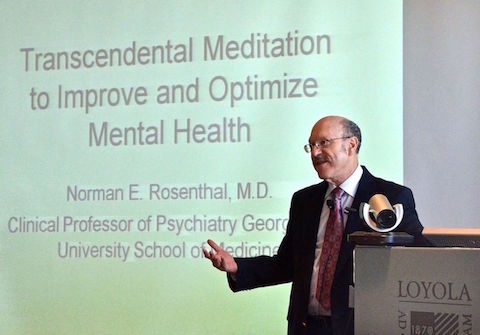
Dr. Norman Rosenthal speaks on TM at Stritch small

I asked TM Teacher Carla Brown how this came about and she explained the back story. Stritch alumnus James Bray MD had sent a letter to his colleague, Dean Linda Brubaker MD, urging her to host George Washington University clinical professor of psychiatry, Norman Rosenthal. Dr. Rosenthal’s talk about the Transcendental Meditation technique and its impact on health moved Linda and Vice Dean of Education Gregory Gruener to invite Duncan and Carla Brown to teach them and their students to meditate. Stritch School of Medicine is the medical school affiliated with Loyola University Chicago.

Since that time a team of MDs and TM teachers have guided Stritch students. The program really took off when Richard Carroll MD, ScM, FACC, joined Duncan and Carla Brown and Deans Gregory Gruener MD and Aaron Michelfelder MD.

“Dr. Carroll helped us create a flexible, blended curriculum,” said Carla. “Students start the TM technique throughout the year as they are free to do so and are able to either attend the five classes given by leading doctors and researchers held throughout the year, or review one or more classes on-line.”
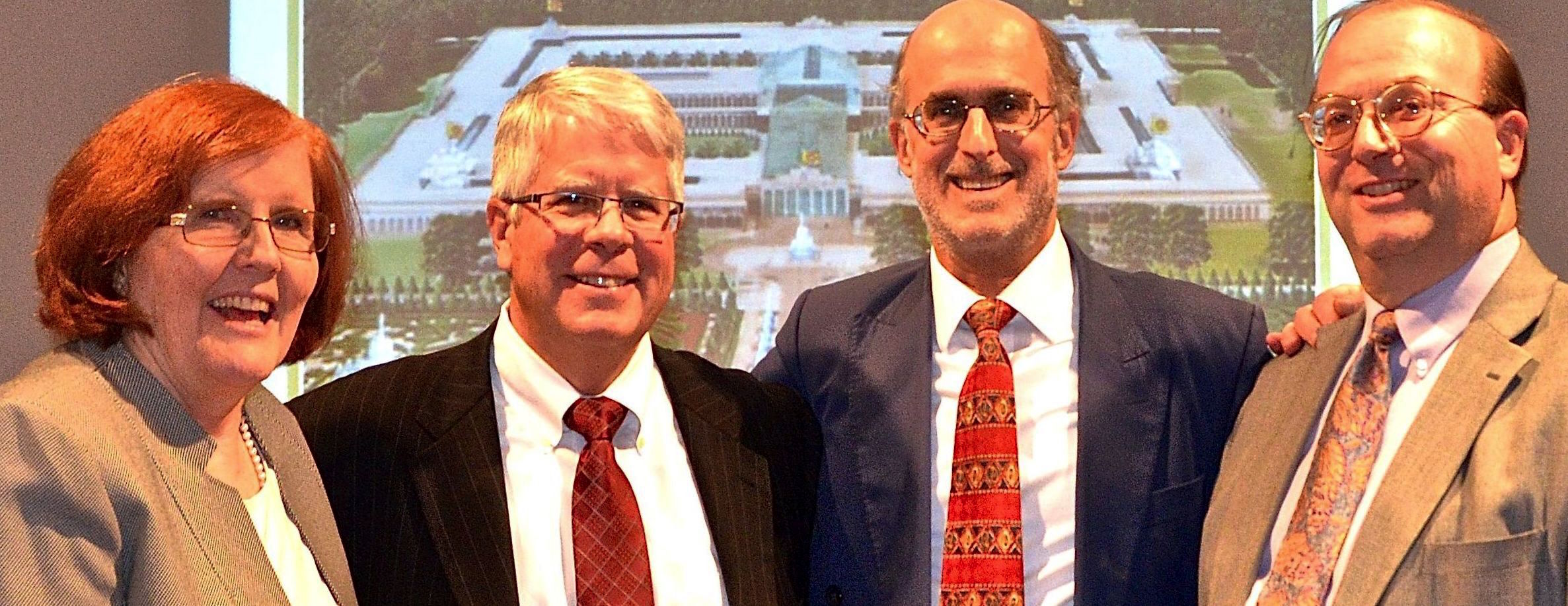
C. Brown,R. Carroll, R. Schneider, D. Brown

Dr. Carla Brown, Dr. Richard Carroll, Dr. Robert Schneider, Duncan Brown

In this picture Dr. Carla Brown, Dr. Richard Carroll and Duncan Brown welcome Robert Schneider MD, FACC (second from right). Dr. Schneider is director, Institute for Natural Medicine and Prevention, Maharishi University of Management, and has led CVD experts and medical researchers from around the country in conducting NIH-funded research over the last 20 years.

Chicago Medicine TM Articles

The first article, Physician, Heal Thyself: Stritch School of Medicine students give new meaning to the adage, was written by Carla L. Brown, EdD, and Gregory Gruener, MD. Students at the Stritch School of Medicine learn about the science and methodology behind the Transcendental Meditation technique in the first TM elective course offered at a major medical school in the United States.

Carla L. Brown, EdD, is an adjunct professor at the Stritch School of Medicine and director of the Center for Leadership Performance, Chicago. Gregory Gruener, MD, MBA, is vice dean for education, and the Ralph P. Leischner, Jr., MD, Professor of Medical Education, and professor and associate chair of the department of neurology at Stritch. The authors conclude with Implications for Patients and Physicians.

Our experience with beginning years of MDED-400 is that students can easily take control of their own wellness by gaining deep rest and improving brain functioning with twice daily TM practice. Attending physicians and students report that TM has added balance to their lives.

Having TM as a tool means our students can recommend something that they know will help, based upon their own experience and upon substantial evidence. They can avoid burnout and maintain their enthusiasm for practicing medicine. They can also become the role models we all aspire to be. Our students have demonstrated that we can join them in restoring our own balance, enthusiasm, and mastery.

The medical profession is in desperate need of support. We’re told, “Physician, heal thyself.” But how? Stritch students have demonstrated that TM might just be the prescription to help answer this charge, by making our profession a more rewarding experience while also offering something of great value for our patients.

Maura Tresch, MDThe second article, The Supporting Science: Multiple studies show the Transcendental Meditation technique can reduce stress, anxiety and cardiovascular disease risk, was written by Maura Tresch, a student who graduated from the program and is now a global health scholar and family medicine resident at St. Vincent’s Medical Center in Jacksonville, Florida. She ends her article with this valuable advice: Take Care of Yourself.

By recommending TM we can inoculate our patients against stress and its associated effects. With TM we do not “manage” stress—we get rid of it. With the stress gone, the health of the body and mind can improve. This is the essence of preventive medicine.

I have been told that “you cannot help others before you help yourself.” When we take an airplane flight, the stewardess tells us that in the event of an emergency, we are to put on our own oxygen mask before we help someone else. To properly care for my patients, I must first care for myself so that I can give them my best possible attentive mind.

Click here to read both articles on pages 22-27. The first one describes the Stritch TM elective, launched in 2014-2015, how the course came about, some of the structure and content, and guest lecturers. It contains photos and some amazing anecdotes from former students now practicing physicians who benefited from TM in challenging circumstances.

Editor’s note: The Chicago Medical Society advocates for 17,000 Chicagoland physicians and their 5 million patients. This issue was mailed to 9,000 physicians, available to patients in their waiting rooms.

Media Response

NPR – WBEZ – The Morning Shift

On Wednesday, February 24, 2016, Chicago NPR station WBEZ’s Tony Sarabia interviewed Dr. Carla Brown and med student Dani Terrell on The Morning Shift. Here is the interview with the lead-in on SoundCloud. Their website introduces this 4th segment of their show: How Loyola’s Meditating Med Students Are Transcending Stress.

The Stritch School of Medicine at Loyola University is the first major medical school in the country to offer a class in Transcendental Meditation. We talk to course instructor Dr. Carla Brown and second-year medical student Danielle Terrell about the class, why it’s being offered, and how the students are using the TM technique to manage the stress and workload of their demanding educational program. [Listen here.]

It’s not easy to get into medical school. Carla said 10,000 students apply to Stritch School of Medicine. They are whittled down to 6,000 and 10%, or 600, are selected for interviews, with only 160 admitted. So Dani represents the cream of the crop!  Listen to her comments in this 15-minute interview.

PBS – WTTW – Chicago Tonight

On Thursday, February 25, 2016, WTTW (PBS 11) Chicago Tonight host Phil Ponce spoke with Linda Brubaker, MD, Dean of Loyola University’s Stritch School of Medicine; Carla Brown, TM Teacher and adjunct professor of the Physician Wellness Program; and Danielle Terrell, a 2nd year med student, about this topic. Watch this impressive interview here.

Chicago Tonight-Physician Heal Thyself

Phil Ponce, Carla Brown, Danielle Terrell, Dean Linda Brubaker, MD.

Phil starts by asking Dean Brubaker why the Stritch School of Medicine decided to introduce this course, and she replies that “this is really a no-brainer” for them, ‘there’s no risk to this,” that they want their “students to learn self-care so that they can become resilient doctors, and Transcendental Meditation is one of the things that can help them get there. We want to bring them to their highest potential in spirit, mind, and body, and this hits all of those.”

Thinking it may be an odd course to be teaching at a medical school, Phil asks the Dean how colleagues at other schools are reacting. If anything, she says, they’re getting a lot of calls and emails asking, “Where can I learn this? How can I get on the bandwagon?” She explains, “They see the benefits in our students, staff, and faculty; it has made a big difference at our medical school. This is a core of how we teach our students self-care. And who wouldn’t want a doctor who’s taking good care of themselves, and has more to give to their patients?”

Dean Brubaker elaborates more when Phil asks why the medical profession is so stressful. She tells him it’s “high-stakes work” to properly diagnose, treat, and help patients get well. “It takes a lot of technical skill, a lot of cognitive skill, and continuous learning for the 25, 35, 45 years that you’re practicing as a physician. That’s a long time to be in a high-stakes situation. And it’s important that you learn self-care so that you don’t burnout, that you remain resilient, that you exhibit outstanding professionalism the whole time you practice as a physician.”

Here was the original introduction (PDF), and the newly updated PDF of that show segment. Click the title to see this stellar 12-minute interview: Loyola University Offers Medical Students Meditation to Combat Stress

UPDATES

Members who attended the July meeting of the Association of American Medical Colleges, Vancouver 2016, each received copies of the Chicago Medicine articles. All incoming and existing medical students at LUC/SSOM will receive copies as well. Both students and faculty have been learning TM, and more will start in the next school year.

On August 22, 2016, the Loyola University Health System Newsroom seemed to follow my lead by boldly issuing this press release: LOYOLA FIRST MEDICAL SCHOOL IN COUNTRY TO OFFER ELECTIVE IN TRANSCENDENTAL MEDITATION  an accomplishment they should really be proud of!

A similar situation in military education is taking place at Norwich University. See Norwich University, oldest private U.S. military college, benefits from Transcendental Meditation.

In related news: There is hope for family caregivers burning out taking care of their elderly infirmed loved ones. Also read this Excellent article on Transcendental Meditation written by Sarah Klein in Prevention Magazine. Posted Oct 31, 2017: Central Saanich Police Service and Area Police Officers Benefit from #TranscendentalMeditation.

On September 16, 2017, David Orme-Johnson, PhD gave the first talk in this year’s lecture series to medical students enrolled in the TM program at Loyola University Chicago’s Stritch School of Medicine. He delivered a two-part presentation. Part 1: The Effects of TM on Brain and Cognitive Processes, and Part 2: Effects of TM on the Autonomic Nervous System and Health. Dr. Orme-Johnson reviewed a large body of research showing TM as a powerful tool that can help medical students and doctors reduce stress and improve their ability to assimilate large amounts of information. Click on this title to read his comprehensive presentation filled with graphics: What does 47 years of research tell us about the Transcendental Meditation technique?

On October 15, 2018, the Catholic Health Association of the United States published this excellent article in Catholic Health World: Medical students learn meditation to counter stress, promote physician wellnessSave

On January 20 and 27, 2021, Dr Tony Nader, MD, PhD, made presentations at LOYOLA University Chicago Stritch School of Medicine via Zoom: 1) Psychiatry Grand Rounds, Loyola University, for medical doctors and health care professionals: Effectiveness of the Transcendental Meditation Technique for Dissolving Stress and Improving Health and 2) The Purpose of Meditation: Physician Wellness through the Transcendental Meditation Technique.

On February 13, 2023, Dr. Tony Nader Q&A with Medical Students. In this episode, Dr. Nader answers questions from medical students at Loyola University Chicago Stritch School of Medicine. He’s joined by Fred Travis, the Director of the Center for Brain, Consciousness, and Cognition at Maharishi International University, and Richard J. Carroll MD, ScM, FACC.

ABC News reports on Maharishi University in Iowa

January 21, 2016

Maharishi University of Management continues to be in the news. Today, a journalist from ABC News visited Fairfield to find out more about this Leading University in Transcendental Meditation.

MUM-SLC-ABC

Maharishi University’s Sustainable Living Center Greenhouse

Thursday, January 21, 2016, Fairfield, Iowa: Campaign Digital Journalist Josh Haskell is in Iowa covering politics for ABC News. When not on the campaign trail he takes time off to see some of the more interesting locations around the state.

Today Josh dropped in on Maharishi University of Management in Fairfield. He was very interested in visiting MUM because of the talk about TM at the New York office. He knew that some of them were meditating including news anchor George Stephanopoulos who had interviewed Jerry Seinfeld and Bob Roth about it.

Josh visited the university’s Sustainable Living Center and was given a tour by David Fisher, the head of the department. David also explained Consciousness-Based Education, a unique feature of this university, and the benefits it brings to students.

Josh saw a very diverse group of students in a Computer Science course meditating at the end of their day in class. He later returned to interview them. He asked about their Transcendental Meditation practice and what it’s like to study at MUM. All the students praised TM and the University for allowing them to think more clearly and learn more effectively in a stress-free environment.

Click the hyperlinked title above the photo or this link to see his 12-minute report: http://abcnews.go.com/video/embed?id=36431564.

Related: @NylonMag visits the @TMmeditation Capital of the Midwest @MaharishiU in Fairfield, Iowa.

The top 25 posts of 2015 on the @TMhome_com website that grabbed people’s attention

December 16, 2015

The popular TMhome.com website publishes a range of beautifully presented articles and interviews on the Transcendental Meditation technique and the people who practice it. They looked back and created a list of their TWENTY-FIVE MOST POPULAR POSTS of 2015.

We made it into the list twice—yours truly (14) and a documentary on Maharishi I facilitated (10), along with a mutual friend, Valerie Gangas (22) and her book, Enlightenment Is Sexy!!!

Well-known supermodel Miranda Kerr (23), Bollywood actress Anushka Sharma (17), business leaders, athletes, the DLF Change Begins Within gala (16) including singer Katy Perry, and TM teachers are listed, along with MUM alumna, singer and mystical poet Lyric Benson Fergusson (7), and former Japan PM Yukio Hatoyama (#24) who delivered MUM’s commencement speech. The telomerase study ranked high (3), and the top post was an interview with Cameron Diaz. The last one is a list of 12 great quotes on creativity. Here are the three I mentioned first.

10

620z_maharishiyogidocumentaryfullmoviehistorychannelw

The full documentary on Maharishi Mahesh Yogi,
now available for watching online.
—— read the article ——
.

14

620z_Kenchawkinpoetry_2
.
We invited Ken Chawkin, the man behind innumerable
written lines and at least one great movie (see no 10 above)
to step into the limelight. .
—— read the article ——
.

22

620z_EnlightenmentisSexybookreviewvaleriegangas_1

Enlightenment is Sexy, Valerie Gangas’s book about
falling in love with the universe made a big splash this summer. .
—— read the article ——

The Atlantic’s Jennie Rothenberg Gritz visited schools where @TMmeditation was being used for stress-reduction and well-being

December 11, 2015

Jennie Rothenberg grew up in Fairfield, Iowa, went to Maharishi School of the Age of Enlightenment, and attended UCBerkeley on a scholarship to study Journalism. She became a professional writer, a wife and a mother. Jennie is a former senior editor at The Atlantic, is now a senior editor at Smithsonian magazine.

The last piece Jennie wrote for The Atlantic, published November 10, 2015, was about the Quiet Time program, promoted by the David Lynch Foundation, and its success sponsoring the Transcendental Meditation technique in schools across the country.

The magazine introduces the article: After growing up with Transcendental Meditation as a spiritual practice, the author visits public schools where it’s being used as a simple tool for stress-reduction and well-being.

In 1974, the year before I was born, my parents had a small wedding in my aunt’s living room and then spent their honeymoon becoming teachers of Transcendental Meditation. Those were the days when just about everyone seemed to be doing it. “Plainly,” wrote the author Adam Smith in The Atlantic’s October 1975 cover story on meditation, “TM was the greatest thing since peach ice cream.” Meditation was enough of a cultural phenomenon that Woody Allen could use it as a punch line. The L.A. party scene in Annie Hall ends with Jeff Goldblum’s character placing a businesslike call to his instructor: “Yeah, I forgot my mantra.”

Considering how many 20-somethings learned to meditate in the 1970s, one might have predicted an explosion of meditating schools in the 1980s. Instead, Americans mostly forgot about the trend as they settled into the Reagan era. My parents were exceptions: They enrolled me in a small private school where the day began and ended with TM. It was an idyllic childhood in many ways, but my classmates and I always knew we lived in a bubble. One summer, at a resort in the Catskills, I listened as my aunt tried to explain my upbringing to a couple of her friends.

“Sure, I remember TM,” one woman replied. “I guess some people got caught up in meditation, just like some people got caught up in drugs.”

“And the rest of us,” her husband finished, “grew up and moved on with our lives.”

So I was fascinated when meditation recently started becoming mainstream again. Coworkers told me about mindfulness apps they were trying and friends mentioned yoga retreats they were planning to attend. The general idea seemed to be that meditation was not so much a technique for spiritual enlightenment as a common-sense lifestyle habit, like getting enough exercise or eating green vegetables. ….

Jennie visited several schools in poor, stressed inner-city locations where children from different ethnic backgrounds and broken homes came to school already traumatized. She wondered how administrators, teachers and students would react to such a program, and how it could be implemented.

It’s hard to change the circumstances that create this kind of stress, though plenty of people are trying. But if you teach kids to meditate in the meantime, the thinking goes, you can help them reduce the stress itself. That reasoning always made sense to me, as someone who has been practicing TM since childhood and seen the research on adults, especially for stress-related problems like heart disease. Struggling schools need lots of things: better food, stronger math programs, and higher-quality teachers, to name just a few. One of those needs seems to be a way to reduce stress so kids can absorb information and go into the world as well-balanced, successful people.

Still, I had a hard time envisioning how meditation programs actually worked when they were dropped suddenly into public schools. Who were the principals who brought them in—did they have hidden mystical streaks, or were their motivations purely practical? Were the teachers enthusiastic or did they see meditation as yet another gimmick imposed on them from the outside? And how did the students really feel about it? Did they roll their eyes when the meditation bell rang or did they actually enjoy it? What was it like to grow up with just meditation—and no spiritual trappings surrounding it?

The article continues with visits to some of the schools where the program was introduced. Jennie interviews principals, teachers, and the students to get their personal reactions to this meditation program and its effects on them.

Read the rest of this objective revealing report: Mantras Before Math Class by Jennie Rothenberg Gritz. This is journalism at its best!

PDF: Quiet Time Brings Transcendental Meditation to Public Schools.

You can follow Jennie Gritz on Twitter.

A year later, Jennie moved to The Smithsonian and published this excellent article: Director David Lynch Wants Schools to Teach Transcendental Meditation to Reduce Stress. The acclaimed filmmaker has become the champion of the practice that’s now been adopted by thousands of kids.

John Hagelin discusses his Global Union of Scientists for Peace offer to World Leaders

December 11, 2015

Hagelin on Meet The Press

John Hagelin

Huffington Post blogger Jeanne Ball spoke with John Hagelin about his Global Union of Scientists for Peace and their Open Letter to prominent world leaders published in the Times. The interview was posted 12/08/2015 1:00 pm EST.

As governments falter in their struggle to find a solution to unpredictable outbreaks of terror, an international alliance of concerned scientists has offered a possible solution.

The Global Union of Scientists for Peace has recently published an Open Letter to Presidents Obama, Hollande and Putin—and to the leaders of all nations—proposing a scientific alternative to the conventional approach of creating peace through force or violence (International New York Times, December 3, 2015).

In the following interview, Quantum Physicist John Hagelin, President of the Global Union of Scientists for Peace, answers questions about this novel, yet scientifically-validated approach.

Read this thought-provoking interview, which includes a short video of John Hagelin explaining how group meditation can bring world peace:

Scientists Propose “Peace-Promoting Technology” To Counter Terrorism: An Interview With Quantum Physicist John Hagelin

See The Power of The Collective, by John Hagelin, an in-depth interview on this topic published in Shift, the journal of the Institute of Noetic Sciences (IONS).

See this related Huffington Post article: Collective Consciousness And Meditation: Are We All Interconnected by an Underlying Field?

Psychology Today also asked a similar question: “Can Meditation Change The World?” See Ken Wilber said meditation can change the world. Jaochim Chissano showed it could – Steve Taylor.

As the world struggles to fight terrorism, scientists propose a plan for world peace, Good Magazine reports: World-Renowned Physicist Proposes ‘Peace-Promoting Technology’ to Counter Terrorism.

See this related video presentation: Dr. Tony Nader delivers a special message of Proven Solutions to Terrorism and Conflict.

A New Development

Watch HuffPost Live, Wed. 12/16, 1 PM EST (Noon CST): Dr. John Hagelin on the Solution to Terrorism. #WhatsWorking: Using Meditation Against Terrorism.

Join the conversation tomorrow, when John Hagelin, Bob Roth and Col. Brian Rees from the Global Union of Scientists for Peace join HuffPost Live, to discuss the use of a scientific alternative to violence against terrorism. Share your questions and comments.

If you missed the interview it’s now available for replay on HuffPost Live.

Also available on the TM Blog: Is There A Solution To Conflict And War?

Watch this brief edited synopsis of that interview.

Save

Transcendental Meditation and lifestyle changes both stimulate genes that reduce blood pressure and extend lifespan

December 7, 2015

A new study published in PLOS ONE found that the Transcendental Meditation technique and lifestyle changes both appear to stimulate genes that produce telomerase, an enzyme associated with reduced blood pressure, cardiovascular disease, and mortality. Both stress reduction approaches prevented telomere deterioration, suggesting a possible underlying mechanism for the improved cardiovascular health in a high-risk population. See a graph showing the growth of telomerase in both groups. Read the full press release at EurekAlert/AAAS.

News of the study was reported by ANI and AINS and as a result it went viral all over India and Asia. There are pages of reports on Google News. The Times of India picked it up—Daily meditation can slow ageing and blood pressure—and so did many others reproducing it.

PM Modi Sify

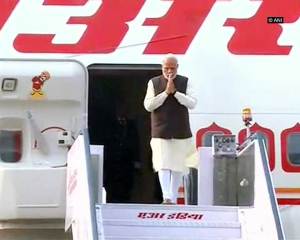
But one of the news reports that stood out to me was at Sify News. They chose a picture of India’s Prime Minister Modi to announce the news. He is seen exiting a plane with his hands together in a namaste pose as if showing respect to Maharishi University and their research scientists! See their full report:  Transcendental Meditation lowers BP, heart and mortality risks.

Another Indian news outlet, The HealthSite, announced the study to its readers in a more instructional way. They had previously published an editorial on TM taking the world by storm, and link to it and previous TM articles from this current report on the new TM study with this well written opening paragraph:

Since the Nobel Prize-winning discovery of the enzyme telomerase in 1984, identifying other biological molecules that lengthen or shorten the protective caps on the ends of chromosomes has been slow going.

A new Maharishi University of Management study found that the Transcendental Meditation technique and lifestyle changes both appear to stimulate genes that produce telomerase, an enzyme that’s associated with reduced blood pressure, cardiovascular disease and mortality. Specifically, these approaches were found to activate two genes that code for telomerase, which adds molecules to the ends of chromosomes, or telomeres, protecting them from deteriorating.

Read the rest of the article: Practise Transcendental Meditation to lower BP, heart and mortality risks.

In the west, Science Codex and Medical Xpress were the first to announce the news. PsychCentral posted Meditation & Lifestyle Both Can Improve Cardio Health. Then, Medical News Today ran two articles, one on the study itself, Transcendental Meditation and lifestyle modification increase telomerase, new study finds, followed by a more in-depth article by MNT’s senior editor and writer Marie Ellis: Can meditating reduce blood pressure?, which is now being referenced in other related articles, like Latinos Post, with their more direct title answering MNT’s question: Meditation Can Help Reduce Blood Pressure – Study.

Other medical blogs are also posting news about this study in more detail. Doctors Health News wrote: Can Transcendental Meditation Reduce Blood Pressure? New Study Says It Can. Syracuse Natural Health Examiner: Transcendental meditation can lower your blood pressure.

The Optimist wrote this great introduction to our study and then linked to the Psych Central article, which reprinted our MUM/EurekAlert press release. See: Transcendental Meditation improves blood pressure and cardio health.

Telomeres are stretches of DNA at the ends of chromosomes that protect our genetic data. Telomere length shortens with age. Researchers also suspect that telomere dysfunction contributes to hypertension and cardiovascular disease. So it’s fantastic to know that we might be able to protect our telomeres a bit. A new study shows that Transcendental Meditation—a technique for avoiding distracting thoughts and promoting a state of relaxed awareness—stimulates genes that produce telomerase, an enzyme that elongates  telomeres. After 16 weeks of meditating, study participants showed significant increases in telomerase gene expression and reductions in blood pressure.

The TMhome website introduced a clear understanding of the role telomeres play on DNA reproduction and the effect meditation, diet and exercise can have on them and our health. See their illustrated explanation why telomeres are the key to our health and aging.

This new scientific evidence at the level of DNA now shows how Transcendental Meditation allows the body to make the necessary changes to repair itself, lower the risks of heart disease, and extend life.

See Dr. Robert Schneider’s presentation at Our Conscious Future: Mind Over DNA: Transforming DNA from the Inside Out.

To learn how the mind can influence our epigenetics, click this link: https://www.youtube-nocookie.com/embed/Gu33jzWYxQU?rel=0.

John Fagan, professor of molecular biology at Maharishi University of Management and senior author on the study, met with Prime Minister Modi in New Delhi, on Jan 13, 2016. My guess is he may have discussed food safety with the prime minister.

The story behind the making of the International History documentary on Maharishi Mahesh Yogi

November 25, 2015

On November 28, 2007, Maharishi Mahesh Yogi, founder of the Transcendental Meditation technique, was featured in a biographical documentary on the International History Channel. ITN Factual, a UK-based production company, was commissioned by A&E to produce it.

During an interview with the folks at TMhome I had mentioned it, but they wanted to save it for a second article by itself. That article was published this week along with the complete film, which aired 8 years ago this coming weekend. Some of you may have seen it, or heard about it but never got see it. Well, now you can.

Previously unseen historical footage of Maharishi had been located and edited segments were provided to the producer/director Fiona Procter. Some of the people I had arranged to be interviewed for the film were David Lynch, Donovan, Mike Love, Bob Roth, Theresa Olson, Alan Waite, Bevan Morris, and John Hagelin. Jerry Jarvis was included when the producer was in Los Angeles.

Sally Peden was also interviewed for the film but did not make final cut. However, she provided additional valuable information for the producer to better understand and appreciate the scope of Maharishi’s contribution to the world. Parts of that interview were transcribed and included in the article on how the film came to be made. Read the complete article and watch the film on the TMhome website: International History Channel documentary on Maharishi Mahesh Yogi: How it was made: The story behind the film. The film is also posted on The Uncarved Blog.