Posts Tagged ‘TM’

Second study to show Transcendental Meditation reduces PTSD in African Refugees—in just 10 days

February 10, 2014

Transcendental Meditation significantly reduces PTSD in African refugees within 10 days
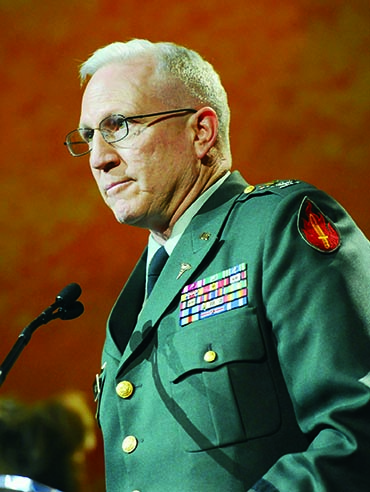
This is lead author Col. Brian Rees, MD, MPH, US Army Reserve Medical Corps

This is lead author Col. Brian Rees, MD, MPH, US Army Reserve Medical Corps

African civilians in war-torn countries have experienced the threat of violence or death, and many have witnessed the abuse, torture, rape and even murder of loved ones. Many Congolese living in Ugandan refugee camps are suffering from severe posttraumatic stress disorder (PTSD).

New research shows that Congolese war refugees who learned the Transcendental Meditation® technique showed a significant reduction in posttraumatic stress disorder in just 10 days, according to a study published today in the February 2014 issue of the Journal of Traumatic Stress (Volume 27, Issue 1, pages 1–119).

In the study, “Significant Reductions in Posttraumatic Stress Symptoms in Congolese Refugees within 10 days Transcendental Meditation Practice,” 11 subjects were tested after 10-days and 30-days TM practice. After just 10-days PTSD symptoms dropped almost 30 points.

“An earlier study found a similar result after 30 days where 90% of TM subjects dropped to a non-symptomatic level. But we were surprised to see such a significant reduction with this group after just 10 days,” said study author Brian Rees, MD, MPH.

The subjects were assessed using the Posttraumatic Stress Disorder Checklist for Civilians, (PCL-C), which rates the severity of PTSD on a scale from 17 to 85. A score below 35 means the symptoms of PTSD have abated.
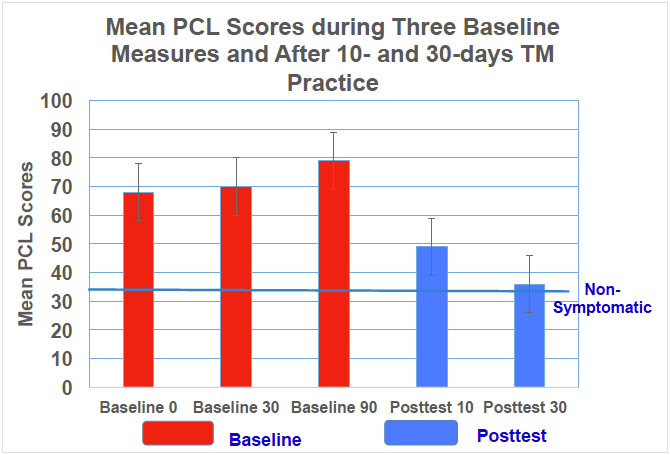
Eleven Congolese refugees who had been tested three times over a 90-day period on the PCL-C, which rates the level of PTSD on a scale from 17 to 85, began with an average score of 77.9. They learned Transcendental Meditation within 8 days of the third test and after 10 days their average score dropped to 48, which was highly clinically significant. They were retested 30 days later measuring an average score of 35.3. With scores below 35 considered non-symptomatic, they were practically symptom free.

Eleven Congolese refugees who had been tested three times over a 90-day period on the PCL-C, which rates the level of PTSD on a scale from 17 to 85, began with an average score of 77.9. They learned Transcendental Meditation within 8 days of the third test and after 10 days their average score dropped to 48, which was highly clinically significant. They were retested 30 days later measuring an average score of 35.3. With scores below 35 considered non-symptomatic, they were practically symptom free.

The subjects in the study initially tested with an average score of 77.9. After just 10 days of practicing the Transcendental Meditation technique, their PTSD test scores dropped to an average of 48, which was highly significant clinically.

Thirty days later the subjects were tested again with their PTSD scores falling to an average of 35.3 — meaning that they were nearly without symptoms of PTSD.

“What makes this study interesting is when we tested them in the 90 days before they began the TM technique, their PTSD scores kept going up,” said coauthor Fred Travis, director of the Center for Brain, Consciousness, and Cognition at Maharishi University of Management. “During that period their scores were rising, from 68.5 at the beginning to 77.9 after 90 days. But once they started the Transcendental Meditation technique, their PTSD scores plummeted.”

According to the researchers, during this particular meditation technique one experiences a deep state of restful alertness. Repeated experience of this state for 20 minutes twice a day cultures the nervous system to maintain settled mental and physical functioning the rest of the day. This helps to minimize disturbing thoughts, sleep difficulties, and other adverse PTSD symptoms.

In this video, Dr. Travis explains the neurophysiology of trauma and how TM relieves it. He says, “Something very profound is happening. Because experience changes the brain, and trauma locks in a specific brain functioning (the over stimulated amygdala), you’re stuck in a specific way of thinking and feeling, (vigilance, fear and mistrust) and appreciating the world.” He further explains how the experience of transcending, with Transcendental Meditation, calms the amygdala, relieves PTS symptoms and frees the individual “to see more possibilities.”
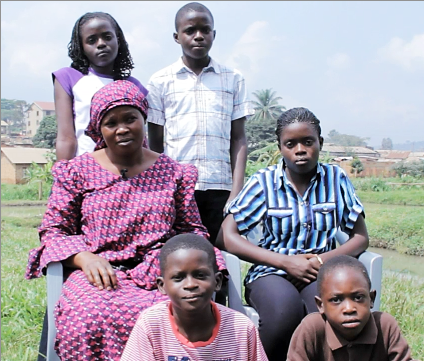
Congolese refugee Esperance Ndozi and her 5 children

Congolese refugee Esperance Ndozi and her 5 children

Esperance Ndozi was one of the Congolese refugees traumatized by the civil war. The 35-year old mother of 5 was part of the group of refugees that learned TM. Before learning the effortless technique, Esperance couldn’t find relief from a flood of dark disturbing memories. She could hardly sleep. After a week of meditating 20-minutes twice a day she describes increasing relaxation and relief from PTSD symptoms. “Your mind, your body relaxes. You feel you are out of the outside world. You are just in your peaceful world. No negativity. It doesn’t come near me now.” Like other refugees in the study the calm and peace grew to last throughout the day. Watch the video.

A previous study of Congolese refugees, which involved 42 subjects found that the Transcendental Meditation group had an average Checklist score of below 35 after 30 days, a non-symptomatic level, while the average score of the control group actually worsened over the same period.

“This is now the fourth study to show an improvement in PTSD,” said Dr. Rees, a colonel in the US Army Reserve Medical Corps. “The Transcendental Meditation technique is increasingly being seen as a viable treatment by the US military.”*

###

Study co-author Dr Fred Travis is a professor of neurophysiology at Maharishi University of Management, an accredited university to the PhD level, where Transcendental Meditation is incorporated into its curriculum and practiced by faculty and students. This provides a way for students, including veterans, to reduce the effects of past stress and trauma, and make learning easier and more enjoyable. www.mum.edu

This study was funded in part by the David Lynch Foundation. www.davidlynchfoundation.org/africa

The Journal of Traumatic Stress is published on behalf of International Society for Traumatic Stress Studies.

Source: EurekAlert!

*Two earlier studies have shown the Transcendental Meditation (TM®) technique to effectively lower post-traumatic stress in veterans of Vietnam and Iraq/Afghanistan wars.

See first refugee study: New study shows Transcendental Meditation significantly reduces PTS in African refugees

New study out on Transcendental Meditation shows reduced teacher stress and burnout

February 3, 2014

Transcendental Meditation Reduces Teacher Stress and Burnout, New Research Shows

Effect of Transcendental Meditation on Employee Stress, Depression, and Burnout: A Randomized Controlled Study

This graph shows the average level of change in total burnout, as measured by the Maslach Burnout Inventory, in the Transcendental Meditation group compared to controls. The graph displays a marked reduction in burnout symptoms in the TM group, with the control group showing a small increase in burnout over the duration of the study.

This graph shows the average level of change in total burnout, as measured by the Maslach Burnout Inventory, in the Transcendental Meditation group compared to controls. The graph displays a marked reduction in burnout symptoms in the TM group, with the control group showing a small increase in burnout over the duration of the study.

A new study published in The Permanente Journal (Vol. 18, No.1) on health showed the introduction of the Transcendental Meditation® technique substantially decreased teacher stress and burnout.

Research indicates that stress and burnout are pervasive problems among employees, with teachers being especially vulnerable to feeling frequent stress from their jobs. Burnout, a syndrome of emotional exhaustion, depersonalization, and job dissatisfaction, has been found to contribute to lower teacher classroom performance and higher absenteeism and job turnover rates.

This current study sought to determine whether practice of the Transcendental Meditation (TM) program results in lower psychological distress and decreased burnout in teachers and support staff at the Bennington School in Vermont, a special in-residence school for students with behavioral problems.

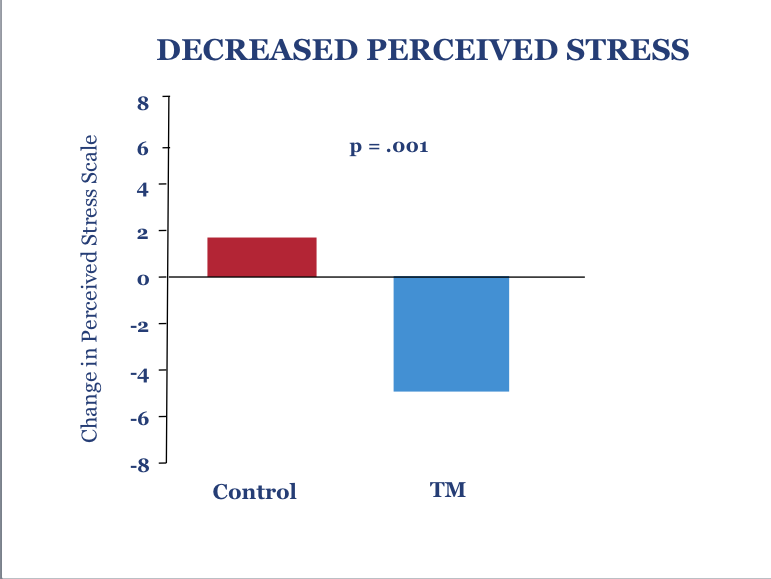
This graph shows the average level of change in perceived stress, as measured by the Perceived Stress Scale, in the Transcendental Meditation group compared to controls. The graph displays a marked reduction in perceived stress in the TM group, with the control group showing a small increase in stress over the duration of the study.

This graph shows the average level of change in perceived stress, as measured by the Perceived Stress Scale, in the Transcendental Meditation group compared to controls. The graph displays a marked reduction in perceived stress in the TM group, with the control group showing a small increase in stress over the duration of the study.

According to Dr. Charles Elder, MD, MPH, lead author of the study and a Senior Physician in the Department of Internal Medicine at Kaiser Permanente Northwest, “The results of this randomized controlled trial are very striking and demonstrate the utility of introducing a stress reduction program for teachers and other public and private employees. The four-month study found significant and clinically important decreases in perceived stress, emotional exhaustion associated with teacher burnout, and depressive symptoms in those practicing the TM program compared to a wait-list control group.”

“Burnout and other psychological distress factors have been linked to negative health behaviors, obesity, and hypertension, all of which are major contributors to cardiovascular disease,” emphasized Dr. Sanford Nidich, EdD, study principal investigator and Professor of Education at Maharishi University of Management. “Prior medical research has found that practice of the TM program is effective in reducing both risk factors for heart disease and cardiovascular events. Taken as a whole, this present study and prior research provide evidence for the value of the TM program for enhancing mental and physical health and well-being, explained Dr. Nidich.”

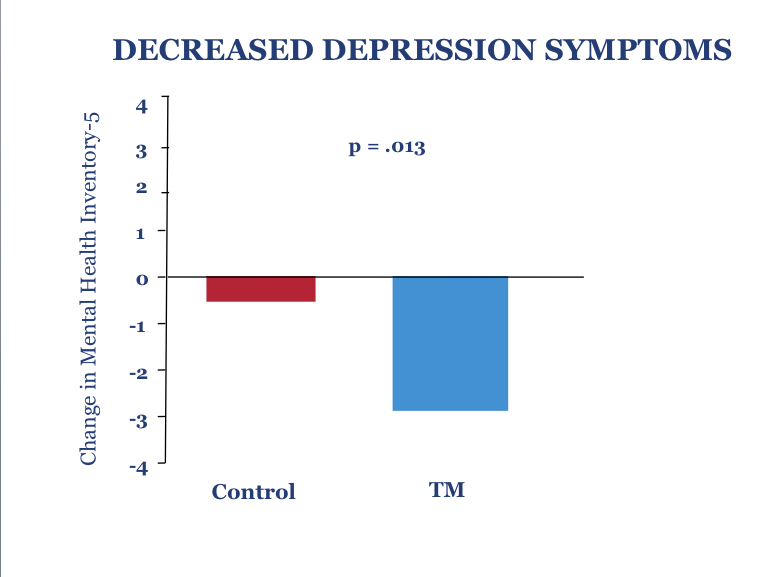
This graph shows the average level of change in decreased depression symptoms, as measured by the Mental Health Inventory-5, in the Transcendental Meditation group compared to controls. The graph displays a marked reduction in depression symptoms in the TM group, with the control group showing a small decrease in depression over the duration of the study.

This graph shows the average level of change in decreased depression symptoms, as measured by the Mental Health Inventory-5, in the Transcendental Meditation group compared to controls. The graph displays a marked reduction in depression symptoms in the TM group, with the control group showing a small decrease in depression over the duration of the study.

The study included 40 teachers and support staff measured at baseline and then randomly assigned to either immediate start of the TM program or delayed start (wait-list control group). Compliance with practice of the TM technique throughout the four-month intervention period was high; 100% of the participants assigned to the TM group meditated at least once a day. Of those, 56% meditated regularly at home twice a day.

This is the first study to investigate the effects of Transcendental Meditation on teacher burnout. Recent published studies have shown a positive impact of this program on student graduation rates, academic achievement, and psychological distress. Transcendental Meditation has seen widespread implementation in secondary schools across the country within the context of school-wide Quiet Time programs.

The study was funded by the Nine East Network and David Lynch Foundation.

About the Transcendental Meditation technique

The TM technique is a simple, natural, effortless procedure practiced 20 minutes twice each day while sitting comfortably with the eyes closed. Extensive peer-reviewed research studies have found that TM reduces psychological distress, including anxiety and depression, and promotes overall mental and physical health.

The TM technique is available in the USA through Maharishi Foundation USA, a federally recognized non-profit educational organization. Through partnerships with other non-profit organizations and foundations, full TM scholarships have been given to more than 250,000 at-risk children, school teachers, veterans suffering from PTSD, homeless people, and others. Visit http://www.tm.org for more information.

About Maharishi University of Management

Maharishi University of Management is an accredited university offering bachelor’s, master’s, and doctoral degrees in the arts, sciences, humanities, and business, where Transcendental Meditation is also practiced by both professors and students. Visit http://www.mum.edu for more information.

Source: EurekAlert!

Australian TV show objectively reports on TM

January 30, 2014

Transcendental Meditation on ABC’s Catalyst Sydney, Australia

Published over a year ago, this report on Transcendental Meditation, by the ABC’s Catalyst in Sydney, Australia, takes an objective look at the uniqueness of the practice, and its personal and health benefits. One skeptical physician says most people would sooner pop a pill to lower their blood pressure than waste time meditating. But, based on the scientific research, the American Heart Association now recommends that physicians may safely prescribe only TM for those patients who want to lower their blood pressure naturally, instead of taking long-term costly medications with potentially harmful side effects.

Dr. Robert Schneider’s tour in Australia and New Zealand educating physicians on the value of TM for heart health

Dr. Robert Schneider, MD, FACC, a leading medical researcher on the application of Transcendental Meditation for heart health, toured Australia and New Zealand in the fall of 2013. He presented the breakthrough scientific research findings of TM’s ability to reduce heart attack, stroke and early death by about 50%.

Dr. Schneider also mentioned the AHA statement, based on meta-analyses of data on different relaxation and meditation techniques, that physicians could only recommend TM to their patients wanting to naturally lower their HBP. You can see a video clip from a presentation made at Macquarie University Hospital in Sydney, Australia.

While making presentations in New Zealand, Dr. Schneider appeared on NZTV’s Breakfast ONE News program explaining how TM improves heart health, and the response from the medical community. You see that lively interaction here.

Related: @MaharishiU’s Dr. Robert Schneider presents @TMmeditation research to @uiowa Hospitals and Clinics medical staff | George Stephanopoulos interviews Jerry Seinfeld & Bob Roth on the importance of Transcendental Meditation for PTSD | Transcendental Meditation May Help Fight Heart Disease—article on Chef Marcus Samuelsson’s blog | Effects of TM Practice on Trait Anxiety: A Meta-Analysis of Randomized Controlled Trials.

Health India’s Editorial Team says Transcendental Meditation (TM) is taking the world by storm

January 14, 2014

Health India

Transcendental Meditation — a meditation technique that is taking the world by storm

Editorial Team January 14, 2014 at 5:24 pm

Meditation, a simple yet deep-rooted technique that helps you think better, control your emotions with finesse and even makes you a better person. First practiced in India, meditation is a method carried down through the ages. It was first mentioned in the Vedas and is well-known in India as a doorway to nirvana. But now the Americans have woken up to its benefits.

According to study carried out by Fred Travis, director of the centre for brain, consciousness, and cognition at Maharishi University of Management in the US, physiological measures and first-person descriptions of transcendental experiences and higher states have only been investigated during practice of the Transcendental Meditation (TM) technique.

After analysing descriptions of transcendental consciousness from 52 people practicing TM, Travis found that they experienced ‘a state where thinking, feeling, and individual intention were missing, but self-awareness remained’. A systematic analysis of their experiences revealed three themes – absence of time, space and body sense.

‘This research focuses on the larger purpose of meditation practices – to develop higher states of consciousness,’ explained Travis. With regular meditation, experiences of transcendental consciousness begin to co-exist with sleeping, dreaming and even while one is awake.

This state is called cosmic consciousness in the Vedic tradition, said the paper published in the journal Annals of the New York Academy of Sciences. Whereas people practicing TM describe themselves in relation to concrete cognitive and behavioural processes, those experiencing cosmic consciousness describe themselves in terms of a continuum of inner self-awareness that underlies their thoughts, feelings and actions, added the paper.

‘The practical benefit of higher states is that you become more anchored to your inner self, and, therefore, less likely to be overwhelmed by the vicissitudes of daily life,’ said Travis. TM is an effortless technique for automatic self-transcending, different from the other categories of meditation – focused attention or open monitoring.

It allows the mind to settle inward beyond thought to experience the source of thought – pure awareness or transcendental consciousness. This is the most silent and peaceful level of consciousness – one’s innermost self, said the study.

Wondering what it is? Here is all you need to know about the TM technique

Transcendental Meditation?

Also called the TM technique, Transcendental Meditation is a simple practice one does for 20 minutes twice in a day. All you need to do is sit comfortably and close your eyes. This meditation technique is not a religion, philosophy or lifestyle, it is simply a way to reach self-development.

This technique allows your mind to settle and gives you a chance to experience pure awareness, also known as transcendental consciousness. It allows you to experience the most silent and peaceful level of consciousness – your innermost self. It also allows your brain to attain deep rest helping you be more efficient and betters your cognitive functions.

Where did this technique originate?

About 50 years ago, Maharishi Mahesh Yogi introduced Transcendental Meditation to the world. Maharishi Mahesh Yogi is considered the representative of Vedic tradition in our day and age. This form of meditation helped in restoring knowledge and helps people experience a higher state of consciousness. The most important aspect of this technique is that it is still practiced with the same technique and principles as it was when the Vedas were first written, giving it maximum effectiveness.

How do I learn?

The TM technique has local teachers who will guide you through the process. It consists of seven steps after which one can practice the TM technique on their own.

Benefits of the TM technique

The TM technique is known to calm your mind, directly affecting the stress that your brain experiences on a daily basis. According to the experts, practicing the TM technique regularly helps in developing total brain control, thereby making you more equipped to deal with every day stress. It indirectly reduces the production on hormones that are commonly produced when one is stressed and thereby stops the damage that is normally produced.

Apart from all this, a calm mind and body is the best way to protect your body from cardiovascular stress. The TM technique also has great benefits for students, it helps improve their memory, IQ and helps them fight stress.

With inputs from: IANS

Reference: Transcendental Meditation

Related: Transcendental experiences during meditation practice – paper published in @AcademyAnnals.

Health India also posts: Practice Transcendental Meditation to lower BP, heart and mortality risks.

See more news coverage: Transcendental Meditation and lifestyle changes both stimulate genes that reduce blood pressure and extend lifespan.

Transcendental experiences during meditation practice – paper published in @AcademyAnnals

January 13, 2014

Overview of research on individuals experiencing higher states of consciousness published in Annals of the New York Academy of Sciences

Today, millions of Americans say they practice some form of yoga and/or meditation. It’s become a health fad. Yet the goal of these practices seems unknown or elusive to many practitioners — transcendence.

Dr. Travis, PhD, Director, Center for Brain, Consciousness, and Cognition, Maharishi University of Management

Fred Travis, PhD, is the Director of the Center for Brain, Consciousness, and Cognition at Maharishi University of Management

An article: Transcendental experiences during meditation practice, by Fred Travis, PhD, Director of the Center for Brain, Consciousness, and Cognition at Maharishi University of Management, provides an overview of research on individuals experiencing higher states of consciousness. It is published today in Annals of the New York Academy of Sciences: January 2014, Volume 1307, Advances in Meditation Research: Neuroscience and Clinical Applications, pages 1-8.

The paper is based on a presentation Dr. Travis was invited to give at “Advances in Meditation Research” (AMR), a meeting of the nation’s top meditation researchers, which took place a year ago  at the New York Academy of Sciences New York City.

In his paper Dr. Travis explains that different meditations have different effects, and that meditation can lead to nondual or transcendental experiences, a sense of self-awareness without content.

However, after a search of the scientific literature he reported that physiological measures and first-person descriptions of transcendental experiences and higher states have only been investigated during practice of the Transcendental Meditation® (TM) technique.

TM is an effortless technique for automatic self-transcending, different from the other categories of meditation — focused attention or open monitoring. It allows the mind to settle inward beyond thought to experience the source of thought — pure awareness or Transcendental Consciousness. This is the most silent and peaceful level of consciousness — one’s innermost Self.

This figure, a 2 X 2 table, compares subjective and objective experiences during waking, sleeping, dreaming, and pure consciousness. As seen in this table, waking state contains a sense of self and mental content, thoughts and perceptions. In contrast, during pure consciousness, there is only Self-awareness, without any sense of time, space, and body awareness.

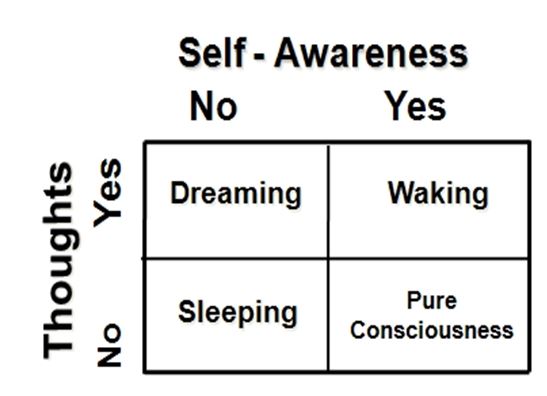
This figure, a 2 X 2 table, compares subjective and objective experiences during waking, sleeping, dreaming, and pure consciousness. As seen in this table, waking state contains a sense of self and mental content — thoughts and perceptions. In contrast, during pure consciousness (Transcendental Consciousness), there is only Self-awareness, without any sense of time, space, and body awareness.

Dr. Travis discusses a study of descriptions of Transcendental Consciousness from 52 subjects practicing the Transcendental Meditation technique and found that they experienced “a state where thinking, feeling, and individual intention were missing, but Self-awareness remained.” A systematic analysis of their experiences revealed three themes: absence of time, space, and body sense.

Specific physiological changes are associated with this subjective experience of Transcendental Consciousness. These include changes in breath rate, skin conductance, and EEG patterns.

Dr. Travis further explains that with regular meditation, experiences of Transcendental Consciousness begin to co-exist with sleeping, dreaming, and even while one is awake. This state is called Cosmic Consciousness, in the Vedic tradition. The paper presents first-person accounts followed by an overview of the physiological patterns associated with Cosmic Consciousness.

Whereas control subjects describe themselves in relation to concrete cognitive and behavioral processes, those experiencing Cosmic Consciousness describe themselves in terms of a continuum of inner self-awareness that underlies their thoughts, feelings, and actions.

In addition, the Cosmic Consciousness subjects showed the EEG patterns seen during Transcendental Consciousness along with the EEG patterns when they were asleep, and during waking tasks. This leads to higher scores on the Brain Integration Scale developed by Dr. Travis.

Dr. Travis suggests that such higher states of consciousness can be seen as normal developments beyond the classic stages described by Piaget. One simply needs a technique to experience transcendence and thereby facilitate the development of these states. The practical benefit of higher states, he says, is that you become more anchored to your inner Self, and therefore less likely to be overwhelmed by the vicissitudes of daily life.

“This research focuses on the larger purpose of meditation practices — to develop higher states of consciousness,” explained Dr. Travis. “This paper is the outgrowth of meetings at Esalen and the Institute for Noetic Sciences to chart the future of meditation research.”

Source: EurekAlert!

The Annals of the New York Academy of Sciences is the oldest continuously published scientific serial in the United States and among the most cited of multidisciplinary scientific serials worldwide. Established in 1823, the Annals is the premier publication of the Academy, offering volumes of review articles in special topical areas and proceedings of conferences sponsored by the Academy as well as other scientific organizations. You can find out more about them here: http://www.nyas.org/whatwedo/publications/annals.aspx.

Read the Foreword to Advances in Meditation Research: Neuroscience and Clinical Applications, by editor Sonia Sequeira.

Related: Health India’s Editorial Team says Transcendental Meditation (TM) is taking the world by storm

Medical News Today: Overview of research on individuals experiencing higher states of consciousness during transcendental meditation.

A PDF of the study is now available at ResearchGate.

@MaharishiU’s Dr. Robert Schneider presents @TMmeditation research to @uiowa Hospitals and Clinics medical staff

January 9, 2014

Doctor touts health benefits of Transcendental Meditation
Written by Sara Agnew, Iowa City Press-Citizen
Jan. 7, 2014 8:55 PM

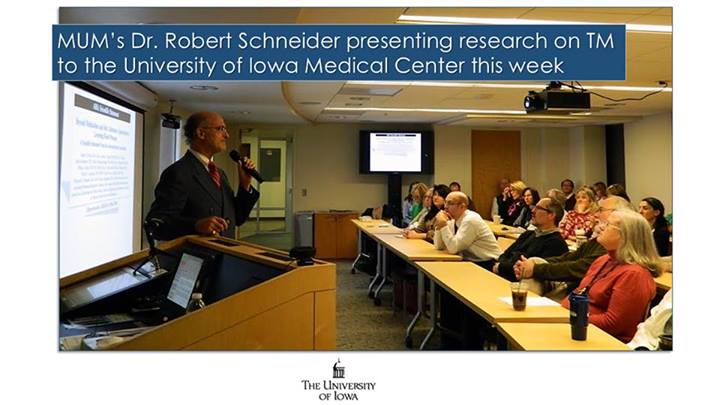
Dr. Francois Abboud, left, talks with Dr. Robert H. Schneider, who spoke with medical staff at University of Iowa Hospitals and Clinics Tuesday about how the practice of Transcendental Meditation can reduce the risk of heart disease and lower blood pressure. / Sara Agnew / Iowa City Press-Citizen

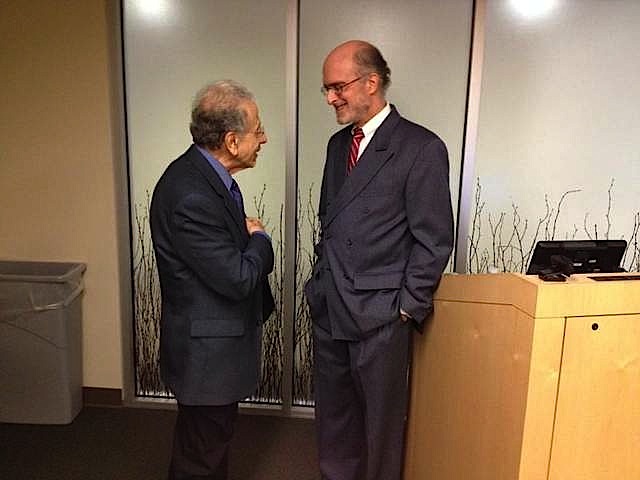
Dr. Francois Abboud, left, talks with Dr. Robert H. Schneider, who spoke with medical staff at University of Iowa Hospitals and Clinics Tuesday about how the practice of Transcendental Meditation can reduce the risk of heart disease and lower blood pressure. / Sara Agnew / Iowa City Press-Citizen

If you want to reduce your risk of cardiovascular disease and lower your blood pressure without taking medication, Dr. Robert H. Schneider has a suggestion: Transcendental Meditation.

Schneider says he has been involved in studies that show this type of meditation can reduce the rate of death from cardiovascular disease by 30 percent and from cancer by 40 percent.

The key is you need to know the “techniques” of Transcendental Meditation to experience the benefits — sitting with your eyes closed for 10 minutes won’t cut it.

That’s the message Schneider shared with about 40 hospital personnel Tuesday during an hourlong presentation called MIND-BODY-HEART: Evidence for Meditation in Hypertension and Cardiovascular Disease at University of Iowa Hospitals and Clinics. It was his first visit with staff and doctors at UIHC.

“It was breakthrough,” he said of his visit.

Schneider is director of the Institute for Natural Medicine and Prevention and dean of medical programs at Maharishi University of Management in Fairfield. As a physician and scientist, Schneider has spent the past 30 years researching evidence-based natural approaches for treating heart disease, high blood pressure, stress and other cardiovascular factors. Over the past 20 years, he has received more than $20 million in research grants from the National Institutes of Health for his natural approaches to treating heart disease.

Much of his work centers on the benefits of Transcendental Meditation.

Schneider said TM is an effortless technique for “automatic self-transcending.” It allows your mind to settle inward beyond thought to experience the source of thought — pure awareness. This is the most silent and peaceful level of consciousness and what many who practice TM call your innermost self.

“It takes a technique that you learn in an eight-hour course,” Schneider said. “Once you have the technique, it happens quite easily.”

Schneider said humans have an “inborn ability” to practice this type of meditation.

“But we have lost this simple and natural technique,” he said.

Schneider said much of his research about the correlation between mind and body were affirmed last June when the American Heart Association announced that Transcendental Meditation is the only meditation practice that has shown to lower blood pressure. In addition, AHA reported lower blood pressure through TM is associated with substantially reduced rates of death, heart attack and stroke.

Ultimately, Schneider said the AHA recommended that TM be recommended for consideration as an alternative treatment for individuals with blood pressure greater than 120/80 mm Hg.

Schneider said he learned about TM 40 years ago as a college student.

“I was always interested in how we can tap into the body’s own cell repair and healing abilities,” he said. “I thought I’d try it and see if it works.”

He read the research and gave TM a try.

“I found I could study better and learn better and had more energy,” Schneider said.

Later, when he was a fellow in hypertension at the University of Michigan Medical School, Schneider took an interest in the connection between the brain and heart.

“I thought maybe we could use the brain to lower blood pressure,” he said.

Schneider believes his years of research on managing the mind-body connection is paying off as organizations such as the AHA begin recognizing the benefits of TM.

During his presentation at UIHC, Schneider highlighted a 2012 study that showed blacks with heart disease who practiced TM regularly were 48 percent less likely to have a heart attack, stroke or die from all causes compared with blacks who attended a health education class over more than five years.

Those practicing TM also “lowered their blood pressure and reported less stress and anger,” Schneider said.

Schneider is interested in researching how TM can be used to help military veterans recover from post-traumatic stress disorder.

Dr. Francois Abboud, the namesake of UI’s Cardiovascular Research Center, asked, “How will I know if I am meditating correctly?”

Linda Rainforth, a certified TM teacher from Iowa City, said people who are practicing TM reach a “deep, deep level of silence and stillness” in which they experience an “expansion of the mind.”

One listener wondered whether men or women followed through most consistently in practicing TM during research studies.

“Men and women both get results,” Schneider said. “But in some of our studies, there was slightly more compliance with the women.”

If you go

Learn more about Transcendental Meditation by attending one of the following presentations by certified teachers in TM. All presentations will be at the Iowa City Public Library, meeting room E.
• 7:30 to 8:30 p.m. Thursday.
• 3 to 5 p.m. Saturday.
• 6:30 p.m. Jan. 16.
TM sessions also can be by appointment by calling Iowa City Transcendental Meditation Program at 936-1986, 641-472-0827 or 641-919-7282. For more information, go to www.tm.org.

MUM's Dr. Robert Schneider presenting research at UIMC

Dr. Robert Schneider was also interviewed by Steve Smith on KMCD’s MUM Spotlight Show about the American Heart Association’s recommendation of Transcendental Meditation to lower high blood pressure. He also reported on his visit to UI’s Medical Center. Steve asked some great questions. It was a lively discussion. Listen here: http://fairfieldiowaradio.com/audio/spotlight%201-9.mp3. (20:45)

See Dr. Schneider on New Zealand Television’s Breakfast ONE News describing the value of TM for heart health. http://tvnz.co.nz/breakfast-news/meditating-your-heart-video-5602306

@MaharishiU Dean of Faculty, Dr. Cathy Gorini, interviews author Steven Verney on MUM’s KHOE

January 2, 2014
Steve Verney Cathy Gorini

Steve Verney  Cathy Gorini

Author Steven Verney is interviewed by Dr. Cathy Gorini, Dean of Faculty at M.U.M. on the KHOE radio program “A Chat with the Dean.” Titled “The Best of all Possible Worlds” Steven Verney’s novel is based on his experiences as a teacher of Maharishi Mahesh Yogi‘s Transcendental Meditation.

Steven sprinkles gems of Maharishi’s knowledge before the reader along with threads of life-changing experiences many teachers of TM will relate to while going about the business of bringing enlightenment to the individual and the world and balancing life in the “real world.” Readers have found it difficult to put down this well-written book.

Click to listen: Steven Verney and Cathy Gorini – mp3 58 min, 16.8MB

A generous percentage of book sales will benefit the David Lynch Foundation teaching Transcendental Meditation to at-risk populations.

To find out more about Steven and his book, read this post and listen to an earlier interview on KRUU FM: Writers’ Voices interviews B. Steven Verney, author of “The Best of All Possible Worlds”.

Visit Steve’s new website one of his son’s designed for him http://steveverney.com and blog. Read the overview of the book and see the Xlibris Book Trailer: The Best of All Possible Worlds.

Steven is at work on his second book, about a lama that got away. The main protagonist is also a philosophy professor. I’ve read an excerpt and can’t wait to see the book when it comes out. If it’s anything like his first one, which I thoroughly enjoyed, then we’re in for another treat!

@JerrySeinfeld talks about @TMmeditation at David @LynchFoundation #ChangeBeginsWithin

January 1, 2014

On Tuesday, December 3rd, at the David Lynch Foundation‘s 5th Annual Change Begins Within Gala at the Conrad Hotel in New York City, Jerry Seinfeld took the stage to open the event. We were waiting for this to come out on YouTube. Jerry is absolutely brilliant! He opens with a funny diversion about Amazon and drones, and then segues to the main topic.

Jerry shares how he started Transcendental Meditation in college and has been practicing it for 41 years. But he reveals for the first time that he had only been meditating once a day instead of the twice-a-day instruction. Still, it was because of TM, he says, that he managed to keep it together during the nine years he was producing his successful hit show Seinfeld.

 “When I was doing the TV series in which I was the star of the show, the executive producer, the head writer, casting and editing, for 22 to 24 episodes on network television—not cable! Network—for 9 years. Okay? That’s a lot of work. And I’m a regular guy, pretty much. You know, I’m not one of these crazy people that has endless, boundless energy. I’m just a normal guy. But that was not a normal situation to be in. And so what I would do is every day when everybody would have lunch I would do TM [Transcendental Meditation] and then while we’d go back to work and then I would eat while I was working because I had missed lunch. But that is how I survived the 9 years, it was that 20 minutes in the middle of the day would save me.”

George Shapiro, Jerry’s manager and fellow meditator, had written into Jerry’s contract that he was to not do interviews or be disturbed during lunch hours, when he would go to his trailer during the taping of the Seinfeld show. Now we know why. What we didn’t know was that he was only doing it once a day, at that time. And look what he accomplished!

Jerry’s handling a lot these days, touring on weekends, producing his internet show, Comedians in Cars Getting Coffee, raising 3 young kids, and yet has the energy to enjoy it all, at 60, when he was thinking he should be slowing down. Meditating twice a day has transformed his life. Here’s the part where he mentions Bob Roth reminding him to do his morning meditation, at 6 mins, 54 secs, and what happened as a result.

By the way, David Lynch never missed his twice-daily TM during the over 40 years he’s been meditating. He also used to do his meditation (second), in private, on film sets when everyone else went to lunch.

Bob Roth interviewed Jerry Seinfeld for the new Sirius XM radio show on TM starting January 2014. Jerry is his first guest. David Lynch will also be on an episode of the show, as will other high-profile celebrities and expert guests.

New York is really the hub of American consciousness—media, finance, fashion, food, arts and entertainment. TM has created quite the buzz in the city. It’s a more peaceful and friendlier place to be in these days. 2014 holds much promise. May it bring us greater joy and success. Happy New Year!

Related stories:
George Stephanopoulos interviews Jerry Seinfeld & Bob Roth on the importance of Transcendental Meditation for PTSD
Renowned (TM) meditation teacher Bob Roth featured on The Third Metric and HuffPost Live
Alec Baldwin asks Jerry Seinfeld about learning Transcendental Meditation on Here’s The Thing
Style.com: David Lynch and Italo Zucchelli on their creativity and Transcendental Meditation
David Lynch on Esquire Network, How I Rock It, talking about Transcendental Meditation
David Lynch on meditation in the NewStatesman: Heaven is a place on earth
David Lynch speaks with Alan Colmes about his 16-country tour film Meditation Creativity Peace
Jerry Seinfeld and Howard Stern share stories about their Transcendental Meditation practice

@MaharishiU Sustainable Living students build adobe house from scratch in Texas desert

December 19, 2013

MUM Students Build Adobe House From Natural Desert Materials

Maharishi University’s Sustainable Living students study natural building and travel to the Texas desert to put up a 14′ x 14′ adobe bunkhouse made primarily from indigenous materials mum.edu/AdobeHousePR

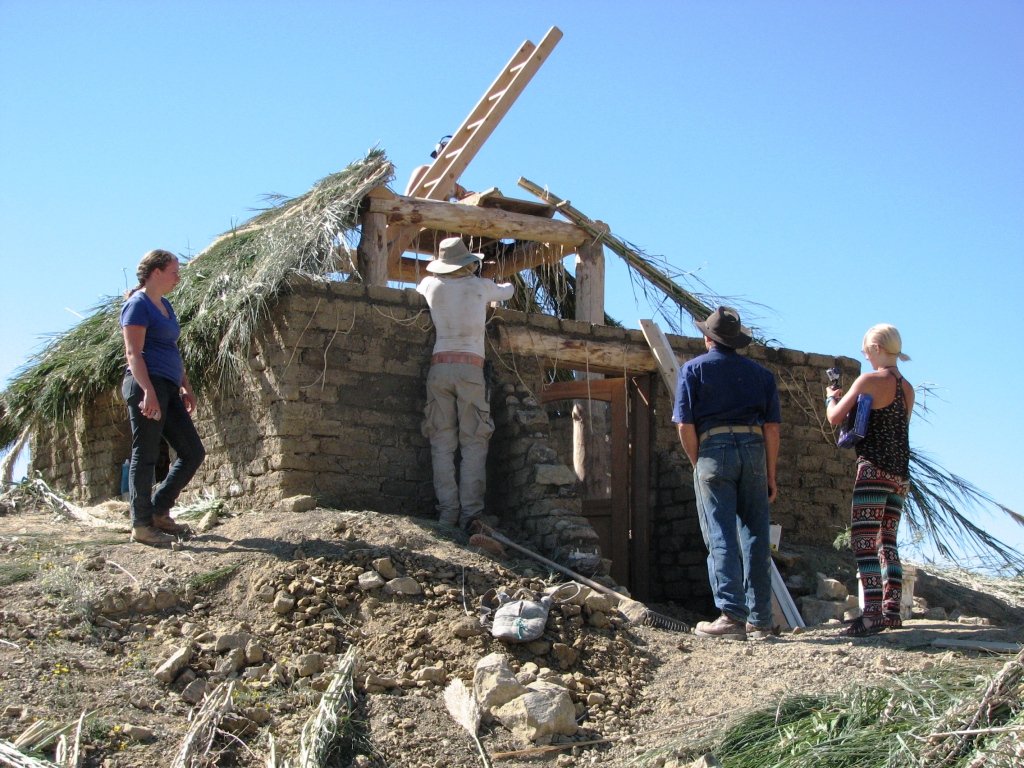
MUM students build adobe house from scratch in Texas desert

MUM students build adobe house from scratch in Texas desert

As a continuation of the Sustainable Living Program at Maharishi University of Management where students learn how to build a tiny house, a group of 12 students traveled to the Texas desert during their October Natural Building class and spent 11 days putting up a 14 x 14 adobe house made primarily from local materials.

They first made 850 adobe bricks from soil near the construction site, created a frame of posts and beams from dead spruce trees harvested beforehand on campus, and then topped the structure with a waterproof thatched roof made of river cane.

“It really has an amazing feel,” said course instructor Mark Stimson. “It’s rectilinear and oriented toward the cardinal directions, and adobe walls give it an ancient, grounded feeling.”

Intended to serve as a bunkhouse for future visitors, it sits on land owned by Mr. Stimson and his wife that’s adjacent to Big Bend National Park. Also on site is a tiny house students built last year.

In addition to learning practical construction skills, the students had the opportunity to experience an extraordinary landscape that includes deep vertical canyons, distant mountains, and rock-outcroppings dating back 500 million years, fossils, petrified wood, and a hot spring on the Rio Grande River. Plus the occasional tarantula and scorpion.

“The students had a transformative experience,” Mr. Stimson said. “They’ve never seen anything like this desert, with its vast scale. The heights and distances reset your perspective on things.”

Mr. Stimson’s desert site is 80 miles from the nearest town on a road too rugged for ordinary cars. The students prepared and canned all their food in advance. That alone was a learning exercise in planning and execution.

They traveled to the site via the Sustainable Living Department bus powered by biodiesel fuel that was made by the students and staff member Steve Fugate.

Every aspect of the construction required learning new skills. The students began their work on campus, creating a plan and estimating the amount of materials they would need.

Once on site, the students learned to sift the soil used for the bricks, moisten it with water, and then use forms to create the bricks. Once skilled, they were able to make a brick in less than a minute.

But then the bricks, all 17,000 lbs. of them, had to be carried up a long hill. The students formed a chain, and accomplished the task with aplomb.

“The students were confronted with many challenges in this remote desert region,” said Stimson, “but in the process they learned a lot about teamwork, leadership, self-sufficiency, and how to be flexible in the changing conditions they encountered.”

He related an incident of the students trying to prepare and dry adobe bricks, when an early morning desert fog prevented the sun from drying them out. It happened three or four days in a row. Of the many things they planned for, he said, the desert wasn’t one of them! But the sun burned it off by noon each day, and the adobe blocks dried enough to be used.

In order to comply with Maharishi Vedic℠ architecture, they learned how to perfectly align the building by using the North Star and the meridian transit off the sun.

“It’s within a quarter or even one-eighth of a degree of being perfectly aligned,” Mr. Stimson said.

He said his desert site is intended to serve as a retreat for campus groups and students in other departments, as well as the Sustainable Living students.

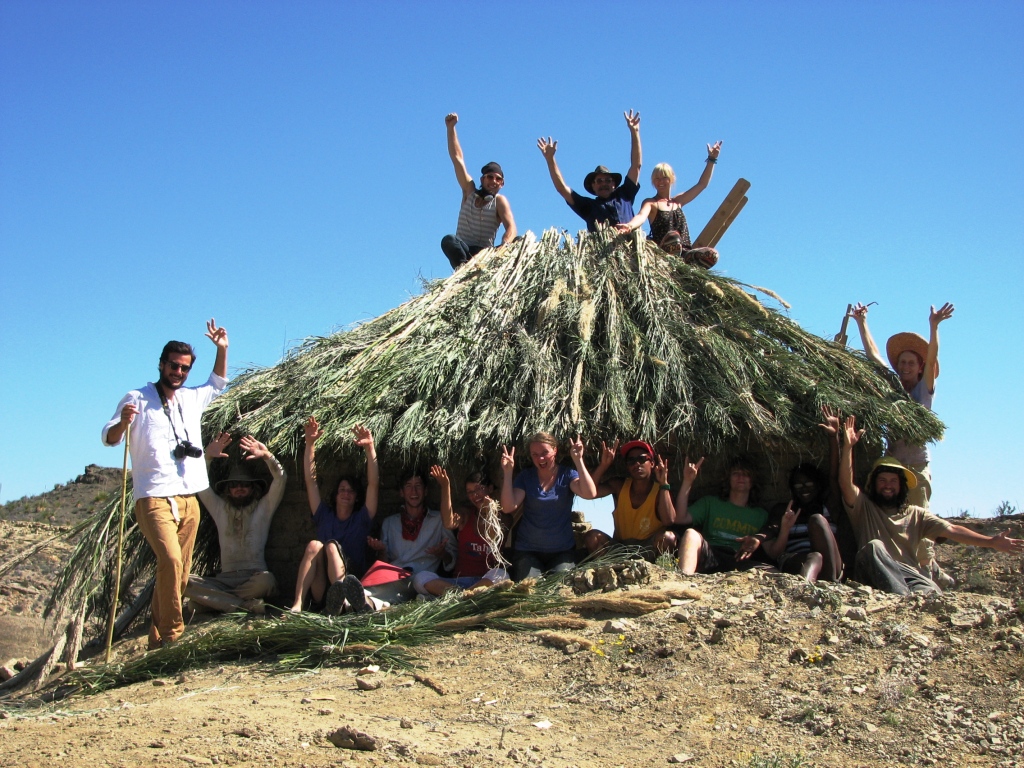
MUM students complete adobe house from scratch in Texas desert

MUM students complete adobe house from scratch in Texas desert

Commenting on the success of this course and the happiness of the students who participated in it, Professor Lonnie Gamble, Co-Director of the Sustainable Living Department said, “They’re happy because they’re taking their part in creating the world that they want to live in. I think it brings out a great joy, a great satisfaction, something that many of them have been looking for at other institutions before they’ve come here.” http://link.mum.edu/AdobeHouse

Part of this report was taken from The Review, Vol. 29, #6, November 27, 2013. For more information visit http://link.mum.edu/AdobeHousePR.

Read the description under this video posted on the MaharishiUniversity YouTube channel with more details describing how the students prepared for their trip, built their tools when they got there, gathered and processed the local materials to construct the adobe house.

Founded in 1971, Maharishi University of Management (MUM) offers Consciousness-Based℠ Education, a traditional academic curriculum enhanced with self-development programs like the Transcendental Meditation® technique. Students are encouraged to follow a more sustainable routine of study, socializing and rest without the typical college burnout. All aspects of campus life nourish the body and mind, including organic vegetarian meals served fresh daily. Located in Fairfield, Iowa, MUM is accredited by The Higher Learning Commission and offers bachelor’s, master’s, and doctoral degrees in the arts, sciences, humanities, and business. Visitors Weekends are held throughout the year. For more information, call the Admissions Office at 800-369-6480 or visit http://www.mum.edu.

Source: PRWeb: http://www.prweb.com/releases/MUM-SL/AdobeHouse/prweb11363060.htm

Alec Baldwin asks Jerry Seinfeld about learning Transcendental Meditation on Here’s The Thing

October 20, 2013

HerestheThing_web_header_alt3Monday, October 14, 2013 | Episode #52 | Jerry Seinfeld
Listen | Download | Stream m3u | Transcript

 Jerry Seinfeld (Jason Sheldon)

Jerry Seinfeld (Jason Sheldon)

This month, Alec Baldwin sat down with comedian Jerry Seinfeld for his show, Here’s The Thing, which airs on WNYC. Jerry had debuted on HBO in 1981, the same year he first appeared on Johnny Carson. Jerry Seinfeld was 27 years old.

Seinfeld’s material stood out. It wasn’t about his upbringing or personal relationships. It was about our universal experience of small things. Eight years after his HBO debut, he and Larry David created a weekly series that changed both their lives. After Seinfeld ran for nine seasons, Seinfeld went back to stand-up, and to his audience. As he explains to Alec, Seinfeld feels uniquely connected to his fans: “You have this relationship with the audience that is private between you and them. Critics want to write, people want to talk. We have our own thing that nobody can break … once you build that it can’t be broken by outside forces.”

In the closing segment (last 3 minutes) Alec asks Jerry about meditation, how and when he learned it. Here’s that section of the transcript:

Alec Baldwin: Jerry Seinfeld has meditated for over four decades and it shows. He says it makes stress float away. I wanted to find out more about Jerry and meditation. So I called him.

Jerry Seinfeld: Transcendental Meditation, that’s what I do. TM.

Alec Baldwin: And how long have you been doing that?

Jerry Seinfeld: Since ’72.

Alec Baldwin: So when did that come into your life? You like saw a billboard when you were at the Long Island Railroad station?

Jerry Seinfeld: Yeah, I saw a flyer in the union at Oswego State University, where I was enrolled.

Alec Baldwin: Seriously?

Jerry Seinfeld: Because I couldn’t take senior year anymore so I left high school six months early, got into college, and left in the middle of senior year. Now I know you didn’t do that.

Alec Baldwin: No.

Jerry Seinfeld: Because you were handsome and the girls were hanging off of you, and senior year was fantastic for you. That’s what I know.

Alec Baldwin: Yeah. It was a vending machine of women. It was just endless.

Jerry Seinfeld: I know. Well it wasn’t like that for me, buddy boy. So I thought I gotta get out of here, and start a new life with people that don’t know me. So I went to Oswego and while I was there, now remember this is still in the flora and fauna of 60s experimentalism, so Transcendental Meditation, somebody told me about it, I don’t remember who. And I thought, well let me see what that’s about and I went to this thing and I learned the technique. It cleared up my acne immediately, I had this great energy and focus, and I’ve been doing it the rest of my life.

Alec Baldwin: So you sound, when you say you learned the technique, and it cleared up your acne, and your energy and focus, it sounds like you ultimately had the sex that had been evading you up until then, before you went to Oswego.

Jerry Seinfeld: That’s correct.

Alec Baldwin: So the TM was really a pathway to sex, correct?

Jerry Seinfeld: What isn’t?

Alec Baldwin: How can I do it? Like where do you do it? Can you do it anywhere? Or do you have to be in a sacred space?

Jerry Seinfeld: You can do it anywhere.

Alec Baldwin: You can do it anywhere.

Jerry Seinfeld: I’m gonna get you doing it now.

Alec Baldwin: I want you to get me doing it.

Jerry Seinfeld: You’re my next victim.

Alec Baldwin: I want more energy, more focus, I want my acne to clear up.

Jerry Seinfeld: Well you don’t need, you can’t have more energy, you can’t even dispose of the energy that you have.

Alec Baldwin: It’s true. But it’s toxic energy. It’s more like a Chernobyl than it is a kind of a babbling brook.

Jerry Seinfeld: Ok, well this is a different, this is a nice energy, really nice. Here’s how I’ll describe it to you. You know how three times a year, you wake up and you go, ‘Boy, that was a really good sleep?’

Alec Baldwin: Yes!

Jerry Seinfeld: Imagine feeling like that every day.

Alec Baldwin: Oh my god!

Jerry Seinfeld: That’s what it is.

Alec Baldwin: Meditation. I gotta try that.

(And I have a feeling he just might.)

Jerry Seinfeld – Personal Archives

Comedians in Cars Getting Coffee

Looking for an episode of Here’s the Thing? View the Full Archive

Related clips involving Jerry Seinfeld and TM. These are funny!!!

@JerrySeinfeld talks about @TMmeditation at David @LynchFoundation #ChangeBeginsWithin

George Stephanopoulos interviews Jerry Seinfeld & Bob Roth on the importance of Transcendental Meditation for PTSD

Highlights of David Lynch Foundation honoring legendary manager and producer George Shapiro at first annual Night of Comedy

Jerry Seinfeld and Howard Stern share stories about their Transcendental Meditation practice

Newly added from Issue 20 of Enlightenment, The Transcendental Meditation Magazine: Jerry Seinfeld Talks TM with Bob Roth, a partial transcription from the Sirius XM radio show “Success Without Stress.” Click here to listen to the complete 60-minute interview.