Posts Tagged ‘Maharishi Mahesh Yogi’

Des Moines Register: Oprah in Iowa: Fairfield meditation segment airs Sunday

March 24, 2012


Oprah in Iowa: Fairfield meditation segment airs Sunday

By TODD ERZEN | FILED UNDER – News | 1:28 PM, Mar. 23, 2012

The media icon paid a stealthy six-hour visit to the Maharishi University of Management last October and will tell the country about her newfound devotion to Transcendental Meditation at 8 p.m. on Sunday as part of her new weekly series, “Oprah’s Next Chapter.”

Fairfield Mayor Ed Malloy, who took the media mogul on a tour of one of the university’s golden domes before she meditated there with about 400 other women, said Winfrey already had a working knowledge of Transcendental Meditation based on her experience with inner-city school systems.

The practice has been introduced there to children suffering from academic and behavioral problems with the help of Maharishi board of trustees member David Lynch, the television and film director whose private foundation promotes “Consciousness-Based Education and World Peace.”

“It’s had phenomenal results (in schools) and I think she became intrigued by that,” said Malloy, who has practiced Transcendental Meditation for 38 years. “Oprah’s bright and energetic and gregarious and thoughtful and provocative and we are honored and tickled to be featured by her in this way.”

Watch a sneak preview of the show

Sneak Preview: Oprah Visits America’s Most Unusual Town

Oprah spends the day in Fairfield, Iowa—one of the safest, greenest and most unusual communities in America. It’s the last place you’d expect to find two huge golden domes built for the thousands of residents who rush there to meditate twice a day. Watch a sneak preview; then tune in for the full episode of Oprah’s Next Chapter on Sunday, March 25, at 9/8c.


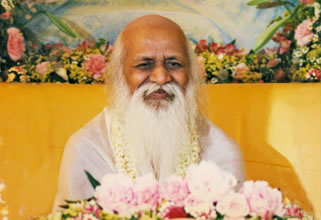
Transcendental Meditation first came to Fairfield by way of the Maharishi Mahesh Yogi, who gained international fame as the guru to the Beatles before transforming the bankrupt Parsons College property into his namesake university in 1974.

In 2001, the Maharishi’s followers incorporated their own town, called Maharishi Vedic City, about two miles north of Fairfield. Sales of non-organic food are banned and buildings are designed to follow principles the Maharishi established, such as facing east and featuring a golden roof ornament. About 1,300 people live there, and an estimated one-quarter of Fairfield’s 10,000 residents also practice Transcendental Meditation.

Winfrey has tried to make a similar impact on her employees by encouraging them to meditate twice during each work day.

Paul Chesnutt-Winer, who hosted Winfrey in his home and will be featured with his family on Oprah’s television show, said the practice of Transcendental Meditation could not have made a better friend.

“She’s an amazing combination of being a strong, executive woman and really a lot of fun,” he said.

See this earlier post by Todd Erzen on Mar 22, 2012 with links to a preview of the show and interview with Dr. Oz on Oprah’s visit to Fairfield and company-wide practice of the Transcendental Meditation technique. Fairfield sees itself through Oprah’s eyes on Sunday.

For information on Transcendental Meditation, visit www.tm.org.

Related articles: Chicago Sun-Times: Oprah will talk about transcendental meditation on OWN | The Fairfield Ledger:Fairfield readies for Sunday debut on Oprah network | OWN: Oprah Visits America’s Most Unusual Town, Sunday, March 25, 8 p.m. CT, 9-10 p.m. ET/PT | KTVO: Fairfield to be featured on Oprah Winfrey Network | Oprah writes in O Mag about her visit to TM Town and meditating with ladies in their Golden Dome | Some Reports on Dr. Oz’s Interview with Oprah about TM and her Next Chapter | Oprah meditates with ladies in MUM Golden Dome | Reports of Oprah’s visit to Fairfield, Iowa | Oprah says she and her staff meditate, enjoy a Quiet Time twice a day—Facebook Live interview. Also see The Iowan: Sizing Up Small Towns: Rethinking Success in Rural Iowa: Fairfield Thinks Inclusively.

What Turkish Sufi poet Yunus Emre realized — everything was found within his cosmic body

February 28, 2012

Ever come across a poem that encapsulates what you’ve read lately or thought about in the past? I found one today in a book I was sampling on Amazon, The Drop That Became the Sea: Lyric Poems, a collection of poems written by Yunus Emre, (1240-1321), translated by Kabir Helminski and Refik Algan.

Yunus Emre was the first in a great tradition of Turkish Sufi troubadours who celebrated the Divine Presence as the intimate Beloved and Friend. Called the greatest folk poet in Islam, the songs of this Sufi dervish are still popular today.

He was a contemporary of Rumi, who lived in the same region of Anatolia. Rumi composed his collection of stories and songs for a well-educated urban circle of Sufis, writing primarily in the literary language of Persian. Yunus Emre, on the other hand, traveled and taught among the rural poor, singing his songs in the Turkish language of the common people.

A story is told of a meeting between the two great souls: Rumi asked Yunus Emre what he thought of his great work the Mathnawi. Yunus Emre said, “Excellent, excellent! But I would have done it differently.” Surprised, Rumi asked how. Yunus replied, “I would have written, ‘I came from the eternal, clothed myself in flesh, and took the name Yunus.'” That story perfectly illustrates Yunus Emre’s simple, direct approach that has made him so beloved.

The poem I’m referring to begins, We entered the house of realization. Inside they find the earth and sky, night and day, the planets, the many veils in the body, what the scriptures say, and more. In that realized state, the poet witnesses everything inside the body; the infinite within the finite, the eternal within the temporal. His body is cosmic, an expression of totality.

It reminded me of the work of Maharaja Adhiraj Rajaraam (Professor Tony Nader, MD, PhD), a neuroscientist and Vedic scholar. Under the guidance of His Holiness Maharishi Mahesh Yogi, Professor Nader showed how the individual is cosmic.

The body, he says, is a manifestation of Natural Law—the Veda and Vedic Literature—the underlying blueprint that creates the individual body and the cosmic body, the Universe, a microcosm of the macrocosm. Yatha pinde tatha brahmande. See link to video at end of this article.

One aspect of the Vedic Literature is Jyotish, Vedic Astrology. Dr. Tony Nader shows a precise one-to-one relationship between the fundamental structures and functions of human physiology (Individual life) and the fundamental structures of Natural Law (Cosmic life). These fundamental structures of Natural Law connect individual intelligence with cosmic intelligence — the basic structures of the human nervous system with their cosmic counterparts. In this chart, the nine Grahas (planets), are shown where they are found in the different aspects of our physiology and their influences.

This first book by Dr. Nader, Human Physiology — Expression of Veda and the Vedic Literature, discusses all 40 aspects of the Vedic Literature and their expressions in the body.

Over a decade in the making, Dr. Nader’s new book, Ramayan in Human Physiology, reveals an understanding of the underlying unity that makes us human — the eternal reality of the Ramayan in the structure and function of the human physiology. Surprisingly, the Ramayan is not just a mythic tale assigned to an ancient culture in a distant past, but a description of the universal transformations continually taking place within our own bodies. Here is a book preview.

Yunus Emre expresses a similar understanding in poem #4, page 20, chapter I, The Dervish Way, in The Drop That Became The Sea.

We entered the house of realization,
we witnessed the body.

The whirling skies, the many-layered earth,
the seventy-thousand veils,
we found in the body.

The night and the day, the planets,
the words inscribed on the Holy Tablets,
the hill that Moses climbed, the Temple,
and Israfil’s trumpet, we observed in the body.

Torah, Psalms, Gospel, Quran—
what these books have to say,
we found in the body.

Everybody says these words of Yunus
are true. Truth is wherever you want it.
We found it all within the body.

A related example was highlighted by Dr. Nader in a press conference when he referenced ‘Abdu’l-Bahá [quoting The Imam Ali], from The Secret of Divine Civilization: “Dost thou think thyself only a puny form, when the universe is folded up within thee?”

Speaking of microcosm-macrocosm, here is an interesting saying from The Conversations (Maqalat) of Shams of Tabriz (Hazret Shams al-Din of Tabriz), Rumi’s master, which gives you a different perspective on the internal life of a saint:

The microcosm is hidden in the creation of man
and the macrocosm is the outer universe.
But for prophets the outer universe is the microcosm
while the inner universe ıs the macrocosm.

These two videos of Maharishi Mahesh Yogi answering questions from the press: As is the cosmic life, so is the individual life, and I am the Self, I am the body, I am the Veda, I am the universe, I am totality, explain the cosmic significance of these Vedic expressions and their practical applications in our daily lives.

See this New Video: Dr. Tony Nader speaks about the Ramayana in Human Physiology, which explains how the whole body is made of Veda, which also structures the cosmic body, the universe, and how the activities described in the Ramayana are a scientific description of the growth and evolution of the human physiology to it’s fully developed enlightened state.

See Sufi poet Hakim Sanai says transcend belief to enter into the mystery.

See Yunus Emre says Wisdom comes from Knowing Oneself — a Singularity that contains the Whole

Singing Image of Fire, a poem by Kukai, with thoughts on language, translation, and creation

January 2, 2012

We read in Genesis that creation came into being with the first utterance: “Let there be light.” So sound came first, then light, followed by forms. Interestingly, the seemingly nonsensical phrase, abracadabra, a magician says when performing a trick, derives its meaning from the ancient biblical language, Aramaic: abraq ad habra, which means, “I will create as I speak.” I discovered that on page 170 of Poemcrazy: Freeing Your Life with Words, a delightful book on finding and writing poetry in many creative simple ways, by Susan Wooldridge, writer, poet and teacher.

This poem by Kukai says a lot about language, creation, consciousness, and our integral relationship to things.

Singing Image of Fire

A hand moves, and the fire’s whirling takes different shapes,
Triangles, squares: all things change when we do.
The first word, “Ah,” blossomed into all others.
Each of them is true.

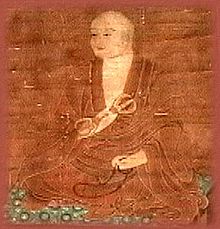
This poem on language, translation, and creation, the pictorial/written representation of vocal sounds and meanings, was written by Kūkai (空海), also known posthumously as Kōbō-Daishi (弘法大師 The Grand Master Who Propagated the Buddhist Teaching), 774–835, a Japanese monk, civil servant, scholar, poet, artist, and founder of the Shingon or “True Word” school of Buddhism. He allegedly developed the system using Chinese characters to write Japanese words. The word “Shingon” is the Japanese reading of the Kanji for the Chinese word Zhēnyán (真言), literally meaning “True Words”, which in turn is the Chinese translation of the Sanskrit word mantra (मन्त्र). The concern was to be as true as possible when translating texts, to have and use the right word when describing something. The Sanskrit language had this perfect one-to-one correspondence between name and form.

The poem was mentioned in Nine Gates: Entering the Mind of Poetry (HarperCollins, 1997) by Jane Hirshfield, a classic collection of essays about the mysterious ways poetry comes to us. In her chapter, The World is Large and Full of Noises: Thoughts on Translation, she highlights this theme with What Rainer Maria Rilke inscribed on the copy of The Duino Elegies he gave his Polish translator.

When I read that line in Kukai’s poem, about the first word, “Ah,” blossoming into all others, and each of them being true, it reminded me of what Maharishi Mahesh Yogi says about the first sound of creation, “A”, how it represents infinity collapsing to a point, “K”, and through its own sequential self-interacting dynamics, creates the whole alphabet, words, verses of Rk Veda, the whole Vedic literature, and their subsequent forms, the universe. This is part of Maharishi’s Apaurusheya Bahashya, the unwritten commentary of the Veda, unfolding itself and commenting on itself to itself. Apaurusheya Bhashya: Rk Veda is said to be nitya, eternal, and apaurusheya, uncreated. Maharishi explains that the sequential unfoldment of Rk Veda is its own uncreated, or unmanifest, commentary on itself, rather than that of an individual making an ‘external’ commentary on Rk Veda.

See Maharishi’s Apaurusheya Bhashya discussed in Everything is made of Vedic Sounds by William F. Sands, PhD. Also see Modern Science and Vedic Science: An Introduction by Kenneth Chandler, PhD.

In his Introduction to Maharishi Vedic University, Maharishi gives us a comprehensive cosmic perspective on the role Sanskrit, the language of Nature, plays in the process of creation. Through the self-interacting dynamics of pure consciousness, the Self, or Atma, reverberates within itself and creates the eternal uncreated sounds of the Veda, its own language, which in turn express themselves into forms—the individual body, Sharir, and the cosmic body, Vishwa. The eternal Silence and its own inherent Dynamism, evolve all parts of itself constantly referring them back to their source. He says it’s a start-stop process of Infinity collapsing to a point, referring it back to Itself, and evolving the next sequential sound, and subsequent form. Full realization, or enlightenment, comes when one comprehends all of creation: Atma, Veda, Sharir, Vishwa, Brahman, or Totality, as the full potential of one’s own consciousness. Aham Brahmasmi. I am totality.

On Page 65 Maharishi writes, “The basic process of change, this basic process of transformation, continuously maintains the momentum of evolution of different levels of expression, creating different levels of manifestation upholding the process of evolution.

“It is this that promotes the eternally self-referral dynamics of Samhita into the sequential evolution of sound, speech, forms of speech in alphabets, words, phrases, verses etc., with corresponding material forms. This process continues eternally, resulting in the ever-expanding universe.” (Samhita is the togetherness of Rishi, Devata, Chhandas; knower, process of knowing, and known.)

I’ve written a poem about this process in Coalescing Poetry: Creating a Universe, (into haiku forms).

To learn more about the source of words, creation, both literal and literary, and their connection to consciousness, read: The Flow of Consciousness: Maharishi Mahesh Yogi on Literature and Language.

Also see: Before He Makes Each One by Rainer Maria Rilke.

Nine years later I posted: Japanese culture: poetic aesthetics, artistry, and martial arts, inspired me to write haiku and tanka.

Meditation for Students: Results of the David Lynch Foundation’s Quiet Time/TM Program in San Francisco Schools

December 24, 2011

David Lynch Foundation Event in San Francisco: Meditation for Students

The David Lynch Foundation held a benefit gala in San Francisco on June 1 at the Legion of Honor, to showcase the successes of a five-year project to bring the stress-reducing Transcendental Meditation technique to students in inner-city San Francisco schools. In this video, you will hear James Dierke, principal of Visitacion Valley Middle School talk about the unprecedented academic achievements of his meditating students; iconic filmmaker David Lynch talk about the inspiring work of his foundation among at-risk populations; and Dr. Norman Rosenthal, internationally renowned psychiatrist and NY Times bestselling author, discuss the amazing results of scientific research on the TM technique. See other featured past events posted on the David Lynch Foundation website. To hear more about the David Lynch Foundation and it’s programs, please visit: http://www.davidlynchfoundation.org.

Uploaded by on Jul 7, 2011.

See selected highlights of Inspiring results from the TM-Quiet Time Program in the San Francisco Unified School District.

George Harrison: The not-so-quiet Beatle, article by Philip Goldberg in LA YOGA Magazine

December 14, 2011

George Harrison: The not-so-quiet Beatle,

by Philip Goldberg, author of American Veda,

published in LA YOGA Magazine.

Download a PDF of this article

found on pages 28+29 of the LAYOGA

December/January 2012 issue.

Listen to this Oct 12, 2012 KRUU FM interview with Philip Goldberg and Cheryl Fusco Johnson on Writers’ Voices http://www.kruufm.com/node/14325/node/14325.

God? ~ Dr. Evan Finkelstein

December 7, 2011

God? ~ Dr. Evan Finkelstein

Some say there is one God; some say there are many Gods, some that there is no God at all.

What does this have to do with the price of beans in China? Not much. Unless you were God, then, according to some, You would be the beans, You would be the price, and You would be China. And, even when people referred to You as “You” they would have to capitalize the Y. That’s pretty special treatment.

Some people destroy in the name of “their” God and are convinced that they are doing the right thing. Others think those people are crazy and that God (“their” God, not the God of the crazy people) will certainly punish the destroyers for their wicked deeds.

Obviously, the God of those people can’t be as great as “our” God; if He/She were, then those people wouldn’t be doing those insane things. Why can’t they just come over to our God? And see the “true” Light? Then, everything would be so much better (at least, from that point of view).

For thousands of years, there have been arguments, wars, inquisitions, trials, immolations, excommunications and on and on, related to the existence and nature of God: what is the right way to envision God?

Does He, or maybe She, sit on a large fancy throne high up in the clouds somewhere in heaven surrounded by angels and other assorted celestial beings? And, how did they get that heavy throne to stay up in the sky? Well, it’s God, man, He/She can do anything!

Well, if He/She can do anything why can’t my team get into the Superbowl? Is He/She deaf? Can’t God hear my prayers? Is Green Bay, Wisconsin closer to heaven than Chicago, Illinois? Or, do they just yell louder? Does this mean that God has preferences? Does He/She just like some of us better than others of us? Is it the way we dress? Our cologne? Our mouthwash? Was it something we said?

And if God is omnipresent why can’t we see Him/Her?

I mean God should be a lot easier to find than our glasses or car keys. Some saints claimed to experience God; others said those saints were nuts and that God is a just a hallucination of their imagination. Some contend God doesn’t exist at all. Life just came into being of its own; we don’t know exactly how it first started; it just did that’s all, just be quiet and pass the chips.

And some say that God is supposed to be omniscient about the past, present, and future. He/She knows everything you’re going to do before you do it. So, do we have free will or not? If God already knows, then isn’t everything already predestined? So is free will fake? An illusion? Are we just a bunch of wind-up toys that can’t find the key nor meet our winder? Some of us fall off the table and some of us don’t, but there’s no rhyme or reason why? Or is there rhyme and reason, but few, if any, can figure it out? Not poets, nor logicians. Maybe, those that think they figured it out start religions or, at least, health spas.

And, what is this whole thing about suffering? Some say that God is all merciful and all loving and omnipotent. If He/She is that way, why is so much of the world in turmoil? Why are there so many tears and fears? Can’t God control His/Her own show?

If not, then where’s the omnipotence? If God can, then where’re all the love and the mercy? Or, do we bring the suffering on ourselves by doing things we shouldn’t and perhaps God’s just shaking His/Her cosmic head thinking: “I really wish they’d stop doing that! Well, in time they’ll learn; if I do it all for them, they’ll never develop.”

And what about Justice? Some say God is like a completely fair and impartial judge. He/She rewards the just and punishes the wicked. Well bad things certainly do happen to good people. At least, many would say they are good people and the things that happened to them were bad. Would God not agree? Does He/She perhaps see things we don’t? Or, is reincarnation true and these good folks are just currently reaping what they have sown in some past not so good life? This could explain a lot of seeming inequities, if it were true.

Maybe there is order and justice in the world; maybe it is being run by an all-knowing, all-powerful, all-loving and intelligent existence, but who really knows?

Maybe it’s all just an empty nothing that came from nowhere and is going to nowhere, but it sure, sometimes, dresses fancy and makes a lot of noise trying to figure things out and find its way! Maybe that’s what God is, the actual process of living.

During my life-search, in 1969 I learned the practice of Transcendental Meditation and something opened up to me inside; it was an experience of simplicity, peace and a sweet feeling of “knowingness,” it felt very good and it occurred many times during my years of practice. These days, when my mind rumbles on, as it sometimes will, about all these theological and philosophical questions, I just have to laugh because it’s just so funny that one can know without knowing. Yes, as strange as it may seem, one can know without knowing.

Lao Tzu put it this way in part of Verse 1 of the Tao Te Ching:

A mind free of thought,
merged within itself,
beholds the essence of Tao
A mind filled with thought,
identified with its own perceptions,
beholds the mere forms of this world.

Buddha put it this way:

Then Subhuti asked: “What does enlightenment mean?”

The Buddha replied: “Enlightenment is a way of saying that all things are seen in their intrinsic empty nature, their Suchness, their ungraspable wonder. Names or words are merely incidental, but that state which sees no division, no duality, is enlightenment.” Prajnaparamita

Subhuti asked: “Is it possible to find perfect wisdom through reflection or listening to statements or through signs or attributes, so that one can say ‘This is it’ or Here it is?’”

The Buddha answered: “No, Subhuti. Perfect wisdom can’t be learned or distinguished or thought about or found through the senses. This is because nothing in this world can be finally explained, it can only be experienced, and thus all things are just as they are. Perfect wisdom can never be experienced apart from all things. To see the Suchness of things, which is their empty calm being, is to see them just as they are.” Ashtasahasrika

Maharishi Patanjali in his Yoga Sutras put it this way:

“Yoga is the complete settling of the activity of the mind.”

David put it this way in the biblical Psalms:

“Be still and know that I am God.”

The Sufi Farid Al-Din ‘Attar expressed it like this:

The heart is the dwelling place of that which is the Essence of the universe within the very heart and soul is the very Essence of God. Like the saints, make a journey into your self; like the lovers of God cast one glance within. As a lover now, in contemplation {sustained experience} of the Beloved be unveiled within and behold the Essence. Form is a veil to you and your heart is a veil. When the veil vanishes, you will become all light.

The Sufi Mahmud Shabistari put it this way:

“In that presence “I” and “we” and “you” do not exist. “I” and “you” and “we” and “He” become one: since in the unity there is no distinction, the Quest and the Way and the Seeker become one.”

The Christian mystic John Ruusbroec said it like this:

“There the soul is simple, spotless, and pure, empty of everything. In this pure emptiness the Father reveals his divine resplendence, which neither reason nor senses, neither rational observation nor distinctions can attain.”

The Cabbalist Rabbi Joseph Gikatilla expressed it this way:

The depth of primordial Being is called Boundless. Because of its concealment from all creatures above and below, it is also called Nothingness…. Its existence cannot be grasped by anyone other than it. Therefore, its name is “I am becoming.”

Maharishi Mahesh Yogi put it this way:

“Once the mind gets to the transcendence, it knows Itself. It’s not the mind that knows Being; Being knows Itself. As long as there is some activity, we say “mind”; when activity subsides, it’s pure awareness. It is not knowing; it is Knowingness.”

“Being is known on the level of Knowingness, not the level of thinking.”

Anyway, some thoughts about God and going beyond them—happy journey!

_______________________________________________________________________

Dr. Finkelstein is professor of Comparative Religion and Maharishi Vedic Science at Maharishi University of Management. He has written articles that identify the common ground inherent in many of the ancient wisdom traditions. He has taught numerous courses on the universal principles that can be located in Hinduism, Taoism, Confucianism, Buddhism, Judaism, Christianity, and Islam.

God? was first published in on Nov 30, 2011.

Also see: Buddha and Meditation by Dr. Evan Finkelstein. And this related article: You Are God: Who? … Me? By William T. Hathaway.

HUFFPOST: David Lynch: Why I Meditate

November 22, 2011
David Lynch
Award-winning director, writer, producer

Why I Meditate

Posted: 11/22/11 08:23 AM ET

Dear HuffPost Friends,

I’ve been asked to write something about meditation today. A question was, “Why do I meditate?” I practice Transcendental Meditation as taught by Maharishi Mahesh Yogi. Before I started TM, I looked into many different kinds of meditation, and something about each of them said they weren’t for me. When I heard about Transcendental Meditation from my sister who had started, I liked what she told me in relation to all the other forms I had looked into. And as I’ve said, I’d heard a change in my sister’s voice. I heard more happiness and more self-assuredness. And I said, “I want this Transcendental Meditation.”

I guess people start meditation for many different reasons, but each person who starts will get the benefit they are looking for, and many other benefits as well. I became interested in meditation because I heard a phrase, “True happiness is not out there. True happiness lies within.” And this phrase had a ring of truth to me, but the phrase doesn’t tell you where the within is, nor how to get there.

One day it hit me that meditation would be the way to go within.

The beauty of Transcendental Meditation is that it gives effortless transcending. It is not a trying form of meditation, not concentration, nor contemplation. It is a unique form of meditation, a mental technique, an ancient form of meditation brought back by Maharishi for this time.

At the base of all matter and all mind there is an eternal field, which is beyond the field of relativity — it is non-relative, absolute. This field has many names. For quantum physicists it is called the Unified Field. It is also known as The Transcendent, Being, The Source, Totality, Ocean of Pure Bliss Consciousness, The Self. This field is that level of life, which has always been, it is, and will be forever.

When a human being truly transcends and experiences this deepest level of life, they’re able to infuse some of that consciousness and begin to expand whatever consciousness they had to begin with. All of us human beings have consciousness, but not every human being has the same amount. The potential for each of us is infinite consciousness, enlightenment, total fulfillment, infinite bliss, liberation.

Tied to consciousness are all-positive qualities, intelligence, creativity, happiness, love, energy, power and peace. With the regular practice of Transcendental Meditation, a person can transcend many times in each meditation and really see huge life-transforming benefits. Those all-positive qualities grow more and more each day. And the side effect is that negativity begins to receded. Stress, anxiety, tension, sorrow, depression, hate, anger and fear begin to lift and this is such a great sense of freedom for the human being. All the stressful things are still out there, all the negative things are still out there, but because the all-positive things are still growing, those negative things have less and less power to hurt us.

For me, I felt so much relief from this heavy weight of negativity lifting. And as I say, I felt the suffocating rubber clown suit of negativity dissolving, and it was such a feeling of bright freedom. I got more and more happiness in the doing of things, ideas seemed to flow more freely. I felt more energy for the work and I began to see other people as people I liked more and more. I felt healthier and more comfortable in my body. The whole world looked better.

There is an expression, “The world is as you are.” I think it means that it can be the same old world, but when we change — in a more positive way — that same old world looks better and better.

The David Lynch Foundation for Consciousness Based Education and World Peace was started to raise money to give the technique of Transcendental Meditation to any student who wanted it anywhere in the world. So far we have helped 250,000 students learn this technique and get the benefits. The foundation has also branched out to funding programs for prisoners, prison guards, children suffering from child prostitution, the homeless, Native Americans suffering from diabetes and alcoholism, veterans suffering with Post Traumatic Stress Disorder. And it’s always the same. No matter what the suffering is or how much stress or torment there is, when people get this technique they get happier. They start feeling better. They start seeing that suffering lift and they say they get their lives back and see a good future.

It’s a human being thing to transcend. Many people have transcended without a technique, but they don’t know how it happened. Transcendental Meditation is a technique that gives a person an opportunity to transcend — first time, every time.

There are so many programs in the world to help people. But unfortunately most of them are surface solutions, and surface solutions will never work. They’ll never address the deep torment, suffering, anger or hate inside the person. When a person can transcend and infuse those all-positive qualities from that beautiful field of pure consciousness within, it’s like cleaning the machine and infusing it with gold.

Einstein said you can’t solve a problem at the level of the problem, you have to solve it from beneath the problem. We can’t get deeper than the Unified Field — The Ocean of Consciousness, Being. This field is also known as the Kingdom of Heaven, which lies within. Think about it, how beautiful it is to sit quietly, close the eyes, start a technique and visit the Kingdom of Heaven each day.

Veterans suffering from Post Traumatic Stress Disorder, from what I’ve heard, are not getting the help that truly lets them have their lives back, which truly relieves their suffering in a real way. Now there have been testimonials from veterans who have gotten the technique of Transcendental Meditation, and it is beautiful to hear their stories of how this has saved their life and helped the lives of their friends and family.

Maharishi revived a great technique, which is a blessing to human beings. Take advantage of it, make hay while the sun shines.

Your friend,

David

Chandrika Tandon Benefit Concert in Iowa Helps Launch Global Peace Initiative

November 9, 2011

Chandrika Tandon Benefit Concert in Iowa Helps Launch Global Peace Initiative to Support 10,000 Maharishi Vedic Pandits

November 9, 2011: (MAHARISHI VEDIC CITY, IOWA) Leaders of the Global Peace Initiative hosted a Vedic Visitors Weekend, November 4 to 6, at Maharishi Vedic City in southeast Iowa, attracting Indo-Americans from cities as far away as Los Angeles and New York.

All the participants assembled for one purpose: to experience a weekend devoted to peace and all things Vedic: Vedic education, Vedic health, Vedic agriculture, and Vedic architecture.

The weekend culminated with Grammy-nominated world music artist, Chandrika Tandon, performing a stunning sold-out benefit concert at the Stephen Sondheim Theatre.

“The combination of different instruments and Chandrika’s voice revealed to me what World Music should be all about,” said Vinod Nayagar, a university student who attended the concert.

“All the sounds emerged from the same source, they resonated and built on each other’s vibrations at the subtlest, most blissful level of creation. The sounds were indistinguishable at transcendental moments—they created a harmony and unity from sound, which is the true purpose of music,” Mr. Nayagar said.

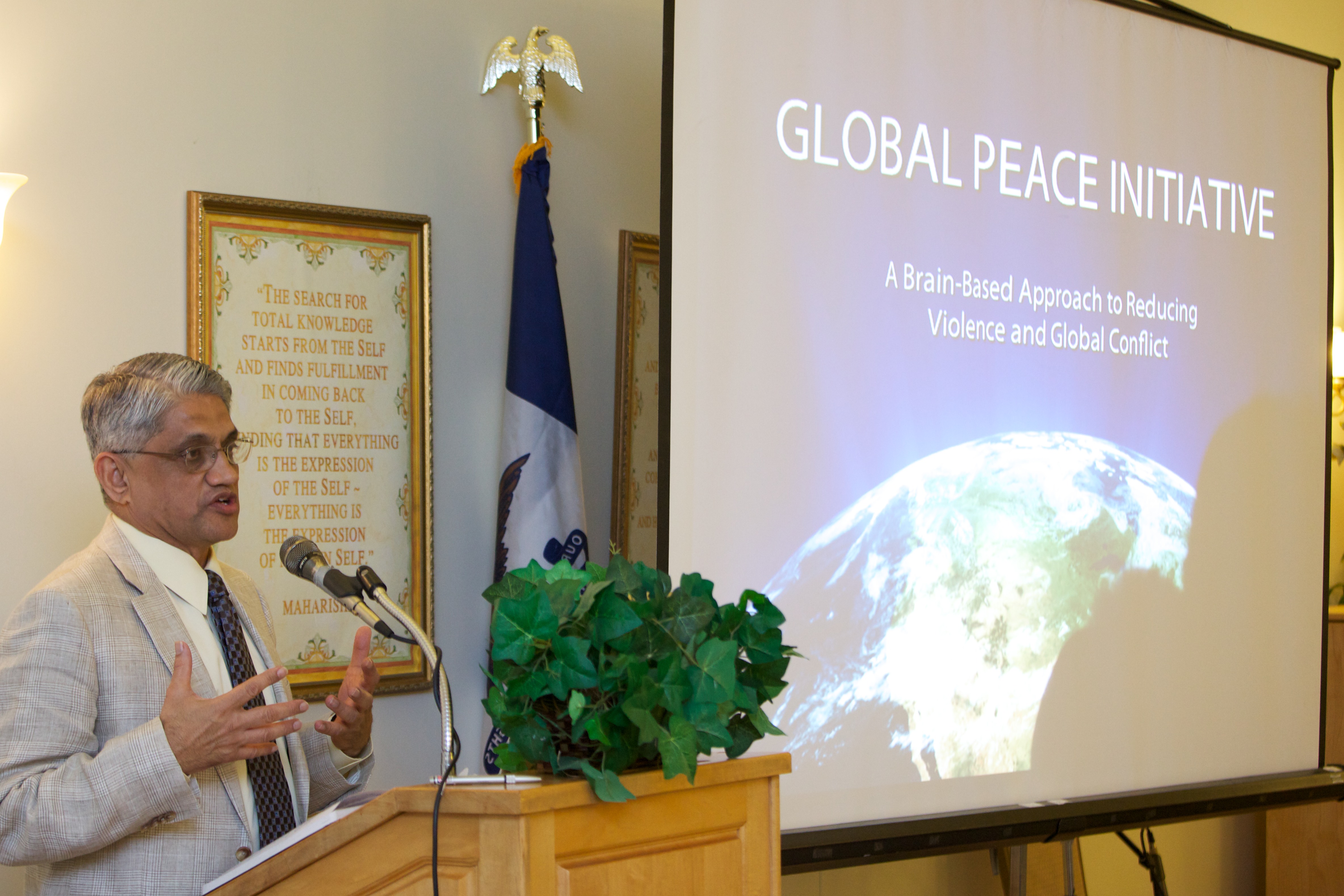
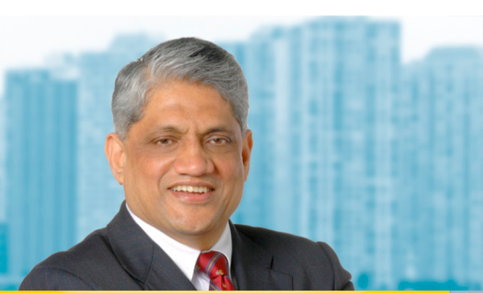
Ramani Ayer, retired CEO of the Hartford Financial Group and current Director of Development for the Global Peace Initiative, who served as a host of the weekend, said, “We invited Indo-Americans from around country to experience how powerful, valuable and relevant the practical application of ancient Vedic wisdom, as developed by Maharishi Mahesh Yogi, is to our daily lives and to the improvement of society.”

Leading Scientists Present Research on Meditation and World Peace

Fred Travis, Ph.D., Director of the Center for Brain, Consciousness, and Cognition at Maharishi University of Management in neighboring Fairfield, Iowa, is one of the world’s leading researchers on the brain, consciousness and meditation. His scientific presentation during the weekend on the effects of Transcendental Meditation on brain functioning was highlighted by slides and graphics illustrating the beneficial changes that occur as a result of regular TM practice.

From EEG signatures and connectivity maps, Dr. Travis showed how different meditation practices impact different parts of the brain. “Most meditations fall into two categories,” Dr. Travis said.

“First are ‘focused attention’ techniques, which require you to concentrate on an object, or a particular word or phrase. The second are ‘open monitoring’ techniques, which involve being mindful of your thoughts or breath without interfering with them. This approach attempts to still the mind and become an uninvolved witness to activity. But these attempts are on the surface level of the mind,” he said.

Dr. Travis then identified a third category—“automatic self-transcending”—a process that allows the mind to transcend its own activity. “This is the Transcendental Meditation technique, during which the mind transcends effortlessly, and arrives at the depth of consciousness, the source of the thinking mind, transcendental consciousness, or Samadhi,” Dr. Travis said.

Dr. Travis said that after several months of TM practice, the brain begins to demonstrate increased connectivity, even outside of meditation. “The brain functions more holistically, which accounts for the meditating student’s improved academic achievement. The student is able to absorb, integrate, and express knowledge more effectively,” Dr. Travis said.

Dr. G.V. Naidu, who traveled from St. Louis to attend the conference, said, “The scientific documentation of ‘The Neurophysiology of Enlightenment’ by Dr. Travis was impressive. And a subsequent presentation by physicist Dr. John Hagelin was a climax of the conference.”

World-Renowned Physicist Explains Global Peace Initiative

John Hagelin, Ph.D., a Harvard-trained, internationally renowned quantum physicist, provided the modern scientific understanding and corroborating scientific research documenting how groups of experts in the Transcendental Meditation and advanced TM-Sidhi program can neutralize violence and conflict and create world peace.

“Extensive research published in peer-reviewed scientific journals verifies that Transcendental Meditation dramatically reduces acute individual stress and its deleterious effects on brain and behavior far more effectively than other methods,” Dr. Hagelin said.

“But perhaps more interesting and important are the 23 published studies which show that relatively small numbers of people practicing the Transcendental Meditation and TM-Sidhi program together in a group can reduce crime, violence, and war throughout the entire population,” he said.

Citing studies conducted in the Middle East showing reductions in war death and violence by 70 percent, Dr. Hagelin said, “There is no approach to peace that has been so thoroughly tested and rigorously established. And now, since the arrival in America five years ago of the large group of Vedic Pandits, there has been a significant decrease in violent crime in America’s largest cities. We are mobilizing to add more numbers to the group, to create an even more positive effect in America.”

Thousands of Maharishi Vedic Pandits to Create Global Peace Effect through Yoga and Yagya

Ramani Ayer provided a vision of the goal of the Global Peace Initiative: To maintain permanent peace-keeping groups of 9000 Vedic Pandits in India and 1250 Vedic Pandits in the United States—the number established by research that is sufficient to create a concrete and demonstrative positive global effect.

“The Vedic Pandits’ daily practice of the TM and TM-Sidhi program establishes their consciousness in Yoga, the pure field of intelligence, at the basis of all creation. And their Vedic recitation from that deep and pure level creates a powerful influence of peace for humanity. This perfect combination of Yoga and Yagya will help create a much higher quality of life for the whole world’s population,” Mr. Ayer said.

The Global Peace Initiative is building an endowment fund to create and maintain these large groups of Vedic Pandits in perpetuity.

Maha Rudrabhishek with 121 Maharishi Vedic Pandits

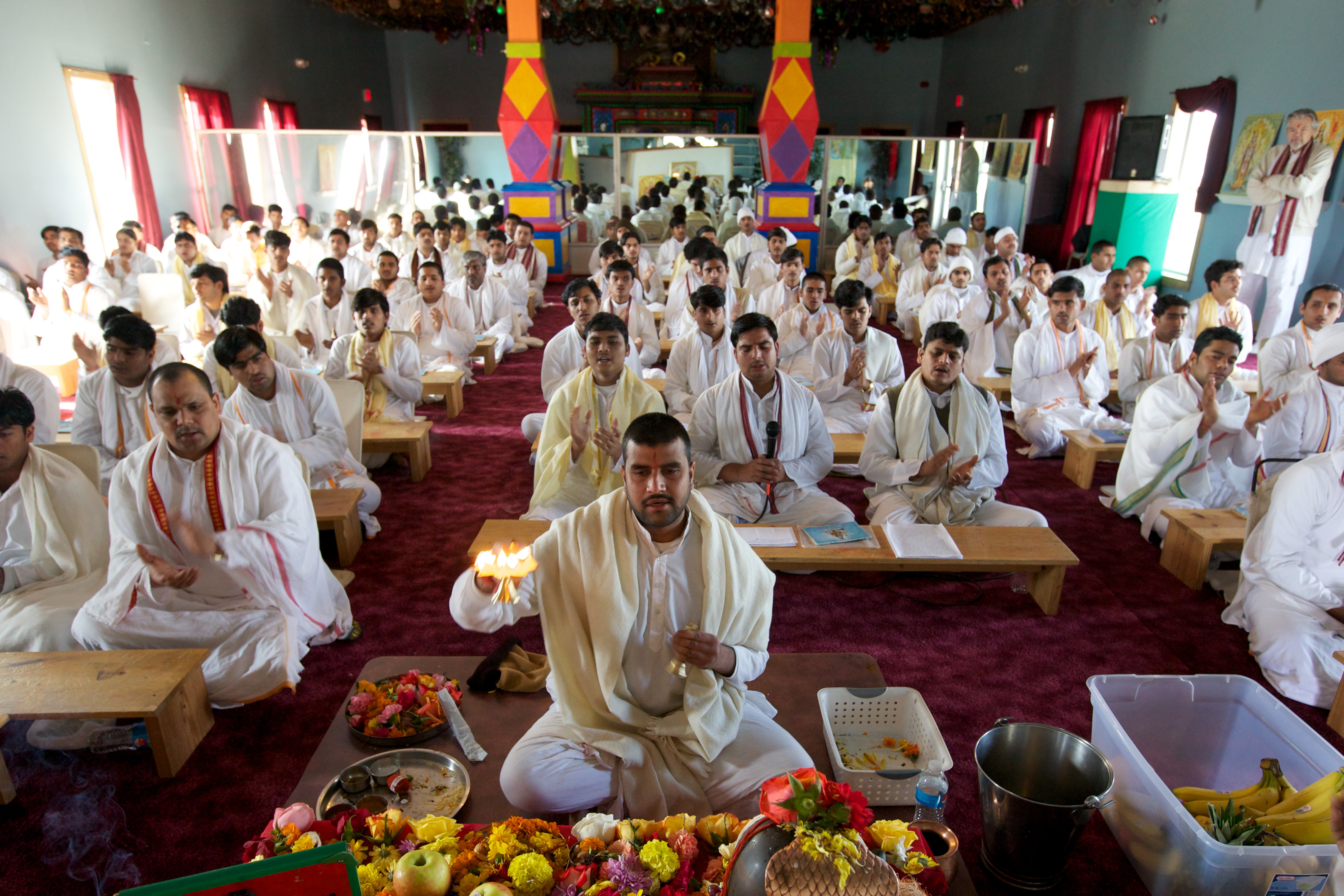
Another sublime highlight of the weekend was the performance by 121 Maharishi Vedic Pandits of Rudrabhsihek.

“It’s an amazing sight to drive over the rolling hills of Iowa and see spread before you a campus where nearly 1000 Maharishi Vedic Pandits from India reside,” said Meenakshi Ghai, from Chicago’s western suburbs, who made the four-hour drive from Chicago with her daughter-in law to attend the weekend. “It was a non-stop wonderful experience packed into 36 hours.”

Mohan Pillai from Long Island, New York, who attended the conference with his family, said, “I cannot describe in words what is was like to hear such a powerful chanting of the Rudrabhishekam. The inner feeling was so good—it was beyond words. I could understand how such large groups of well-trained Vedic Pandits can create peace.”

G.V. Naidu expressed enthusiasm for the global initiative: “We were pleasantly surprised to see that Maharishi Vedic Vishwa Vidyalaya is training thousands of Vedic Pandits here in America as well as in India. These Vedic Pandits are propagating and sustaining ancient Vedic culture. At the same time, they are conducting fundamental research on the positive effects of meditation—far more than any other organization. I wish more people will participate in future seminars conducted by Maharishi University of Management,” Mr. Naidu said.

Mr. Ayer concluded: “As Indians who cherish the Vedic tradition in our hearts, we should feel very proud that this great knowledge has given us a practical means to create peace in the world.”

For more information, visit www.GlobalPeaceInitiative.org and www.VedicPandits.org.

Also see Global Peace Initiative: 13 Questions and Answers with Ramani Ayer, Chandrika Tandon Concert to Benefit 1000 Maharishi Vedic Pandits Launches Global Peace Initiative, and Lavina Melwani interviews Chandrika Tandon on her Grammy Award nomination.

How The Uncarved Blog got its name

November 7, 2011

How The Uncarved Blog got its name by Ken Chawkin

Some readers have asked me about the name of my blog, what it means, and how I came up with it. When I explain it to them they say I should write it down for others to see. So I just added it to the About section, and have also decided to include is as its own post. Here it is:

Heather Hartnett at the David Lynch Foundation, encouraged me to set up my own blog and post all the TM-related articles I was sending around. So, when I thought of the word, blog, it reminded me of the word, block, the uncarved block specifically, a term from Taoism that means the uncreated pure potentiality from which all things are created, the Tao, the source of the 10,000 things. It also reminded me of the unmanifest pure Creative Intelligence Maharishi talks about in his Science of Creative Intelligence, the field of pure potentiality; also the Unified Field of all the Laws of Nature, the Veda within Atma, Sutratma, the Self. And since ‘block’ and ‘blog’ sounded so similar, I thought it was a clever poetic way of coming up with a name.

I first read about the uncarved block in a wonderful book, Creativity and Taoism, by Chang Chung-Yuan. In it he described how the Taoist artist, a sculptor in this case, used to meditate, fast, purify himself first, and then go into the forest to find the right tree that for him contained the vision of what he was called to create. He would take that block of wood back to his studio and carve it out. Think Michelangelo freeing the statue from the marble he was carving.

Same message in the Bhagavad Gita translated and commented on by Maharishi Mahesh Yogi, the founder of the Transcendental Meditation program and Maharishi University of Management: Transcend, Be, then act; and, established in Being perform action. Established in the Self, act in tune with Natural Law. Then you’ll be more successful in actualizing whatever inspired vision, or idea, you had that motivated you to create, whether it’s a poem, a painting, a piece of sculpture, or a blog post.

I certainly enjoy blogging, and glad I started. It’s a fun creative process using digital words, images, and sounds, to carve out something meaningful for myself and hopefully my readers. Of course, there’s so much more one can do in terms of the look and functionality of a blog. That takes up even more time, so I’ll leave that up to the good folks at WordPress.com to keep coming up with more ways to improve the experience, both for bloggers and readers. Enjoy exploring The Uncarved Blog, and thank you for visiting!

And in case you were wondering what the small colored abstract square you see next to the link in your finder at the top left, or on the right next to my comments, is all about, it’s one of Ken West’s photos, used as the blog picture, or icon, for The Uncarved Blog. Here is the complete photo © 2008 Kenneth G. West Jr.. Click on it and it will open up in a larger format. I chose it for its beauty and abstract quality; it can mean different things. For more information and links to a video and photo gallery, check out this blog post: Ken West and his unique landscape photographs are featured on IPTV show Iowa Outdoors.

Global Peace Initiative: 13 Questions and Answers with Ramani Ayer

November 6, 2011

Global Peace Initiative: 13 Questions & Answers with Ramani Ayer

Ramani Ayer, former Chairman and CEO of The Hartford Financial Services Group (USA), Chairman of the Brahmananda Saraswati Foundation Development Council

1. What is the Global Peace Initiative?

Ramani: It is a powerful, practical, scientific, and highly cost-effective initiative to reduce violence and conflict in the world. We call it a “brain-based approach to peace.”

2. What do you mean by a “brain-based approach to peace?” And how is it different than other approaches to reduce conflict and terrorism?

Ramani: I think the approach is different because conventional approaches to reducing social violence don’t address the underlying cause which is acute societal stress—whether its political, ethnic, or religious. All of our behavior is directly linked to brain functioning. We know now how stress impacts the brain. It shuts down the prefrontal cortex—the CEO of the brain. Everyone has heard of the “fight or flight” response. Stress can also over stimulate the amygdala, the brain’s “fear center,” causing fear-driven, and aggressive, violent, antisocial behavior. Acute stress on a societal scale impacts the brain and behavior of everyone in society, and that fuels crime and social violence. The brain-based approach to peace solves the problem on a deeper level.

3. How does it work?

Ramani: It is actually simple to understand. Extensive scientific research shows that an easy to learn, evidence-based meditation practice, revived by Maharishi Mahesh Yogi from the Vedic Tradition of India called Transcendental Meditation (TM) dramatically reduces acute individual stress and its deleterious effects on brain and behavior in a far more effective way then other methods. Equally important, TM and its advanced procedures called the TM-Sidhi program activate the prefrontal cortex and different areas of the brain, while deactivating the amygdala—the fear center of the brain. Research has shown it to be highly effective in treating acutely stressed individuals –even difficult cases such as soldiers with PTSD and prisoners in jail.

4. I can understand how meditation works to reduce stress in a person, but how does it reduce societal violence?

Ramani: I do not think it is surprising that if you reduce stress on an individual level, it causes a corresponding reduction of stress on the societal level. But what is surprising, and what has been shown by extensive research, is that a small proportion of a population practicing TM and the TM Sidhi program in a group produces a significant reduction in social stress, and crime and violence. To understand how it actually works, one has to turn to a “field model of consciousness” in which consciousness, at its deepest level, is a field that underlies and connects individuals throughout society.

5. Isn’t a “field model of consciousness” beyond our current theories?

Ramani: It may seem to be, but such a theory is consistent with the latest findings of physics, physiology and neuroscience. In any such model the peace promoting influence of a group will grow as the square of the size of the group. This is what makes the  “brain-based approach to peace” practical. It only takes about 9000 individuals—the square root of 1% of the world’s population practicing the TM and TM-Sidhi program in a group in one place to create an effect large enough to significantly reduce global violence and conflict.

6. Is there any proof?

Ramani: Yes. To date there have been over 50 demonstration projects and 23 scientific studies that confirm the effectiveness of the “brain-based approach to peace.” This research has been carefully scrutinized by independent scholars and published in top academic journals. The demonstration projects have been conducted in many parts of the world including those most prone to violence, such as the Middle East. What the demonstrations show is a dramatic reduction in violence, crime, and war and increased peace and positivity in society. As far as I am aware, there is no approach to create peace that has been so thoroughly tested and rigorously established.

7. Have any of these demonstrations been conducted in India?

Ramani: The first sustained global demonstration project of this approach was held in India from 1987-1990. It involved a group of 7,000 highly trained Maharishi Vedic Pandits from India. The group was located for several years in Noida, outside Delhi.  During the time of the demonstration there were historic, unprecedented, totally unexpected changes in the world: the fall of the Berlin Wall, the end of apartheid, end of the Cold War. It was an amazing time for our world family.

8. Why did the demonstration end?

Ramani: Quite simply, we ran out of funds to support the large group of Maharishi Vedic Pandits. Today, with a larger world population than the 1980’s, in order to create and maintain this peaceful effect on a global scale will require a permanent group of 9000 Vedic experts in one place. This is the square root of one percent of the world’s population, which is a formula derived from science. To endow such a group requires a fund of about $1.1 billion—which is negligible when compared to the 8 trillion cost of global violence in 2010.

9. Why was a large group of Vedic Pandits from India used to create the effect of peace? Could not any group practicing TM and the more advanced TM-Sidhi program create the effect?

Ramani: Yes, any sufficiently large group of properly trained advanced meditation experts can create this coherent and peaceful effect. But the Maharishi Vedic Pandits, who also practice Transcendental Meditation and its advanced techniques, have a crucial advantage. As beneficiaries of their great family traditions for centuries, these Vedic Pandits have learned how to recite in Sanskrit specific peace-promoting sounds from the level of the Unified Field, the Transcendent—sounds that Maharishi describes as “reverberations of Natural Law.” Through this precise art and science of Vedic recitation, the Vedic Pandits amplify the peace-creating effect. It is for this reason that Maharishi said, “When the Vedic Families of India are able to uphold their tradition of daily recitation of the Vedas from the transcendental level of consciousness then the whole world enjoys peace.”

10. Are there any efforts underway now to build and maintain a large group of Vedic experts?

Ramani: Yes. Maharishi Mahesh Yogi, the founder of this Vedic Peace Technology and the Global Peace Initiative, created in the geographical center of India (near Jabalpur) a 1,700-acre campus for Vedic Pandits. Currently, there are 1,500 Vedic experts in residence there. And very fortunately, in America, at Maharishi Vedic City in Iowa, there is a second campus with about 1,000 Vedic Pandits.  Our goal is to raise the number to 9,000 Vedic experts in India and 1,250 Vedic experts in the USA. This will complete the first phase of the Global Peace Initiative. Subsequent phases will focus on creating additional groups of Vedic experts sufficient to focus specifically on individual countries.

11. What is the money used for that is being raised?

Ramani: Donations from around the world principally are received by The Brahmananda Saraswati Foundation (BSF), a tax-exempt (501c3) organization in the U.S and it’s sister organization in Europe that shares its goals and mandate. The foundation is independently audited. Maharishi established the trust in the name of his Guru, Swami Brahmananda Saraswati, to create a permanent financial basis for peace for the world. The funds are used to create infrastructure on the campuses, train the Vedic experts (which takes years to do), and then pay the Vedic experts an appropriate salary.

12. What kind of training do the Vedic Pandits receive?

Ramani: It is a very thorough training that takes place in three phases. The first phase is in the local villages; the second phase is in regional centers; and the third phase is in the national centers established throughout India. It is important to note that those who complete the training receive academic degrees from Maharishi Vedic Vishwa Vidyalaya, a statutory University established by the government of Madhya Pradesh in India. In the past Maharishi’s organization has actually trained about 50,000 of these Vedic experts, but never been able to maintain them in a group.

13. You were CEO of one of the largest financial firms in the world. How did you get involved in this initiative?

Ramani: I personally had benefited in my own life by practicing Transcendental Meditation. It helped me in so many ways as an individual. And when I met Maharishi, and I saw his deep concern for the future of the world and how he had worked most of his life to create this opportunity for mankind, I really felt I should do whatever I could to see his work come to fruition. Most people don’t even think world peace is possible, that it’s a dream. But I am convinced we now have a scientific, practical, and reliable way to use mankind’s most ancient knowledge, the Veda, to usher in a new destiny for mankind. It’s a very big thing—historic—and it is a joy to be part of the global efforts. As Indians who cherish the Vedic tradition in our hearts, we should feel very proud that this great knowledge has given us a practical means to create peace in the world.

For more information, visit www.GlobalPeaceInitiative.org and www.VedicPandits.org.

See: Chandrika Tandon Concert to Benefit 1000 Maharishi Vedic Pandits Launches Global Peace Initiative and Chandrika Tandon Benefit Concert in Iowa Helps Launch Global Peace Initiative.