Posts Tagged ‘health’

Healing the Hidden Wounds of War: open forum for Iowa veterans and their families affected by PTSD, sponsored by Operation Warrior Wellness

July 10, 2012

Healing the Hidden Wounds of War, an open forum for Iowa veterans and their families affected by PTSD, sponsored by Operation Warrior Wellness, a division of the David Lynch Foundation, in Fairfield, Iowa.

Veterans are overcoming PTSD through meditation and reclaiming their lives. Meditation Saves A Veteran From Suicide is a video of Iowa veteran Luke Jensen describing his experiences in Afghanistan, how he tried to deal with his PTSD, and what finally worked for him.

After reading about Luke’s situation in a Des Moines Register article: Former undercover cop, MP battles PTSD: How Afghanistan service affected one soldier, Jerry Yellin, co-director for Operation Warrior Wellness, reached out to Luke and offered him a scholarship from the David Lynch Foundation to learn Transcendental Meditation.

As a result of learning to meditate, and the relief it brought him and his wife, Abi, Luke wanted to join Jerry in making this program available to other Iowa veterans and their families suffering from PTSD. They are organizing a special open forum, Healing the Hidden Wounds of War, to take place Saturday, July 28, 2012 at 2 pm in the Fairfield Arts & Convention Center in Fairfield, Iowa.

Iowa veterans can find relief from combat-induced stress and escape the self-destructive cycle of drugs, alcohol, and depression. To learn more, or to register, visit http://operationwarriorwellness.org/iowa.

Uploaded by on Jul 10, 2012

Some excerpts from the video:

“The first week I was there three soldiers got killed there….I was certain I wasn’t going to make it back home and I started thinking about suicide. I felt I was going to die anyway, so why be miserable day after day when it’s going to happen? I was just certain it was going to happen….I tried five or six different kinds of depression medicine, two or three different kinds of anxiety medicines. When I continued to try and try and try and things weren’t helping, hopelessness really was taking over and I still continued to think almost daily that suicide was going to be the option.”

In 2011, Luke Jensen learned the Transcendental Meditation (TM) technique – a stress reducing practice, proven to combat the effects of PTSD.

“For the first time in I don’t know how long I felt hope….I don’t take anxiety medicine at all anymore….It’s made me a better father, a better husband. I’d consistently thought about suicide before I learned TM. It was the first thing to kind of get that away and get that off my mind. It changed everything.”

To support the David Lynch Foundation’s Operation Warrior Wellness program: http://www.operationwarriorwellness.org/how-to-help

Operation Warrior Wellness has been championed since 2010 by a coalition of meditating veterans spanning four wars. Their mission is to deliver rapid and profound relief to veterans and active-duty military suffering from PTSD, promote resiliency among military personnel and cadets, and provide much needed support to military families serving the rewarding but often taxing job of caring for their loved ones.

See this KTVO News report: Veterans speak out on post-traumatic stress, offer a proven way to heal PTSD.

A few related articles: POLITICO: Coping with PTSD  |  Post Traumatic Stress and How Transcendental Meditation Can Help [Infographic] Transcendental Meditation Drastically Turns Life Around For Veteran With PTSD  |  Star Tribune: Meditation brings peace to war vets  |  Ruben Rosario: Recovered veteran’s latest mission: helping those like him

Here is a wonderful  interview with Jerry Yellin and Lisa Cypers Kamen of Harvesting Happiness Talk Radio July 18th. You can listen online to Jerry Yellin, Operation Warrior Wellness and Debbie Gregory, Military Connection or download the the podcast.

KTVO’s Kate Allt: From the earth to your plate; one university’s lesson in sustainable agriculture

May 25, 2012

From the earth to your plate; one university’s lesson in sustainable agriculture

By Kate Allt

Friday, May 25, 2012

Greenhouses at Maharishi University KTVO’s Kate Allt

FAIRFIELD, IOWA — The cafeteria at Maharishi University is like no other dining hall on any campus in the country. Every meal is vegetarian and organic, and many of the ingredients are grown right on campus by students and staff.

Ayurvedic food preparation, which pays particular attention to seasonal foods, is a growing trend and the roots of the movement are planted in the greenhouses at Maharishi University.

“This greenhouse has been here since 2004; we put it up,” said Steve McLaskey, Director of the Maharishi organic farm. “The university had been organic – the food service had been organic for quite a number of years before that and then in 2003, they decided to take the next step and grow as much of their own food as possible.”

Maharishi’s greenhouse is the first of its size to grow crops year-round in a cold climate. The students and staff who work with the plants have learned much more than identifying a cucumber from a zucchini.

“I get a lot of satisfaction out of growing good produce and providing it to the university,” McLaskey said. “We also sell at the Golden Dome market, the little market on campus, and at the farmer’s market, and I get a lot of comments from customers who appreciate the quality, the freshness.

“When we’re eating good food, then the action that happens from putting good things in is more directed and its more focused,” said Molly Haviland, a MUM student. “So it goes along with the principle of do less, accomplish more.”

James Gavin, a worker at the greenhouse, said he has learned so much from working at the greenhouse and it has improved his quality of life.

“This greenhouse is a real opportunity for all of us… and for the county, I think,” he said.

“I really encourage everyone to grow their own garden and to look up alternative methods of making sure everything is natural, no chemicals, and everything like that,” said student Sultan Salah. “So I would say the experience of working with fresh vegetables is probably the best experience.”

“We grow some of the tastiest vegetables there are,” said Edward Hipp, another greenhouse worker. “When its fresh off the plant, it doesn’t get much better than that.”

Then – fresh off the plant – the food goes to the Maharishi kitchens, where vegetarian, organic recipes and Ayurvedic methods are utilized.

“We’re trying to keep all the Ayurvedic guidelines in touch with the recipes so that it still tastes really good for everybody,” said Sharon Stinogel, Maharishi Executive Chef. “So it’s kind of a challenge, but it’s fun.”

“Since we’ve arrived here at Maharishi, we’ve shared the fact that organic and vegetarian is out there,” said Ken Zimmerman, food service director at Aladdin Food Management Services. “There’s a lot of our accounts that do offer organic vegetarian but not on a wide range like we do here in Fairfield.”

The cafeteria serves 800 to 1,000 people a day and after the meal, the leftover food is collected to be turned into compost, completing the cycle back to the earth.

1 comment:

Sharalyn Pliler · Maharishi University of Management

In my book, THE RELUCTANT VEGETARIAN, I make the point that it’s ever more important to eat organic than it is to be a vegetarian, but at the MUM cafeteria, where I love to go to eat, we can have it all. Good food, safe food, and good company. :-) I love MUM!

South Asian Heart Center uses Transcendental Meditation to prevent and manage heart disease

May 12, 2012

South Asians are becoming painfully aware of the high incidence of heart attacks, often fatal, frequently among seemingly healthy, trim, and physically active close family & friends.

The South Asian Heart Center (SAHC) at El Camino Hospital in Mountain View, California has developed a four-pronged approach to prevent and successfully manage heart disease among men and women of South Asian descent living and working in America. Here is an introduction to their work presented by Executive Director Ashish Mathur, and SAHC Medical Director Cesar Molina, MD, FACC: South Asian Heart Center Helps South Asians Fight Heart Disease.

In this fourth of a four-part series on Therapeutic Lifestyle Changes Dr. Molina focuses on the importance of deep rest and its effect on heart-health and diabetes. He specifically covers the importance of meditation (or restful alertness) on longevity and health, and the science behind the effective technique of Transcendental Meditation (TM), which produces a “hypo-metabolic state of restful alertness.” Learn the evidence on the profound impact of this unique form of meditation on a whole class of chronic ailments. This is a very clear and comprehensive presentation!

South Asian Heart Center Webinar: TLC – Restful Sleep & Restful Alertness April 25, 2012, published on Apr 26, 2012 by sahcsathi.

At 26:26 of Part 4, Dr. César Molina begins talking about resting while awake with Transcendental Meditation and how it impacts our health, especially for South Asians and their propensity toward heart disease. One of the therapeutic modalities from the South Asian Heart Center is Transcendental Meditation as a stress-reduction technique. Dr. Molina reviews his talk starting at 56:18. He summarizes the lifestyle methodology to prevent heart disease and enhance longevity at the South Asian Heart Center: nutrition, physical activity, the importance of restful sleep, and the importance and benefit for stress reduction through Transcendental Meditation decreasing cardiovascular risk factors, decreasing hospital expenditures and admissions, and enhancing longevity.

Dr. César Molina presents Wednesday Lunch-hour Webinar Series TLC: Therapeutic Lifestyle Changes. Here are the 4 topics where you can download the video and a PDF of the main points and graphs for each talk. The recommendations can be applied to all Americans regardless of ethnicity or geographical location.

1. TLC: Therapeutic Lifestyle Changes Overview: May 2, noon
2. TLC: Exercise as Medicine: May 9, noon
3. TLC: The Dinner vs. the Diner: May 30, noon
4. TLC: Restful Sleep and Restful Alertness: June 20, noon

For more information: www.southasianheartcenter.org and www.tm.org.

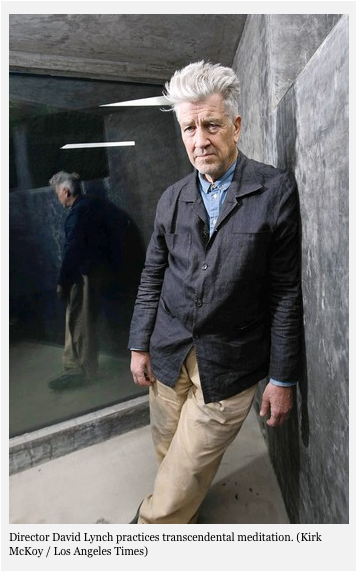
David Lynch speaks with LA Times health writer Jeannine Stein about Transcendental Meditation

March 20, 2012

Five Questions: David Lynch on transcendental meditation

David Lynch talks about TM and his David Lynch Foundation for Consciousness-Based Education and World Peace.

By Jeannine Stein, Los Angeles Times
March 17, 2012

We know filmmaker David Lynch for the dark surrealism of “Eraserhead,” “Blue Velvet,” “Inland Empire” and “Twin Peaks,” as well as for his deep, abiding love of coffee.

Lynch is also passionate about transcendental meditation, which he first took up “on a beautiful, sunny Saturday morning” in 1973. That passion spawned a book, “Catching the Big Fish,” and the David Lynch Foundation for Consciousness-Based Education and World Peace.

Lynch spoke about what TM means for him and why others should try it too.

PODCAST: David Lynch

Can you describe how you discovered TM?

I didn’t know anything about meditation, and I thought it was a waste of time. Then I heard a phrase that true happiness is not out there, true happiness lies within. And I started thinking about that, and it had a ring of truth. It hit me that maybe meditation was the way to go within.

One day my sister called, and she said she started TM, and I heard a change in her voice — more happiness, more self-assuredness. And I said, “This is what I want.”

I was filled with an anger and sorrows and doubts and melancholy. And I took it out on my first wife. I made her life pretty much a hell. So I start transcendental meditation, and two weeks later she comes to me and says, “What is going on? This anger, where did it go?” Things lift away so naturally.

Your foundation started with introducing TM into schools. What changes have you seen in students who have been through the program?

They say stress is hitting kids at a younger and younger age. There’s violence, bullies, there’s very little learning, and it’s not fun to learn. [With TM] they get more intelligence, they have more creativity, more energy, more happiness, and then when the teacher says something, understanding is growing. The teachers say, “Now Billy can focus, and Suzy is just blossoming.” Kids start finding what they really love and finding a way to do it.

The foundation has now expanded to other realms, such as introducing TM to veterans and prisoners.

Prisoners get this technique and they get super, super happy. And they get this ability to pause before they do something. So something that people say is, “Before I started meditating, I just reacted. Now, with meditation, I have this pause and this reasoning: Do I really want to blow this man’s head off with a .357 Magnum in my hand?” And then the answer is, “No, I don’t think so.” They have time to think.

Is it hard to meditate in certain places?

You can do it anywhere. One of my best meditations was in kind of a little closet room with a wall that was by a sidewalk. All during my meditation, there was some guy jackhammering the concrete sidewalk. But as he jackhammered, it jiggled the bliss in me and I was just flying high. It was so beautiful.

Are coffee and TM compatible?

For me, coffee and transcendental meditation go together like a horse and carriage. You don’t have to give up anything to do TM. I think most meditators go easy on the coffee, naturally.

I smoke cigarettes too, and most meditators say the urge to smoke kind of lifted away when they started meditating. Not me! My urge to smoke got greater. I just love tobacco.

I eat pretty good, but I just love these things, and that’s the way it is.

jeannine.stein@latimes.com

Copyright © 2012, Los Angeles Times

Also see HUFFPOST: David Lynch: Why I Meditate and The Wall Street Journal: 20 ODD QUESTIONS (with David Lynch).

Meditation for Students: Results of the David Lynch Foundation’s Quiet Time/TM Program in San Francisco Schools

December 24, 2011

David Lynch Foundation Event in San Francisco: Meditation for Students

The David Lynch Foundation held a benefit gala in San Francisco on June 1 at the Legion of Honor, to showcase the successes of a five-year project to bring the stress-reducing Transcendental Meditation technique to students in inner-city San Francisco schools. In this video, you will hear James Dierke, principal of Visitacion Valley Middle School talk about the unprecedented academic achievements of his meditating students; iconic filmmaker David Lynch talk about the inspiring work of his foundation among at-risk populations; and Dr. Norman Rosenthal, internationally renowned psychiatrist and NY Times bestselling author, discuss the amazing results of scientific research on the TM technique. See other featured past events posted on the David Lynch Foundation website. To hear more about the David Lynch Foundation and it’s programs, please visit: http://www.davidlynchfoundation.org.

Uploaded by on Jul 7, 2011.

See selected highlights of Inspiring results from the TM-Quiet Time Program in the San Francisco Unified School District.

Real Life Solution: Combating PTSD with TM

March 25, 2011

March 25, 2011 posted by Veterans Today · Leave a Comment

By Dr. David Leffler

In early 2010 WWII veteran Jerry Yellin was introduced to a young man, Dory Klock, an eight-year Army veteran who had fought in Bosnia. Dory was having difficulty adjusting, keeping a job, and fighting drugs and alcohol. As a combat veteran, Jerry knew these inner struggles all too well. Dory’s wife and two daughters were suffering with him, and Dory’s mom Lin, Jerry’s friend, was beside herself. Then one day Lin called and asked Jerry if he could help her out. “Sure, Lin, anything,” he told her.

She began weeping; she couldn’t speak. Finally, she asked, “Can you help me put Dory’s medals and ribbons on his dress uniform? We want to bury him in it, Jerry. He committed suicide yesterday.” Lin brought Dory’s uniform to Jerry’s home and he put the medals and insignias in place. When Lin left, Jerry broke down. His thoughts ran wild with the suffering so many are experiencing from the life and death of our warriors who experience combat and have nothing to hold onto when they come home. Jerry was a P-51 Pilot who flew 19 missions over Japan and saw the horror of Iwo Jima – a battle involving 90,000 soldiers on a small island where 28,000 people died. He knew from his own experiences as a returning veteran who suffered from what is now called Post-Traumatic Stress Disorder (PTSD) that the problem is overwhelming our nation.

Jerry relates: “Can we expect our warriors to return from the horrors and experiences of war and integrate back into a normal routine without something deep and meaningful to hold onto? I could not. And neither can they. I also know that each and every PTSD victim needs a vehicle, a methodology that will help them help themselves. Antipsychotic and antidepressant drugs are used extensively but are extremely costly, especially for the long haul, and do not provide a cure. Many turn to alcohol and recreational drugs as a temporary escape from problems. Eighteen veterans from all our wars are said to be committing suicide daily. I know that care is dependent on complete willingness and cooperation from the patient. And that takes a long time. America does not have that time now. We are in crisis.”

This article offers a scientifically verified, time-tested solution to how we can help our military personnel, veterans and their families.

Read the rest of Real Life Solution: Combating PTSD with TM.

Also posted on OpEd News and the Purple Heart Service Foundation as Combating PTSD.

Hollywood Today reports on American Indian Conference

September 20, 2009


American Indian Conference to Focus on Health, Sustainability

September 20, 2009

Stocel+drum

STOLCEL of the WSANEC First Nation performs traditional recitation at international conference in Holland

Leaders of Native Indian tribes from around the US and Canada will gather on the campus of Maharishi University of Management in Fairfield, Iowa, for an international conference September 25-27 entitled “Building Healthy, Sustainable American Indian Communities.”

Conference speakers include Joe A. Garcia, president of the National Congress of American Indians; Robert Cook, president of the National Indian Education Association; Lucille Echohawk, strategic advisor for the Casey Family Programs; and Kevin Skenandore, acting director of the Bureau of Indian Education.

Conference hosts and participants include the Hocak Elders Council, Inc., the Indian Health Services (IHS), the National Congress of American Indians (NCAI), the National Indian Education Association (NIEA), the Bureau of Indian Affairs (BIE), Winnebago Tribal Health Services (WTHS), the Winnebago Treaty Hospital-IHS, and the David Lynch Foundation.

For more information see conference website and video on TM and Diabetes Among Native Americans: http://www.americanindiansustainableconference.org/

See Indian Country Today article, Sustainability quest: http://bit.ly/4vNhWo

Also News From Indian Country article, Indian Country leaders meet in Iowa to explore new approaches to sustainable communities: http://bit.ly/JUOM7

Canadian First Nations participants include STOLCEL [John Elliott], Tekahnawiiaks [Joyce King], and Tim Paul. STOCEL is a cultural and language custodian for his [Saanich] People and speaks extensively on culture and language and history; Tekahnawiiaks [Joyce King] is currently the Director of the Akwesasne Justice Department and is on the Mohawk Council of Akwesasne; and Tim Paul, is Executive Director of the Maliseet Nation Conservation Council of New Brunswick. http://mncc.ca/

STOLCEL will be receiving an honorary Ph.D. from M.U.M. for his lifelong work to revive the mother tongue of the Saanich People, his contribution as Co-Founder of FirstVoices, the world’s first web-based Aboriginal language archive, and for his discovery of the connection between the traditional language of his people and the underlying intelligence of Nature available in the sounds and structure of Veda, which he made in collaboration with M.U.M. founder Maharishi Mahesh Yogi. [See BACKGROUNDER on STOLCEL]

Tekahnawiiaks [Joyce King] will be speaking twice at the conference: on Education, and on Safeguarding Culture and Language. She lives on the Akwesasne Reserve near Cornwall, Ontario, along the border between Canada and NY State. Her bio is available online: <http://www.tekahnawiiaks.com/bio.html>.

Tim Paul will speak on his own experience with TM and the lowering of his blood sugar levels, as well as his keen interest in the “eco village” model at MUM, and the desire of the Maliseet Nation Conservation Council to incorporate many of the “sustainable technologies” demonstrated there, in his own Maliseet communities throughout New Brunswick.

The conference will showcase Consciousness-Based education, prevention-oriented health care, renewable energy, organic agriculture, and cultural preservation.

Researchers will also present the results of several controlled studies on the effects of the Transcendental Meditation® technique for reducing acute stress and behavioral problems among hundreds of at-risk American Indian youth at the Winnebago (Nebraska), Pine Ridge (South Dakota), and Passamaquoddy (Maine) reservations.

Findings to date show the Transcendental Meditation technique promoted higher scores on standardized state tests of mathematics and reading, 25% less absenteeism, a 20% drop in disciplinary incidents, and 30% higher graduation rates among the meditating young people compared to controls.

“The timing is perfect for this conference because the need is so great among the tribes,” said John Boncheff, who is co-director of the Transcendental Meditation program at the Winnebago reservation. “The Transcendental Meditation technique is not only helping students perform better in school, but it’s also helping both adults and children to overcome the terrible epidemic of diabetes, which strikes up to 80 percent of all American Indians.”

Dr. Boncheff said that it’s also helping American Indians reconnect with their spiritual heritage and traditional culture.

—————————–

BACKGROUNDER

STOLCEL [John Elliott]

(Photos available upon request)

STOCEL is a descendant of the hereditary family of Chiefs of the WSANEC [Saanich] People and lives on the Tsartlip Reserve near Victoria, Vancouver Island, British Columbia. He is the Co-Founder of ‘First Voices’, the world’s first web-based Aboriginal language archive. This web-based archive allows predominantly oral tradition languages of any aboriginal nations to be recorded, uploaded, saved, and learned in perpetuity by future generations online, rather than becoming obscure or obsolete when the Elders or fluent speakers pass away. As a result of his initial inspiration, there are now over 60 First Nations archiving their languages online, with 35 of those now publicly available for First Nations’ youth and non-mother tongue speakers to learn their languages: <http://www.firstvoices.com/>.

STOCEL is the Chair of the Subcommittee on Language for the First Nations Education Council for British Columbia, as well as the Chair of the Saanich Native Heritage Society, and is an active member on the Board of Governors of the First People’s Cultural Foundation. He has been teaching, developing curriculum, and preserving aboriginal languages for thirty years.

STOLCEL holds First Nations’ Language Certification from the British Columbia College of Teachers. He has taught in all grades and is now teaching Grades 7-10 in the SAANICH Tribal School as well as SENTOTEN for adults at the University of Victoria.

STOLCEL is being honored with of the degree of Doctor of Natural Law Honoris Causa by Maharishi University of Management for his work to bring out the connection of traditional language and the underlying field of Nature that upholds every culture in peace and progress.

In STOLCEL’s words: “There is never time enough time in the day for all the work that has to be done. Our languages are the key to ancient knowledge. Inside each language is the pattern of how to live in harmony with the earth and all the living things. More today, than ever, this knowledge is needed. Each time another language dies forever, our ancient connections to all life, our knowledge of the plants the animals, the trees and our mother earth is lost.”

Canadian Contact: Christopher Collrin, 506-471-5598, collrin@gmail.com

US Contact: Ken Chawkin, 641-470-1314, kchawkin@mum.edu

INDIAN COUNTRY TODAY: Sustainability quest: Tribes to gather for conference of meditation and renewal

September 11, 2009

Indian Country Today

Sustainability quest

Tribes to gather for conference of meditation and renewal

By Rob Capriccioso

Story Published: Sep 15, 2009

FAIRFIELD, Iowa – Organizers are preparing for a unique gathering of tribal elders, leaders and members to focus on building sustainable communities through meditation, renewable energy, organic agriculture and cultural preservation.

The event, billed as the “International Conference on Building Healthy, Sustainable American Indian Communities,” is largely being put together by the Hocak Elders Council, the Ho-Chunk Elders Advisory Council, the David Lynch Foundation and members of the Winnebago Tribe of Nebraska.

It will be held at the Maharishi University of Management in Fairfield, Iowa Sept. 25 – 27. Planners expect hundreds of participants to attend.

“We are very excited to be able to help offer this one-of-a-kind experience,” said Bob Roth, vice president of the David Lynch Foundation, which focuses on spreading scientifically-proven stress-reduction Transcendental Meditation technique to at-risk youth.

The meditation techniques focus on regular, quiet reflection times aimed at reducing stress and its harmful health impacts.

Studies have shown the methods to have health benefits, such as curbing behavioral disorders in youth and reducing the need for insulin in those with Type 2 diabetes.

Planners with the foundation are using the conference as a platform to highlight their commitment for the past three years to a project called the “Model American Indian Community Initiative” on the Winnebago Reservation.

The project strives to help at-risk youth relieve stress through meditation. It has achieved some promising results which conference organizers are eager to share.

John Boncheff, an event organizer who co-directs the Winnebago project, said Indian youth in the program are not only doing better in school, they are absent less and have a better chance of graduating.

Esteemed Indian leaders have taken note. Joe A. Garcia, president of the National Congress of American Indians; Robert Cook, president of the National Indian Education Association; Lucille Echohawk, a strategic planner for Casey Family Programs; and Kevin Skenandore, acting director of the Bureau of Indian Education are scheduled to attend and present at the sustainability gathering.

The Pine Ridge Reservation in South Dakota and the Passamaquoddy Tribe of Maine have started similar projects, hoping for equally positive results. Planners said many more tribal leaders have requested information.

Roth said it has been an honor to see more tribes get involved and for Native Americans to teach each other the benefits of healthy meditation and its similarity to some traditional spiritual beliefs.

Prosper Waukon, a leader with the Hocak Elders Council and a citizen of the Winnebago Tribe, said the project has also attracted keen interest from his tribe’s elders.

In 2007, Waukon said several older tribal members took a trip to Maharishi University to learn about transcendental meditation, which the institution strongly promotes. Many were suffering from debilitating side effects of diabetes and wanted to understand ways to meditate to improve their well-being.

Some of the elders have since been able to dramatically better their health outcomes, and some rely much less on diabetes medications, Waukon said.

“Many elders found there was something missing with medication alone. Using meditation to relieve stress ended up helping them connect with traditional ways. It has been a win-win situation.”

As a part of studying the elders’ progress, IHS has contributed $560,000 to the project in in-kind testing services. They are hopeful that IHS may end up promoting the program to more tribes in the future upon seeing positive results.

Information about the elder diabetes program will also be highlighted at the conference.

Waukon said the event won’t just be about promoting sustainability through meditation. It will also feature sessions on organic farming, wind and solar energy development and cultural preservation.

“These are areas of sustainability that all connect to each other,” he said, adding that experts in the various fields will be in attendance.

Boncheff would like the conference to raise awareness of the Winnebago project’s success and to see what can be done to take it to the next level. He is hopeful that at least seven more tribes launch similar sustainability projects by next year.

For people who can’t afford to attend the conference, it will be Web cast online. Registration information and more details are also available online.

On February 1, 2012, Indian Country Today published an article, Transcendental Meditation Combating Diabetes in Indian Country, by Mary Annette Pember.