Posts Tagged ‘depression’

Training from the Inside: Treating PTSD with TM

November 11, 2012

Training from the Inside: Treating PTSD with Transcendental Meditation

“I deal with pain every day. I have nerve problems in my leg and the PTSD that the doctors diagnosed me with…functioning becomes impossible, lack of sleep, your work ethic sucks, you can’t focus at work, you can’t do anything, everybody pisses you off…it’s different for everybody. Memories saturate your mind…for me every day is a constant reminder — you relive the same crap over and over and over.” – Sgt James Thrasher, USMC

“I myself have been deployed eight times and been to combat four times. I was diagnosed with PTSD, depression, insomnia. We fight through whatever problems we have, we suck it up, and I did that for many many years. The trauma that I’ve seen the situations that I’ve been through…you take all of that stuff and you put it in a bag and we keep filling up our bag with all these problems rather than dealing with them. – GySgt Richard Wilson, USMC

“What peaked my interest in TM was all the research that’s been done and how incredibly effective it is for trauma, stress…the evidence now is that in combat stress the trauma actually changes the brain so that the ability to self-regulate isn’t there. Meditation helps with information processing, helps with self-regulation. Here we have another tool that is fabulous and they can do for themselves.” – Anna Benson, PhD, Clinical Psychologist

“I was interested in the TM program but I was skeptical at the same time. The power of the TM meditation…it really came out fast and it was surprising to me. Having that inner peace after meditation really really emboldened me to deal with things that I’d been just kind of stuffing away. So to be able to have relief from agitation, have relief from anger, frustration, sleeplessness, alcoholism, drug addiction…that’s huge.” – Sgt James Thrasher, USMC

Uploaded by on Aug 28, 2012

See updated article with photos by Mario Orsatti posted on the TM Blog December 13, 2012: U.S. Marines Talk About the Effect of TM on PTSD.

For more information on the David Lynch Foundation’s Operation Warrior Wellness program please visit http://operationwarriorwellness.org.

For more information on the Transcendental Meditation technique please visit http://tm.org.

Since 2005 the David Lynch Foundation has shared Transcendental Meditation with our most stressed populations. The David Lynch Foundation runs entirely on donations and there is a long list of veterans and sufferers of post-traumatic stress eager to participate.

If you were inspired by this video and would like to make a donation please visit: http://www.operationwarriorwellness.org/how-to-help. Your donations will be used in 3 ways—to help active duty military and veterans suffering from PTS, cadets in training and activated soldiers, and family members of retired and active service personnel. Thank you!

Related news: Soledad O’Brien interviews Russell Simmons and Bob Roth of the David Lynch Foundation on TM for Vets with PTS on CNN’s Starting Point | Military Leaders to Promote Meditation at Iowa Summit to Help Reduce Veteran Suicide EpidemicMatt Kelley of Radio Iowa interviews Jerry Yellin about an Iowa Veterans Summit solution to PTSD | See video highlights of the Iowa Veterans Summit – PTSD and Transcendental Meditation | KTVO News: How one soldier regained his life with help from WWII veteran and TM for PTSDFairfield and Ames war veterans team up to bring meditation (TM) to fellow Iowa vets with PTSD | Mark Newman: Courier: Iowa soldier seeks peace of mind through meditation and medicationMilitary veterans speak on need to increase resiliency: by Diane Vance, Fairfield Ledger | Story County Veteran Once Suicidal Finds Relief from PTSD with Transcendental Meditation: AmesPatch article by Jessica Miller | Veterans speak out on post-traumatic stress, offer a proven way to heal PTSD | Healing the Hidden Wounds of War: open forum for Iowa veterans and their families affected by PTSD, sponsored by Operation Warrior Wellness | Post Traumatic Stress and How Transcendental Meditation Can Help [Infographic] | Meditation Improves Performance at Military University | Meditation Saves A Veteran From PTSD and SuicideDr. Oz on the Benefits of the TM Technique

Military Leaders to Promote Meditation at Iowa Summit to Help Reduce Veteran Suicide Epidemic

October 4, 2012

 Military Leaders Promote Meditation to Reduce Suicide
Epidemic Among Veterans

VA Funds Studies on PTSD; Iowa Summit to Showcase Benefits

Eighteen veterans commit suicide every day—
a horrific consequence of post-traumatic stress disorder (PTSD).
More veterans die by suicide every year than are killed annually in Iraq and Afghanistan.

New York, NY — October 4, 2012: America’s veterans and their families are turning to meditation to ease the trauma of combat and pave the way to a healthier life.

The David Lynch Foundation, a 501(c)(3) charity founded by iconic filmmaker David Lynch to bring Transcendental Meditation to at-risk populations, will hold an Iowa Veterans Summit on Thursday, October 11, 2012 at the West Des Moines Marriott. A press avail will take place at 10:00 A.M., followed by the Veterans Summit from 1:00 P.M. to 2:30 P.M.

The Summit will present the research and clinical applications of Transcendental Meditation for reducing stress, Post-Traumatic Stress Disorder (PTSD), substance abuse and suicide, depression and enhancing resilience and performance.

The Washington Post reported in May that the Department of Veterans Affairs, seeking new ways to treat PTSD, is studying the use of Transcendental Meditation to help returning veterans of Iraq and Afghanistan.

Thousands of veterans have learned Transcendental Meditation. Research on veterans who meditate has shown that the technique not only reduces the psychosocial symptoms of stress, anxiety and depression, but also balances serotonin and norepinephrine, and regulates the sympathetic nervous system. Transcendental Meditation is used on the oldest private military campus, Norwich University.

Panelists at The Iowa Veterans Summit include: Dr. Richard W. Schneider, USCGR (Ret.), President, Norwich University; Jerry Yellin, World War II P-51 Fighter Pilot and National Co-Chair, Operation Warrior Wellness; Col. Brian Rees, M.D., Command Surgeon, 63rd Regional Support Command and Luke Jensen, Operation Enduring Freedom veteran and Operation Warrior Wellness (OWW)–Iowa Advisory Board Member. All panelists have extensive experience in using Transcendental Meditation.        

Bob Roth, the Executive Director of The David Lynch Foundation, stated, “It is imperative that we help veterans and the brave men and women still in active-duty deal with the stress that stays with them long after they have returned home. Transcendental Meditation is a wonderful tool that can help those overcome the stress and anxiety from the theater of war, allowing them to lead healthier, more resilient lives.”

Todd M. Jacobus, the Chair of the Iowa Commission of Veteran Affairs, also stated, “Reducing the number of suicides among our Army personnel and veterans today is a top priority of the Army community. Commanders and leaders at all levels of our U.S. Armed Forces are making efforts to remain engaged in the lives of our Soldiers in order to be responsive to their needs and issues, and to get them help. However, these efforts can’t succeed without the involvement of the greater community, including programs like Operation Warrior Wellness, and the Resilient Warrior Program.”

WHAT: Presentations will highlight program outcomes for active-duty military personnel, veterans, cadets and their families. Those invited include military and Veterans Affairs leadership, behavioral health officers, mental health professionals caring for veterans and their families, policy makers, medical researchers and educators.

WHO: Dr. Richard W. Schneider, RADM USCGR (Ret.), President, Norwich University; Jerry Yellin, World War II P-51 Fighter Pilot and National Co-Chair, Operation Warrior Wellness; Col. Brian Rees, M.D., Command Surgeon, 63rd Regional Support Command and Luke Jensen, OEF veteran and OWW–Iowa Advisory Board Member   

WHERE: West Des Moines Marriott, 1250 Jordan Creek Parkway, West Des Moines, Iowa

WHEN: Thursday, October 11, 2012

10:00 A.M.: Press avail

12:00 P.M. – 1:00 P.M.: Lunch

1:00 P.M. – 2:30 P.M.: Veterans Summit

You can view the event brochure by visiting, http://www.operationwarriorwellness.org/iowa_summit.

To arrange an interview with Bob Roth or Jerry Yellin, please contact Ken Chawkin at 641-470-1314 or kchawkin@mum.edu.

About The David Lynch Foundation
The David Lynch Foundation, a 501(c)(3) organization, was established in 2005 to fund the implementation of scientifically proven stress-reducing modalities including Transcendental Meditation, for at-risk populations such as underserved inner-city students; veterans with PTSD and their families; American Indians suffering from diabetes, cardiovascular disease, and high suicide rates; homeless men participating in reentry programs striving to overcome addictions; and incarcerated juveniles and adults. For more information, please visit www.davidlynchfoundation.org.

###

Reported in The Gazette: Summit in Iowa to promote meditation to reduce suicide among veterans. Radio Iowa: Veteran shares story in hopes of helping others deal with impact of war and Matt Kelley of Radio Iowa interviews Jerry Yellin about an Iowa Veterans Summit solution to PTSD

Here is a newly published Letter to the Editor of the Air Force Times by Dr. Leffler and Dr. Schneider: TM CAN SLOW AGING EFFECT. Also see: Norwich University Studies the Benefits of TM on Cadets.

See video highlights of the Iowa Veterans Summit – PTSD and Transcendental Meditation

Norman Rosenthal spoke in Chicago on Light and Transcendence—alternative modalities to reduce stress, optimize health

September 11, 2012

Norman Rosenthal, M.D., was in Chicago September 5-7 to deliver a series of talks at various medical, educational, and public venues. His main theme was using Light and Transcendence as alternative approaches to reduce stress and optimize health. Dr. Rosenthal addressed 200 people at the University of Chicago Gleacher Center Wednesday evening, spoke on Thursday with staff and students at Stritch School of Medicine at Loyola, and talked with health care and other professionals as a guest of the Chicago Lakeshore Hospital at a Friday luncheon.

Dr. Norman E. Rosenthal is the world-renowned psychiatrist and author whose research in describing seasonal affective disorder (SAD) and pioneering the use of light therapy has helped millions of people. The New York Times best-seller, Transcendence: Healing and Transformation Through Transcendental Meditation, is out in paperback this month (September 2012), with a Foreword written by Mehmet C. Oz M.D., and a new concluding chapter, After Transcendence.

At the same time, Winter Blues: Everything You Need to Know to Beat SAD, which the New York Times called “a landmark book,” is being released in its revised and updated fourth edition. It includes a chapter, Meditation for the Winter Blues.

Stressful times affect health and happiness

Economic challenges, the feeble job market and information overload, not to mention the drought, conspire to stretch people to the breaking point. Everyone is experiencing some degree of stress and anxiety in their lives. In fact, the NIMH (National Institute of Mental Health) estimates that 40 million adults, one in seven, have some type of anxiety disorder.

Dr. Rosenthal pointed out the current epidemic of stress has resulted in cardiovascular disease as well as psychiatric disorders. It effects everyone from war veterans to the general public. “Having witnessed the mental and spiritual anguish of many hundreds of people,” he said, “I find the potential clinical power of this technique (TM) amazing.”

Transcendental Meditation—a simple effective solution

A Clinical Professor of Psychiatry at Georgetown University Medical School, Dr. Rosenthal was initially very skeptical about the effectiveness of the Transcendental Meditation technique for beating stress and anxiety. After examining the research, however, he said, “I came to scoff and remained to pray,” paraphrasing a famous line from Irish writer, playwright, and physician Oliver Goldsmith‘s poem The Deserted Village.

Dr. Rosenthal at University of Chicago Gleacher Center explained three different categories of meditation and how they effect the brain producing different results

The former NIMH researcher explained three different categories of meditation and how they effect the brain. He said having the right instruction in meditation can make a world of difference in the results.

Dr. Rosenthal described research examining the Transcendental Meditation program resulting in hard evidence not seen with other meditation techniques. He cited improvements in cardiovascular health, reduced drug, alcohol and tobacco use, reduced PTS symptoms in veterans, and studies showing significant reductions in health care costs and utilization resulting from twice daily TM practice.

Mr. Ulrich Sandmeyer, co-owner with his wife Ellen, of Sandmeyer’s Bookstore, an independent Chicago bookseller, brought Dr. Rosenthal’s books to every event. He does this service for speakers 3-4 times a week and has done so for 20 years.  He said that Norman Rosenthal was the most compelling speaker he has ever encountered. Coming from Mr. Sandmeyer that says a lot!

Thanks to Carla Brown, Ed.D., co-director of the Transcendental Meditation Program in the Greater Chicago Area, for organizing these events for Dr. Rosenthal and for sending us some highlights of the tour.

Click on Transcendental Meditation Visualized [Infographic] to see this new post on Dr. Rosenthal’s blog. He says, “The infographic below is brought to you as a resource and extension of the book ‘Transcendence,’ which features some of the main points about Transcendental Meditation that I highlighted in the book.”

Related posts on this topic

Dr. Norman Rosenthal gives an engaging talk to medical staff at Northern Westchester Hospital

PsychCentral reviews Norman Rosenthal’s book Transcendence: Transcendental Meditation: What Is It and How Does It Work?

Dr. Catherine Ulbricht interviews psychiatrist and author Dr. Norman Rosenthal for Natural Standard

A Transcendental Cure for Post-Traumatic Stress by David Lynch and Norman E. Rosenthal

Additional information on Norman Rosenthal, Transcendence and Winter Blues are listed below and available in his Press Kit.

(more…)

Mark Newman: Courier: Iowa soldier seeks peace of mind through meditation and medication

July 30, 2012

Iowa soldier seeks peace of mind through meditation and medication

July 30, 2012

MARK NEWMAN Courier Staff Writer

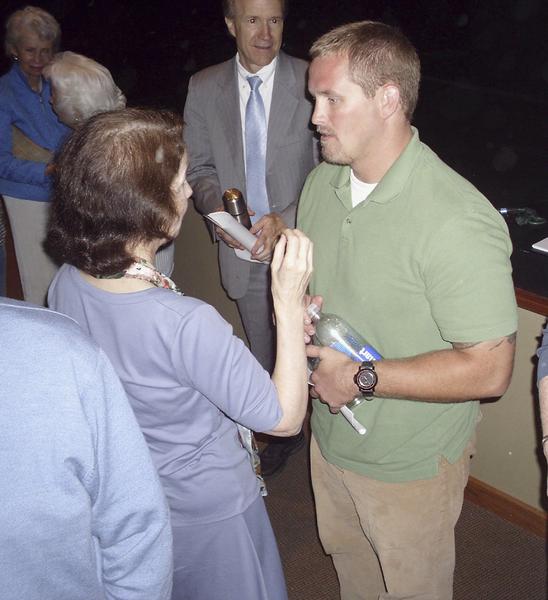
War veteran Luke Jensen from Colo, Iowa, speaks with audience members after taking part in a presentation on post traumatic stress disorder Saturday in Fairfield. A civilian police officer and SWAT team member when his Army Reserve unit was deployed, Jensen thought he was too tough to suffer PTSD. Mark Newman/The Courier

FAIRFIELD — Military police sergeants, civilian police officers and SWAT team members are all supposed to be tough. Luke Jensen was all three, so when the stress of combat began eating away at him, he felt so ashamed, he wanted to die.

Meditation helped correct that desire — and he believes it could help other soldiers and veterans.

Jensen was asked by Operation Warrior Wellness to speak about his experiences with post traumatic stress disorder (PTSD) during a presentation Saturday on PTSD, the military and the advantages of Transcendental Meditation.

“The medical [tents] in Afghanistan were for 10th Mountain Division soldiers who’d been wounded in combat,” said the Nevada, Iowa man.

How could he possibly walk into that tent and tell a medic that he was sad?

He told the Fairfield audience that his base was hit their first night there. Gunshots, explosions and outgoing fire were nearly constant. And the things he saw around him were worse than he felt he could handle.

He couldn’t sleep, he was having panic attacks and in addition to worrying about himself, the staff sergeant had his men to lead.

“I thought I was tough,” he said.

But in a combat zone, his world was out of control. When sent to investigate a report of a little Afghani girl struck by a U.S. vehicle, he found the child dead near the road.

The upset family came to claim her. Jensen contacted the Army’s Criminal Investigation Division then kept people from walking onto the death scene. He had no translator. The locals were getting angrier and more numerous, not understanding why this armed foreigner would want to keep the girl’s body from her family.

Later, someone — Jensen never found out who — ran over and killed a nearby U.S. serviceman.

His nerves couldn’t handle any more. As soon as he was able, he decided to take his sidearm and shoot himself dead. When health personnel he’d sought out heard about his attempt, he was evacuated — which made him feel as though he’d failed in his duty.

At least he could move on with his life. So why did he keep thinking the most logical step would be to take his own life — even when back in the U.S.? He still couldn’t sleep. He still had panic attacks. And he felt a deep sense of shame — especially because while on a U.S. base receiving medical care, he saw the other soldiers who had “real” injuries.

Dr. Fred Travis, a psychologist in Fairfield, said PTSD produces an injury as real as any wound. Travis is the director of the Center for Brain, Consciousness and Cognition at Maharishi University of Management.

CAT scans of patients suffering from PTSD, he said, provide evidence that the brains of sufferers are different from those without PTSD. The effect is physical.

But Jensen didn’t know his brain was short circuited. He was taking medication for depression and anxiety, back in Iowa working in law enforcement. He still wanted to die.

When his police supervisors heard he was suicidal, they began proceedings to terminate him.

“Jerry Yellin saved my life,” Jensen said.

Yellin was a World War II fighter pilot who went undiagnosed with PTSD for 30 years. Transcendental Meditation was what helped him find relaxation and peace. When he heard about the young soldier, he called him.

Yellin got support from MUM and the David Lynch Foundation in order to provide a sort of “scholarship” for Staff Sgt. Jensen and his wife to learn TM.

Jensen thought it’d be worth a try. He had recently made a suicide threat, loaded gun to his head in front of his wife and five-year-old daughter.

The trip to Fairfield was worth it, he said. He learned to find quiet in his mind, which allowed him to relax peacefully for the first time in a long time, he said.

Dr. Travis said what appears to be happening with PTSD is that in a combat zone, the mind naturally must be super vigilant. One needs to be able to see every danger, lock that sound or sight into the memory — and avoid it.

With PTSD, every similar noise or sight becomes a life-or-death situation. Memories of danger are “locked” into the brain. Worse, parts of the mind are “short circuited” so that while the “problem-seeing” part of the brain is stuck in the “on” position, the “problem-solving” part of the brain is off. Desperation develops when all you see are problems — problems with no solution.

By meditating, TM practitioners are trained to go around that damaged part of the brain, Yellin said.

Travis said CAT scans show that, too. There is more blood flow to the frontal lobes and the portion of the brain that is generally considered to be “in charge.”

In a video about their situation, Jensen’s wife said TM saved her husband’s life. Yellin wants more soldiers to have that opportunity, and is working with the David Lynch Foundation as co-chair of Operation Warrior Wellness.

Like other parts of the body, the brain responds to exercise, becoming more resilient.

“If your frontal lobes are more developed, we believe you will be better able to deal with stressful situations,” said Travis.

Presenters said practitioners of meditation are also better able to separate the quiet of inner peace from traumatic situations in the outside world. The military is starting to take notice, as is the Veterans Administration.

Chris Busch, director of programs for the David Lynch Foundation, said the VA has commissioned two large studies to see if TM really shows results.

TM is not a replacement for traditional medicine, he said. It can be, however, one of the options doctors offer mental health patients on their way to recovery.

Yellin said Saturday’s event was the start to an effort to provide scholarships every veteran who needs TM.

For more information, visit www.operationwarriorwellness.org.

Also published in Journal Express of CNHI/SE Iowa.

Other news coverage: KTVO News: How one soldier regained his life with help from WWII veteran and TM for PTSD and WHO TV 13: WARRIOR WELLNESS: Healing Hidden Wounds  |  Des Moines Register: Fairfield and Ames war veterans team up to bring meditation (TM) to fellow Iowa vets with PTSD  |  Fairfield Ledger cover article by Diane Vance: Combat stress subject of public forum Saturday  |  KTVO: Veterans speak out on post-traumatic stress, offer a proven way to heal PTSD  |  Story County Veteran Once Suicidal Finds Relief from PTSD with Transcendental Meditation: AmesPatch article by Jessica Miller  |  Healing the Hidden Wounds of War: open forum for Iowa veterans and their families affected by PTSD, sponsored by Operation Warrior Wellness | TM Blog: “TM saved my life”—Suicidal Afghanistan war veteran who suffered from PTSD

Healing the Hidden Wounds of War: open forum for Iowa veterans and their families affected by PTSD, sponsored by Operation Warrior Wellness

July 10, 2012

Healing the Hidden Wounds of War, an open forum for Iowa veterans and their families affected by PTSD, sponsored by Operation Warrior Wellness, a division of the David Lynch Foundation, in Fairfield, Iowa.

Veterans are overcoming PTSD through meditation and reclaiming their lives. Meditation Saves A Veteran From Suicide is a video of Iowa veteran Luke Jensen describing his experiences in Afghanistan, how he tried to deal with his PTSD, and what finally worked for him.

After reading about Luke’s situation in a Des Moines Register article: Former undercover cop, MP battles PTSD: How Afghanistan service affected one soldier, Jerry Yellin, co-director for Operation Warrior Wellness, reached out to Luke and offered him a scholarship from the David Lynch Foundation to learn Transcendental Meditation.

As a result of learning to meditate, and the relief it brought him and his wife, Abi, Luke wanted to join Jerry in making this program available to other Iowa veterans and their families suffering from PTSD. They are organizing a special open forum, Healing the Hidden Wounds of War, to take place Saturday, July 28, 2012 at 2 pm in the Fairfield Arts & Convention Center in Fairfield, Iowa.

Iowa veterans can find relief from combat-induced stress and escape the self-destructive cycle of drugs, alcohol, and depression. To learn more, or to register, visit http://operationwarriorwellness.org/iowa.

Uploaded by on Jul 10, 2012

Some excerpts from the video:

“The first week I was there three soldiers got killed there….I was certain I wasn’t going to make it back home and I started thinking about suicide. I felt I was going to die anyway, so why be miserable day after day when it’s going to happen? I was just certain it was going to happen….I tried five or six different kinds of depression medicine, two or three different kinds of anxiety medicines. When I continued to try and try and try and things weren’t helping, hopelessness really was taking over and I still continued to think almost daily that suicide was going to be the option.”

In 2011, Luke Jensen learned the Transcendental Meditation (TM) technique – a stress reducing practice, proven to combat the effects of PTSD.

“For the first time in I don’t know how long I felt hope….I don’t take anxiety medicine at all anymore….It’s made me a better father, a better husband. I’d consistently thought about suicide before I learned TM. It was the first thing to kind of get that away and get that off my mind. It changed everything.”

To support the David Lynch Foundation’s Operation Warrior Wellness program: http://www.operationwarriorwellness.org/how-to-help

Operation Warrior Wellness has been championed since 2010 by a coalition of meditating veterans spanning four wars. Their mission is to deliver rapid and profound relief to veterans and active-duty military suffering from PTSD, promote resiliency among military personnel and cadets, and provide much needed support to military families serving the rewarding but often taxing job of caring for their loved ones.

See this KTVO News report: Veterans speak out on post-traumatic stress, offer a proven way to heal PTSD.

A few related articles: POLITICO: Coping with PTSD  |  Post Traumatic Stress and How Transcendental Meditation Can Help [Infographic] Transcendental Meditation Drastically Turns Life Around For Veteran With PTSD  |  Star Tribune: Meditation brings peace to war vets  |  Ruben Rosario: Recovered veteran’s latest mission: helping those like him

Here is a wonderful  interview with Jerry Yellin and Lisa Cypers Kamen of Harvesting Happiness Talk Radio July 18th. You can listen online to Jerry Yellin, Operation Warrior Wellness and Debbie Gregory, Military Connection or download the the podcast.

Star Tribune: Meditation brings peace to war vets

May 17, 2012

Meditation brings peace to war vets

May 16, 2012 | Lifestyle | Star Tribune | Kristin Tillotson

Transcendental meditation has its detractors, but many veterans say it helps them with post-war stress.

Fernando Franco, who served in both Bosnia and Iraq, uses meditation techniques to control stress. — Photo: Carlos Gonzalez, Star Tribune

Like many veterans, Fernando A. Franco had trouble sleeping through the night.

A major in the Minnesota National Guard, he was deployed twice between 2003 and 2007, once to Bosnia and once to Iraq, with barely six months’ break in between. The place where he was stationed near Balad, Iraq, was nicknamed “Mortaritaville” because “we were attacked every day,” he said.

After Franco got back home to St. Paul, he was hard-wired to wake up at 3 every morning, the same hour that in Mortaritaville he and his fellow soldiers would start hearing the shells aimed their way and brace for battle. Once he woke up, he’d stay up, living in a state of perpetual exhaustion.

“It really affected not only my work, but my relationship with my wife and kids,” he said. Then he heard about TM.

Transcendental meditation, or TM for short, is hailed by its devotees as good for just about anything that ails you. Skeptics call it everything from a bunch of hooey to a brainwashing cult, but those who do it daily claim they feel calmer, have more energy and feel healthier, both mentally and physically, than they used to. It’s not a religion, they say, just a practice that reduces anxiety and improves well-being.

Now the U.S. military — not known for embracing the mystical — has taken note. The Department of Veterans Affairs has invested $5 million in a dozen trial programs studying TM’s effects on post-traumatic stress disorder (PTSD), including one at the Minneapolis VA Health Care System.

The VA hopes to recruit 30 vets for the trial beginning in about a month, said spokesman Ralph Huessner, noting that it should not be confused with Mindfulness-Based Stress Reduction, a different meditation program already offered.

‘A part of the universe’

Franco, 49, works in human resources for Target Corp. No matter how busy he gets, he always takes 20 minutes twice a day, at about the same time every day, to meditate, using the discipline he learned as a soldier to strictly maintain his schedule.

“The only way to get the full benefit is to do it morning and afternoon, no matter what,” he said, “even if you have to do it standing up in a bathroom stall.”

TM practitioners call the state they go into one of “restful alertness.” Transcendence is achieved, they say, by repeating a mantra and emptying the mind. So how does it feel?

“There is a moment when you go into a void, an emptiness, and you feel a part of the universe,” Franco said. “It’s like in the movie ‘Avatar’ when the creature says they are a part of everything. That’s how I would explain it.”

He first heard about TM for veterans through Operation Warrior Wellness, an initiative launched last year by the foundation run by film director and TM advocate David Lynch.

“I’m Roman Catholic, but I’m very open-minded about Eastern philosophies,” Franco said.

In October, he attended training classes at the TM center in St. Paul. Six months later, he usually sleeps through the night and has passed his enthusiasm for TM along to his 15-year-old son.

“When you come back from war, where you’ve learned to shut down your emotions, you have to relearn how to be with your family,” he said. “It helps you not only to reconnect with yourself, but other people. I’ve also noticed I’m able to concentrate better.”

Some critics of the TM movement have accused it of being a religion, of amassing wealth for its leaders, and of brainwashing. Franco, who learned TM through a scholarship from Operation Warrior Wellness, said he’s seen none of that.

“I have never felt coerced into making this a religious path, and have encountered people of all faiths  who do it,” he said. “I have never been asked to make a donation.”

Although Franco said he does not have PTSD, he thinks meditation could help veterans who do.

“It’s different for everyone, and you still might need counseling and pills, but TM is one of the best tools for stress out there,” he said.

The draw of Oprah’s blessing

Long, white and stately, the local Peace Palace — which is what the international TM network calls its specially constructed education centers — sits just off a freeway frontage road on the eastern edge of St. Paul. Next door to an insurance office and a hop and a skip from Culver’s, the Maharishi Invincibility Center is hard to miss, an Eastern architectural presence in Midwestern suburbia.

At a recent open house, center director Billie Jean Billman led visitors on a tour. Since Oprah aired a special extolling the virtues of TM in April, Billman said, there has been a spike in interest. The center recently doubled its instructors from two to four.

“TM is not a panacea for everything, but it’s a non-pharmacological process that wakes up the body and the brain,” Billman said.

Two veterans who recently started TM, Sarah Ditto and Pat Watson, were also on hand to describe the benefits they’ve experienced.

“I was amazed at how completely calm I felt,” said Watson, 54. “It’s like pancake batter spreading across a griddle, slowly turning golden brown. You really are resting but awake. After I meditate, people ask me what I’ve been doing.”

“I was really energized after the first time I did it,” said Ditto, 25, who works with disabled veterans at the Metropolitan Center for Independent Living in St. Paul. “I went home and did a bunch of yard work. It’s helped me to focus better, too.”

Ditto likes to visit the center to do her meditating because its minimally decorated rooms are ideal for it. But, she says, she sometimes encounters a problem.

“I meditate facing Culver’s, and instead of my mantra I start saying in my head, Chocolate custard. Chocolate custard. Chocolate custard.”

Kristin Tillotson • 612-673-7046

For more information visit these websites:

www.tm.org and www.operationwarriorwellness.org.

Related articles: Washington Post: VA testing whether meditation can help treat PTSDPOLITICO: Coping with PTSD | Norwich University President Receives “Resilient Warrior Award” at National Veterans Summit in Washington, DC | Washington Post: Does Transcendental Meditation help veterans with PTSD? | Transcendental Meditation Drastically Turns Life Around For Veteran With PTSD | David Lynch gives $1M to teach vets meditation | David Lynch donates $1 million in grants through his foundation to teach veterans to meditate | Replay of David Lynch Foundation Launch of Operation Warrior Wellness Los Angeles | Post Traumatic Stress and How Transcendental Meditation Can Help [Infographic]

POLITICO: Coping with PTSD

May 4, 2012
Opinion Contributor
Coping with PTSD

More than 500,000 returning veterans suffer from psychological injuries, the author said. | AP Photo

By RICHARD W. SCHNEIDER | 5/3/12 9:24 AM EDT

Developing military leaders who are smart, strong and courageous — both on and off of the battlefield — is essential. We are still learning how to create soldiers prepared for the emotional wounds of war. We need to teach coping skills to help these men and women reduce the terrible effects of post-traumatic stress disorder.

Veterans, who have experienced the horrors of war, are the most common sufferers. More than 500,000 returning veterans from Iraq and Afghanistan suffer from psychological injuries — including PTSD or major depression.

But even military cadets, when in a highly disciplined and rigorous academic environment, can feel similarly overwhelmed. Under intense stress, many men and women just give up. They don’t have the tools to stay focused and grounded.

We must give them the tools they need. This means helping them to be successful socially, emotionally and in a military setting. Our future leaders need this knowledge.

Transcendental Meditation has demonstrated an ability to help those suffering from PTSD and high stress environments. Recent trials of TM’s effects on psychological distress have revealed: reduced perceived stress, improved constructive thinking, decreased state anxiety, increased behavioral coping and reduced depression. This is the focus of the David Lynch Foundation, which highlights TM’s positive effects.

TM helps military cadets become more resilient, according to Norwich University studies, so that they can be better soldiers on the battlefield as well as better equipped to recover from the traumas of war and have a normal life after returning home.

Evidence suggests that TM may help people handle the stresses that come before as well as during military service and when they return to civilian life.

A 2011 Norwich University study, with funding from the David Lynch Foundation and the Educational Foundation of America, showed the positive effects that TM can have on helping students cope with the stresses of leadership in being a member of the Norwich University Corps of Cadets. TM has proven to be a highly effective coping strategy and has set a high bar to further explorations and research.

Many cadets who enter the military will likely be exposed to trauma that can have a destructive effect on their lives and the lives of their families. Whether a veteran or a military cadet, the method of dealing with PTSD is crucial.

For these “invisible wounds” can take a high toll — on family, quality of life and work performance. There is also a greater risk for violent and self-destructive behavior.

Effective treatments have been difficult to identify. Many expensive combinations of chemicals, for example, have been explored. But TM is an evidence-based technique that is available anywhere and at any time. Those who practice it develop the ability to improve daily stresses in the workplace and in life.

The technique helps address anxiety, mood change and situational awareness. Its powerful impact can produce long-term results in improving daily lives.

The goal is clear: to develop the whole person with maximized abilities and capacity in all situations.

Richard W. Schneider, a rear admiral USCGR (Ret.) is the president of Norwich University. The David Lynch Foundation on Thursday is hosting its first annual National Summit, investigating effects of Transcendental Meditation on active-duty personnel and veterans suffering from PTSD, cadets in training — and their families.

Short URL: http://politi.co/JPLv7Z

Related articles: Washington Post: Does Transcendental Meditation help veterans with PTSD? | Norwich University President Receives “Resilient Warrior Award” at National Veterans Summit in Washington, DC | Washington Post: VA testing whether meditation can help treat PTSD

PsychCentral reviews Norman Rosenthal’s book Transcendence: Transcendental Meditation: What Is It and How Does It Work?

September 16, 2011

Transcendental Meditation: What Is It and How Does It Work?

By Therese Borchard

Transcendental Meditation: What Is It and How Does It Work?Being that my job is to feature and review books on psychology, spirituality, and especially the intersection between the two, I receive my share of books on meditation. And as a person who has been trying to meditate for two years, but who just can’t seem to get the hang of it, I always open the cover a tad sinister, looking for a magic bullet.

The book Transcendence: Healing and Transformation Through Transcendental Meditation was on my decline stack until I read the short bio on Norman Rosenthal, M.D. and became intrigued. He’s a clinical professor of psychiatry at Georgetown Medical School. He conducted research at the National Institute of Mental Health. And he was the one who first described and diagnosed seasonal affective disorder (SAD). Ironically, I knew of him through my good friend Michelle, who had been one of the case studies for him on SAD.

So, with those credentials I opened the book and began to read stories that inspired me and gave me hope that one day I might be a meditator too.

Rosenthal won my trust in that he clearly states in the introduction that Transcendental Meditation is not a stand-alone treatment for emotional disorders, especially when effective treatments are available and work (if not full proof). He writes, “The fact is that no single treatment works every time for any given set of symptoms. We often have to try several different medications or treatment approaches before we find the right mix. I am suggesting that TM should be part of that mix, especially when conventional approaches prove unsatisfactory.” Rosenthal would in no way advise a person to go off his meds and try this type of meditation. However, he believes that practicing it can be the difference between a life of coping and a life of living.

Before reading Rosenthal’s book, I was unaware of the ways different kinds of meditations activate neurons in distinct regions of the brain. For example, Mindful Meditation increases the activity of neurons not only in certain emotional areas of the brain, but also in frontal regions, which are responsible for decision making and other functions. In Transcendental Meditation, there is a more global effect. Characteristic brain wave patterns are seen in many different parts of the brain, so the meditator has a better chance of experiencing the effects of meditation long past the meditation session.

What, exactly, is this Transcendental Meditation? Rosenthal writes:

Transcendental Meditation is always taught one-on-one, at least initially, by a teacher who is a longtime meditator trained not only to instruct new students and provide follow-up, but also to customize the approach for each student. Initial instruction has seven steps: two lectures and a personal interview with a certified teacher, then four teaching sessions on four consecutive days. Each session lasts about ninety minutes. Ideally, the fledgling meditator then follows up with the teacher, perhaps weekly for the first month and monthly thereafter. These thirty-minute “checking” sessions give students a chance to ask questions and make sure their technique is still on track, so they will derive the maximum benefit.

Basically, TM is a nonreligious practice that involves sitting comfortably for twenty minutes twice a day, while using a silent mantra, or nonverbal sound, to attain a profound state of aware relaxation. And just like yoga or martial arts, says Rosenthal, in order to learn it correctly, you need ongoing guidance with a teacher.

A profound gift of TM is that regular practice increases brain wave coherence, meaning that the frequencies of brain waves in different parts of the brain work together as a result of TM. In seasoned meditators, brain wave coherence can be found throughout the day, not only during meditation. Electroencephalograms (EEG) indicate that TM calms the brain while organizing the prefrontal brain regions so that meditators can improve their focus, decision-making, and job performance.

Especially enlightening to me were Rosenthal’s chapters on how TM can help treat acute anxiety, major depression, and bipolar disorder. This psychiatrist and some of his colleagues obtained a grant to study TM in a group of bipolar patients. In the study, eleven people received immediate TM training, while fourteen people were placed on a wait list. Both groups continued with their previous medical treatments. A few from the TM group reported a drop in manic symptoms, however, depressive symptoms were especially relieved, as stated in the patient reports but also upon inspecting the results of TM by Rosenthal and his team. Explains Rosenthal:

Several patients reported increased calmness, improved focus, and improved ability to stay organized and set priorities–no surprise, given TM’s known effects on the prefrontal cortex. TM helped bipolar patients improve their executive function, just as it did for people with anxiety disorders and ADHD… All in all … our study study suggests that TM might be very helpful for bipolar patients. In fact, all the clinicians who worked on the study are now referring certain of their bipolar patients, particularly those with residual depression, for TM training–along with their other treatments.

Check out Rosenthal’s book, Transcendence, for more information on the science and benefits of Transcendental Meditation.

Therese J. Borchard is Associate Editor at Psych Central, where she regularly contributes to World of Psychology. She also writes the daily blog, Beyond Blue, on

Beliefnet.com. Therese is the author of Beyond Blue: Surviving Depression & Anxiety and Making the Most of Bad Genes and The Pocket Therapist. Subscribe to her RSS feed on Psych Central or Beliefnet. Visit her website or follow her on Twitter @thereseborchard.

APA Reference
Borchard, T. (2011). Transcendental Meditation: What Is It and How Does It Work?. Psych Central. Retrieved on September 14, 2011, from http://psychcentral.com/lib/2011/transcendental-meditation-what-is-it-and-how-does-it-work/

Scientifically Reviewed
Last reviewed: By John M. Grohol, Psy.D. on 13 Jul 2011
Published on PsychCentral.com. All rights reserved.

————–
Also listen to an excellent interview with Norman Rosenthal and Jenny Crwys-Williams on South Africa’s 702 Talk Radio. Click to download Podcast. It’s mentioned in this post: Meditation for Health, Happiness and Spirituality.

TM Reduces Veterans PTSD Symptoms by 50%

June 1, 2011

Veterans Show a 50% Reduction in PTSD Symptoms
After 8 Weeks of Transcendental Meditation

WASHINGTON | Wed, June 1, 2011, 9:00am EDT

Veterans of the Iraq/Afghanistan wars showed a 50 percent reduction in their symptoms of post-traumatic stress disorder (PTSD) after just eight weeks of practicing the stress-reducing Transcendental Meditation technique, according to a pilot study published in the June 2011 issue of Military Medicine (Volume 176, Number 6).

The study evaluated five veterans, ages 25- to 40-years-old, who had served in Iraq, Afghanistan or both from 10 months to two years involving moderate or heavy moderate combat.

The study found that Transcendental Meditation produced significant reductions in stress and depression, and marked improvements in relationships and overall quality of life. Furthermore, the authors reported that the technique was easy to perform and was well accepted by the veterans.

The Clinician Administered PTSD Scale (CAPS) was the primary measure for assessing the effectiveness of TM practice on PTSD symptoms. CAPS is considered by the Department of Veterans Affairs as the “gold standard” for PTSD assessment and diagnosis for both military Veteran and civilian trauma survivors.

The paper’s senior researcher, Norman Rosenthal, M.D., is clinical professor of psychiatry at Georgetown University Medical School and director of research at Capital Clinical Research Associates in Rockville, Maryland. Dr. Rosenthal was the first to describe seasonal affective disorder (SAD) and pioneered the use of light therapy as a treatment.

“Even though the number of veterans in this study was small, the results were very impressive,” Rosenthal said. “These young men were in extreme distress as a direct result of trauma suffered during combat, and the simple and effortless Transcendental Meditation technique literally transformed their lives.”

The findings were similar to those from a randomized controlled study of Vietnam veterans conducted by researchers at the University of Colorado School of Medicine. In that study, published in the Journal of Counseling and Development in 1985, after three months of twice-daily TM practice, the veterans had fewer symptoms than those receiving   conventional psychotherapy of the day.  In fact, most of the TM-treated subjects required no further treatment.

“Even though the combat experiences of OEF/OIF veterans and Vietnam veterans are quite different, the fact that our study corroborates the results of the previous study tells us that this technique has the potential to be an effective tool against PTSD and combat stress, regardless of combat situation,” explained Sarina Grosswald, EdD, co-researcher on the study.

Rosenthal hypothesizes that Transcendental Meditation helps people with PTSD because regular practice produces long-term changes in sympathetic nervous system activity, as evidenced by decreased blood pressure, and lower reactivity to stress. “Transcendental Meditation quiets down the nervous system, and slows down the ‘fight-or-flight’ response,” he said.  People with PTSD show overactive fight-or-flight responses, making them excellent candidates for Transcendental Meditation.

Rosenthal points out that there is an urgent need to find effective and cost-effective treatments for veterans with combat-related PTSD. “The condition is common, affecting an estimated one in seven deployed soldiers and Marines, most of whom do not get adequate treatment.  So far, only one treatment—simulation exposure to battleground scenes—has been deemed effective, but it requires specialized software and hardware, trained personnel and is labor intensive.

“Based on our study and previous findings, I believe Transcendental Meditation certainly warrants further study for combat-related PTSD,” says Rosenthal.

Rosenthal is the author of a new book, “Transcendence: Healing and Transformation through Transcendental Meditation,” which will be released by Tarcher Penguin on June 2, 2011. For those wanting to interview Dr. Rosenthal, contact his publicist, Dean Draznin Communications, Inc., 641-472-2257, dean@drazninpr.com.

Results of the new “PTSD and Meditation” study will be announced at special presentations: Tuesday evening, June 7, in New York City, and Wednesday evening, June 8, in Washington, DC.

Watch: Reduction of PTSD Symptoms in Veterans with Transcendental Meditation.

FACT SHEET

Post-Traumatic Stress Disorder (PTSD)

  • A new report paints a stark picture of the toll on the U.S. military of almost a decade of war: higher stress and lower morale. The report, released Thursday, May 19, 2011, at the Pentagon, relied on questions to soldiers and Marines in Afghanistan in July and August of last year and compared responses with similar surveys in 2005 and 2009. The report noted “significant decline in reports of individual morale” as well as “acute stress rates significantly higher” than in earlier years. Source: CNN: New Pentagon study finds psychological toll from years of fighting.
  • VA’s suicide hotline receives 10,000 calls per month from active and retired servicemen. There are 950 suicide attempts per month by veterans receiving care from the VA. 18 veterans commit suicide each day, 5 of them are under the care of the VA. Source: Army Times: 18 veterans commit suicide each day.
  • The Rand Corporation’s study “Invisible Wounds of War” revealed a disturbing truth about the health of our military as recently as 2008:  Over 300,000 returning veterans from Iraq and Afghanistan suffer from PTSD or major depression.  According to the Rand report, these “invisible wounds” take a high toll—impacting veterans’ quality of life, hindering their performance at work, straining their families, and placing them at greater risk for violent and self-destructive behaviors. The economic cost of these disorders is equally great—reaching as high as $6 billion over 2 years. Yet, despite the heavy toll of PTSD and depression, only half of affected veterans seek care, and only a third of those who do, receive adequate treatment. Thus, over 80% of affected veterans remain without needed help.

The Transcendental Meditation Technique

  • The Transcendental Meditation technique is an effortless technique practiced 10-20 minutes twice a day sitting comfortably with the eyes closed.
  • TM is not a religion or philosophy and involves no new beliefs or change in lifestyle.
  • Over 350 peer-reviewed research studies on the TM technique confirm a range of benefits for mind, body and behavior.
  • Several studies have compared the effects of different meditation practices and found that Transcendental Meditation provides deeper relaxation and is more effective at reducing anxiety, depression and hypertension than other forms of meditation and relaxation. In addition, no other meditation practice shows the widespread coherence throughout all areas of the brain that is seen with Transcendental Meditation.
  • The Transcendental Meditation technique is taught in the United States by a non-profit, educational organization.

Source: EurekAlert! Veterans show a 50 percent reduction in PTSD symptoms after 8 weeks of Transcendental Meditation.
The Huffington Post: Top Research Psychiatrist Promotes Meditation for Healing and Transformation.
Fox News.com: Could Transcendental Meditation Help Veterans Suffering From Post-Traumatic Stress Disorder?
The Epoch Times by Ginger Chan: Post-Traumatic Stress Disorder Reduced by Meditation.
Insidermedicine: Transcendental Meditation May Help Veterans with PTSD (Video)
ABC News/Health: ABC News: Meditation Heals Military Vets With PTSD
Medical News Today: Veteran PTSD Symptoms Significantly Reduced After 8 Weeks Of Transcendental Meditation
Click here for more articles and news videos on TM and PTSD posted on The Uncarved Blog.

Brain Researchers Demonstrate How Students Can Overcome Stress And Function Like Top Achievers

February 1, 2011

Prominent Brain Researchers Demonstrate
How Students Can Overcome Stress Crisis
And Function Like Top Achievers

Free Public Lecture: February 8, 2011, 5 p.m.
Location: Harper Memorial, #103, 1116 E. 59th Street, Chicago, IL 60637
Sponsored by: Students Transcendental Meditation Association, University of Chicago
Contact: Dr. Carla Brown: 773–324–8695, chicago@tm.org

How can today’s students overcome the debilitating effects of heavy stress – made even more difficult by the economy – in order to perform at their best?  It is indeed possible, and two prominent brain researchers will demonstrate how and share their compelling research findings on Tuesday, February 8, during a free public lecture at the University of Chicago. Check below for a listing of other lectures at different locations throughout the week.

Dr. William Stixrud, Ph.D., a prominent clinical neuropsychologist from Silver Spring, M.D., and Dr. Fred Travis, a neuroscientist and Director of the Center for Brain, Consciousness and Cognition at Maharishi University of Management in Fairfield, IA, will discuss how meditation can affect functional integration of the brain and enable changes that result in dramatic reductions in stress hormones and cardiovascular disease.

Both doctors agree that students can use these same meditation techniques to help them reduce and overcome stress and pressure, perform better, and engender increased well being and contentment.

Last week the New York Times covered a survey of 200,000 college freshmen that found that their emotional health was at the lowest level surveyed in 25 years. Dr. William Stixrud, who specializes in work with children and adolescents, responded,

“It is possible for students to ‘have it all’—to experience high achievement in a competitive world and still have happiness and peace of mind.”

Dr. Stixrud’s 2008 research found that middle school students with ADHD who practiced the Transcendental Meditation technique twice a day in school experienced over 50% reduction in stress and anxiety, and improvements in ADHD symptoms.

During the lecture on February 8, Dr. Travis will also present a live demonstration of changed brain activity as a result of the Transcendental Meditation® technique and will discuss differences in TM from other mental techniques.

In 2009 Dr. Travis collaborated with the American University Department of Psychology in Washington, D.C. in the first random assignment study of effects of meditation practice on brain and physiological functioning in college students International Journal of Psychophysiology, 2009. Dr. Travis and colleagues randomly assigned American University students to practice the Transcendental Meditation technique. Measured during the height of exam pressures, these students exhibited functional brain integration resembling that of gold medal athletes.

Non-meditating controls in this experiment were overwhelmed and displayed significantly less brain integration, which is brain functioning that was more fragmented and disorganized. Students reported being more anxious and irritable, reflecting the detrimental effects of college life on the students.

According to a study published in the American Journal of Hypertension, December 2009, the Transcendental Meditation technique was shown to be an effective method of reducing blood pressure, anxiety, depression, and anger among at-risk college students.

“The problem is stress,” says Dr. Stixrud, who has studied and lectured frequently on the effects of stress on the brain, particularly the developing brain. Dr. Stixrud added,

“The effects of stress are not pretty. Not only does stress interfere with functions such as attention, memory, organization, and integration, but prolonged stress actually kills brain cells and shrinks the brain’s main memory structures. In fact, the top stress researchers in the world report that lifelong stress level is the best predictor of risk for Alzheimer’s disease and other forms of dementia. In light of this research, I am increasingly struck by how counterproductive it is for students to learn in highly stressful contexts, since stress not only interferes with their learning and retention in the short run but also burns out their brains in the long run.”

FREE PUBLIC LECTURE SERIES:

Diamond Bank, Conference Room, 1800 W. North Avenue, Chicago, IL — Tuesday, February 8th, 11:30 am

University of Chicago, Harper Memorial, #103, 1116 E. 59th Street, Hyde Park, Chicago, IL — Tuesday, February 8th, 5 pm, sponsored by: Students Transcendental Meditation Association

Joliet Junior College, 1215 Houbolt Road, Rm. D 2001, Joliet, Il — Wednesday, February 9th, 1:15 pm. For information, call Pat Tinken 815 280 6660

Oak Park Public Library, Veterans Room (2nd Floor), 834 Lake St., Oak Park, IL — Saturday, February 12th, 2 pm

LINKS:

New York Times: Record Level of Stress Found in College Freshmen
College freshmen at 25-year low in emotional health, study says
Dr. Travis: Live demonstration: What happens when you meditate?

Dr. Travis: Transcending & Brain Research
Dr. Travis: What’s missing from education?
Also see: David Lynch Foundation: School Projects