Posts Tagged ‘David Lynch Foundation’

The David @LynchFoundation @TMmeditation Program Brings Relief to Traumatized Moms Who Lost a Child to City Violence

August 28, 2014

Here is a great article by Erin Meyer, and inspiring interview with DNAinfo Chicago Radio News Director that aired August 22, 2014: Moms Traumatized by City Violence Join David Lynch Meditation Program.

Erin answers Jon’s questions based on what grieving mothers who had lost a child to city violence, and have now started meditating, are telling her. This is the first time they’ve been able to experience any kind of inner peace for 20 minutes twice a day. For these program participants, TM is bringing relief to their stress-filled days and nights.

HUMBOLDT PARK — Eyes closed in meditation, a small group of grieving women sat in a circle on the second floor of a Humboldt Boys & Girls Club one recent Sunday afternoon.

The lights were dimmed. Except for the hum of the air conditioner and the far away sound of basketballs hitting the gym floor below, the room was awash in a deep silence.

The quiet, say the mothers — most of whom have lost children to Chicago violence — was coming from within, a rediscovered inner peace thought to have died with their children.

“For all these years, I’ve been fighting with my brain. I took medication to forget, but you can never forget,” said 49-year-old Beti Guevara, who was just a girl when her brother was slain 38 years ago.

Erin Meyer says the mothers struggle to find peaceful moments after the death of a child:

With Transcendental Meditation, “I can think clearly, I’m calmer, and I can finally sleep,” he said.

Guevara and her friends are learning the trademarked relaxation method, called TM for short, at the invitation of the David Lynch Foundation for Consciousness-Based Education and World Peace.

Lynch, an innovator of cinema best known as the director of the TV series “Twin Peaks” and films including “Mulholland Drive” and “Lost Highway,” views TM as a tonic for victims of trauma and a vehicle to world peace.

The New York-based foundation that bears his name teaches TM on American Indian reservations, in prisons and schools, to homeless people, to former soldiers suffering post-traumatic stress disorder and to victims of war in Africa, according to the organization’s website.

Recently, the David Lynch Foundation added to that list Chicago mothers living in the wake of a child’s murder.

Among those participating are: An-Janette Albert, mother of 16-year-old Derrion Albert, whose 2009 beating death outside Fenger High School shocked the nation; Myrna Roman, who lost her first-born in an unprovoked 2010 drive-by in Humboldt Park; and Maria Pike, the mother of an aspiring chef, Ricky Pike, who was gunned down in Logan Square in 2012.

The group met multiple times over the course of a week with a husband-wife TM instruction team, adopted their mantras and started meditating twice a day for 10 to 20 minutes at a time. Four days into the practice, most of the new students said they have found a surprising measure of peace.

Transcendental Meditation is not an ancient technique, but a method developed by the Indian guru Maharishi Mahesh Yogi in the 1950s. It became wider known when it was adopted by members of The Beatles.

On Sunday, at the Union League Boys & Girls Club, meditation teacher Chris Busch described TM as a nonreligious exercise with myriad mind and body benefits ranging from stress reduction to reduced cholesterol and improved cardiovascular health.

“It’s a simple thing,” Busch said. “Even children 10 years old, they can do it,” he said, describing improvements that some schools in San Francisco have seen through the implementation of a TM program for students.

Lynch told the New York Times earlier this year that he began TM in 1973.

“The Beatles were over with Maharishi in India and lots of people were getting hip to Transcendental Meditation and different kinds of meditation, and I thought it was real baloney,” Lynch said. “I thought I would become a raisin-and-nut eater, and I just wanted to work.”

Then, he heard the phrase, “True happiness is not out there, true happiness lies within.”

“And this phrase had a ring of truth to it,” Lynch said.

He described TM, which usually costs about $1,000 to learn through TM teachers, as “a key that opens the door.”

After spending time with Maharishi Mahesh Yogi, he decided to set up a foundation in 2005 to spread the meditation approach, according to the Times.

“Things like traumatic stress and anxiety and tension and sorrow and depression and hate and bitter, selfish anger and fear start to lift away,” Lynch said. He launched a Women’s Initiative in 2012.

The Chicago mothers, just beginning to see the potential meditation has to bring order to their lives, stumbled into TM.

Maria Pike was telling friends on a recent trip to Washington D.C. about the daily challenges she encounters just trying to live a normal life in the wake of her son’s murder. The friends turned out to be TM practitioners, Pike said.

They made some phone calls, which led to more phone calls. Eventually, supporters of the David Lynch Foundation offered to pay for Pike and her friends to take the TM training.

“I feel like it was meant to be,” Pike said.

Published with permission from the author. See the complete article with photos here.

See executive director Bob Roth speak at Google Zeitgeist 2014 about the work of the David Lynch Foundation offering Transcendental Meditation to at-risk populations, as well as Wall Street executives.

Second study to show Transcendental Meditation reduces PTSD in African Refugees—in just 10 days

February 10, 2014

Transcendental Meditation significantly reduces PTSD in African refugees within 10 days

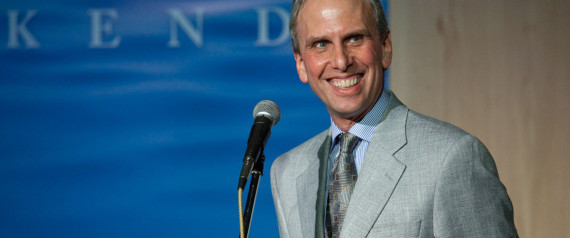
This is lead author Col. Brian Rees, MD, MPH, US Army Reserve Medical Corps

This is lead author Col. Brian Rees, MD, MPH, US Army Reserve Medical Corps

African civilians in war-torn countries have experienced the threat of violence or death, and many have witnessed the abuse, torture, rape and even murder of loved ones. Many Congolese living in Ugandan refugee camps are suffering from severe posttraumatic stress disorder (PTSD).

New research shows that Congolese war refugees who learned the Transcendental Meditation® technique showed a significant reduction in posttraumatic stress disorder in just 10 days, according to a study published today in the February 2014 issue of the Journal of Traumatic Stress (Volume 27, Issue 1, pages 1–119).

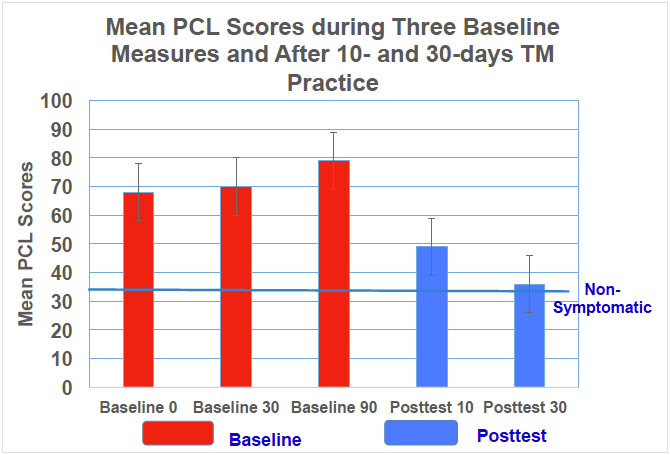
In the study, “Significant Reductions in Posttraumatic Stress Symptoms in Congolese Refugees within 10 days Transcendental Meditation Practice,” 11 subjects were tested after 10-days and 30-days TM practice. After just 10-days PTSD symptoms dropped almost 30 points.

“An earlier study found a similar result after 30 days where 90% of TM subjects dropped to a non-symptomatic level. But we were surprised to see such a significant reduction with this group after just 10 days,” said study author Brian Rees, MD, MPH.

The subjects were assessed using the Posttraumatic Stress Disorder Checklist for Civilians, (PCL-C), which rates the severity of PTSD on a scale from 17 to 85. A score below 35 means the symptoms of PTSD have abated.

Eleven Congolese refugees who had been tested three times over a 90-day period on the PCL-C, which rates the level of PTSD on a scale from 17 to 85, began with an average score of 77.9. They learned Transcendental Meditation within 8 days of the third test and after 10 days their average score dropped to 48, which was highly clinically significant. They were retested 30 days later measuring an average score of 35.3. With scores below 35 considered non-symptomatic, they were practically symptom free.

Eleven Congolese refugees who had been tested three times over a 90-day period on the PCL-C, which rates the level of PTSD on a scale from 17 to 85, began with an average score of 77.9. They learned Transcendental Meditation within 8 days of the third test and after 10 days their average score dropped to 48, which was highly clinically significant. They were retested 30 days later measuring an average score of 35.3. With scores below 35 considered non-symptomatic, they were practically symptom free.

The subjects in the study initially tested with an average score of 77.9. After just 10 days of practicing the Transcendental Meditation technique, their PTSD test scores dropped to an average of 48, which was highly significant clinically.

Thirty days later the subjects were tested again with their PTSD scores falling to an average of 35.3 — meaning that they were nearly without symptoms of PTSD.

“What makes this study interesting is when we tested them in the 90 days before they began the TM technique, their PTSD scores kept going up,” said coauthor Fred Travis, director of the Center for Brain, Consciousness, and Cognition at Maharishi University of Management. “During that period their scores were rising, from 68.5 at the beginning to 77.9 after 90 days. But once they started the Transcendental Meditation technique, their PTSD scores plummeted.”

According to the researchers, during this particular meditation technique one experiences a deep state of restful alertness. Repeated experience of this state for 20 minutes twice a day cultures the nervous system to maintain settled mental and physical functioning the rest of the day. This helps to minimize disturbing thoughts, sleep difficulties, and other adverse PTSD symptoms.

In this video, Dr. Travis explains the neurophysiology of trauma and how TM relieves it. He says, “Something very profound is happening. Because experience changes the brain, and trauma locks in a specific brain functioning (the over stimulated amygdala), you’re stuck in a specific way of thinking and feeling, (vigilance, fear and mistrust) and appreciating the world.” He further explains how the experience of transcending, with Transcendental Meditation, calms the amygdala, relieves PTS symptoms and frees the individual “to see more possibilities.”

Congolese refugee Esperance Ndozi and her 5 children

Congolese refugee Esperance Ndozi and her 5 children

Esperance Ndozi was one of the Congolese refugees traumatized by the civil war. The 35-year old mother of 5 was part of the group of refugees that learned TM. Before learning the effortless technique, Esperance couldn’t find relief from a flood of dark disturbing memories. She could hardly sleep. After a week of meditating 20-minutes twice a day she describes increasing relaxation and relief from PTSD symptoms. “Your mind, your body relaxes. You feel you are out of the outside world. You are just in your peaceful world. No negativity. It doesn’t come near me now.” Like other refugees in the study the calm and peace grew to last throughout the day. Watch the video.

A previous study of Congolese refugees, which involved 42 subjects found that the Transcendental Meditation group had an average Checklist score of below 35 after 30 days, a non-symptomatic level, while the average score of the control group actually worsened over the same period.

“This is now the fourth study to show an improvement in PTSD,” said Dr. Rees, a colonel in the US Army Reserve Medical Corps. “The Transcendental Meditation technique is increasingly being seen as a viable treatment by the US military.”*

###

Study co-author Dr Fred Travis is a professor of neurophysiology at Maharishi University of Management, an accredited university to the PhD level, where Transcendental Meditation is incorporated into its curriculum and practiced by faculty and students. This provides a way for students, including veterans, to reduce the effects of past stress and trauma, and make learning easier and more enjoyable. www.mum.edu

This study was funded in part by the David Lynch Foundation. www.davidlynchfoundation.org/africa

The Journal of Traumatic Stress is published on behalf of International Society for Traumatic Stress Studies.

Source: EurekAlert!

*Two earlier studies have shown the Transcendental Meditation (TM®) technique to effectively lower post-traumatic stress in veterans of Vietnam and Iraq/Afghanistan wars.

See first refugee study: New study shows Transcendental Meditation significantly reduces PTS in African refugees

New study out on Transcendental Meditation shows reduced teacher stress and burnout

February 3, 2014

Transcendental Meditation Reduces Teacher Stress and Burnout, New Research Shows

Effect of Transcendental Meditation on Employee Stress, Depression, and Burnout: A Randomized Controlled Study

This graph shows the average level of change in total burnout, as measured by the Maslach Burnout Inventory, in the Transcendental Meditation group compared to controls. The graph displays a marked reduction in burnout symptoms in the TM group, with the control group showing a small increase in burnout over the duration of the study.

This graph shows the average level of change in total burnout, as measured by the Maslach Burnout Inventory, in the Transcendental Meditation group compared to controls. The graph displays a marked reduction in burnout symptoms in the TM group, with the control group showing a small increase in burnout over the duration of the study.

A new study published in The Permanente Journal (Vol. 18, No.1) on health showed the introduction of the Transcendental Meditation® technique substantially decreased teacher stress and burnout.

Research indicates that stress and burnout are pervasive problems among employees, with teachers being especially vulnerable to feeling frequent stress from their jobs. Burnout, a syndrome of emotional exhaustion, depersonalization, and job dissatisfaction, has been found to contribute to lower teacher classroom performance and higher absenteeism and job turnover rates.

This current study sought to determine whether practice of the Transcendental Meditation (TM) program results in lower psychological distress and decreased burnout in teachers and support staff at the Bennington School in Vermont, a special in-residence school for students with behavioral problems.

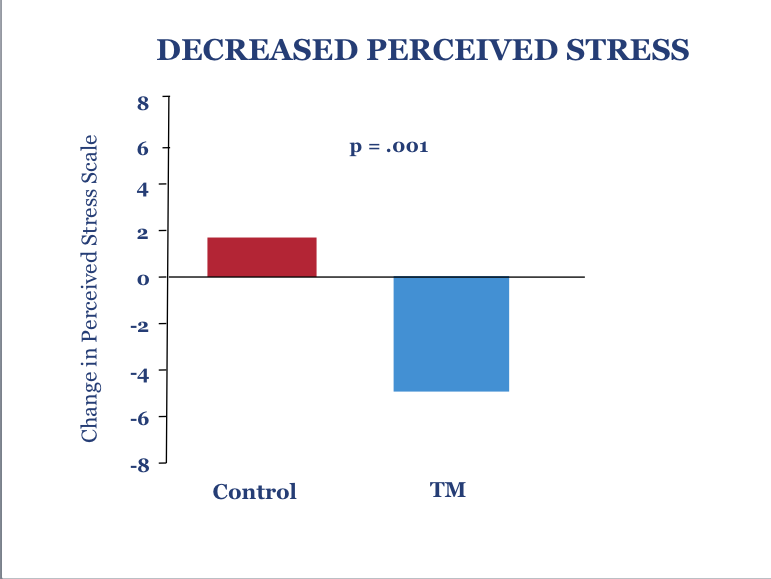
This graph shows the average level of change in perceived stress, as measured by the Perceived Stress Scale, in the Transcendental Meditation group compared to controls. The graph displays a marked reduction in perceived stress in the TM group, with the control group showing a small increase in stress over the duration of the study.

This graph shows the average level of change in perceived stress, as measured by the Perceived Stress Scale, in the Transcendental Meditation group compared to controls. The graph displays a marked reduction in perceived stress in the TM group, with the control group showing a small increase in stress over the duration of the study.

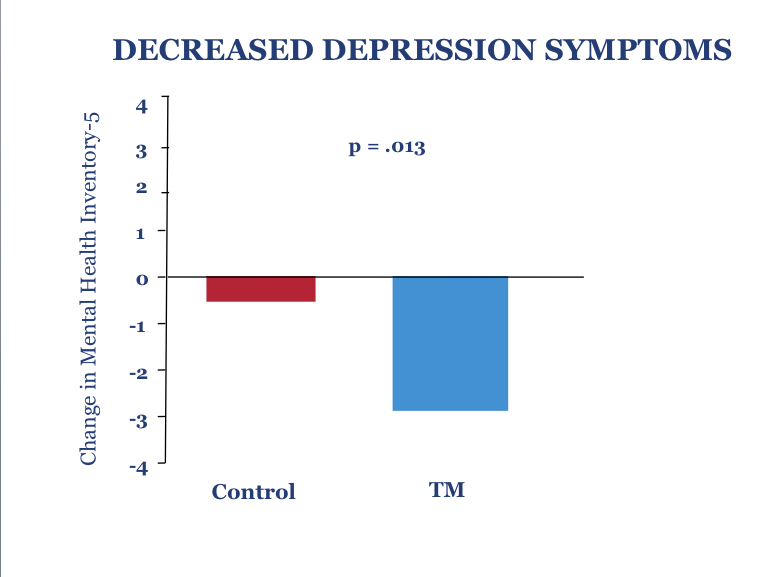
According to Dr. Charles Elder, MD, MPH, lead author of the study and a Senior Physician in the Department of Internal Medicine at Kaiser Permanente Northwest, “The results of this randomized controlled trial are very striking and demonstrate the utility of introducing a stress reduction program for teachers and other public and private employees. The four-month study found significant and clinically important decreases in perceived stress, emotional exhaustion associated with teacher burnout, and depressive symptoms in those practicing the TM program compared to a wait-list control group.”

“Burnout and other psychological distress factors have been linked to negative health behaviors, obesity, and hypertension, all of which are major contributors to cardiovascular disease,” emphasized Dr. Sanford Nidich, EdD, study principal investigator and Professor of Education at Maharishi University of Management. “Prior medical research has found that practice of the TM program is effective in reducing both risk factors for heart disease and cardiovascular events. Taken as a whole, this present study and prior research provide evidence for the value of the TM program for enhancing mental and physical health and well-being, explained Dr. Nidich.”

This graph shows the average level of change in decreased depression symptoms, as measured by the Mental Health Inventory-5, in the Transcendental Meditation group compared to controls. The graph displays a marked reduction in depression symptoms in the TM group, with the control group showing a small decrease in depression over the duration of the study.

This graph shows the average level of change in decreased depression symptoms, as measured by the Mental Health Inventory-5, in the Transcendental Meditation group compared to controls. The graph displays a marked reduction in depression symptoms in the TM group, with the control group showing a small decrease in depression over the duration of the study.

The study included 40 teachers and support staff measured at baseline and then randomly assigned to either immediate start of the TM program or delayed start (wait-list control group). Compliance with practice of the TM technique throughout the four-month intervention period was high; 100% of the participants assigned to the TM group meditated at least once a day. Of those, 56% meditated regularly at home twice a day.

This is the first study to investigate the effects of Transcendental Meditation on teacher burnout. Recent published studies have shown a positive impact of this program on student graduation rates, academic achievement, and psychological distress. Transcendental Meditation has seen widespread implementation in secondary schools across the country within the context of school-wide Quiet Time programs.

The study was funded by the Nine East Network and David Lynch Foundation.

About the Transcendental Meditation technique

The TM technique is a simple, natural, effortless procedure practiced 20 minutes twice each day while sitting comfortably with the eyes closed. Extensive peer-reviewed research studies have found that TM reduces psychological distress, including anxiety and depression, and promotes overall mental and physical health.

The TM technique is available in the USA through Maharishi Foundation USA, a federally recognized non-profit educational organization. Through partnerships with other non-profit organizations and foundations, full TM scholarships have been given to more than 250,000 at-risk children, school teachers, veterans suffering from PTSD, homeless people, and others. Visit http://www.tm.org for more information.

About Maharishi University of Management

Maharishi University of Management is an accredited university offering bachelor’s, master’s, and doctoral degrees in the arts, sciences, humanities, and business, where Transcendental Meditation is also practiced by both professors and students. Visit http://www.mum.edu for more information.

Source: EurekAlert!

@JerrySeinfeld talks about @TMmeditation at David @LynchFoundation #ChangeBeginsWithin

January 1, 2014

On Tuesday, December 3rd, at the David Lynch Foundation‘s 5th Annual Change Begins Within Gala at the Conrad Hotel in New York City, Jerry Seinfeld took the stage to open the event. We were waiting for this to come out on YouTube. Jerry is absolutely brilliant! He opens with a funny diversion about Amazon and drones, and then segues to the main topic.

Jerry shares how he started Transcendental Meditation in college and has been practicing it for 41 years. But he reveals for the first time that he had only been meditating once a day instead of the twice-a-day instruction. Still, it was because of TM, he says, that he managed to keep it together during the nine years he was producing his successful hit show Seinfeld.

 “When I was doing the TV series in which I was the star of the show, the executive producer, the head writer, casting and editing, for 22 to 24 episodes on network television—not cable! Network—for 9 years. Okay? That’s a lot of work. And I’m a regular guy, pretty much. You know, I’m not one of these crazy people that has endless, boundless energy. I’m just a normal guy. But that was not a normal situation to be in. And so what I would do is every day when everybody would have lunch I would do TM [Transcendental Meditation] and then while we’d go back to work and then I would eat while I was working because I had missed lunch. But that is how I survived the 9 years, it was that 20 minutes in the middle of the day would save me.”

George Shapiro, Jerry’s manager and fellow meditator, had written into Jerry’s contract that he was to not do interviews or be disturbed during lunch hours, when he would go to his trailer during the taping of the Seinfeld show. Now we know why. What we didn’t know was that he was only doing it once a day, at that time. And look what he accomplished!

Jerry’s handling a lot these days, touring on weekends, producing his internet show, Comedians in Cars Getting Coffee, raising 3 young kids, and yet has the energy to enjoy it all, at 60, when he was thinking he should be slowing down. Meditating twice a day has transformed his life. Here’s the part where he mentions Bob Roth reminding him to do his morning meditation, at 6 mins, 54 secs, and what happened as a result.

By the way, David Lynch never missed his twice-daily TM during the over 40 years he’s been meditating. He also used to do his meditation (second), in private, on film sets when everyone else went to lunch.

Bob Roth interviewed Jerry Seinfeld for the new Sirius XM radio show on TM starting January 2014. Jerry is his first guest. David Lynch will also be on an episode of the show, as will other high-profile celebrities and expert guests.

New York is really the hub of American consciousness—media, finance, fashion, food, arts and entertainment. TM has created quite the buzz in the city. It’s a more peaceful and friendlier place to be in these days. 2014 holds much promise. May it bring us greater joy and success. Happy New Year!

Related stories:
George Stephanopoulos interviews Jerry Seinfeld & Bob Roth on the importance of Transcendental Meditation for PTSD
Renowned (TM) meditation teacher Bob Roth featured on The Third Metric and HuffPost Live
Alec Baldwin asks Jerry Seinfeld about learning Transcendental Meditation on Here’s The Thing
Style.com: David Lynch and Italo Zucchelli on their creativity and Transcendental Meditation
David Lynch on Esquire Network, How I Rock It, talking about Transcendental Meditation
David Lynch on meditation in the NewStatesman: Heaven is a place on earth
David Lynch speaks with Alan Colmes about his 16-country tour film Meditation Creativity Peace
Jerry Seinfeld and Howard Stern share stories about their Transcendental Meditation practice

Style.com: David Lynch and Italo Zucchelli on their creativity and Transcendental Meditation

December 25, 2013

Style.com: The Transcendentalists: David Lynch and Calvin Klein Collection’s Italo Zucchelli on their shared passions: creativity and Transcendental Meditation

By Matthew Schneier. Photographs by Olivia Malone
Published December 24, 2013

On a winding road high in the Hollywood Hills, not far from Mulholland Drive, is a Brutalist-looking concrete structure that’s equal parts manse and bunker. It’s the studio of David Lynch, and appropriately for his many pursuits—he is an auteur across media, from film and television to painting, music, self-help books, and coffee roasting—it has a variety of different spaces: a screening room, a recording studio, storage for his photographs and artwork, a kitchen with an industrial-grade espresso machine. (Lynch die-hards may recognize it as the house from Lost Highway.)

I’ve come here from New York, along with fashion designer Italo Zucchelli, to discuss one of Lynch’s abiding passions, Transcendental Meditation. The director established his own nonprofit, the David Lynch Center for Transcendental Meditation and World Peace, in 2005. He credits the practice with much of his success, and he’s devoted as much time to raising awareness of it as he has to virtually any of his other endeavors. His 2006 book, Catching the Big Fish, is dedicated to the subject.

Transcendental Meditation is an ancient practice, but its profile was raised in our era when the Beatles took it up in 1968, under the guidance of its twentieth-century guru, Maharishi Mahesh Yogi. It comes with, and rules out, no religion, faith, or creed, but because of its new-wave aura, it has largely bubbled away at the fringes of culture. Lately, however, it is experiencing a new boom. “In the last year, something tipped,” says Bob Roth, the affable executive director of The David Lynch Foundation for Consciousness-Based Education and World Peace. “If one [particular] thing happened, I haven’t seen it—and I’ve been on the front lines. But something happened, [because] I don’t have enough teachers to teach all the people in New York City who want to learn.”

TM has a very healthy celebrity fan base, which no doubt helps its public profile, and the foundation, which exists to provide scholarships to at-risk populations so they can learn the practice, including schoolchildren, survivors of domestic abuse, and military personnel, has taken advantage of that fact. Paul McCartney, a practitioner, performed at the foundation’s first benefit concert. Hugh Jackman and Jerry Seinfeld, Transcendental Meditators both, were honored at its most recent benefit gala, in December. Mario Batali and Martin Scorsese will both speak at its upcoming conference in February. The list of adherents is even longer. Ellen DeGeneres does it. Oprah does it. Ray Dalio, the founder of Bridgewater Associates, the world’s largest hedge fund, does it. And in the realm of fashion, so does Zucchelli, who is celebrating his tenth year as creative director of menswear for Calvin Klein Collection.

“It” is a relatively simple practice. It consists of devoting twenty minutes twice a day to meditating, which in the Transcendental iteration means silently chanting a Sanskrit mantra. (The mantra must be given by a teacher of Transcendental Meditation, as part of an instruction that can cost upwards of $1,000.) Devotees say that it combats stress, improves mood, and staves off illness and disease. Remarkably, science confirms much of this. The American Heart Association found in a study that Transcendental Meditation, alone among meditation practices it tested, reduces high blood pressure; other studies indicate it can improve functional capacity in patients with congestive heart failure. Over the past forty years, more than 300 studies have been published about the effects of the practice in peer-reviewed medical journals, and the National Institutes of Health and the Department of Defense have both given millions for further testing. While a quick Google search does turn up skeptics and critics—more of charlatan practitioners than of the practice itself—the tide seems to be now firmly in TM’s favor.

“In 1968, meditation was a fad,” says Roth. “In 2013, because of the research, Transcendental Meditation is being incorporated into the actual fabric of our culture.”

There’s something undeniably intriguing about the beatific bliss that Lynch and Zucchelli radiate—in the filmmaker’s case, in stark contrast to his dark, often violent work. I wanted to find out more about the connection they both draw between the practice and their creative lives. Below, condensed and edited, is a transcript of that free-flowing discussion.

Visit Style.com to read this intriguing interview and see the photos.

See David Lynch on Esquire Network, How I Rock It, talking about Transcendental Meditation.

(more…)

Renowned (TM) meditation teacher Bob Roth featured on The Third Metric and HuffPost Live

October 14, 2013

Huffington Post Senior Writer profiled Bob Roth, Executive Director of the David Lynch Foundation, an exemplary representative for The Third Metric: Redefining Success Beyond Money and Power. huff.to/1albfF9 (10/14/2013)

Meditation Teacher To The Stars: His clients include Oprah, Russell Brand, Martin Scorcese and Dr. Oz, but renowned meditation teacher Bob Roth also serves low-income and under-served communities by sharing his passion: Transcendental Meditation.

Bob Roth was also interviewed on @HuffPostLive: Stress Is The New Black Plague: Meditation guru Bob Roth ‏@meditationbob joins host Nancy Redd ‏@nancyredd to explain the benefits of meditation: Bob Roth Talks Transcendental Meditation @TMmeditation. Watch this lively interview http://huff.lv/GZQpn9 (12:46).

Bob Roth: Bringing Calm To The Center Of Life's Storm

Bob Roth: Bringing Calm To The Center Of Life’s Storm

If there was a perfect year in which to discover Transcendental Meditation, it might just have been 1968. That was the year that Bob Roth was a freshman at UC Berkeley — a campus considered Ground Zero for the anti-war movement and the cultural changes sweeping through the country at the time. He remembers living surrounded by helicopters spewing tear gas over student war protesters and Army tanks parked outside his front door. Demonstrations. Riots. Chaos.

And against this backdrop, Roth did what many college students do: He took a part-time job. He sold scoops of ice cream at Swenson’s ice cream parlor, never expecting that amid the rush of pending social changes engulfing him, it would be at the ice cream shop where he would meet a guy who would ultimately alter the course of his life forever.

The college crew at Swenson’s was the usual motley collection of hippies, straights and everything in between, recalls Roth. But one guy stood out: Peter Stevens. “He was like a quiet reflection pool amid the chaos,” recalls Roth, “and I was drawn to him.”

“Peter was centered, energetic, super-smart, kind to all, easy-going, never agitated, with an ineffable calm about him,” Roth told The Huffington Post. He learned that Peter “meditated,” something that Roth said was a bit of a disconnect for him. “Meditation was not in my vocabulary.” But he was intrigued and curious, and went with Stevens to a class in Transcendental Meditation, a meditative practice derived from the ancient Vedic tradition in India. After just one class, Roth was hooked.

Today, Roth is the executive director of the David Lynch Foundation, where he has helped bring Transcendental Meditation programs to more than 300,000 at-risk kids in 35 countries, as well as veterans suffering from post-traumatic stress disorder, and women and girls who are survivors of domestic violence. He’s also the national director of the Center for Leadership Performance, which introduces the TM program to business, industry and government organizations — and even some United Nations groups.

Today, Roth’s student roster includes a lot of very recognizable names: Oprah, Russell Simmons, Russell Brand, Martin Scorsese, Mehmet Oz, Hugh Jackman and dozens of others. He’d be embarrassed to be called “meditation teacher to the stars,” but such a description wouldn’t be far off. For the past 40 years, he has meditated twice a day no matter where he is, in places as discombobulating as an airplane when need be.

He explains Transcendental Meditation with the following analogy: The surface of the ocean is waves and white caps. But deeper down, the ocean is still. How TM differs from other meditations, he says, is that it doesn’t attempt to still the waves, but rather allow access to the stillness. By practicing it twice a day for 20 minutes, he said, studies have shown that people sleep better, reduce their stress, and lower their blood pressure. In children, the practice can reduce ADHD symptoms and symptoms of other learning disorders.

Not all Roth’s clients are rich and famous. One of the key focuses of the David Lynch Foundation is to target those who aren’t and improve their lives through TM. There’s a story that Roth likes to tell about the DLF’s Quiet Time program — where thousands of at-risk children are taught TM in school. It involves a little girl he called Jessica (not her real name) who lives in a crime-infested neighborhood of San Francisco. Jessica showed up one day at school wearing a white dress splattered with what her teacher, at first glance, thought was red paint. It was blood — blood from Jessica’s uncle who had been shot that morning in a random drive-by while waiting with her at the bus stop.

Instead of running home, Jessica ran to school so that she could meditate, she told her teachers. The DLF Quiet Time program had been in her school for about a year at the time and for her, it made school a safe place whereas her home often couldn’t be. “For me,” said Roth, “that says it all.”

As part of the Quiet Time Program, the foundation supplies teachers for each child to have one-on-one meditation instruction and follow-up. “In a school with 1,000 students,” he said, “we bring in 20 teachers.”

The results have been gratifying, said Roth, who believes that results must be quantifiable to matter. “Change needs to show up in grades, reduced number of suspensions and dropout rates,” he said. And the Quiet Time program has done all that. The San Francisco Unified School District reports an 86 percent reduction in suspensions over two years in schools where the program has been introduced; a 65 percent decrease in violent conflict at the John O’Connell High School; and the Journal of Psychiatry shows reduced ADHD symptoms and symptoms of other learning disorders among students who practice TM.

Carlos Garcia, retired superintendent of the San Francisco Unified School District, heralded the program as one which is “transforming lives.” He said, “It is transforming schools and neighborhoods, and it will transform our society.”

All of which is music to Roth’s ears. TM is a life-changer for individuals, he said, but also a game changer in the broader sense. It may start with an individual’s desire to sleep better or reduce stress, but results are similar to what happens when you pull on one leg of the table, said Roth. “The whole table moves.” And what moves in this case are blood pressure numbers, heart attack risk factors, and the overall ability to make better decisions with a more focused mind. “You are thinking more clearly, are able to make decisions more ethically, perform more creatively.” It’s like when you water a plant because some leaves are wilting, he said, but the whole plant benefits from the water. And it spills over into those around you in a chain reaction.

Companies interested in innovation are drawn to TM because of the positive impact it has on their work force. It’s why Oprah had Roth bring his program to her staff of 400. “It’s not just about learning to relax,” said Roth. “TM wakes up the brain and the executive functions. It resets the brain to perform in a less ‘flight or fight’ manner.”

And yes, it reduces stress. Whether he is teaching a homeless guy — the DLF has a program that works with New York City homeless — or a billionaire, “they both suffer from stress,” said Roth.

But as one celebrity who shall remain unnamed quipped when Roth asked her why she wanted to learn to meditate, “I want to maintain a permanent connection with the intelligence of the universe. I also can’t sleep.”

TM training allows people to access an ability they already are hard wired for: to take a profound rest at will.

Roth says the tipping point has been reached in regard to the public’s understanding of the value of meditation. As he wrote on Maria Shriver’s blog, “It feels like something foundational can be done to help transform lives through meditation, not only among those most at-risk to suffer traumas in life, but also the teen in the private school who battles the very real demons of substance abuse and unspoken thoughts of suicide; the parent who is struggling to survive an ugly divorce and still keep the family intact; or just the person — man, woman, boy, girl — who is navigating life’s daily vicissitudes and can’t seem to catch a breath, turn off the noise, get a good night’s sleep.”

Ann Brenoff can be reached at: ann.brenoff@huffingtonpost.com.

Here is a lovely reproduction of the Huffington Post article with more pictures created by the David Lynch Foundation: Meditation Man.

See The GQ Guide to Transcendental Meditation: The Totally Stressed-Out Man’s Guide to Meditation, an excellent article written by Josh Dean who learned TM from Bob Roth and interviewed him.

Bob Roth is also featured in the April 2, 2014 issue of MANHATTAN Magazine: Transcendental Inspiration.

Bob Roth (S)(C)On July 16, 2015, Harper Spero, a New York City-based lifestyle and career coach, published this wonderful interview on her blog: (So)(Co) Sit Down with Bob Roth. While working at Agent of Change, she produced the Women.Meditation.Stress. Luncheon and Panel Discussion for the David Lynch Foundation (DLF), which is how she met Bob, its executive director. It contains a nice large-sized photo of Bob at the bottom of the blog post.

The GQ Guide to Transcendental Meditation: The Totally Stressed-Out Man’s Guide to Meditation

September 10, 2013

The GQ Guide to Transcendental Meditation

GQ

Men’s Lives

The Totally Stressed-Out Man’s Guide to Meditation

by Josh Dean | Illustrations by Brian Cronin | September 2013

The most successful, innovative men alive do it. Overworked, very, very busy (and insanely rich) hedge-fund managers swear by it. So the question is: Should you cross your legs, close your eyes, and join in?  Read more >

This is the best no-nonsense, hip, informed article on Transcendental Meditation I have ever come across. See “6 Things TM Can Make You Better At” on page 1, listing  what TM will do for busy execs, including the results of a school project implemented by the David Lynch Foundation.

Check out The Tree of Ommmm on page 2 of the 3-page article, which has a chart with pictures of Maharishi to Paul McCartney representing The Beatles, to two levels of Celebrities with David Lynch as guru to the stars. Click on the picture and it will enlarge so you can see and read it better. I also added this comment posted there. GQ also embedded the video described in the comment with the link.

There’s a great video of Maharishi Mahesh Yogi giving a brief answer about what TM is and how it is taught. You won’t won’t find a reference that gives more insight into the technique itself and the teaching methodology used to teach it than this: Mantra and Transcendental Meditation explained by Maharishi.

To see what the whole article looks like with the illustrations, pick up a copy of the magazine, otherwise see it online by clicking on the title. Here is a scanned PDF of the article as it appears in the magazine. It’s an enjoyable read!

See a review of  “The Totally 
Stressed-Out 
Man’s Guide 
to Meditation” on the TM Blog by Mario Orsatti.

This article was updated and republished Oct 18, 2016 with the same title, but a different comparison chart: GQ-The Totally Stressed-Out Man’s Guide to Meditation.

Also see Renowned (TM) meditation teacher Bob Roth featured on The Third Metric and HuffPost Live.

Watch David Lynch on Esquire Network, How I Rock It, talking about Transcendental Meditation, which contains a link to a lucid description of Josh Zabar’s experiences with TM: Daily Reset – A Look Into Transcendental Meditation.

On March 19, 2025, GQ published an excellent article on TM and DLF. Colin Groundwater spoke with Bob Roth about the history, mission, and growth of the Foundation and David Lynch’s immense contribution. See David Lynch Was Transcendental Meditation’s Greatest Ambassador. What Happens to the Movement Now?

— Written and compiled (citing sources) by Ken Chawkin for The Uncarved Blog.

Celeb Spiritual Report: One significant day in my life by David Lynch for Jane Magazine (May 2004)

August 3, 2013

Here is an article I helped facilitate for David Lynch when we first started working with him, a year before the idea for the David Lynch Foundation was created under the dynamic leadership of Bob Roth, executive director for the Foundation. Up to this point David had kept his Transcendental Meditation practice private. When he made the decision to go public and help the TM movement he turned out to be a most unique and brilliant spokesman.

One event was a project to create world peace. We sent out our press release to the media and set up a NY press conference David would attend. Jauretsi Saizarbitoria, the entertainment editor for Jane magazine at the time, emailed back saying she was interested in David’s meditating and suggested he write an article for their special celeb issue on the topic: One significant day in my life. We mentioned it to him and he sent us an article of the day he learned that our human physiology, our body, was made of consciousness, which we forwarded to them. Knowing he was a painter, they also wanted to know what consciousness looked like to David. He sent a jpeg of an image he had created and they included it, giving him a whole page and titling it a Celeb Spiritual Report, with that announcement on the bottom right side of the magazine cover. It was published in their May, 2004 celeb issue. Jane was a popular woman’s magazine, published from 1997-2007. David posted the report on his website with other earlier David Lynch articles and interviews.

Here is David’s love of Maharishi’s Vedic knowledge explained in such a simple conversational tone that’s truly David Lynch. He’s actually a brilliant writer and speaker! They put the text on the bottom right of this photo. Here it is with the text underneath.

Jane – May, 2004
One significant day in my life

By David Lynch

This is a picture that director David Lynch (above) painted to show what consciousness looks like.

This is a picture that director David Lynch (above) painted to show what consciousness looks like.

A significant event occurred in my life the day I learned that our human physiology, our body, is made of consciousness.

Consciousness???

“What???” I asked out loud in wonder.

I learned that our human physiology is so magnificent and complex, and so exquisite in its design and makeup, as to be wondrous beyond imagination. We are spun out of unbounded, infinite, eternal consciousness.

I learned that underlying all matter is a vast, unbounded, infinite and eternal field of consciousness called the Unified Field. I found out that modern science started taking this field seriously about 25 years ago and that all matter is unified at this level in a state of perfect symmetry, or balance. The entire universe emerges from this field in a process called “spontaneous sequential symmetry breaking.”

Are you still with me?

I also learned that there is another science called Vedic Science. This Vedic Science is ancient, and it has always talked of the Unified Field.

Interesting!

Veda, I learned, means “total knowledge.” The home of total knowledge is the Unified Field. It is also the home of all the laws of nature. The branches of Veda, 40 in total, make up the language of the Unified Field, the impulses of this eternal field.

I realized this Unified Field is quite an interesting place. It is not manifest and is full, meaning it is no thing, yet all things in potential. It manifests and permeates all things: the whole universe, everything, while still remaining full and not manifest.

Amazing!

Is this mind-boggling or what?

Now comes the hippest part. I have learned that any human being can “experience” the Unified Field.

Really?

Or: So what?

Why in the world would we care to experience the Unified Field?

First, another question.

Have you ever heard that most of us human beings use only 5 percent of our brain, our mind? Have you ever wondered what in the heck the other 95 percent is all about?

This is the beautiful part coming up.

The “experience” of the Unified Field actually unfolds “enlightenment”—higher states of consciousness culminating in Unity Consciousness, the highest state of consciousness. These higher states use that 95 percent of the brain. That is what the 95 percent is there for—to give us permanent, all-time enlightenment.

Now, what is enlightenment? If you were a lightbulb, let’s say, your “glow” might light up your whole house and surrounding yard. In enlightenment, your “glow” would be unbounded, infinite and eternal. That would be some glow!

Enlightenment is fulfillment. Supreme fulfillment. Unbounded, infinite, eternal bliss, consciousness, intelligence, creativity, harmony, dynamic peace.

Enlightenment, I have learned, is our “full potential.” It is the birthright of every human being to enjoy enlightenment.

Is this good news? I think it is such good news.

In Vedic Science, the Unified Field is called “Atma.” Translated, that is “Self”—the Self of us all.

The Unified Field is not something foreign, or even something far away. It is right within each of us at the base of our mind, the source of thought. A great sage from the Himalayas, Maharishi Mahesh Yogi, brought a beautiful gift to our world in the form of Transcendental Meditation. Transcendental Meditation is an easy and effortless, yet supremely profound, technique that allows any human to dive within and experience that unbounded ocean of pure bliss, pure consciousness. the Unified Field, our Self.

It may be interesting for you to know that millions of people are practicing Transcendental Meditation all around the world. People from all religions, and all walks of life. Over 600 studies have been done in universities and research institutes validating the profound benefits of Maharishi’s Transcendental Meditation Program.

Having this kind of knowledge and technologies of consciousness available to us in this age is, in my mind, a significant event. Yet the “experience” of that Unified Field is the most significant event, because it unfolds what we truly are—totality.

David’s movies include Eraserhead, Dune, Blue Velvet and Mulholland Drive. He is looking forward to Creating World Peace Day, to be held mid-September at the Maharishi University of Management in Fairfield, Iowa (www.mum.edu).

Copyright 2004 Fairchild Publications, Inc.

(more…)

Grammy Award winner Omar Akram says TM brought him closer to his source of creativity

June 26, 2013

Enjoy this great interview Christopher Caplan conducted with Omar Akram, published June 25, 2013 at 12:15 pm in RYOT Reports. I was pleasantly surprised to learn how Transcendental Meditation freed the creativity of this Grammy award-winning composer and recording artist, and the respect he has for David Lynch and the David Lynch Foundation.

Q&A: Omar Akram, first Afghan American to win a Grammy, talks Transcendental Meditation

Omar Akram, 2013 New Age Music Grammy Award Winner

I recently sat down with Omar Akram, the first Afghan American to win a Grammy award to learn a bit more about his creative process. He has been referred to as a cultural diplomat by many, and the musical equivalent of Khaled Hosseini, author of The Kite Runner, in that he is (gradually) mending cultural differences between war-torn nations through art. His recent article on The Huffington Post bespeaks of a well traveled life in which he has mingled with Cuban dictators and contributed to peace in the Middle East. What’s particularly interesting about Omar is the way he uses Transcendental Meditation in his creative process, as well as his support and admiration of the David Lynch Foundation.

Q: When and how did you first discover Transcendental Meditation?

I began using TM about 5 years ago. I was going through some creative blocks, so to speak, and a friend of mine suggested it. I’d known about it for years, but I had never taken the time to try it. I started to meditate slowly, and after doing it a few times, I got hooked.

Q: How has TM helped your creative process over the years?

I think it definitely brings you closer to the source of creativity. I feel this way almost every time. I remember David Lynch was talking about it. He said it was like “searching for the big fish,” or in other words, reaching deep down. I can reach deep down inside of myself and get to the big fish — that big creative idea. That’s what it’s all about, the big creative idea, and TM helps me find this.

Q: Have you tried other forms of meditation?

Yes, I’ve tried straight meditation, on and off for many years. But five years ago I became a lot more serious about it.

Q: How do you feel about David Lynch’s recent advocacy of TM?

I think what he’s doing is fantastic because he is really trying to get it out to school kids and to people that have never been exposed to it before. I think that once people try it, I mean really try it, they realize how beneficial it is.

Q: How do you think TM can help children and students?

One thing that I know is that kids sometimes have a hard time focusing on anything. Especially nowadays because they are being bombarded with so much media. I think it’s really helpful for kids once they give it a chance. They learn the value of meditation and focus. It will be hard in the beginning to understand what they’re doing, but with proper guidance they’ll learn. I think that not only will it help them become more creative, but they will improve in all aspects of schooling and self-esteem.

Q: Do you use TM when you are in the recording studio?

I try to do it a couple of times a day, once in the morning, and once in the evening. It has been really helpful both with creativity and dealing with the stress and deadlines of my upcoming album, “Daytime Dreamer.” It kind of sets the course of my whole day. Once I’m in the studio, I like to take a few minutes, but it’s hard to do it during the day, and that’s my routine. When I do it the morning it helps me focus for the whole day, and shift everything so I have a clearer sense of what I need to do. In the evening I can absorb everything that I’ve done, and refresh my mind all over again.

Q: What do you see for the future of TM and its continuing acceptance in the mainstream?

I think the more people are exposed to TM the more they’re going to realize the benefits of it. A lot of people are not aware of TM, and that’s what David is doing, he’s going around and introducing it to a lot of people that otherwise would never be exposed to it. The more people are exposed to it, the more practitioners there will be, and I think it’s going to be huge. Guys like David Lynch are pioneers in that. I have nothing but respect for him, especially with what he’s doing in schools. I think it’ll make a huge difference.

posted by Omar Akram. Check out his blog: www.omarmusic.com.

RYOT NOTE: Transcendental Meditation not only helps to reduce stress, it also helps with clearing the mind and allowing people to be more creative. The David Lynch Foundation provides millions of dollars of free services every year, implementing these scientifically proven stress-reducing modalities for at-risk populations and communities. See other related articles on David Lynch from RYOT posted at the bottom of this article, and click the gray box to learn more, donate and Become the News!

You can read more about Omar Akram’s background and musical influences in this PRWeb press release: Grammy Award Winning Artist Omar Akram Becomes Latest Entertainment Client to Join YM & Associates PR Marketing Firm at Beverly Hills.

UPDATE

In an April 29, 2019 interview in Thrive Global, Omar was asked:

Which tips would you recommend to your colleagues in your industry to help them to thrive and not “burn out”?

What helps me is meditation. I would highly recommend it to my colleagues. I’ve been doing Transcendental Meditation for many years and it has had a big difference in my life.

David Lynch, Russell Brand, Bob Roth Q&A after screening Meditation, Creativity, Peace documentary at Hammer Museum

May 24, 2013

David Lynch: Meditation, Creativity, Peace Q&A

Filmmaker David Lynch, comedian Russell Brand, and David Lynch Foundation Executive Director Bob Roth answer questions about Transcendental Meditation following a screening of the documentary Meditation, Creativity, Peace. (Run Time: 41 minutes, April 2, 2103.)

Published on May 2, 2013 by hammermuseum

See related videos: Russell Brand and David Lynch at LA Premiere of ‘Meditation, Creativity, Peace’ Documentary and Watch the trailer for a new documentary film on David Lynch titled “Meditation Creativity Peace”

Enlightenment, The TM Magazine, also reported on the event: Meditation Creativity Peace: How the David Lynch Foundation Brings Change from Within.

David Lynch speaks with Alan Colmes about his 16-country tour film Meditation Creativity Peace.

Visit the new website, Meditation Creativity Peace, for a list of upcoming and previous screenings: http://meditationcreativitypeace.com.