When I saw this clever New Yorker cartoon by William Haefeli it reminded me of the one by Karl Stevens. Both humorously emphasize the need to be present—to learn to live in the moment, in the now.
William’s cartoon shows a wife’s frustration with her husband’s memory loss, and his clever way of dealing with it: “I’m not losing my memory. I’m living in the now.”
In a way, when it comes to dementia, the present moment is all some afflicted seniors are eventually left with as they forget the wounds from their past and stop worrying about an unknown future. A welcome relief. But the present moment is all that the rest of us have as well. It all comes down to how much of it are we aware of, and actually, happily, living.
To see more of William Haefeli’s cartoon art, visit the Condé Nast Store. He also has cartoons posted on the Punch Magazine website in the UK. William Haefeli was interviewed for A Case For Pencils. He was also featured in a more personal article at the Advocate: Drawing on life.
New Yorker cartoon editor Bob Mankoff is quoted in the Advocate article talking about seeing a cartoonist’s comic style and a personality. “Sometimes it’s commentary, sometimes satire, sometimes absurdity, sometimes what I call ludic, a mind play. It’s someone communicating his ideas through the medium of humor. Bill is one of the best examples of it—his cartoons are social commentary.”
It took Bill Haefeli 19 years of failed submissions to the New Yorker, until Mankoff became cartoon editor, when he received his first acceptance. “Bill is an interesting cartoonist because he thinks of a broad range of issues—gay and straight,” explains Mankoff. “He has a world that’s not just a joke. It’s bigger than a stereotype.”
There has been a wave of publicity before, during, and after the largest group of 11,000 TM meditators from 139 countries who gathered at Kanha Shanti Vanam near Hyderabad for 14 days to help create world peace. Here is a sample of some of that news coverage starting with The Week, which came out in their print issue on Sunday, February 4, 2024.
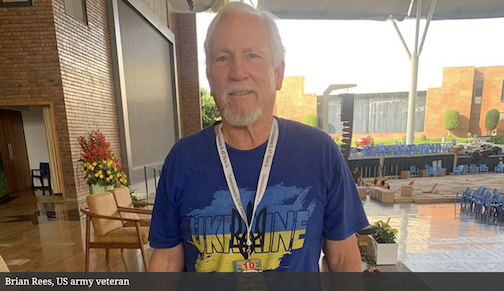
IN EARLY 2005, security checkpoints at the Abu Ghraib prison complex in Iraq―notorious for torture and abuse of its inmates―were overrun by armed militants. The surprise attack met with strong resistance from US coalition forces guarding the site. Several American soldiers suffered injuries, and many militants lost their lives. Brian Rees, a doctor with the US military, remembers rushing out to treat civilian casualties. Whenever he got a chance, he said, he would retreat to a corner and meditate.
I felt I could use TM to reset. It kept me resilient on the ground. It is important to maintain a healthy rhythm.
—Brian Rees, us army veteran
Rees has learned to find peace among chaos. He meditates twice a day―20 minutes each in the morning and in the evening. Transcendental Meditation (TM) has been a source of strength for him while serving in Iraq and in Afghanistan. It helped him beat long periods of boredom and to cope with the shocking sights of blood and gore. “I felt I could use TM to reset. It kept me resilient on the ground. It is important to maintain a healthy rhythm or things can go very wrong,” said the veteran about the benefits of meditation in a war zone.
Rees has introduced hundreds of US veterans to TM in the last 10 years, helping them return to normalcy after stressful missions. He still remembers a veteran telling him just two minutes after attending a session that TM was going to save his life. “The veterans have a lot of questions on why this is happening. But they have no answers,” said Rees. “TM will really help them see hope and remove negative aspects.”
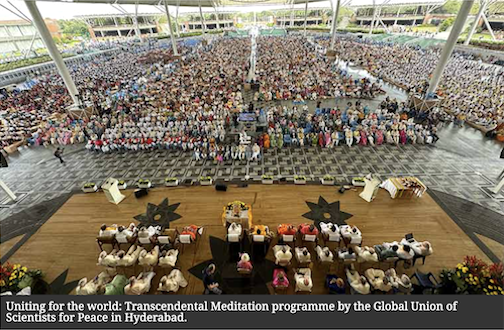
Nearly 4,000 TM practitioners from outside India like Rees and 6,000 Indians took part in a residential meditation programme organised by the Global Union of Scientists for Peace (GUSP), a group that works to carry forward the legacy of the late Maharishi Mahesh Yogi. It was held for two weeks from December 29 at the Kanha Shanti Vanam ashram near Hyderabad. The programme was intended to trigger a world peace field based on a theory propagated by the Maharishi.
Tony Nader, chairman of GUSP, explained the idea behind getting 10,000 people at one place. “The research is based on findings of 50 years that when one per cent of the total population practises Transcendental Meditation in any city, there is a reduction in crime, conflict, hospital admission and road accidents. One per cent of the world population today would be 81 million and it is a big number to bring together for meditation. The Maharishi produced a new technique, which is based on Patanjali yoga sutras, where it was found that the square root of one per cent of the population is enough to achieve the desired effect. It means that instead of 81 million, its square root―9,000―could be used. The number 10,000 was selected to have the safety factor on top of the needed number.”
Nader, who leads TM-related organisations in more than 100 countries, hails from conflict-ridden Lebanon and credits meditation for helping him survive the horrors of the civil war in the 1970s. The 14-day programme saw participants practise basic TM, yoga sutras and flying sutras. Frederick Travis, director of the Centre for Brain, Consciousness and Cognition, Maharishi University of Management, Iowa, used a special device fitted with 19 sensors on a participant to study the impact of group meditation on the brain. He recorded a high coherence in the brain as a result of meditation practised by thousands in the vicinity.
Alex Kutai, a theatre actor-turned PR professional from Israel, said meditation was an antidote to war. Kutai, an active TM teacher, was drawn to the movement after the 1973 Yom Kippur war. “After every war, the interest in TM becomes high. Thousands learned TM after the Yom Kippur war. I thought it could support my well-being,” he said.
Kutai said many people were suffering from trauma, depression and pain because of the ongoing Israel-Gaza conflict. “When people along the Gaza Strip had to be evacuated, we taught them meditation so that they could cope with the loss. We are also teaching TM for free to those who are suffering from the loss of lives of close ones,” he said. Kutai lives in Hararit, a village near the Lebanon border which was created by a community of TM members in the 1980s. Though he has not taught TM to Palestinians, Kutai said he was willing to teach friendly Arabs who reside around his village.
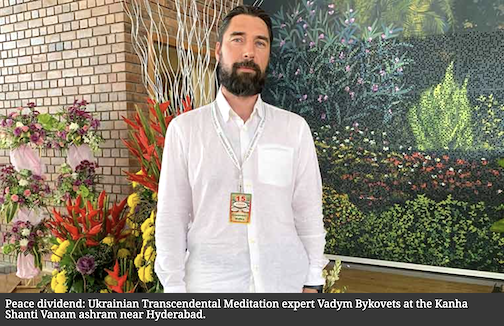
Another participant in the programme was Vadym Bykovets, a Ukrainian who nurses war wounds even though he is not physically involved in the war with Russia. The 49-year-old lives in Lithuania and works in the private sector. He counts his friends and acquaintances among those who died or were seriously wounded. He encourages fellow Ukrainians to practise meditation. “I feel that they are emotionally wounded and stressed. Without meditation, they would feel terrible. They are even scared of loud sounds.” How does meditation help him? “War is a painful topic. Regardless of what information I get from back home, I meditate,” he said. “It cleans my mind and soul, and I do not feel involved in that situation.” The reason Bykovets came all the way to Hyderabad is to support the belief that meditation is the right medium to achieve global peace.
Correction: Maharishi University of Management is Maharishi International University.
# # #
Visit Dr Tony Nader’s Instagram @drtonynader for inspiring photos, excerpts from articles, and video clips from the course and more.
They wrote: Dive into the fascinating world of Dr. Tony Nader, a Lebanese neuroscientist, researcher, and leader of the Transcendental Meditation movement. Discover his inspiring journey from the turmoil of the Middle East’s civil war to becoming a renowned figure in neuroscience. Join RJ Archana as she explores Nader’s insights on the current global conflicts, the roots of youth anger, and the importance of grassroots change. Learn about Nader’s transition from his initial days to his current stature, and gain profound insights into his work, including the founding of the International Journal of Mathematics and Consciousness. Don’t miss this thought-provoking episode on Viral City!
This first video (6:05) features Dr. Tony Nader at Maharishi International University (MIU) in Fairfield, Iowa talking about the need for TM in today’s stressful world. The video opens with students meditating with Dr. Nader. Using EEG, Dr. Fred Travis demonstrates the increase in brainwave coherence of a subject as she starts meditating. Students also discuss the practical benefits from their TM practice.
The second video (7:50) takes place in Medellín, Columbia at one of Father Gabriel Mejia’s shelters for rehabilitating homeless children with addiction problems. One of them went on to become a TM teacher and returned to teach the students how to meditate. They were inspired by the positive transformation and growth in his life.
The third video (5:02) was filmed in a Rhode Island hospital where medical staff were still dealing with the stressful repercussions from the Covid-19 pandemic. TM provided welcome relief from the traumatic loss of life and continues to be taught there. Dr. Nader mentions the David Lynch Foundation’s Heal the Healers Now campaign. They provided the funding for TM instruction, which helped thousands of healthcare professionals during the pandemic. Many continue to meditate regularly.
Embedded below are the videos with their short descriptions posted on the GWI site. Each title and chapter also take you to the BBC StoryWorks pages with the same videos plus 3 slides selected from each per chapter: Nature, Self, Community.
1. TM: Listening to your inner rhythm: Dr Tony Nader has been researching the mind and meditation since he was a medical student. Discover his methods for finding peace in a busy and ever-changing world.
2. TM: A healing journey: For Breiner, meditation had a transformational effect on his life, a lesson which he is now passing on to younger generations.
3. TM: The calm in the storm. Finding a peaceful moment to recalibrate. Ongoing strains on health clinicians from the Covid-19 pandemic are still apparent in hospitals. These medical doctors are finding strength in the moments of peace that Transcendental Meditation can provide.
See this remembrance of Mary Oliver (1935-2019) and her astonishing poetry, with links to articles, interviews, and readings, as well as more of her favorite poems I’ve loved and posted over the years.
— Written and compiled (citing sources) by Ken Chawkin for The Uncarved Blog.
Mary Oliver’s poem, Swan, asks us if we see, hear, and feel what she does, drawing rich references to the beautiful aspects of a swan, culminating in two powerful questions.
Did you too see it, drifting, all night, on the black river? Did you see it in the morning, rising into the silvery air, an armful of white blossoms, a perfect commotion of silk and linen as it leaned into the bondage of its wings; a snowbank, a bank of lilies, biting the air with its black beak? Did you hear it, fluting and whistling a shrill dark music, like the rain pelting the trees, ...like a waterfall knifing down the black ledges? And did you see it, finally, just under the clouds — a white cross streaming across the sky, its feet like black leaves, its wings like the stretching light of the river? And did you feel it, in your heart, how it pertained to everything? And have you too finally figured out what beauty is for? And have you changed your life?
The questions that Mary Oliver asks her readers at the end of the Swan poem remind me of the one she asks at the end of The Summer Day (aka “The Grasshopper”).
See this remembrance of Mary Oliver (1935-2019) and her astonishing poetry, with links to articles, interviews, and readings, as well as several of her favorite poems I’ve loved and posted over the years.
— Written and compiled (citing sources) by Ken Chawkin for The Uncarved Blog.
On December 8, 2023 Angelina Jordan Official/Republic Records/UMG released her new 5-song Christmas album, Driving Home for Christmas. I think the first song, Driving Home for Christmas, may have been recorded this year, while the other 4 holiday tunes were taken from her live-streamed Christmas Concert Dec 23, 2021 during the pandemic.
I hadn’t heard of this song before and loved it. This popular holiday tune was written and recorded by Chris Rea in 1986. I did some research and was surprised to discover he’d also written and performed the 1978 hit song, Fool (If You Think It’s Over), which I remembered and enjoyed.
Here are videos of Angelina Jordan and Chris Rea singing ‘Driving Home for Christmas’. Chris explained he wrote the song during a snowstorm on the drive home for Christmas. He misplaced it, forgot it, rediscovered and recorded it for fun, and surprisingly, without promotion, it later became a seasonal favorite. It was voted the UK’s favorite Christmas song, and is considered to be one of their top 10 Christmas singles. I can see why. It is a very catchy tune about people driving home for Christmas. Chris Rea and Angelina Jordan also sing this song on Spotify.
This song was broadcast Dec 25, 1986 in the UK appropriately on Christmas Day. Read the music video’s notes detailing the song’s release dates and ratings in different countries over the years. TopPop have now remastered it in HD and posted it Dec 19, 2023. Enjoy listening to Chris Rea – Driving Home For Christmas [REMASTERED HD] • TopPop
Here is a longer version: Rock ‘n’ roll survivor, slide player and all-round top guy Chris Rea tells The One Show how “Driving Home For Christmas” came about. Interesting how he first got the idea for the song at Abbey Road Studios and returned years later, successful, to record it with added strings. How Chris Rea wrote “Driving Home For Christmas”.
The holiday season is upon us and families get together to celebrate Thanksgiving and Christmas. Here are some funny videos related to these special occasions. The first one has not been featured here before, while the other two have, so I’ll reference and link to them below.
Frontline nurses who learned the Transcendental Meditation® (TM®) technique during the COVID-19 pandemic showed rapid and significant improvements in flourishing, PTSD, anxiety, and burnout over 3 months compared to controls, according to a study published today in the Journal of Nursing Administration.
The objective of this study was to evaluate the impact of Transcendental Meditation on nurses’ multidimensional well-being, conceptualized as the presence of flourishing and the absence of PTSD, anxiety, and burnout.
A total of 104 nurses in three Florida hospitals participated. Validated tools included the Secure Flourishing Index (SFI), PTSD Checklist for DSM-5 (PCL-5), General Anxiety Disorder-7 (GAD-7) and Maslach Burnout Inventory (MBI). Nurses also completed a Demographic Survey and a Meditation Frequency Questionnaire.
Clinical nurses who were randomized to the Transcendental Meditation group took the instruction with certified TM teachers, which included follow-up meetings over a 3-month period. Adherence to the study protocol was notably strong considering the disruption caused by the pandemic. The control group continued with “life as usual” and were offered the TM course at the conclusion of the study.
Study Results
(Click image to see details or on hyperlinked words below to view each chart on EurekAlert!)
Based on the statistical analysis there was a 62% decrease in anxiety in the TM group from baseline to 1 month compared to 3% in the controls, and a 54% decrease in the TM group after 3 months compared to 17% in the controls.
PTSD decreased 53% from baseline to 1 month in the TM group compared to 9% in the control group, and 57% in the TM group over 3 months compared to a 17% decrease in the controls.
Burnout (due to emotional exhaustion) decreased by 27% from baseline to 1 month in the TM group compared to no change in the controls, and 24% in the TM group over the 3-month study period compared to no change in controls.
In the TM group, flourishing improved by 15% from baseline to 1 month compared to a decrease of 1% in the control group and increased 16% in the TM group compared to a 3% increase in controls from baseline to 3 months.
Authors’ Conclusion
According to lead author Jennifer Bonamer, PhD, RN, AHN-BC, NPD-BC, Nursing Professional Development Specialist at Sarasota Memorial Health Care System: “It has never been more crucial that we support the health of our nurses and other clinical staff. This study is important because it demonstrated that TM was substantially helpful, even during COVID, in reducing PTSD, anxiety and burnoutexperienced by nurses.Furthermore, it helped to improve nurses’ experience of thriving (flourishing) beyond just surviving, even in the midst of today’s challenging healthcare environment.”
The authors conclude this study demonstrates the effectiveness of nurses’ practice of the TM technique to improve flourishing and reduce PTSD, anxiety, and burnout. TM provides nurses with a simple, effective, and evidence-based strategy for enhancing well-being, with the goal of retaining clinical nurses in practice.
About the Transcendental Meditation Technique
Transcendental Meditation is a simple, natural technique practiced 20 minutes twice each day while sitting comfortably with the eyes closed. It is easily learned, and is not a religion, philosophy, or lifestyle. It does not involve concentration, control of the mind, contemplation, or monitoring of thoughts or breathing. The practice allows the active thinking mind to settle down to a state of inner calm. For more information visit https://tm-nurses.org.
February 4, 2024:TM Talks host Mario Orsatti interviewed Amy Ruff about this study, an earlier one, and her work of bringing TM to the nursing profession, for which they earn continuing education credit. See Happier Nurses Result in Healthier Patients – Enjoy TM News where you can watch their informative conversation (53:12), which includes video excerpts of health professionals discussing how TM helped them deal with the demands of their profession, especially during the COVID crisis.
— Written and compiled (citing sources) by Ken Chawkin for The Uncarved Blog.
As the world watches on in helplessness the unnerving bloodletting and destruction in Gaza in the aftermath of Hamas’s carnage in Israel, there is someone who genuinely believes that world can fundamentally alter its ways to achieve peace and harmony using Transcendental Meditation techniques. That someone is Dr. Tony Nader, an eminent neuroscientist, successor to Maharishi Mahesh Yogi, a Transcendental Meditation pioneer who is also a medical doctor trained at Harvard University and Massachusetts Institute of Technology. In the runup to an upcoming two-week event titled ‘10,000 for World Peace’ in Hyderabad, India from December 29, Dr. Nader is urging the world to at least attempt to change its violent ways. He spoke to Mayank Chhaya Reports about the event as well as broader themes.