Don Arney, inventor of aerial wildfire-fighting @Bambi_Bucket, inducted into @InventorsHOF #NIHF17 #NightAtTheNIHF

May 7, 2017
Don Arney Inventors Hall Of Fame

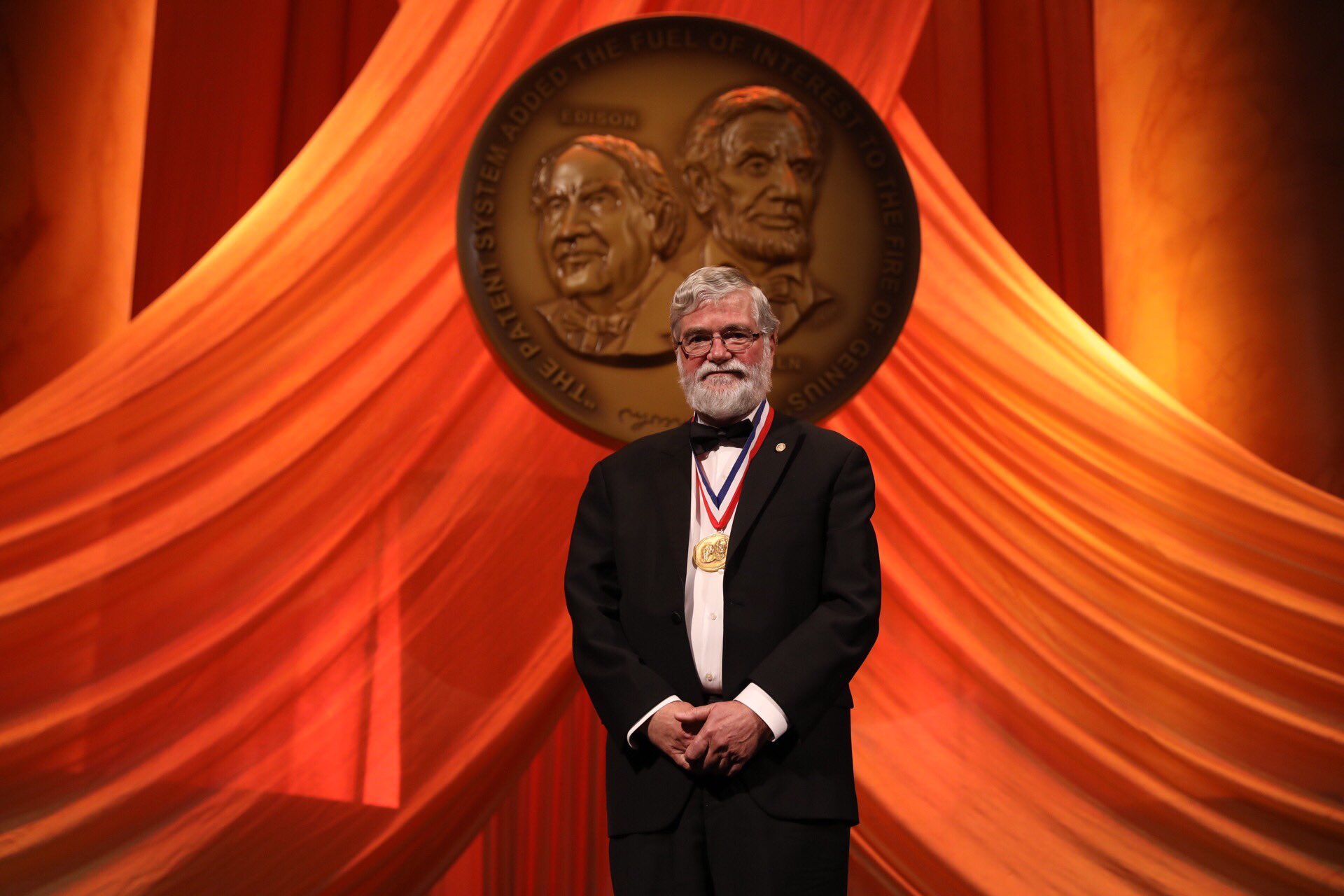
Don Arney, newly inducted into the 2017 National Inventors Hall of Fame, stands under the medal, with Edison and Lincoln looking on. The inscription reads: The Patent System Added The Fuel Of Interest To The Fire Of Genius.*

Induction at the Inventors Hall of Fame

The National Inventors Hall of Fame‘s induction ceremony took place Thursday evening, May 4, 2017 in the majestic central hall of the National Building Museum, in Washington, D.C., where presidential inaugural balls are usually held. Don Arney, who attended, said, “It is beyond awesome!”

Forbes reported, Fifteen amazing innovators became 2017 inductees into the National Inventors Hall of Fame.* Don Arney, inventor of the Bambi Bucket® for Aerial Firefighting, is one of them! Frederick E. Allen, Forbes Leadership Editor, wrote an article on the evening’s activities: To Become A Great Innovator, Get Left Back In Fourth Grade: Induction At The Inventors Hall Of Fame. Here’s an excerpt mentioning Don:

Don Arney invented the Bambi Bucket, which carries and shoots out huge quantities of water to fight forest fires, suspended from a helicopter. It is used in more than 110 countries. He said he owed his success to Transcendental Meditation, which he discovered after a spiritual journey that began when he found himself “sitting in the university library wondering if facts are all there is. . . . I’ve been doing it for 47 years now, twice a day, every day.” He said TM has helped him understand that when it comes to invention, or any kind of creativity, “you don’t do it yourself. Those things are gifts that come to you.”

When the announcement came out two months ago about Don Arney being selected as one of the NIHF inductees for 2017,  Derrick Penner interviewed him and wrote an excellent article for the Vancouver Sun: B.C. inventor of wildfire-fighting Bambi Bucket inducted to hall of fame.

The Don Arney Story
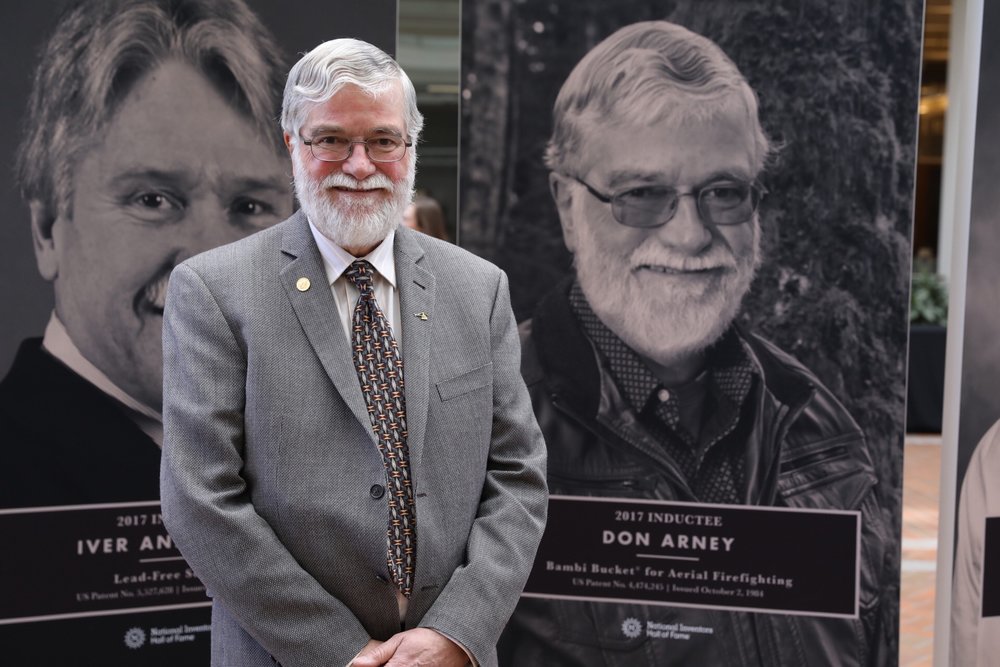
Don Arney, 2017 NIHF Inductee

You can see several photos of Don at the National Inventors Hall of Fame 45th Annual Induction Ceremony, especially in the Illumination Ceremony, being inducted, and with other honorees. This one of Don standing in front of his official portrait is very cool!

The NIHF also showed an impressive Induction Video of Don Arney telling the story of how he invented the Bambi Bucket. Filmed from his beautiful home on Salt Spring Island, Don talks about mining the mind for ideas at deeper levels, much like David Lynch describes in his book, Catching The Big Fish: Meditation, Consciousness, and Creativity.

Don has found “that meditating is a completely non-directed process, and inventing has to be the same.” He explains, “you know all of the things you’re going to be doing as you engage in the process, but you don’t direct it.” What he finds is that the answers come, and organize, on a very profound level. “They bubble up, and very quickly and innocently the solution appears.”

There’s elegance in simplicity

Another shorter video, Don Arney’s Road to NIHF: A Blissful Processlooks like an interesting outtake from the production of The Don Arney Story. For Don, getting and building a new idea is a very exhilarating and blissful process. Like Joseph Campbell following his bliss, Don says, “you kinda follow your charm and see what’s there.” An intelligent observer, he saw the “elegance in simplicity,” how one thing could be adapted, improved upon, and applied in a whole new way—which led to the Bambi Bucket.

The NIHF will probably post the Induction Ceremony on their YouTube channel, but I was able to find it in their Facebook Time line. So you can watch it here. The evening was hosted by Mo Rocca. He introduces Don Arney around 21:38, the induction video is shown, Don is then officially inducted, and he speaks for around 3 1/2 minutes.

When I asked Don for a copy of his acceptance speech he told me: “I had a prepared speech and ditched it at the last minute and spoke off the cuff.” Don’t know what he had planned but his talk comes across as genuine and sincere. Don acknowledges the power of his decades-long Transcendental Meditation practice, twice a day since 1970, to clear the mind and enhance his creativity, which allows him to mine the “nuggets of information” and “kernels of innovation” as gifts that come to him.

Don also pays an emotional tribute to his longtime SEI Industries business partner, Mark McCooey, and invites him to stand and be recognized. Mark was able to transform Don’s invention into an iconic product sold around the world. Their patent commands over 95 percent of the international market. Bambi Buckets come in a range of sizes and capacities and are sold in 110 countries. They were also used to cool Japan’s Fukushima nuclear site after the 2011 tsunami. The Bambi Bucket has saved forests, homes and lives. These facts, plus the simplicity, effectiveness and ubiquity of the product was why the NIHF chose Don Arney as one of their 2017 inductees.

In an earlier newsletter I had included a video of the 2017 National Inventors Hall of Fame Inductee Class. You hear Don’s voice in the opening scene (00:09) and then see him with footage around his home on beautiful Salt Spring Island (until 00:21); later at 1:24 to 1:31 talking about clearing the mind as an essential part of the inventing process; and again, visually, at 2:10-2:12, and 2:15. Here is that video.

*Since our founding in 1973, the National Inventors Hall of Fame (NIHF) has inducted more than 500 visionary men and women who conceived, patented, and advanced the greatest technological achievements of our nation.

Personal note: As we get older, it’s interesting to see how we are ending up in the latter part of our lives, with what we’ve accomplished, intended or otherwise. It’s also great to celebrate our friends’ accomplishments, especially when they’re connected to Maharishi and what he taught us. I was impressed that Don acknowledged how TM had impacted his life and career, how he highlighted it in the video and in his acceptance speech!

I’ve known Don Arney, and Mark McCooey, since we were young meditators. I’ve seen him progress from a dreamy inventor to a very successful businessman and innovator, doing good for the planet. Those of us who know and love Don and Mark are proud of them and their accomplishments. Their support of the TM Movement in Canada is also very much appreciated.

Read more About Don Arney on his website www.donarney.com. Don also included excerpts of this report with additional photos from the event on his website: Don Arney Inducted into Inventors Hall of Fame, May 4th 2017.

Related news coverage

Bambi Bucket inventor Don Arney on TM as a tool for innovation

His Invention Saves Lives, Wildlife, and Millions of Acres in 115 Countries. Click the arrow at the top of the article to watch the induction video and acceptance speech of Don Arney (9:04), courtesy of the National Inventors Hall of Fame. 

On December 5, 2017, The National Inventors Hall of Fame posted a video on The Building Blocks of Innovators, where inductees talk about what drives them to invent and come up with innovative solutions and products. Many of them mention curiosity and persistence. Don Arney appears at 48 seconds in for 18 seconds talking about some problems being obvious and easy to solve, while others require persistence, solving them, “one by one by one” to come up with a new product.

On Oct 19, 2018, Shaw TV’s Coast Connections (Nanaimo) host Elizabeth Heinz interviewed Don Arney about how this big orange bucket became a brand name synonymous with helicopter firefighting not only in British Columbia but worldwide. You can see, Fighting Wildfires with Don Arney, Inventor of the Bambi Bucket, in this latest blog post: Elizabeth Heinz of Coast Connections interviews Don Arney on his fire-fighting @Bambi_Bucket invention and use of #TranscendentalMeditation

On Oct 13, 2024, Don Arney was featured in Enjoy TM News: Saving Lives and Lands with the Bambi Bucket and Other Inventions by Roseanne Wagger and interviewed by Christine Albers on TM Talks: A conversation with Don Arney. Click the arrow there to watch the 1:01:41 discussion.

— Written and compiled (citing sources) by Ken Chawkin for The Uncarved Blog.
Fortune, Forbes, Business Insider report on the beneficial effects of @TMmeditation in business

May 4, 2017

There’s been a strong interest in meditation lately among stressed, high-powered Wall Street bankers, investors, and CEOs. Many extol the virtues of Transcendental Meditation, aka TM. One investor describes TM as “Low investment, High return.” Here are a few of the many articles in such leading publications as Fortune, Forbes, and Business Insider.

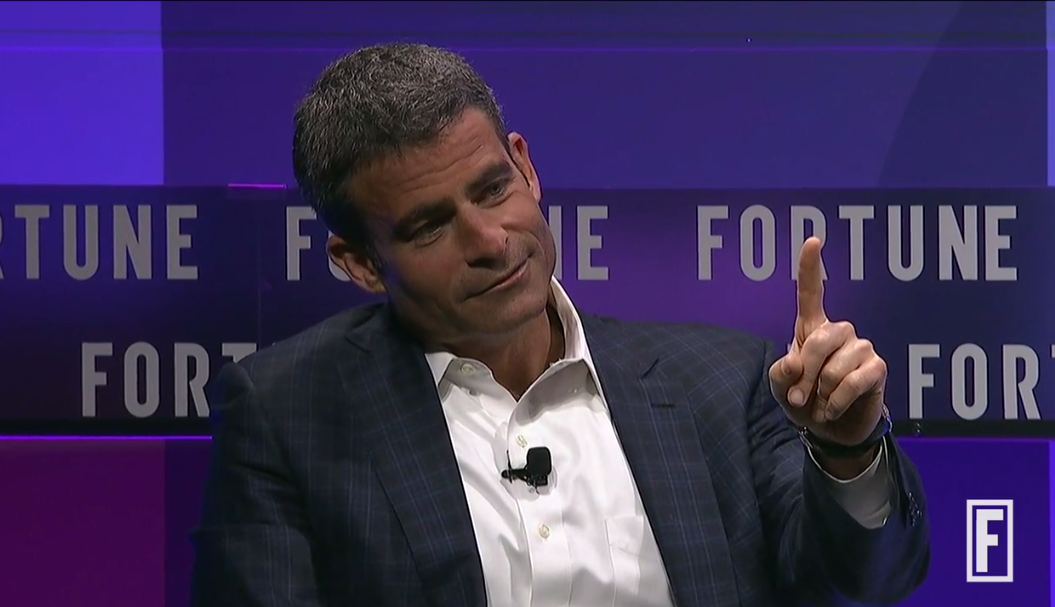
Fortune reports: This Banking CEO Swears by Meditation. Barry Sommers (J.P. Morgan) has been doing Transcendental Meditation twice a day for the last ten years. He says he saw major positive changes in a longtime friend and colleague. Sommers then learned about TM from Bob Roth, CEO of the David Lynch Foundation. Watch this dynamic video clip from Fortune’s second annual Brainstorm Health conference, moderated by Arianna Huffington. It’s embedded in this Fortune article: Why America’s Top Bosses Love Sleep and Meditation, part of which is excerpted here:

CEO Barry Sommers speaks on TM at Fortune's 2nd annual Brainstorm Health conference

CEO Barry Sommers praises TM at Fortune’s Brainstorm Health conference

Some corners of corporate America have long had a culture that wears its long and grueling hours like a badge of honor. Now a group of executives is trying to change that by opening up about how they each found balance in their own lives and by making wellness a priority at their companies.

“I’ve found in a culture like Wall Street, people are obsessed with how many hours people work,” said Barry Sommers, CEO of Wealth Management at J.P. Morgan Chase, during Fortune’s second annual Brainstorm Health conference in San Diego on Tuesday. “Way too many people are getting out of there as fast as they can because they’re totally burnt out.”

Sommers decided to take his health into his own hands a decade ago after someone he’d known personally and professionally for 30 years started doing Transcendental Meditation. “It transformed this person’s life,” he said. “I saw a different person.”

Sommers has now been doing Transcendental Meditation 20 minutes two times a day for a decade. And he prioritizes sleep, getting seven and half to eight hours every night. “I changed my schedule and lifestyle,” he said. “When I do a dinner, we’ll be at the restaurant at 5pm, not at 8pm.” He said his kids make fun of it, but he wakes up every morning “incredibly happy.” If there’s a problem at the office, his employees know to call the house and his wife will wake him up. But rarely is there anything so important that it can’t wait until the morning, he said.

“This goes completely against mainstream assumption that J.P. Morgan is the boiler room of burnout,” said Arianna Huffington, the founder and CEO of Thrive Global, who moderated the panel.

Forbes, France also covered this topic: Transcendental Meditation: The Secret Weapon of Leaders, which includes this embedded video of Ken Gunsberger, from the Center for Leadership Performance.

Ken Gunsberger, VP, UBS Wealth Management in New York .png

Ken Gunsberger, VP, UBS Wealth Management New York, doing his TM

Writer Catherine Nivez interviewed Wall Street investor and TM meditator Ken Gunsberger who refers to TM as “Low investment, High return.” Vice President of UBS Wealth Management in New York, Kenneth Gunsberger manages his clients’ fortunes, market competition and professional stress. Leonard Stein, TM Teacher representing DLF in Geneva, is also quoted extensively in this excellent article.

In the video, Ken expresses a concern to his NY TM instructor: “How am I gonna know when I’m “in the zone” when I’m meditating? The reply he was given: “You’re not. The goal is to not be in the zone when you’re meditating. The goal is to be in the zone when you’re done. When you’re in that meeting at work. When you’re with your kids. When you’re with your spouse. That’s when you wanna be in the zone.”

Ken adds: “And because of the TM it has enabled me to do a much better job all across the board.” Ken said TM “literally changed my life.” After meditating only two and a half months his business increased; he had the best month in twenty-five years. Even his relationship with his daughter improved. He sums up the results of his TM practice this way: “Better choices. Better allocation of energy. Better results.”

Click on the link to watch to the rest of the video. Click the title to read the article. If you don’t understand French, use Google Translate. It’s worth the effort.

Business Insider has written before about TM in Business. Recently, Richard Feloni wrote a comprehensive report: Transcendental Meditation, which Bridgewater’s Ray Dalio calls ‘the single biggest influence’ on his life, is taking over Wall Street. It was republished in many places, including SFGATE. Here is an excerpt:

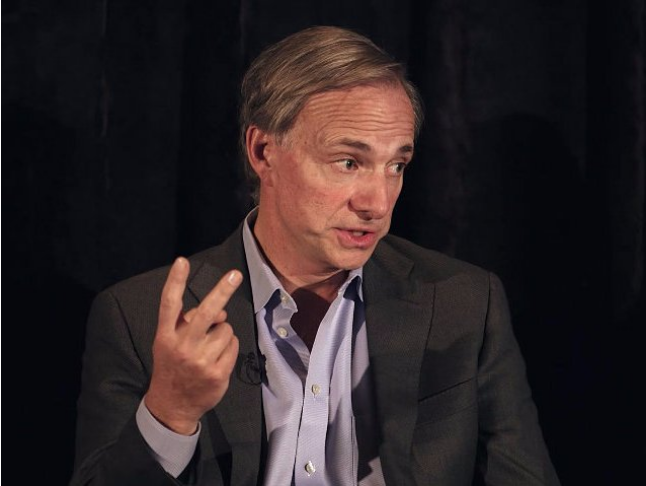
Ray Dalio, Founder, Bridgewater Associates, world's largest hedge fund

Ray Dalio, Founder, Bridgewater Associates, world’s largest hedge fund

Around eight years ago, Bridgewater Associates founder Ray Dalio introduced Transcendental Meditation to his then—735 employees.

Dalio had already established a unique, intense culture at Bridgewater that he likes to say is akin to being part of an ” intellectual Navy SEALs ,” and he believed that Transcendental Meditation (TM) would work as an effective counterbalance.

“I did it because it’s the greatest gift I could give anyone—it brings about equanimity, creativity and peace,” Dalio told me via email.

Since then, TM has popped into the mainstream, and over the last three years, the David Lynch Foundation TM center has taught almost 2,500 professionals, with roughly 55% of those from Wall Street, and 1,150 of those in 2016 alone.

Read the rest of this fabulous article—Transcendental Meditation, which Bridgewater’s Ray Dalio calls ‘the single biggest influence’ on his life, is taking over Wall Street—one of the best yet, and other TM articles archived on their website.

Note: I gave Jochen Uebel permission to translate this post into German: Prominente Business-Zeitschriften berichten über Transzendentale Meditation (Prominent business magazines report on Transcendental Meditation).

Growth, a spontaneous haiku/tanka @kenchawkin

April 11, 2017

Here’s a little poem that came about as I was waking up on a Saturday morning, April 1, 2017. Around 7:15 a.m. CT, I reached for my journal and started writing it down. It took about 3 minutes. I had been thinking about life and how we all go through a series of lessons, a process of self-realization, whether we know it or not, and this poem started forming itself in my mind, first as a haiku, and then extended to a tanka.

Growth
A spontaneous haiku/tanka

Whatever happens
to and by you is also
happening for you

Everything is a lesson
for you to learn and grow from

© Ken Chawkin

Related: Growth Haiku written by @kenchawkin and his son Nathanael Chawkin @integralsensei.

Celebrating Poetry Month with one of my poems, Poetry—The Art of the Voice, and what inspired it

April 10, 2017

Since 1996, the Academy of American Poets have designated April as National Poetry Month as a way to increase awareness and appreciation of poetry in the United States. Since 1998, National Poetry Month has also been celebrated each April in Canada. Being a Canadian living in the United States, I have 2 reasons to celebrate it with a poem I wrote on the subject 17.5 years ago. I’d also like to share what inspired me to write it.

One morning, while recuperating from a cold in my room, I had been listening to the Diane Rehm Show. At the end she announced her guest for the next day, Bill Moyers, who would talk about his latest poetry project. I tuned in and recorded it on Tues, Oct 05, 1999, 10-11 a.m. ET.

In that episode of the show, Moyers discussed his upcoming PBS poetry special: Fooling with Words with Bill Moyers, the result of a visit to the Dodge Poetry Festival, which featured readings by US Poet Laureate Robert Pinsky and other leading poets. He also mentioned his accompanying book, Fooling With Words: A Celebration of Poets and Their Craft (William Morrow). You can actually see Part One and Part Two of Fooling With Words, produced by and archived at Moyers & Company.

Moyers mentioned that television lends itself well to the human voice reading poetry. He said, “Poetry is music for the human voice,” but what really made an impression on him was watching “people listening to poetry.” His cameras focused in on both the poets reading their poems, and members of the audience listening attentively.

What Bill Moyers said about this dynamic caught my attention: “Poetry is reflected in the face of the listener, in the eyes, and in the intensity of the listener’s response. It’s like a mirror to the poet’s own face. And you watch those faces and you really see that poetry is sinking in, and meeting an audience in that individual listener.”

Diane and Bill then invited 3 poets on the show to read a poem and explain how they came to write it: Marge Piercy, Mark Strand (16:44), and Jane Hirshfield (32:57). After listening to the ideas and images expressed in the conversations and poems, I was so inspired that I wrote a poem about it called: Poetry—The Art of the Voice.

Poetry—The Art of the Voice

How fine will your breath become
from listening to these words?
How soft will they seem to be
as they settle through the mind
like silent snowflakes falling
from a windless winter sky?

I often marvel at the mystery—
how words can work
on a listener’s heart and mind,
upon hearing a poet’s thoughts,
a poet’s breath, flowing
from an inner voice—

a windless wind, speaking
through a voiceless voice.

© Ken Chawkin

Years later, when Freddy Fonseca put out a call for poems from Fairfield poets for This Enduring Gift-A Flowering of Fairfield Poetry (2010), I sent it in along with some other poems.  At Freddy’s suggestion I changed one word, which caused me to refine it even more, taking it to the intended level. He published it, five haiku, and a tanka, and later selected it as POEM OF THE DAY: Poetry – The Art of the Voice, by Ken Chawkin.

Over the years, Bill Moyers has welcomed some of America’s best poets to share their works and inspiration. Many of those writers have performed at the Geraldine R. Dodge Poetry Festival, which Bill and his colleagues covered for television specials including Fooling with Words (1999), The Language of Life (1995) and Sounds of Poetry (1999). Enjoy Poets in Performance, a showcase of such poetry from past and recent productions from Moyers & Company, performed by the poets who dreamed them up, or by other artists who, like Bill, simply adore poetry.

Another poem I wrote at that time was Thinking of You Today. It was inspired by reading Jorie Graham’s poem, Salmon (PDF), included in The New Yorker article about her. The spirit of beauty in that poem touched me and I had to write one too. It came out in one take, not a word changed.

— Written and compiled (citing sources) by Ken Chawkin for The Uncarved Blog.
Follow-up study suggests large advanced TM groups reduced murder rates in large US cities

March 30, 2017

Large groups practicing the advanced Transcendental Meditation program were associated with significant reductions in murder rates in US urban areas during the period 2007–2010

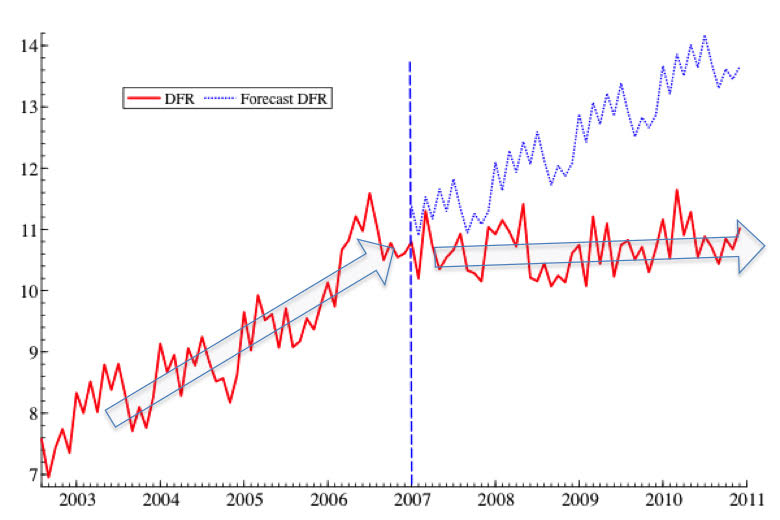
A follow-up study in the Journal of Health and Environmental Research examines a novel proposed approach to help reduce murder rates in large US urban areas. In a prospective social experiment from 2007 to 2010, practice of the Transcendental Meditation® and TM-Sidhi® program by a large group at Maharishi University of Management in Iowa was associated with a 28.4% reduction in murder rates in 206 US urban areas, preventing an estimated 4,136 deaths.

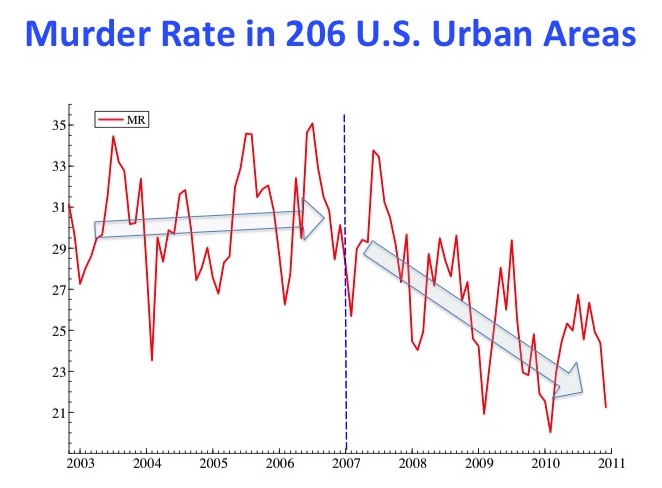
JHER 2017 Fig 1. Reduced Murder Rate in 206 Urban Areas

A slightly rising trend in the urban murder rate during the baseline was reversed significantly when the Transcendental Meditation and TM-Sidhi group exceeded 1,725 participants in January 2007 (vertical dashed line).

Follow-up study suggests group meditation reduced murder rates in large US cities

Following up on a 2016 study on group meditation that found a 21.2% reduction in the national homicide rate during the period 2007–2010, a new study focusing on 206 large US urban areas found an even greater decrease of 28.4% in the murder rate. In both studies, the reductions during the period 2007–2010 were in comparison to the baseline period 2002–2006.

In their study, published in the Journal of Health and Environmental Research, the authors suggest that these results are consistent with the hypothesis that a sufficiently large group practicing the Transcendental Meditation® technique and its advanced program, the TM-Sidhi® program would lead to reduced societal stress, as reflected in reduced rates of murder and violence. This group practice is said to create a positive effect in the environment due to a hypothesized “field effect of consciousness.”

During 2007–2010, the size of the TM-Sidhi group located at Maharishi University of Management in Fairfield, Iowa, was above or near 1,725 participants, the size predicted to have a positive influence on the US quality of life. This predicted threshold represents the square root of 1% of the US population at that time.

“In view of the recent increases in murder rates in large US cities, the results of this prospective social experiment should be of particular interest to government policy makers seeking an effective method of reducing urban violence,” said lead author Dr. Kenneth Cavanaugh.

“This study and 17 other peer-reviewed studies suggest that one’s individual consciousness is directly connected to an underlying, universal field of consciousness, and that by collectively enlivening that universal field through the Transcendental Meditation technique, such a group can have a positive effect on the quality of life in society,” added coauthor Dr. Michael Dillbeck.

28.4% reduction compared to previous four-year period

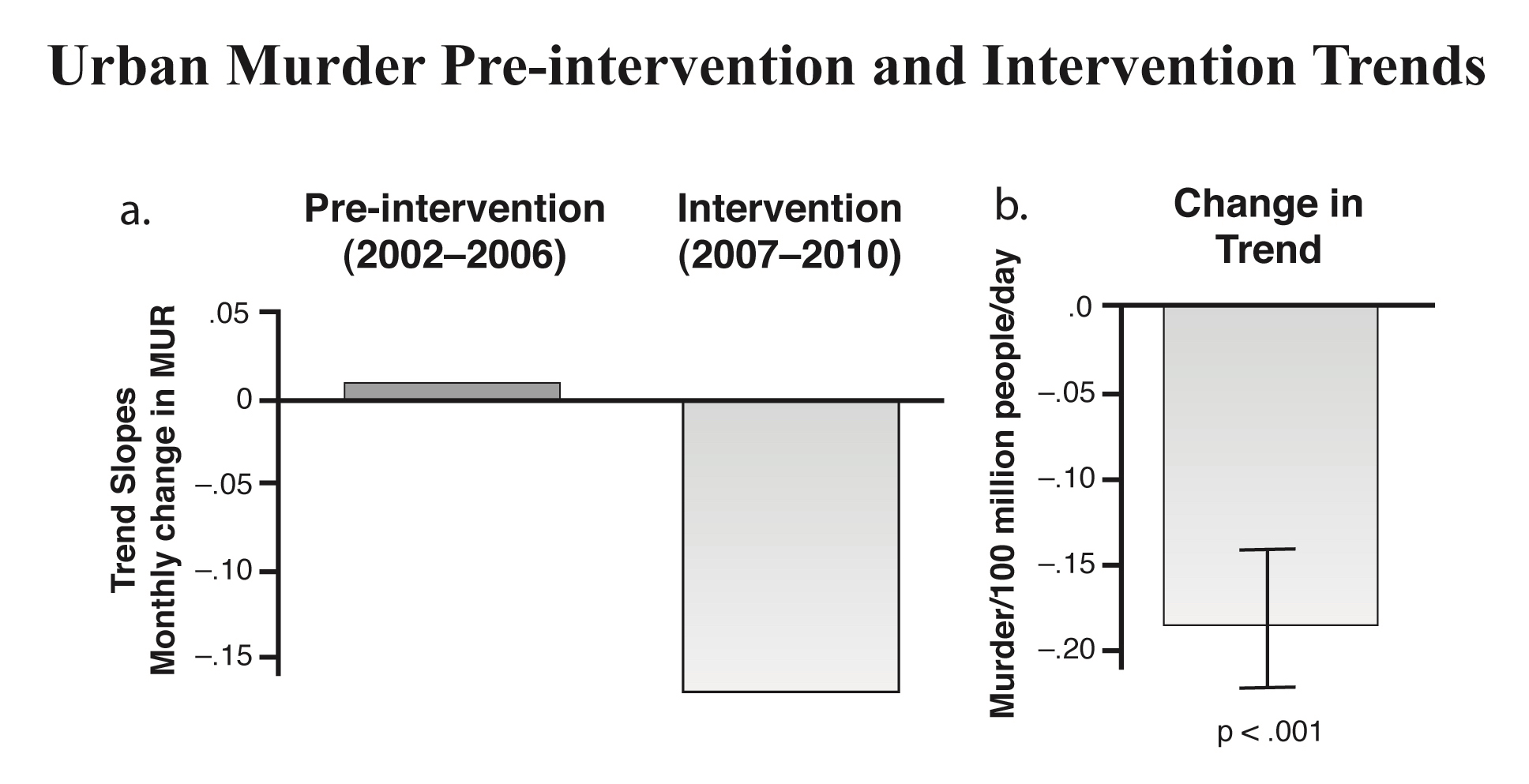
The study found that a slightly increasing trend in murder rate during the baseline period 2002 to 2006 shifted significantly to a declining trend during the four-year period 2007 through 2010. As a result, the urban murder rate was reduced 28.4% relative to the 2002–2006 average. The researchers estimated 4,136 murders in the 206 cities were averted by the significantly reduced trend in murder rates.

They calculated that the probability that the reduced trend in murder rates could simply be due to chance was 1 in 10 million million.

Rising murder rates cause concern

Despite long-term declines in US murder and other violent crime rates from their peak in the early 1990s, recent increases in these rates have led to heightened concern among policy makers and the general public.

Beginning at historically low levels not experienced since the early 1960s, the national murder rate (murder and non-negligent manslaughter) increased 10.8% in 2015, the largest increase in 25 years. Ten large cities with an average population of about one million experienced a disproportionately large surge in homicides during 2015. Preliminary data indicate that continued increases in national murder rates in 2016 were also being driven by a handful of large US cities.

“The 2015–2016 increase in US murder and violent crime rates, especially in urban areas, highlights the need to consider new, alternative approaches to reducing violence that might help address this important national issue,” said Dr. Dillbeck.

Using time series analysis to compare trends

The researchers first calculated a baseline trend for monthly murder rates during 2002–2006 for all 206 urban areas over 100,000 population for which uninterrupted FBI data were available. They then used time series intervention analysis to compare that baseline with the corresponding trend for the intervention period 2007–2010.

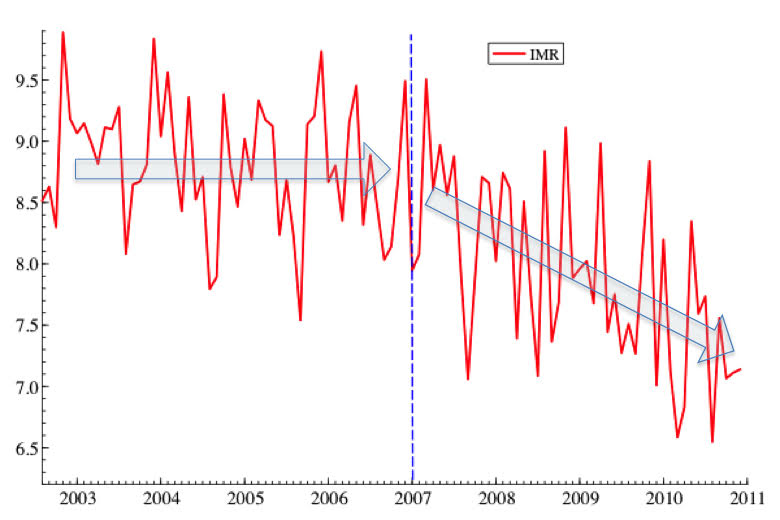
A slightly rising trend in the urban murder rate (see Figures 1 and 2) during the baseline was reversed significantly when the Transcendental Meditation and TM-Sidhi group exceeded 1,725 participants beginning in January 2007 (vertical dashed line in Figure 1). This declining trend continued through 2010. (The irregular ups and downs of the murder rate shown in Figure 1 are largely due to seasonal fluctuations around the trend.)

G25. Urban murder bw

This chart shows the slightly rising trend in the urban murder rate 2002-2006 (left bar), the declining trend 2007-2010 (middle bar), and the highly significant change in trend (right bar).

A hypothesized “field effect of consciousness”

The Transcendental Meditation technique is said to allow the mind to settle down to quieter states and ultimately experience “pure consciousness” or “pure awareness,” in which the mind is aware but without an object of thought. EEG research and subjective reports suggest the existence of this unique state. Research has found that experience of this state results in benefits such as reduced stress and increased brain integration.

According to Dr. Cavanaugh, “The basis for the hypothesized effect on society is that consciousness in its pure form, pure consciousness, has a field-like character and is a universal field at the basis of everyone’s thought and behavior. When the participants in a group equal to or exceeding the square root of one percent of the entire population are experiencing pure consciousness during group practice of the Transcendental Meditation and TM-Sidhi program, the field of pure consciousness is enlivened in the entire population. This will positively influence all others in society, leading to development in the same holistic direction as experienced by individuals practicing the Transcendental Meditation technique.”

Reduction not explainable by factors such as policing

The authors noted that reductions in the trends of murder rates occurred at the predicted time and in the predicted direction, and this reduction could not be predicted from baseline trends or seasonal cycles.

The researchers also were able to rule out other alternative explanations. The reduction in murder rates could not be explained by such factors as unemployment and national economic conditions, changes in incarceration rates, police strategy and police technology, urban demographics, police reporting standards, or temperature changes. And for the first time in a major economic downturn since 1945, the murder and violent crime rates failed to rise during the severe recession of December 2007 to June 2009.

The authors point out that the study’s findings are especially noteworthy because these 206 large urban areas pose a particularly difficult challenge to any proposed initiative to help reduce urban rates of murder and violence. These cities experience higher poverty rates, lower educational levels, higher unemployment, greater social instability, and other predictors of higher rates of violent crime than the rest of the US.

A total of eighteen peer-reviewed articles have now been published validating the prediction by Maharishi Mahesh Yogi, the founder of the Transcendental Meditation program, that a TM-Sidhi group of this size would lead to reduced societal stress, as reflected in reduced crime, violence, accidents, illness, and increased positive trends in society.

Fourth study in a series

The study, titled “Field Effects of Consciousness and Reduction in US Urban Murder Rates: Evaluation of a Prospective, Quasi-Experiment,” was published in the Journal of Health and Environmental Research, March 2017.

This article is the fourth in a series that comprehensively evaluates the impact of the Transcendental Meditation and TM-Sidhi group on the US quality of life and public health.

The first in the series, published in 2016 in SAGE Open journal, reported a highly significant 21.2% reduction in the US national homicide rate during the same 2007–2010 period, resulting in the prevention of an estimated 8,157 homicides. A reduction of 18.5% in violent crime rates in 206 urban areas was also found, thus averting an estimated 186,774 violent crimes.

The second article in the series, published in the January/February 2017 issue of the Journal of Consciousness Studies, found a highly significant reduction of 20.6% in the rate of US motor vehicle fatalities and 13.5% in the rate of all other accidental fatalities during the same experimental period. The study estimates that 19,435 motor vehicle fatalities and 16,759 other accidental deaths were averted by the significantly reduced trends in fatality rates.

The third in the series, published in the March 2017 issue of SAGE Open, found a highly significant reduction of 30.4% in the US drug-related death rate and 12.5% in the rate of infant mortality. The researchers estimate that 26,425 drug-related fatalities and 992 infant deaths were averted by the significantly reduced trends in fatality rates.

In view of these findings, the authors invite governments to implement and evaluate this scientifically validated approach to reducing violence and other negative trends in society.

###

Field Effects of Consciousness and Reduction in US Urban Murder Rates: Evaluation of a Prospective, Quasi-Experiment. Kenneth L. Cavanaugh and Michael C. Dillbeck, Institute of Science, Technology, and Public Policy, Maharishi University of Management, Fairfield, Iowa. DOI: 10.11648/j.jher.s.2017030301.13 (PDF)

Source: EurekAlert/AAAS

Four-year study finds large advanced Transcendental Meditation group reduces drug-related deaths nationally

March 14, 2017

Large groups practicing the advanced Transcendental Meditation program were associated with significant reductions in rates of drug-related death and infant mortality during the period 2007–2010

A new study in SAGE Open reports a novel solution to US fatality rates from the misuse of prescribed and illegal drugs. In a prospective social experiment from 2007 to 2010, practice of the Transcendental Meditation® and TM-Sidhi® program by a large group at Maharishi University of Management in Iowa was associated with a 30.4% reduction in the rate of growth of US drug-related fatalities, preventing an estimated 26,425 deaths.

drug-deaths

A rapidly rising trend in the drug-related fatality rate during the baseline period leveled out significantly when the Transcendental Meditation and TM-Sidhi group exceeded 1,725 participants beginning in January 2007 (vertical line).

Four-year study finds group meditation reduces drug-related deaths in general population

The rate of US drug-related fatalities fell 30.4% nationwide from 2007 to 2010 due to the reductions in societal stress and increased alertness in the individuals in society created by a large group practicing the Transcendental Meditation® technique and its advanced program, the TM-Sidhi® program, a new study shows.

The hypothesis: the reduction comes not from drug abusers using meditation to get off drugs, but from a TM-Sidhi group large enough to create an effect in the environment due to a hypothesized “field effect of consciousness.”

“It’s a bold claim,” said lead author Michael Dillbeck, “but there are now 14 peer-reviewed published studies that suggest that one’s individual consciousness is directly connected to an underlying, universal field of consciousness, and that by collectively tapping into that universal field through Transcendental Meditation, we can have a positive effect on the environment.”

26,425 drug-related fatalities averted

The surge in drug-related deaths began in 1990, fueled by skyrocketing rates of drug overdose, largely from prescription painkillers and anxiety drugs. Drug deaths exceeded motor vehicle accidents as a cause of death in 2009, killing more than 37,000 people a year nationwide.

The study found that during the four-year period 2007 through 2010 this upward trend in the rate of drug-related deaths was interrupted by a highly significant shift to a greatly reduced, flatter trend. As a result, the drug-related fatality rate was reduced 30.4% relative to the 2002-2006 baseline average. The researchers estimated that 26,425 drug-related fatalities were averted by the significantly reduced trend in fatality rates.

The probability that the reduced trend in rates of drug-related fatalities could simply be due to chance was reported to be 3.1 in 10 billion.

During 2007–2010, the size of the TM-Sidhi group located at Maharishi University of Management in Fairfield, Iowa, was above or near 1,725 participants, the size predicted to have a positive influence on the US quality of life. This predicted threshold represents the square root of 1% of the US population.

Time series analysis shows a reduction

The researchers first calculated a baseline trend for monthly fatality rates during 2002–2006, and then used time series intervention analysis to compare that baseline with the corresponding trend for the intervention period 2007–2010. A rapidly rising trend in the drug-related fatality rate (see Figure 1) during the baseline period leveled out and slowed significantly when the Transcendental Meditation and TM-Sidhi group exceeded 1,725 participants beginning in January 2007 (vertical dashed line). This flatter trend continued through 2010. (The irregular ups and downs of the fatality rate shown in the graph are largely due to seasonal fluctuations around the trend.)

Change produced by enlivening “field of pure consciousness”

How could this change in society be produced by the meditation practice of participants in the Transcendental Meditation and TM-Sidhi group? Published research has shown that Transcendental Meditation creates a state of restful alertness, increases brain integration, reduces individual stress, and enables greater use of one’s inner potential.

“These benefits are the natural by-product of the experience during Transcendental Meditation practice of a silent, wakeful state of the mind known as ‘pure consciousness’,” Dr. Dillbeck said.

According to coauthor Kenneth Cavanaugh, the basis for the effect on society is that pure consciousness has a field-like character and is a universal field at the basis of everyone’s thought and behavior. When the participants in a group equal to or exceeding the square root of one percent of the entire population are experiencing pure consciousness during group practice of the Transcendental Meditation and TM-Sidhi program, the field of pure consciousness is enlivened in the entire population.

“This field effect positively influences the quality of consciousness in the individuals in society in much the same direction as that experienced by those practicing the Transcendental Meditation technique,” Dr. Cavanaugh said. “It’s as if the non-meditating populace experienced the same benefits of those meditating.”

Reduces social stress

This research tests the hypothesis that practice of the Transcendental Meditation and TM-Sidhi program by a group of sufficient size will result in reduced stress and increased alertness in the individuals in society, thus contributing to reduced trends of these two stress-related public health indicators.

“Chronic stress contributes to increased likelihood of illness as well as to the use and abuse of illicit and prescribed drugs,” Dr. Dillbeck said. “Stress can reduce the degree of conscious alertness and vigilance necessary to avoid drug misuse, especially highly potent and potentially addictive narcotic painkillers.”

Alternative explanations ruled out

The authors noted that reductions in the trends of both fatality rates occurred at the predicted time and in the predicted direction, and neither reduction could be predicted from baseline trends or seasonal cycles. The researchers also were able to rule out other alternative explanations. For example, the reduction in drug-related death rates could not be explained by such factors as unemployment and national economic conditions, increased public and professional medical awareness of the hazards of opioid painkillers, and sales of such painkillers.

Reduction in infant mortality

infant-deaths

With the onset of the intervention period in January 2007 (vertical line), the infant mortality rate significantly shifted from a flat to a declining trend.

This study of stress-related public health indicators also found that during the same period the rate of infant mortality was reduced by 12.5%. The researchers found a highly significant shift from a flat or slightly declining trend in 2002–2006 to a substantially faster declining trend in 2007–2010. An estimated 992 infant deaths were averted. The probability that the reduced trend in rates of drug-related fatalities could simply be due to chance was reported to be less than 2.1 in 100,000.

Third study in a series

The study, titled “Group practice of the Transcendental Meditation and TM-Sidhi program and reductions in infant mortality and drug-related death: A quasi-experimental analysis” was published in the social science journal SAGE Open, Mar 2017, 7(1).

This article is the third in a series that comprehensively evaluates the impact of the Transcendental Meditation and TM-Sidhi group on US quality of life and public health. The first in the series, published in 2016 in SAGE Open journal, reported a highly significant 21.2% reduction in US homicide rates during the same 2007-2010 period, resulting in the prevention of an estimated 8,157 homicides. A reduction of 18.5% in violent crime rates in 206 urban areas was also found, thus averting an estimated 186,774 violent crimes.

The second article in the series, published in the January/February 2017 issue of the Journal of Consciousness Studies, found a highly significant reduction of 20.6% in the rate of US motor vehicle fatalities and 13.5% in the rate of all other accidental fatalities during the same experimental period. The study estimates that 19,435 motor vehicle fatalities and 16,759 other accidental deaths were averted by the significantly reduced trends in fatality rates.

A total of fourteen peer-reviewed articles have now been published validating the prediction by Maharishi Mahesh Yogi, the Founder of the Transcendental Meditation program, that a TM-Sidhi group of this size would lead to reduced societal stress, as reflected in reduced crime, violence, accidents, illness, and increased positive trends in society.

The authors call for governments to implement and evaluate this approach as the natural next action step.

###

Group practice of the Transcendental Meditation and TM-Sidhi program and reductions in infant mortality and drug-related death: A quasi-experimental analysis. Michael C. Dillbeck and Kenneth L. Cavanaugh, Institute of Science, Technology, and Public Policy, Maharishi University of Management. DOI: 10.1177/2158244017697164 (PDF)

Source: EurekAlert/AAAS

See the first study in this series: Can group meditation prevent violent crime? Surprisingly, the data suggests yes: New study.

The film Arrival asks: If you could see your whole life from start to finish, would you change things?

March 12, 2017

The main question posed in the 2016 sci fi film Arrival is, If you could see your whole life from start to finish, would you change things?

Arrival (2106)

When mysterious spacecraft touch down across the globe, Colonel Weber (Forest Whitaker) recruits Dr. Louise Banks (Amy Adams), a renowned linguist, and Dr. Ian Donnelly (Jeremy Renner), a theoretical physicist, to try and communicate with the Aliens and find out why they have landed on Earth. Dr. Banks races against time to decipher their intent. As tensions mount between fearful governments, she discovers the Aliens’ true purpose and, to avert global war, takes a chance that could threaten her life, and quite possibly humanity. This mesmerizing masterpiece has a mind-blowing ending that will leave you wondering what happened and how.

That’s the external story, but the essential message of this movie is more internal. It’s about love, determinism and choice.

Based on the award-winning science fiction novella, Story of Your Life, by Ted Chiang, it was convincingly transformed into a screenplay by Eric Heisserrer. Having read the book and been moved by it, director Denis Villeneuve wondered how it could be turned into a science fiction film, a genre he had been thinking about for years. When he received the script he decided he finally had to make this film, but with Amy Adams in the lead as Dr. Louise Banks. Even though she was taking a break from filmmaking, after reading the script, she was in. Everyone involved with making the film read the book and loved the story.

In the opening scenes we learn that Professor Louise Banks is losing her daughter Hannah to a rare disease. As a child, Hannah asks her mother how she chose her name. Louise tells her she has a special name, because it is a palindrome. It’s spelled and read the same way, forwards and backwards.

This is a clue that may help you make sense of certain events in the film that appear as flashbacks. Or are they flashforwards? Yet, in retrospect, it’s not the beginnings and endings that are important to Louise, but how she lived her life, the choice she made to love, regardless of the outcome.

Watching this movie was a right-brain experience; it’s non-linear. Dr. Banks goes through changes as she learns the Alien language. Their images communicate ideas in circles without reference to tense or time. Comprehending their language transforms Louise’s brain. She begins to experience the events in her life from a less sequential, more holistic perspective.

This is reality parsed and put together from a female perspective. She is the only one who can save the situation when she finally understands why the Aliens are here. The other challenge now is communicating it to a male-dominated world intent on destroying itself. This Chinese quote is another important clue: “In war there are no winners, only widows.”

Towards the end of the film, having collaborated with and seen how brilliant, brave, and compassionate Louise has been throughout their encounter with the Aliens, and the Army, Ian realizes he’s fallen in love with her. As much as he was amazed by his encounters with the Aliens, his “greatest surprise” he tells her, “is you.”

To love is human. It takes us out of our time, because Love Is Eternal. It always Is. We participate in It. If we are lucky enough. I wrote this as a comment to my son who purchased the film and sent me the link. I couldn’t help turning it into a tanka.

After watching “Arrival” (2016)

To love is human
It takes us out of our time
Love Is Eternal

We participate in It
If we are lucky enough

© Ken Chawkin
Mon Apr 6, 2017
Fairfield, Iowa

You should see this film twice to better understand and appreciate it. Below is the trailer, followed by the Featurette on the DVD Extras.

This DVD Featurette gives you a perspective of what went into the making of the film: Arrival (2016) | Behind the Scenes | Understanding Arrival | Full Extras | Full HD.

Binge Society later posted Arrival (2016): First 10 Minutes | Opening Scene. They wrote: “This suspenseful introduction sets the stage for one of the most thought-provoking science fiction films of the decade. Watch now and discover why Arrival is a must-see for fans of alien encounters, first contact stories, and mind-bending narratives.” You can rent or buy Arrival on Prime Video/Paramount+. After seeing the movie twice, this article and these videos will help you make better sense of it all.

Nick Statt wrote a great article for The Verge on living with the power of choice: How the short story that inspired Arrival helps us interpret the film’s major twist. ScreenPrism offers an intelligent explanation of the ending of this film. ChewingSand shares good insights in this video: Why ARRIVAL is Great Sci-Fi. See Logos Made Flesh: Arrival Explained, FilmComicsExplained: ARRIVAL (2016) Ending + Creature EXPLAINED, and Heavy Spoilers: ARRIVAL Breakdown | Ending Explained, Easter Eggs, Hidden Details & Things You Missed. Sendarya posted this Feb 16, 2024: Arrival || FULLY DECODED || Deep Dive and Analysis, which looks at everything from sounds design to thematic framing to find the answers. See The Director’s Cut by Jilloms: Denis Villeneuve on How He Directed Arrival. Many more explanations and reviews are available on YouTube.

See a fun, informative post-screening SAG-AFTRA Foundation interview: Conversations with Amy Adams and Denis Villeneuve of ARRIVAL.

Links to the beautiful Arrival Soundtrack – On The Nature Of Daylight by Max Richter and Jóhann Jóhannsson – Heptapod B [From “Arrival” Soundtrack / Pseudo Video].

Wikipedia gives a comprehensive review/explanation of the film, which might include some spoilers if you haven’t already seen it yet.

Also see these favorite romantic films of mine. They reveal the transformational power of love over time.

 — Written and compiled (citing sources) by Ken Chawkin for The Uncarved Blog.
Haiku for Her, a new poem for Sali, @kenchawkin

March 12, 2017

I was reading this two-tanka poem again, Sali’s Shakti, and realized it was mostly written on March 12, 2012, five years ago today. Synchronicity? It was completed and posted the next day, March 13. Even though she passed Oct 1, 2016, Sali still inspires me. I miss her, but This Quiet Love we shared doesn’t diminish. Here is a new poem for Sali:

Haiku for Her

You gave me a taste
Of true Love and Unity
For Eternity

© Ken Chawkin
March 12, 2017
Fairfield, Iowa, USA

Though my mother died 31 years ago, March 12 this year is also the 100th anniversary of her birth. Another coincidence? A good day to remember two very special women in my life.

Update: March 13, 2017: I had a hunch I would add something the next day, as I did on the earlier post about Sali referenced above. See For Us—a tanka honoring Sali and what we shared.

Last night the older of my two younger sisters emailed to say she was made a TM Teacher on March 12, 1972. All 3 of use were in Europe with Maharishi on our Teacher Training Course. But the strangest coincidence dawned on me this morning. Both Sali and my mother died in their 69th year!!


— Written and compiled (citing sources) by Ken Chawkin for The Uncarved Blog.
Final entries leading up to and after Sali’s passing

March 1, 2017

Here are 4 entries—two leading up to Sali’s passing; a poem describing it, written 7 weeks later from India, 5 days after having spread her ashes in the holy Narmada River; and one poem composed a few days ago in remembrance of Sali, and the gift of love we shared together.

Ahead of the Game
Friday, September 23, 2016

You’ve been practicing for your next journey. With the dementia and a possible stroke that rendered you almost speechless, how can you communicate, except with inaudible sounds, and even those you no longer bother to form or utter.

But you can still smile and giggle, communicating great joy like the angels, with pure feeling and silence, where words are no longer needed or used.

You’ve been practicing for your upcoming journey. You’re way ahead of the game.

###

Not the End Game
Tuesday, September 27, 2016

The nurse called this afternoon to tell me you seemed to stop swallowing. You haven’t been able to eat or drink. The Hospice nurse who knows you started putting things into action to get you back on Hospice care. Will know by tomorrow morning after their evaluation and direction from your doctor.

So it looks like this is it. No more rehearsals. You’re going for the final homerun sliding into heaven. I think we’re better prepared now, having read The Grace in Dying. We have a better understanding and appreciation for the end game, which, as it turns out, will not be the end.

To be continued…..

(Sali would soon pass, on Saturday night, 11:17 pm CT, Oct 1, 2016, first day of the Nine Days of Mother Divine. Her glorious Memorial Service and blissful Vedic Cremation Ceremony took place on the 5th day, Wed, Oct 5, 2016. See Celebrating the glorious life of Sally M Peden.)

###

Five days after spreading Sali’s ashes from a boat on the Narmada River in India during a most auspicious day, I started to write about our final moments together back in Fairfield when she passed, around 7 weeks earlier, during the first night of the Nine Days of Mother Divine, Navratri. The answer to a question of what had happened came in one word during an evening meditation at the Brahmasthan. It became the title and last line of this poem.

UNDIFFERENTIATED
The Peace that Passeth Understanding

The final feeling
Between us was a Great Peace
Deep within the Heart

All that remained was Silence
After you took your last breath

Where was that Peace coming from
In your heart, mine, or ours
Beyond my comprehension

UNDIFFERENTIATED

©Ken Chawkin
Nov 19, 2016
Bijouri Campus
Brahmasthan of India

Contained within An early attempt at some kind of closure with a poem on Sali’s passing and auspicious times. Included are some of the inspiring tributes to Sali we shared during her Memorial Service and Vedic Cremation Ceremony on that very special send-off.

###

The Rare Gift of Love
A Tanka in Remembrance of Sali

Your heart opened up
Time and illness tempered you
Then, the Surrender

What we shared was glorious
A Gift from God and Guru

©Ken Chawkin
February 27, 2017
Fairfield, Iowa

###

Updated March 22, 2017: On March 12th, I wrote a new poem for Sali, Haiku for Her. Five years earlier, on the same day, I had written the two-tanka poem, Sali’s Shakti.

On June 30, 2017, nine months after her passing, I posted this piece with photos: For Us—a tanka honoring Sali and what we shared.

On August 31, 2017, I posted, ‘In Our Loving Eyes’ a poem by @kenchawkin remembering a special love with Sally Peden.

Added June 28, 2019: Poem for Sali—An Undying Love—heals the heart.

— Written and compiled (citing sources) by Ken Chawkin for The Uncarved Blog.
Dr. Edwards Smith on #TranscendentalMeditation Health and Social Policy @CommonGoodVT #video

February 26, 2017

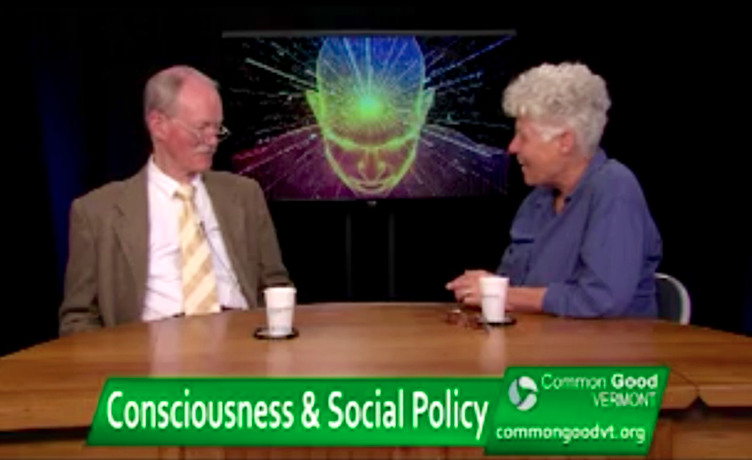
Lauren-Glenn Davitian, host of Common Good Vermont, interviews Edwards Smith M.D. about the impact of Transcendental Meditation on individual and social health. Lauren prefaces the interview by saying, “We’re going to talk about Transcendental Meditation and consciousness as a way of improving the well-being of our community and as a social policy tool.”

edwards-smith-m-d-on-common-good-vt

Edwards Smith M.D. is a western and AyurVedic doctor and leading practitioner of Transcendental Meditation as a practice for personal resilience and community well-being. Dr. Smith served in active duty with the US Army Medical Corps, taught at Maharishi University of Management, ran the Maharishi College of Vedic Medicine in Albuquerque, and is widely published on subjects ranging from pharmacology and rheumatology to Transcendental Meditation. Based on his experience with war veterans and community indicators of well-being, he believes that TM and TM-Sidhi programs are human resource-based technologies that offer immense potential for the health care system of any country.

This excellent interview, titled Consciousness and Public Policy, was filmed on February 23, 2017 for Channel 17/Town Meeting TV in Burlington, Vermont. Dr. Smith is very thorough in his explanations of TM research and how it has impacted the health of individual lives and societies as a whole. Click here to watch (25:53).