Interview

Deep Craft : A Conversation with Jane Hirshfield
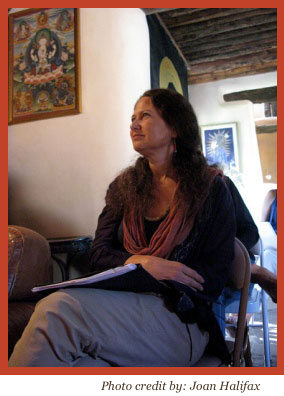 Pirene’s Fountain is privileged to present Jane Hirshfield in this issue, speaking to us both as one of the finest poets writing today and as a mentor and teacher. The idea to offer a craft-oriented interview came about from letters and queries sent by readers looking to enhance their poetry writing, and we thought there would be no better way to begin an ongoing discussion of craft issues in Pirene’s Fountain than to invite the thoughts of a master poet on the subject. In this exchange, rather than concentrate on mechanics, we try to understand some of the rare, indefinable qualities that pulse in a poem and make it real, tangible, and breathing—words capable of charging the imagination for years to come. Ms. Hirshfield shares her insights here in response to questions based on her essays, both a series of recent ones (published in such periodicals as The American Poetry Review and The Associated Writers Programs Chronicle)and those collected in her highly acclaimed book on craft, Nine Gates: Entering the Mind of Poetry (HarperCollins, 1997). Now considered a classic of its kind, Nine Gates has been taught to students of architecture, dance, and the visual arts as well as to writers of both poetry and prose. Works of insight, wisdom and learning, grounded in philosophy, world literature, and ruminations about the essential nature of art, Hirshfield’s essays are meditations on life as well as on poetry. In these explorations of poetic craft, Hirshfield conjures meaning and beauty, revealing how words, in poetry, can come to overspill their own brim, and how poetry reflects and expands upon the most central issues of human life.
With Ami Kaye
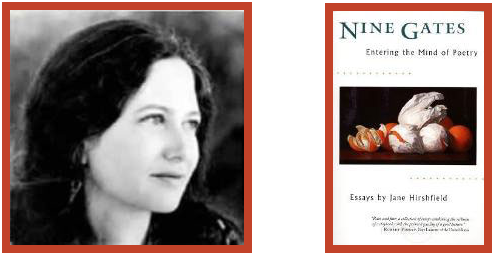
Ami: Jane, it’s an honor to speak with a poet who brings such a rare and deep vision both to poems and to thinking about how poems work. Perhaps we can start right off by talking about the trope of “hiddenness,” the subject of a recent essay that appeared in The AWP Chronicle. Early on, you quote a line from Keats’s “Ode on a Grecian Urn”: “Heard melodies are sweet, but those unheard are sweeter.” You go on to comment, “Many poems hold certain of their thoughts in invisible ink.” Can you please tell us something more about hiddenness and craft?
Jane: I’ve come more and more to believe in the presence and centrality of that invisible ink—or, to use a different metaphor, to believe that there is a set of hidden clockworks beneath the surface of any poem we find ourselves moved by. This is true, paradoxically, even of poems that seem to tell everything outright. A poem may seem naked or plain, but if it moves us, there will always be something else at work, under the surface of its words. This second, undertow life is what differentiates poetry from instruction manuals, journalism, or, for that matter, a diary-type journal. Good poems always travel in more than one direction. They do not soothe us with platitude knowledge, they broaden us with complication, multiplicity, permeability to the subtle, and with unexpected perceptions, gestures of language, and comprehensions.
In addition to this larger scale dimension of hidden energies in poems, there is also a set of particular craft devices that might be described as “invisible ink.” One example is the deliberate choice to leave something out. A poem can convey an emotion or event’s presence by walking around it, revealing its shadow, alluding without naming, pressing back against it. Poems can create meaning in the same ways that mimes create walls, tables, balls, out of thin air and their own responses. This mode of communication falls into the category of what rhetoric calls periphrasis. Think of those Chinese scrolls in which the moon is a circle left uncolored. It is simply the paper, unpainted. That is an act of visual and physical periphrasis—the ink brush touches everything but the moon itself, which is, as in the physical sky, beyond any actual touch or reach.
In more subtle ways, as well, a sense of something present but unspoken makes a poem feel not only richer, more subtle, and more tactful but also more convincingly “true,” because it seems three-dimensional. What has a front, a back, an unseen interior, feels to us real. Yet another example of “invisible ink”: if some emotion or event seems impossible to describe effectively, or perhaps at all, it can still be conveyed by leaping over it, going straight to some aftermath condition. You can describe a storm, or you can describe the wreckage afterward—the boat in a field half a mile inland from shore tells us most everything we need to know of water and wind. What the reader imagines in the absence of words is often more powerful than anything words could evoke, because the reader’s own thoughts, associations, and experience can perfume the poem.
Ami: In the essay “Poetry and Uncertainty,” which first appeared in The American Poetry Review, you allude to Keats again, this time to his idea of “negative capability” ( “…. Negative Capability, that is when man is capable of being in uncertainties, Mysteries, doubts without any irritable reaching after fact & reason.”). The essay goes on to examine that concept in a number of different ways. Can you tell us more about how uncertainty relates to poetry and its making?
Jane: It’s always hard for me to summarize my essays, but the gravitational center of that one is that good poetry always includes not only knowing but also some real measure of not-knowing. Uncertainty is the basic condition of life, a condition that most of the time we try to ignore. Good poems let that essential unknowability into the room, and we are changed—our relationship to our lives is changed—by agreeing to its presence.
I’m in general wary of certainty, which tends to limit not just the imagination but also compassion. We do need to know things of course. Facts exist, and they matter. There are objective truths, at least for the purposes of daily life. Yet our certainties also create fixity and boundary in us, and a surfeit of sureness can lead to rigor mortis of intellect and heart. It’s a poet’s job to be vulnerable, and at risk. The subject haunts my poems as well as the essay, and has been much on my mind in recent years, raised in no small part by the seeming increase of fundamentalist beliefs in the world. Those reified beliefs’ effects seem to me universally disastrous, no matter which ones or whose they are. I am aware of the irony of the seeming certainty with which I say this. But I’ve come to feel that nothing is more dangerous to self and others than a person sure of her or his own rightness. When I find myself adamant, in life or in a poem, I try to catch that tone, and administer a useful antidote—a question. “Is that so? Is it the whole story?” Sometimes I’ll end up letting a statement stand, sometimes I’ll change it, or add to it. The habit of questioning a little further is what matters—it throws open the doors to the new.
The defining gesture of a lyric poem, for me, is that its words create and then preserve, in revisitable form, some act of discovery. This means there must be some point in a poem’s composition when the author cannot really know what he or she is going to say— the already known cannot be discovered. Many poems of course hold re-discoveries, refreshments of discovery. That is no less real. Some realizations or recognitions cannot be made what food producers call “shelf-stable”— they need to be created from scratch each time. The realizations I most care about are like this: they are fragile and evaporative and can only be held aloft as a hot-air balloon or soufflé is, by some active counterforce to the ordinary gravities of complacency, sleepiness, and received comprehension.
To find your way to any discovery requires exceptional attention. The mind and heart and tongue need to be free of shackles if they are to leap. The teaching motto of the Korean Zen teacher Seung Sahnim was “don’t-know mind.” The Japanese Soto Zen teacher Suzuki-roshi famously said, “In the beginner’s mind there are many possibilities, in the expert’s, only one.” Then there was Sartre, who described genius as what we invent in desperate circumstance. That statement points to the necessity for heat—for the passion that causes attention and language to rise beyond their ordinary capacities and satisfactions.
To make a new poem, you need a new person. This moment’s person, with this moment’s needs. Otherwise, you might as well simply read one of the many great poems already written. The only reason to want to write something new is that you need to find something out for yourself, to run the old problem freshly, through your own life, tongue, perceptions, and feelings. Poetry is the antithesis of mathematics. In poetry, the old problems (love, loss, suffering, bewilderment, Wordsworth’s excess of emotion, the ancient conundrums of philosophy and myth and spirit) remain perhaps constant—these things are bedrock in human life. But their solutions need to be re-found each time, and will never be exactly the same as the one found before.
I’ll add one more thing. The expansions of subject matter and style in lyric poetry over the past thousand years or so are a matter of not only new persons but also of new “problems” being let in to the field of the poem. Men, for instance, did not know until quite recently that there were poems to be written about fatherhood and their children— then suddenly we find Galway Kinnell writing a poem about the birth of his son. That kind of discovery also has to do with uncertainty and not knowing. A person has to “not know” what poetry is, what belongs or doesn’t belong in a poem, to bring something new into poetry. Basho had to not know that haiku were only a parlor game and amusement. Gerard Manley Hopkins had to unbind his ears from known metrics and musics. What can be found when expertise is replaced by exploration is breathtaking. But to explore, you need to venture past the edge of the already constructed map, whether physical, conceptual, or emotional.
Ami: This reminds me of something you wrote in one of your earlier essays, “Poetry and the Mind of Indirection,” in Nine Gates. You wrote about attentiveness, craft, and their opposite: “Craft and consciousness matter. But a poet’s attention must also be open to what is not already understood, decided, weighed out. For a poem to be fully alive, the poet needs to surrender the protection of the known and venture into a different relationship with the subject—or is it the object? Both words miss—of her attention. The poet must learn from what dwells outside her conceptions, capacities, and even language: from exile and silence.” Can you please say a little more about how “knowing” and “not-knowing” balance each other in working with craft in making a poem?
Jane: Most of the time, when we talk about craft in poems, we naturally speak of things that are able to be spoken of. We talk about what we know and what we can say. And so we say, “Verbs are stronger blacksmiths of meaning than adjectives are, yet sometimes, the plainest adjective, a color, for instance, can bring enormous expansion to a poem, simply by engaging the senses.” We say, “Each moment of your reader’s granted attention is a gift you must repay with something worthy; every syllable, every comma, must be in the poem for good reason.” We say, “There are at least seven different forms of ‘you,’ and if you change between them mid-poem, the reader must be able to know that has happened, or will be confused.” We say, “Some poems pause to look at something outside their given world; these window-moments bring light and air, volume and contrast, and can be what allows the unbearable to be fully felt.”
These are the kinds of craft points I make when I teach. I teach punctuation as a form of orchestration and musical notation. I teach close reading, rhetoric, transitions. But the opposite of all this, equally important, cannot be taught; it can only be remembered and acknowledged. After a poem is written, something of what has happened outside the writer’s consciousness can sometimes be named. But during the writing, the poet cannot know everything about the poem. In lyric poems, I suspect the poet often enough may not know much of anything. Not what it is about, not where it is going. The poem needs its first draft intoxication, its subversive trickster energies, its whistling in the dark, its unexpected and unfendable off pang of longing. A poem too sure of itself will have no crack for breathable air to enter, and will die for lack of permeability. Poems that are alive will have a life of their own, beyond the control of the writer. The writer’s only task when that life arrives is to get out of its way.
We are the amanuenses of our poems. They dictate us. Or so it seems to me. We learn everything we can of craft so that what we know can be of service to what wants to come through us.
Ami: In yet another recent essay, “Poetry and the Constellation of Surprise,” you wrote: “Good poems provide an informing so simultaneously necessary and elusive that they are never, it seems, taken in fully, and can never be fully used up.” Can you say more about this insight?
Jane: That essay began with a question I suddenly realized I had been carrying in the back of my mind: How is it that we never tire of reading a great poem? No matter how many times I’ve read Cavafy’s “Ithaka,” for instance, it has never failed to move me. The same is true of great paintings—we do not tire of them, we do not exhaust them. I thought about this for months, and finally came up with the ideas that underlie the sentence you’ve quoted. But it took the whole essay to spell out the recipe for elusiveness and necessity. All I can say briefly is what the essay’s title says: poetry’s perennial newness has something to do with discovering and then preserving, for perennial re-discovery, something surprising. This is done in the way a magician sustains the surprise of the rabbit, or the way a winding road preserves the shock of the glittering, tall city it leads to: the traveller cannot take the destination in ahead of time, because, while moving toward it, you can only see what is there, immediately around you. Poems are not lab notebooks—they are the experiment itself, which must be run completely each time, inside the reader. If a poem were some summarizable “conclusion,” we would not need the poem.
That’s probably all I can say, short of saying it all…
Ami: Let’s go on then to another subject. We are fortunate to live in a world where we can read the literature of many cultures, first written in many languages. Reading works from other traditions, you’ve said in your essay on translation in Nine Gates, enriches and informs our own. We must also celebrate the diversity of the many styles, schools and forms of poetry in existence, for surely the world is large enough to house them all. In your essay, “The World Is Large and Full of Noises,” you speak of the delicate balance between freedom and fidelity in translating. Could you elaborate on that thought, and also on the way that the practice of translation can change a writer’s relationship to her own work?
Jane: I always like to begin by acknowledging that there are different philosophies of translation. Walter Benjamin famously suggested that the qualities of the original language (not only its sounds, but also its idiosyncracies of grammar, word order, and so on) should be preserved in a translation. Other translators advocate the approach I’ve followed in my own translations, what Octavio Paz describes as “the same effects by different means.” You might at first think of these two approaches as “fidelity of surface” vs. “fidelity of sense,” but any time you divide poetry up so simply, you end up in trouble—the substance and meaning of any poem is in the physical sounds it makes as much as in its ideas. Word choices, rhythms, sentence structures, dipthongs, and trochees—what other body does a poem have? Poems are not ghosts: their feet are countable, and real.
A few translators of great genius, such as Richard Wilbur, manage to convey both sound and sense quite closely. A rhymed sonnet in French can become a rhymed sonnet in English. This is less easily done, though, in languages more diverse. A Japanese poem might have no specified grammatical voice; a Chinese poem might not indicate whether its verb tense is past, present, or future. In bringing such poems into English, you almost always have to make a choice. In such cases, certain kinds of freedom are in fact fidelity. The same holds for cultural background information that may not be in a poem’s words, but would be known to everyone in its home culture. Whether by footnote or adjective, that information needs to be given, if the reader is to have access to the full poem, and not be left standing outside a window, peering in at food she cannot eat and fire whose warmth she cannot feel. It’s the translator’s task to find a poem’s core heat, and to carry that embering coal across time and language unextinguished.
Translation is also (as you’ve alluded to in your question) the way that new modes and structures come into a poetic tradition. The sonnets of Keats and Donne and Millay and Gwendolyn Brooks came to us first in sonnets written in Italian. The imagism that changed American poetry so profoundly in the early 20th century came from long-standing poetic strategies of China and Japan. The Spanish poets gave American literature the “deep image” and surreal freedoms. Neruda and Ponge swung wide poetry’s embrace of everyday objects. It was the translated Bible that gave Whitman his armature, his embouchement, his praise of all being. The Urdu ghazal has influenced contemporary American poetry far more than is generally realized. And that is how it should be. When new techniques of thought and feeling come into a language, if the graft takes at all, it will soon be indistinguishable as immigrant or native. The accent is recognizable perhaps for a generation, but the discovery becomes as common a heritage as bread or pizza.
For the question of translation’s effects on a poet who translates, practicing translation is not unlike practicing scales—inevitably, you internalize. Certain gestures and moods cannot help but enter your own lexicon of expression. Kenneth Rexroth’s essay on translating poetry is brilliant on this point, and on another as well: one reason to translate good poems, Rexroth says, is that it keeps you in such good company. For me, the year I spent translating the classical-era Japanese women’s poems that became The Ink Dark Moon felt like a love affair—it was an exhilarating and intimate encounter; my pulses would race when I turned to the poems each week. It also became an extended exercise in openness to alternative possibility, and left me a writer with a very different relationship to revision. The experience of translating a poem seven or ten different ways, and feeling how each can be faithful to the original in its own way, is revelatory. A cook never makes the same dish twice—the salt is different, the flame is different, even the water is different. And the tongue of the cook is different. Translating poems makes clear that the same is true of words. Put two of them next to each other a thousand times, they will say a thousand slightly different things. That discovery was deeply liberating for me as a writer, and it can be learned more freely in translating than in working with your own poems: in translating, the original remains reliably there, and cannot be lost or damaged, only served.
Ami: One final question. In the chapter of Nine Gates called “Facing the Lion,” about a poet’s relationship to difficulty, pain, and “shadow” (in the Jungian sense), you wrote: “The trick , then, is to let the lion into the house without abandoning one’s allegiance to the world of the living: to live amid the overpowering scent of its knowledge, yet not be dragged down entirely into its realm. This is the reason Dante is forbidden pity when he looks upon the damned—to feel their fate too intimately would put his own salvation at risk. What is required is a certain distance—made, in part, through the mind of art itself. Every poet is a Scheherazade, acceding to fate while at the same time delaying it. And Scheherazade’s salvation, not unlike Dante’s, is accomplished by abundance and imagination, by her offering the cruel king the one thing he cannot do without: a story worth hearing. For it is not our death the lion wants to eat, but our lives. In the difference lies one of the great source-springs of poetic power.” Could you share with us something more about this idea of the poet as a Scheherazade?
Jane: Scheherazade, of course, is the young woman who narrates the stories we have come to know as The 1001 Nights. The underlying movement of those tales, which most of us learn so young that we are unable to see them for what they are, is the story of the reassembling and cure of a broken heart and psyche. That is of course the King’s—a man who, betrayed by his wife, will not risk his heart again. He decides to sleep each night with a new virgin, who is slaughtered at dawn. Many have died when Scheherazade, the King’s vizier’s daughter, volunteers for her turn in his bed, but with a plan—once the King has had his way with her, she begs permission to tell her younger sister one final bedtime story, which dawn interrupts. The King, who has been listening, keeps her alive for one more night, to hear its end. But one story leads to the next, each interrupted. This goes on for 1000 nights, until the King has both fallen in love with the teller and, equally important, has come to understand that his own story is not exceptional, but part of the common lot. Trickery, lust, betrayal come to all. Laughter is a saving grace. Perspective and wisdom are possible. Connection, risk, desire, and ingenuity enlarge life; anger, coldness, and separation foreclose it. And so by the time Scheherazade completes her last tale, the King has been restored to an unfractured existence by his acknowledgment that life will be what it will be for us all. Words have reawakened first his curiosity, then his willingness to live.
Poems, Robert Frost wrote, are a momentary stay against confusion, beginning in delight and ending in wisdom. That progression is a good description of Scheherazade’s task—to take a person who has lost his ground of humanity and compassion, and, through the experience of moment by moment delight, through the lure of narrative skill and the evocation of life’s range, absurdity, and beauty, restore him to his wisdom and wholeness.
Poems are one way we relearn the capacity to go on, no matter what happens to us in the course of a life. Scheherazade does not fear death, nor does she court it—but she risks it, she moves toward it rather than away. Her one defense against the King’s ruined pride and ruinous power is a set of seductions: the seduction of well-crafted art, the seduction of human commonality, and (not to be underestimated) the seduction of her own presence, fully and vulnerably offered. All this seems to me to model something of direct use to aspiring poets.
Pirene’s Fountain is deeply indebted to Ms. Jane Hirshfield for her gracious participation in this illuminating conversation. With sincere gratitude, we also acknowledge her publishers for the works and extracts in the conversation above: The American Poetry Review, the AWP Chronicle, and HarperCollins for “Nine Gates: Entering the Mind of Poetry.” The materials and quotations from Jane Hirshfield’s works are used by permission of the author. Please visit our Showcase to read more about this remarkable poet.
Also see the excellent Poetry Foundation biography on Jane Hirshfield, including poems, articles and more; Interview from FROGPOND with Jane Hirshfield on The Heart of Haiku; and What Rainer Maria Rilke inscribed on the copy of The Duino Elegies he gave his Polish translator.