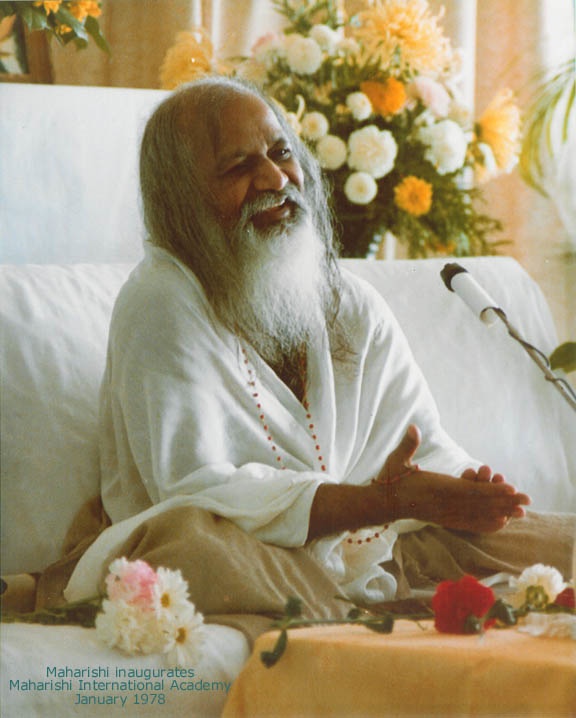
Maharishi in Canada, January 1978

December 28, 2009


Maharishi Mahesh Yogi

Jai Guru Dev

Maharishi International Academy

Kingsway, Lake of Bays, Ontario, Canada

Mailing Address:
P.O. Box 6500, Huntsville, Ontario, P1H 2J8 Canada
Telephone: 1-705-635-9041
Fax: 1-705-6359686
E-mail:
maharishiworldpeacebay@maharishi.ca

An email from Canadian friends.

Silence

December 28, 2009

SILENCE

Silence vibrating is Creation.

Silence flowing is Love.

Silence shared is Friendship.

Silence seen is Infinity.

Silence heard is Adoration.

Silence expressed is Beauty.

Silence maintained is Strength.

Silence omitted is Suffering.

Silence allowed is Rest.

Silence recorded is Scripture.

Silence preserved is Our Tradition.

Silence given is Initiating.

Silence received is Joy.

Silence perceived is Knowledge.

Silence stabilized is Fulfillment.

Silence alone is.

—author unknown

The poem about Silence was written by a course participant on the Teacher Training Course (TTC) held in Mallorca, 1971. At the end of the evening meetings, Maharishi often asked if anyone had a poem they would like to read out. One of the course participants (CP’s) read out his poem, “Silence”, which has been incorrectly attributed to Maharishi. This clarification came from someone on that course.

Also see Telling the Story of Silence by Ken Chawkin.

Mellow Fellow Donovan

December 28, 2009


MELLOW FELLOW; Crowned a musical icon, Donovan has other priorities…: such as introducing Scotland to transcendental meditation

By JOHN DINGWALL

He is the singer-songwriter who helped out The Beatles.

And his music is still enjoyed four decades after he found fame thanks to a brilliant back catalogue that includes hits such as Mellow Yellow and Hurdy Gurdy Man.

Donovan, 63, has recently been recognised as a legend with a BMI Awards Icon Award but talking to the singer there are none of the airs and graces you might expect from someone who can regard himself as being right up there with the legends of pop and rock royalty.

Instead, Donovan is down to earth. And right now he is more concerned with saving Ayrshire’s River Doon from environmental catastrophe than bragging about his own career highs.

To help the river, Donovan has put a new melody to the famous Burns poem The Banks O’ Doon in the year of Homecoming Live.

His rendition of the Burns poem aims to highlight the plight of the Doon, which is under threat from new power company plans to divert the famous river, which inspired many of Burns’ famous poems.

Donovan revealed: “Everything that can be done to save it is so important. I’ve even recorded a song to raise awareness called Save The Doon, which is available on iTunes.”

Instead of trying to plug his music, Donovan wants Scots to get behind a petition to save the river, insisting I mention http://www.savethedoon.com.

Clearly a man with a conscience, Donovan is finally being recognised for his influence on pop and rock despite starting out as a folk musician.

His BMI award recognises the UK and European songwriters and publishers of the past year’s most played BMI songs on US radio and television. The Icon designation is given to BMI songwriters who have bestowed “a unique and indelible influence on generations of music makers.”

He has joined an elite list of past honorees that includes Bryan Ferry, Peter Gabriel, Ray Davies, Van Morrison, the Bee Gees, Isaac Hayes, Dolly Parton, James Brown, Willie Nelson, Hall & Oates, Paul Simon, Steve Winwood and many more.

It’s a fitting tribute to the singer who transformed popular music in the 1960s and went on to build a legendary career. In the 1960s, he enjoyed 11 consecutive Top 40 hits, including Mellow Yellow, Sunshine Superman, Wear Your Love Like Heaven, There Is a Mountain, Lalena, Epistle to Dippy, Atlantis, Hurdy Gurdy Man, and Jennifer Juniper, all of which he wrote.

His songs have contributed to the soundtracks of films and TV series including Goodfellas, Election, Dumb and Dumber, Rushmore, The Simpsons, Nip/Tuck, Ugly Betty and Clueless.

A huge influence on The Beatles, Donovan became one of an elite handful of artists who collaborated on songs with the band.

He recalled: “I was a friend of The Beatles and I remember being at my place in London one Sunday morning and there was a knock on the door. It was Paul McCartney standing there with his guitar.

“He said, ‘I’ve got this song but I’m having trouble with the lyrics.’ So I told him to come in and he sang a bit of Yellow Submarine. I went into the other room and worked on it for a bit then came back out and sang him a line for the song.

“He said, ‘That’ll do.’ It was funny because The Beatles were really famous and almost to prove the point a policeman came to the door and said, ‘Mr. McCartney, is that your car parked there?’ In those days on a Sunday morning, the streets would be deserted. There was Paul’s sports car badly parked. Instead of giving him a ticket, the policeman asked if he could have the car keys to move it for him. That was the way it was in those days. Even then The Beatles were like royalty.”

Donovan was just 18 years old when he made his first records in 1964, immediately drawing comparisons with Bob Dylan.

He said: “Every British band from the Stones to the Beatles were copying all the American pop and blues artists – this is the way young artists learn. There’s no shame in mimicking a hero or two – it flexes the creative muscles and tones the quality of our composition and technique. I sounded like him for five minutes – others made a career of his sound.”

While Beatlemania was gripping the UK and the US, in 1965, Donovan’s song Catch the Wind earned an Ivor Novello Award for best contemporary folk song. It was the first time the honor was bestowed on an artist’s debut single. Hard at work on a new album entitled Ritual Groove, Donovan is planning to tour throughout 2010, giving him a chance to return to his roots.

Born and brought up in Maryhill, Glasgow, he is hoping to establish Scotland’s first university in Transcendental Meditation.

Donovan said: “During the past two years myself and my wife Linda and David Lynch have traveled the world, presenting the meditation technique of Maharishi Mahesh, Yogi and attracting mass media attention. The technique is now transforming education and students wellbeing wherever it has been introduced.”

It was in 1968 that Donovan, The Beatles, Paul Horn and other seekers of enlightenment went to India to study with their teacher Maharishi. On his return Donovan was at the forefront in promoting meditation to the West.

He said: “The Beatles and I had searched for a teacher of meditation, as we knew from our studies of the books that this was the way truly to make humankind aware of what we were doing to each other and to bring peace to the world .We found Maharishi and he found us.”

In April of this year, the David Lynch Foundation for Consciousness-Based Education and World Peace, of which Donovan is the musical wing, put together an incredible line-up of Donovan, Paul McCartney, and Ringo Starr, for a concert at Radio City Music Hall, New York City.

Lynch, best known for films such as Blue Velvet and Mulholland Drive, has acknowledged the important role that Donovan’s example gave in bringing him to meditation 39 years ago.

Donovan said: “We had earmarked some land just outside Edinburgh and planned to name it the Donovan University of Transcendental Meditation or the Transcendental Meditation University but there are some hoops that we’d have to go through.

“David Lynch and I have introduced it to schools all over America and it has done wonders for the children’s self-esteem. If they could introduce it here it might give a lot of kids self respect they need to go on and make something of their lives.”

http://bit.ly/78BIEi

(c) 2009 Sunday Mail; Glasgow (UK). Provided by ProQuest LLC. All rights Reserved.

A service of YellowBrix, Inc.

The American Chronicle, California Chronicle, Los Angeles Chronicle, World Sentinel, and affiliates are online magazines for national, international, state, and local news. We also provide opinion and feature articles. We have over 5,000 contributors, over 100,000 articles, and over 11 million visitors annually.

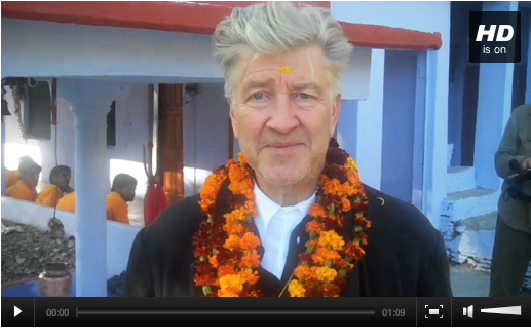
David Lynch on his next film, in Uttarkashi, India, at Maharishi’s house

December 13, 2009

December 10, 2009

DAVID IN INDIA – MAHARISHI’S HOUSE

http://dlf.tv/category/david-in-india/

David Lynch is in India right now, starting work on his film on Maharishi Mahesh Yogi—the founder of Transcendental Meditation. David’s first report comes to DLF.TV from high in the Himalayas, in the small town of Uttarkashi, known as the “Valley of the Saints,” where for thousands of years, seekers of truth have gathered to meditate and rise to enlightenment. Maharishi spent two years in silence in Uttarkashi, from 1953 to 1955, following the passing of his teacher, Guru Dev. More reports from David to follow.

You can also follow Bob Roth, DLF VP, who’s traveling with David, on Twitter. http://twitter.com/bobbyroth. Click back to Dec 4th and read up. Found this interesting comment in one of Bobby’s tweets: Fernando Sulichin and Rob Wilson who work with Oliver Stone and Spike Lee are producers—along with Tabrez who produced Slumdog Millionaire.

Fascinating stuff! This looks like it promises to be the definitive documentary on Maharishi. We all look forward to that, whenever it comes out, hopefully some time next year.

PEACEFUL POETS: Filmmaker Haydn Reiss on Rumi and Stafford and the Power of Words

December 9, 2009

Haydn Reiss on Rumi & Stafford

Two Documentaries on Poets of Peace

BY TONY ELLIS

Filmmaker Haydn Reiss

The moral dilemma most often thrust in the face of those who oppose war goes something like this: What would you do if the lives of your loved ones were being threatened right in front of you? Would you not grab any weapon available in order to protect them? So why not fight to defend your country?

National Book Award-winning poet and World War II conscientious objector William Stafford (1914-1993) wrote in his journal: “The question, ‘Wouldn’t you fight for your country?’ begs the real question which is, ‘What is the best way to behave here and now to serve your country?’ So the real answer would be, ‘If it was the right thing to do, I would fight for my country. Now let’s talk about, what is the right thing to do?’ ”

This was one of the quandaries I discussed recently on the phone with Haydn Reiss, producer and director of Every War Has Two Losers: A Poet’s Meditation on Peace, a thoughtful and beautifully crafted documentary based on the writings of Stafford, and Rumi: Poet of the Heart, a previous work about the life of the Sufi mystic poet. Both films feature comments from a number of well-known poets, writers, and thinkers, including Robert Bly, Coleman Barks, Michael Meade, Alice Walker, Huston Smith and Deepak Chopra.

Reiss, a self-confessed “producer for hire,” has been involved in a range of visual media from Hollywood features (JFK and Jacob’s Ladder) to TV shows, but it is obvious his real passion lies in his work about these two poetic masters, separated in time by more than 700 years, and the potential of their words to move the hearts and minds of men away from conflict.

Reiss believes Stafford, like many of his fellow conscientious objectors, was no starry-eyed idealist. He accepted that conflict is always a possibility in the course of human affairs, says Reiss. But Stafford didn’t believe war was inevitable or even advisable. In Stafford’s view the consequences of war are rarely, if ever, beneficial to humanity. He encouraged everyone to consider the motives of those who urge us to war before getting caught up in the fever of victory. “How do we know war is the answer?” asks Stafford in his journal. “How can there be a nation we don’t like? That’s a fiction put onto a million different people. It has been created by interests you might well do to analyze.”

“It would be very satisfying to think,” says Reiss in an interview on the film’s website, “that after viewing the film you would ask yourself, at a deep level, what you really believe about war. And the follow-up question of ‘How did I come to believe that?’ ”

“I think we have been very successfully indoctrinated into accepting that war is a given, it’s what human beings do,” Reiss continues. “The distinction is, and I think this is what Stafford is saying, is ‘Yes, we do and can make war. But what else can we do?’ The undiscovered possibilities in human behavior are what we should pursue. The die is not cast; imagination and creativity are not in short supply. That this is the real, pragmatic work of the world.”

We live in such a culture of violence that sometimes it is hard to imagine how the actions or words of one person can be heard above all the clatter. Stafford believed peace is achieved gradually, created one person, one small step at a time. “Artists and peacemakers are in it for the long haul,” Stafford writes in his journal. “Redemption comes with care. Here’s how to count the people who are ready to do right: 1 . . . 1. . . 1.”

His chosen medium was poetry. In a poem entitled “A Ritual to Read to Each Other,” composed in Iowa City on June 23, 1953, he wrote:

For it is important that awake people be awake,
or a breaking line may discourage them back to sleep;
the signals we give—yes or no, or maybe—
should be clear: the darkness around us is deep.

In Every War Has Two Losers, Stafford’s friend Michael Meade comments, “Something very deep in the human heart wants beauty, love, and relatedness more than it wants destruction, war and violence.” This theme is further explored in Rumi: Poet of the Heart, a tender and insightful portrayal of the life and work of Sufism’s most cherished poet. Reiss is a big believer in the power of poetry to take us to deeper understanding. “It’s alchemical,” he tells me, and quotes from William Blake’s poem “Jerusalem”: “I give you the end of a golden string, only wind it in a ball, it will lead in at Heaven’s gate built in Jerusalem’s wall,” a theme I discovered Stafford often used in his lectures. “Poetry can take us to a place where nations and newspapers are not so important as what is happening out in the fields and the birds and the wind,” says poet Coleman Barks in the film. His soulful translations of Rumi’s poems have made them famous worldwide. Deepak Chopra suggests that if more poetry was read to children we could substantially change the world for the better.

Stafford wrote a poem a day after rising before dawn and spending time in contemplation and reflection. “I have an appetite for finding the perfect language to describe the experience of life you’re having right now,” he once said. “Every now and then I break off a piece of that and call it a poem.” Rumi poured out thousands of lines of exquisite verse as he struggled to deal with the devastating loss of his friend and mentor, Shams of Tabriz.

“Rumi’s poetry emerged from grief, which we do our utmost to avoid,” comments Robert Bly when interviewed. It is as if his heart, in being broken open, became a container for an immense divine love. “I am so small I can barely be seen,” wrote Rumi. “How can this great love be inside of me?”

Rumi’s message of love described by Rumi: Poet of the Heart is so profound and essential it has the power to touch the soul within each of us. “Everyone loves Rumi. He has no enemies,” someone comments in Reiss’s film. “I fly with Rumi. I forget I am on the earth,” says another. It is a wonderful and revealing irony that in this time of widespread “Islamophobia,” Rumi, an Islamic mystic, should be the best-selling poet in America. He touches a universal nerve. The lesson to learn is this: if we can reach into our hearts and see the world through the eyes of a poet like Rumi, we can form bonds that unite us, whatever our culture or religion. Peace is the natural by-product of this experience. War, on the other hand, thrives on fear and division. “If loving everyone is too much to ask,” says Reiss, paraphrasing Kurt Vonnegut, “at least we should respect each other and maybe occasionally it will turn into love.”

“Love is the religion. The universe is the book,” says Coleman Barks, quoting a Sufi master. Stafford wrote on behalf of “the unknown good in our enemies,” comments one of his friends in the film.

Can the actions of one individual or a few well-chosen words really make a difference in this large chaotic world? Reiss believes so. On the website for Every War has Two Losers, he includes this quote from Stafford: “Every thought re-orders the universe.” And at the end of our conversation, he passes on this gem of wisdom from folksinger Pete Seeger. Seeger would say that life is like a seesaw and each of us is a grain of sand. It’s important which side of the seesaw you put your grain of sand. You never know which grain will be the one that tips it in the right direction.

Haydn Reiss will be visiting Iowa in spring 2010. Watch for upcoming announcements of his talk and film screenings.

For more information on both films and to watch trailers, visit www.rumipoet.com for Rumi, and www.everywar.com for Stafford.

To read more of William Stafford’s writings visit http://williamstaffordarchives.org/.

Tony Ellis is a Fairfield-based writer and poet. He blogs regularly at www.iowasource.com. To read more of his work, visit www.tonyellis.com. This article appears as the cover story of the December 2009 issue.

Also see Every War Has Two Losers, a Haydn Reiss film on poet and conscientious objector William Stafford and A Fascinating Approach to Peace.

PATH LIGHTS debuts on DLF.TV for one week

December 6, 2009
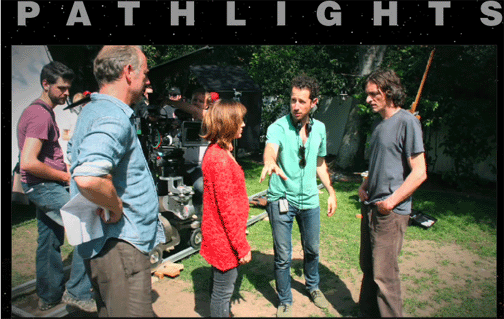
On location, left to right: Xander Berkeley, Sarah Utterback, director Zachary Sluser, lead actor John Hawkes.

Director Zachary Sluser has turned Tom Drury’s New Yorker short story into a short film now debuting on David Lynch Foundation Television. It is up for one week only, from December 2-9, 2009. After this showing, it will be presented at film festivals in 2010.

I highly recommend watching the short film, and the 3-part Behind The Scenes series on the making of this film. Some of the staff at DLF.TV were invited to film and interview the people involved in the making of this short feature—actors and crew. Very inspiring. Gives you a deeper insight and appreciation for these fine young filmmakers from MSAE, MUM, Fairfield, and their LA friends working on set. The value of TM is also mentioned. The bliss generated by everyone dedicating themselves to the project, for free, is special, and DLF.TV was able to capture it—a great example of what this young and vibrant new online TV channel is all about—celebrating consciousness, creativity and bliss. Catch the wave: http://dlf.tv/2009/pathlights/

Path Lights, introduced at the Woodstock Film Festival, has now been selected for the international competition at the 32nd Clermont-Ferrand Short Film Festival, Jan. 29-Feb.6, 2010 in south-central France. It’s the premiere short film festival (they screen short films exclusively) in the world and the second largest film festival in France after, Cannes.  Over 5100 short films were submitted and there are usually around 75 international (non-French) short films in competition. Very exciting. http://www.clermont-filmfest.com/index.php?m=226&c=3&id_film=100077897&o=88.

Following that acceptance was news that Path Lights has been invited to participate in the 39th International Rotterdam Film Festival, which will take place January 27–February 7, 2010. Rotterdam is probably the 4th major film festival after Cannes, Berlin, and Venice.    …. more to come ….

Some recent articles on Path Lights debuting on DLF.TV

THE NEW YORKER
Q&A: Tom Drury
http://www.newyorker.com/online/blogs/backissues/2009/12/q-a-tom-drury.html

IFC.com: The Independent Eye: Turn on your Path Lights.
By Alison Willmore on 12/02/2009
http://www.ifc.com/blogs/indie-eye/2009/12/path-lights.php

USATODAY POPCANDY
David Lynch Foundation spotlights a noteworthy short film
http://content.usatoday.com/communities/popcandy/post/2009/12/david-lynch-foundation-spotlights-a-noteworthy-short-film/1


PASTE MAGAZINE
By Emily Riemer
David Lynch Television Presents Short Film Path Lights
http://www.pastemagazine.com/articles/2009/12/david-lynch-television-presents-short-film-pathlig.html

The Millions: Curiosities
Oh, Tom Drury, how I love thee.
http://www.themillions.com/2009/12/oh-tom-drury-how-i-love-thee.html

UPDATE: Path Lights is now available on Vimeo: https://vimeo.com/117333877.

President Obama, Peace in the Middle East: Scientific solution to your political problem?

December 2, 2009

President Obama, Peace in the Middle East: Scientific solution to your political problem?

Wednesday, 02 December 2009 17:52

Peace in the Middle East is easily within our grasp, as indicated by a new scientific paper recently published in the “Journal of Scientific Exploration.”

The study addresses the possibility that a relatively small group of people practising the Transcendental Meditation™ and TM-Sidhi programme®, as founded by Maharishi Mahesh Yogi, twice daily together in a group can create peace in the Middle East.

The hypothesis is not new. Fifty studies have found that when 1% of the population practises Transcendental Meditation, or sufficiently large groups practise the TM-Sidhi programme together twice daily, it can have a positive influence on society as a whole. The studies show, for example, decreased violence, crime, car accidents, and suicides, and improved quality of life in a society. Critics had questioned the credibility of the evidence in light of the unconventional nature of the proposition.

Reduced conflict and improved quality of life in the Middle East:

August-September 1983

A composite sociological index closely tracks the size of a group practising the Transcendental Meditation and TM-Sidhi programme. (See details in text below.)

The new analysis addresses this question more thoroughly than previously. It presents new statistical evidence that all credible conventional explanations – such as military and political events, public holidays, and the weather – could not explain the observed statistically significant changes in sociological variables shown in an earlier study on the influence of groups practising the TM-Sidhi programme (Orme-Johnson DW, Alexander CN, Davies JL, Chandler HM, & Larimore WE. International peace project in the Middle East: The effect of the Maharishi Technology of the Unified Field. Journal of Conflict Resolution 1988 32:776-812, findings illustrated above). The observed changes in the Middle East included reductions in war deaths of 75%, war intensity of 45%, in crime of 12%, in fires of 30%, plus there were improvements in national mood of 27% and the stock market of 7% during the experimental period.

Although conventional factors did have a measureable influence on the level of violence and other sociological variables, the effect of the Transcendental Meditation group was, according to the researchers, both independent of these other factors and approximately two to five times stronger.

Brain research has found that Transcendental Meditation increases coherence in brain functioning. Lead author of the new study David Orme-Johnson, former Chairman of the Psychology Department at Maharishi University of Management, suggests that: “Given the assumption of Maharishi’s theory that individuals are the units of collective consciousness, increased coherence at the individual level could be expected to have a positive effect on the population level”.

According to a number of earlier studies, this effect is magnified when, in addition to Transcendental Meditation, the more advanced TM-Sidhi programme, which includes Yogic Flying, is practised in a group. In this case, the square root of 1% of a population practising Yogic Flying in a group is the threshold at which changes in social trends begin to be observed. Interestingly, this effect appears to be irrespective of national borders and different cultures. According to the theory, a group of 10,000 generating such an influence of coherence would be sufficient to noticeably influence the collective consciousness of the whole world.

If the science is so watertight, and the potential benefits so great, the obvious question, then, is: Why has no one yet established such a group anywhere in the world? One reason why policy makers have been reluctant to do so is that they take the view that conventional military and political factors must have more influence than Transcendental Meditation and Yogic Flying. However, the new research has shown that this assumption is quite incorrect.

A coherence-creating group of 10,000 people could be established for less than 0.2% of the world’s military expenditure, and yet, according to the research, could ensure a stable state of world peace.

The David Lynch Foundation for Consciousness-Based Education and World Peace, founded by the award-winning filmmaker, joined with Paul McCartney in April to raise funds to teach Transcendental Meditation to one million at-risk children. The benefit concert in New York is said to have raised £2m on ticket sales and fund raising continues. The philanthropic Foundation is already involved in teaching Transcendental Meditation in schools in the Middle East with the explicit aim of creating permanent peace in the region.

Dr. Orme-Johnson is available for interview: Tel 850-231-2866 See his website: http://www.truthabouttm.org
Dr. David Leffler is available for interview and to set up interviews with other military-related people. See this website: http://www.StrongMilitary.org  Tel 845-489-8653

Beautiful film on Algerian artist Malek Salah by Amine Koudier

November 30, 2009

Malek Salah: Majnûn Laylâ – Artist

Enjoy this short film about the Algerian contemporary artist Malek Salah as he prepares for the inaugural exhibition titled ‘Majnûn Laylâ’ for the new Modern Art Museum of Algiers, the first of its kind in the Arab world. The film brings deep insight into Salah’s world—his creative process, the information contained within his work, his relationship to his art, and through it, with the Algerian society.

This beautiful film of a meditating Algerian artist, Malek Salah, is a fine example of a famous artist profiled by one of our MUM students, who later became a videographer for DLF.TV. The young filmmaker, Amine Koudier, a senior student at the time in MUM’s digital media class, was asked to make this film to accompany an opening exhibit of the new Modern Art Museum of Algiers (MaMa), the first of its kind in the Muslim world.

When Amine showed it to me I was really impressed and encouraged him to translate and add English sub-titles and enter it into competitions. I ended up helping him with the French to English translation, and he won first place wherever he entered it. He took the top 2008 Award of Excellence in the student category from the Iowa Motion Picture Association and Winner in the student film category of 2008 Landlocked Film Festival.

David Lynch visited the students when he was here last year and commented on this film. He said he loved the artist, his work, and what he had to say about it, and how Amine had portrayed it—high praise for a student. Amine was later hired to work at David Lynch Foundation Television upon graduating. Read an excellent article in the Iowa Source written by Mo Ellis about him and the film.

Watch the 13-minute film Malek Salah: ‘Majnun Layla’ on DLF.TV, on Vimeo, or on YouTube Part 1 and Part 2. Also see David Lynch Foundation Television to premiere David S. Ware: A World of Sound. The Ware and more profiles by Amine and other DLF.TV filmmakers are available here.

This blog post was published November 30, 2009. After working for the David Lynch Foundation, Amine would become a teacher of Transcendental Meditation and later taught TM and filmmaking at Maharishi University. He gave a wonderful interview to Nylon Magazine, and later invited a photographer from the Ottumwa Courier into his classroom as part of her profile on the university.

Home is where the heart is – Felicia Hoo

November 29, 2009

Living Guides – Profile

By Willy Wilson | Nov 06, 2009

Home is where the heart is – Felicia Hoo

–––––––––––––––––––––––––––––––––––––––––––––––––––––––––––––––––––––––––––

Fifteen miles west of Kuala Lumpur sits the quintessential upper middle class Malaysian suburb of Kota Kemuning, Shah Alam. There are acres of private club houses, newly-built malls, public schools and Wet World Waterpark.

Dry, quiet and remote, these thoughts came to mind when I first visited the area. But what seems to be monotonous life in Kota Kemuning could very well be its best offering, for many of the residents here prefer a quiet suburban life to a hectic existence in the city. Or at least that is the case of Felicia Hoo.

For Felicia, Kota Kemuning offers an unmatched convenience for her family, her business and herself. The jovial woman is the CEO of Samaria Sdn Bhd by day, a single mother by fate and an artist by choice. She runs a multi-million dollar worth of cutlery business, sends her two boys to school and takes time to paint from her mini studio – all of which are done within Kota Kemuning.

“The tranquility this area offers is supreme,” she says, “the kind of peacefulness you only get outside of Kuala Lumpur.”

Although Kota Kemuning is far from the city centre, Felicia maintains that the area is by no means a secluded one. Thanks to the well linked major expressways such as the North-South Central Link, Federal Highway, Damansara-Puchong expressway and the proposed Kemuning-Federal Highway link.

“It is just the best location for me and my family,” Felicia comments proudly of her area.

Nostalgic and Alluring

Stepping into Felicia’s 2-storey bungalow feels like a trip down the memory lane. There is an arresting nostalgic appeal that is usually present in your grandparents’ house; the kind of old house charm that instantly makes you feel at ease.

Part of it could be due to a Singer sewing machine and an old stereo that are perched in one corner of the living room, while the other could be because of the old-fashioned arrangement of the furniture, the simple selection of fabric for the curtain and the natural greeneries the house is surrounded by. Whatever it is, it is hard to resist the allure of this house.

Yet, from the outside, it is a mere modern bungalow with an extensive garden, a spacious living room and a lot of canvasses propped against the walls. Such contrast makes this house, well, charming.

The first floor consists of two living rooms, a kitchen and a guest room that is converted into a mediation room. Three bedrooms on the second floor are occupied by Felicia and her two sons.

“People always say that my house has an air of an art gallery,” says Felicia of her cosy house. Which is understandable; there are at least sixty canvassed paintings scattered around the house, all of which are done by the lady herself. The well-ventilated house has two big doors that allow fresh air and sunlight to come into the house.

The central area of the house is a mini studio with high-ceiling concept from where Felicia paints. “I prefer my house to be this way,” says Felicia, “It gives me an inner peace.”

Felicia asserts that she does not feel the need to decorate her house with fancy stuff. What she looks for in a house, according to her, is comfort.

“A house that provides you with a peace of mind is priceless. Your home is worth millions when it houses your heart,” she says. How true!

For the Love of Art

Felicia Hoo is not the typical CEO with a power suit, two assistants and three mobile phones. She is, indeed, more of a jeans-and-funky-hairstyle kind of CEO. As if that is not rare enough, Felicia is also a soon-to-be Transcendental Meditation (TM) instructor, an avid traveller and an occasional host in household product exhibitions. Yes, she does all these while having her cutlery business rolling.

Of her occasional hosting gigs, Felicia comments, “I had been given chances to do a 45-minute food carving demo to visitors during exhibitions like HomeDec.” She does not consider such shows as merely a part of marketing strategy, but also a chance to bond with her customers.

“There are so many things I would like to share with people,” she says, “And it is not just about my business, but also about my passion in meditation, arts and green lifestyle!”

Ever an advocate for green cause, Felicia is set to educate her customers about this issue. She has started this effort by utilising 100 percent non-toxic materials for the production of Samaria products. It is not surprising, then, that her business only gets bigger by the day.

She credits her house for her tremendous success. Which Feng Shui guru did she seek advice from, you may ask!

“I never had any Feng Shui advice from anyone,” she says.

“What we all need is a place where we belong. I can go into a state of total absence from stress and anxiety from work when I paint here,” she says, pointing at one corner in the kitchen, where a cloth-coated wooden table, a few chairs and a fan are placed modestly.

“I sketch faces, emotions and natural beauty here. When I get a solid idea, I spill it onto a canvas and start painting at my mini studio,” says Felicia.

Her abstract arts are quite impressive, especially considering the fact that she has never been trained professionally.

“Better yet, I will have my first solo exhibition in Iowa, United States, next year. The art gallery and I are firming things up now,” she says, “I have my home to thank for this exhibition.”

The moral of the story is: to make your home a comfortable space for your mind, body and soul is to write your own success story both in personal and professional life. Just ask Felicia!

–––––––––––––––––––––––––––––––––––––––––––––––––––––––––––––––––––––––––––

This article was the result of a group assignment in one of HUC Professor Mohan Gurubatham’s classes on entrepreneurship in Kuala Lumpur, Malaysia. One of the student groups contacted The Star to interest them in an interview with Felicia Hoo, a friend of Mohan’s who visited their class. Mohan, who also lives and teaches part time at MUM, says, “She epitomizes following your heart and bliss, a classic rags to riches story of single parent mother, bottom up, and my students volunteered to rebrand her business and shape her strategy. She is a firm believer in doing nothing and accomplishing everything from the source of thought!!! She is going to be a TM teacher.”

After Willy Wilson, the student who wrote this article, thanked Dr. Mohan for the class, Mohan replied that it had been a pleasure for him as well, and that Felicia was going to Thailand to train as a TM teacher very soon. The end of the article mentions that she will have her “first solo exhibition in Iowa, United States, next year. The art gallery and I are firming things up now,” she says.

A good guess would have it in one of Fairfield’s more prominent art galleries. More to come….

UPDATE: Nov 17, 2022

Feli Hoo not only became a TM teacher, she turned her business over to her sister/CEO, retired, married Danish psychiatrist and TM teacher, Henrik Westergaard, and moved there. Read about it in their interview with Mary Swift for TM Home: What happens if you add a daily dose of Transcendental Meditation to the life of a businesswoman from Malaysia and a psychiatrist from Denmark? Here’s how the practice of TM transformed this lovely couple—and how each of us can become our own therapist and find our way home.
Filmmaker Responds To BC Government Arts Cuts

November 28, 2009

Filmmaker Responds To BC Government Arts Funding Cuts

Artless PSA Goes Viral

Kryshan Randel and Cara Yeates Join Forces With Top Art Venues To Create “A World Without Art”

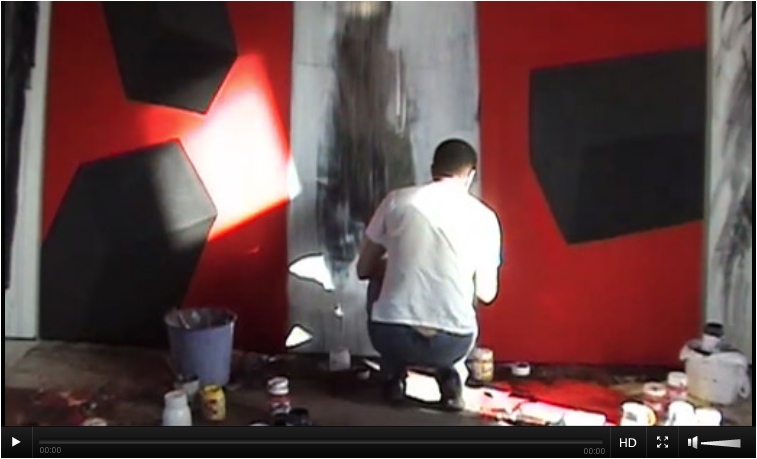
ARTLESS, an independently produced public service announcement about the arts funding cuts, was released online Tuesday as part of a campaign to protest the BC government’s current and planned arts funding cuts. The ad, which imagines a grey artless world, is shot in some of Vancouver’s most iconic artistic venues. This powerful visual statement is rapidly gaining attention.

After its premiere as a part of the Wrecking Ball Cabaret on Monday, this PSA received over 1000 hits its first day on YouTube. ARTLESS is currently featured on the Facebook and Twitter pages of many of BC’s top entertainers, and is spreading fast to theatres, schools and TV stations. It can be seen at artlesspsa.wordpress.com

Kryshan Randel and Cara Yeates were assigned the theme “A World Without Art” by the Wrecking Ball Committee. Immediately, they had the ambitious idea of filming inside some of Vancouver’s most important artistic venues, including the Orpheum, Fifth Avenue Cinemas and Grunt Gallery, emptying them of their art and replacing it with grey. To create further impact, the ad features twelve year old rising star Alex Ferris (RV, The Time Traveller’s Wife) wandering through the stark venues, trying to imagine what art looks like. His journey is accompanied by a haunting song, which was provided by a local elementary school choir.

The team consisting of Randel (Director/Co-writer), Yeates (Co-writer/Producer), Toby Gorman (Director of Photography) and Mathieu Wacowich (Co-Producer), was small but fearless. The shoot was a tremendous challenge; five locations photographed in one ten-hour filming day on Gorman’s one day off from on-set work. “My guerrilla filmmaking background helped us make our day, but barely – it was the hardest thing I’ve ever done”, says Randel.

But the hard work is already paying off. Alan Franey director of the Vancouver International Film Festival has committed to passing this PSA onto the festival’s contact list and screening it at the VanCity Theatre. ARTLESS will be soon featured on Novus Television and KVOS. And the message is being delivered to schools across BC. Every hour Randel and Yeates are updated of more good news in regards to its exposure.

The team of working artists is dedicated to this cause. Randel has a personal investment in the issue. His short drama GLIMPSE recently won the NSI Short Filmmakers Award. GLIMPSE was funded by the Kick Start program, which was recently cancelled due to the funding cuts. Randel’s career is on the rise; his short horror film JACK, made in collaboration with many of BC’s top talents including Zach Lipovsky (ON THE LOT), won four awards including the Grand Jury Prize at this month’s Bloodshots Film Festival. Judge Dan O’Bannon (creator/writer of ALIEN, writer of TOTAL RECALL) praised the film’s entertaining blend of humor and horror. BC’s arts funding is a strong component of Randel’s future as a filmmaker in Vancouver. If it goes, he may be forced to go as well.

Yeates just finished a whirlwind international tour with her one woman plays SOME RECKLESS ABANDON. Her work has been supported by the BC Arts Council in the past and she’s hoping to get funding for her latest project. Cara was just awarded the first ever Joanna Marratta award for artistic achievement and community leadership at the Vancouver Fringe.

At the moment, all of Randel and Yeates’ energies are concentrated on getting the PSA screened everywhere they can. Yeates notes “as artists we are fighting these cuts the only way we know how, through our art”.

To spread the word about ARTLESS please visit: artlesspsa.wordpress.com