Archive for the ‘Writing’ Category

A baptism by fire: Why Paul Dalio’s debut as a filmmaker is Touched With Fire

July 25, 2016

TOUCHED WITH FIRE PosterPremiered last year at SXSW, with a theatrical run this spring, and now on DVD, Paul Dalio’s first full-length feature film, Touched With Fire, is a love story between two bipolar poets that reveals the relationship between illness and creativity.

Dalio was inspired by Kay Redfield Jamison’s book, Touched with Fire: Manic-Depressive Illness and the Artistic Temperament, which explores the link between great art and bipolar disorder. He read that many famous writers, poets, and artists suffered from this mania and may have produced their work because of it. Their genius was touched with fire.

This was a welcome relief for Paul who had become bipolar. He now saw himself no longer in clinical terms as a social outcast without a cure, but as a creative artist who was dealing with a neurological imbalance.

The most well known example of that heightened state was Vincent Van Gogh’s Starry Night. The painting is a kind of leitmotif throughout the film, even materializing as a literal hallucination by the main characters.

Vincent Van Gogh's Starry Night

Reflecting on his own experience of being bipolar, Paul wanted people suffering with the illness, and those concerned with their health, to better understand what they are going through, that they are not necessarily crazy, perhaps gifted, and to help remove the stigma associated with the disease.

He compares the manic highs and depressive lows of the disease to the seasons. The film’s palatte of colors reflects the changing emotions within and between the main characters. Attempts to control these mood swings with drugs create deadening side effects, part of the conflict within their relationship.

In his Huffington Post blog, Touched With Fire, Paul asks: How much more receptive would a patient be to treatment if the patient was told that the treatment was to nurture a gift they had, instead of terminate a disease they had?

Director Dalio gave author/psychologist Kay Redfield Jamison a role in the film as herself, to explain how the right balance of medication can help rather than hinder a manic personality. Marco is concerned that the medications are stopping him from feeling any emotions, and is destroying his creativity. From her own experience, Kay shares with them how “medication can tamp the fire down a bit without losing that gift.” She tells him, with the right dosage, which takes time, she became even more productive than before becoming bipolar.

Cast and Crew

Paul Dalio wrote, directed, edited and scored Touched With Fire, his feature-film debut starring Katie Holmes and Luke Kirby, with other performances by Griffin Dunne, Christine Lahti and Bruce Altman.

Paul’s longtime friend, Jeremy Alter, produced the film, along with Kristina Nikolova, Paul’s wife and fellow student at the NYU Film School, who convinced him to make this semi-autobiographical film. Their teacher, Spike Lee, is the executive producer.

The brilliant acting in this passionately moving film is intensely engaging. Holmes (Carla) and Kirby (Marco) play two poets with bipolar disorder whose art is fueled by their emotional extremes. When they meet in a treatment facility, their chemistry is instant and intense driving each other’s mania to new heights. They pursue their passion, which breaks outside the bounds of sanity, swinging them from fantastical highs to tormented lows until they ultimately must choose between sanity and love. Watch the official trailer.

Comments from the Critics

The New York Times Critic’s Pick wrote: “Luke Kirby and Katie Holmes boldly meet the challenge of playing bright, high-strung artists. An extraordinarily sensitive, nonjudgmental exploration of bipolar disorder and creativity.” Read the Review: ‘Touched With Fire,’ a Love Story Between Two Bipolar Poets.

The Los Angeles Times said: Writer-director Dalio has firsthand experience with bipolar disorder, and his perspective sheds fresh light on the unique ways in which manic-depressive individuals experience love and creativity. Read the Review: Katie Holmes and Luke Kirby propel ‘Touched With Fire’ as it shines fresh light on bipolar disorder and creativity.

This is a powerful film! We witness their struggles from the inside out. More reviews are listed on the film’s website.

The Role of Poetry in the Film

In one of the interviews from the Special Features of the DVD, Paul Dalio talks about the value of poetry in his life, and for the main characters in the film. “It was only when I met my wife that my heart became more tender, and I actually started reading poetry, which I never did, and I started writing poetry.”

Paul describes the transforming power of poetry to heal and create beauty. He speaks from his own personal experience as someone who has dealt with the ups and downs of this disorder while trying to become a writer, composer, and filmmaker. The film is an amazing testament to his artistic achievement! See his bio under Cast & Crew for more details.

“Poetry at its best has the deepest expression of being in the worst hell, and having no choice but to bring some kind of aesthetic meaning to it, and some kind of beauty to it, just to even cope with it. (and) Only by being forced down there to such a hell are you forced to bring that much beauty to that hell, and in the process it becomes a healing. And so it was natural how it wove itself into the film, as these two characters use it to cope with their psychosis, and to deal with coming out of their situation.”

From my own experience, writing poetry does have the power to transform and heal. Another film where poetry is featured is in Words and Pictures, where a poem invites you to be who you are.

The Soundtrack to the Movie

Paul Dalio’s blog post includes both the song and lyrics to Starry Nights. Listen to the Touched With Fire Soundtrack Preview, followed by Starry Nights, the song at the end of the film during the credits, published by Lakeshore Records. Download the album on iTunes.

Interviews with the Director and Actors

Charlie Rose: ‘Touched With Fire’ (Feb. 4, 2016)  Director and writer Paul Dalio, actor Luke Kirby, and psychologist Kay Jamison discuss the movie “Touched with Fire” and the connections between bipolar disorder and creativity. (18:51) Paul does mention his use of medication and meditation, which he elaborates upon in this next video.

At a David Lynch Foundation-hosted screening of the film, Paul opened up about his own struggles with bipolar and how pivotal the practice of Transcendental Meditation has proved to be in living a happy, healthy, and creatively rich life. “TM is the difference between surviving with bipolar and thriving with bipolar. I never stopped meditating, without fail,” he says. “That’s when my doctor, Norman Rosenthal, witnessed the power of TM and was so blown away he decided to do a study on the effects of TM.” Paul was responsible for Dr. Rosenthal restarting his long-lapsed TM practice, which led to the publication of two best-selling books on the subject. Visit NORMAN ROSENTHAL, MD for details. See Thriving with Bipolar – A Conversation with Writer/Director Paul Dalio.

TODAY: Katie Holmes Discusses Role In ‘Intense’ Film ‘Touched With Fire’ (4:41)

The Washington Post: Filmmaker Paul Dalio mines his bipolar disorder for feature debut

HotSpot: TOUCHED WITH FIRE | Katie Holmes, Luke Kirby, Paul Dalio & Jeremy Alter Interview | February 8, 2016 (26:54)

Video of Marbling Art Animation of Starry Night and Van Gogh

Check out this amazing video on marbling art animation of Starry night and a Van Gogh self-portrait: Van Gogh on Dark Water Animation. The Turkish artist is Garip Ay, and the ancient technique of painting on water to marble paper is called Ebru.

The Unexpected Math Behind Van Gogh’s “Starry Night”

Physicist Werner Heisenberg said, “When I meet God, I am going to ask him two questions: why relativity? And why turbulence? I really believe he will have an answer for the first.” As difficult as turbulence is to understand mathematically, we can use art to depict the way it looks. Natalya St. Clair illustrates how Van Gogh captured this deep mystery of movement, fluid and light in his work. Visit TED-Ed for more.

Fast forward: A new study found that the skies in Van Gogh’s “Starry Night” align with current models of atmospheric turbulence. NBC News’ Ellison Barber spoke with astrophysicist Adam Frank on the science behind the iconic swirly sky. See this fascinating and revealing report: New research finds Van Gogh’s ‘Starry Night’ skies align with physics.

Don McLean’s song to “Vincent” (Starry, Starry Night)

Don McLean’s compassionate acknowledgement in song to “Vincent” (Starry, Starry Night), was used with images of Vincent Van Gogh’s paintings, and lyrics to the song, in this beautiful video compiled by a YouTuber who uploaded it to explain his love of Van Gogh’s art to a dear friend whose first language is not English. The video has been seen over 74 million times with thousands posting comments! He never imagined it would have received so many views and comments, and is glad he was able to share it. Not many dry eyes are left after hearing/seeing it.

Lisel Mueller on Claude Monet’s vision

Failing eyesight or spiritual insight: a poet’s interpretation of a master artist’s vision. In this related post, Nobel poet laureate Lisel Mueller gives us a different twist on another kind of perceived abnormality. Enjoy her powerful poem, Monet Refuses the Operation.

See: Vincent Van Gogh’s The Starry Night: Great Art Explained.

— Written and compiled (citing sources) by Ken Chawkin for The Uncarved Blog.

Enjoy some of the Zen Poetry of Ryōkan

July 3, 2016

Zen Poet RyōkanA friend loaned me a copy of Dewdrops on a Lotus Leaf, Zen Poems of Ryōkan, translated by John Stevens. A delightful little book, his poems are deceptively simple, yet go straight to the heart. A Zen master, Ryōkan was also considered one of the greatest calligraphers of all time in East Asia. Living as a hermit, he spent much of his time writing poetry, doing calligraphy, and communing with nature.

The Translator’s Introduction ends with this sage advice from the poet:

Good friends and excellent teachers—
Stick close to them!
Wealth and power are fleeting dreams
But wise words perfume the world for ages.

Ryōkan’s poems are pure, honest, direct. Here are a few beauties that caught my attention as I read them aloud to Sali.

It’s a pity, a gentleman in refined retirement
……….composing poetry:
He models his work on the classic verse of China,
And his poems are elegant, full of fine phrases.
But if you don’t write of things deep inside your own
……….heart,
What’s the use of churning out so many words?

 —————

In the stillness by the empty window
I sit in formal meditation wearing my monk’s surplice.
Navel and nose in alignment,
Ears parallel with the shoulders.
Moonlight floods the room;
The rain stops but the eaves drip and drip.
Perfect this moment—
In the vast emptiness, my understanding deepens.

—————

At night, deep in the mountains,
I sit in meditation.
The affairs of men never reach here:
Everything is quiet and empty,
All the incense has been swallowed up by the endless
……….night.
My robe has become a garment of dew.
Unable to sleep, I walk into the woods—
Suddenly, above the highest peak, the full moon
……….appears.

—————

When all thoughts
Are exhausted
I slip into the woods
And gather
A pile of shepherd’s purse.

Like the little stream
Making its way
Through the mossy crevices
I, too, quietly
Turn clear and transparent.

—————

The Lotus

First blooming in the Western Paradise,
The lotus has delighted us for ages.
Its white petals are covered with dew,
Its jade green leaves spread out over the pond,
And its pure fragrance perfumes the wind.
Cool and majestic, it rises from the murky water.
The sun sets behind the mountains
But I remain in the darkness, too captivated to leave.

—————

Bamboo

The thick bamboo grove near my hut
Keeps me nice and cool.
Shoots proliferate, blocking the path,
While old branches reach for the sky.
Years of frost give bamboo spirit;
They are most mysterious when wrapped in mist.
Bamboo is as hardy as pine and oak,
And more subtle than peach or plum blossoms.
It grows straight and tall,
Empty inside but with a sturdy root.
I love the purity and honesty of my bamboo,
And want them to thrive here always!

—————

Leave off your mad rush for gold and jewels—
I’ve got something far more precious for you:
A bright pearl that sparkles more brilliantly than the
……….sun and moon
And illuminates each and every eye.
Lose it and you’ll wallow in a sea of pain;
Find it and you’ll safely reach the other shore.
I’d freely present this treasure to anyone
But hardly anyone asks for it.

—————

Keep your heart clear and transparent
And you will never be bound.
A single disturbed thought, though,
Creates ten thousand distractions.
Let myriad things captivate you
And you’ll go further and further astray.
How painful to see people
All wrapped up in themselves.

—————

I watch people in the world
Throw away their lives lusting after things,
Never able to satisfy their desires,
Falling into deep despair
And torturing themselves.
Even if they get what they want
How long will they be able to enjoy it?
For one heavenly pleasure
They suffer ten torments of hell,
Binding themselves more firmly to the grindstone.
Such people are like monkeys
Frantically grasping for the moon in the water
And then falling into a whirlpool.
How endlessly those caught up in the floating world
……….suffer.
Despite myself, I fret over them all night
And cannot staunch my flow of tears.

—————

Even if you consume as many books
As the sands of the Ganges
It is not as good as really catching
One verse of Zen.
If you want the secret of Buddhism,
Here it is: Everything is in the Heart!

—————

Chanting old poems,
Making our own verses,
Playing with a cloth ball,
Together in the fields—
Two people, one heart.

The breeze is fresh,
The moon so bright—
Together
Let’s dance until dawn
As a farewell to my old age.

See some of Ryōkan’s quotes at goodreads. Here’s one I liked:

“In all ten directions of the universe, there is only one truth. When we see clearly, the great teachings are the same. What can ever be lost? What can be attained? If we attain something, it was there from the beginning of time. If we lose something, it is hiding somewhere near us.”
― Ryokan

Here is a goodreads description of his life introducing Sky Above, Great Wind: The Life and Poetry of Zen Master Ryokan.

Enjoy another Zen master’s poetry: Wu-men shares the beauty of each season in his poem 10,000 telling us how to enjoy our best life.

— Written and compiled (citing sources) by Ken Chawkin for The Uncarved Blog.

Five great articles on #TranscendentalMeditation in The Quad-Cities Online @Dispatch_Argus

July 1, 2016

Here is a series of five stories exploring Transcendental Meditation written by Jackie Chesser and published in The Dispatch and The Rock Island Argus. Click the titles to see each one of them online with photos at QCOnline. Or click Dispatch-Argus-May 2016 articles to see a PDF of them all together, courtesy of The Dispatch/Argus.

May 14, 2016: Transcendental Meditation could improve your life

May 15, 2016: Transcendental Meditation a lifesaver for vets with PTSD

May 15, 2016: Q-C instructors are passionate about Transcendental Meditation

May 16, 2016: Transcendental Meditation pays off in the classroom

May 17, 2016: ‘It has been a godsend!’: Q-C people talk about Transcendental Meditation

Fairfield, Iowa, TM and MUM make national news

June 10, 2016

Many articles have come out in praise of Fairfield, Iowa. Two and a half years ago, Rox Laird, The Des Moines Register’s editorial columnist, published an Opinion piece, Fairfield defines community action, on the city’s civic collaboration and Maharishi University’s Sustainable Living Center. The Smithsonian named Fairfield 7th out of 20 best small towns to visit that year. BuzzFeed named Fairfield one of the coolest small towns in America. And The Iowan had published an article on how Fairfield thinks inclusively creating rural success in Iowa.

I like to think the positive outcome of this latest article on Fairfield, TM and MUM, by Kevin Hardy in The Des Moines Register and the  USA TODAY NETWORK, resulted from a phone call I received on my birthday.

In April, I went to visit my son Nathanael at his new home in the Santa Barbara Riviera. For lunch he took me to The Boathouse at Hendry’s Beach, a well-known outdoor restaurant on the beach by the ocean. While waiting for our food to arrive, an unknown number called my cellphone. It was Kevin Hardy. He told me he covered business, labor and the economy for the Des Moines Register, and was researching why some towns in Iowa were thriving while many were losing population and failing economically. Then he said something that surprised me.

According to the U.S. Census Bureau, Fairfield was Iowa’s fastest-growing city among cities of a similar size. Kevin wanted to know what role I thought Maharishi University of Management had played in the demographic and economic growth of Fairfield.

In addition to some of the longtime established businesses, I  gave him an historical overview how hundreds of meditators came from all over the US and Canada after MIU had moved to town from the mid-1970s onwards. Many would stay and relocate their businesses or start new ones. Also told him about today’s younger entrepreneurs, the new successful ventures they started, and gave him a list of people and companies to visit and interview.

Kevin Hardy and Register photographer/videographer Zach Boyden-Holmes really did their homework. They put together an impressive article that became a national success story! It is reproduced here with permission.  See the full article with 14 photos taken May 9, 2016 by Zach Boyden-Holmes/The Register. I added links for more information.

Why this Iowa town is thriving when so many aren’t
By Kevin Hardy, June 1, 2016

Click here to see a short (1:20) video of Fairfield entrepreneurs.

Fairfield out-performed all of the state’s 15 micropolitan areas in terms of population growth between 2010 and 2015.

FAIRFIELD, Ia. – Take a walk around this town’s bustling square and you’ll see an array of businesses that would rival some shopping malls.

On one corner sits a coffee shop that roasts its own beans in house. Down the block is a store specializing in sustainable children’s clothing and toys. Along another strip, there’s a women’s boutique, a Verizon store and a nutrition company.

The town’s retail center also is home to a salon, a consignment store, a furniture store and an art gallery. Just off the square is a pet spa, a natural remedy store and a photography studio. And for those looking for a bite to eat: a Thai restaurant, an Indian cafe, an Italian spot and a joint peddling pizza and steak.

In fact, local officials count only one vacancy in the storefronts that line shady Central Park. It’s just one more sign of success in this town of 9,500 in a state where most small cities and rural areas are seeing residents leave.

Since 1969, census data show Iowa’s metropolitan areas have gained nearly a half million people, while smaller cities and rural places have lost more than 171,000 residents.

But Fairfield has prospered, particularly in recent years. Between 2010 and 2015, the city saw a 4 percent population gain – a rate that rivaled the growth of some of Iowa’s much larger metro areas.

This southeast Iowa city is known as a magnet for practitioners of Transcendental Meditation at Maharishi University of Management, who flocked here since the 1970’s. Fairfield was able to capitalize on that unique niche, building a surprisingly metropolitan quality of life.

While Fairfield is home to 1,000 fewer jobs than it had 15 years ago, state figures show employers have rebounded in the last five years, adding nearly 700 jobs between 2010 and 2015. During that time, Fairfield went from 714 employers to 751, according to Iowa Workforce Development.

“We have a great quality-of-life culture and an entrepreneurial culture,” said Mayor Ed Malloy. “And we see it is allowing more young people to put down roots in this community.”

Around town, there is no shortage of small-city staples like Casey’s General Store and Pizza Ranch, though Fairfield is better known for its funky coffee houses, shops and restaurants. Locals claim the city is home to more restaurants per capita than San Francisco.

Yet the place that Oprah Winfrey dubbed “America’s most unusual town” is more than just quirky. It’s one of the few nonmetropolitan areas in Iowa posting strong population growth, according to U.S. Census figures. And around town, evidence abounds that Fairfield has done what so many small cities in the Midwest struggle to achieve: attract and retain people.

Troy with MUM Solar Array

Troy Van Beek stands in front of a solar power array his company Ideal Energy installed at the Maharishi University in Fairfield Monday, May 9, 2016. Zach Boyden-Holmes/The Register

TM’s long effect
Maharishi Mahesh Yogi introduced Transcendental Meditation, or TM, in India in the 1950’s.

But he brought his technique and “Consciousness-Based education” to Iowa in 1974, when Maharishi International University moved from Santa Barbara, Calif., to the 1 million empty square feet vacated by Parsons College in Fairfield. (The university later changed its name to Maharishi University of Management.)

While some in the community resisted the influx of meditators, locals say most of those tensions were alleviated years ago.

“As time has gone on, everybody’s meshed seamlessly,” said local designer Linda Pettit.

Pettit, who with her husband owns Finishing Touch interior design, has watched Fairfield thrive over the last 32 years from her storefront on the town square. She ticks off quality-of-life improvements such as a new pool and new recreation center.

She boasts about the many restaurants. And she tells of all the new and unusual businesses that have opened.

“We have a very vibrant community,” she said. “I think a lot of small towns don’t have the diversity that we do.”

Pettit hears about layoffs at plants in nearby Ottumwa. She knows how Iowa farmers are struggling with low commodity prices. But she said that isn’t Fairfield’s storyline.

Her business works on residential and commercial projects. But she’s noticed a slant toward more commercial projects in recent years, as new businesses pop up and old ones invest in upgrades.

“It’s a great place to have a business,” she said.

Iowa’s ‘Silicorn Valley’
Over the years, many TM practitioners and others who visited Fairfield decided to stay.

Once here, they had to find a way to make a living. Some Fairfield residents drive to Ottumwa or Iowa City for work. But many have started small businesses in Fairfield, which has been called “Silicorn Valley” for its mixture of tech startups and entrepreneurial ventures.

“People moved here and they had to figure out how to stay here,” said David Navarrete, spokesman for Sky Factory.

The 38-employee company was founded in 2002 by Bill Witherspoon, an artist who moved to Fairfield for its TM community. A serial entrepreneur, he formed Sky Factory as a means of supporting his family. It creates window and ceiling panels that recreate outdoor views like those of a blue sky or a beachfront.

Sky Factory’s biggest clients are health care providers, as research shows even a simulated view of the outdoors can boost moods for those trapped indoors.

“I think there’s definitely an entrepreneurial spirit here, and I think a lot of that comes from the university,” said Witherspoon’s son, Skye Witherspoon, now the company’s CEO.

Fairfield is also home to a surprising array of manufacturing.
Creative Edge makes intricate flooring for some of the world’s best known hotels, casinos, hospitals and universities. Bovard Studios makes and restores stained glass windows for churches across the country. And a host of businesses manufacture agricultural parts, iron castings, polyethylene piping and laundromat washers and dryers.

So many things are made in Fairfield that the Iowa Economic Development Authority will host an export conference here in the fall.

Fairfield’s biggest employers have grown in recent years, too.

Cambridge Investment Research now employs about 700 and boasts more than $70 billion in assets under its management.

Mixed signals
Like many small cities, some employers in Fairfield report trouble recruiting and hiring, especially with Iowa’s unemployment rate remaining below 4 percent.

Lori Schaefer-Wheaton, president of the 170-employee Agri-Industrial Plastics, said hiring is a struggle. She has 20 openings, a number that has held fairly constant over the last two years, she said.

Fairfield is an anomaly among small cities in Iowa, she said, but she thinks recent population growth is largely related to the university.

“That kind of population growth might show up on our census,” she said. “But I don’t think it changes the dynamics of the workforce in our town.”

Iowa State University Economist Dave Swenson said Fairfield definitely out performs many similarly sized cities. But some signals are mixed: While some measures show recent job growth, other data actually point to employment losses, he said.

“They seem to be demonstrating both demographic and economic growth that stands out,” he said. “The big question is this a short term growth or is it sustainable?”

Natives return home
Meghan Dowd came to Fairfield as a child when her parents migrated here for the TM community.

She moved away for college, then ended up working in television in California.

From there, she visited her mom in Fairfield and realized it was going through a “renaissance,” with monthly art walks, a new events center and lots of cool coffee shops and restaurants. She moved back in 2009 and started Shaktea, a maker of kombucha, a trendy fermented drink.

In Fairfield, she says she can do just about anything she could in a metro city. Plus, it’s much cheaper to buy a home or start a business. (She also started Cado, an organic avocado-based ice cream, featured with a photo in the article and video.)

Her children attend a Waldorf-inspired preschool. And after yearning for a yoga studio, she just opened her own.

“A lot of people moved here, the kids grew up here, but then the kids wanted to go out into the world and experience different things,” Dowd said. “I think that happened and some of that is kind of boomeranging back to Fairfield.”

Jesse Narducci followed a similar path. He returned home to Fairfield a few years ago after living in Colorado and California for more than a decade. He opened Jefferson County Ciderworks just outside of town. He brews hard apple cider and runs a taproom featuring hard-to-find craft brews.

Narducci said many of Iowa’s smaller towns are undesirable places to live because they lack quality places to grab a meal or a drink out. Not Fairfield.

“You don’t have to drive to Iowa City to have a good ale or a good meal,” he said. “I don’t really leave that often. … I’m trying to create my own little paradise out here.”

(more…)

The Curse of Dementia: On watching a loved one diminish before your eyes, poem by Ken Chawkin

May 29, 2016

I sometimes get depressed seeing what’s happening to my sweetheart over time. She has dementia and lives in a care facility.

I keep my feelings in and don’t burden people with them. Only talk favorably about her. But sometimes I have to write them down. It’s one way to deal with an emotional reaction to a worsening situation. There may be more going on, but I am not always privy to such spiritual transformation.

Writing offers relief. By expressing what I’m feeling, I objectify my feelings in words and no longer hold them in. Then I can rework the words into a poem, and an introduction. This creates a kind of satisfaction. It gives me something else to focus on, and lightens the emotional load.

Hopefully, it will ease the hearts of those carrying a similar burden, should they read this. And maybe inspire them to do the same.

The Curse of Dementia
On watching a loved one diminish before your eyes

This passing of time
Is too fast for comfort

You’re changing but not
Getting any better

As I get used to this
Diminished form of you

I forget who you used to be to me

But this is nothing compared
To what you have lost

Yet who is happier

Mortality marches on
Until it will fall off

This cliff called life

© Ken Chawkin
May 29, 2016
Fairfield, Iowa

Related: An Unwanted Guest | Dementia Blues | Teapot Poem

— Written and compiled (citing sources) by Ken Chawkin for The Uncarved Blog.

The beautiful views to and from Nathanael’s Santa Barbara Riviera home inspired this short poem

April 20, 2016

My son Nathanael recently moved to the Santa Barbara Riviera and would send me photos of the view from his home. One early misty morning he posted a surreal photo taken from his balcony. It inspired this Santa Barbara Riviera Haiku.

View to Nathanael's home

Nathanael had invited me to see for myself how special it is to live there. When I arrived a few days ago, I was struck by the beauty of the place. As I entered the gated property, I sensed a stillness, and noticed the artistic landscaping filled with all kinds succulents and flowering bushes.

As I approached the front steps, I was literally stopped in my tracks, by an overwhelming floral scent. After recognizing it, I had to write a Threshold Haiku, and took a photo of the entrance way to go with it.

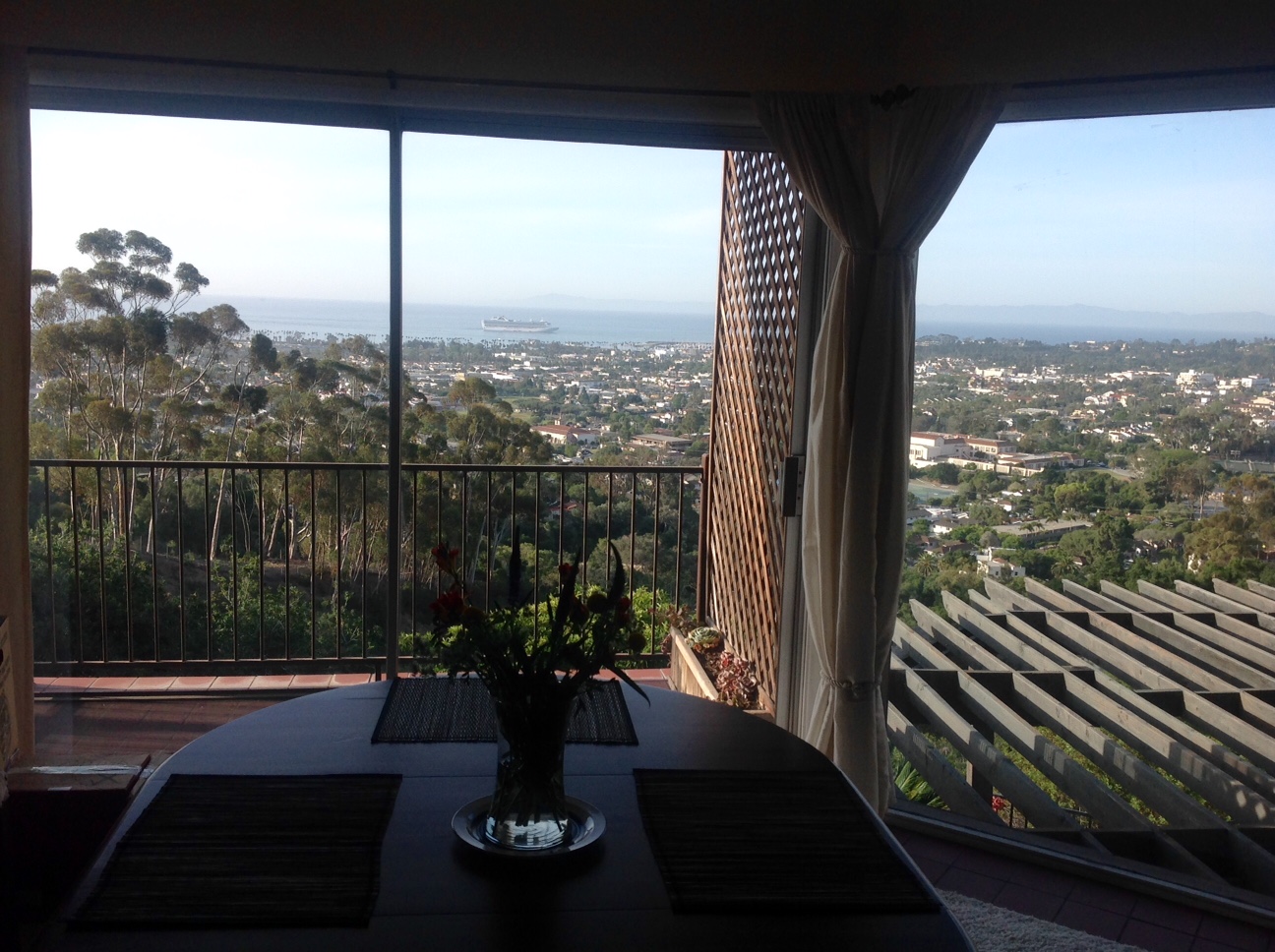
Once inside, I was overwhelmed again, this time by the view from his living room window. It looks out onto the city, the ocean and neighboring Channel Islands, topped by an expansive blue sky. Now I knew what he meant. The view is spectacular! The colorful natural scenery is constantly changing. At night the lights of the city and the stars create a different picture. It’s all very relaxing. You don’t want to leave.

Today I told him how lucky he was to be in this place, in such an incredible location. It’s like living in a painting. He said he had spent time exploring the different Santa Barbara neighborhoods, and was immediately drawn to Toro Canyon, Eucalyptus Hill, and the Riviera. Here’s a picture of the view that inspired yet another short poem.

View from Nathanael's home

You’re living in a painting
In the eye of the artist’s
Object of adoration

©Ken Chawkin
Santa Barbara
April 18, 2016

——————

A bit of history

I remembered the first time I came to Santa Barbara, in April 1974, an exotic welcome relief from the cold Canadian winter. I was a student at MIU, based in a temporary campus in Goleta. The university had rented an enclosed apartment complex. After a few months an actual college campus was purchased and we all moved to our permanent home in Fairfield, Iowa. Those were exciting days. We were pioneers!

The most recent time I was in Santa Barbara was in the summer of 2012 on my way to Greg and Britta Reitman‘s wedding in Ventura. Miriam Kasin, a friend who was living in Santa Barbara at the time, showed me around town for a few days before we drove to the wedding, where we had a fabulous time.

Yesterday, Nathanael took me to see the facility where MIU, now MUM, started in Goleta. That was 42 years ago! The place looked the same, but obviously different. I had turned 30 at that time, 5 years younger than Nathanael is now. By the time I was his age, I would already be married and he would be born a year later. And here we were, together sharing a part of my early history. What a difference a generation has made, thanks to Maharishi Mahesh Yogi!

Where MIU was in Goleta, CA

Central courtyard where MIU had set up campus in Goleta, California

For my birthday, Nathanael took me to The Boathouse at Hendry’s Beach for lunch. While waiting for our food I received a phone call from an unfamiliar caller. Here’s what happened.

— Written and compiled (citing sources) by Ken Chawkin for The Uncarved Blog.

Save

Save

Save

Threshold Haiku by Ken Chawkin for Nathanael

April 16, 2016

This haiku was inspired by the overwhelming scent of jasmine that greeted me as I crossed the threshold to my son’s home in the Santa Barbara Riviera.

image

Threshold Haiku

Before entering
The threshold to my son’s home
Pillars of jasmine

©Ken Chawkin
Santa Barbara
April 15, 2016

See more beautiful views to and from Nathanael’s Santa Barbara Riviera home that inspired another short poem.

Two and a half years later while visiting my son again I wrote another haiku about those same plants: Late Autumn in Santa Barbara.

— Written and compiled (citing sources) by Ken Chawkin for The Uncarved Blog.

The top 25 posts of 2015 on the @TMhome_com website that grabbed people’s attention

December 16, 2015

The popular TMhome.com website publishes a range of beautifully presented articles and interviews on the Transcendental Meditation technique and the people who practice it. They looked back and created a list of their TWENTY-FIVE MOST POPULAR POSTS of 2015.

We made it into the list twice—yours truly (14) and a documentary on Maharishi I facilitated (10), along with a mutual friend, Valerie Gangas (22) and her book, Enlightenment Is Sexy!!!

Well-known supermodel Miranda Kerr (23), Bollywood actress Anushka Sharma (17), business leaders, athletes, the DLF Change Begins Within gala (16) including singer Katy Perry, and TM teachers are listed, along with MUM alumna, singer and mystical poet Lyric Benson Fergusson (7), and former Japan PM Yukio Hatoyama (#24) who delivered MUM’s commencement speech. The telomerase study ranked high (3), and the top post was an interview with Cameron Diaz. The last one is a list of 12 great quotes on creativity. Here are the three I mentioned first.

10

620z_maharishiyogidocumentaryfullmoviehistorychannelw

The full documentary on Maharishi Mahesh Yogi,
now available for watching online.
—— read the article ——
.

14

620z_Kenchawkinpoetry_2
.
We invited Ken Chawkin, the man behind innumerable
written lines and at least one great movie (see no 10 above)
to step into the limelight. .
—— read the article ——
.

22

620z_EnlightenmentisSexybookreviewvaleriegangas_1

Enlightenment is Sexy, Valerie Gangas’s book about
falling in love with the universe made a big splash this summer. .
—— read the article ——

Nature’s Jewelry — haiku inspired by photograph

December 11, 2015

This week I went to my local Fairfield bank and picked up two copies of next year’s 2016 calendars for Sali and me. The pictures selected for each month were beautiful artistic photographs of local nature scenes. I recognized three of the photographers, friends of mine.

As I was showing and describing the pictures to Sali, one of them caught my eye and I was inspired to write a haiku, which happens around her! After many versions, here’s what I finally came up with.

Spider+Webs-8118

Nature’s Jewelry
A haiku based on a photograph by Jim Davis

tiny drops of dew
strung along a spider’s web
bright pearl necklaces

© Ken Chawkin
December 10+11, 2015
Fairfield, Iowa

Jim Davis, the photographer and a longtime friend, gave me permission to include this spider web photo from the First National Bank calendar, sponsored in part by the Jefferson County Trail Council. It was used for the month of May, Sali’s birth month. You can see more of his beautiful photographs in the calendar, if you have access to it. Visit his website: Jim Davis Images.

I asked Jim when and how he was able to take such a magical picture and he explained it this way:

The conditions for such a photo generally occur in late August and early September. It is an intersection of more spider webs due to onset of fall and warm days with cool nights creating early morning dew that drops off as the heat rises. Within those few days where the dew is created, there is the rare time when the air is still and the webs do not move. Without perfectly still air the dew drops would appear blurry or out of focus.

I turned the calendar upside down and noticed what appears to be Jim’s head and hat reflected in the large clear dewdrop under the leaf. He confirmed it saying his image would appear upside down in the drop.

Enjoy this other nature post and poem: The magic of fireflies is captured in this beautiful short film by @MaharishiU alum Radim Schreiber.

The Atlantic’s Jennie Rothenberg Gritz visited schools where @TMmeditation was being used for stress-reduction and well-being

December 11, 2015

Jennie Rothenberg grew up in Fairfield, Iowa, went to Maharishi School of the Age of Enlightenment, and attended UCBerkeley on a scholarship to study Journalism. She became a professional writer, a wife and a mother. Jennie is a former senior editor at The Atlantic, is now a senior editor at Smithsonian magazine.

The last piece Jennie wrote for The Atlantic, published November 10, 2015, was about the Quiet Time program, promoted by the David Lynch Foundation, and its success sponsoring the Transcendental Meditation technique in schools across the country.

The magazine introduces the article: After growing up with Transcendental Meditation as a spiritual practice, the author visits public schools where it’s being used as a simple tool for stress-reduction and well-being.

In 1974, the year before I was born, my parents had a small wedding in my aunt’s living room and then spent their honeymoon becoming teachers of Transcendental Meditation. Those were the days when just about everyone seemed to be doing it. “Plainly,” wrote the author Adam Smith in The Atlantic’s October 1975 cover story on meditation, “TM was the greatest thing since peach ice cream.” Meditation was enough of a cultural phenomenon that Woody Allen could use it as a punch line. The L.A. party scene in Annie Hall ends with Jeff Goldblum’s character placing a businesslike call to his instructor: “Yeah, I forgot my mantra.”

Considering how many 20-somethings learned to meditate in the 1970s, one might have predicted an explosion of meditating schools in the 1980s. Instead, Americans mostly forgot about the trend as they settled into the Reagan era. My parents were exceptions: They enrolled me in a small private school where the day began and ended with TM. It was an idyllic childhood in many ways, but my classmates and I always knew we lived in a bubble. One summer, at a resort in the Catskills, I listened as my aunt tried to explain my upbringing to a couple of her friends.

“Sure, I remember TM,” one woman replied. “I guess some people got caught up in meditation, just like some people got caught up in drugs.”

“And the rest of us,” her husband finished, “grew up and moved on with our lives.”

So I was fascinated when meditation recently started becoming mainstream again. Coworkers told me about mindfulness apps they were trying and friends mentioned yoga retreats they were planning to attend. The general idea seemed to be that meditation was not so much a technique for spiritual enlightenment as a common-sense lifestyle habit, like getting enough exercise or eating green vegetables. ….

Jennie visited several schools in poor, stressed inner-city locations where children from different ethnic backgrounds and broken homes came to school already traumatized. She wondered how administrators, teachers and students would react to such a program, and how it could be implemented.

It’s hard to change the circumstances that create this kind of stress, though plenty of people are trying. But if you teach kids to meditate in the meantime, the thinking goes, you can help them reduce the stress itself. That reasoning always made sense to me, as someone who has been practicing TM since childhood and seen the research on adults, especially for stress-related problems like heart disease. Struggling schools need lots of things: better food, stronger math programs, and higher-quality teachers, to name just a few. One of those needs seems to be a way to reduce stress so kids can absorb information and go into the world as well-balanced, successful people.

Still, I had a hard time envisioning how meditation programs actually worked when they were dropped suddenly into public schools. Who were the principals who brought them in—did they have hidden mystical streaks, or were their motivations purely practical? Were the teachers enthusiastic or did they see meditation as yet another gimmick imposed on them from the outside? And how did the students really feel about it? Did they roll their eyes when the meditation bell rang or did they actually enjoy it? What was it like to grow up with just meditation—and no spiritual trappings surrounding it?

The article continues with visits to some of the schools where the program was introduced. Jennie interviews principals, teachers, and the students to get their personal reactions to this meditation program and its effects on them.

Read the rest of this objective revealing report: Mantras Before Math Class by Jennie Rothenberg Gritz. This is journalism at its best!

PDF: Quiet Time Brings Transcendental Meditation to Public Schools.

You can follow Jennie Gritz on Twitter.

A year later, Jennie moved to The Smithsonian and published this excellent article: Director David Lynch Wants Schools to Teach Transcendental Meditation to Reduce Stress. The acclaimed filmmaker has become the champion of the practice that’s now been adopted by thousands of kids.