Here’s a little backgrounder on this poem, which I wrote around 20 years ago while on a course at Heavenly Mountain in Boone, North Carolina. The first part was originally just a haiku. It was a fun way to point out the need to increase awareness as a preparation to write. Years later, an idea presented itself extending the metaphor to its logical conclusion. The phrase, taken literally, was an unexpected surprise, along with the irresistible pun. I added them as a hoku, completing the poem, transforming it into a tanka on writing. Enjoy reading “Preparing to Write.”
We often hear about the the benefits of being in nature. I remembered an experience I had with a tree when I went for a winter walk with a friend on the University Endowment Lands in Vancouver during the mid-1990s. I’ve now updated that blog post with what had happened and how a poem came to be written around 25 years ago. The post contains links to other poems written about trees, and advice from Mary Oliver.
We often hear about the the benefits of being in nature. I remembered an experience I had with a tree when I went for a winter walk with a friend on the University Endowment Lands in Vancouver during the mid-1990s.
I stopped in front of a particular tree to admire its intricate bark structure up close. I felt a ray of loving attention come from the tree into my heart-mind with these words: “the realness of natural things, the nearness of you.” It was an unexpected intimate experience and I quickly wrote the words down for further exploration. The next morning, I rewrote them as a two-line stanza, and then sequential stanzas naturally unfolded sharing its wisdom. It was as if I had been given a creative seed and it sprouted into a poem.
This gift from the tree was much appreciated. The experience reiterated what Mary Oliver described in…
One of the first books of poetry I ever bought for myself was You Must Revise Your Life by William Stafford. It was part of The University of Michigan Press series of Poets on Poetry. His poems, essays and interviews on writing, teaching, and performing were a revelation!
I was discovering the writing process at the time and how to facilitate it, and found Stafford’s poems and his thoughts on the teaching of writing poetry to be very relevant. Here are a few that caught my attention: When I Met My Muse, You and Art, Ask Me, and A Course in Creative Writing.
I reread his poem, Rx Creative Writing: Identity, and decided to include it.
Rx Creative Writing: Identity By William Stafford
You take this pill, a new world springs out of whatever sea most drowned the old one, arrives like light.
Then that bone light belongs inside of things. You touch or hear so much yourself there is no dark.
Nothing left but what Aquinas counted: he—touched, luminous— bowed over sacred worlds, each one conceived, then really there—
Not just hard things: down on a duck as real as steel. You know so sure there burns a central vividness.
A writer is not so much someone who has something to say as he is someone who has found a process that will bring about new things he would not have thought of if he had not started to say them.
William Stafford & Mary Oliver on an inner light and telling about it
William Stafford describes “then that bone light belongs inside of things. You touch or hear so much yourself there is no dark. You know so sure there burns a central vividness.”
Mary Oliver’s uses similar imagery in her poem, White Owl Flies Into And Out Of The Field: “maybe death isn’t darkness, after all, but so much light wrapping itself around us—that is without the least dapple or shadow, that is nothing but light–scalding, aortal light—in which we are washed and washed out of our bones.”
Stafford concludes his poem with the role of the poet: “It tells you; all you do is tell about it.”
Mary Oliver, in her poem, Sometimes (4th stanza of 7), teaches us how to live a life — especially as a poet — in 3 short, powerful sentences. “Instructions for living a life: Pay attention. Be astonished. Tell about it.”
She exemplified this essential message in her poem, Mindful, where she delights in the world around her, which leaves her “like a needle in the haystack of light. It was what I was born for — to look, to listen, to lose myself inside this soft world — to instruct myself over and over in joy, and acclamation.”
New York poet laureate Marie Howe’s experience captured in her poem, Annunciation, and her conversations with On Being’s Krista Tippett and The Millions’ Alex Dueben, reveal a profound understanding of how poetry vividly comes to and through us.
These great poets remind us that, at our core, we are essentially pure light. All they do is listen and tell us about it.
— Written and compiled (citing sources) by Ken Chawkin for The Uncarved Blog.
Mary Oliver’s poem, Messenger, was written in her own unique voice, but it must have been influenced by her favorite American poet, Walt Whitman. It’s a perfect poem to share for Thanksgiving, since her poetry is a thanksgiving for being alive in the world, appreciating every living thing in it, and singing their praises. “My work is loving the world…mostly standing still and learning to be astonished…which is mostly rejoicing…which is gratitude…a mouth with which to give shouts of joy.”
My work is loving the world. Here the sunflowers, there the hummingbird— equal seekers of sweetness. Here the quickening yeast; there the blue plums. Here the clam deep in the speckled sand.
Are my boots old? Is my coat torn? Am I no longer young, and still half-perfect? Let me keep my mind on what matters, which is my work,
I posted many wonderful poems under this blog’s Poetry category. Also saved comments about poetry written by poets throughout the ages. These three made an impression on me years ago.
Hazrat Inayat Khan(1882–1927): The Music of Life,Poetry (pg. 327)
The one who reads poetry, the one who enjoys poetry, and the one who writes poetry must know that poetry is something that does not belong to this earth: it belongs to heaven, in whatever form one shows one’s appreciation and love for poetry, one really shows one’s appreciation and love for the spirit of beauty.
Yang Wan–li (1127–1206) Sung dynasty poet: What is Poetry?
Now, what is poetry? If you say it is simply a matter of words, I will say a good poet gets rid of words. If you say it is simply a matter of meaning, I will say a good poet gets rid of meaning. “But,” you ask, “without words and without meaning, where is the poetry?” To this I reply, “Get rid of words and get rid of meaning, and still there is poetry.”
Wei T’ai (5th Century BC) Chinese Song Dynasty poet and scholar
Poetry presents the thing in order to convey the feeling. It should be precise about the thing and reticent about the feeling, for as soon as the mind responds and connects with the thing the feeling shows in the words; this is how poetry enters deeply into us.
William Carlos Williams reiterates Wei T’ai in Jim Jarmusch film
In the Jim Jarmusch film, Paterson, the writing philosophy of American poet William Carlos Williams reiterates what Wei T’ai wrote around 2600 years ago, when he said, no ideas but in things. It’s similar to no feelings but in things. This historical view of Williams is discussed in an essay by Ed Wickliffe in the 2nd issue of Triggerfish Critical Review: Historical View of W.C.Williams’: “No Ideas But in Things” by Ed Wickliffe.
I enjoy listening to songwriters talk about their creative process—how they approach the task of writing a song, the kind of strategies they use.
How Don Henley writes his songs
I recently watched a 92nd Street Y interview posted on YouTube in 2015. American Rock royalty Billy Joel and Eagles drummer and singer-songwriter Don Henley covered a lot of ground in 85 minutes. One of the things Joel asked Henley about was what does he do to get himself into the space where he can write songs.
Don tells Billy how he may hole up in a cabin, or somewhere where he won’t be disturbed, and shuts out all electronic distractions. He also says he doesn’t just sit there and write; he can’t force the words to come. He says he follows the zen-like advice to do a simple task first.
He tells the audience, “I’m dead serious. I’ve written some of my best stuff loading and unloading the dishwasher! Because you’re distracted and yet you’re not. I don’t know how to explain this. But, and I’ve read, you know, zen masters talking about the same sort of thing—if you can just do a menial task instead of sitting there with a pen and paper, in front of you going, (he clenches his fists and grunts).” That part of this fascinating discussion starts at 57:14 in the embedded video below.
How Lissie writes her songs
That reminds me of the exact same thing Lissie said in The A-Sides Interview. She discusses how she is learning to balance art with commerce, and spontaneity with structure. Describing her creative process she usually comes up with a melody, sometimes working with other musicians, then later writes the lyrics alone.
When writing lyrics, she’s “careful to not force it” and is always surprised when rhyming phrases pop into her head “if I’m doing the dishes, or if I’m walking.” That’s when she’s presented with newer better word choices she hadn’t thought of.
Lissie emphasizes finding a balance “being spontaneous, yet structured.” That part, and more, of this interesting interview starts at 4:58 in the embedded video below.
How Colin Hay writes his songs
Another singer-songwriter I had discovered and recently wrote about is Colin Hay. When it comes to writing songs he says he likes to have as empty a mind as possible and puts himself in a space where he won’t be interrupted. He emphasizes that time is important, to give himself enough time to fail. He describes a scene where he’s all alone for 3 or 4 hours without any distractions, just sitting with his acoustic guitar doing nothing, just idling, coming up with musical ideas.
At other times, a friend may drop by and mention something in passing that will act as a catalyst to what he’s been thinking about. It triggers the melody, and then the words spontaneously come out in one take. In those cases he’ll quickly finish a song in under an hour. That’s how he wrote Waiting for my Real Life to Begin.
Colin explains this to Brooke Baldwin in a 2011 CNN interview when she asks him where he was when he wrote that song, then quotes some of the lyrics to him. That part starts at 3:52 in the embedded video below.
TM, creativity, and the default mode network
Our minds are usually working on a particular problem, consciously and unconsciously. I’ve had the same thing happen to me when I’m writing a poem or a blog post and reach an impasse. I give up, let it go, and, surprisingly, the right solution later presents itself when I least expect it.
Science calls that place in our brains the default mode network (DMN), a.k.a. the imagination network or genius lounge. It’s activated when the mind is daydreaming, not engaged or concentrating on anything, just “idling” as Colin Hay put it. The key is to be easy. Focusing or “forcing it” turns it off.
Interestingly, the DMN is also activated during the effortless practice of the Transcendental Meditation technique as practitioners experience a state of “restful alertness.” Sometimes great ideas may show up during, but more likely after TM, what David Lynch calls, “Catching the Big Fish.” He often tells students, “TM is a boon for the filmmaker.” It facilitates access to one’s inner resources to create and think out of the box.
Jon Bon Jovi says washing dishes brings on hit songs
Addendum: Jon Bon Jovi, who loves doing TM, shared the same experience as Don Henley and Lissie on Monday night’s A Late Show with Stephen Colbert when they discussed the events that influenced his new album, Bon Jovi 2020. He told Colbert how the song Do What You Can came about when he was washing dishes in one of their JBJ Soul Kitchens during the COVID-19 pandemic. Bon Jovi concluded, “Washing dishes brings on hit songs, Stephen.”
“A few are as permanent as love is old.” Wise words from this young poet! They ring true; go deep. Some of us may be blessed to have such people in our lives. Maybe we are that person for someone. Either way, it’s a blessing.
I was lucky to have been in a committed relationship with a special lady in my life, and was there for her, right up to her last breath, and beyond. Even though she passed away four years ago tonight (Oct 1, 2016), the love remains.
The perception of time is strange. Memories of certain events remain with us long after they’ve gone. They become part of our story. I still remember a unique experience I had over 20 years ago. I found the poem I had written about it trying to understand what was happening at that time. But first, a backgrounder on what led up to it.
Saturn (Shani) was exerting its influence during an Antardasha, or sub-period. I was also in the last third of a 7.5 years-long period of Shani influencing my Moon (Chandra), which governs the mind and emotions. It is a challenging time known as Sade-Sati in eastern astrology. We go through this transit at least once or twice during our lifetime. The texts say that “persons under this influence are betrayed in their financial, personal, social and marital matters.” I often recalled what Nietzsche said about life’s suffering: “That which does not kill us, makes us stronger.”
My life wasn’t that bad, yet I had been under a lot of different pressures going nowhere. I was given the opportunity to join the Maharishi Purusha Program. It was something I had thought about, but life’s decisions had taken me in other directions. I reconsidered my current situation and decided to give it a try.
At one point the Maharishi Jyotish office offered astrology readings and recommended remedies for what might be coming down the proverbial karmic pipeline. This was something I had always wanted to do but could never afford to. Since I was on this special program for single men, the cost for the reading and remedy was more within reach. The main recommendation was to have a double level Maharishi Yagya done for both Shani influences. I decided to go for it, not knowing what to expect.
While an ancient Vedic performance was being conducted in India, I was feeling something in North Carolina! The experience was abstract, yet so real! The only way I could make any sense of it was to put it into words. This poem came out and surprisingly defined the moment for me.
Awake Before The Dawn
Another sun has risen this morning not one of light but of wakefulness
I find myself strangely silent inside not feeling anything but lightness
So this is what it’s like to be alive awake at last to the Dawning of Eternity
Written on Saturday, July 10, 1999 In honor of my Shani Yagya Ken Chawkin, SCA, Boone, NC
Aside from what Nietzsche said, having that Yagya and being on Purusha helped lighten the karmic load considerably!! Eleven months later I volunteered for a project and found myself in the exotic land of Indonesia. An unusual experience greeted me there early one morning. I woke myself up to write down this Indonesian Mystery Poem.
Interestingly, during that year abroad, I would spend time in 5 different countries: Indonesia, Singapore, Malaysia, India, and Australia. I later discovered that when I left Boone to travel to Jakarta, Jupiter (Guru) had started a 13-month transit across my 12th house, which indicated a loss of homeland. Amazing how this all works!
I’m currently undergoing a Maharishi Yagya for an upcoming major Mars period, Mangal Mahadasha. It brought up memories from that time at the Spiritual Center of America where I wrote this poem and the journey that would later unfold. Another incredible story that would take volumes!
I first discovered this great Canadian aboriginal writer on a blog I follow. I looked into the book she quoted from, Embers: One Ojibway’s Meditations by Richard Wagamese, and bought it based on this first entry I read in Chapter I: STILLNESS.
I AM MY silence. I am not the busyness of my thoughts or the daily rhythm of my actions. I am not the stuff that constitutes my world. I am not my talk. I am not my actions. I am my silence. I am the consciousness that perceives all these things. When I go to my consciousness, to that great pool of silence that observes the intricacies of my life, I am aware that I am me. I take a little time each day to sit in silence so that I can move outward in balance into the great clamour of living.
These two entries in Chapter II: HARMONY are equally profound. This first one, about the relationship between the soul and the body, reminds me of what the Sufi mystics said about the body and the universe, the microcosm and the macrocosm.
I USED TO believe my body contained my soul. That was fine for a while. But when I started thinking about oneness with Creator, I came to believe that it’s the other way around. My soul contains my body. It is everything that I am. I am never separate from Creator except within my mind. That’s the ultimate truth, and I need to be reminded, to learn again, to learn anew in order to get it. When I do, I know the truth of what my people say: that we are all spirit, we are all energy, joined to everything that is everywhere, all things coming true together.
Interestingly, when the mind forgets this oneness, loses its connection to inner wholeness, the result is what Maharishi calls Pragyāparādha, the mistake of the intellect, which identifies with a changing limited reality instead of our unbounded inner Self. This identification with the world and loss of memory of the Self is the root cause of all of our suffering, the difference between bondage and liberation.
The other entry, about coming under the influence of the muse, reminds me of William Stafford, another poet who would also get up early every morning to write before sunrise. Although similar in theme, but not as profound, his poem, When I Met My Muse, is more lighthearted.
WHEN THE MUSE is full upon you, you move to the chair at your desk as if entranced, and in that ghostly glow against the full dark before sunrise, story becomes a shape-shifter, a presence that cajoles you, tempts you, coaxes words to eke out onto the page, creating worlds and people from the fire deep within you so that this alchemy of creation becomes transcendent, making time lose all its properties. There is just you and the universe and this creative fire moving through your fingers in bold palettes of colour chasing the dark away until you emerge in the sure, calm light of morning and feel like a writer again.
I discovered a similar transcendent experience described by Canadian Realist Painter Sarah McKendry as she paints through the night until sunrise. See my comment and her quote below in the Responses section.
Discovering Richard Wagamese the Storyteller
Richard Wagamese (October 14, 1955 – March 10, 2017) was an internationally renowned, award-winning author, newspaper columnist and reporter who had also worked in radio and television. In this CBC interview, Candy Palmater asks Richard how a library helped him become a writer. As a destitute, homeless teenager, he walked into a building for warmth and noticed it was filled with silence and many books. He didn’t know where he was. A kind librarian brought him some food and showed him how to find what he was interested in. Richard had only a grade 9 education and devoured books on a wide range of topics. He taught himself how to become a writer and would copy sentences by hand of the great authors who moved him just to see what it felt like. He tells Candy the role he played in the making of the film based on his book.
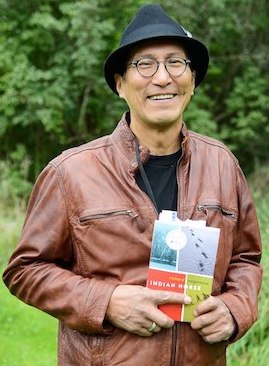
Indian Horse, the novel and the film
I had just watched an emotionally-charged film on Netflix called Indian Horse. I checked and found out that the film was based on the award-winning novel Indian Horse written by this same Ojibway author! Clint Eastwood was the executive producer. It tells the tragic, yet hopeful and redemptive story of the main character, Saul Indian Horse. Events unfold during a dark era in Canadian history, when young native Indians were separated from their families (including Wagamese’s parents), and sent to notorious Catholic Residential Schools where they were forced to not speak their language or practice their culture. The nuns and priests tried to “scrape the Indian out of them” violently molding them into Christians, traumatizing them for life.
Despite this, Saul finds salvation in the unlikeliest of places and the most favorite of Canadian pastimes — hockey. Fascinated by the game, he secretly teaches himself how to play, and develops a unique and rare skill. Saul’s talent leads him away from the misery of the Residential School to a Northern Ontario Indigenous league and eventually to the pros – but the terrors of Saul’s past seem to follow him.
Wagamese suffered from second-generational trauma, abused drugs and alcohol, was homeless and landed in prison many times. He would eventually be diagnosed with PTSD, which gave him a better understanding of his helpless situation, and finally sought treatment.
A wise tribal Elder told him his role in life was to become a storyteller. Writing would become a healing redemptive practice for him. Surprisingly, many of his readers felt seen, understood. His stories helped them too in their healing journey, fulfilling his destiny.
People who knew Wagamese said he was the creator, parent and protector of stories. Host of CBC Radio’s The Next Chapter and chancellor of the University of Victoria, Shelagh Rogers said of her longtime friend, “Richard really believed everybody had a story.” Listen to Shelagh Rogers’ tribute to Richard Wagamese, a great man who passed away unexpectedly and too soon at the age of 61.
The nature of a writer‘s life
As a writer, Richard Wagamese would win many prestigious awards. On November 3, 2015 in Toronto, the Writers Trust of Canada honored him with the 2015 Matt Cohen Award: In Celebration of a Writing Life. In his humble, at times emotional acceptance speech, he beautifully described his early morning rituals followed by sitting for a while in the candle-lit darkness, thinking about what it is that he is about to do, “and you ask for as much guidance and strength from The Creator as possible.” He heads down the hall to a place where he will sit for hours at his computer. “And you sit there and you breathe and you hope and you dream and you close your eyes, and you feel the essence of that gift radiating inside you. And you put your fingers on that keyboard and watch while they emerge out upon the screen.”
I love this part of his speech: “And you wait for that time when you know that that perfect sentence has just occurred. And there‘s a gladdening in your spirit when that happens, and you seek to write another one, just like it, to follow it across the page. And in my experience, that‘s the nature of a writer‘s life. That immaculate sense of solitude, when there‘s just you and the language and the air and the universe and that gift that The Creator downloaded you with free-of-charge…. “
Richard Wagamese 2015 Matt Cohen Award speech
And in my experience, that‘s the nature of a writer‘s life. That immaculate sense of solitude, when there‘s just you and the language and the air and the universe and that gift that The Creator downloaded you with free-of-charge.
Writing for the story’s sake and not your own
In this talk at the University of British Columbia (Nov 27, 2013) on his book tour for Indian Horse, author Wagamese gives some valuable advice for young writers. His years of experience honing his craft as a journalist and a writer for radio and television prepared him to become a successful novelist and poet. “In that way of writing you learn how to be sharp, simple and concise, and learn how to trim the fat from every sentence, and you learn how to say exactly what you mean and to mean what you say.” He emphasized “that conciseness and that brevity that results in perfect clarity really served this novel well.”
He goes on to explain that it wasn’t necessary to be overly dramatic or poetic in his prose. “You harness that, you reign that back in and you learn to work for the story itself. And if there’s any aspiring or perspiring writers in the room, that’s the biggest advice I can give you, that if you work for the story’s sake all the time it will spare you the anxiety and the inner debate about how much you should write or in what way you should write it because you’re writing for the story’s sake and not your own. And again that particular rule served me well in the writing of Indian Horse.”
In a July 4, 2014 Globe and Mail article, we learn where he got that advice from: Q: What’s the best advice you’ve ever received? A:Norval Morrisseau once told me to “work for the story’s sake” and that is the best advice I’ve ever received. When I work for the story’s sake I leave my ego at the door and the energy of the story emerges without my interference. It’s why Indian Horse and Medicine Walk ring so resonant with people – because me and my ego are not in the way of the story pouring outward.
Embrace everything and write what you don’t know
A year later (Nov 18, 2014), Richard Wagamese was invited to read from the MacEwan Book of the Year 2013/14, Indian Horse. It included an on-stage interview with author Richard Van Camp. He read from Indian Horse, answered good questions from the audience, and concluded with a reading from his new book Medicine Walk, a story about a reconciliation between an absent father and his son, something Wagamese had been grappling with in his own life. MacEwan University posted this inspiring event on YouTube.
He offered good advice to hopeful writers and shared his process, how when he goes on long walks, he connects with the land, and thinks about ideas that get triggered. He says them out loud to himself as he develops a story until it’s clearer to him, then returns home to type it up on his computer, offline to avoid distractions. He told them to be open to anything as it could trigger a story. They should open themselves up to and embrace everything as it would impact their writing and keep their readers engaged.
He also touched on the notion that “some courses and programs tell you to write what you know.” I found his take on that advice revealing: “But it’s come to me over the course of the last few books, that if I write what I don’t know, then the process of me discovering the answers to what I don’t know makes the journey of following the story in the book stronger for the reader, because we both get to find the answer together.” (These great writers said the exact same thing.)
But it’s come to me over the course of the last few books, that if I write what I don’t know, then the process of me discovering the answers to what I don’t know makes the journey of following the story in the book stronger for the reader, because we both get to find the answer together.
This final question was very interesting, one that he “was not often asked.” He gave a surprising and impressive answer. He shared how his 16 months of yoga and meditation practice, along with a change in diet had improved his life physically, emotionally, and spiritually. On all these levels, yoga was “informing my sense of myself.” It brought a peace and a quietness within the process “that I’ve been waiting for all my life.” Answering her question specifically he explained, “and so when I turn to the act of writing, I bring that same sense of holism into the process of writing.” He then described the kind of improvements he experienced in his skill as a writer, attributing them to that influence, which, he concluded, created “a big leap forward” that showed up in his new book, Medicine Walk. (A good question that elicited a great answer!)
Learning to become a better person
In her informative and heartfelt obituary (March 24, 2017, updated May 16, 2018): Ojibway author Richard Wagamese found salvation in stories, Globe and Mail journalist Marsha Lederman wrote that “his last book, Embers: One Ojibway’s Meditations, came out of Mr. Wagamese’s daily Facebook posts. They had a devoted following and Douglas and McIntyre head Howard White proposed publishing them as a collection. On March 7, Embers was nominated for a BC Book Award. Two nights later, Mr. Wagamese went to sleep and didn’t wake up.”
The book actually did win the 2017 Bill Duthie Booksellers’ Choice Award. This is the conclusion to her article: In one of Mr. Wagamese’s final Facebook meditations, posted in November, he wrote about starting his day with candlelight, tea and meditation, and what the years had taught him. “Actions born of contemplation are wiser than those made in quiet desperation. If all that’s true, and I feel it is, then I have grown some in these 61 years. I have learned and become a better person. And from that maybe it’s the years ahead that will be the richest of my life. A quiet man moving forward, gladly beyond all expectation.”
Two new posthumously published books by Richard Wagamese
CBC Books posted news of two new posthumously published books by Richard Wagamese: the unfinished novel Starlight (Mar 01, 2018) and One Drum (Nov 06, 2019). This latest book review also includes 3 earlier CBC Radio interviews, 2 of which are referenced in this blog post. You can Read an excerpt from Richard Wagamese’s final book, One Drum.
Related posts: I later found this excellent book review by Eldon Yellowhorn in The Ormsby Review posted on BC Booklook: Richard Wagamese’s third solitude. He concludes Indian Horse “is the composition that will forever evoke the name Richard Wagamese.”
I’ll admit my ignorance here. All I remember of Erica Jong was her early 70’s infamous best-selling novel, Fear of Flying. I had no idea that she had become such a prolific award-winning writer. Besides being a famous author, she is also a fine poet. She says, “The poetry is the source of absolutely everything I do.” I discovered some of her impressive poems looking inside Becoming Light: New and Selected Poems, and on poetry websites PoemHunter and Poeticous.
Filled with life and passion, Jong uses breath, air, wind, “prana whistling in the dark;” and fire, “a flame in the heart,” “a living lantern,” as imaginary ways to describe the creative forces within the heart of a poet. They are beautifully expressed in these 3 poems: Alphabet Poem: To the Letter I, Poem to Kabir, and Zen & the Art of Poetry. There may be other poems with these motifs I have yet to discover, but these caught my attention for their shared imagery and theme of being a poet, a writer.
Alphabet Poem: To the Letter I (12th/last stanza, 3rd poem in Becoming Light)

We are all one poet
and always
we have one
communal name,
god's name, nameless,
a flame in the heart,
a breath,
a gust of air,
prana whistling in the dark.
i dies—
but the breath
lingers on
through the medium
of the magic
alphabet
and in its wake
death is no more
than metaphor.

Poem to Kabir

Kabir says
the breath inside the breath
is God

& I say to Kabir
you are the breath inside that breath
which is not to say
that the poet is God–

but only that God
uses the poet
as the wind
uses
a sail.

Zen & the Art of Poetry

Letting the mind go,
letting the pen, the breath,
the movement of images in & out
of the mouth
go calm, go rhythmic
as the rise & fall of waves,
as one sits in the lotus position
over the world,
holding the pen so lightly
that it scarcely stains the page,
holding the breath
in the glowing cage of the ribs,
until the heart
is only a living lantern
fueled by breath,
& the pen writes
what the heart wills
& the whole world goes out,
goes black,
but for the hard, clear stars
below.
In the last section of What You Need to Be a Writer, Jong comes clean, listing her fears, then describes what it really takes to be a writer — having something to say so intensely, that it “burns like a coal in your gut…pounds like a pump in your groin,” and concludes with having “the courage to love like a wound that never heals.” Ah, the human condition.
& then there’s all
I did not
say:

to be
a writer
what you need
is

something
to say:

something
that burns
like a hot coal
in your gut

something
that pounds
like a pump
in your groin

& the courage
to love
like a wound

that never
heals.
In a Mother’s Day Playboy interview last year, the first question daughter and writer Molly Jong-Fast asks her mother is how she knows things, especially what’s happening to women in the socio-political arena. Jong answers: “I think a writer is someone who lives like a wound that never heals. And if you’re a writer, you feel the rumblings in the air.” It’s interesting how she uses the same metaphor for a writer to love or live like “a wound that never heals.” How she’s been bravely living her life.



 The Uncarved Blog