
Archive for the ‘Poetry’ Category

Another Fall Haiku

November 6, 2011

Another Fall Haiku

The wind is blowing
Leaves on the ground are running
Winter is coming

*

Another Fall Haiku
(2nd version)

Cold winds are blowing
Fall leaves are running … running
Winter is coming

© Ken Chawkin
November 6, 2011
Fairfield, Iowa

See The Fall in Five Haiku and 13 Ways to Write Haiku: A Poet’s Dozen

— Written and compiled (citing sources) by Ken Chawkin for The Uncarved Blog.

POEM OF THE DAY: Mirror Lake by Rolf Erickson

October 11, 2011

MIRROR LAKE

One
trout
rises

to nibble
a
reflected star

sending ripples through the universe

© Rolf Erickson

Published in This Enduring Gift—A Flowering of Fairfield Poetry, 2010, and selected as the Poem of the Day, October 8, 2011.

Also see The Poet by Rolf Erickson.

Mary Oliver’s poem of a fish leaping At the Lake also captures this kind of magic in words.

Willow Tree Tanka II

October 3, 2011

It’s a long story, but some people drive on the front lawn, under and through the willow tree branches, to get to the next-door neighbor, something I wasn’t too happy about. One of the visitors complained about the long willowy branches getting in the way, which prompted the management to trim them back. Not something I cared to see happen. Sort of like getting a brushcut when you preferred keeping a pompador. Welcome to the Midwest!

Willow Tree Tanka II
(in reverse)

Why the Willow Tree complained
After its branches were cut

They say I’m too long
You can’t let your hair down here
So they cut me short

Ken Chawkin
Oct 3, 2011
Fairfield, Iowa

See the first poem: Willow Tree – a tanka – from a tree’s perspective.

Hoku For Sali

September 24, 2011

Hoku For Sali

A Goddess Dwells Within You
And She Is So Beautiful

© Ken Chawkin
September 24, 2011
Fairfield, Iowa

Also see Haiku For Sali and Sally’s Smile (Haiku for Nurse Dan)

Haiku For Sali

September 23, 2011

Haiku For Sali

We are true lovers
You are the key that unlocks
The Beauty in me

© Ken Chawkin
September 23, 2011
Fairfield, Iowa

Also see Hoku For Sali and Sally’s Smile (Haiku for Nurse Dan)

Sally’s Smile (Haiku for Nurse Dan)

September 23, 2011

Whenever Nurse Dan came into Sally’s room to dispense her meds, he would cheerfully call out her name and greet her with a big smile. We were always happy to see him and Sally would light up. Dan told us he was going to be leaving the facility to work at just his other job. But he added there was one thing he was going to miss around here, and that was Sally’s smile. Sally does have a beautiful smile, and I thought that was a great title for a poem. So as soon as Dan left the room I wrote this haiku and dedicated it to him. The first two lines came easily, but I had to think about what was really going on when Sally smiled at someone who acknowledged her. She watched me writing and saying it to myself. When I read it to her, she quietly said, “Thank you.”

Sally’s Smile
(Haiku for Nurse Dan)

Flooded with Sunshine
From the Glow of Sally’s Smile
You Know Your Own Worth

© Ken Chawkin
September 22, 2011
In the presence of my muse,
Sali M. Peden

Also see: Sweet Haiku for Sali | Haiku For Sali | Hoku For Sali

See these newer poems: Sali’s Nature and Tanka For Sali Upholding Her Wonderful Nature.

POEM OF THE DAY: Poetry – The Art of the Voice, by Ken Chawkin

September 18, 2011

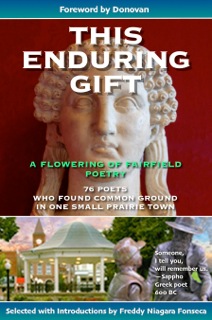
Here’s the POEM OF THE DAY, presented by THIS ENDURING GIFT, A Flowering of Fairfield Poetry, 76 Poets Who Found Common Ground in One Small Prairie Town:

POETRY – THE ART OF THE VOICE

How fine will your breath become
from listening to these words?
How soft will they seem to be
as they settle through the mind
like silent snowflakes falling
from a windless winter sky?

I often marvel at the mystery—
how words can work
on a listener’s heart and mind,
upon hearing a poet’s thoughts,
a poet’s breath, flowing
from an inner voice—

a windless wind, speaking
through a voiceless voice.

© Ken Chawkin

Published in This Enduring Gift, 2010
http://www.thisenduringgift.com/poetry-the-art-of-the-voice.html

“This Enduring Gift is a testament to the abiding power of poetry within a particularly unique community and, by extension, speaks to poetry’s universal relevance. Here, a convergence of voices from places near and far, gathered in a small Midwestern town, observe, reflect, meditate, and wonder. From evocative lyrics to compelling narratives, from precise moments of deeply felt experience to inquiries of mystical complexities, these poems resonate with individual authenticity and true collective spirit.”
— Walter E. Butts, 2009-2014 Poet Laureate of New Hampshire

Enjoy and share these POEMS OF THE DAY with friends and poetry lovers you know.

Freddy Niagara Fonseca
PO Box 1271
Fairfield, IA 52556
641-472-7634
operafred@lisco.com

Creator of
Fairfield’s No. 1 Bestselling Poetry Book
THIS ENDURING GIFT
A Flowering of Fairfield Poetry
76 Poets Who Found Common Ground in One Small Prairie Town

Published in 2010 by 1st World Publishing
To purchase THIS ENDURING GIFT, go to http://www.thisenduringgift.com

Also available in Fairfield at Revelations Cafe & Bookstore

If you click on the link to the Poem of the Day you’ll notice only two stanzas of 6 and 8 lines each, which is the way I had originally written it. Below is an explanation I had emailed friends for this change into three stanzas, a newer final version:

(more…)

Persian Poetry Gets the Blues

September 10, 2011


MUSIC
AUGUST 30, 2011
Persian Poetry Gets the Blues
By EMILY ESFAHANI SMITH
New York

Sitting at a chic wine bar in the Flatiron district, Rana Farhan lounges back in her chair—a cup of hot black tea in her hand on this balmy August day. “It’s very hard to take classical Persian poetry and make it sound like Al Green or Billie Holiday,” she says in her husky voice. But this has been the Iranian jazz singer’s pursuit since 2005, when she stumbled upon an intoxicating and utterly fresh musical combination: singing the exquisite Persian verses of mystical poets like Rumi, Hafez and Omar Khayyám to the rhythms of cool American blues, jazz and soul.
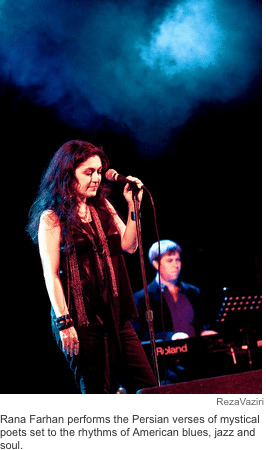
Her latest album, “Moon and Stone,” is an expressive tribute to soul music. “I’ve been listening to a lot of Teddy Pendergrass and Otis Redding lately.” Through her raspy Iranian accent, she adds, “Oh, and Sam Cooke. I love him.” On Saturday, Ms. Farhan will be celebrating the release of her CD with a performance at Caffe Vivaldi here, followed by a tour in the coming weeks with stops at the El Rey Theatre in Los Angeles and  Yoshi’s Jazz Club in San Francisco.

While Ms. Farhan has been a renowned musician in Iran for several years now, it was not until 2009 that she grabbed the attention of the international scene with her sultry jazz song “Drunk With Love.” The song was prominently featured in the heart-wrenching Iranian movie “No One Knows About Persian Cats.” The film, which won an award at the 2009 Cannes Film Festival, tells the story of Iran’s underground indie-rock scene.

Sung passionately in Farsi, “Drunk With Love” is from a Rumi poem that celebrates a sensual—even erotic—passion for the divine: “Oh love . . . the king of kings has gotten drunk, / Get up, grab his curls and pull him near. / Every thought that comes into my heart speaks of the Lover, / I’ll put my life before him, I want to kiss him and fill his mouth with gold, / face like a rose, voice of a nightingale, / I want to fulfill all his desires. . . .”

This is a far cry from the heartless Islam of Iran’s anti-American mullahs. But Iran was a different country during Ms. Farhan’s youth—it was the place that stirred her jazzy muse; it was her home. During her carefree childhood, before the Islamic Revolution, Western media could flow freely into Iran’s urban centers. One of Ms. Farhan’s haunts back then was a “cool” used-record store in Tehran called Beethoven. There, she could get her hands on the latest American sounds—Janis Joplin, the Rolling Stones and Johnny Winter, for instance.

“I fell in love with the blues early on,” she tells me. Specifically, she fell intensely in love with Billie Holiday. “I’ve read every single biography of her.”

Ms. Farhan says that she “was constantly trying to figure out how to sing Persian poetry to the blues.” In Iran, classical poetry is a cherished part of the traditional music culture, the same way that jazz and blues define U.S. music culture. Even Iranians who cannot read or write grow up learning the poems of Rumi by heart. Ms. Farhan says she and her family would read classical Persian poetry together on their vacations. “The way I see the poems as blues really comes from my father,” she says.

But Iran’s 1979 revolution changed life completely for Ms. Farhan, who was a student at the Tehran University of Fine Arts at the time. With the establishment of an Islamic theocracy, women’s freedoms were radically and suddenly restricted. Today, women are not allowed to perform before mixed-sex audiences.

So Ms. Farhan fled her home country and came to New York, carrying in her mind a trove of Persian poetry—and her childhood desire to blend it with raw American blues.

Years later, she finally managed to get these two unlikely lovers together. It was 2005 and she was living in Manhattan when she stumbled across a guitar case sitting in a pile of trash on the sidewalk outside of her apartment. Inside the case was a beat-up guitar. Ms. Farhan was offended that someone had thrown away a perfectly good instrument, so she took it to her producer, the guitarist Steven Toub, and the two of them cleaned it up and put new strings on it.

“Then,” Ms. Farhan begins, “Steve started randomly playing a blues riff on it. Rumi’s book was laying open nearby, so I started singing in Farsi [the poem] ‘Rumi’s Prayer.'” To their astonishment, they had a sexy blues number on their hands. It was Lady Day meets the 13th-century Islamic world. And, like so many of Rumi’s poems, the song was about God, the Beloved.

They promoted the track to their friends and fans, and as Ms. Farhan recalls, “the whole thing exploded. Everybody loved it.” With that enthusiastic response from both U.S. and international listeners, Ms. Farhan and Mr. Toub released a full-length CD of Persian jazz in 2007. The album, called “I Return,” featured the poetry of Hafez and Rumi. “That year was Rumi’s 800th birthday, and it was like—yeah! Rumi wanted jazz for his birthday,” Ms. Farhan says with a laugh.

Finishing up her tea and cookies, Ms. Farhan notes that mixing “the best of Iranian culture” with “the best of American culture” is not as far-fetched as it seems. “Rumi and Hafez were the blues of their time.” Humming a melody from her new CD, she explains, “When you put their verses with the blues, it’s like they’ve always belonged there.”

Ms. Smith is managing editor of the Hoover Institution journal Defining Ideas and assistant editor of The New Criterion.

Copyright 2011 Dow Jones & Company, Inc. All Rights Reserved

Rana Farhan: Website, MySpace, Facebook, YouTube, TwitterWiki 

Listen to Rana Farhan sing this beautiful song, Tangled, from her new CD, Moon And Stone, a unique fusion of classical Persian poetry with contemporary blues and jazz.
At last—the truth about Frankenstein

August 19, 2011

This is one of my favorite poems, written by a good friend and a fine poet, Bill Graeser. The title now links to his new website where the poem has since been divided into seven stanzas. 

What You May Not Know About Frankenstein

Although he had not the hands to crochet, the patience to build birdhouses or the nerve to push a hook through a worm in the hope of pulling a fish from the sea, he did write poems and wrote often and late into the night.  Was it pain that made him write?  The pain of all those stitches, of shoes that despite their size were still too small?  Was it psychological pain of social non-acceptance?  Or the electricity that years later still snapped between his fingers?

No, it was simply what his brain wanted to do, the brain they dug up and sowed into his head, it was just grave-robbing luck.  At poetry readings, where everyone is welcome, he read his poems sounding like a man who having fallen into a well and cried out for years was now finally being heard.

Like this there are many so-called monsters with poems to share.  The same is true of angels, of gangsters, shepherds, anyone who fits words together like body parts, revises, revises again, until magically, beautifully, lightning leaps from the pen and the poem opens its eyes, sits up from the page, staggers into the world, and whether it is seen as monster, or friend, it is alive, every word it says is real and it comes not from the grave, but from the sky.

© Bill Graeser

Also see Bill Graeser memorializes Ansel Adams in his award-winning poem “Magic Light”.

In an interview for the Fall 2001 issue of Paris Review, George Plimpton asks US Poet Laureate Billy Collins to describe what it takes to be a poet.

(more…)

The Power of The Pen, by Ken Chawkin

July 3, 2011