Archive for the ‘Poetry’ Category

Vancouver Park Poems by Ken Chawkin

January 23, 2012

Some people whistle while they work; I write poems. I wrote a poem on my first day working for the Vancouver Board of Parks and Recreation as a paper-picker in Queen Elizabeth Park. It was in the mid-1990’s, during winter, and I remember noticing that berries on trees had turned white.

The regular park attendant left each year to go to California for the winter and he was looking for a temporary replacement. Some friends who had done the job for him the previous year asked me if I was interested. I told them I was and suggested they arrange a meeting.

Turns out he was a poet and a spiritual seeker who had been to India to spend time with his guru. We talked about meditation and shared some of our poetry. I admired his nature poems written from his experiences in the park. They were rhapsodic. I remember him telling me that every tree in the park knew him. He arranged for me to take his job for the winter, and we negotiated my staying in his place, the park facility across the street in Hillsdale Park.

I was very lucky to have gotten that job by referral, by default. That’s what his boss implied since he had to approve me for the position. He wasn’t too happy with the arrangement but went along with it. He said many people were on a waiting list to become a paper-picker or a caretaker in one of the city parks, prized positions that paid well.

When the person I had replaced returned, the Parks Board manager offered me a job for the summer, going to Stanley Park and other city facilities along the public beaches, cleaning up and replacing soap and paper supplies in public washrooms. That was an afternoon job with a lady. We would travel as a team in one of the Park vans.

But the winter job kept me active, walking miles each day, spent mostly in nature, in a beautiful park setting. It was what I needed at the time. And I made more money doing that than my other job teaching kids writing after school at a Sylvan Learning Center in North Vancouver.

As a city employee, I had become a member of the local blue collar union. My responsibilities included cleaning the public washrooms early in the mornings, the gardeners’ facilities on Sundays, and walking the park grounds picking up trash. That wasn’t too bad in the winter compared to the summer when a lot of people used the park for picnics.

In the early mornings, I’d see many Chinese people doing their Tai Chi and walking around. When I’d walk by they’d tell me I had the best job—I was getting my exercise and getting paid! But having to work outside in the often cold, windy, rainy weather was not something I looked forward to. So to help me get through those days, I’d repeat something Maharishi had told us about work: “See the job; do the job; stay out of the misery.”

It was good to just do physical work for a change, be simple, appreciate nature, and compose poems when inspired to do so as I walked around. I kept myself amused that way. Here’s an example. On that first day as I was walking in the park, I thought of how things grow in nature, and their relationships, like those whitened berries, and the birds who ate them. Every time I share this poem with kids, they squeal with delight!

NATURE’S BI-CYCLE

Berries are meant to be eaten by birds
who poop out the seeds contained in their turds
this process prepares seeds to sprout in the spring
’til one day they’re trees and in them birds sing

Here are a few more poems written while working in that Vancouver City Park. I was walking along the park lawn picking up trash when I almost got hit by a falling acorn. I looked up and saw a tall oak tree. That was funny, I thought. Did that tree try to get me? What a sense of humor! I chuckled to myself and wrote this haiku.

I Wonder

Do trees have a say
When to drop anchors away
As ripe acorns fall?

I noticed that crows used to climb on top of the large garbage cans and pull out the trash. Not only did we have to pick up trash dropped by visitors to the park, we also had to contend with the animals, like crows, ducks, geese, seagulls, squirrels, and racoons. Here’s a little poem I made up while walking among the gardens, ponds and lawns. It went something like this.

Along the path
comes the paper-picking man,
picking up paper
as fast as he can.

Sparrows fly like arrows
among the underbrush,
foraging for food,
they’re always in a rush.

Crows put their nose
into every garbage can,
pulling out the trash
for the paper-picking man.

There were stanzas about ducks quibbling over crackers, and squirrels stashing nuts. You get the idea. That was one way to keep from getting bored on the job. Speaking of geese, having spent years in Iowa, seeing cows grazing in the countryside, the first time I went downtown to Stanley Park, I saw Canada Geese grazing on the park lawns. A very strange sight, to me, at the time. It sparked this haiku.

Canadian Geese
Grazing on the park’s green grass
Downtown city cows.

On one of my walks another day, I was playing with words and came up with this seemingly nonsensical fun poem about transformation.

   Bats, Birds, & Words

A Bat is a Rat with Wings
A Bird is a Word that Sings
A Cat eats the Rat
The Bird eats its Word
A Bird is Aword with Wings

I used to go for walks with a friend in Cates Park, located in Deep Cove, a little seaside village situated on the eastern edge of the District of North Vancouver. In that park along the Burrard Inlet there is a walk called the Malcolm Lowry Walk, named after author, Malcolm Lowry, who squatted in the park from 1940-1954 in a shack with his wife Margerie. He wrote much of his classic novel, Under the Volcano (1947), there. John Huston made it into a movie by the same name (1984). This short trail takes you through a forest path, past a children’s play area, then along the waterfront to a nice pebble beach with a view of Indian Arm.

On one walk, I noticed a bunch of smooth rocks along the roadside. I thought it was odd for these water-worn rocks to be by the road instead of on the beach. I began thinking of that childhood tune of sticks and stones breaking bones, and was drawn to one of the rocks. It spoke to me. It cracked me up with it’s cosmic sense of humor; I had to write it down. After I wrote the poem, I picked up the rock and took it home.

RIVER ROCK SPEAKS

Deep Cove River Rock
From the Road
Says its Thing
I’ve been Told

Make No Bones
About This
Of All Stones
I AM ONE!

© Ken Chawkin

These two poems, Being in Nature, and its sequel, trees—a poem about the nature of trees, were a gift from a tree on the edge of the UBC Endowment Lands, another park in Vancouver. I also went to Lynn Canyon Park in Lynn Valley, North Vancouver. Check out the Virtual Tour. I took the Suspension Bridge across the ravine to walk in the rainforest. Along one of the trails I noticed these beautiful small white flowers at the base of a very tall tree, which inspired another haiku, Forest Flowers. It was later published in a group, 13 Ways to Write Haiku: A Poet’s Dozen for The Dryland Fish, and in Five Haiku for This Enduring Gift.

Forest Flowers

tiny white flowers
a constellation of stars
so low yet so high

Since we’re on a favorite topic, trees, see What Do Trees Do? Something to think about, also written when I was living in North Vancouver; and these two more recent poems from Fairfield, Iowa: Willow Tree – a tanka – from a tree’s perspective, and Friendship – another tree tanka, about two trees in front of my house.

More poems were written during my stay in Vancouver and surrounding locales, but we’ll have to leave those for another time, before this post turns into the chapter of a book!

If you plan to visit Vancouver, check out some of these wonderful parks. There’s a reason they call it Super, Natural British Columbia. Watch this 90-second video made for the 2010 Olympic Winter Games, Vancouver 2010: You Gotta Be Here – Super Natural British Columbia, featuring British Columbians Michael J. Fox, Ryan Reynolds, Erick McCormack, Kim Cattrall, Steve Nash, and Sarah McLachlan.

If you’re in Vancouver, BC, a Dec 6, 2023 video created by Canadian travel videographer Les McDonald might inspire you to visit Vancouver Island Canada: What to Do The Ultimate Insider’s Guide. If you’re really feeling adventuresome, see this documentary he made featuring The Real Canadian Rockies: Banff, Jasper, Kootenay, and Yoho National Parks.

Les includes views of the Fairmont Chateau Lake Louise. That was the sublime setting for a meditation course I had attended, June 9-14, 1968. It was memorialized in a CBC documentary, Maharishi at Lake Louise.

— Written and compiled (citing sources) by Ken Chawkin for The Uncarved Blog.
trees—a poem about the nature of trees

January 23, 2012

      trees

trees are patient
trees are kind

trees don’t argue
they don’t mind

if we’re cruel
….. or unkind

trees are patient
trees are kind

© Ken Chawkin

A sequel to Being in Nature, a gift from a tree.
Both written mid-1990’s in winter, Vancouver, BC.

Also see What Do Trees Do? Something to think about, Willow Tree – a tanka – from a tree’s perspective, and Friendship – another tree tanka.

ArtWords—poem about a creative awakening

January 7, 2012

Ever tried painting? I mean the creative kind, not just painting the walls of your apartment. During my last year (1998), living in Vancouver, BC, Canada, one of my friends gave me the gift of an art class with Anita Nairne, an intuitive artist and teacher. She had been studying with Anita and I was impressed with the transformation in her artwork. At the time Anita was promoting her classes as Paint with your Angels. I found her website and she now calls her Intuitive Painting workshops & classes Creative Awakening.

Painting From The Inside Out

Anita is like a midwife to your artistic instincts. It was an unforgettable experience. She gave me a large white gessoed piece of thick art paper stock, brushes, and acrylic paints, and told me to just cover it with paint, anyway I liked. Without realizing what was happening, I found myself freely, intuitively brushing blotches of paint all over the paper. I was having fun. At one point she took the paper and put it up on the wall under lights and asked me what I saw. She would outline those shapes with chalk, or erase them, depending on what I thought was there. Much to my surprise, the edges of those blotches looked like facial profiles. She returned the artwork and showed me how to accentuate and bring out the faces. At one point, I realized I was ‘painting’ a sort of visual biography of my life, ‘recognizing’ some of the people I had loved, and who had loved me, or at least attempts at loving.

Feelings Not Thoughts

During this process my active thinking mind was not involved—a rare occurrence for someone who’s used to working with words all the time to express himself. I was now creating from a deeper, quieter, more intuitive place within me. I was painting from my heart. I was painting feelings, and they were telling me something! That realization blew my mind. Automatically the words started to form in my mind to describe what had just happened. Below is a poem from that experience.

ArtWords

The artwork informs
The canvas reveals
The mind then knows
What the heart feels

The faces in the painting
The pictures of my life
Where love was a saviour
Where love caused much strife

This process uncovers
Those parts of our lives
To show us the truth
To make us more wise

It’s possible to know
It’s possible to forgive
I’ll never forget you
As long as I live

© Ken Chawkin

I returned for two more classes. I was taking a new direction in my life and was getting ready to leave town in a few months to join the Purusha group in North Carolina. During my last class, I guess that sense of impending movement and transformation, the anticipated travel and making a new beginning, was trying to express itself on paper. I ended up painting a brightly colored phoenix bird at the top, flying eastward. Prophetic!

Here is a related poem featured in a film about verbal vs visual creativity: A poem in a movie inviting you to be who you are.

— Written and compiled (citing sources) by Ken Chawkin for The Uncarved Blog.
Singing Image of Fire, a poem by Kukai, with thoughts on language, translation, and creation

January 2, 2012

We read in Genesis that creation came into being with the first utterance: “Let there be light.” So sound came first, then light, followed by forms. Interestingly, the seemingly nonsensical phrase, abracadabra, a magician says when performing a trick, derives its meaning from the ancient biblical language, Aramaic: abraq ad habra, which means, “I will create as I speak.” I discovered that on page 170 of Poemcrazy: Freeing Your Life with Words, a delightful book on finding and writing poetry in many creative simple ways, by Susan Wooldridge, writer, poet and teacher.

This poem by Kukai says a lot about language, creation, consciousness, and our integral relationship to things.

Singing Image of Fire

A hand moves, and the fire’s whirling takes different shapes,
Triangles, squares: all things change when we do.
The first word, “Ah,” blossomed into all others.
Each of them is true.

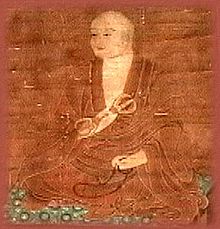
This poem on language, translation, and creation, the pictorial/written representation of vocal sounds and meanings, was written by Kūkai (空海), also known posthumously as Kōbō-Daishi (弘法大師 The Grand Master Who Propagated the Buddhist Teaching), 774–835, a Japanese monk, civil servant, scholar, poet, artist, and founder of the Shingon or “True Word” school of Buddhism. He allegedly developed the system using Chinese characters to write Japanese words. The word “Shingon” is the Japanese reading of the Kanji for the Chinese word Zhēnyán (真言), literally meaning “True Words”, which in turn is the Chinese translation of the Sanskrit word mantra (मन्त्र). The concern was to be as true as possible when translating texts, to have and use the right word when describing something. The Sanskrit language had this perfect one-to-one correspondence between name and form.

The poem was mentioned in Nine Gates: Entering the Mind of Poetry (HarperCollins, 1997) by Jane Hirshfield, a classic collection of essays about the mysterious ways poetry comes to us. In her chapter, The World is Large and Full of Noises: Thoughts on Translation, she highlights this theme with What Rainer Maria Rilke inscribed on the copy of The Duino Elegies he gave his Polish translator.

When I read that line in Kukai’s poem, about the first word, “Ah,” blossoming into all others, and each of them being true, it reminded me of what Maharishi Mahesh Yogi says about the first sound of creation, “A”, how it represents infinity collapsing to a point, “K”, and through its own sequential self-interacting dynamics, creates the whole alphabet, words, verses of Rk Veda, the whole Vedic literature, and their subsequent forms, the universe. This is part of Maharishi’s Apaurusheya Bahashya, the unwritten commentary of the Veda, unfolding itself and commenting on itself to itself. Apaurusheya Bhashya: Rk Veda is said to be nitya, eternal, and apaurusheya, uncreated. Maharishi explains that the sequential unfoldment of Rk Veda is its own uncreated, or unmanifest, commentary on itself, rather than that of an individual making an ‘external’ commentary on Rk Veda.

See Maharishi’s Apaurusheya Bhashya discussed in Everything is made of Vedic Sounds by William F. Sands, PhD. Also see Modern Science and Vedic Science: An Introduction by Kenneth Chandler, PhD.

In his Introduction to Maharishi Vedic University, Maharishi gives us a comprehensive cosmic perspective on the role Sanskrit, the language of Nature, plays in the process of creation. Through the self-interacting dynamics of pure consciousness, the Self, or Atma, reverberates within itself and creates the eternal uncreated sounds of the Veda, its own language, which in turn express themselves into forms—the individual body, Sharir, and the cosmic body, Vishwa. The eternal Silence and its own inherent Dynamism, evolve all parts of itself constantly referring them back to their source. He says it’s a start-stop process of Infinity collapsing to a point, referring it back to Itself, and evolving the next sequential sound, and subsequent form. Full realization, or enlightenment, comes when one comprehends all of creation: Atma, Veda, Sharir, Vishwa, Brahman, or Totality, as the full potential of one’s own consciousness. Aham Brahmasmi. I am totality.

On Page 65 Maharishi writes, “The basic process of change, this basic process of transformation, continuously maintains the momentum of evolution of different levels of expression, creating different levels of manifestation upholding the process of evolution.

“It is this that promotes the eternally self-referral dynamics of Samhita into the sequential evolution of sound, speech, forms of speech in alphabets, words, phrases, verses etc., with corresponding material forms. This process continues eternally, resulting in the ever-expanding universe.” (Samhita is the togetherness of Rishi, Devata, Chhandas; knower, process of knowing, and known.)

I’ve written a poem about this process in Coalescing Poetry: Creating a Universe, (into haiku forms).

To learn more about the source of words, creation, both literal and literary, and their connection to consciousness, read: The Flow of Consciousness: Maharishi Mahesh Yogi on Literature and Language.

Also see: Before He Makes Each One by Rainer Maria Rilke.

Nine years later I posted: Japanese culture: poetic aesthetics, artistry, and martial arts, inspired me to write haiku and tanka.

Learning To Let Go

January 1, 2012

Learning To Let Go

You’ve been learning to let go
Accepting things as they are
And your bliss is zooming forth

That Being inside of you
It’s so full; it’s so vibrant
You’re becoming who you are

To me you’re the lucky one
But others would not know it
They only see what they see

If it wasn’t for my muse
I’d have no reason to write
This—the soul of the matter

© Ken Chawkin
Talking with Sali, my friend and muse
Saturday, December 31, 2011
Finalized Sunday, January 1, 2012
Fairfield, Iowa, USA

Before He Makes Each One by Rainer Maria Rilke

December 25, 2011

Before He Makes Each One

Before he makes each one
of us, God speaks.

Then, without speaking,
he takes each one
out of the darkness.

And these are the cloudy
words God speaks
before each of us begins:

“You have been sent out
by your senses. Go
to the farthest edge
of desire, and give me
clothing: burn like a great
fire so that the stretched-out
shadows of the things
of the world cover
me completely.
Let everything happen
to you: beauty and terror.
You must just go–
no feeling is the farthest
you can go. Don’t let
yourself be separated
from me. The country
called life is close.
By its seriousness,
you will know it.
Give me your hand.”

~ Rainer Maria Rilke  ~

(Translated by Annie Boutelle, Metamorphoses Fall 2001)

First published in German in 1905, by Rainer Maria Rilke, as Das Stundenbuch, The Book of Hours: Prayers to a Lowly God. There are several translations, known as Rilke’s Book of Hours: Love Poems to God. Here is another version, God speaks to each of us, translated by Anita Barrows and Joanna Macy.

Born: December 04, 1875 in Prague, Czech Republic
Died: December 29, 1926

Quotes by Rainer Maria Rilke

“Be patient toward all that is unsolved in your heart and try to love the questions themselves, like locked rooms and like books that are now written in a very foreign tongue. Do not now seek the answers, which cannot be given you because you would not be able to live them. And the point is, to live everything. Live the questions now. Perhaps you will then gradually, without noticing it, live along some distant day into the answer.”

“The work of the eyes is done. Go now and do the heart-work on the images imprisoned within you.”

“The only journey is the one within.”

This idea was expressed more eloquently by American poet, lecturer and essayist (1803-1882) Ralph Waldo Emerson when he said: “What lies behind us and what lies before us are tiny matters compared to what lies within us.” I wonder if Rilke read Emerson?

See Letters to a Young Poet Quotes.

Also see: Singing Image of Fire, a poem by Kukai, with thoughts on language, translation, and creation.

A Haiku on The Heart of Haiku

December 18, 2011

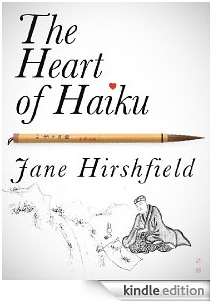
This week I discovered and posted the Interview from FROGPOND with Jane Hirshfield on The Heart of Haiku. I had read Nine Gates: Entering the Mind of Poetry by Jane Hirshfield, a classic collection of essays about the mysterious ways poetry comes to us, and had thoroughly enjoyed it. So this first Kindle Single by Jane on haiku looked very enticing.

On Friday night, after reading a free sample of The Heart of Haiku, named “Best Kindle Single of 2011,” I decided to purchase this 29-page essay about the life and poetry of Matsuo Bashō, recognized as the master of concise, compelling Japanese haiku. I downloaded the free App from Amazon, then bought the $0.99 Kindle Single. It loaded instantly. I signed in, and started reading. It was that simple.

Saturday I took my computer with me when I went to visit my friend Sali. I explained what I had done, showed her what the essay looked like in the Kindle Cloud Reader on my computer, how it allowed me to select the look of the page, (I chose Sepia), change the size of the font and length of the lines, highlight and make notes. I continued reading, aloud to Sali, where I had left off at home. We were fascinated!

Bashō had discovered the earlier Chinese and Japanese poets, wrote renga, tanka, and haiku, became a poet and teacher, studied Zen and Taoism, indulged his senses, then lived like a monk roaming the countryside. We appreciated the beauty, simplicity and depth of his poetry, and the skill of Jane Hirshfield’s erudite explanations, herself a poet, teacher, and practitioner of Zen. It seemed appropriate for her to explain where Bashō was coming from. Hirshfield had collaborated with Mariko Aratani, her co-translator for the classical-era tanka poets in The Ink Dark Moon.

It was dinner time and the other residents were already eating their meal. An aide brought in Sali’s tray, but we were enjoying the story so much I just kept on reading and lost track of the time. I happened to mention that and realized I was speaking out what could easily become a haiku. Sali has that effect on me; she’s my muse! So here’s the haiku on reading The Heart of Haiku to Sali.

A Haiku on The Heart of Haiku

We forgot to eat
Reading The Heart of Haiku
It can fill you up

Also see the excellent Poetry Foundation biography on Jane Hirshfield, including poems, articles and more; Pirene’s Fountain: Jane Hirshfield on Poetic Craft; and What Rainer Maria Rilke inscribed on the copy of The Duino Elegies he gave his Polish translator. You can find some of my own haiku and tanka under My Poems.

— — —Save

Twelve years later I discovered Pebbles – Brief poems by Jane Hirshfield posted on March 6, 2023 by briefpoems. In this excellent post, the blogger mentions this Amazon Kindle single under the subheading of Matsuo Bashō and goes on to explain this about the title.

Jane Hirshfield was unhappy with the title: my title was Seeing Through Words: Matsuo Basho, an Introduction. I think that tells you quite a lot about how I see this piece: I would never myself have made such a grand claim for it as The Heart of Haiku does. 

You can read a pdf of the short book posted by The Haiku Foundation: Seeing Through Words: Matsuo Bashō.

Interview from FROGPOND with Jane Hirshfield on The Heart of Haiku

December 15, 2011

where the writers are

Interview from FROGPOND with Jane Hirshfield on The Heart of Haiku

Blog Post by Jane Hirshfield – Oct.25.2011 – 6:22 am

The new issue of the Haiku Society of America’s excellent FROGPOND journal is out. The following interview appears there.

“At the Heart of The Heart of Haiku: An Interview with Jane Hirshfield”

This interview was conducted by email in August, 2011.

CE: Thank you, Jane, for agreeing to this interview. I think your Kindle Single, The Heart of Haiku, will be of interest to many haiku poets, as will your comments about this essay. You have a long history of printed publications, and you have described yourself previously as someone who is not especially comfortable with computer technology. What prompted you to circulate The Heart of Haiku as a Kindle Single?

JANE: Thank you—I appreciate the chance to talk about this with what I see as this piece’s most natural audience, the haiku community.

Bringing this piece out as a Kindle Single was an experiment—I had never read an e-book myself before this came out. I have to admit, I don’t really like reading on-screen. But many others do, and mostly I did this because the description for the Single program fit exactly what I had: an essay-lecture too long for publication in any magazine, but not long enough for a formal printed book. I had thought about expanding it into a regular book—but I’d have needed to polish many more of the new translations I’d done (with the invaluable help of Mariko Aratani, my co-translator for the classical-era tanka poets in The Ink Dark Moon), and I’d also have needed to round the book more fully. I do now wish I had put some back matter into even this Single—a “further resources” section, for instance. But I never could quite decide to expand it, the piece stayed on my desk, and when the suggestion to submit this to the new Kindle Singles program came up, I took it almost on impulse. I didn’t actually expect them to accept it—it’s by far the most literary thing on their list so far. And then from acceptance to publication was dizzyingly fast—two weeks, including their copyediting, which was, by the way, very good. So I didn’t have any time for anything but the quickest final pass.

You know, Basho himself might have been one of the first to buy an iPad or Kindle. He was never without the books of earlier Chinese and Japanese poets he loved, and I imagine would have been happy to carry less weight in his knapsack. He was, throughout his life, both practical and what’s now called “an early adopter”—haiku anthologies were the first broadly popular printed books in Japan, so Basho, who published in them and also brought one out himself, was participating in the leading-edge technology of his time. One thing I muse over in The Heart of Haiku is that Basho, today, might have been the first person to take You Tube videos and turn them into a true art form. What he did feels comparable to that, to me.

There are so many superb books on Basho already, I’m not sure the world needs another. That was always one of my hesitations about turning this into a book. I do retain all the rights, and will quite likely include this in my next book of essays. That way it will reach more people who don’t already know about haiku—which is what I first wrote it to do. And the Kindle Single did do that—a truly startling number of people have bought it so far, in only two months. I’m sure it helps that it costs only 99 cents, and can be downloaded onto any computer almost instantly. I hope some of them may continue to pursue that curiosity further.

CE: I understand that this project began as a presentation for the 2007 Branching Out series of poetry lectures held in public libraries around the country, a program co-sponsored by the Poetry Society of America and Poets’ House. How would you characterize your initial audience? How much did you revise the presentation before it was published by Amazon? For instance, to what extent was this project originally conceived of as a way to help people better understand and appreciate haiku as readers or as casual writers of haiku-like poems? Do you feel that the current version is at least as much directed toward those who already write haiku as it is toward the initial audience?

I was asked by the Branching Out program to give a talk for the general public—for people who might not have read much poetry, let alone haiku. I tried to do that—to find ways to open the field to newcomers—but poetry is a universal language, whose very point is that it does not simplify; it expands, saturates, investigates, faces many directions at once. I tried to make the original talk something that would be interesting to both kinds of audience—new, and informed—and truly, there isn’t that much of a gap. You’re always a beginner, entering a poem. A poem asks an original, unjaded presence, some state that includes both informed awareness and the erasure of preconception.

I have polished the piece quite a lot since the original lecture, but that’s just what I do with anything I write, poetry or prose. I’d gone over it again just this past February, when I was asked to lecture on Basho at a Japanese university. As to whether I changed it to make it more useful for serious writers of haiku, no, not specifically. I myself don’t make that strong a distinction between looking at poetry as a writer and as a reader. Every serious writer needs also to read alertly, with a real depth of attention—both her or his own work, and the work of others; and every act of reading a poem is a recreation of the original energies of its writing—that is what a poem is: not a record of thought, experience, emotion, realization, but a recipe for its own reenactment.

CE: You have extensive knowledge about poetry in general and haiku in particular, including a knowledge of the history of haiku in English. Where do you see this book fitting in among some of the other work on haiku in English (for instance, Eric Amann’s The Wordless Poem; R. H. Blyth’s Haiku in 4 volumes; Harold G. Henderson’s Haiku in English; and William J. Higginson and Penny Harter’s The Haiku Handbook to name just a few foundational texts in this field)?

And where do you see this essay fitting in among other considerations specifically focused on Basho’s life and work (Robert Aiken’s A Zen Wave; Haruo Shirane’s Traces of Dreams; Makoto Ueda’s Basho and His Interpreters come to mind among others)?

Those books are indispensable, and many were part of my own introduction to haiku and, I’ll add, to poetry as a whole: the first book of any kind I ever bought for myself, at age eight, was a Peter Pauper Press book of translated Japanese haiku. We should add also the many translations of Basho’s poetry now in print. I recommend them all—I think that to understand anything, especially when there are large leaps of culture and time and translation involved, the most accurate understanding comes from looking at multiple sources. There is no single “best” authority. If you can’t read Basho, Issa, Buson, or Yosano Akiko in the original, then reading them through many eyes is best.

As for how my contribution fits in, The Heart of Haiku was retitled by Amazon when they took it for the Kindle Singles program; my title was Seeing Through Words: Matsuo Basho, an Introduction. I think that tells you quite a lot about how I see this piece: I would never myself have made such a grand claim for it as “The Heart of Haiku” does. My piece is introductory, not exhaustive, and its angle of entrance is historical, through Basho, not haiku in general, though to read Basho you have to understand what haiku are, and how they work, and what they can hold at their best. Basho himself, though, is a perennially useful lens, since haiku as we now know it was so radically changed by Basho, generally described as its “founder,” even though the form existed before him. For current, American writers of haiku, The Heart of Haiku is really a way to look back to the rootstock, to refresh their relationship with how haiku was first conceived by its extraordinarily radical and continually evolving founding figure. Basho himself was concerned with so many of the issues that current haiku writers are concerned with—how to write in this moment’s language and perception, how to learn from the past without being bound by it, how to use haiku as a tool not only for expression but for the navigation of a life. I still read Sappho and Homer, I still read Su Tung Po and Dante, and I still read Basho and Issa and Buson. These are wellspring poets for me. Basho’s teachings about writing are as relevant and provocative now as they were when he was alive. “Poetry is a fan in winter, a fireplace in summer.” “To learn of the pine, go to the pine.” “Don’t imitate me, like the second half of a melon.” His navigation of the creative life and poverty, his restless curiosity, his losses, even his death was exemplary, really—Basho’s last spoken words take the point of view of the flies his students were trying to chase from the room. They show how supple and compassionate a poet’s sense of existence can be.

CE: The Ink Dark Moon, it’s been said, helped inspire what’s become a working community of tanka writers, both in the U.S. and in Australia. How do you see  your role here, as a poet, translator, and teacher?

JANE: I might not have published this Basho piece at all, except that people who’d heard it or read it in manuscript kept telling me both that they loved the translations and that it does bring something new to the table. That it was helpful. That’s my hope for anything I do, though I write my own poems outside of any hope, or intention, beyond the needs of that particular poem and moment. I translated Basho’s haiku freshly mostly because I found I couldn’t use other people’s translations for the original talk—not because they weren’t good, just because, once you’ve done some translating, you understand how much more intimate an entrance to a poem that is. I am tremendously lucky that my old co-translator, Mariko Aratani, agreed to re-join me for this project. As a teacher of poems, I’ve been investigating the deep workings of poetry for almost forty years now, both Japanese and Western. I believe in the happy accidents of cross-fertilization and that different traditions have always informed one another. There are two essays in Nine Gates: Entering the Mind of Poetry that talk about Japanese poetics and translation. My interest is always the same: in how poems work, precisely, in why they affect us they do, and in bringing in whatever background helps us read more vulnerably, openly, accurately, and deeply. I think this is especially needed for haiku. We teach haiku to third graders, but in fact it’s an art form that requires some real initiation to be truly practiced or read. Haiku are the most immediate of art forms in one way, but in another, they are slip knots that you need to know the knack of, to untie fully.The more I learn about haiku, the more I feel how much I have not yet learned. It is bottomless, really. Any good poetry is.

CE: In your essay, you address the wide popular interest in non-literary haiku and you specifically reference the thousands of haiku written about Spam (“Spamku”) and posted online. You foreground that, “… to write or read with only this understanding is to go back to what haiku was before Basho transformed it: ‘playful verse’ is the word’s literal meaning. Basho asked for more: to make of this brief, buoyant verse-tool the kinds of emotional, psychological and spiritual discoveries that he experienced in the work of earlier poets. He wanted to renovate human vision by putting what he saw into a bare handful of mostly ordinary words, and he wanted to renovate language by what he asked it to see.” To what extent do you find contemporary English-language haiku poets continuing to follow this approach?

It seems to me that the best contemporary haiku writers are in Basho’s lineage, and Issa’s and Buson’s. This is of course my own definition of “best.” It’s fine that many poets do other things as well. But the central work of poetry is the same everywhere—from Sappho to Akhmatova, Tu Fu to Frank O’Hara, lyric poets magnify and enlarge and open our relationship to our lives, to the lives of others, and to the world.

Your consideration of Basho’s overall output of haiku leads to an intriguing claim about the impact transparent seeing can have. You state, “Basho’s haiku, taken as a whole, conduct an extended investigation into how much can be said and known by image. When the space between poet and object disappears, Basho taught, the object itself can begin to be fully perceived. Through this transparent seeing, our own existence is made much larger.” Would you please elaborate on how this type of seeing enlarges our existence?

I’ve come to feel that every good poem does this, not only haiku. The exchange currency of the imagination is fundamentally transformative and empathic. The current thinking in neuroscience is that this recreation of other within self has something to do with mirror neurons, but poets have known the alchemies of empathy from the beginning. Permeability is how image works, how metaphor works. Every time we take in an image in a poem, we become for an instant that image. Reading “mountain,” I become for that moment everything I know of mountainness—its steepness, its insects, its largeness, its seeming immobility punctuated by streams or rockslide, what it asks of the legs that travel it, what it asks of the breathing, of the eyes, what it tells us of abidingness and perspective, of distance and scale.  Any time we take in a poem’s held experience, we become that experience. The experience of a poem is not “about” life—it is life. And so taking in a good poem, our lives are expanded by that poem’s measure. One of the great paradoxes of haiku is that the measure of taken-in meaning can be so large, from a vessel so small, and how meaning in haiku can reach in almost any direction. A haiku can puncture our human hubris, or can remind us that we too are going to die. It can pierce us with the beauty of spareness or open us to the futility of ambition. It can evoke humor, memory, grief. It can, at times, do all these things at once.

CE: You also note that “…the haiku presents its author as a person outside any sense of the personal self.” Do you see contemporary English-language haiku presenting the authors as people outside a sense of the personal self? What might the author gain from striving to experience and write haiku in this manner?

JANE: I recently judged a haiku competition and was a bit startled by the frequency of the pronoun “I” in one form or the other, and by the strong presence of personal life that was in them, including in those I chose as the winners. In some cases, I wondered if the pronoun might have been there to fill in the count, since these were haiku written in the traditional 5-7-5. But I think it runs deeper, and is more a reflection of how poetry in general is written in America today.

Basho studied both Taoism and Zen, and his relationship to poetry reflected that. Basho once said that the problem with most haiku was that they were either subjective or objective. A student asked him, “Don’t you mean too subjective or objective?” Basho answered, simply “No.” I share Basho’s Zen training and interests, and I see poetry as, in part, a mode of perception by which we can slip the shackles of single view and single stance. I think that is one of poetry’s tasks in our lives, to liberate us from narrow, overly pointed seeing. A good poem never says or holds only one thing.

This opening into broader ways of perceiving does happen in poems that include “I” and personal circumstance, I should add. And on the other side, I think it a misconception to believe that all haiku ae somehow supposed to be “objective,” and impersonal. Poetry reflects inner experience and understanding. The most objective haiku I can think of is Buson’s: “Spring rain,/ the belly of the frog/ is not wet.” This is not a metaphor for anything other than what it holds, the awareness of rain so gentle that it does not drip down to or splash up to even something so near as the frog’s belly. And yet, reading that haiku, I feel it, in body and in spirit; I feel appreciation for the action of the small and the subtle, for the wetness of the frog’s back and the grass tips’ thirst. To have such an experience is to step outside of ego, but not outside our experience of life on this earth, a life with rain, shared with other creatures. And this modest, homely, silent frog is something that emerged into Japanese poetry with haiku—in earlier Japanese poems, we know frogs by their voices, not by their skin’s dryness or wetness. Frogs’ calling is an image of our own longing, desire, and courtship, of the small sounds we ourselves make amid the vast dark. Buson’s silent frog, or Basho’s in his famous “Old pond,/ frog jumps in/ the sound of water,” these are different. Frog is frog, water is water, the sound of their meeting is completely itself, part and whole neither vanish nor are separate. This seems to me something worth noticing, worth storing in repeatable words, worth practicing. Isolation is real, the solitude of the self is real, but interconnection is equally real. A good haiku keeps us in the particular and multiple, not the generic. It stops us from leaning too far in any direction.

Thank you again, Jane, for participating in this interview and providing additional insights into your essay, The Heart of Haiku.

NOTE: Jane Hirshfield’s The Heart of Haiku is available from Amazon.com as a $.99 Kindle Single, and can be read on any computer or smart phone, not only Kindles, with a free download. A new book of poetry, Come, Thief, has also just been published, by Knopf.

Keywords:, , , , , , , ,
———–
Also see A Haiku on The Heart of Haiku; the excellent Poetry Foundation biography on Jane Hirshfield, including poems, articles and more; Pirene’s Fountain: Jane Hirshfield on Poetic Craft; and What Rainer Maria Rilke inscribed on the copy of The Duino Elegies he gave his Polish translator.

Ten years later On Being with Krista Tippett interviewed Jane Hirshfield on The Fullness of Things, which I discovered today, March 6, 2023, in Pebbles – Brief poems by Jane Hirshfield posted by Brief Poems.

Sweet Haiku for Sali

November 20, 2011

Sweet Haiku for Sali

Dancing eyes of light
A smile of pure delight
That’s my Sali gal

© Ken Chawkin
November 19, 2011
Fairfield, Iowa

See: Haiku For Sali, Hoku For SaliSally’s Smile (Haiku for Nurse Dan), and Haiku for Sali II and Haiku Muse.

Haiku for Sali II and Haiku Muse

November 20, 2011

Haiku for Sali II

Beautiful blue eyes
Soft silky silvery hair
Angel in disguise

Haiku Muse

The job of a Muse? —
Keeping her lover amused
Writing Poetry

© Ken Chawkin
Oct 8, 2011
Fairfield, Iowa

See: Haiku For Sali, Hoku For SaliSally’s Smile (Haiku for Nurse Dan), and Sweet Haiku for Sali.